Why Don’t We Eat Horse? Ctd

A reader writes:

About three years ago, I was eating at a grotto in Lugano, Switzerland. I saw the word “puledro” on the menu. Not knowing the term, I reasoned that it sounded a bit like “pollo,” so I guessed it was chicken. I ordered it. To my surprise, a steak was brought to the table. I proceeded to eat what was the best steak I’ve ever eaten in my entire life (and I live in Kansas City, so I’ve had a lot of great steaks). The next day I raved about the wonderful steak to my friends. Then I mentioned it to my friend who is the dean of the college where I was teaching that summer. “Steak?” she said, “I didn’t know they served steak there. What was it called?” “Puledro,” I replied. “Oh,” she said, “that means you just ate horse.”

The strange thing is, just knowing this leaves me doubting I could ever order it again. It reveals a lot about how our social custom and schemes of classifying animals and foods according to what is acceptable and unacceptable shape everything about our choices. I don’t plan to eat horse again. But I’d be lying if I pretended it wasn’t delicious!

Another writes:

Mr. Shafer needs to do just a tad more research. We don’t eat horse in the US because horses are not specifically raised for food here. And that is a big problem because the horses that do end up in the food supply are full of a wide variety of chemicals that range from unhealthy to downright dangerous. I have a horse and he routinely gets a number of drugs that are specifically labelled “not for use in animals intended for food”.

Perhaps the most dangerous horse drug, and one of the most commonly used, is phenylbutazone, an anti-inflammatory with such distinct carcinogenic properties in humans that EU specifically forbids horses who have ingested it from being used in human food. It never clears the horse’s system. Horses are not tracked like cattle are in the US. There is no food safety mechanism for horse meat. Horse brokers routinely falsify the documents that accompany slaughter horses that are supposed to certify that the horses are drug free.  So pity the poor Europeans who thought they were eating free range American mustangs and who were getting instead broken-down race horses full of steroids, bute, de-wormer, and other unsavory substances.

In addition, horses are very uneconomic to raise, taking much longer to reach market weight and are therefore less profitable. They are also a mess to slaughter as their blood volume is much greater than cattle, resulting in a waste water nightmare. If you google Kaufman, TX and the closure of Canadian horse slaughter plants, you will learn more than you ever want to know about the environmental downside of horse slaughter.

The horse meat found in the latest scandal came from Romania … who knows what their food safety processes are. I am a horse owner and horse lover. I would never eat horse because of emotional issues but because I know far too much about where the meat came from and how lax the controls on the supply are.

Another:

The reason we don’t eat horses is that our lives depended on them for centuries.  They have killed themselves to be loyal, and they are perceptive and intelligent in a way a cow or a deer or a pig is not.  Our entire civilization was, until recently, based in their labor.  I cannot believe that obtuse reader thinks it’s some weird cultural attachment.  To get a better understanding of their contributions, and to fully understand what kinds of horses wind up in the killing pen, read the bestseller The Eighty-Dollar Champion.

Debating “Southernomics”

Michael Lind, author of Land of Promise: An Economic History of the United Statesconsiders “cheap, powerless labor” to be the “original sin” of the South:

The purpose of the age-old economic development strategy of the Southern states has never been to allow them to compete with other states or countries on the basis of superior innovation or living standards. Instead, for generations Southern economic policymakers have sought to secure a lucrative second-tier role for the South in the national and world economies, as a supplier of commodities like cotton and oil and gas and a source of cheap labor for footloose corporations. This strategy of specializing in commodities and cheap labor is intended to enrich the Southern oligarchy. It doesn’t enrich the majority of Southerners, white, black or brown, but it is not intended to.

He sees the influence of “Southernomics” in calls for guest-worker policies, the fight against unions, and support for the Earned Income Tax Credit. Ed Kilgore acknowledges an historical focus on “low-road” development but resists the claim that it is regionally specific:

Lind appears, however, to be entirely unaware there was a fairly powerful revolt against this model of economic development in the South during the 1980s and 1990s—indeed, it’s one of the things that helped make Bill Clinton famous… The revolt died out during the last decade, in no small part because Democrats lost their competitive status in the region, yielding the field back to atavistic pols like Rick Perry and Nikki Haley, to cite the most egregious examples. But the recent rapid adoption of the low road to development by Yankee pols like Scott Walker is another indicator that it is not some inherent or exclusive product of the evil Southern Character.

19 Degrees Of Separation

opte-1

Hungarian physicist Albert-László Barabási produced a model tracing the interconnecting points of the Internet’s 14 billion pages:

Distributed across the entire web, though, are a minority of pages—search engines, indexes and aggregators—that are very highly connected and can be used to move from area of the web to another. These nodes serve as the “Kevin Bacons” of the web, allowing users to navigate from most areas to most others in less than 19 clicks.

Barabási credits this “small world” of the web to human nature—the fact that we tend to group into communities, whether in real life or the virtual world. The pages of the web aren’t linked randomly, he says: They’re organized in an interconnected hierarchy of organizational themes, including region, country and subject area. Interestingly, this means that no matter how large the web grows, the same interconnectedness will rule. Barabási analyzed the network looking at a variety of levels—examining anywhere from a tiny slice to the full 1 trillion documents—and found that regardless of scale, the same 19-click-or-less rule applied.

J.K. Trotter has some fun with the study:

There isn’t yet a decent explanation for the 19-clicks rule — Barabási thinks it has something to do with the way pages on the Internet are grouped — but then again, there isn’t yet a decent explanation for the Six Degrees of Kevin Bacon rule, either. Of course, that popular movie trivia game (1) was itself inspired by the 1993 movie Six Degrees of Separation (2), which starred Will Smith, and does not feature Bacon. The movie was based on a 1990 play of the same name written by John Guare (3), and while it’s not clear where he got the idea (some say credit the Italian inventor Guglielmo Marconi), the earliest cited proponent of the theory is Hungarian novelist and poet Frigyes Karinthy (4) who is discussed in the 2002 book Linked by Albert-László Barabási (5) who today wrote about how many clicks separate web pages on the Internet (6).

(Image: A visualization of the billions of pages connected through the Internet by Opte Project.)

Protesting With Corpses

PAKISTAN-UNREST-SOUTHWEST

After Sunni militants killed nearly 90 people of the Shi’a Hazara minority in a Quetta market on Saturday, mass protests erupted among Pakistan’s Sh’ia population:

From Karachi to Parachinar, and Hyderabad to Multan, Rawalpindi and Islamabad, people staged sit-ins, blocking main thoroughfares. The protesters’ demand at all these places was the same: call in the army in Quetta and take immediate action against the extremist militant group, Lashkar-i-Jhangvi [LeJ], which in recent months has played havoc with Shias, mainly the peaceful Hazara community of Balochistan, through a string of attacks.

In Quetta, as seen above, thousands of Hazaras protested by refusing to bury those killed on Saturday, sitting next to the bodies of their friends and family members for three consecutive days until the government finally agreed to the majority of their demands. AJE has more:

On Tuesday, Information Minister Kaira announced that the government had arrested 170 suspects in connection with the attacks, and that the army would not be deployed. Four LeJ fighters were also killed on Tuesday in a suburb of Quetta, the government said. Seven of their comrades were arrested in that operation.

Hazara Shia community leaders, however, have told Al Jazeera that they believed the police and paramilitary Frontier Corps (FC) were complicit in the attacks on their community. Last year was the bloodiest in recent history for Pakistan’s Shia Muslims, who account for about 20 percent of the population, according to Human Rights Watch. More than 400 were killed in targeted attacks across the country, at least 125 of whom were died in Balochistan.

And only one month ago there was a similar bombing in Quetta that killed more than 100. Jamila Shamsie notes that almost identical protests that followed that attack clearly did nothing to prevent the one on Saturday. She has trouble imagining a solution to the sectarian violence:

Everyone in Pakistan has their theories [about who is promoting the religious divide which is fueling the attacks]: it is the deal the intelligence agencies have made with militants in exchange for support in Kashmir; it’s an attempt to derail forthcoming elections; it’s linked to the army’s struggle against Baluch nationalists; it’s “the foreign hand” causing instability; it’s the Saudi influence; and on and on. But what will it take for the civilian government and – more importantly, the military – to do what is necessary to make it stop? This is the question that makes Pakistanis, uncharacteristically, fall silent.

(Photo: Pakistani Shiite Muslims gather around the coffins of relatives during a mass burial ceremony in Quetta on February 20, 2013. Mass burials for 89 victims of a bomb attack targeting Pakistani Shiite Muslims began after three days of nationwide protests at the government’s failure to tackle sectarian violence. By Banaras Khan/AFP/Getty Images)

China’s State-Sponsored Hackers

Kim Zetter goes over the new report from security firm Mandiant, which appears to have caught the Chinese army initiating a wide range of hacks into American companies:

Victims have included the security firm RSA, Coca-Cola and the maker of equipment used in critical infrastructure systems. Multiple industries have been targeted, including the aerospace and high-tech electronics industries as well as transportation, financial services, satellite and telecommunications, chemical, energy, media and advertising and food and agriculture.

Dan Goodin explains further:

According to Mandiant, [Comment Crew, the group behind the hacks,] has for years vacuumed up the proprietary secrets of more than 100 targets, including technology blueprints, manufacturing processes, clinical trial results, pricing documents, and negotiation strategies. Of more concern, Comment Crew hackers have most recently tuned their focus to computer systems used to control dams, gasoline refineries, and other critical infrastructure.

Goodin adds that, “[g]iven the IP addresses and clues gleaned from individual members with hacker handles including UglyGorilla and DOTA, the authors conclude that the campaign is almost surely sponsored by the Chinese government or military.” Evan Osnos’s perspective:

Mandiant and the Times stop short of saying [Chinese military] Unit 61398 was directly in charge; “the firm was not able to place the hackers inside the twelve-story building, but makes a case there is no other plausible explanation for why so many attacks come out of one comparatively small area.” Caveats aside, the accumulated evidence should retire the old notion that China’s most sophisticated hackers are just patriots freelancing from their parents’ basements.

A Smart Immune System

Neuroimmunologist Jonathan Kipnis found a possible link between a body’s immune system and intelligence. Carl Zimmer explains:

When we’re healthy, T cells keep the immune cells in the meninges from inflaming the brain. But when we get sick, the T cells loosen their hold to let the immune system attack invading pathogens. The resulting inflammation helps clear out the invaders, but it also blunts learning. When we’re sick, Kipnis proposes, it’s more important to launch a powerful immune attack than to have a sharp mind. “Everything in life is priorities,” he says.

Kipnis has recently started to investigate what happens to people’s brains when they start losing T cells. People with cancer, for example, often suffer a loss of T cells when they undergo chemotherapy. It may be no coincidence, he argues, that chemotherapy is notorious for causing “chemo brain”—a fuzzy mental state in which patients have trouble thinking clearly. Kipnis proposes that without T cells to keep inflammation in check, immune cells in the meninges pump harmful compounds into the brain.

Why this research matters:

Drugs that might be able to rework neurons inside the brain and improve mental sharpness are often too big to get past the blood-brain barrier, for example. Dopamine, a molecule crucial for signaling between neurons, cannot cross this barrier, which is why its chemical precursor, L-dopa, is used instead to treat Parkinson’s disease. But the immune system offers a new way of changing our cognition and treating illnesses affecting the brain.

Green Shoots On The Right II

Responding to Ponnuru and Wehner’s constructive, sane essay, Chait welcomes their contributions, but insists they also be willing to “identify or confront the forces within the party that prevent these reforms from succeeding”:

[W]here are the Republicans speaking in opposition to [Paul] Ryan and his allies? I haven’t seen a single Spring Snowstorm Hits Northern Scotlandone. Instead, they ignore the existing configurations altogether. Wehner had a blog post yesterday railing against “the refusal by Democrats to reform entitlement programs in general.” But Obama has been offering to reduce spending on Social Security and Medicare for two years now, in return for Republican agreement to spread the burden of the fiscal adjustment. They won’t take the deal.

Let me note once more this sentence from the State of the Union:

On Medicare, I’m prepared to enact reforms that will achieve the same amount of health care savings by the beginning of the next decade as the reforms proposed by the bipartisan Simpson-Bowles commission.

Why was this not seized upon by the right? Another missed opportunity. Still, we finally have Conor’s wet dream. Sane conservative S E Cupp (her sanity means she has to be on MSNBC, not Fox) finally said it in last week’s cover-story for the New York Times Magazine:

“And we can’t be afraid to call out Rush Limbaugh. If we can get three Republicans on three different networks saying, ‘What Rush Limbaugh said is crazy and stupid and dangerous,’ maybe that’ll give other Republicans cover’ to feel comfortable disagreeing with him as well from time to time.”

Better still, she’s not backing down:

Some demanded I apologize. Others implied I just committed career suicide. Others still politely suggested I commit actual suicide.

I’ll end the suspense for some: There will be no apology. I make a living disagreeing with people who are far more successful, famous, wealthy and important than I am. I have spent thousands of hours on television and thousands of column inches criticizing the President of the United States. If you think I’m going to apologize for suggesting that it might be okay to disagree with a radio host sometimes, you don’t know me at all.

But I guess I’m not surprised at the rancor. For one, part of the point I was trying to make was that the impulse to defend anything and everything that a party heavyweight says — to the death — has the deleterious effect of making conservatives seem irrational and herd-like. No one is right all the time, and no one is above reproach. Limbaugh, who has frequently criticized Republicans, knows this better than anyone.

This gets a little defensive, but it still shows necessary courage:

I care deeply about the conservative movement, which is why I regularly put myself in a position to defend it in hostile territory, on liberal media outlets where I am usually outnumbered. It’s why I am my party’s biggest cheerleader when our leaders do the right thing. And it’s why I travel the country telling as many people as possible why conservative policies are better for them than liberal ones.

But it’s also why I risk friends and fans by calling out Republican elected officials, operatives like Karl Rove, the Republican National Committee, and conservative pundits when necessary. It’s no profile in courage, but merely common sense. We’ll never win credibility with new voters if we insist everything that every conservative says or does should be defended and justified.

Nothing has been more harmful for conservatism these last few years than its ruthless pursuit of heresy, its relentless policing of dissent, and its surrender to the most insular, extremist nutballs on talk radio and Fox. Maybe even Roger Ailes is beginning to realize this. But let us honor and remember Cupp for saying what needs to be said. Until Limbaugh – and all the cynical, money-grubbing, racist demagoguery he represents – is disowned publicly by major Republicans, the party will have a trivial chance of recovery. He is their Sistah Soldja. And the GOP awaits its Bill Clinton.

Sully And Hitch: “That Great Avian Demagogue, Saint Francis”

A few years ago, I taped a long conversation into the night with the late Christopher Hitchens. We’ve been running excerpts this month and you can read all of it from the beginning here. Here’s the latest new installment:

H: [Jihadism] is motivated by a hatred for not just America’s hedonism, but for its existence, not for its policy but for its existence in the world.

Now at that stage, I began to realize that many of the criticisms I had myself made of the United States — none of which I would take back — or of its policies or many of its statesmen, were no less valid than they have been but were to be considered in this light. And I think that’s the lesson, successively, of what happened in the Balkans, in the Gulf, in the Hindu Kush and beyond. Because these ideologies, especially the latter one, are potentially toxic everywhere. I mean by that the Islamic Jihad ideology. It doesn’t exist in absolutely every country in the world, but it is a threat in a large number of countries beyond the zone of historical Islam itself. Including in our country of birth.

A: Yes. More so, it seems, almost. I read this Pew poll about the attitudes of Muslims in Europe and in Britain; they seem to be more hostile to Western pluralism in Britain than they were even in Germany or France.

H: Yeah, I believe I have an explanation for that, too, though I could well be wrong. There’s a wonderful essay by Sigmund Freud called, “The Narcissism of the Small Difference,” and it has to do with they way in which divisions that are invisible to the outsider — as between, say Sinhala and Tamil in Sri Lanka, or Protestant and Catholic in Northern Ireland — are everything to the people who live there. The least thing is the one that divides them. If you were a Zulu, say, or Han Chinese and you go to Belfast…”what are they fighting about? This seems preposterous!” But to them it’s everything, in many ways it’s all they know, it’s what gives them identity.

A: Right, it’s like when someone asks me, “Why don’t you become an Episcopalian?” and I say, “You have no idea.”

H: (Laughs.)

A: “I could sooner become a Muslim.”

H: Yes, and this translates, I think — I’m only translating fairly roughly in the present state — that those who are far from the action, as say is a Muslim in Belgium or Norway…

A: Or Coventry.

H: Or Coventry. He feels he has a great deal more to prove. He doesn’t live in Chechnya, he only reads about it. He doesn’t live in Kashmir. He has to be more affirmative the further he is from the field.

A: There is a dynamic between modernity itself and the primordial resistance too it, right? I mean, some of what we’re talking about in terms of this religious fundamentalism and its political ambitions seems to Qutbhave intensified in modernity. The hijackers were — it’s not as if bin Laden had no knowledge of the United States, it’s not as if Mohammad Atta was not aware of what this was like. The closer they get to it, the more they’re repelled, the more they have to force it out of their consciousness and destroy it.

H: This is famously true of Sayyid Qutb, one of the founders, who appears to have been, it’s actually very fascinating, drawn to the United States precisely by the magnetic elements that draw everybody to it. But when he got there he was appalled by its immorality, and its amorality as well, and its hedonism. And when you look up the events he attended and the scenes that he witnessed you find that it’s some university in the Midwest, I forget where it was: he was invited to a party where women mingled openly and I think perhaps smoked cigarettes and wore what he thought was provocative apparel.

When one goes back to check what that party was like…it was a sort of mixer on some rather dull campus where I don’t believe anyone was showing any cleavage and there was no alcohol served, even! It was one of those, sort of fruit juice, “maybe we’ll be really daring and put a disc-sized record on a gramophone and maybe someone will dance” — a pretty deadly evening. For him, profanity to the utmost extent.

I mention it for two reasons:

1) anecdotally I think it’s very important, 2) it shows that there isn’t a way of being that one could adopt that would be less provocative. Many are saying “we are offending them, we’ve upset them, we disrespected them,” and so on. Well, exactly what would you have to do to not to incur their wrath? This man, Sayyid Qutb, was no mild critic of the United States; he came back having seen this profane campus mixer, that neither of us would’ve bothered to go to, determined to destroy the United States and as far as he could the whole concept of “Western civilization” as we know it, whatever cliché you like.

It was no mild critique he was making of this Babylon. What I object to the most I think, at present, in our culture is the masochism of people who say, “well if only we hadn’t upset them.” They have no idea of how strenuous a condition this is.

A: No, no, well they don’t understand the fundamentalist psyche. Well, the fundamentalist psyche is rather like the totalitarian psyche; it cannot tolerate any deviation at all. And therefore the very concept of a society that’s constructed upon a constitution and the pursuit of happiness as its declared object, is itself anathema, right?

H: Well of course it is, because who doesn’t know that happiness is available to you by opening one book, The Recitation, the Qu’ran? Who doesn’t know that? Isn’t it obvious that all you need is one book? One book itself is there to tell you it’s the only book you need. And that it’s the literal word of God, and not only that — because there’ve been other books that claim to be that — but the final, unalterable word of God. With this book, inquiry and anxiety end, you have everything you need. How could anyone be so wretched and so ungrateful as to reject this gift? It’s like adding to the misery of Calvary –

A: It is translating neutrality towards it as hostility towards it, which is what I mean by the fundamentalist-totalitarian link. It was impossible under Stalin to be neutral, you know?

H: Hannah Arendt made a brilliant remark about Stalinism and she said that its great success among the intellectuals — and not just the Russian ones, I mean, among its intellectual adherents around the world — was that it had replaced all questions of validity or testability or objectivity with the question of motive. In other words, “comrade x has written this attack on our collectivization policy and says it’s not working—“

A: “Why would he do such a thing?”

H: “And why now? Why would he do it, and who put him up to it?” And that mentality you can find still strongly exemplified.

A: And what is the origin of that mentality?

H: The origin of that mentality is religious.

A: Yes, so what is religion, in your view — ?

H: That’s the inquisitional mentality: if you can’t find heresy, you must go and look for it.

A: Right. But what — leaving me out of this for a minute — in your view, is the human need that mentality is fulfilling that you seem to have no use for?

H: The need for certainty. And therefore security.

A: Which means that they are insecure. Which means that they are afraid. I mean I do think there is a connection between a sense of dislocation, a sense of beleaguerment, a sense of loss, and an attempt to repair it with absolute certainty. I think there is a relationship between those two things.

H: Common to all such systems, including the secular ones — I would exempt fascism because it had no canonical texts, besides the turgid garbage of Mein Kampf —

A: Right. Or some crazy 19th century racial eugenics.

H: Or with Gobineau, Rosenberg, ethnic theorists and crackpots, people measuring bumps in people’s skulls. Phrenologists. Crackpots. I mean, fascism is unbelievable intellectual degradation. But certainly with communism, with the Catholic Church — well, the Christian Church to begin with, before the schism — any revisiting of the canonical texts makes people extremely nervous. Great attempts are made to either bury things in libraries or to burn them.

A: Except I think you are ignoring large sections of — I’ll speak about Christians — in which this is not: for example, the monastic life, in which one can see people having no interest in controlling the world whatsoever, and in withdrawing from the world to pursue what they think is God’s will. Or, a figure like St. Francis, who one cannot even begin to accuse of seeking power, or even to control anybody else’s life. And, similarly, Jesus, I mean, you have to concede there are two forces. I completely agree with you that this element in religion is integral to it, it’s part of it, it’s a constant — but I don’t think it exhausts the entire arsenal of religious activity or thought.

H: I’ve no knowledge of the real existence either of Jesus of Nazareth or of St. Francis of Assisi, who may very well have been a great avian demagogue —

A: (Laughs.)

H: But I do know that it would be quite false to say that the Franciscan order sought no influence over the world, along with all the other orders: First, in the accumulation of property, second in the administration of local government and third in the promulgation and proselytization of the faith. I don’t think they at all renounced the world. I believe it may have been their ambition, but in point of fact, the world cannot be renounced. The world is as it is.

A: Yes, but insofar as it can be, many have tried. And to dismiss them as not religious, or to conflate all of them with the Grand Inquisitor seems to me to miss a very large swath of religious experience.

H: I don’t conflate all of them with the Grand Inquisitor but if Christianity wants to be identified with St. Simeon of Stylite — the site of whose supposed pillar I once visited in the original territories of early Christianity, eastern Christianity, which is the real original one, in northern Syria — who decided to mortify himself and withdraw from the world by standing on top of a pillar for forty years … It doesn’t bother me, it seems like a waste of life and a waste of mind and a terrible waste of energy.

A: But why would you care? Why would you even go that far?

H: Well, exactly. If that’s what it was, it’s fine, let him go do that just as I don’t mind if some hippie goes off to start some commune and live entirely on nature and have his wife have the baby on a wooden table. It doesn’t bother me at all. But Christianity does not give me that option! It wants to save my soul; it wants to tell me that my children must be taught garbage in the schools in the 21st century, in the United States; it wants to tell people that condoms are worse than AIDS —

A: Some of them do. Not all of them.

H: I’m sorry, the authoritative ones do, the leadership does. The others who’ve become, I have to say, I’ll agree with you — Church of England, for example, has become more or less a humanist, bleating organization that stands for nothing. Fine!

A: No I think that’s way too dismissive.

H: I think it’s way too lenient.

A: It’s perfectly possible to say that one believes in the teachings of Jesus; that one attempts to inculcate them in oneself; that one appreciates and has come to terms with the mystery of his incarnation; one wishes to commemorate it through the sacraments…

H: I’m not hearing this for the first time.

A: I’m sure you’re not — without attempting to control anybody else, without attempting to impose it on a single other soul, and without even…I mean, for example, I think of many of my lay-Catholic peers or friends or family and I do not think that the fact they’re not running around trying to convert every single human being they meet — and they’re not, Christopher, they’re just not — to them, their faith is for themselves and the people they love, and for them it is the truth, but it’s held with much less certainty and much less intolerance than some other people.

Now, I think that comes, to some extent, from being able to live with doubt. The psychological and spiritual reserves that allow one to live in the middle of confusion, and yet not to abandon faith. It is a sign of weakness that one has to translate religious experience into a set of inviolable doctrines which must, by necessity — and I understand the point you’re making, by logic — be required to be applied to everybody else with whom one comes into contact. But it’s not the only form of Christianity. It’s not the only form of faith.

H: But just to respond to those in reverse order: It would very surprising if Christians were not assailed with constant doubt because the worldview of their church has been repeatedly challenged and overthrown ever since Galileo and extending to our own day with Stephen Hawking. And including—

A: And of course, Darwin.

H: To say nothing of Darwin—and including matters that are not to do with the magisterium of the spiritual at all, that are to do with actual questions, such as whether the sun goes round the Earth or not, whether we live in a man-centered or an Earth-centered universe. These things have been decided. Christianity could not now, I think, be invented. So, that they’re doubtful is to their credit, and furthermore, their attempts to evangelize their world have failed, I think rightly and I also think inevitably. They were cruel, most of them, and additionally ineffective.

A: They’re succeeding very well right now in Africa as we speak.

H: The attempt will never stop, but I thought you said that one should consider Christianity as a skeptical movement, you can’t have that both ways.

A: No, I’m not having that both ways.

H: Of course they’re never going to give it up because there’s no point to them if they do, but just to finish my reverse: the other reason without which we would’ve never heard about Christianity is that it happened to be adopted as the official state ideology of the Roman Empire in a rather great stroke of luck.

A: Right.

H: Which made it semi-compulsory for people, well, entirely compulsory for many. Going back to your view about the transcendent refulgence of the Nazarene: I don’t believe a word of that. He quite plainly though the world was going to end quite soon, rather looked forward to the prospect, thought that he would be a big feature of that event, and inculcated this belief in other people. That is…

A: No, we do not know that. Christopher, we know that the people who wrote the Gospels attributed that to him.

H: Well, look, you’re not gonna trap me into saying the Gospels are true. I don’t think they’re true at all, I don’t think there’s a word of truth in them.

A: You think it was entirely made up. He didn’t even exist.

H: I think the entire thing—the Gospel account of his life is of course an absolute fiction—

A: Absolute?

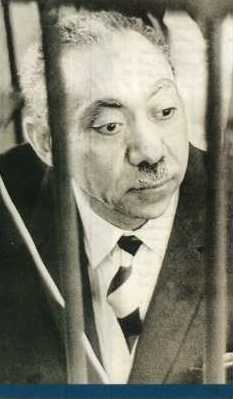
(Photo: Sayyid Qutb, 1965, via Wiki.)

Infinitives, Consider Yourselves Split

Patricia T. O’Conner and Stewart Kellarman deconstruct common myths about grammar:

[P]erhaps the biggest grammar myth of all is the infamous taboo against splitting an infinitive, as in “to boldly go.” The truth is that you can’t split an infinitive: Since “to” isn’t part of the infinitive, there’s nothing to split. Great writers—including Chaucer, Shakespeare, Donne and Wordsworth—have been inserting adverbs between “to” and infinitives since the 1200s.

Where these supposed rules come from:

For some of them, we can blame misguided Latinists who tried to impose the rules of their favorite language on English. Anglican bishop Robert Lowth popularized the prohibition against ending a sentence with a preposition in his 1762 book, A Short Introduction to English Grammar; while Henry Alford, a dean of Canterbury Cathedral, was principally responsible for the infinitive taboo, with his publication of A Plea for the Queen’s English in 1864.

In Latin, sentences don’t end in prepositions, and an infinitive is one word that can’t be divided. But in a Germanic language like English, as linguists have pointed out, it’s perfectly normal to end a sentence with a preposition and has been since Anglo-Saxon times. And in English, an infinitive is also one word. The “to” is merely a prepositional marker. That’s why it’s so natural to let English adverbs fall where they may, sometimes between “to” and a verb.