The Dead Eyes Of A Princess

kate-middleton-portrait

There’s been a huge fooferaw in Britain about a recent Hilary Mantel speech that contemplated what monarchy and public institutions like it do to actual human beings. Some Brits are up in arms about some phrases used by Mantel – in what is, in my view, a simply brilliant, must-read piece about all institutional humans (from presidents to popes and kings and queens) and their bodies. The outrage requires ignorance of the actual speech, because it’s spoken from a rather inspired version of empathy, not scorn, as Massie notes here.

Mantel has been writing some staggeringly good books about the Tudor period, so she knows the full history of monarchy, its quirks and details and foibles. And she points out something very obvious, though usually forgotten: the constant public viewing of a royal has to be a dehumanizing, even depleting, experience from the other side of the looking glass. It becomes both the most extreme form of celebrity, but still has to be scandal-free to survive. Those dead eyes in the new and genuinely awful portrait of Middleton (see above) are dead for a reason: self-protection. In one passage, Mantel recalls what Diana did for Britain and what Britain and the entire world did to the human being who was once Diana Spencer:

Diana was more royal than the family she joined. That had nothing to do with family trees. Something in her personality, her receptivity, her passivity, fitted her to be the carrier of myth. She came near to claiming that she had a healing touch, the ancient attribute of royal persons. The healing touch can’t be felt through white gloves. Diana walked bare-handed among the multitude, and unarmed: unfortified by irony, uninformed by history. Her tragedy was located in the gap between her human capacities and the demands of the superhuman role she was required to fulfil. When I think of Diana, I remember Stevie Smith’s poem about the Lorelei:

There, on a rock majestical,
A girl with smile equivocal,
Painted, young and damned and fair,
Sits and combs her yellow hair.

Soon Diana’s hairstyles were as consequential as Marie Antoinette’s, and a great deal cheaper to copy.

But this exposure – from that first picture with sunlight behind her dress revealing one hell of a pair of legs – is what in the end killed her inside and then outside. How, in other words, do you remain a human being and an institution at the same time? And on that question, Mantel’s examination of the time she met the Queen is simply priceless. Mantel was invited to a social event at Buckingham Palace, which the Queen attended. As the Queen walked around, Mantel noticed people move away, shifting their gaze, trying not to engage: “The guests studied the walls, the floor, they looked everywhere except at Her Majesty.” Now imagine being the person at the center of this social embarrassment for your entire lifetime. You are so alone; you are so necessarily aloof; your humanity has to be contained for the enigma of the monarchy to remain. The alternative is a car wreck in an underpass in Paris. And then Hilary actually catches Her Majesty’s eye and we see the human cost:

I am ashamed now to say it but I passed my eyes over her as a cannibal views his dinner, my gaze sharp enough to pick the meat off her bones. I felt that such was the force of my devouring curiosity that the party had dematerialised and the walls melted and there were only two of us in the vast room, and such was the hard power of my stare that Her Majesty turned and looked back at me, as if she had been jabbed in the shoulder; and for a split second her face expressed not anger but hurt bewilderment. She looked young: for a moment she had turned back from a figurehead into the young woman she was, before monarchy froze her and made her a thing, a thing which only had meaning when it was exposed, a thing that existed only to be looked at.

And I felt sorry then. I wanted to apologise. I wanted to say: it’s nothing personal, it’s monarchy I’m staring at.

You were and you were not. And this is worth thinking about as well with respect to the Papacy. Perhaps what the introverted Ratzinger feared was the kind of public spectacle that John Paul II endured, as his slowly disintegrating body was wheeled around like some kind of relic, because the institution and the person were fused. And now, there is no escape from mass media, no relief from scrutiny, no amount of frills and lace and ermine and Prada to conceal the man beneath the robes. Maybe someone genuinely committed to the Gospels simply could not face that form of endless, merciless Hell. Hilary concludes:

It may be that the whole phenomenon of monarchy is irrational, but that doesn’t mean that when we look at it we should behave like spectators at Bedlam. Cheerful curiosity can easily become cruelty. It can easily become fatal. We don’t cut off the heads of royal ladies these days, but we do sacrifice them, and we did memorably drive one to destruction a scant generation ago.

Middleton in some ways is the antidote to Diana: beautiful but safe, young but mature, alive but slowly dying under the exposure that never, ever ends. We have an institution that demands a mask for a human being to survive within. But the mask has been removed, and the flashbulbs won’t stop.

Guns Are Bad For Your Health, Ctd

In response to Frum’s worries about gun safety, Robert VerBruggen claims “gun accidents are statistically very rare.” Frum fires back:

In 2007, the United States suffered some 15,000-19,000 accidental shootings. More than 600 of these shootings proved fatal. Is that “very rare”? The total number of Americans killed and wounded by gun accidents exceeds the total number killed or injured in fires. The number killed in gun accidents is 20% higher than the total number killed in all U.S. civil aviation accidents.

In 2011, the Consumer Product Safety Commission voted to ban drop-side baby cribs because these cribs have been blamed for “dozens” of infant deaths over the entire previous decade. The 600+ accidental gun deaths in any single year amount to 50 dozen. Back when the Centers for Disease Control were allowed to do gun research, they found that American children under age 15 were nine times more likely to die of a gun accident than children in other advanced wealthy countries.

The Centers for Disease Control reserve the term “very rare” for accidental deaths from vaccines, the number of which is zero, or close to it. If more than 600 people a year were dying from vaccines, we’d have a national uproar, if not a revolution.

Green Shoots On The Right I

Spring Snowstorm Hits Northern Scotland

Joining Ponnuru, Michael Gerson and Pete Wehner try to save the GOP from itself:

[I]t is no wonder that Republican policies can seem stale; they are very nearly identical to those offered up by the party more than 30 years ago. For Republicans to design an agenda that applies to the conditions of 1980 is as if Ronald Reagan designed his agenda for conditions that existed in the Truman years.

They ask for some intellectual honesty as a precondition of renewal:

Republicans need to express and demonstrate a commitment to the common good, a powerful and deeply conservative concept. There is an impression—exaggerated but not wholly without merit—that the GOP is hyper-individualistic. During the Republican convention, for example, we repeatedly heard about the virtues of individual liberty but almost nothing about the importance of community or social solidarity, and of the obligations and attachments we have to each other. Even Republican figures who espouse relatively moderate policy prescriptions often sound like libertarians run amok.

This is true – but it seems to me equally true that the spending recklessness of the Bush-Cheney era made that libertarian turn inevitable, vital and important, if the party is to regain any credibility on fiscal matters. The utopian ideals and dystopian means by which the last Republican president promised to end tyranny on earth also require a slightly more robust critique than this:

In every presidential election since the Nixon–Humphrey contest in 1968, Republicans began with a significant lead in this respect. With the end of the Cold War in 1989, this potent issue was largely taken off the table. Nor has the decidedly mixed legacy of the wars in Iraq and Afghanistan over the last decade worked to bolster the Republicans’ electoral advantage in the conduct of foreign policy; if anything, the opposite is the case.

At some point, “decidedly mixed legacy” will become “huge fucking errors”. Then we’ll see the ice really break up. But this is a vital shift among the more thoughtful and flexible of the conservative intelligentsia:

Reasonable tax rates and sound monetary policy remain important economic commitments. But America now confronts a series of challenges that have to do with globalization, stagnant wages, the loss of blue-collar jobs, exploding health-care and college costs, and the collapse of the culture of marriage.

Amen. And the defense of the free market from the corrupting concentration of wealth among the very few is a truly important building bloc for renewal. Wehner and Ponnuru are dead-on here:

Republicans could begin by becoming visible and persistent critics of corporate welfare: the vast network of subsidies and tax breaks extended by Democratic and Republican administrations alike to wealthy and well-connected corporations. Such benefits undermine free markets and undercut the public’s confidence in American capitalism. They also increase federal spending.

Conservatives should want to gut corporate welfare, simplify the tax code (because Obama can’t or won’t), and break up the banks as a champion of middle class bottom-up entrepreneurialism and growth.

Prison reform would also, in my view, not only be a vital measure, but also rebrand the GOP rather radically, by showing its concern for the entire polity, including even criminals, because the government should not be indifferent to any segment of its citizens, even the shadow nation that now lives behind bars in often horrifying conditions. On social issues, this is an endorsement of the Rauch-Blankenhorn approach:

Republicans need to make their own inner peace with working with those who both support gay marriage and are committed to strengthening the institution of marriage.

Pete and Ramesh use two historical examples of political parties reforming themselves – the Democrats under Clinton and the Labour Party under Blair. It’s odd to me that they don’t talk about the more obvious parallel: how the British Tories tried to climb their way back to relevance after becoming deeply branded as the “nasty party” in 1997. They needed a new leader who showed he backed the welfare state – using socialized medicine for a special needs child; who represented the next generation – by backing marriage equality for conservative reasons; and who signaled a new commitment to the common good by embracing the fight against climate change. Even then, his fiscal austerity in this period, which I broadly supported, has clearly failed – to reinvigorate the private sector, increase growth and reduce the debt. In retrospect, I see the milder deficit contractions under Obama to be closer to the sweet spot of growth and debt-trimming we currently need.

As I wrote yesterday, I suspect that the increasingly potent force of global capitalism will require the right to buttress the welfare state rather than dismantle it, at least in the short and medium term. The times might also suggest a slower path back to fiscal balance than I first thought was possible. In Britain, the Tories have the previous Labour government to blame for all the domestic and war spending and debt they inherited. And the public still agrees with them on blaming Labour. But here’s a sign that conservatives in America need to notice. Even when the Tories can blame the other party for the massive debt before the Great Recession (which gave the government almost no fiscal room to maneuver), the public is still souring on them badly. Labour leads the Conservatives by 42 – 31 percent in the polls, and Cameron’s move to the middle has also created an opening for the anti-Europe, anti-immigrant far right party, UKIP, which is now polling at 8 percent, just behind the Liberal Democrats at 12.

In other words, in” this present crisis,” as someone once said, government may have to be part of the solution. Finding what part that is, honing policies that can better address soaring social inequality, a corrupt tax code, the abuse of market power by the financial and healthcare industries, a chaotic, incoherent immigration system, a prison-industrial complex of often unspeakable brutality: that’s the task we need to take on. It may mean a crippling split on the right, as we’ve seen in the UK, where the Tea Party equivalent is separate from the Tories and at 8 percent. That could keep empowering the Democrats in the US as Labour’s internal splits effectively kept Thatcher in power for more than a decade (she never commanded anywhere near 50 percent in the general elections she won).

But the only way past this desert for American conservatism is through it. And Ponnuru and Wehner deserve props for saying so – and so clearly and sincerely.

(Photo: A daffodil in bloom stands in the snow near the Spittal of Glenshee on April 3, 2012 in Glenshee, Scotland. Snow has returned to parts of Scotland just a week after the country experienced record high temperatures for March. By Jeff J Mitchell/Getty Images.)

The Price Of A Pack Is About To Go Up

How Obamacare penalizes smokers:

Although low- and middle-income tobacco users will get premium subsidies meant to make health insurance more affordable, that government assistance would not apply to the tobacco surcharge, leaving the smoker to foot the bill. One analysis, prepared by the nonpartisan Institute for Health Policy Solutions, estimated that the tobacco surcharge could cause a low-income individual’s annual premiums to jump from $708 to $3,308.

A major question that remains: “Who counts as a tobacco user in the first place?”:

A smoker who goes through a pack a day likely fits the bill, but what about one who only smokes the occasional cigarette in the bar? The person making a quit attempt? The user of e-cigarettes? These are questions that, 10 months before this provision goes into effect, are still wide open. They are also a great example of why a 900-page law requires thousands more pages of regulation, as the federal government tries to turn relatively vague provisions into concrete law.

Guns Are Bad For Your Health

Should the Democrats’ gun control efforts fail, Frum suggests steps the Obama administration can take unilaterally:

Congress in the mid-1990s forbade the federal government to fund its own research into the health risks presented by guns. By now, however, enough research has been done by privately funded scholars that the surgeon general could write a report based on existing material. Such a report would surely reach the conclusion that a gun in the home greatly elevates risks of suicide, lethal accident and fatal domestic violence. The first step to changing gun policy is to change public attitudes about guns, as Americans previously changed their attitudes about tobacco and drunken driving. The surgeon general can lead that attitude change with more authority than any other public official.

Why this kind of scrutiny is necessary:

So many gun accidents occur because guns almost never indicate whether a bullet is present in the chamber. A gun owner might remove the gun’s magazine and believe the gun unloaded, when in fact it still contains one potentially deadly shot. Why not require guns to be equipped with indicator lights? Why not require that guns be designed so that they will not fire if dropped? We have safety standards for every consumer product, from children’s cribs to lawnmowers, except for the most dangerous consumer product of them all. Not only that, Congress has actually immunized makers of that product against harms inflicted by unsafe design.

Totes Dangerous, Ctd

Ramesh recently worried about the health consequences of banning plastic bags:

Jonathan Klick and Joshua Wright, who are law professors at the University of Pennsylvania and George Mason University, respectively, have done a more recent study on the public-health impact of plastic-bag bans. They find that emergency-room admissions related to E. coli infections increased in San Francisco after the ban. (Nearby counties did not show this increase.) And this effect showed up as soon as the ban was implemented. (“There is a clear discontinuity at the time of adoption.”) The San Francisco ban was also associated with increases in salmonella and other bacterial infections. Similar effects were found in other California towns that adopted such laws.

City officials in San Francisco are pushing back on this research:

In a memo (pdf) released earlier this week, [Tomás Aragón, an epidemiologist at UC Berkeley and health officer for the city of San Francisco] explained that this is an example of the “ecological fallacy.” In order to establish a link between the bag ban and illnesses, the authors would have to show that the same people who are using reusable bags are also the ones getting sick. This study doesn’t do that. Aragón also points out that emergency-room data can be very incomplete—under an alternate measure, there’s been no rise in E. coli at all.

Aragón also offers an alternative hypothesis for the recent rise in deaths related to intestinal infections. A large portion of the cases in San Francisco involve C. difficile enterocolitis, a disease that’s often coded as food-borne illness in hospitals. And this disease has become more common in lots of places since 2005, all around the United States, Canada, and Europe (for yet-unexplained reasons). “The increase in San Francisco,” he notes, “probably reflects this international increase.”

Previous Dish on the subject here.

The Cost Of Miracles

Yglesias responds to the now FDA-approved technology that can allow limited sight to the blind through the use of an optical implant, video camera and belt-worn processor:

Of course the ability to cure the blind could also lead to “higher health care costs” (cue threatening music). Most likely it won’t actually make “health care costs” much higher, simply because the share of the population with severe retina damage is pretty small. But it’s still an amazing breakthrough. Restoring the sight of blind people is genuinely miraculous. And further technological breakthroughs to ameliorate more common ailments would be good things, not bad things. Which is why I don’t love the rhetoric of health care costs. Inefficiency is costly, and we should strike to purge it from the system. But new cures may be expensive without being costly at all. Blindness is costly. Chronic lower back pain is costly. Cancer is costly. Finding ways to treat these problems will likely lead to the expenditure of funds on the treatments, but that’s because the treatments are valuable.

Austin Frakt worries about overuse of new technologies:

Sure, restoring sight to people with blindness, relieving back pain, finding and curing cancer are all good to the extent the technologies work relative to alternatives and to the extent they are applied to people who need them. But what you find is that the technology to restore sight is, decades later, enhancing the vision of those with 20-20 sight. You find the cure for back pain that involves advanced imaging isn’t any better than physical therapy, but it is now a multi-billion dollar industry. You find that cancer screening is being applied to people who are at very low risk of cancer and, as a result, that screening is actually causing harm and costing us a fortune.

The View From Your Window Contest: Winner #141

vfyw_2-16

A reader writes:

Pollution, filthy window, characteristic air conditioners, paper over windows across the way (in lieu of curtains or shades) is typical in working people’s homes in China. Probably Beijing, possibly in or near Dashanzi industrial zone and 798 Arts District. Further than that I cannot say.

Another:

I was in Shanghai last summer and this view is reminiscent of the local architecture throughout the non-downtown areas.  So I’ll go with Shanghai as my guess and have a glass of scotch to soothe the trauma of a freshly renewed memory of a horrific cab ride through the city. My driver’s name was Crash … no more needs to be said.

Another:

Several buildings in the picture are very distinctive, so I tried a number of Google searches for “yellow and brown striped building” or “building that looks like it has an alien spaceship on top of it,” but sadly those searches yielded nothing. This place really seems like it could be anywhere cold and industrial, from Baltimore to Beijing. I’ll go with Harbin, China. I took a trip through the area a couple years ago, including a visit to the border with North Korea, and this scene definitely reminds me of the Northeastern Chinese cities that I traveled through.

Another:

I see dreariness, slightly Middle Eastern look but with not enough sat dishes and possibly wartorn. I’ll go with Grozny.

Another:

The pollution is a dead giveaway for a developing country – look at how dirty the buildings are from the coal burning! Beyond that, the color of the buildings and the unique fusion of the single skyscraper in the background suggest a city in Iran, perhaps?

Another:

The smoke and grimy window and American looking buildings and some sort of industry and presumably water cutting off the scenery beyond make me think of Gary, Indiana. A cheap hotel in Gary is my guess.

Another:

Where the meteor dropped some pieces: Deputatskoye, Russia. It’s a neat name even if not a winner. Sure looks like some Russian industrial town.

Another gets the right city:

Bad air, hot climate as suggested by the industrial air conditioners, muslim country as suggested by the one minaret or I’m hoping the Cairo Tower, but probably not.

Cairo, Egypt it is. Another gets more specific:

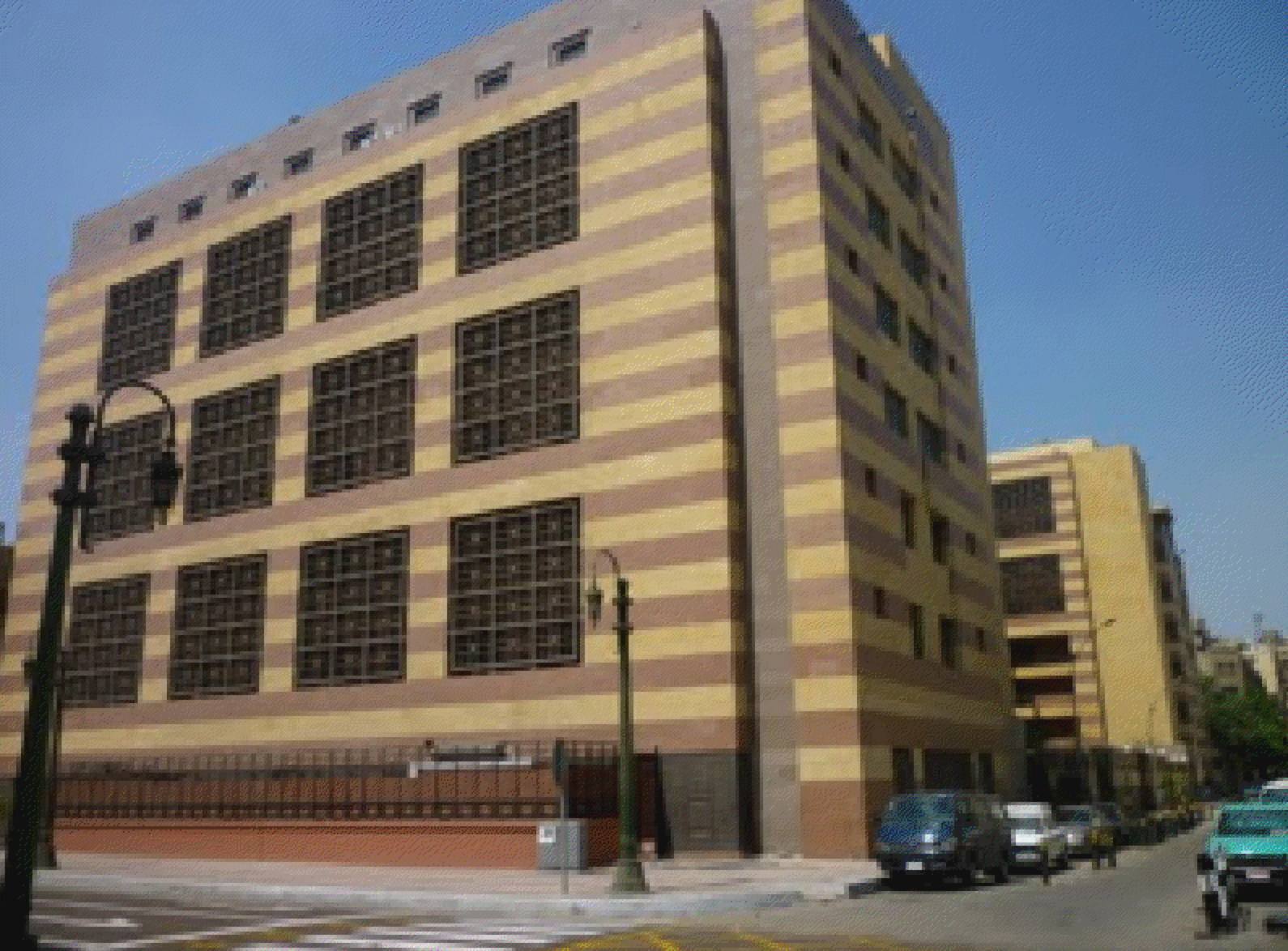
It didn’t take long to figure out that we’re looking at Cairo: the small striped building in the center is the Falaki Academic Center (part of American University in Cairo), and the distinctive building in the far right background belongs to Banque Misr.  Determining where exactly the photo was taken from proved far more challenging.  As best as I can figure, the photo was taken from the south side of Hussein Hegazy street, looking north into Cairo.

cairo

The adjacent rooftop structures seem to match (are those air conditioning units?), as does the light blue roof on the far left.  Unfortunately, I don’t have a window to highlight. But if it comes down to a tiebreaker this week, I was one of the many people who also identified the correct window last week. Hopefully that counts for something!

So close to breaking the tie, but the prize this week goes to the following reader, who got much more specific and who has also entered a dozen more contests than the previous reader:

A lot harder than last week!  My initial gut reaction was “Arab world” just based on the appearance of the buildings and a sort of resemblance to Amman, which I visited last year.  Amman was out, however, due to the flatness of the terrain visible, and the buildings were not modern enough for the Gulf, so my next thought was Syria.  I spent a while searching skylines of Damascus and then Aleppo with no luck, so I thought about what other cities in the region were big enough to have a view like the contest’s view, and Cairo occurred to me.

I spent another long while poring over skylines before I found the photo attached as “Cairo from old city” (link here).  I’ve put an arrow over the building which I’m pretty sure is the one on the right in the contest photo:

Cairo from old city

Next step: actually find where that is in Cairo.  The big mosque in the foreground was relatively easy – the Mosque Madrassa of Sultan Hassan, taken from the Citadel.  Then, I used the very helpful wikipedia page “List of tall buildings in Cairo” to identify the twin buildings in the far right background as the Nile City towers.  I then used Google maps to make a line-of-sight – somewhere along that line roughly was, if not the Window, then the key tower:

Line of sight

Aha!  If only I had drawn that line the first time around it would have saved me an embarrassingly long time combing the city, because as it happens the tower in question fell right on it!  The Banque Misr headquarters – satellite image attached, link here.  Here it is from the front, I think.

If only that were the actual Window.  I still had some work to do.  The absence of other large buildings and or visible open areas/parks from the shot narrowed down somewhat the possible directions we could be facing, but it took me a while of looking for the second-tallest building in the shot, the one on the far left, until I found this one.

More frustrating streetcombing with Google maps and image search, and another piece of the puzzle fell into place: The orange/tan stripey building in the center-right, midfield of the Window, is the Falaki Academic Center of the American University in Cairo, and is located here.  That would make the black smoke billowing upward in the center of the photo roughly coming from Sheikh Rihan street, the site of recent riots, or possibly from the front of the Egyptian Parliament, which has also seen its share of the riots.

Working backwards (south) from my triangulated points, passing the campus and the Egyptian Parliament, the first set of “roof stuff” that seemed to fit the necessary angle was this building on Hussein Hegazy street (green arrow, not red “A”), so that’s my answer – top floor:

The Window

I searched for the street number google suggested (12 Hussein Hegazy), and came across the Albawtaka Review, an “Arabic independent (non-governmental) non-profit online quarterly concerned with translating English short fiction.” (from here)  That sounds like Dish readership potential, so I’ll hazard that the photo came from their office.

So there we have it.  The first time I think I’ve gotten two windows in a row, and this one being the hardest one I’ve gotten.  Maybe this is my week to win!

Indeed. From the submitter:

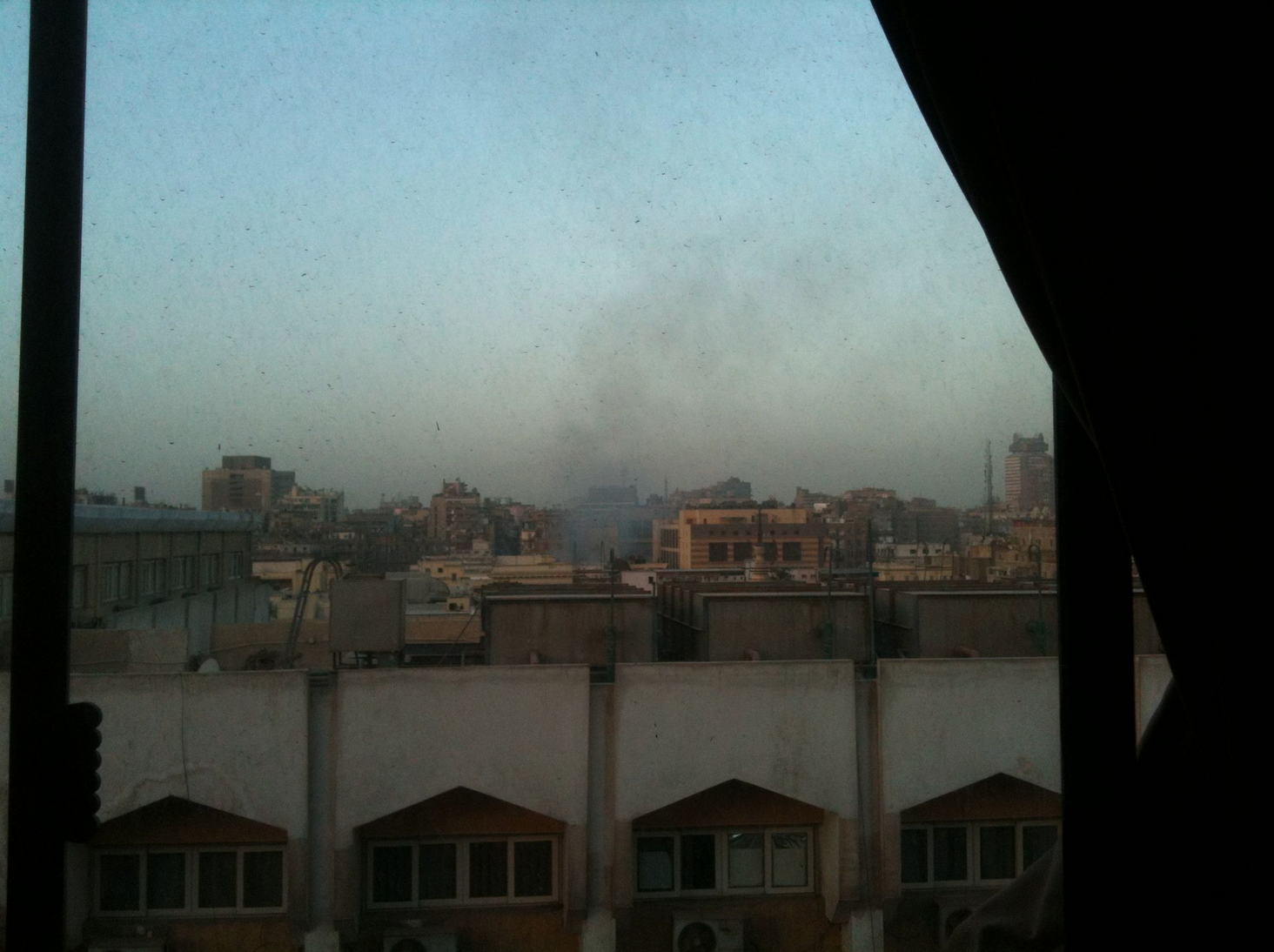
The photo was taken at about 5:15 pm local time on January 26, 2013, in Cairo, Egypt. The smoke rising is from clashes near the interior ministry; my apartment is right next to the Cabinet and near a variety of other government buildings, so when things get hot, protestors head here. With the 2nd anniversary of the revolution yesterday and the government’s announcement of the outcome of trials of those police and protestors involved in the Port Saeed massacre of last year (21 received death, 70 some trials were delayed, including those of all police involved), things are not looking too hot in Egypt right now.

Follow-up from the submitter:

No way you chose my photo! This is excellent, much appreciated. I love the Dish, gonna subscribe now, rather than just mooch off my Google Reader.

In case you need any extra details should some creep figure out exactly where I sleep, I live at 12 Hussein Hegazy Street, in an area of Cairo called Mounira. I’m on the 9th floor (10th by American counting), and this is from the eastern-most window on the floor.

Thanks a lot for all the blogging!

Another close entry from a first-time contestant:

Finally, one that I recognize! This photo is taken in Cairo, Egypt, to the southeast of Tahrir Square. The cityscape immediately made me think Cairo, where I lived for a year back in 2006, but I’ve thought that before and been wrong. After I started looking closely, the striped building in the center looked familiar, and a Google image search confirmed that it is part of the American University in Cairo’s old campus near Tahrir. This building, which is called the Falaki center:

Screen Shot 2013-02-19 at 1.09.05 PM

I’m pretty sure the tall building on the right is the Banque Misr building, which means this photo is facing north. If my extrapolation is correct, the photo was taken on the 7th floor (or thereabouts) at 12 Hussein Hegazi Street, which is just a few blocks from where I used to live. The building in the foreground, with its quintessential third-world bureaucracy architecture, is part of the Ministry of Health, I believe. Tahrir Square is very close, a few blocks to the left of the Falaki building.

One reader totally nailed the right location – down to the exact floor – but he has already won a contest and VFYW book:

That was exhausting. I must have been to every souk and high rise from Amman to Riyadh before finding the right spot. This week’s view, however, comes from the heart of Cairo, Egypt. I believe the shot was taken from roughly the ninth floor of 12 Hussein Hegazy Street. The viewer was looking north, north eastward, with the Misr Bank Tower being the most distinctive landmark on the far right of the image. Egypt’s National Assembly building is only a block away, but it’s hidden from view by the building in the left foreground.

Hussein Hegazy Street is named for the first Egyptian soccer player to play in the professional English soccer leagues, way back in 1911. More recently, the street itself was the location of major protests over union and minimum wage issues in the spring of 2010. Only eight months later and a few blocks away some of those same protesters returned to Tahrir Square as the Egyptian revolution began.

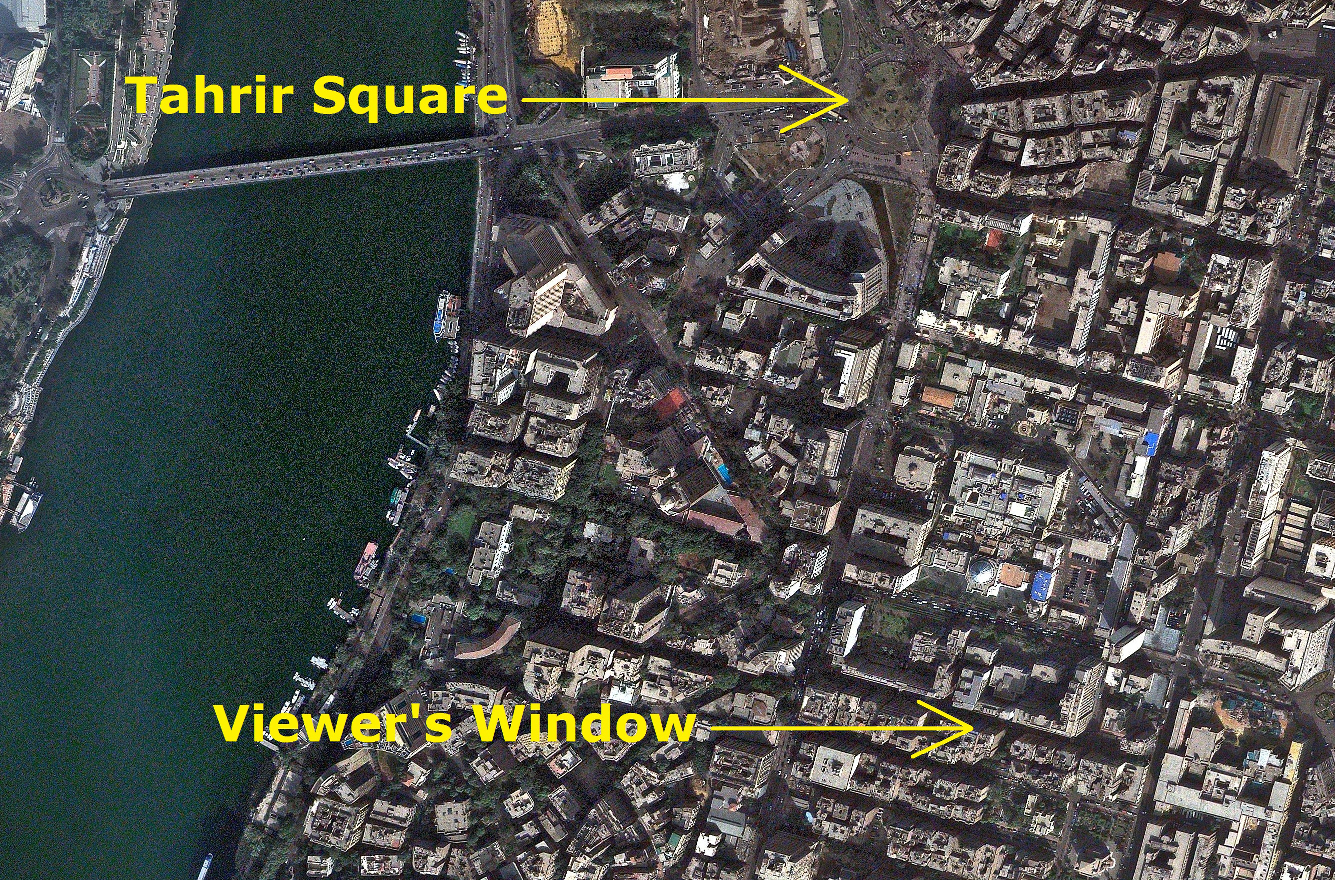
Attached is a labeled, high-resolution satellite view showing your viewer’s position in relation to Tahrir that was taken during the January 2011 revolution:

Cairo VFYW Overhead Marked2 - Copy

(Archive)

How Capitalism Creates The Welfare State

SKOREA-SOCIETY-SUICIDE

The two concepts are usually seen in complete opposition in our political discourse. The more capitalism and wealth, the familiar argument goes, the better able we are to do without a safety net for the poor, elderly, sick and young. And that’s true so far as it goes. What it doesn’t get at is that the forces that free market capitalism unleashes are precisely the forces that undermine traditional forms of community and family that once served as a traditional safety net, free from government control. In the West, it happened slowly – with the welfare state emerging in 19th century Germany and spreading elsewhere, as individuals uprooted themselves from their home towns and forged new careers, lives and families in the big cities, with all the broken homes, deserted villages, and bewildered families they left behind. But in South Korea, the shift has been so sudden and so incomplete that you see just how powerfully anti-family capitalism can be:

[The] nation’s runaway economic success … has worn away at the Confucian social contract that formed the bedrock of Korean culture for centuries. That contract was built on the premise that parents would do almost anything to care for their children — in recent times, depleting their life savings to pay for a good education — and then would end their lives in their children’s care. No Social Security system was needed. Nursing homes were rare.

But as South Korea’s hard-charging younger generations joined an exodus from farms to cities in recent decades, or simply found themselves working harder in the hypercompetitive environment that helped drive the nation’s economic miracle, their parents were often left behind. Many elderly people now live out their final years poor, in rural areas with the melancholy feel of ghost towns.

The result is a generation of the elderly committing suicide at historic rates: from 1,161 in 2000 to 4,378 in 2010. The Korean government requires the elderly to ask their families for resources if they can pay for retirement funding – forcing parents to beg children to pay for their living alone – a fate they never anticipated and that violates their sense of dignity. Hence the suicides.

We can forget this but the cultural contradictions of capitalism, brilliantly explained in Daniel Bell’s classic volume, are indeed contradictions. The turbulence of a growing wealth-creating free market disrupts traditional ways of life like no other. Even in a culture like ours used to relying from its very origins on entrepreneurial spirit, the dislocations are manifold. People have to move; their choices of partners for love and sex multiply; families disaggregate on their own virtual devices; grandparents are assigned to assisted living; second marriages are as familiar as first ones; and whole industries – and all the learned skills that went with them – can just disappear overnight (I think of my own profession as a journalist, but it is one of countless).

Capitalism is in this sense anti-conservative. It is a disruptive, culturally revolutionary force through human society. It has changed the world in three centuries more than at any time in the two hundred millennia that humans have lived on the earth. This must leave – and has surely left – victims behind. Which is why the welfare state emerged. The sheer cruelty of the market, the way it dispenses brutally with inefficiency (i.e. human beings and their jobs), the manner in which it encourages constant travel and communication: these, as Bell noted, are not ways to strengthen existing social norms, buttress the family, allow the civil society to do what it once did: take care of people within smaller familial units according to generational justice and respect. That kind of social order – the ultimate conservative utopia – is inimical to the capitalist enterprise.

Which is why many leaders in the nineteenth and twentieth centuries, conservatives as well as liberals, attached a safety net to such an unsafe, bewildering, constantly shifting web of human demand and supply. They did so in part for humane reasons – but also because they realized that unless capitalism red in tooth and claw were complemented by some collective cushioning, it would soon fall prey to more revolutionary movements. The safety net was created to save capitalism from itself, not to attack capitalism.

This is not to argue against the conservative notion that it is precisely because of capitalism that we have to foster greater family bonds, keep marriage alive, communities together. It is simply to argue that to argue for this and the kind of capitalism that Paul Ryan favors is a tall order. And it isn’t working. The forces of global capitalism – now unleashed on an unprecedented global scale with China, Russia, Brazil and India – are destroying the kind of society which allows and encourages stability, traditional families, and self-sufficient community.

One reason, I think, that Obama’s move toward a slightly more effective welfare state has not met strong resistance – and is clearly winning the American argument – is that the sheer force of this global capitalism is coming to bear down on America more fiercely than ever before. People know this and they look for some kind of security. In other words, it is precisely capitalism’s post-1980s triumph that has helped create the social dependency so many conservatives bemoan today. And this time, there is even a sense that whole industries are disappearing faster than ever before – not simply because of outsourcing but because of technology itself, tearing through old ways of life like acid through iron.

It is unstoppable. I fear its power – given that it relies on emitting carbon in vast quantities – will soon make the world less habitable for large numbers of people. I fear it may kill so many species we will have become God on our own earth. And I think an understanding that the state will have to step in to blunt the sharper edges of this newly creative extra-destruction is emerging slowly in the public at large.

Bell was right. Capitalism destroys the very structure of the societies it enriches. But I doubt even he would have anticipated the sheer speed at which this is now happening. It makes the conservative project all but impossible, if still necessary. It does require a defense of the family, of marriage, of personal responsibility. But it also demands a compassion toward the victims of this economic and social change, an understanding of their bewilderment – which can often express itself neurotically in fundamentalist forms of religion or culture.

All I know is that it is a core conservative idea that revolutions can end in nightmares. But we conservatives also long supported and indeed recently breathed new life into the industrial and post-industrial revolution. We see the consequences far beyond the suicides of elderly Koreans. And in my bleaker moments, I wonder whether humankind will come to see this great capitalist leap forward as a huge error in human history – the moment we undid ourselves and our very environment, reaching untold material wealth as well as building societies in which loneliness, dislocation, displacement and radical insecurity cannot but increase. It seems to me this is not the moment for Randian purism.

Do we not as conservatives have a duty to tend to the world we helped make?

(Photo: This photo taken on January 11, 2013 shows an anti-suicide monitoring device (L) installed by the government at Mapo Bridge -a common site for suicides- over Seoul’s Han river. The South Korean capital has installed anti-suicide monitoring devices on bridges over the city after 196 people jumped to their deaths on 2012 according to South Korean officials. The new initiative — in a country with the highest suicide rate among leading developed nations — incorporates closed-circuit television cameras programmed to recognize motions that suggest somebody might be preparing to jump from a bridge. By Pedro Ugarte/AFP PHOTO/Getty Images.)

How Obama Legitimized Torture

Screen shot 2013-02-19 at 11.42.08 AM

Jane Mayer compares Bush’s torture memos to Obama’s targeted killing memos, and makes a critical distinction that some have tried to elide:

Clearly there are plenty of troubling questions surrounding the Obama Administration’s targeted-killing program. But, that said, are Obama’s drones comparable in terms of human-rights violations, to Bush’s Torture program?

Those who argue so miss an important distinction, one that David Cole also has brought up: torture under all our systems of law—including the laws of war—is illegal. This is true without exception, regardless of the circumstances, including national-security emergencies. Torture is also condemned by every major religion. Waterboarding was, and is, a form of torture. This has been established as far back as the Spanish Inquisition, and as recently as the Vietnam War. To argue otherwise is to legalize criminality. That was what the Bush Administration’s torture memos did. …

Obama, in contrast, has tried to bring his counterterrorism program inside the law by reasserting the criminality of torture and by trying to define which drone strikes are legal. The Obama Administration’s lawyers’ attempt to define those boundaries in their white paper isn’t prima facie scandalous, because the Constitution authorizes lethal combat, unlike torture.

She goes on to make various valid critiques of Obama’s targeted killing program, but the above distinction is worth keeping in mind during these debates. It comes up again and again, on the hard left and, of course, on the hard right. Take this sentence from Jeffrey Rosen, unwilling to accept that some of his legal friends are war criminals:

Although the Obama administration’s brief is directed at the assassination of Americans abroad, the arguments it offers could apply with equal force to the assassination of Americans at home; lawyers for the Bush administration who tried to justify lesser outrages have been pilloried for supporting torture.

But they did support torture, didn’t they? And there is no conceivable way for that to be legal, right? Part of my frustration with this debate from the get-go has been the assumption that the rule of law is something just to get around, rather than to abide by. And so torture is immediately discussed by Greater Israel fanatics like Alan Dershowitz as if it were an actual, live option in a society governed by the rule of law. It is not and for a very long time has not been a legal option, as Dershowitz well knows. And as David Luban recently noted, the crime of torture carries a 20 year prison sentence and the death penalty if the victim is tortured to death, as happened well over a dozen times under the criminal regime of Bush and Cheney. Every single war criminal – except a few grunts at the very bottom of the chain taking signals from their superiors at Abu Ghraib prison – walked free. War criminals who actually destroyed the video evidence of their torture sessions now sit on AEI panels and brag of their criminality to Beltway applause. With perjury a civil suit for sexual harassment, illegality among high oficials led to one president’s impeachment. With the criminal felony of torture, the rule of law matters not at all. We are not even allowed to see the Senate’s report on the torture program.

By allowing all CIA officials who tortured prisoners off any legal hook, and by deciding that Cheney and Bush and the architects of the plainly illegal torture program were easily integrated back into respectable American society – with the chief war criminal, Dick Cheney, still treated as an elder statesman on network television – the Obama administration may have stopped torture but they also helped legitimize it. By refusing to deal with it as a serious crime, they allowed many other Americans to take the same position.

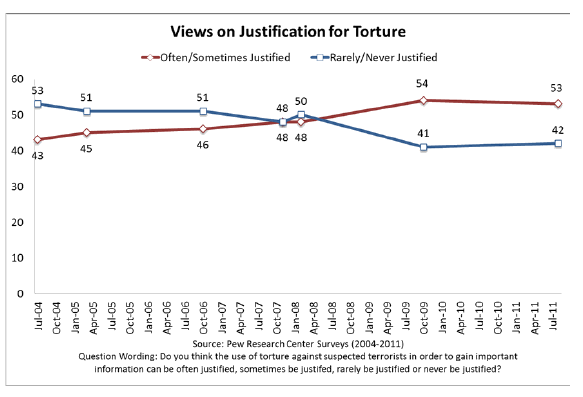
Can you see when public approval for torture begins to rise in the graph above? After Obama and Holder told us it was no big deal, and no one should be held in the slightest way accountable.