Matrimonial Inequality

Marriage_Education

David Blankenhorn, in a conversation with Jonathan Rauch, worries about the marriage class divide:

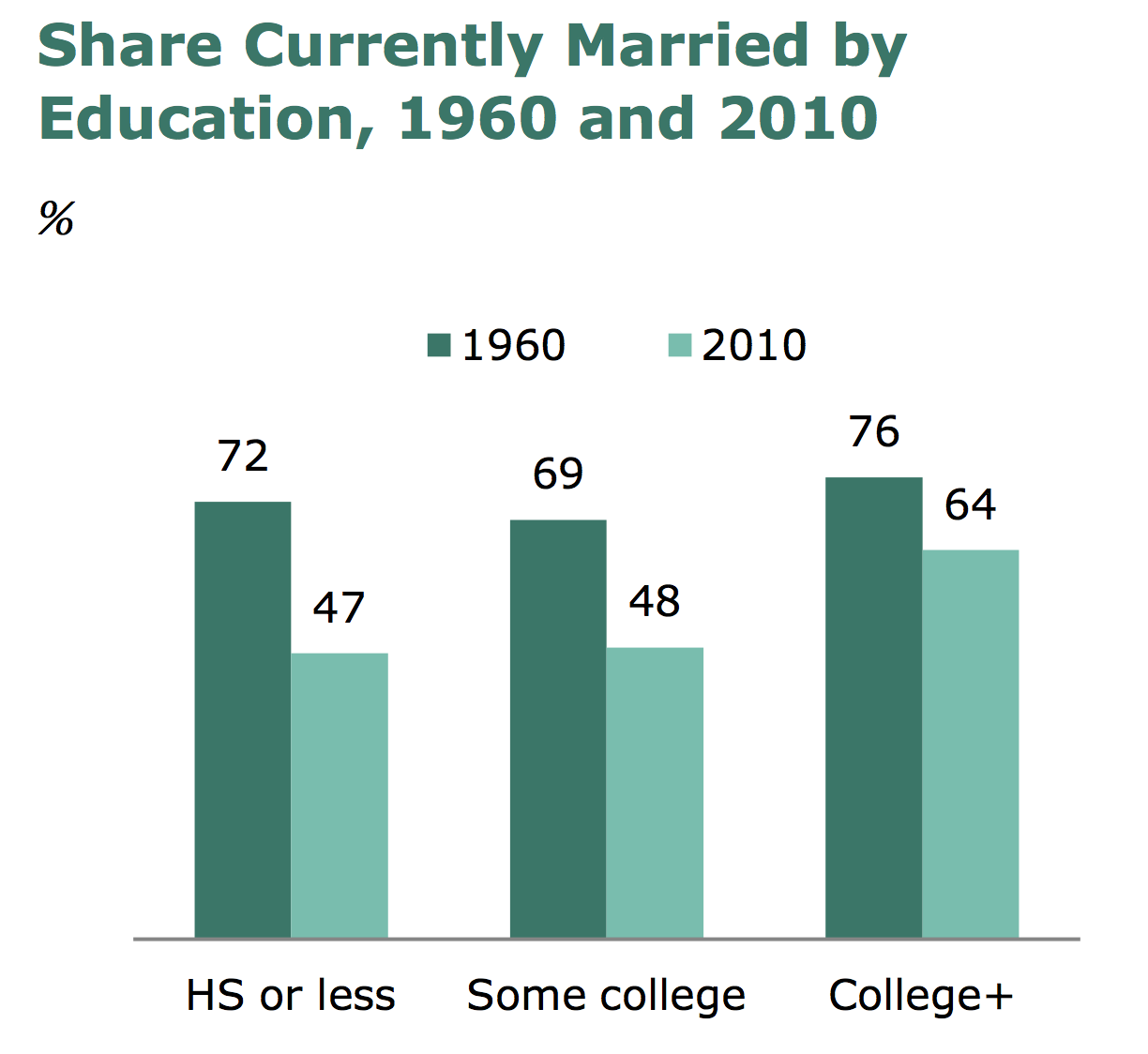
[W]hile marriage equality is winning victories and gaining converts (like me), marriage overall in the United States is fracturing along class lines. Among the 30 percent or so of upscale Americans with four-year college degrees, marriage trends are looking pretty good! (If this group were the entire nation, I’d be as encouraged as I was in the late 1990s.) But among the 60 percent or so of Americans who have high school degrees but not four-year college degrees — the nation’s broad lower middle class and working class — marriage is disappearing, right before our eyes. More and more unwed child bearing, one-parent homes, serial love relationships, chaotic home lives for children, frustrated hopes, bruised lives — the whole sad shebang. And very few people in high places seem to give a damn about it, or even to have noticed.

Rauch adds:

Yes, class bifurcation is the marriage problem of our time. Family instability among the less-educated and rising inequality are two sides of the same coin, each perniciously feeding the other. Yes, it’s tough to do anything about. But yes, I have hope, because we’ve arrived at a moment when, as a society, we can finally take off the culture-war blinders and see the real problem, which is the sine qua non for doing anything about it.

For many years, liberals were loath to talk about marriage and family values because both were code for “beat up on homosexuals.” At the same time, conservatives were loath to talk about inequality and class because both were code for “beat up on free markets.” But the era of gay marriage raises the prospect of a pro-marriage agenda which liberals can embrace as not even slightly anti-gay. And the country’s rapid division into marital and educational haves and have-nots makes inequality a problem that family-values conservatives can’t ignore.

(Chart from (pdf) Pew)

Driving While Stoned, Ctd

This embed is invalid


Jacob Sullum summarizes a recent experiment (seen above) by a Seattle TV station:

The station enlisted three volunteers: Addy Norton, “a 27-year-old medical marijuana patient and heavy daily marijuana user who smoked pot before arriving at the test site”; Dylan Evans, a 34-year-old weekend pot smoker; and Jeff Underberg, 56-year-old who smokes pot occasionally. All three of them satisfactorily completed a driving course at THC levels far above the legal limit.

Norton arrived with a THC level of 16 nanograms, more than three times the DUID cutoff, but nevertheless drove fine, according to the driving instructor who accompanied her with his foot hovering over a second brake and his hand ready to take the wheel. After Norton smoked three-tenths of a gram, she tested at 36.7 nanograms, more than seven times the legal limit, but still drove OK. Even after she consumed nine-tenths of a gram, a “drug recognition expert” from the Thurston County Sheriff’s Office said her driving was merely “borderline.” Only after consuming a total of 1.4 grams of pot and achieving a THC level of 58.8 nanograms, almost 12 times the legal limit, was Norton clearly too stoned to drive.

Josh Harkinson looks at more research on the subject:

While booze can make people drive faster and more aggressively, marijuana has the opposite effect: Pot smokers, studies show, tend to compensate for their impairment by slowing down and leaving larger gaps between themselves and other cars. Still, Ramaekers cautions against thinking that stoners acting like Sunday drivers are safer. Marijuana users may “try to create their own box of safety, and within that world they can operate fine,” he says. “But there’s a lot of other information outside of that box that they can’t process, and that is a problem.”

Road tests and driving simulator studies have found that the more weed drivers inhale, the worse they do at essentials such as staying in their lanes, responding to sudden hazards (like a dog running into the street), and multitasking—for example, reading street signs on a twisty road while avoiding oncoming traffic. On average, drivers with blood THC levels equal to or in excess of 5 ng/ml cause crashes at 2.7 to 6.6 times the rate of sober drivers, and getting into the driver’s seat less than an hour after smoking a joint nearly doubles your risk of getting into a crash.

Earlier Dish on stoned driving herehere, and here.

Is The Dish A “Community”?

dish-community copy

A reader writes:

I’ve known since the day you announced the change that I was going to [tinypass_offer text=”subscribe”], because there is no single thing on the Internet that has enriched my life more than The Dish in the past six years. But because I’m extremely broke, and saving up for an engagement ring to boot, I’ve been waiting to subscribe, thinking that at some point it would become inevitable because of the meter and then I’d be able to justify my spending to my inner voice of frugality.  But after reading the obnoxiously condescending dissent you aired, claiming that I must be a really sad person to feel a sense of community around the Dish, I can’t help but subscribe right this minute.

I’m really surprised that this reader has never felt any sense of kinship with someone merely because they share some intellectual interests. I won’t stoop to his level and call him sad, but I do pity him for never experiencing, for example, the fun of being in an elevator with someone carrying a copy of your favorite book, and exchanging knowing glances about the cliffhanger at the end. We are all part of many, many wordless communities. Has he really never seen someone else wearing a jersey from his favorite sports team on game day and shared a brief but powerful connection because of it? Has he never chuckled at an inside joke on a stranger’s bumper sticker or vanity plate?

But there’s an even more important reason I want to subscribe: yours ISN’T a wordless community at all, and your airing of his dissent (and other reader responses) proves that. I’ve never encountered any media outlet or quasi-public figure who so often acknowledged criticism and attacks on him and on his ideas. I hope some day to be half as comfortable as you hearing people say that I’m an idiot.

You get used to it after a while. And sometimes they’re right. Another reader is on the same page:

I consider myself American, that is a member of the community called “America.”  Does that identity become invalid simply because I don’t interact with the overwhelming majority of them?  I also don’t happen to interact with almost anyone in my neighborhood beyond my roommates, but I’m still considered part of that “community.” On the Dish, I’ve had e-mails posted, read threads that have led to many interesting conversations with others, and been exposed to the experiences and viewpoints of a diverse array of individuals I couldn’t hope to replicate myself.  In my opinion, the VFYW contest alone invalidates their point.

On that note, another writes:

I don’t bother joining in on the View From Your Window contests, preferring to read the guesses of others who have more time than I to figure those things out. But I was surprised when I read one of this week’s entries from the woman who sent in the picture taken by her fiancé of her looking out the window of the Puerto Rican fort. I’m not sure I would have recognized her from the back, but her description of being in San Juan in December and traveling on to Vieques to celebrate their engagement made me gasp. I received a note from a former student of mine in early January telling me that he and his wife-to-be were vacationing in Vieques over the holidays. And this young couple will be coming up to visit us on Thursday. We consider them dear friends, but we didn’t know until I wrote them a few minutes ago that we both follow your blog. Small world in more ways than one!

More small-world moments from our contest here and here. Another reader dissents:

You asked, “Why else would so many people send us links or write emails like yours or send in their window views or vote for awards and so on if they were not part of a community?” I will never regard the Dish as a community while you insist on running reader contributions anonymously. As far as I know, none of the media outlets you worked at prior (and during) your time at the Dish remove the attribution of the people who contribute letters and other forms of feedback. I don’t begrudge your newly independent site its success, but I would never pay for it while that policy is in place. It seems like an attempt to downplay the fact that a lot of what makes the Dish interesting is written by people who are not named Andrew Sullivan.

There are reasons for that. First, if we identified every reader by name, we would feel obliged to run our edit of their emails for their permission first. The time that would take back and forth would be enormous, and the conversation would have moved on by then. The second is that this blogazine has a single voice and it is a mixture of individual – me – and collective – my colleagues and you. Keeping that intact and integrating the readers into the product in the same voice keeps the place coherent, and doesn’t separate us from you. Third, we want the arguments to count, not the egos. And we want to create a safe space for people to say things they might feel uncomfortable saying under their own name. I do not think we would have been able to collect the breadth and depth of our testimonials on the “Cannabis Closet”or the extraordinary stories in our thread on late-term abortion without providing a safe space as free of ego and comments-section-bile as possible.

Another dissenter:

“Because we are a community.” No we’re not. We are something, but not a community. Who is gonna give me a job? Or be a really nice person and give me $1,000 dollars to get me through the next month and fix the car along with it? Or drive me to the doctor since the car isn’t running?  None of you come over and hang out on my back porch. And I don’t run into any of you in the supermarket, even though two of us might be in the supermarket at the same time.

I don’t have time to read all of the sources. You and the rest of you are a great bunch of editors. Someday, when I have a job, it’s worth 20 bucks a year to have you around.

Several more readers share their thoughts on the Dish community:

I’m a new father of a baby daughter, who just moved his family into an apartment, and the money is extremely tight right now. But once I get the extra scratch I am going to 1) subscribe to The Dish and 2) donate to my local NPR station. Both of which I heavily rely on for news, information and intelligent discourse. What I get from these sources is well worth my money and, when the time comes, I expect to feel a little ping of pride in being a subscriber to The Dish.

The thing is, even without giving dollar one, I still feel a sense of community. The vast and diverse segment of the population that are Dish readers is constantly astounding to me. Whether or not I agree with a reader whose email you showcase, I know that at the very least they put some thought into it and are sincere. Thinking and sincerity isn’t something you would normally find in a comments section.

Another:

I probably send more emails to the Dish than to any one person I know outside of work, other than my close relatives and girlfriend. To the extent that “community” and “communication” have a shared root (which they do),qm The Dish is a community to me. And in any community, there are those who get a thrill up their leg being an active member (your “dorky” subscriber), and those who keep their distance from any displays of affection (your dissenter). And there are those who simply appreciate the stimulation the community provides and find it occasional cathartic to throw in their two cents (or pence in my case) by shooting of an email.

The Dish is not Oprah. It is that rare thing on the Internet: a place for intelligent discussion that wears itself lightly. Most of the web communities I’ve seen are populated by either emotion-infused screeds or dispassionate analyses that betray nothing of the writer’s bias. The Dish is the only place I find commentary that doesn’t pander to either extreme. In part because reader feedback is moderated. But largely because, while biased, the editing is, as you claim, remarkably balanced.  The attitude that led you to publish dissents of the day is I think the most compelling reason for the blog’s enduring success.

Another:

On whether the Dish is a community, I never gave it much thought but that’s besides the point. My main draw is that there are no comments. I see real discussions, not the mutated form that passes for “debate” these days, saturated with ad hominem and strawman attacks. I want to read comments to see what people think and use those thoughts to build, strength or reconsider my own ideas, but it’s disheartening (and time consuming) when the vast majority of comments I see on news-related sites contribute so little, and all they do is get my stress up.

I think part of this is not the inherent nature of comments itself, but our failure to teach people about real discussions. I admit there was an aspect of The Dish that made me uncomfortable, which was this very fact that we are at the mercy of you and your staff to judge which of our emails are worthy. It took some time to build that trust but now I now trust your abilities as our filter and to present a range of informed opinions. I don’t agree with everything I read, but I think it’s a mark of a good discussion when I can disagree without feeling like I was personally insulted.

In typing this email, it made me realize how much I’ve come to love The Dish, so I just subscribed.

You can join him and 21,387 other founding members [tinypass_offer text=”here”].
Burma vs Myanmar

A reader pushes back on my “personal note of thanks [to Obama] for using the words Rangoon and Burma” in his SOTU address:

I also used to make a big deal about using the terms “Rangoon” and “Burma”.  That was before I actually had been there. On each visit, I found that everybody in Myanmar says they live in Myanmar and that their capital is Yangon. Foreigners don’t get to decide that for them; they declare it stoutly, even if those changes were made by their despicable military regime.  We can all mourn the lost years in Myanmar, but we don’t need to fixate on the linguistics of their own place names. Several people, certainly not military sympathizers in any way, will point out that Myanmar is the country’s original name, that the Brits changed it to Burma to reflect the overweening power of the majority Bamar ethnic group in civic life.

One of the uses of the label Myanmar is to indicate inclusion of all the numerous ethnic groups as equal citizens.

Certainly it can be argued that that inclusion is by and large mere wallpaper, but what is also true is that little by little, many of the ethnic uprisings are quietly ending by treaties and peaceful means. Significant exceptions to that remain, such as the Kachin factions still boiling near Bhamo. (Apparently the old-school military fellows are continuing the battle despite orders from Naypyidaw to knock it off already.)

For what it’s worth, this appears to be the most exciting time to be a citizen of Myanmar in generations. One Burmese academic that a friend of mine interviewed said very eloquently that in the past, people in Myanmar “shuffled around” but now they are striding into the future. Even their gait and demeanor expresses that. Some of our American friends were cycling through Myanmar this winter and happened to be in Yangon when Obama arrived and witnessed thousands of people lining the streets thrilled to their bones at the ending of this long, brutal isolation. It’s beyond remarkable what has happened there in the last two years.

I think it’s fine to call it Burma or Myanmar, and certainly folks there wouldn’t bother to correct you.  I just think it’s time to stop being smug about using the term Burma to indicate a political viewpoint that in Myanmar itself is pretty irrelevant.

I wasn’t intending to be smug. I was resisting the re-naming of the country by a fascist junta. And the truth is that Burma and Myanmar are closely related and both exclude the long-brutally oppressed ethnic minorities:

Both these names are derived from the name of the majority Burmese Bamar ethnic group. Myanmar is considered to be the literary form of the name of the group, while Burma is derived from “Bamar”, the colloquial form of the group’s name.

The question of whether we should call foreign countries the same names they call themselves in their own language is a separate one. I’ll agree when my reader is fine visiting München and Москва with me. Till then I’ll call it Burma – which is an anglicized version of what Brits heard when they listened to the locals.

The Big Rock Heading Our Way

But first, holy shit:

The footage was taken last night in the Urals, where over 1,000 were injured from the impact. The meteor was likely related to the asteroid 2012 DA14, which is scheduled to barely miss our planet today. Phil Plait provides a primer:

[E]xcluding actual impacts, 2012 DA14 will be still only be the eighth-closest approach by a known asteroid on record. The closest on record without actually hitting us was 2011 CQ1, which, in 2011, passed us by about 5500 km (3300 miles)—less than Earth’s radius! It was only about a meter across, so even if it had hit us we would’ve gotten a spectacular fireball, but probably no actual damage.

However, this is the largest asteroid we’ve seen come this close. Even then, it’s only 50 meters across, which is small as asteroids go.

Update from a reader:

The meteor is “likely related to asteroid 2012 DA14”.  This is untrue.  In fact, they approached the Earth from completely different directions.  See the statement from Don Yeomans, head of NASA’s Near-Earth Object Program: “This bolide event probably had nothing to do with the upcoming close Earth approach of asteroid 2012 DA14, which is due to pass closely (and safely) past the Earth at 19:24 GMT today [2:24 p.m. ET].” Yeomans added that the Russian bolide trail did not travel south to north as the asteroid will.

It won’t hit us, Plait argues, but it’s a sobering reminder of our weak NASA budget and our inability to deflect asteroids:

This threat is no joke. It’s quite real, and we need to take it seriously. We need more observatories watching the sky, and a plan in place in case we do see one with our number on it. Some new observatories will soon be coming online that will help. Also, both NASA and the privately-funded B612 Foundation have plans to launch space missions that can better look for near-Earth asteroids. B612 even has ideas on how to stop a potential impactor from ruining our day, too. I gave a TEDx talk on this very topic.

For more footage of that Russian meteor strike and its aftermath, including the sonic boom, go here.

Sleuthing for Love

Daniel Estrin spotlights a unique challenge for couples looking to get married in Israel – the proof of a matrilineal Jewish ancestry to satisfy the Orthodox tradition:

[T]hey call Har-Shalom, who runs a nonprofit detective agency that specializes in sniffing out long-lost Jewish ancestry. His agency, called Shorashim (Hebrew for “roots”), is funded in part by the Israeli government. Each year he takes on roughly 1200 cases that test his fluency in Yiddish and Russian dialects, his familiarity with czarist and Soviet history, and his patience for combing through old Soviet archives. He then presents his findings to a rabbinic court, which almost always accepts his expert opinion about a citizen’s Jewish identity.

Estrin followed a genealogist working with Har-Shalom and witnessed the depth of the detective work:

An archivist willing to breach protocol located Olga’s grandmother’s original birth registration, which identified her as Jewish. Olga then paid Paley another $400 to secure a copy of her great-grandfather’s KGB file, which classified her great-grandmother as Jewish. Although these documents bolstered his case, Har-Shalom’s investigation dragged on for two more years.

Finally, last month, Olga was summoned to an Israeli rabbinical court. A judge sat at a raised bench. He reviewed the report Har-Shalom submitted of the evidence he gathered. Then the judge held up an old family photograph. “Who is in this picture?” he asked the defendant. Olga identified her mother, her grandmother, and her grandfather’s friend. The hearing lasted 15 minutes, and at the end, the judge handed down his verdict: Olga is Jewish. By extension, her daughter is, too.

A Fascist Kind Of Love

Grappling with her ongoing desire for an ex-flame, Natasha Vargas-Cooper is convinced by Blake and Rousseau that her feelings are something much darker than a search for acceptance:

Blake is the British Marquis de Sade, probing and exposing the tyrannical impulses behind misty emotionalism. Blake is interested in “coercion, repetition-compulsion, spiritual rape.” Like Rousseau, Blake wanted to free sex from religious and social restraints, but unlike Rousseau, Blake recognized there is no escaping the domination of nature and our own ignoble desires. His poems are filled with a latent human amoralism: men and women cannibalizing each other (“The Mental Traveler”), physically and psychologically exploited children (“The Chimney Sweeper,” “The Little Black Boy”), erotic ambivalence (“The Sick Rose”), and resentment towards the demonic power of sex.

She turns to literary critic Camille Paglia to make sense of her schemes to get the boy back:

In one liberating spank, Paglia’s reading of [Blake’s poetry] made me realize that my phone calls and romantic gestures were not noble or life-affirming but a perverse, coercive form of power. What I perceived to be my romantic idealism was actually a fascistic impulse to dominate, what Paglia describes as “sadistic tenderness”: “Every gesture of love is an assertion of power. There is no selflessness or self-sacrifice, only refinements in domination. …”

When Ratzinger Met ACT-UP

A revealing anecdote from theocon Rabbi David Novak:

The one and only time I met Pope Benedict XVI was when he was Joseph Cardinal Ratzinger. The time was 1988, and the place was St. Peter’s Lutheran Church in New York. The occasion was a lecture by the cardinal arranged by Fr. (then Lutheran Pastor) Richard John Neuhaus. The occasion was memorable less for what the cardinal had to say (though it was typically learned, intelligent, and politically astute) than for the disruption of the lecture by a militant gay group, “Act-Up.” They were protesting what they claimed was the Catholic Church’s fault for the AIDS crisis by its designation of homoerotic acts as morally disordered. (Their “logic” then and now escapes me, since if most of those who have contracted AIDS followed the prohibition of homoerotic acts in the Hebrew Scriptures, which the Church accepted in its refusal to totally break with Judaism, there wouldn’t be an AIDS crisis at all.)

While most of the people at this lecture were too dumbfounded by this sacrilegious break-in to do or say anything, Cardinal Ratzinger “kept his cool” and (as I recall) he said (in perfect English like the lecture itself) in a clear, firm voice (and as one might say in his native German: mit brennender Sorge, i.e., “with burning concern,” the title of Pope Pius XI’s famous anti-Nazi encyclical of 1937): “We have now heard your voice; now listen to mine!” That, plus the quick arrival of NYPD, enabled us to hear the rest of the lecture. I greatly admired the way he stood up to these enemies of the Judeo-Christian moral tradition.

Nudged In The Gut

Based on a “clear correlation between increases in portion sizes and increases in obesity”, Cass Sunstein, Nudge co-author, suggests “attention to the subtle social cues that lead to excessive eating” as a starting point for improving public health:

Brian Wansink, a Cornell University professor of consumer behavior, helps to explain why portion sizes have such a large effect. He finds that much of our eating is mindless or automatic in that we tend to eat whatever is in front of us. If you are given a half-pound bag of M&M’s, chances are that you will eat about half as much as you will if you are given a one- pound bag. People who receive large bowls of ice cream eat a lot more than those who get small bowls.

The good news is that once we isolate the sources of excessive eating, we will be able to identify potential solutions. Google Inc. found that its New York cafeteria, which offered a lot of high-calorie items, was producing a lot of unwanted pounds. In response to employee complaints, it initiated changes to nudge people toward healthier choices. … The redesigned cafeteria took a number of smart steps to make healthy choices simpler and more convenient (and to make less healthy choices less so). As a result, it helped to produce big reductions in both calories and fat consumed from candy.

See the related Dish thread on Bloomberg’s soda ban here.

Our Cyberwar With China

A recent National Intelligence Estimate determined that the US is “the target of a massive, sustained cyber-espionage campaign that is threatening the country’s economic competitiveness,” pointing to China as the country “most aggressively seeking to penetrate the computer systems of American businesses and institutions.” Just before his SOTU speech, Obama signed an executive order on cyber-security. Andy Greenberg examines its privacy implications and sees progress:

[T]he House of Representatives may have hoped the President’s own cybersecurity initiative would divert some of the attention away from the controversial legislation known as CISPA [Cyber Intelligence Sharing and Protection Act]. Instead, the White House’s long-awaited executive order on cybersecurity is actually scoring points with the privacy advocates–and putting CISPA in a worse light than ever. … [W]hile the order allows the sharing of government data with the private sector, the data sharing doesn’t flow back the other way. That means the order, unlike CISPA, doesn’t raise the hackles of privacy groups that have protested that CISPA could grant immunity to private sector firms who want to share their user’s personal information with the government.

The ACLU “welcomed Obama’s order.” Less than 24 hours after the president signed it, the House reintroduced the controversial CISPA with no changes.