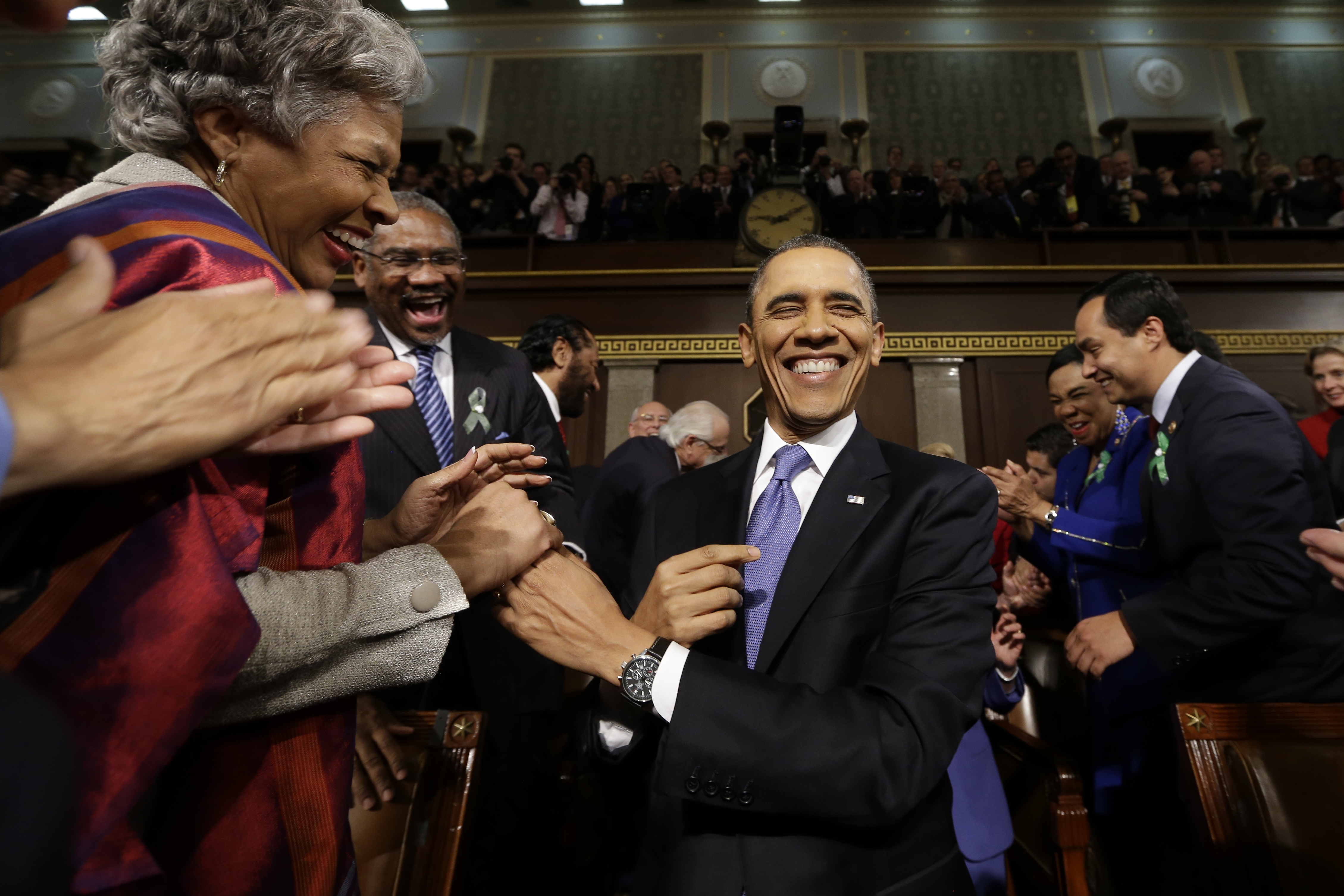
SOTU From The Shadows

Benjy Sarlin watched Obama’s address with “hundreds of immigrant day laborers, domestic workers, hotel workers, many of them undocumented”. The reaction was more complex than you might imagine:

Obama received cheers and whoops as he announced that “the time has come to pass comprehensive immigration reform.” But they quickly turned to boos, hisses, and even a “Shame on you!” as he pivoted to tougher border security.

There were more discontented murmurs as he said undocumented immigrants need to go “to the back of the line” behind legal immigrants to obtain a green card, a system many fear may be too hopelessly damaged to ever make them permanent residents. … The immigrants in the room were well aware that the current reform push is likely the best chance they’ll have, short term or long term, to secure a path to citizenship, or at least legal status that would allow them to work in the open. … “It’s going to happen soon, but we have no idea exactly what it is that’s going to happen,” Martin Unzueta, a labor organizer for immigrant workers in Chicago, told TPM. “Obama’s speech hasn’t changed in ten years, it’s the same speech Bush gave to us.”

He talks to Jose Antonio Vargas, whose testimony today before the Senate is featured in the above video:

Everyone wanted him to emphasize specific points for his big speech – the record number of deportations under Obama, the importance of legalizing low skill workers, including new labor protections for immigrants workers. “I have 200 people saying you have to include this, you have to include this!” he told one worker. “I have 800 words!” Vargas said his goal was “to be as aggressively respectful as possible” despite any urges to the contrary.

Hitch And Sully: “The Problem Is The Will Of So Many People To Obey”

The late night conversation we taped seven years ago but never published continues. I apologize for teasing you about his evolving views on the Iraq War earlier today. That comes later in the early morning after a few more Johnnie Walker Blacks. We’ll get there soon. This is still a conversation about religion and totalitarianism:

A: The last four years, or five years — the last ten years, I could say, more generally — to any believing Christian, observant Christian, like myself, have been a sort of reading period in the dangers of religion. I don’t think in my lifetime this has ever been clearer, to any observer, in world history, for a very long time, how dangerous this is. When was the last time we had this kind of religious terror?

H: We’re not now speaking just of Christianity’s fanatics.

A: No, we’re not, we’re talking about Islam.

H: Just when people had begun to think that the age of totalitarian ideology had gone, the idea of the one leader, the one supreme…

A: The one truth.

H: …the one truth, the one party—just when one thought one had left that all behind…

A: It comes back like Glenn Close out of the bathtub.

H: I once did a calculation:

I was in Romania in 1989 and in Hungary, at the end of communism. I saw the end of Ceausescu. I thought, “Alright, that’s it, in Europe anyway — but it seemed globally — the idea of the absolute leader, the absolute party, the undisputable truth is over. And maybe our future will be a little bit banal. I remember reading the Fukuyama stuff and thinking, probably true, but a little tedious.

A: I could live with it. I could absolutely live with it.

H: How bad is the idea of, you know, essentially a market economy and essentially a political pluralism? You know, as someone who had once had utopian opinions…I didn’t feel pumped up by it but I thought, “hmm, doable.” And people talked about at that stage, “the peace dividend” — remember that expression?

A: I do.

H: “Now think of all the money we’ve been spending on the Cold War, we don’t have to spend it anymore, on the weaponry. Think, furthermore, which we now can, on the better uses for it; the long neglected crisis in Africa, the problem of AIDS, the general problem of poverty and degradation and of failure of other societies to have caught up with whatever we want to call it. The market-pluralist model, at a minimum. We have all these chances now!”

That, I calculated once, I don’t remember how many days it went on, but I think it was 120 days of this illusion. Not very long before Slobodan Milosevic invaded Bosnia — we’d overlooked this little dictator in the Balkans — and Saddam Hussein abolished the existence of Kuwait; not invaded it, as some people say, but annexed it and said, “a member state of the United Nations, of the Arab League and the Islamic Conference no longer exists, it belongs to me personally, and my crime family.” Ah, how interesting!

A: Yes, but two mafia bosses, one in the Balkans and one in Iraq, do not make a new wave of ideology.

H: No, they don’t, but both of them were supported by their local religious authorities, in Milosevic’s case the Orthodox Church and in Saddam’s case by at least the Sunni ulema in Baghdad. And while all this was going on, and we were confronting it, coming up on another track slightly to the outside, something that had been noticeable before ’89, but had become actually noticeable on February 14th of that year — the fatwa against Salman Rushdie by the theocratic head of a foreign state offering money in his own name for the murder of a novelist in England — became an aspect of this, too.

A: Right.

H: And an extra totalitarian ideology suddenly became very menacing and, without us paying anything like enough attention, took over at least one state, namely Afghanistan and probably Sudan as well.

A: Does that make one, in some ways, more aware of the fact that maybe human beings want this? They can’t live without it? The possibility of the daily ordeal of consciousness, of figuring out what the hell one’s life means and what the world is, is not as attractive to many people as surrendering to some ideology or some dictatorship or some mass movement. In other words, since we have not had a period of global history since the French Revolution, really, in which something like this hasn’t been abroad in the world, is it not simply a permanent fact of the human condition?

H: Well, if one stops talking about that immediate period, I remember there was a very old anarcho-socialist slogan that says, “the problem is not the will of some people to command. It’s the will of so many people to obey.”

A: Right.

H: And that there is, in some sense, an innate capacity in human mammals, human primates, to be wished to be told what to do. To be asked to be given security in that form. And of course there are people in countries like Iraq or Serbia — and it would be true of anywhere else —

A: And here, for God’s sake.

H: —who, if they were asked, if offered the chance to help themselves to the treasure and property of a helpless neighbor will say, “well, how bad could that be?” That’s, yes, that will always be a problem. But the recrudescence of the totalitarian idea in that period made me realize that there was, apart from the general fact that we are a poorly evolved mammalian species — we prove that every day without being totalitarian or without being rapists or conquerors or fascists — a specific, locatable problem which has preoccupied me ever since. Namely that all of these regimes — Saddam Hussein’s regime is very sectarian, based on a minority of a Sunni minority; Milosevic’s regime was based on a Serbian Orthodox minority trying to kill Muslims in Bosnia; and al-Qaeda’s friends in the Taliban in Afghanistan hated, probably more than anything else, the Shi’a, and acted accordingly in butchering them as you can tell by seeing what happened to the Hazara population in Afghanistan. Or, to move it outside the world of Islam, to the Bamiyan statues, the Helleno-Buddhist sculptures of Afghanistan’s antiquity. But for all these discrepancies between and among themselves they have absolutely one thing in common: visceral loathing of the United States. For its pluralism, for its secularism…

A: For its constitution, primarily, right? They can’t dislike America for its religious principles.

H: No, it is done, people do say, “ah well, because George Bush believes in God he’s as much of a theocrat as Osama bin Laden,” let’s leave all that crap to one side. No, I think one would also have to say for its hedonism. Not only is [the US] a dominant power in the world, and a global force…

A: But it’s enjoying it too much.

H: Yeah, it’s having such a good time it barely notices how other people live. By the way, I think that’s a very powerful force of resentment. But it’s phrased by these people as, “well [the US] is
basically run by a load of Jews and dykes and faggots and entertainment moguls and heartless tycoons. A sort of Brechtian parody of an opulent, plutocratic state.

A: “Weimar.”
Nirvana For Sale

Tim McGirk delves into the challenges facing today’s reincarnated Buddhist teachers, known as rinpoche or tulku, “a supposedly enlightened being who continues his teaching from one lifetime to the next”:

Often, when a well-known lama dies—even if he’s not a tulku—he may leave behind real wealth: temples, property spread across various countries, a treasure of donations. The late teacher’s devotees usually have a vested emotional and, at times, material interest in keeping things as they were. And so they search for his reincarnation. Many Tibetan monks and scholars say the system is spinning out of control, growing too commercial. “In Tibet, it was more restricted to a monastic context,” said Thupten Jinpa, the scholar. “But now the control mechanisms are becoming relaxed.” No longer are the proper divinations always done, nor does the candidate have to give proof of memories of a past life.

A notable example:

[I]n 1997, Hollywood’s scowling action star and martial-arts expert Steven Seagal was declared by a well-known lama to be the reincarnation of a seventeenth-century terton.

A terton is a kind of spiritual treasure-seeker, able to find the hidden objects left behind by Padmasambhava, an eighth-century mystic and sorcerer who brought Buddhism to Tibet and who supposedly hid religious objects and texts that were to be revealed, throughout the centuries, at the right moment. Following the uproar over this announcement, Penor Rinpoche, who had anointed Seagal as a terton, had to fend off accusations that he had taken donations from the Hollywood heavy. Seagal, resplendent in a silk jacket embossed with dragons and accompanied by two surly bodyguards, was seen pacing outside the Dalai Lama’s prayer-flag-draped residence in Dharamsala, waiting for official recognition of his new mystical status from the boss. But it never came.

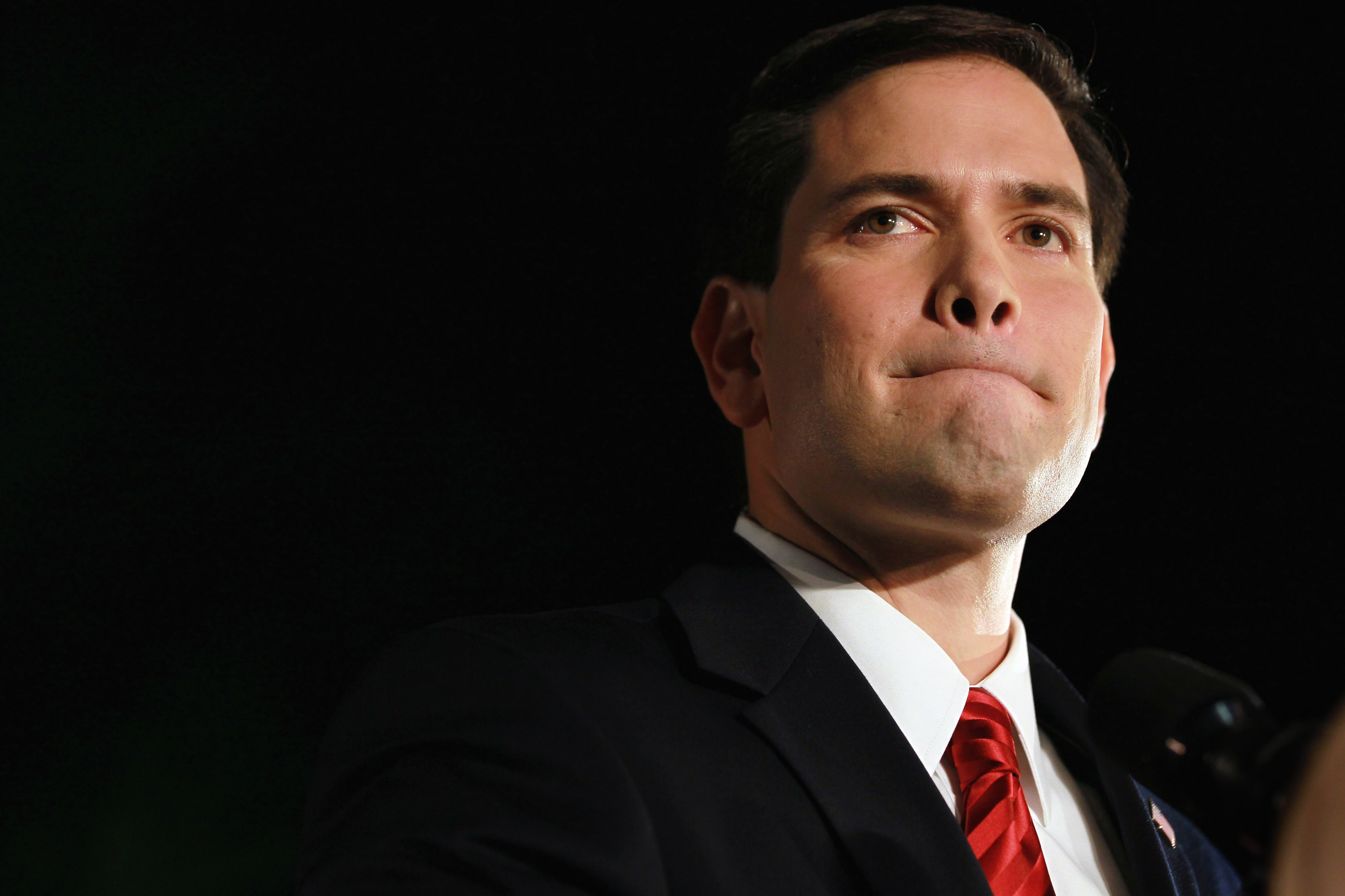
Rubio’s Pathetic, Exhausted, Vapid Response

Senate Candidate Marco Rubio Attends Election Night Event

In the reax below, I have to say I think Conor has it right. The question I have to ask is a simple one: could this speech have been given thirty years ago? Of course it could have. It was not a political speech; it was a recitation of doctrine, dedicated to Saint Ronald, guardian saint of airports. Here is an article of faith which is now so banal it does indeed sound, as Conor notes, like a song whose lyrics have become meaningless by repetition:

More government isn’t going to help you get ahead.  It’s going to hold you back. More government isn’t going to create more opportunities.  It’s going to limit them. And more government isn’t going to inspire new ideas, new businesses and new private sector jobs.  It’s going to create uncertainty.

Then this truism from the 1980s:

In order to balance our budget, the choice doesn’t have to be either higher taxes or dramatic benefit cuts for those in need.  Instead we should grow our economy so that we create new taxpayers, not new taxes, and so our government can afford to help those who truly cannot help themselves.

Wow. Never heard that before. And this utopian, Randian future:

If we can get the economy to grow at just 4 percent a year, it would create millions of middle class jobs. And it could reduce our deficits by almost $4 trillion dollars over the next decade. Tax increases can’t do this. Raising taxes won’t create private sector jobs.

They did in the 1990s. And cutting taxes irresponsibly in the 2000s reduced the rate of job growth. Nonetheless the dogma is in place, like some Animal Farm slogan: “Big government” is bad. “Small business” is good. And yet, Rubio, in the few instances when he mentioned specifics that might tackle actual problems, was in favor government action:

Helping the middle class grow will also require an education system that gives people the skills today’s jobs entail and the knowledge that tomorrow’s world will require. We need to incentivize local school districts to offer more advanced placement courses and more vocational and career training. We need to give all parents, especially the parents of children with special needs, the opportunity to send their children to the school of their choice. And because tuition costs have grown so fast, we need to change the way we pay for higher education. I believe in federal financial aid.

Is that not government? Yes, there were things that were dead-on and I’d prefer them to what Obama is offering. A simplified tax system? There are few indications Obama is interested. This I profoundly believe:

The truth is every problem can’t be solved by government. Many are caused by the moral breakdown in our society. And the answers to those challenges lie primarily in our families and our faiths, not our politicians.

But sadly, the speech was also full of lies, avoidance and misdirection. This one really pissed me off:

The President loves to blame the debt on President Bush. But President Obama created more debt in four years than his predecessor did in eight. The real cause of our debt is that our government has been spending 1 trillion dollars more than it takes in every year. That’s why we need a balanced budget amendment.

Seriously? A president who gave us two unfunded wars, massive tax cuts, and unfunded new entitlement in our biggest spending program, Medicare, in a period of growth was more fiscally prudent than a president who inherited a collapse in revenues to 60 year-lows because of the worst recession since the 1930s? And a balanced budget amendment, which in general I favor, would have been catastrophic in the last four years as demand was wiped out of the economy. For these statements to be true, you have to live in a sealed ideological universe that hasn’t changed since 1979.

On policies? No compromise on gun control. Immigration? Secure borders first. Growth? Drill, baby, drill – as if we haven’t. Climate change? “No matter how many job-killing laws we pass, our government can’t control the weather.” Please. Gay equality? Not a word. Foreign policy? Nothing on Afghanistan; nothing on what the last decade has taught us; nothing on drone warfare; nothing. No wonder the GOP has the lost its historical advantage on this topic.

Then this:

Presidents in both parties – from John F. Kennedy to Ronald Reagan – have known that our free enterprise economy is the source of our middle class prosperity.

But President Obama? He believes it’s the cause of our problems. That the economic downturn happened because our government didn’t tax enough, spend enough and control enough. And, therefore, as you heard tonight, his solution to virtually every problem we face is for Washington to tax more, borrow more and spend more.

This idea – that our problems were caused by a government that was too small – it’s just not true. In fact, a major cause of our recent downturn was a housing crisis created by reckless government policies.

This is unhinged. Obama has never said this, never given any indication that he believes this and has repeatedly said that the private sector is the engine of growth. And the recession was caused by government support for mortgages for low-income home-owners? Wall Street was a by-stander? This is a talk-radio talking point, not an analysis. And the sequester is now apparently an Obama policy, not just a short-term attempt to keep the government from a self-imposed credit crisis caused by nutball Republicans in 2011 that Obama wants to avoid.

We don’t have to raise taxes to avoid the President’s devastating cuts to our military.

Then there is this simple and obvious contradiction:

More government isn’t going to help you get ahead. It’s going to hold you back. More government isn’t going to create more opportunities. It’s going to limit them.

Only minutes later, he said this:

I believe in federal financial aid. I couldn’t have gone to college without it.

So does government help people get ahead? Or does it hold them back? Which one is it, Senator?

This was an intellectually exhausted speech that represents the intellectual bankruptcy of contemporary Republicanism. It was a series of Reaganite truisms that had a role to play in reinvigorating America after liberal over-reach in the 1960s and 1970s. It had precious little new in it. If reciting these platitudes in Spanish is what the GOP thinks will bring it back to anything faintly resembling political or intellectual relevance, they are more deluded than even I imagined.

(Photo: Photo by Joe Raedle/Getty Images.)

Debating The Minimum Wage

A reader quotes me from last night:

Does [Obama] believe that raising the minimum wage would have no impact on jobs growth? Does he believe it would actually increase employment and growth?

Here are three sources – 1, 2, 3 (pdf) -showing that changes in the minimum wage have little effect on employment, and the little effect they do have is actually a decrease in unemployment. While it seems like increasing labor costs would initiate layoffs, what actually happens is more money is available to spend, pay down debt, buy houses, etc., boosting the economy and overall demand a little. Small growth impacts then follow.

So yeah, I think President Obama probably does believe it will actually increase employment and growth. It may not be spectacular, but it gets more money in the hands of the working poor, and that’s a good thing.

Another agrees:

As far as the reason behind why raising the minimum wage could be beneficial: an employee rarely gets paid an amount equal to their production, period. And it basically never happens at the lowest rungs of employment. They get paid for the going price of their labor. Any sanely run company will – or should – hire based on the marginal value of that new employee. If that employee will produce more than he or she will earn, then hire up. The general difference between this added value and the labor market’s price for an employee largely contributes to profits. Those profits are then funneled to shareholders, and the amount that companies keep is invested or hoarded.

Workers earning minimum wage tend to face the fiercest competition for their jobs simply due to the vast number of people capable of fulfilling those positions, and I would argue that that competition drives the price of their labor well below their actual productive output, which is likely far higher than $9 an hour. So what a minimum wage increase would be is, essentially, decreased profits in the short term to lenders taxed at 15%. But longer term, think about it: lifting people out of poverty isn’t just feel-goodery, it will decrease the burden on the welfare state and reduce the deficit.

Additionally, individuals with lower incomes are significantly more likely to spend that newly additional income, either to pay for things they need (like food and shelter) or on things they desire as they begin to become more middle class (cars, TVs, etc). This sort of spending is the lifeblood of the economy. People can giddily invest in start-ups all they want, but it will all amount to wasted potential if less and less people can actually procure their goods and services. Think of it as a permanent stimulus with absolutely minimal government interference/pork and in order to be eligible you have to work.

One practical example: One of the few industrialized countries that is doing fairly well, Australia, has an unemployment rate of 5.4%. Their current minimum wage is about $13.50 in USD (about $16 Australian dollars). Granted, they only have about 22 million citizens, but a comparison to Australia – as opposed to European nanny-states – is probably a more likely model for what an America with higher minimum wage would look like.

Another points to further evidence along these lines:

The main point to realize is that jobs aren’t like tomatoes, where if the price goes up, people purchase less of them.  In fact, studies have found that increasing minimum wage at fast-food restaurants, for example, ends up increasing job stability, which in turn is good for the employer (it costs a lot of money to train newbies) and ends up saving them money.  In the meantime, of course, the working poor, because they have so many needs, spend their new-found money faster than any other group, which in turn, boosts overall consumer spending.

“Minimum Wages and Employment: A Case Study of the Fast-Food Industry in New Jersey and Pennsylvania” (pdf) is a landmark study published in 1994 by David Card and Alan Krueger in the American Economic Review examining employment at fast-food restaurants on both sides of the New Jersey-Pennsylvania border after New Jersey raised its minimum wage to $5.05 an hour while Pennsylvania’s minimum wage held constant. The authors conducted a phone survey of over 400 fast-food restaurants and found no evidence that the increase in the minimum wage in New Jersey led to job loss­. In fact they found that employment increased in fast-food restaurants in New Jersey. For this and related research, Card was awarded the John Bates Clark medal, ­the so-called “junior Nobel prize,” granted by the American Economics Association every two years to the best economist under forty.

See also this post, which updates that study.  Money quote:

Dube’s findings indicate that a higher minimumwage helps service retailers attract and retain employees, increasing their productivity. He said that a restaurateur, for example, is likely to reduce his employees when the wage goes up if only one restaurant raises their wage, but if most of them raise it, the added cost is passed on to the consumer who is likely to absorb it without decreasing their demand.

SOTU: Your Thoughts

Ouch. My objection is to ribbons. It’s all inclusive. I hated and still hate red ribbons for AIDS, for example. The fact that we gays started this lame tradition truly saddens me. But I know it’s a lost battle. We are all ribboned now.  I just wonder how they keep coming up with new colors for new causes. Will they have to go to paint charts soon? Still, it was a moment of dyspepsia, I concede. But I regard a blog as a right to occasional dyspepsia. Another reader writes:

The Sandy Hook ribbons aren’t just ribbons in honor of it. And they’re not lame. They were originally made for the teachers and administrators to wear to the funerals so they could be identified. They were noticed, so they were made by folks at the school, one of whom is friend of mine. One day they made 700. They are selling them to raise money for the school. It’s called the Sandy Hook angel project. They are $3 each. I’ll get you one.

I won’t wear it. But I can sure see the point of identifying the teachers and administrators. That is a signifier I could happily endorse. Just not Joe Biden, please. Or every other grandstanding pol. Another:

Here in Shelby County, Alabama, my son’s elementary school now has an armed guard standing outside each morning. This doesn’t make me feel safer. It’s simply a reminder of Newtown. Today, a man entered a local middle school and held several students hostage. Today. No, he didn’t have an assault rifle. He had a pistol. But can you imagine being one of those students?

Andrew, Newtown changed me. I have two small children – a son, 8, and daughter, 3. I’m a conservative in the Bible Belt, yet I feel like a noose is tightening on our kids due to our gun culture. And I really don’t know how it stops. I emailed my senator (for whom I voted), Richard Shelby, asking him to support an assault weapons ban. Of course, I got the standard “Thanks for writing. Here’s why I don’t support a ban” letter. I think of Newtown every time I see that guard. And I wonder which school is next.

On the core question of banning assault weapons and universal background checks, and much more aggressive ATF funding and regulation, I’m with you all the way. But as you point out, even that won’t stop these horrifying events, using mere pistols, just minimize the carnage. Another quotes me:

The passion, the reason, the sincerity: this was an invigorated president, trying to shift the mood away from zero-sum partisanship to non-zero-sum citizenship. It’s what we always hoped from him, and I think it places the Republicans in a horrible bind.

How are the Republicans in a horrible bind?

The number of Republicans in the Senate is still 45 and there’s no risk of their changing for another two years.  None of the emotion and the meaning of Obama’s speeches matters a bit unless somehow 5 of those 40 have suddenly changed their mind based on this speech.  That would be a shocking turn of events to say the least.

Republicans engaged in a policy of deep, nihilistic intransigence for four years.  When they began that policy they had 41 Senators, and now they have 45 (after a brief climb up to 47).  They had 178 representatives and now have 234 (afte a brief climb up to 242).  So is there anything in our politics that would suggest to the average Republican that they should change couse?  The Republican party is like a collection of spoiled children and until they get a sense that there will be real and dire consequences for them, they will not change how they behave.

While there’s certainly some long-term concern among Republicans over the demographic trends of the country, Republicans believe the best answer to that is trying to convince conservative Latinos that the Republican party has something to offer.  Beyond that, the Republicans are still firmly wedded to zero-sum partisanship and there is nothing that Obama said tonight that will change that.

I don’t disagree, but politics change tectonically. What Obama was doing last night was what I saw him doing a long time ago:

This guy is a liberal. Make no mistake about that. He may, in fact, be the most effective liberal advocate I’ve heard in my lifetime. As a conservative, I think he could be absolutely lethal to what’s left of the tradition of individualism, self-reliance, and small government that I find myself quixotically attached to. And as a simple observer, I really don’t see what’s stopping him from becoming the next president…

I fear he could do to conservatism what Reagan did to liberalism. And just as liberals deserved a shellacking in 1980, so do “conservatives” today.

What makes this more interesting is that events have made his case stronger since. The collapse of the Wall Street casino, the relentless rise in inequality, our crumbling infrastructure, the crippling cost of policing the entire globe: these changes makes Obama’s core vision more reasonable to conservatives like me who suspect government but believe there are times when we truly, desperately need it. Another reader’s take:

That was a very strong SOTU. The President has honed his presentation of what activist government should look like in the 21st century, and, amazingly, it actually rings more conservative than the bullshit being peddled by the so-called conservatives in the chamber. And the last segment of the speech, on voting and then gun violence, was incredibly powerful. I had a tear in my eye. I can’t believe Boehner wasn’t bawling … well, then again, there’s no telling what will make the Speaker break out in tears.

Rubio, on the other hand, gave a speech that clearly had nothing to do with the SOTU address that preceded it, which made it very flat and tone deaf. It was alternately condescendingly partisan and incredibly defensive. Surprisingly weak. We know which of these two is the Alpha Male in American politics today.

What did Rubio say last night that could not have been said by a conservative Republican in 1980? It was a recitation of dogma, not a response to the actual contingent problems we face. Another notes:

The amusing thing about that Ted Nugent photo is who he was sitting next to: Thomas Lauderdale, the founder and band leader of Portland-based Pink Martini. Based on Nugent’s uncomfortable posture, I think he figured out that Lauderdale is also gay.

SOTU: Tweet Reax

US-POLITICS-STATE OF THE UNION-OBAMA

(There is a glitch in the formatting of the tweets after the jump, so click here to view the whole reax in the proper format.)

GIF of the exploding fist-bump here.

(Top photo: Rock musician and gun rights activist Ted Nugent listens to US President Barack Obama deliver his State of the Union address before a joint session of Congress on February 12, 2013 at the US Capitol in Washington. By Mandel Ngan/AFP/Getty Images)

Live-Blogging The State Of The Union

President Obama Delivers State Of The Union Address

10.12 pm. Now we’re really into Reagan territory. The 102 year-old is pretty damn amazing. And, yes, it is a national scandal that she had to wait six hours to vote. Then a heroic cop. “That’s just the way we’re made.” I have to say that even to these jaundiced ears, that peroration moved me. The passion, the reason, the sincerity: this was an invigorated president, trying to shift the mood away from zero-sum partisanship to non-zero-sum citizenship. It’s what we always hoped from him, and I think it places the Republicans in a horrible bind. Are they going to prevent a vote on guns? Are they going to refuse Bowles-Simpson Medicare reform? Are they willing to force a sequester rather than cooperate with this popular president? Does the Speaker not appreciate a 102 year-old getting to vote? Why did he stay seated? I have a feeling that moment will strike people.

Meep meep.

10.08 pm. He’s ending on Newtown. Ticking off the majority’s support for background checks, citing the support of the police for ending weapons of grotesque destruction. A thousand gun-deaths since Newtown. And then the emotional power/blackmail of the parents of a little girl culled by a gun. “They deserve a vote” is a great line.

10.05 pm. “Families, gay and straight.” The confidence with which he now routinely includes gay people among his public statements is truly remarkable. It’s as if he’s been liberated to champion this civil rights movement, which he has done more than any president to advance and legitimize.

10.02 pm. A personal note of thanks for using the words Rangoon and Burma. Then the Arab Spring: it will be messy, we cannot control events, but we should back freedom. Pretty much: stay out of the way. A minor note on Israel: emphasizing security and a “just peace.”

9.54 pm. This is now the goal of the Afghanistan war: destroying the “core of al Qaeda.” But the promise is the withdrawal. The leaked 34,000 troop withdrawal was correct. Again, this was, remember, why he was elected – because he resisted the pro-war consensus in Washington. He’s ruling out ground invasions. And then a vague commitment for greater Congressional control and scrutiny – with no judicial element. Somewhat disappointing. And he sure sounds like he’s not backing down on drone warfare – or unilateral presidential war-making.

9.51 pm. I wasn’t aware – and should have been – that the minimum wage for a family of four is $14,000. But I’m surprised by the unapologetic liberalism there. Does he believe that raising the minimum wage would have no impact on jobs growth? Does he believe it would actually increase employment and growth?

9.48 pm. A tough line on immigration reform. But the real ovation came from expanding legal immigration. Still, the rhetoric again was not partisan, and included GOP talking points.

9.41 pm. People have been talking about Obama’s new swagger and self-confidence. I can see that in this speech, but I don’t see an aggressive partisan attack. He has consistently mentioned bipartisan initiatives; he has endorsed major tax reform as a way to avoid the sequester; he’s now onto one of the most critical issues in America today: the lack of good pre-K education.

9.38 pm. So he’s for more energy investment but with added research into cleaner emissions. And then what strikes me as pretty banal but has become somewhat partisan: rebuilding bridges and roads and infrastructure and Internet.

9.35 pm. I’m genuinely surprised that he’s put climate change so early and so emphatically. Tow valentines to McCain, I note. One a handshake at the start and now a tip to McCain’s previous proposal for cap and trade. I wish I believed it could truly work.

9.34 pm. Now he’s emphasizing investments in science. He’s speaking as if the crisis is over and morning in America is coming. By the way, the green ribbons are in honor of Sandy Hook. Lame.

9.33 pm. This is an optimistic speech, gaining momentum as it goes along. Then a nod to Clinton: not a bigger government, but a smarter one.

9.30 pm. Deficit reduction is important – just not as important as investing in the middle class. Krugman must be happy.

9.28 pm. He’s on a roll now, lambasting the fiscal brinksmanship of the last several years.

9.24 pm. He’s backing the Bowles-Simpson commission’s goals on Medicare over the next decade – that strikes me as a big concession.

And then he says “we must keep the promises we’ve already made.” I’m getting a little whiplash. But now we’re getting to comprehensive, bipartisan tax reform. Is this a late modification of Bowles-Simpson – with more populism and energy?

9.22 pm. And we’re right into the sequester – “a really bad idea”. But he prefers it to cutting entitlements while leaving the Pentagon alone. A pretty lame adjective for the fiscal crisis in Medicare: modest adjustments.

9.20 pm. Biden stands up for “country before party”. Boehner stays in his chair.

9.19 pm. “A rising, thriving middle class”: that’s becoming the theme of his presidency. Notice too the little inclusion of gay love.

9.16 pm. A unifying start, quoting Kennedy, and then a reminder of why he became president in the first place: ending the Bush-Cheney wars.

9.15 pm. What is that weird ribbon on Biden’s lapel?

How Benedict Just Revolutionized The Papacy

Ross today worried about the theological consequences of a papal resignation. It does subtly shift the theology of the office – for the better, I’d say. The way in which the papacy and the clerical state as a whole had begun to assume almost super-human capacities in the heretical mind of some undoubtedly contributed to the child-rape conspiracy over which Benedict presided. Underscoring a possibility the Dish noted yesterday, Alexander Still holds out the hope that, whatever conspiracy theories are proffered, “the Pope is making a clear-eyed decision based on a desire to spare the Church, and himself, the full cost of what may be a long, slow decline toward death”:

Predictably, for an institution in which one is expected to die in office, there is a long tradition of electing elderly Popes. Ambitious younger cardinals have sometimes pushed the candidacy of this or that septuagenarian in the hopes of occupying the throne of Saint Peter in a few years’ time. Electing a young and vigorous Pope who governs for an entire generation—as in the case of Karol Wojtyla, who was fifty-eight when he became John Paul II—carries a considerable risk: that of allowing a hugely important and highly diverse planetary institution to gradually bear the personal stamp of one man. The election of Benedict XVI, then Joseph Ratzinger, at age seventy-eight expressed a desire for continuing the Wojtyla legacy (since Ratzinger had been one of John Paul II’s key advisers) as well as a wish to avoid another twenty-eight-year papacy. And yet his brief and often controversial reign shows the risks of electing an elderly man more than ten years past the normal age of retirement as Pope.

Seen in this light, Benedict’s decision to step down may suggest an effort at finding a third way. By setting a precedent for papal resignation, it offers the possibility of choosing someone closer to the prime of life who may not need to reign into full senescence.

Similarly, in a really helpful primer on the historical backdrop to Benedict’s abdication, Kevin White emphasizes that the Pope consciously may be trying to revolutionize the future of the office:

The better frame for today’s events is that they are precedent-setting. It remains to be seen, in future years, if Benedict’s successors will follow his example. But Benedict may have just established a new, and revolutionary, norm for holding the papal office. It affirms that the pope is not primarily a personality, or a gifted human being, but an officeholder who serves for the good of the Roman Catholic Church.

Potentially, this could serve to reduce the personality-driven, almost celebrity-like attitude towards the papacy that developed among many under John Paul II. The office remains the same, but this practice could emphasize that the man holding it is simply the recipient of a sacred, but temporary, trust.

John Paul II’s legacy as a super-star was not, in my view, good for the institution as a whole. David Gibson adds:

[A] graceful exit could also be Benedict’s lasting legacy precisely because this most traditional of churchmen has, with his simple decision, effectively altered the meaning of the papacy.

“Benedict’s resignation helps refine the notion of the papacy and, thanks be to God, distinguishes the person from the office,” Terence Tilley, a theologian at Fordham University and past president of the Catholic Theological Society of America, wrote in a discussion of Benedict’s resignation at the blog of Commonweal, a leading Catholic magazine…

There is still the potential for this move to become another left-right battle in the church. Liberals could welcome this reimagining of the papacy as a way of demystifying the job and perhaps pointing toward a less papal, more collegial form of church governance. Conservatives could fear the same thing.

And perhaps especially telling on this front is what the fate of Benedict’s Twitter account might confirm about the above speculations:

[W]hen the Vatican was choosing a handle for the pope, @benedictusppxvi was considered and rejected in favor of the more general, less personal @pontifex. This would seem to indicate the Twitter handle is attached to the office, not the man. Additionally, though Benedict personally composed his first tweet on an iPad on Dec. 12 (not without technical difficulty), most of the tweets from his account have been composed by aides. Therefore, it’s likely that control of the Twitter account will remain with the Vatican rather than with Benedict.

All About Israel

The Christianist extremist, James Inhofe, is now trying to block the Hagel nomination by a war of attrition:

“Hagel may be passed out of the committee, but it’s going to be a long, long time before he hits the floor,” Inhofe says. “We’re going to need as much time as possible, and there are going to be several of us who will have holds.”

Butters has also gone nutters on the same theme, although he is the last Republican Senator who seems to think Benghazi is somehow Watergate. But one wonders exactly what is really behind this truly unprecedented hostility to a Republican former Senator war hero. Inhofe is admirably frank:

“Each day that goes by will make it more difficult for Democrats who say they are pro-Israel to hold out,” Inhofe explains. “I want everyone to be very clear about his past statements and his positions.” … Inhofe’s main concern remains Hagel’s position on Israel. “The anti-Israel history of Chuck Hagel is real,” he says. “We can’t have someone at the Pentagon who has made these kind of statements.” Hagel’s financial-disclosure issues, he adds, are not central to why he’s working to postpone the nomination. “That doesn’t bother me,” he says. “To me, that’s minor.”

To understand where he is coming from, you have to understand Christian fundamentalism. Here’s an extract from a 2002 speech when Inhofe explained why Greater Israel deserves to expand:

I believe very strongly that we ought to support Israel; that it has a right to the land. This is the most important reason: Because God said so. As I said a minute ago, look it up in the Book of Genesis. It is right up there on the desk. In Genesis 13:14–17, the Bible says:

The Lord said to Abraham, “Lift up now your eyes, and look from the place where you are northward, and southward, and eastward and westward: for all the land which you see, to you will I give it, and to your seed forever. . . . Arise, walk through the land in the length of it and in the breadth of it; for I will give it to thee.” That is God talking.

The Bible says that Abraham removed his tent and came and dwelt in the plain of Mamre, which is in Hebron, and built there an altar before the Lord. Hebron is in the West Bank. It is at this place where God appeared to Abram and said, “I am giving you this land — the West Bank”. This is not a political battle at all. It is a contest over whether or not the word of God is true.

When I’m told I exaggerate the influence of fundamentalism in American politics, it’s worth remembering that quote. This is not the foreign policy of a nation state; it’s the religious dictates of a religion. And it is currently preventing this country from having a secretary of defense.