The Other Ukraine Votes

Close on the heels of a parliamentary election that handed a decisive victory to pro-Europe parties, separatist rebels held elections of their own this weekend in the “people’s republics” of Donetsk and Luhansk:

Election organizers declared that rebel leaders Alexander Zakharchenko and Igor Plotnitsky won sizable majorities in Donetsk and Luhansk respectively, reports Radio Free Europe. Both men have led rebel groups in the fight against the Ukrainian government in Kiev. But the elections have been controversial from the start, with Kiev and Western powers calling them a violation of a peace agreement drawn up in Minsk, Belarus, in early September. Under the Minsk agreement, Kiev would enact legislation that would grant Donetsk and Luhansk considerable autonomy, but under the auspices of Ukrainian law. Sunday’s elections do not comply with Ukrainian law, Kiev argues, and are therefore illegal.

Russia, predictably, endorsed the elections as legitimate today. Bershidsky notes just what a farce they were:

In Donetsk and Luhansk, people bring submachine guns to restaurants and polling stations alike. Since the rebels did not have access to electoral rolls, it was laughably easy to register as a voter. One woman apparently filled in the requisite questionnaires for a cow, putting down “Ear Tag MOO-123321, issued on 01.01.1998 by shepherd Semyon Ivanovich,” as identifying document, and received a number allowing her to cast a vote online. When the OSCE refused to observe the elections, a group calling itself the Association (or Agency, to hear its different members talk) for Security and Cooperation in Europe popped up conveniently and gave a press conference in Donetsk, praising the votes. The delegation consisted of far-right politicians from Austria, Belgium, Italy, France and several eastern European nations, as well as two Greek Stalinists.

But Linda Kinstler isn’t laughing:

The rebels, of course, claim that the elections were entirely legal under the provisions of the Minsk agreement. “It was said there [in the Minsk protocol] that we have the right to hold our own elections. The date was not specified,” Zakharchenko said on Sunday, RIA Novosti reports. It is abundantly evident that the Ukrainians had no plan for how exactly “early local elections in accordance with the Law of Ukraine” could possibly be held in rebel territory, just like it is also painfully clear that the government has no plan for how that territory will ever be re-integrated into the rest of the country.

Glenn Kates worries that the vote will embolden the separatists to escalate their conflict with Kiev:

Large swaths of separatist-controlled eastern Ukraine both blame Kyiv for the violence and hope their votes will bring stability to the region. But for the self-proclaimed separatist leadership and their backers in Moscow these two thoughts may paradoxically be a signal to continue fighting. Ukraine is unlikely to restore pension payments or energy provisions, which were cut off in the summer. Meanwhile, separatists will now have to back up the claims that they can govern without Kyiv by providing some of the resources that have been so sorely lacking. If claiming territories is seen as a way to do so and they believe any violence will be blamed on Kyiv, fighting, in a purely political sense, may not have a downside.

Sebastian Smith weighs Kiev’s options for dealing with the separatists at this point. As he sees it, the government can either choose to write off the breakaway regions and let them be Russia’s problem, or wage a costly war to restore control over them. Neither option is terribly palatable to Ukrainians:

Not many Ukrainians are ready for all-out war, says Glib Vyshlinsky, deputy director of GfK Ukraine marketing company in Kiev. “If you’re talking about fighting, with thousands of casualties being lost in order to win back these regions, then there is not support. Ukrainians are not such an imperial people as Russians and consensus will be against this,” he said. …

A GfK poll in September showed that 31 percent support a “bad peace,” including giving up some territory to Russia. Fifty four percent were for fighting on. One concrete sign that Ukraine’s government is preparing to sever at least some ties with the east is the suggestion from top ranking officials in recent days that gas supplies may be ended to rebel territories — which would turn to Russia for help. “Those announcements are trial balloons to test Russia,” said Taras Berezovets, head of Berta Communications in Kiev. “Russia doesn’t want to have to pay for Donbass.”
Operation Strategic Trolling

NATO reported an “unusual burst of activity” by Russia’s nuclear-capable strategic bombers on its borders this week. While none of the flights violated NATO airspace, they are emblematic of the increasing tensions in Europe over the conflict in Ukraine:

In all, Nato said, its jets intercepted four groups of Russian aircraft in about 24 hours since Tuesday and some were still on manoeuvres late on Wednesday afternoon. “These sizeable Russian flights represent an unusual level of air activity over European air space,” the alliance said. A spokesman stressed there had been no violation of Nato air space, unlike a week earlier when a Russian spy plane briefly crossed Estonia’s border. But so many sorties in one day was unusual compared with recent years. … Nato said it had conducted more than 100 such intercepts of Russian aircraft this year so far, about three times as many as in 2013 before the confrontation with Moscow over separatist revolts in Ukraine soured relations.

Elias Groll adds:

Last month, Estonia accused Russia of kidnapping an Estonian intelligence agent. Swedish defense officials now speak of a fundamentally altered security paradigm in the Baltic after Russian planes carried out a mock bombing of Stockholm and violated Swedish airspace in the region.

Groll says such actions “bring relations between Moscow and the West to their lowest point since the end of the Cold War.” Marc Champion also finds that “a version of the Cold War is returning, but its rules and parameters aren’t clear”:

A defining aspect of the Cold War was that, for the most part, deterrence kept each side from meddling in the other’s sphere: The U.S. and NATO stood by during the uprisings in Hungary in 1956 and Czechoslovakia in 1968. Putin wants a similar kind of tacit agreement with the U.S. now. … So Putin may see testing NATO as a form of shoe-banging. The danger of this new Cold War is that there is complete disagreement between Russia on one side and the U.S. and European Union on the other as to the dividing lines are and the rules of the game.

Dave Majumdar solicits the opinions of some military experts, who see the Kremlin pushing NATO’s buttons but probably not rehearsing a nuclear attack:

Analyst Rebecca Grant, president of IRIS Independent Research, said that the recent display of Russian air power was just another provocation in a long line of similar antagonistic moves by Russia. The Russian strategic bomber foray into the Atlantic is also reminiscent of a September incident where two nuclear-capable Tu-95s bombers, two Il-78 tankers and two MiG-31 Foxhound fighters were intercepted near Alaska.

“This reminds me of the exercises Russia has been flying in the Pacific for a few years now, just transferred to the European theater,” Grant said. “I don’t read this as a specific nuclear or conventional scenario practice, rather an exercise in long-range navigation and provocation. It’s clearly designed to annoy NATO but from a purely tactical perspective, this was still a pretty small display of airpower.”

In these circumstances, Keating worries less about deliberate acts of war and more about accidents:

This doesn’t necessarily mean Russia is preparing for war, and open conflict between Russia and NATO countries still seems pretty unlikely. It probably has more to do with Russia seeing how much it can get away with, and making it clear that it disapproves of Europe’s pro-Ukraine stance. But as June’s shootdown of a Malaysian airliner demonstrated, tragedies can happen when there are itchy fingers on the triggers of anti-aircraft missiles.

Ukraine Is Still A Mess

Adam Chandler highlights a UN report revealing that at least 331 people have been killed in the Ukrainian conflict since the signing of a ceasefire on September 5:

“There is a total breakdown of law and order,” said Gianni Magazzeni, the United Nations human rights official who announced the release of the report in Geneva. Over the past month, grim developments have included the shelling of schools and city buses, the gutting of villages, the fierce battles for control of Donetsk’s Sergei Prokofiev Airport, and startling lists of locals who are believed to either be missing or held captive by pro-Russian rebels. An early October report estimated that nearly 400,000 Ukrainians are internally displaced, part of a seven-figure estimate for the total number of Ukrainians who have been displaced.

While the latest violence has largely been limited to the exchange of small-arms fire—a shift from this summer’s large-scale military offensives, which drove up death tolls and ultimately forced the warring sides to negotiate—there’s been little letup in fighting over the past month.

With a battle raging between Ukrainian and rebel forces over the Donetsk airport, the ceasefire appears to be going off the rails entirely, threatening to take the upcoming parliamentary elections with it:

As the shaky cease-fire has failed to quell the most intensive fighting in and around Donetsk, government officials fear the separatists are regrouping for a fresh offensive to take Mariupol and the rest of the seaside corridor that would connect mainland Russia with the Crimean peninsula that the Kremlin seized and annexed seven months ago.

Ukraine has scheduled parliamentary elections for Oct. 26, and the Moscow-backed separatists are suspected of aiming to control enough Ukrainian territory by then to prevent voting in the areas they hold in order to undermine the legitimacy of the election. Although hundreds of thousands of eastern Ukraine residents have fled the fighting, the Crimea, Donetsk and Luhansk regions were home to 8.5 million before the conflict, representing about 18% of the country’s population.

The Interpreter underscores a series of unsettling surveys showing that 70 percent of Ukrainians believe they are at war with Russia, while nearly 50 percent want the country to become a nuclear power again. At the same time, western Ukrainians are getting tired of supporting the hundreds of thousands of people displaced by the fighting:

Attitudes toward IDPs in Ukraine appear to have shifted since the onset of the conflict pitting government forces against pro-Russian separatists in the country’s east. As displaced families continue to stream westward, the initial outpouring of solidarity — which once saw residents extend free accommodation to IDPs — is slowly giving way to impatience and distrust. “You can often see ads that say ‘Flat for rent, people from Donetsk, Luhansk, and Africa please abstain,'” says Ivan Kudoyar, a real estate lawyer in Kyiv.

Things like this aren’t just happening in Kyiv. Anastasia, a young woman who fled Donetsk two weeks ago, says she’s losing hope of finding a flat to rent in the western city of Lviv. “The main obstacle I’ve encountered during my search is my Donetsk registration,” she says. “I meet with the landlord, we agree on the rent, then he looks into my passport and says ‘Sorry, this is a matter of principle.”

The Geopolitics Of Slightly Cheaper Oil

Looking over Russia’s budget for the coming year, Callum Williams observes how many of its assumptions depend on oil prices remaining pretty high:

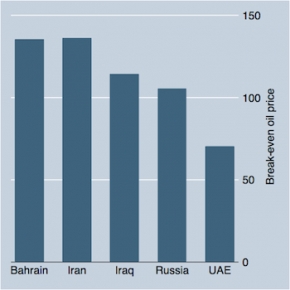
graph_3In 2015 Russia will need an oil price of about $105 a barrel to balance its budget (see chart). But crude is currently trading in the mid-$90s, down by about 10% since May. Weak demand from China and healthy supply from America help explain the drop.

Lower dollar-denominated oil prices are not so bad for Russia, given that the rouble has weakened so much. But over the past few years the budget’s reliance on oil revenues has increased. When excluding oil, there was a shortfall of 3.6% of GDP in 2007, but now it is more like 10%. Russia expects to run a small budget deficit (about 0.6% of GDP) this year. That prediction is optimistic—the Kremlin is banking on an oil price of $100. The latest predictions from Energy Aspects, a consultancy, show that the price of Brent is not expected to pass $100 for about nine months.

Steven Mufson details how the dip in demand and surge in US production is bad news not only for Russia, but Iran as well:

Crude oil and oil products made up 46 percent of Russia’s budget revenues in the first eight months of this year. At a time when the West is trying to sanction Russia for its incursions in Ukraine, a 10 to 20 percent drop in oil prices could prove powerful. Still, it’s still a far cry from the 1980s, when Saudi Arabia produced enough oil to flood the market and drive prices down so far that many experts say it sped up the fall of the Soviet Union. That’s not going to happen now, but Russia could be squeezed a bit.

Iran, whose oil exports are limited by sanctions related to its refusal to limit its nuclear program and open it up to greater international scrutiny, will also suffer a setback. Iran’s oil minister Bijan Namdar Zangeneh late last month called on the Organization of the Petroleum Exporting Countries to keep oil prices from falling any further. “Given the downward trend of the oil prices, the OPEC members should make efforts to offset their production to keep the prices from further instability,” Zangeneh said according to Shana, a news agency supported by Iran’s oil ministry.

But according to Keith Johnson, the other Gulf petrostates are much less vulnerable:

“In the short term, the Saudis are the last ones who need to worry. They can sit it out for a couple of years, even with oil below $90,” said Laura El-Katiri, a research fellow at the Oxford Institute for Energy Studies. Other Gulf states, such as Kuwait and the United Arab Emirates, can also resort to deficits or spending tweaks to weather a price storm, she said. That may partly explain the deaf ears turned by Saudi Arabia and other big OPEC members to Iran’s pleas. Of the big producers, Iran by far requires the highest prices to remain fiscally sound, by some estimates as much as $130 a barrel. Further, Iran has been hammered by Western sanctions that have cut its oil exports — and earnings — almost in half.

Yet Saudi Arabia, still the world’s swing oil producer and a visceral opponent of Shiite Iran, has little interest in slashing output. Quite the contrary: Saudi Arabia on Wednesday suddenly started offering discounts to maintain its market share, even if it undermines overall crude prices.

Whither Now, Ukraine?

Michael Weiss’s overview of the situation in Ukraine today touches on several salient topics—corruption, nationalism, the economy, Russia—and is worth a full read. Here, he addresses the law the Ukrainian parliament passed this week granting a measure of autonomy to the country’s eastern regions:

There are already signs that Ukraine and Russia will interpret it differently. The Russian Foreign Ministry, for instance, said in a statement that the law grants the “development in certain regional districts of cross-border cooperation designed to deepen good-neighborly relations with the Russian Federation’s administrative and territorial units,” which is a pretty way of describing a breakaway autonomous zone removed in all but name from the central authority in Kiev. … For their part, the Ukrainians who elected Poroshenko largely on his campaign promise to ensure the territorial integrity of their country fear that this deal is another kind of sellout: the de facto ceding of the Donbass to Russia, or the perpetuation of an occupation in all but name. This is why protests objecting to the special status law have recently erupted outside the Rada.

“The mood at the ministry, specifically with the new foreign minister and his team, is to get it over with,” a Ukrainian diplomat told me, referring to a then-nascent cease-fire agreement. “There is one fear that we will have a new Transnistria. The other is that [the war] goes on indefinitely. The first is more awful.”

Alexander Motyl, however, argues that a frozen conflict “will actually be to Ukraine’s benefit”:

The [Donbas] enclave, which is where much of the region’s population and industry were concentrated, is in ruins. Hundreds of thousands of middle-class professionals have fled and will not return. Industry is shrinking. Infrastructure has collapsed. All these negative tendencies will accelerate, as Putin’s terrorist proxies, remnants of the (formerly ruling) Party of Regions and the Communist Party, the Kremlin, the Donbas oligarch Rinat Akhmetov, and the Russian Orthodox Church duke it out over influence. In a word, the Donbas enclave is finished, and, as deindustrialization continues, depopulation will proceed apace. Whoever inherits the mess caused by Putin and his proxies will have a ball and chain on his leg. Fortunately for Ukraine, it doesn’t—and in all likelihood will not anytime soon—control the enclave. Rightly or wrongly, justly or unjustly, legally or illegally, the burden of control, and the burden of governance, will fall on Putin. Bully for him. The day is not far off when the economic disaster that is the Crimea and the Donbas will burden Putin, and he will be hard-pressed to claim that his imperialism has served Russia well.

Chrystia Freedland warns against complacency now that the conflict has been, as it were, settled. After all, she writes, we still don’t know what Putin’s endgame is:

[W]e need to be careful not to confuse what we want with what we have. If Poroshenko’s wager pays out, we will be tempted to forget about Ukraine, as we forgot about Georgia after the hot summer of 2008. That would be a mistake. Putin won’t forget. And even if this compromise holds, his actions have shattered the European security order. With the annexation of Crimea and the invasion of eastern Ukraine, Putin has unilaterally declared himself to be above the rules of the post-1991 international system. He hasn’t yet told us what new rules he considers himself bound by. The post-Soviet peace is over: Whatever happens next week, next month or next year in the Donbass—the densely populated area of eastern Ukraine that Putin is seeking to dominate—this fundamental question will remain open.

Adrian Karatnycky argues that Mitt Romney was right in the 2012 presidential debate when he called Russia our greatest geopolitical threat:

A Russian occupation of large parts of Ukraine would clearly threaten the stability and security of our NATO allies on Ukraine’s western border. Further, Ukraine is home to three gigantic nuclear power plant complexes, which could become dangerous battlegrounds with unpredictable consequences for nuclear safety. War could disrupt or destroy Ukraine’s energy pipeline network, which is the central mechanism through which more than half of Russia’s exports of gas and oil to Europe travels. Successful Russian expansion into Ukraine would increase the chances of further adventurism in energy-rich Kazakhstan, where an elderly President will soon physically fade from power. And Russia would be emboldened to exert even stronger influence over the policies of energy-rich Turkmenistan. Would these developments not be as significant in impact as the fate of Saudi, Iraqi, and Qatari oil and gas reserves?

And what of recent, aggressive Russian canards about the alleged mistreatment of ethnic Russians in the Baltic NATO states? Would an aggressive and expansionist Russia not be more be willing to launch new efforts to threaten those states, engaging our Article 5 NATO treaty obligations to directly enter into military operations?

Ukrainian President Petro Poroshenko certainly encouraged that kind of thinking in his address to the US Congress this morning:

To roaring applause and whooping cheers, the Ukrainian candy mogul-turned politician likened Ukraine’s struggle against Moscow to a global battle for the preservation of the post-World War II international order. “Democracies must support each other,” he said. “Otherwise they will be eliminated, one by one.” … Poroshenko, clearly afraid that the Russian aid has already decisively turned the tide, implored politicians to stand up to Russia.

“Blankets and night-vision goggles are important. But one cannot win a war with blankets!” Poroshenko said, raising his voice for emphasis. “I understand that American citizens and taxpayers want peace, not war … However, there are moments in history, whose importance cannot be measured solely in percentages of GDP growth.”

The Great “Unraveling”?

[Re-posted from earlier today.]

I’m a huge admirer of Roger Cohen’s writing – and can appreciate many of the thoughts percolating in his latest column on what he sees as a disintegration of the world order. He manages to cite Scottish independence, the rise of ISIS, and the devolved powers to Eastern Ukraine – and even Ebola! – as part of a trend toward dissolution and anarchy.

But when I look at all the developments he is citing, I don’t really see anything that new. Take Iraq – please. What we are witnessing is the second major Sunni revolt since they were summarily deposed from power by the United States in 2003. How is this new? The Sunnis have long since believed in their bones that Iraq is theirs by right to govern. They despise the Shiites now running the show. The entire construct Syria_and_Iraq_2014-onward_War_mapof Iraq in the first place was designed on the premise of permanent Sunni rule over the majority. That rule necessarily had to be despotic – as all attempts to permanently deny rights to a majority in the country must be.

So we removed the despot – as we did in Libya – and we have an ongoing power-struggle that is a continuation of the same power struggle Iraq has been hosting since time immemorial. I mean look at that map on the right, from Wiki on the current division of power and land in Iraq. Does it look familiar? It looks like every map of Iraq’s sectarian divide since time immemorial. And we think we will change that by air-strikes?

My fear is that the catastrophic error of 2003 will never lead to a stable state, because the Sunnis will never tolerate or trust majority Shiite rule. Yes, we bribed them enough to switch sides temporarily in the “surge”. But they knew we’d leave; and they knew what they had to do when we did. The only conceivable way to avoid such a scenario would be to stay in Iraq indefinitely – but that too is untenable, for both the Iraqis and for us.

The Beltway nonetheless decided – against all the evidence – that the surge had worked, that sectarian passions had subsided, and that a multi-sectarian government would be able to overcome the profound rifts in Iraqi society that have always been embedded in its DNA. We were sold a bill of goods – by Petraeus and McCain and the other benign imperialists. They have spun a narrative that Iraq was “solved” in 2009 – and that the absence of US troops led to subsequent failure. But they flatter themselves. We never had any real reason to believe these sectarian divides had been overcome – and after a decade of brutal and traumatizing mutual slaughter, why on earth would they be?

Iraq was unraveled in 2003; in my view, it has thereby become the battle-ground for the simmering, wider Sunni-Shiite civil conflict that has also been a long-running strain in the region. Our own solipsistic focus on ISIS as another al Qaeda against us – again the narrative of the utterly unreconstructed neocon right and the pious interventionist left – misses this simple fact. We cannot see the forest for our own narcissistic tree.

When you look at Russia and Ukraine from the same historical perspective, the unraveling meme also seems unpersuasive. Russia is a proud and ornery and mysterious country. It has gone from global super-power to regional neo-fascist state in a matter of decades. Its sphere of influence has retreated from the edge of Berlin to the boundaries of Ukraine, which it simply controlled for an extremely long time.

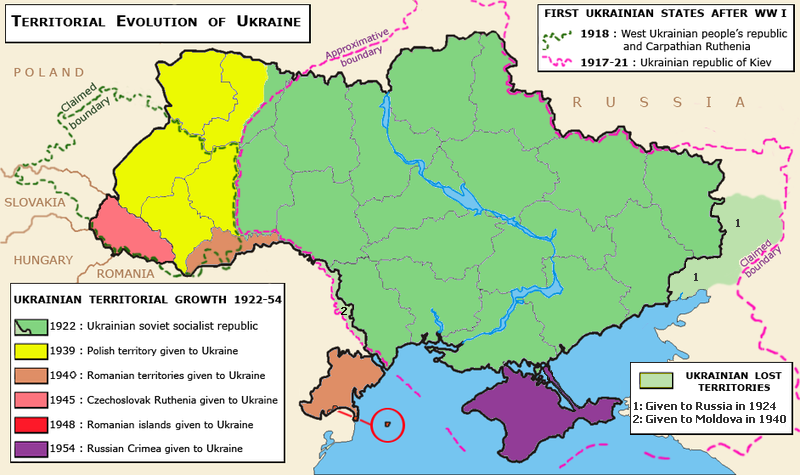
Ukraine has never existed as an independent country for very long; as you can see from another Wiki map on the left, it is itself a cobbled together mix of land lost to Russia, gained from Poland and Czechoslovakia and Romania. It was “given” the Crimea by the Soviets only in 1954. And throughout, Russia has obviously been its big brother, with a deep belief in its right to dick around with its near-abroad (a similar historic belief to the Sunnis faith in their own right to rule).

Ukraine-growthAnd what is sometimes lost in all this is that the last pro-Russian leader of the country was democratically elected and then deposed by a revolution from the European-centered populations of the West of the country. Russia did not start this; it reacted to a sudden, revolutionary loss of a pliant neighbor. Anyone with any inkling of Russian history would know what would happen next. I’m not defending Putin’s military and pseudo-military aggression. I am saying that the resolution reached this week – with significant autonomy for the Eastern, Russian-speaking provinces together with a new trade pact with the EU is a perfectly logical way to resolve this. And if Scotland demands outright independence, who could deny the East Ukrainians for wanting more autonomy?

Then Scotland. I don’t know what will happen – and, yes, the term “unraveling” is the most apposite in this case. But what the campaign has shown is that the unraveling has already taken place, that the desire for self-government and the disdain for the Westminster elites have combined to make the current arrangement anachronistic. But that kind of change – conducted democratically and peacefully – is not the same thing as an undoing. It is an adjustment to an emergent, new reality. And it increases democracy in the UK, rather than diminishing it.

What I’m saying is that America is in great danger of over-reacting to all these things, and blundering into new errors because of a generalized anxiety about declining relative US power, and PTSD from 9/11 in which every Jihadist in a hummer with a knife and a social media presence is imminently going to come over here and slit our collective throats. So my “hysteria” about this new, unknowable, fast-escalating rush to war is actually the opposite. It’s really a call to calm down, to breathe deeply, to stop reacting to the news cycle like neurotic lab-rats and to remember history – ours and theirs.  And to carry on.

I thought Obama was the man to sell this message. But he has been overwhelmed by the collective freak-out. Maybe he’ll regain his composure, keep this war limited and contain these loons for others, with much more at stake, to fight. Or maybe American amnesia will take hold again – and the Jacksonian impulse will once again trump every rational attempt at a foreign policy that isn’t always doomed to repeat the errors of the past. From the way things are going, it’s America’s own history of Jacksonian violence against outsiders that will prevail. We believe we are immune from history – that it can be erased, that what matters is just the latest news cycle and the political spin that can be applied to it. But history will have – and is having – the last word.

Ukraine Splits The Difference

The Ukrainian parliament had two big items on its agenda today:

In a vote synchronized with the European Parliament in Strasbourg, Ukrainian lawmakers unanimously approved the association pact over objections from Russia, which fears the loss of a market for its goods and damage to its economy from an influx of European products through Ukraine. … Earlier Tuesday, legislators voted behind closed doors to approve two bills granting amnesty to rebels and greater autonomy for eastern regions as part of an effort to consolidate a tenuous Sept. 5 cease-fire and end the fighting in eastern Ukraine. The decision on Tuesday to enshrine in law an amnesty and a framework for self-rule in the east represented a major concession to Russia that in many ways gave the Kremlin what it had been seeking since early in the conflict, long before the violence broadened and thousands died.

Bershidsky doubts Ukrainians will thank Poroshenko for this:

That, in effect, is Ukraine’s signature under the creation of a frozen conflict area.

For Russia, that kind of buffer is the best: It’s not an unrecognized state with a murky status, but an officially recognized enclave within Ukraine. Kiev takes responsibility for it, but has little or no influence on what happens there. The law will probably stand for now, as long as Poroshenko and Putin manage to make the shaky cease-fire in eastern Ukraine stick.

This is a bitter pill for Ukrainians to swallow. “I wouldn’t have voted for this bill if I had been a legislator,” journalist Mustafa Nayyem, who is running for a parliament seat as part of Poroshenko’s electoral bloc,wrote on Facebook. “I see no value in compromises that can lead to another political split in Kiev, mutual accusations of treachery and a show-off patriotism contest.”

Linda Kinstler is despondent:

A frozen conflict, when the Kremlin is involved, is what happens when, as the BBC put it, “a bloody, territorial conflict with no obvious solution is put on hold, with Russia stepping in to keep the peace on its own terms.” On Tuesday, the self-declared Donetsk and Luhansk People’s Republicsannounced they are merging their militias into a single force, the United Army of Novorossiya, which will liberate Ukraine from “Nazi scum.” These are the people who will be ruling the populations of Donetsk and Luhansk for the next three years. It’s hard to look at all this and not get the feeling that those who died fighting for Ukraine gave their lives for naught.

Walter Russell Mead is aghast:

Make no mistake about this. The settlement is a deeply damaging blow to our values, to our prestige and to our geopolitical interests. The foolish and distracted Western policies that encouraged Ukraine into a confrontation with Russia in which the West was unwilling to back it; the shameful and feckless mix of triumphalist rhetoric and minimalist action; the cluelessness in the face of Putin’s skillful mastery of Western psychology and divisions; the miserable consequences of all this for the Ukrainian state: every country, every leader in the world has been paying close attention. Historians, by the way, will also pay attention; the Obama legacy has been permanently tarnished. Unless some real changes take place, neither this President nor his close associates will cut an impressive figure when the accounts are drawn up.

And Jan Techau is skeptical that the EU will be able to act as “the de facto guarantee power for another entity’s political success against the declared intentions of a regional rival”:

There is already a sense creeping into the foreign policy crowd that Europeans may have bitten off more than they can chew. Unity among 28 member states is extremely fragile. The remodeling of the European Neighborhood Policy—the instrument that guides EU relations with Ukraine and other Eastern neighbors—will be tedious and fraught with institutional infighting in Brussels. And money is scarce. More significantly, there are severe doubts that the EU has the political will and the diplomatic toughness to insist on conditionality, the core piece of the neighborhood policy. But without a swift, watertight, and potentially brutal sanctions mechanism for neighbors that do not adhere to an agreed reform process, the transformative power of any new policy will be exactly what it was under the old one: close to zero.

On the other hand, the recent US-EU sanctions on Russia really do seem to be biting, with the Russian ruble falling and state-owned industries like Rosneft asking the government for aid:

Economist Alexei Kudrin, who served as finance minister under President Vladimir Putin for 11 years until 2011, said Tuesday that the sanctions could send Russia into a long recession. “The sanctions that have been imposed are going to have an effect (on the economy) for the next one or two years because they have limited opportunities for investment in this uncertain environment,” Russian news agency Interfax quoted him as saying. … The rouble is this year’s biggest-declining major emerging currency, having lost more than 15 percent in value to hit a new low against the US dollar on Tuesday.

Zenon Evans sees signs that tensions are de-escalating:

Russian state-owned media has made a “drastic change” lately by softening its anti-Ukrainian rhetoric, according to the independent Moscow Times. This may be a positive sign of Russia winding down its war. For its part, the U.S. is also speaking somewhat more softly about Russia. President Barack Obama admitted that Crimea “is gone,” and Secretary of State John Kerry last week called upon Moscow to help America fight the Islamic State, which has personally threatened Putin.

But Katie Zavadski catches a Russian official talking about Russians in the Baltics in a manner eerily reminiscent of the lead-up to the Crimea invasion:

Konstantin Dolgov — Russia’s foreign minister on issues of human rights, democracy, and rule of law — voiced concern Saturday over the treatment of Russian citizens in the Baltic states. Consider that a warning. According to the text of a speech published on the Russian foreign ministry’s website (and evidently given at the Regional Conference of Russian Compatriots of Latvia, Lithuania, and Estonia in Riga), the “protection of the rights and lawful interests of our compatriots abroad is one of the prioritized actions” of the foreign ministry. The speech’s inflammatory language echoed the precursors of Russia’s annexation of Crimea, citing concerns for the well-being and rights of Russians in the territory.

NATO is hip to this threat, Eli Lake reports, and is warning the Kremlin against trying to pull off a stealth invasion of a Baltic state:

[NATO Commander Gen. Philip] Breedlove, speaking at the Atlantic Council on Monday, said if the Kremlin tried that in one of the NATO allies that border Russia—like the former Soviet republics in the Batlics, for example—it would risk triggering Article Five of NATO’s charter which is the section that calls on the alliance to come to the defense of a member state being attacked. … Breedlove added that the issue was discussed this month at Wales at the head of state summit. “We had great acceptance among the NATO allies though that if you attribute this ‘little green men’ issue to an aggressor nation, it is an Article Five action and then all of the assets of NATO come to bear.”

New Russia Sanctions: A Salvo In The Energy War?

The US imposed additional sanctions on Russia’s finance, energy, and defense sectors today over its involvement in the Ukraine crisis, on the heels of another round of sanctions from the EU:

The U.S. Treasury Department tightened on September 12 debt-financing restrictions for sanctioned banks from 90 days to 30 days. And it added Sberbank, Russia’s largest financial institution, to the list of state banks subject to the restriction.  It also prohibited the exporting of goods, services, and technology for Russian deepwater or offshore projects for five Russian firms: natural gas monopoly Gazprom Gazprom, its oil unit Gazprom Neft, Lukoil, Surgutneftgas, and Russia’s largest oil producer, Rosneft. Gazprom Neft and pipeline operator Transneft also have new debt restrictions of over 90 days’ maturity. … The European Union’s new sanctions include asset freezes on 24 senior officials and lawmakers, including nationalist firebrand Vladimir Zhirinosvky, bringing to 119 the number of people sanctioned by the bloc over the Ukraine conflict. The measures also include restrictions on financing for some state-controlled Russian companies such as Rosneft, Transneft, and Gazprom Neft.

Noting that the sanctions on Rosneft might freeze a $500 billion joint project with ExxonMobil to drill for oil in the arctic, Matthew Philips comments that “these latest energy sanctions could sever what are arguably the closest ties remaining between Russia and the West”:

In the two decades since the Cold War ended, Russian and American astronauts have worked together on the International Space Station, and the Russian military has helped the U.S. get equipment in and out of Afghanistan. But the strongest area of cooperation has come in the energy industry, where U.S. oil majors such as Exxon and Chevron(CVX) have entered into a number of joint ventures with Russia’s state-controlled energy giants Rosneft and Gazprom (GAZP:RM).

The Bloomberg View editors also tie the EU sanctions to the energy war:

Putin may have himself to blame for tipping the EU’s internal debate against him. By reducing natural gas deliveries to Poland and Slovakia this week, Russia made it clear that it still plans to escalate its effort to turn Ukraine into a failed state. Russia’s state gas company OAO Gazprom has cited maintenance work as the cause of the stoppages. That’s hard to believe. Poland and Slovakia happen to be the two countries that are reversing pipeline flows to pump natural gas from the EU into Ukraine, which Russia cut off from supply in June. The goal was to ensure that Poland doesn’t have enough gas to sell to Ukraine — which is exactly what happened. Slovakia has been warned.

Keith Johnson sees the Kremlin’s latest moves as an escalation in the gas war:

It’s not entirely clear whether the sudden drop in Russian gas exports to those countries is politically motivated or if there is a technical reason, such as maintenance on the Russian gas system or the pipelines themselves. Gazprom said that shipments to both countries remain unchanged. In any event, Polish officials said they have been assured by Russia that gas volumes will return to normal on Friday.

But Russian President Vladimir Putin made clear earlier this year that Moscow would aggressively go after countries that buy Russian gas and then turn around and ship it to Ukraine. That kind of energy trade, known as “reverse flow” because most of the gas pipelines pump fuel from east to west, has long incensed Gazprom and the Kremlin, which charge different countries different prices for gas and which rely on energy exports to maintain leverage over former client states in Central and Eastern Europe.

But Bershidsky calls sanctions on Russia a lose-lose proposition, particularly for Europe:

In this race to the bottom, Russia may prove the more resilient, if only because Putin’s authoritarian regime has a mandate from a majority of Russians to wage a new cold war. The food embargo and the price increases it caused in Russia did not drive down Putin’s approval ratings, and Russians have stoically accepted the ruble’s recent losses against the dollar. The currency depreciation can also help the government weather low raw materials prices by boosting the value of foreign-currency exports in ruble terms.

Europe, on the other hand, cannot take much more economic pain. A new slump could send some governments tumbling. In France, 62 percent of the population already wants President Francois Hollande to resign. The world is too interconnected economically, and the European recovery too fragile, to keep using trade disruptions as weapons. Even Ukraine is taking a hit from slumping metals prices: Steel and iron ore account for about a third of its exports.

From The Annals Of Chutzpah

Russia suddenly discovers international law:

“The U.S. president has spoken directly about the possibility of strikes by the U.S. armed forces against ISIL positions in Syria without the consent of the legitimate government,” Foreign Ministry spokesman Alexander Lukashevich said. “This step, in the absence of a U.N. Security Council decision, would be an act of aggression, a gross violation of international law.”

Morrissey retorts:

Gee, I must have missed the UN Security Council resolution that granted Russia sovereignty over Crimea, and the invitation to send armor and infantry into eastern Ukraine. For that matter, perhaps the Kremlin could be kind enough to point us toward the UNSC resolution that authorized the Russian invasion of Georgia in 2008 and the seizure of Abkhazia and South Ossetia as well. After all, Vladimir Putin’s regime appears to be an expert on international law, so …

Is Russia Withdrawing From Ukraine?

All eyes are on the impending ISIS war today, but things are still happening in Ukraine as well. Five days after the announcement of a ceasefire, Kiev now claims that most of the Russian forces that had invaded the country have left, while Poroshenko is making some concessions to separatist sentiments in the east:

President Petro Poroshenko told a televised cabinet meeting Ukraine would remain a sovereign, united country under the terms of a peace roadmap approved last Friday, but said parts of the east under rebel control would get special status. “According to the latest information I have received from our intelligence, 70 percent of Russian troops have been moved back across the border,” he said. “This further strengthens our hope that the peace initiatives have good prospects.” However, Poroshenko said the ceasefire was not proving easy to maintain because “terrorists” were constantly trying to provoke Kiev’s forces. Ukraine’s military recorded at least six violations of the ceasefire overnight but said there were no casualties. Five servicemen have been killed during the ceasefire, Ukraine says. A civilian was also killed at the weekend during shelling of the eastern port of Mariupol on the Sea of Azov in eastern Ukraine.

But Morrissey is skeptical of this supposed Russian retreat:

The “terrorists” may be rebels attempting to keep Russia from retreating. Moscow may not need much of a provocation, either. Yesterday, Sergei Lavrov accused Ukraine of building up forces for an attack on Donetsk, and multiple reports of artillery fire put the truce into serious question … Hopefully, the retreat of Russia from Ukraine is real and will continue. With Lavrov looking for an excuse to return and the rebels perhaps desperate to provide it, I wouldn’t count on it.

Alec Luhn remarks on the chaotic battlefield, noting that neither Moscow nor Kiev has enough control over its fighters to enforce an airtight ceasefire:

Both the rebel and government forces are comprised of a potpourri of fighting units, most of which center around an individual leader. This has led to a chaotic command structure that makes such truces difficult to enforce on the ground, according to Vladimir Ruban, a former lieutenant general in the Ukrainian Army who has been negotiating prisoner exchanges on behalf of Kiev and persuaded the rebels to participate in peace talks. “Some people aren’t interested in a cease-fire … on both sides,” Ruban said, suggesting rogue actors may keep fighting, despite their leadership’s intentions. Slovo i Delo, an NGO that monitors Ukrainian politicians, recently compiled a list of 37 volunteer battalions fighting on the side of Kiev, many of which include radical fighters who say they don’t trust the military leadership. Members of the Azov Battalion, which is defending the coastal city of Mariupol, griped last week about the cease-fire that was then being negotiated, with one calling it a “political game.”

Alina Polyakova is pessimistic about the effectiveness of the West’s response:

As a long-term strategy, sanctions could eventually constrain Russian action. But the Ukrainian crisis requires short- and medium-term solutions, which the West has been reluctant to explore. NATO’s plan to deploy a 4,000-strong rapid reaction force to the Baltic States is a step in the right direction, but it may come too late to influence Russian policy in Ukraine. Western leaders squandered a key opportunity to take a strong stance against Russia after the Crimean annexation in March. If the NATO force was deployed six months ago, Putin may have thought twice about invading Ukraine. Putin has exploited this tactical mistake masterfully. As Russia continues to set the agenda on Ukraine and the West continues to implement the same ineffective strategy, Ukrainians feel increasing abandoned. The crisis has reached a point of no return, and Poroshenko is left with no options.

Marc Champion scrutinizes the purpose of the EU’s sanctions on Russia:

Putin is claiming the right to determine the foreign and trade policies of his neighbors. He has claimed the right to intervene militarily in any country where Russian-speakers live. He has said as a matter of policy that Russia is the heart of a separate civilization, defining it against the values of Europe, and leaving open the question of where that civilization begins and ends. This is frightening stuff when carried out by a nuclear power that is re-militarizing. So the sanctions policy shouldn’t be seen as an attempt to secure victory for Ukraine (it will have to cut a deal). Nor should it be seen as an attempt to make Putin unpopular at home, or to get his inner circle to revolt (a ludicrous hope), as sometimes suggested. The sanctions should demonstrate what behavior Europe is unwilling to accept in a partner and what rules it will stand up for — even at the cost lost business and a bad relationship with Russia.

But at the same time, the West is also squeezing that partner. Josh Cohen warns that the IMF is doing the same thing to Ukraine today that it did to Russia in the ’90s:

Ukraine’s government is in the middle of implementing a set of stringent economic reforms agreed to in April with the International Monetary Fund (IMF) in exchange for a $17 billion bailout. Although Kiev has been commended by the IMF for a “bold economic program,” the loan’s terms, combined with Ukraine’s political and economic crisis, are a recipe for disaster. We have seen this story before. During the 1990s, when I worked at the U.S. Agency for International Development (USAID) in the office charged with managing economic reform projects in the former Soviet Union, I observed that the type of austerity now being required of Ukraine was the standard prescription for countries in economic crisis. The leading Washington financial institutions, such as the IMF, World Bank, and U.S. Treasury Department, were passing out this one-size-fits-all solution. And it almost never worked.

Meanwhile, Poland is reporting a mysterious 25 percent drop-off in its gas supplies from Gazprom, and Putin is beefing up Russia’s military defense capabilities and testing ICBMs:

Putin also took greater control of a commission that oversees the defense industry and made a new call for Russia to become less reliant on imported Western equipment. He said NATO was using rhetoric over the Ukraine crisis to “resuscitate itself” and noted that Russia had warned repeatedly that it would have to respond to such moves. Shortly before he spoke, Russia successfully tested its new submarine-launched Bulava intercontinental missile, a 12-metre- long weapon that can deliver a nuclear strike with up to 100 times the force of the atomic blast that devastated Hiroshima in 1945.

Larison sighs:

At each stage in the Ukraine crisis and for many years before that, Russia hawks in the West have urged the U.S. and its allies to goad and provoke Russia on the assumption that Russia won’t respond. Then each time that Russia responds more aggressively than they thought possible, the same people insist on more goading and provoking in order to “stop” Russia from what it is doing, which of course just leads to another harsh Russian response. It doesn’t occur to them that Russia will most likely keep matching any action that the U.S. takes by taking even more aggressive measures of its own. The country that stands to lose the most from continuing this back-and-forth is Ukraine.