Is Obama Fumbling Ukraine?

by Dish Staff

Christopher Dickey isn’t impressed with the president’s response to the Russian invasion, which he still won’t call an “invasion”:

Obama knows invasion is a “fightin’ word,” as they used to say in old Hollywood Westerns. And he knows — and we all know — a shootout in the Ukraine corral against the world’s other great nuclear power would be beyond foolish. But under the circumstances, even such a stalwart of administration policymaking as Ivo Daalder has run out of patience with the vague language coming out of Foggy Bottom and the White House. Daalder doesn’t recommend military action, certainly, but he does recommend NATO members step up their defense spending and deploy their vast military resources throughout the alliance in a way that makes the threat of force more credible. After all, Putin has shown his imperial appetite knows no bounds, and the tactics he’s used to shave off portions of Georgia, Moldova and Ukraine could be turned on the NATO-member Baltics. Daalder also calls on Western countries to supply advance weapons and a steady stream of intelligence to Kiev. And finally the U.S. and the E.U. need to impose full-scale economic sanctions on Moscow.

Noah Rothman faults Obama for tying his own hands diplomatically by revealing too much:

One never takes a tool off the table during a negotiation without reciprocity from the negotiating partner. To do otherwise is to set a bad precedent, one which a smart negotiating partner will make you repeat. President Obama insisted that the sanctions regime he has imposed on Russia is working, that he will not approve a military solution to the crisis in Ukraine, and that providing lethal aid to Kiev’s forces is not under immediate consideration. What, then, is on the table? Our options are increasingly limited while Moscow’s freedom to escalate or de-escalate as he sees fit remains robust.

Steven Pifer recommends an assertive response, including more sanctions and military aid to beef up the Ukrainian army:

First, the West should adopt additional economic sanctions on Russia. Those applied to date have had an impact, as evidenced by increasing capital flight, a rising inflation rate and an economy that teeters on the verge of recession. The prospect of additional economic pain will cause greater unease in Moscow and could press Putin to reconsider his course. Second, the United States and Europe should provide Ukraine with lethal military assistance, such as light anti-armor weapons and shoulder-fired surface-to-air missiles. The West cannot give Ukraine enough to defeat the far stronger Russian army, but it can enable the Ukrainian military to drive up the cost of aggression. The Kremlin has tried to cover up reports of Russian casualties in Ukraine. Although the Russian people have supported Putin’s policy toward Ukraine, polls show that an overwhelming majority do not want the Russian army there. That could be significant, especially if the number of Russian casualties grows, which could well erode the political support that Putin enjoys. That might push him to change his calculus.

But Marc Champion is not so sure that arming Ukraine is a good idea:

The U.S. and Europe have made it clear that they will not go to war with Russia — a nuclear superpower — to defend Ukraine’s borders. That may not be fair, but it is rational. And no matter how many weapons the U.S. and European allies supply to Ukraine, Russia will deploy more of them, wielded by better trained troops. The logical progression of a NATO armament program for Ukraine is broader conflict. Putin would proceed, knowing that, in the end, Ukraine’s allies would not have its back. The calculation could change if Putin decides to push his military deeper into Ukraine — realizing fears of a wider conflict while heightening the security concerns of nearby Poland. For now, however, a formal arms program seems unwise.

NATO, meanwhile, isn’t exactly speaking with one voice here:

All NATO members oppose Russia’s destabilizing role in Ukraine. But they don’t place the same priority on stopping it, nor have they agreed on a strategy to address it. The annexation of Crimea has sent tremors through the Baltics, and rightly so: Estonia, Latvia, and Lithuania are all home to sizable ethnic Russian minorities. Eastern European leaders have called on NATO for assistance, but the allied response has been mixed. Before arriving in Wales, President Obama will visit Estonia to “reassure allies in Central and Eastern Europe” and “reaffirm our ironclad commitment to [Article 5] as the foundation of NATO.” Meanwhile, Secretary-General Anders Fogh Rasmussen announced that NATO would begin building up its military presence along its eastern borders. But Germany, Italy, Spain, and France—far less vulnerable than the Baltics—are reluctant to further antagonize Moscow.
Yep, This Sure Looks Like An Invasion, Ctd

by Dish Staff

29-08_eng

Jason Karaian and Heather Timmons bring us up to speed on the latest developments in Russia’s invasion of Ukraine:

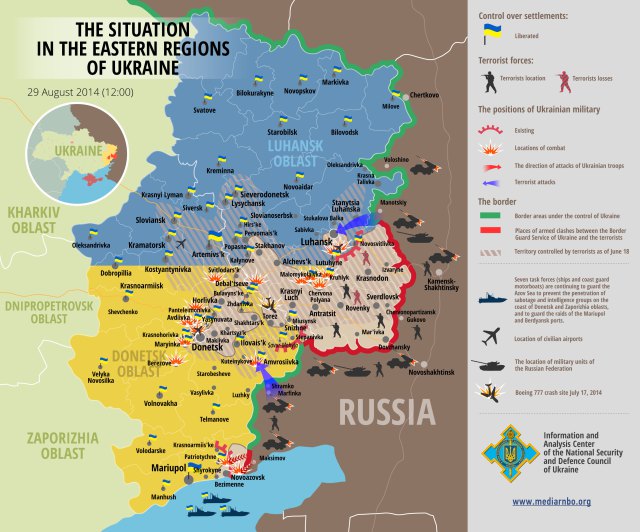
On the ground, Ukraine troops in the southeastern city of Novoazovsk told Vice News that they’re not getting the support they need to repel invading fighters. Russia Today released a video of a separatist flag being raised over a Novoazovsk state building. And Ukraine’s security council distributed a video of what it said was a Russian tank in Novoazovsk[.]

Overnight, Russian president Vladimir Putin issued an appeal to the separatist groups to create a “humanitarian corridor” in order to allow besieged Ukrainian troops to return “to their mothers, wives and children.” But in addressing the rebels as the “Novorossiya militia,” he employed a provocative Czarist era term that implies Russian ownership of a big chunk of modern-day Ukraine. A separatist leader said that his forces would grant safe passage for Ukrainian troops to flee the fighting, on the condition that they left all of their weapons behind.

Max Fisher is perturbed by Putin’s use of the term “Novorossiya” or “New Russia”:

The statement itself was otherwise banal, but in giving the rebels this name, he is seemingly not just referring to them as an extension of Russia (everybody already knew this) and not just adopting the heavily loaded imperial terminology, but endorsing that the rebels and the land they stand on are, in a sense, part of Russia. In other words, Putin’s choice of phrasing — and picking such a hotly political phrase is no accident — sounds an awful lot like a rhetorical step toward annexing all or part of the rebel-held territory. Significantly, earlier this week Russian forces invaded a part of Ukraine where there had been no previous fighting, along the southeastern-most coast with the Black Sea. That is not a rebel-held area, but it is prime Novorossiya territory.

Linda Kinstler observes that the Kremlin is still pretending it has nothing to do with the events in Ukraine:

At Thursday’s UN Security Council emergency meeting, Russian UN envoy Vitaliy Churkin said, “The current escalation is a direct effect of Kiev’s criminal polices and war being waged against its own people”it has nothing to do with Russia, the Kremlin line goes. The Russian Foreign Ministry is claiming that the only reason Kiev has sounded the alarm of a full-fledged Russian invasion this week is because the Ukrainian “anti-terrorist operation” is failing in the east, RIA Novosti reports, leaving aside the obvious reason why the Ukrainian military has suffered setbacks recently, which is that Russia opened up a new front in southeastern Ukraine this week. Izvestia reports that Ukraine is accusing Russia of invading only because the “President of Ukraine is looking for an external enemy” to fend off domestic disapproval.

This absurd commitment to denial leads Joshua Keating to label the invasion “postmodern”:

The Russian government continues to deny that Russian forces are crossing the border or that the government is arming the rebels. One can only imagine what creative explanations they’ll come up with next. Just a few weeks ago, in the wake of the MH17 crash, the conflict seemed on the verge of being snuffed out with Ukrainian forces rapidly regaining rebel-held territory. Now, even as Ukrainian forces close in on the rebel strongholds of Donetsk and Luhanks, Russian troops appear to have opened a new front of the battle along the southeastern portion of the border. Incredibly, this has been done in such a way that President Vladimir Putin can continue denying that Russia is playing a direct military role in the conflict while holding talks this week with Ukrainian President Poro Petroshenko.

Elias Groll and Reid Standish get the sense that Putin is making up his strategy as he goes along:

“Putin has been throughout this crisis a bit of a gambler,” said Jonathan Eyal, the international director at the Royal United Services Institute, a British think tank. “We underestimate the element of improvisation within the Russian decision-making in this crisis.” … Regardless of whether Putin expands the offensive, the Russian leader in the meantime achieves his short-term goal of propping up the separatists he backs. “He wants a failed, destroyed Ukrainian state and to prevent Ukraine from falling in the Western sphere of influence,” Eyal said. “The strategy is to not have a strategy.”

Leonid Bershidsky is pessimistic:

As a Russian, I get a sinking feeling when I think about my country winning this war. It is being fought against a peaceful, Russian-speaking people whose only transgression is a desire to be part of the European Union rather than a Russian client state. They even managed to topple a corrupt dictatorship — a task in which the Russian people have failed. A military victory against Ukraine would bring Russia no glory and cost many lives. “We can stop this,” billionaire and former political prisoner Mikhail Khodorkovsky said today. “It’s enough to just take to the streets and threaten a strike. The authorities will deflate immediately, they are cowardly.” That may be true, but it’s not likely to happen, because most people in Russia believe Putin’s propaganda. Unless the death toll mounts so that everyone knows a dead or injured soldier, this is not a war that protests inside Russia are likely to stop.

Brian Whitmore compares this episode with Georgia and fears it will end up the same way:

When Russian-backed separatists seized control of Georgia’s Abkhazia and South Ossetia regions in the early 1990s, it didn’t make international headlines. Likewise, when separatist fighters in Moldova’s Transdniester region took control of that strip of territory with Moscow’s implicit blessing, it was largely met with a collective yawn in the international community. The script and the playbook have been the same as has the result: exploiting a local ethnic conflict, the Kremlin has repeatedly used local proxies, and then its own troops to seize de facto control of a breakaway region in a former Soviet state. And all the while Moscow has maintained a semblance of plausible deniability that it was the conflicts’ principal instigator. The result was a series of “frozen conflicts” that Moscow has been able to use to influence and pressure its neighbors.

Yep, This Sure Looks Like An Invasion, Ctd

by Dish Staff

image_thumbnail

Evidence is mounting that Russia has launched an outright invasion of Ukraine:

In Brussels, a Nato military officer told Reuters that the alliance believes there are now more than 1,000 Russian soldiers fighting in Ukraine. Russia has repeatedly denied it is fighting in Ukraine, and speaking after the Minsk negotiations, Putin said that a solution to the crisis in east Ukraine is “not our business; it is a domestic matter for Ukraine itself”. He said all Russia could do was “support the creation of an environment of trust”. … Russia’s denials appear increasingly flimsy.

When the Guardian saw a Russian armoured column cross the border two weeks ago, the foreign ministry and local security services denied any incursion had taken place, saying it was a border patrol that had not strayed into Ukrainian territory. Earlier this week, when Russian paratroopers were captured well inside Ukraine, sources in the defence ministry also said they had been part of a border patrol that had got lost and entered Ukraine “by accident”. The head of the self-declared Donetsk People’s Republic, Alexander Zakharchenko, admitted on Thursday that there are serving Russian soldiers among his fighters, but claimed they were volunteers who were taking a holiday in the region.

The Interpreter’s live blog flags a NATO release of satellite imagery purporting to show Russian artillery in Ukrainian territory a week ago:

Dutch Brigadier General Nico Tak, director of the Comprehensive Crisis and Operations Management Centre (CCOMC), Allied Command Operations said the images confirmed what NATO and its Allies had been seeing for weeks from other sources. “Over the past two weeks we have noted a significant escalation in both the level and sophistication of Russia’s military interference in Ukraine,” said Brigadier General Tak. “The satellite images released today provide additional evidence that Russian combat soldiers, equipped with sophisticated heavy weaponry, are operating inside Ukraine’s sovereign territory,” he said. These latest images provide concrete examples of Russian activity inside Ukraine, but are only the tip of the iceberg in terms of the overall scope of Russian troop and weapons movements.

Lest anyone forget, Ilya Somin stresses that Russia already invaded Ukraine a while ago:

In the discussion over whether Russia has “invaded” eastern Ukraine in recent months, few mention that it already invaded Ukraine in a more blatant way months ago, and continues to occupy a large swath of Ukrainian territory. While Putin’s efforts to aid the brutal separatists in Eastern Ukraine are reprehensible, at least the West continues to oppose them, and Ukrainian forces may well defeat the separatists before Russia is willing or able to provide them enough assistance to save them. By contrast, little effort is being made to challenge Putin’s annexation of Crimea -a much more flagrant invasion that has largely become a fait accompli. It may be that nothing can be done to reverse it, at least in the short term. But we should at least remember the true nature of what has happened, and look for opportunities to change it in the future.

Dmitri Trenin hopes a peace deal is in the offing sooner rather than later:

Any future settlement would probably have to include Kiev engaging in a serious political dialogue with the eastern regions, and adjusting its nation-building policies to take into account Ukraine’s diversity. Wide-ranging amnesty would be granted to the participants in the conflict. It would also need to include Russia’s acceptance of Ukraine’s European choice, and specifically its association with the EU. NATO membership for Ukraine, by contrast, would remain out of reach to Kiev—more as a result of a German veto than a product of Ukraine’s federalization. Ukraine would not become a formal federation, but the “unitary nature” of its state would allow a significant degree of decentralization, including in economic, financial and linguistic issues. At some point, Russia and Ukraine would settle for a mutually acceptable gas price, with the EU guaranteeing the gas transit across Ukraine, and the case against Gazprom would be withdrawn from the Stockholm arbitrage.

A deal along the lines described above may look too unpalatable to many people. However, the absence of any deal deemed minimally acceptable to all sides would steer Europe toward an abyss.

Yep, This Sure Looks Like An Invasion

by Dish Staff

Just one day after Vladimir Putin and Petro Poroshenko met in Belarus to discuss a resolution to the Ukrainian conflict, the NYT is reporting that Russian forces have invaded southeast Ukraine near the city of Novoazovsk:

The attacks outside this city and in an area to the north essentially have opened a new, third front in the war in eastern Ukraine between government forces and pro-Russian separatists, along with the fighting outside the cities of Donetsk and Luhansk. Exhausted, filthy and dismayed, Ukrainian soldiers staggering out of Novoazovsk for safer territory said Tuesday they were cannon fodder for the forces coming from Russia. As they spoke, tank shells whistled in from the east and exploded nearby. … A Ukrainian military spokesman said Wednesday the army still controlled Novoazvosk but that 13 soldiers had died in the fighting. The behavior of the Ukrainian forces corroborated assertions by Western and Ukrainian officials that Russia, despite its strenuous denials, is orchestrating a new counteroffensive to help the besieged separatists of the Donetsk People’s Republic, who have been reeling from aggressive Ukrainian military advances in recent weeks.

The Interpreter’s live blog rounds up reports of other incursions:

The ATO press centre has announced that reports have been received of a column of up to 100 Russian military vehicles, including tanks, armoured personnel carriers, infantry fighting vehicles and Grad rocket launchers, on the move towards Telmanovo along the road from Starobeshevo, which reportedly fell to Russian or Russian-backed forces earlier. According to Ukrainska Pravda, the ATO press centre noted that the vehicles were marked with white circles or triangles. A battalion task force of the Russian Armed Forces has reportedly set up headquarters in the village of Pobeda, just to the south of Snezhnoye. Russian or separatist reinforcements have been sent to Amvrosievka, where they are fighting Ukrainian forces, claims the ATO press centre.

In Max Fisher’s interpretation, Putin’s stealth war strategy is now paying off:

That lesson is this: the Western world can set all the red lines it wants — don’t use chemical weapons, don’t invade sovereign countries — but if you cross that red line just a little bit at a time, inching across over weeks and months, rather than crossing it all at once, then Western publics and politicians will get red-line fatigue and lose interest by the time you’re across. … Russia’s meddling in eastern Ukraine became a stealth invasion, which has become an overt invasion. But it was all done just gradually enough, and with just enough uncertainty around each incremental escalation, that Russia has managed to invade a sovereign European country, in the year 2014, without sparking any larger war or the credible threat of any substantial response beyond sanctions.

That’s because, as Thomas Graham underscores, Russia cares a lot more about Ukraine than we do:

Tellingly, throughout this crisis, no prominent Western leader has seen it fit to make a major address to explain what is at stake in Ukraine and to request significant sacrifices to advance Western goals. Indeed, it was the upsurge of public outrage over the downing of Flight MH17 and the desecration of the crash site that compelled reluctant European governments to accede to the more stringent sectoral sanctions against Russia. But with that outrage subsiding, the preference remains to focus on what both governments and publics see as their more salient domestic political and economic challenges rather than divert resources to either punish Russia or help Ukraine. Putin knows all this, even if many armchair generals in Washington do not. This balance of interests, resources, and sacrifice means that the West and Kyiv will have to accommodate Russia to some extent, especially on the question of Ukraine’s geopolitical orientation and Russian influence in Eastern Ukraine, to resolve the crisis.

Will Ukraine Talks Resolve Anything?

by Dish Staff

Vladimir Putin and Petro Poroshenko met face-to-face in Minsk today, for the first time since June, to discuss the crisis in Ukraine and how to resolve it:

Putin devoted most of his opening remarks to trade, arguing that Ukraine’s decision to sign an association agreement with the EU would lead to huge losses for Russia, which would then be forced to protect its economy. Russia had been counting on Ukraine joining a rival economic union that it is forming with Belarus and Kazakhstan. Ukraine is set to ratify the EU association agreement in September. On the fighting that began in April between Ukrainian troops and pro-Russia separatists, Putin said only that he was certain the conflict “could not be solved by further escalation of the military scenario without taking into account the vital interests of the southeast of the country and without a peaceful dialogue of its representatives.”

Poroshenko would be unlikely to agree to Russia’s frequent call for federalization — devolving wide powers to the regions from the central government — but could agree to allow them to have some expanded powers. He also has spoken against holding a referendum on Ukraine’s joining NATO; Russia’s desire to keep Ukraine out of the alliance is seen as one of Moscow’s key concerns.

Just prior to the start of the talks, Ukraine announced that it had captured ten Russian paratroopers on its territory, proving that Russian forces have been deployed on the ground there. The Kremlin admits the soldiers are Russian but claims they ended up in Ukraine accidentally:

“The soldiers really did participate in a patrol of a section of the Russian-Ukrainian border, crossed it by accident on an unmarked section, and as far as we understand showed no resistance to the armed forces of Ukraine when they were detained,” a source in Russia’s defence ministry told the RIA Novosti agency. Ukraine said it had captured 10 Russian soldiers, though it did not state how they were caught. Weapons and fighters are able to cross the porous border freely, but until now there has never been confirmation that serving Russian soldiers were active inside Ukraine, despite repeated claims from Kiev and some circumstantial evidence.

To Ed Morrissey, this revelation is just another sign that Putin is preparing for all-out war:

For most leaders, this would provide enough of an embarrassment to force a halt in their strategies. Not Vladimir Putin, though. If anyone believes that Putin will slow his roll into eastern Ukraine just because he’s been caught red-handed with paratroopers on the other side of the border, think again. Putin has taken his measure of the West and thinks he can live with the economic pain for the short period of time in which sanctions will bite. Fall is coming, and with it the need for Russian gas in eastern Europe. Nothing in the past few weeks other than the lack of an all-out invasion to relieve the rebels gives any indication that Putin’s plans have been deflected to any significant degree. Don’t expect a few POWs to shame Putin into backing down now.

Also yesterday, Poroshenko dissolved parliament and called for new elections in two months. Steve LeVine analyzes the political situation in Kiev:

While the country is more stable politically since the May elections that brought Poroshenko to power, it remains in a tremendous military and economic crisis. … The more elections Poroshenko gets under his belt, the more legitimacy he hopes he will have, as Russian president Vladimir Putin effectively challenges his right to rule. In the last couple of weeks, Putin has appeared to retreat from his most vitriolic rhetoric regarding Ukraine, but the likelihood is that he will only reluctantly stand down from his ultimate goal, which is to keep Ukraine so destabilized that it cannot join NATO or be a fruitful economic partner of Europe’s.

Belarus, meanwhile, hopes to benefit just from hosting the talks:

[Belarusian President Alexander] Lukashenko’s iron-fisted internal politics haven’t changed but he has always remained open to overtures from the west despite his close ties to Russia, said Fyodor Lukyanov, editor of the journal Russia in Global Affairs and chairman of the Council on Foreign and Defence policy. “The geopolitical situation has changed and now Lukashenko doesn’t seem as awful as he did a year ago,” Lukyanov said. Because of its relatively neutral position with regard to both Russia and Ukraine, Belarus has become essentially the only place where leaders from both sides can meet without losing face. “Being a country that’s connected with Russia but can preserve fairly independent politics makes Belarus an important player between Ukraine, the EU and Russia,” Lukyanov said. “The EU is forced to relate to [Lukashenko] differently.”

Russia Has Already Invaded Ukraine?

by Dish Staff

NATO claims that Russian artillery have been moved into Ukraine over the past few days and are now firing on Ukrainian forces:

NATO Secretary General Anders Fogh Rasmussen, in a statement from Brussels, said the group has “also seen transfers of large quantities of advanced weapons, including tanks, armoured personnel carriers, and artillery to separatist groups in Eastern Ukraine. Moreover, NATO is observing an alarming build-up of Russian ground and air forces in the vicinity of Ukraine.” Rasmussen condemned Moscow for allowing an ostensibly humanitarian economic convoy to enter Ukraine with no involvement from the International Committee of the Red Cross, which typically coordinates such missions. He went on to blame Russia for escalating tensions with a military buildup along the Ukrainian border.

Brett LoGiurato portrays Russia’s decision to send its suspicious aid convoy across the border without the Ukrainian government’s consent as calling the bluff of Kiev and its backers in the West:

The European Union commission urged Russia to “reverse its decision.” The Pentagon told Russia to “remove its vehicles immediately.” But the “or else” threats from the West have been piling up for months in the Ukrainian crisis. And Putin suspects that Ukraine will not fire on the convoy, which would give Russia a pretext for more direct intervention. Putin also knows the European Union and U.S. are unlikely to directly intervene, as they are looking to calm tensions in the region and for a possible cease-fire. Putin and Ukrainian President Petro Poroshenko are scheduled to meet next week in Minsk, Belarus, the first time the two will have met face-to-face since June. It’s the best chance in a while that European leaders have seen to defuse the crisis.

“Meanwhile, Russia has been losing on the military front in southeast Ukraine. So the advantage to Russia is to get the humanitarian convoy in and sit there, making it much more difficult for the Ukrainian government to defeat the separatists. The separatists, in turn, can take the time to rearm and reorganize,” Bremmer told Business Insider in an email. “Putin just called Ukraine’s bluff … and Ukraine (wisely, in my view) has chosen not to attack the convoy,” Bremmer added. “But that means what we’ve known all along. Putin was never going to allow Ukraine to ‘win’ this conflict. We’re back to the long game.”

Naturally, the Kremlin and its supporters are spinning the situation a bit differently:

But the indispensable Interpreter, which has been documenting Russian military incursions into Ukraine for some time now, clears up a few things about who the aggressor is:

Despite the Russian Foreign Ministry’s statements that Moscow is working to bring peace to eastern Ukraine while Kiev and the West are working to continue the conflict, two things should be noted. The first is that Kiev, with the cooperation of the International Red Cross, have already delivered an aid convoy to Lugansk within the last week. The delivery of that convoy was incident free. Russia, on the other hand, has been pouring weapons and soldiers across the border and has continued to build an invasion force just kilometers from Ukraine (here’s just yesterday’s evidence of that buildup). In the last week Ukrainian positions have been laced with artillery and mortars which are firing from inside Russian territory. Ukrainian soldiers say that they have orders not to fire back, and are taking heavy losses as a result.

Russia “Invades” Ukraine

by Dish Staff

A Russian aid convoy bound for eastern Ukraine crossed the border today without the permission of the Ukrainian government, which is calling the act an “invasion”:

Russia’s Foreign Ministry said in a statement Friday morning that Moscow had run out of patience with “delays” and other “excuses” from Ukraine. It charged that Ukraine’s leaders were deliberately trying to slow-walk the delivery of aid to the war-torn region of Luhansk until “there is no one at all to provide help to.”

The decision to send in the aid without the consent of the Red Cross or Ukrainian authorities marked a dangerous new step in the four-month conflict. If Ukrainian forces fire on the trucks, they could trigger an all-out invasion by Russian forces that have accumulated by the tens of thousands across the border from eastern Ukraine. If they allow the trucks to disperse across the Luhansk region without any Ukrainian controls, Russia in effect will have imposed a cease-fire in the fight against pro-Russian separatists without Kiev’s permission.

That’s precisely what Ed Morrissey suspects the Kremlin is trying to do:

Russia tried a direct invasion last week in what appeared to be an attempt to start a shooting war. Although Russia later denied it, at first they confirmed the incursion, but didn’t follow up with military action when it came under Ukrainian fire. Prior to that, I warned that the aid convoy could be used to force the Ukrainian military into a unilateral cease-fire to prevent any Russian retaliation for convoy losses in potential firefights, and that seems to be at least one of the motives for running through the border now. Otherwise, why not wait for the inspections? …

Until the rebellion gets settled one way or the other, peace will not be forthcoming. The aid convoy only delays that resolution if Russia plans to use it as a barricade for the rebels, or as a beachhead for an occupation.

The Interpreter live-blog passes along a report that most of the trucks had not been inspected by Ukrainian border guards:

“In total, 34 people and 34 vehicles were processed. The total weight was 268,020 kg. Vehicles were loaded to two thirds of their capacity. The average weight of one vehicle was 8,375 kg. 32 trucks carried food products (buckwheat, rice, sugar and water), 2 trucks carried medical supplies,” report border guards. … Andrei Lysenko, the spokesman for the Ukrainian National Defence and Security Council (SNBO), has told reporters at a briefing today that more than 90 trucks (note that only 34 passed customs clearance) have set off into Ukrainian territory today.

To Russia Without Love

by Dish Staff

russia_favorability_rating_2014.0

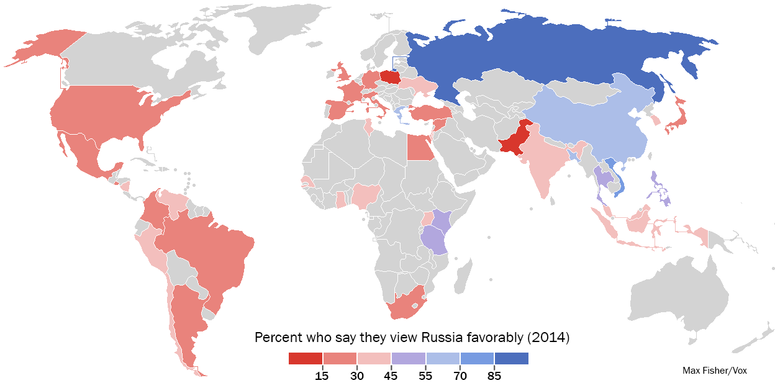
Max Fisher highlights a Pew study (pdf) released last month that documents attitudes toward Russia in countries around the world. As you can see from the map, the erstwhile superpower is not very well liked at the moment:

Russia is most unpopular in Poland, which, as a long-suffering Soviet puppet state, is exceptionally alarmed about Russia’s recent invasion of Crimea and its sponsorship of separatist rebels in eastern Ukraine. In Poland, only 12 percent say they have a favorable view of Russia, with 81 percent holding an unfavorable view. The rates are not much higher in the rest of Europe, which is part of why European leaders are becoming much more willing to impose tough sanctions on Russia, even at some cost to European economies.

But Russia is also deeply unpopular in the Middle East.

This is most true in Turkey, where only 16 percent hold a favorable view of the country, with 73 percent holding an unfavorable view. This may be a result of Russia’s sponsorship of Syrian leader Bashar al-Assad, who has been able to get away with slaughtering thousands of civilians in that country’s civil war in part because Moscow shields him from international action.

Jan Cienski zooms in on how Eastern European countries, most of which are notably absent from the Pew report, are responding to Putin’s aggression in Ukraine—or not responding, as it were:

Despite their common experience of spending a half-century under Moscow’s heel as part of the Soviet bloc, it has proven impossible for Poland to forge a regional alliance against Russia. Some countries are awake to the danger of Russian tanks and green-uniformed troops appearing on their own borders; others are still keen to cut commercial deals that require being in the country’s good graces.

“The Hungarians are still conducting a policy of rapprochement with Russia. The Czechs don’t care what is happening in Eastern Europe. The Bulgarians first joyfully accept, then doubt, then again accept [Russian proposals for the South Stream, a new natural gas pipeline running through Bulgaria to Southern Europe],” said Roman Kuzniar, national security advisor to Polish President Bronislaw Komorowski, in a recent radio interview. “The Baltic countries also do not have a common front. That shows how easily we are divided, even among countries which have a heightened geopolitical awareness.”

How Do You Solve A Problem Like Vladimir?

by Dish Staff

Russian President Vladimir Putin Visits Samara

Jeffrey A. Stacey and John Herbst argue that the international community needs to do more to combat Putin’s aggressive behavior:

The time has come for the West to make a decisive move to counter Putin’s irregular war against Ukraine. The Russian president has introduced a perilous new norm into the international system, namely that it is legitimate to violate the borders of other countries in order to “protect” not just ethnic Russians, but “Russian speakers” — with military means if necessary. Putin has notoriously threatened to annex Transnistria, the Russian-speaking territory of Moldova, inter alia. The Putin Doctrine represents a serious transgression of the status quo that has guaranteed the continent’s security since the end of World War II; moreover, it violates the most essential tenet of the post-1945 international order.

They recommend a comprehensive approach to increase the cost of Putin’s meddling in Ukraine, including “even tougher economic sanctions; military armaments to Ukraine; and an updated NATO strategy.” But Eugene Rumer thinks the situation may be hopeless:

With force off the table, the West’s response to Putin’s actions in Ukraine has been sanctions and more sanctions. They have failed to dissuade and deter Russian support for the separatists. Yet, the West is threatening more sanctions if Russia attacks. Albert Einstein supposedly described insanity as doing the same thing over and over again and expecting different results.

The West can double down on sanctions and threaten more of the same, but the result is also going to be the same. The United States and its allies have made it clear that Ukraine is not as important to them as it is to Russia. Russia is prepared to go to war for it. They are not. It is tempting to say that all parties need to talk and reach a reasonable, mutually acceptable compromise. But it looks less and less likely or feasible at this stage of the conflict. Kyiv senses victory and appears poised to go for it. Putin fears defeat and is not prepared to accept it.

Masha Gessen is chagrined at how far Putin’s lies have gotten him so far:

Bald-faced lying is the one tactic Putin has used consistently through the six months of his Ukrainian incursion. It works every time, precisely because he and his Western counterparts are playing by different sets of rules: Every time, the West has to accept Putin’s version of events until it can be disproved beyond a reasonable doubt, and even then he gets to claim any area that remains gray.

He got to annex Crimea before his assertion that the Russian military was not there was exposed as the lie it was. Because his claim that the Russian military is not in eastern Ukraine has not been definitively disproved, Western media and politicians continue to call the fighters “separatist rebels” or “pro-Russian” or “Russian-backed separatists.” We all know that these are armies formed and armed by Russian military and intelligence officers, but we know this the same way we know the “humanitarian convoy” is a lie: without being able to prove it. So the strongest term Western media or politicians have applied to these fighters is terrorists, which is not strong enough—calling these people terrorists defines them as nonstate actors. Nor is the suggestion that Russia should be labeled a state sponsor of terrorism strong enough. Russia is not sponsoring other people’s terrorism; it is waging an illegal war against a neighboring country.

(Photo by Sasha Mordovets/Getty Images)

Did Russia Just Invade Ukraine For Real?

by Dish Staff

The Russian aid convoy Ukraine believes to be a Trojan horse might just be a decoy. Journalists who had a chance to look inside some of the trucks said they did contain humanitarian supplies like buckwheat and sleeping bags, but suspiciously, some of them were almost completely empty. Meanwhile, a column of Russian armored vehicles was spotted crossing into Ukraine yesterday:

The Guardian saw a column of 23 armoured personnel carriers, supported by fuel trucks and other logistics vehicles with official Russian military plates, travelling towards the border near the Russian town of Donetsk – about 200km away from Donetsk, Ukraine. After pausing by the side of the road until nightfall, the convoy crossed into Ukrainian territory, using a rough dirt track and clearly crossing through a gap in a barbed wire fence that demarcates the border. Armed men were visible in the gloom by the border fence as the column moved into Ukraine. Kiev has lost control of its side of the border in this area.

The trucks are unlikely to represent a full-scale official Russian invasion, and it was unclear how far they planned to travel inside Ukrainian territory and how long they would stay. But it was incontrovertible evidence of what Ukraine has long claimed – that Russian troops are active inside its borders.

What’s more, Ukraine claims to have attacked and destroyed most of the Russian APCs:

Ukraine said its artillery partly destroyed a Russian armoured column that entered its territory overnight and said its forces came under shellfire from Russia on Friday in what appeared to be a major military escalation between the ex-Soviet states. Russia’s government denied its forces had crossed into Ukraine and accused Kiev of trying to sabotage deliveries of aid. NATO said there had been a Russian incursion into Ukraine, while avoiding the term invasion, and European capitals accused the Kremlin of escalating the fighting.

Kiev and its Western allies have repeatedly accused Russia of arming pro-Moscow separatist rebels in eastern Ukraine, and of sending undercover military units onto Ukrainian soil. But evidence of Russian military vehicles captured or destroyed on Ukrainian territory would give extra force to Kiev’s allegations – and possibly spark a new round of sanctions against the Kremlin.

But Anna Nemtsova remains suspicious of the convoy itself:

Authorities in Kiev and the International Committee of the Red Cross demanded the Kremlin present a detailed inventory of what was inside the glistening convoy. And Aleksander Cherkasov, director of the human rights center “Memorial,” laid out several problematic questions in an interview with The Daily Beast: “We would like to know why the military trucks were loaded not by the ministry of emergency affairs but at the base of Tamanskaya Motor and Rifle Division in Moscow region,” said Cherkasov. “And also, for what reason about 30 military vehicles that accompany the convoy have no plates on them.” This is a problem, since no traffic police can identify any of the trucks if they start to disperse once they enter Ukraine.

“This time the Kremlin is openly supporting separatists in Ukraine by sending in military vehicles,” said Cherkasov. “If the trucks cross the border without official permission from Kiev, it would be considered a pure invasion.”