The State Of The Secret Service, Ctd

whitehosue.0

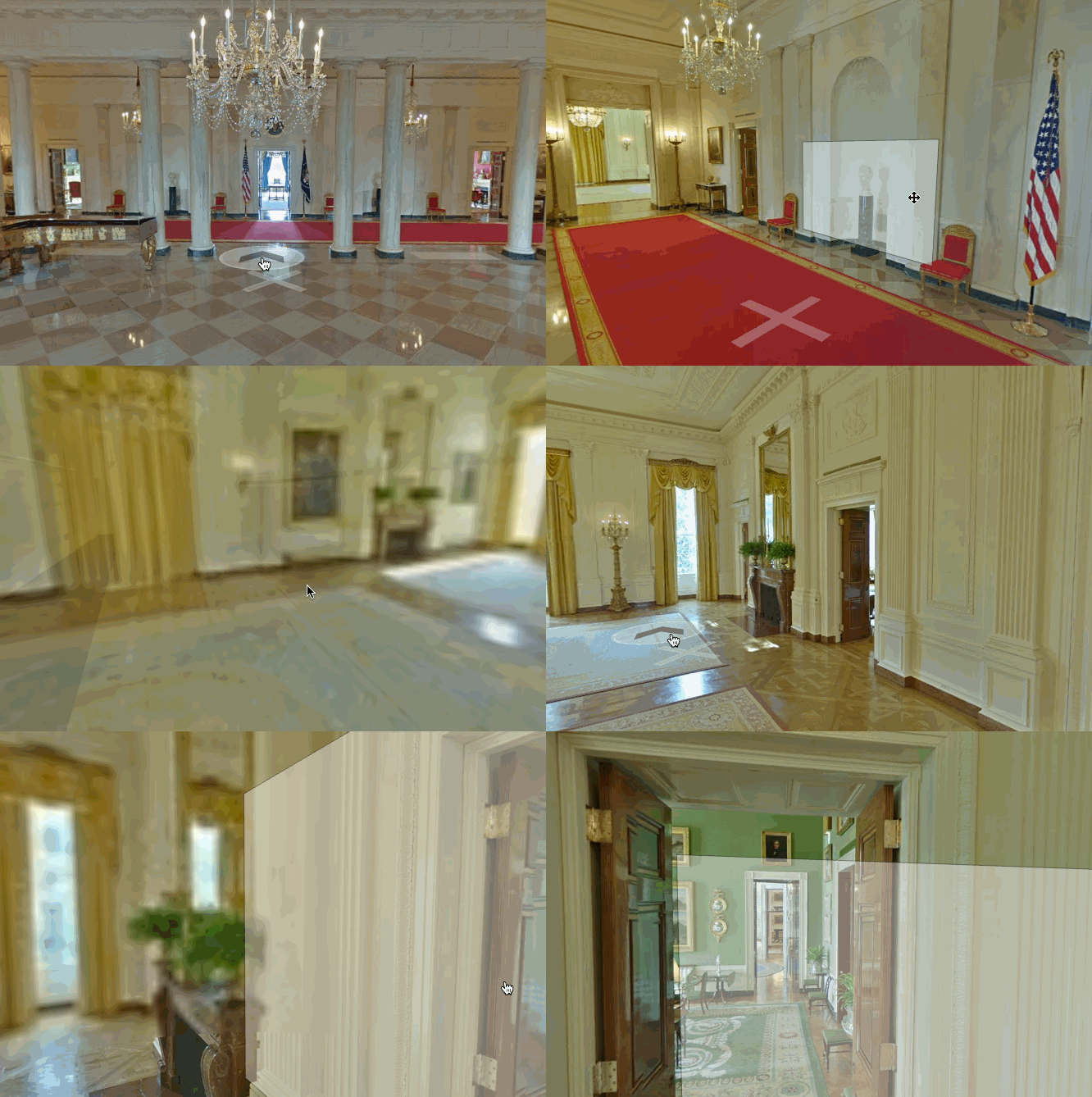
It turns out White House fence-jumper Omar Gonzalez made it far past the mansion’s front door. Adam Baumgartner created the above animated GIF of Gonzalez’s route based on the following description from Carol Leonnig:

After barreling past the guard immediately inside the door, Gonzalez, who was carrying a knife, dashed past the stairway leading a half-flight up to the first family’s living quarters. He then ran into the 80-foot-long East Room, an ornate space often used for receptions or presidential addresses. Gonzalez was tackled by a counter-assault agent at the far southern end of the East Room. The intruder reached the doorway to the Green Room, a parlor overlooking the South Lawn with artwork and antique furniture, according to three people familiar with the incident.

According to Leonnig, an alarm box meant to alert the Secret Service to intruders had been “muted” at the request of the White House usher staff.  Joe Coscarelli adds:

That wasn’t the only failure. Gonzalez seems to have made it past the following lines of defense, according to the Post:

1. “a plainclothes surveillance team … on duty that night outside the fence, meant to spot jumpers and give early warning”
2. “an officer in a guard booth on the North Lawn”
3. attack dogs, which were never released
4. a “specialized” SWAT team
5. the front-door guard

Amy Davidson notes, “The head of the Secret Service, Julia Pierson, will testify before Congress on Tuesday, and will be asked to account for this failure; she should be thankful that she’s not explaining a far worse one”:

She and others in the White House should also be asked why there wasn’t a straightforward account of the intrusion. The story was that, although Gonzalez wasn’t stopped when he climbed over the fence, or by the officers who were supposed to tackle him on the lawn, or by the dogs that were supposed to be released, or by the door that was supposed to be locked, he “was physically apprehended after entering the White House North Portico doors,” as the Secret Service said, in a statement at the time. This was taken to mean that he was pounced on the moment his toes touched the White House floor, and, as the Times noted on Monday, “Secret Service officials said nothing in their public comments after the incident to suggest otherwise.”

House Oversight Committee members Jason Chaffetz and Elijah Cummings are already murmuring about changes in leadership. It will be interesting to see how the Pierson’s testimony, which is in progress, will play out. Ed Krayewski listened in:

[W]hile the Secret Service’s recent history of mishaps was brought up throughout the hearing, several members of Congress, both Democrat and Republican, appeared more interested in demanding the Secret Service use more force in situations like last week’s fence jumper. This even though the president and his family weren’t at the White House that day, something the Secret Service knew when responding but Gonzales probably didn’t.

Josh Marshall thinks excessive force would be a mistake:

The White House lawn is pretty big. And the place is crawling with Secret Service. It should be possible to apprehend someone on the lawn. It should definitely be possible to incapacitate and stop them at the building perimeter or just inside it. If the intruder is armed, obviously the entire calculus changes. But until you know that or can reasonably assume they shouldn’t be just shooting to kill every time someone hops the fence.

The State Of The Secret Service

Peter Grier looks ahead to next week’s Oversight hearing on the Secret Service, scheduled soon after an intruder dashed across the White House lawn and made it into the building:

Among the questions sure to arise: Why wasn’t the White House front door locked? Why didn’t the uniformed Secret Service agents on the grounds unleash their trained defense dogs, or fire at Mr. Gonzalez before he reached the White House threshold? Had the Secret Service heard about Gonzalez beforehand? After all, he’d been arrested in rural Virginia on July 19 for erratic driving. In his vehicle, law-enforcement officials found three rifles and two handguns, ammunition, and a map of Washington with a circle around the White House grounds.

Ambinder says the Secret Service’s problems run much deeper than unlocked doors and text-happy agents:

After the Sept. 11, 2001, attacks, the Secret Service found itself overburdened, under-resourced and undermanned. Agents who might not have passed muster in previous eras – including several involved in the recent alcohol-fueled scandals overseas – not only survived, they became supervisors. Ignoring, for the most part, the Secret Service, the government focused instead on building the Transportation Security Agency and the Federal Air Marshal Service, added thousands of agents and officers to the Border Patrol and to the Immigrations and Customs and Enforcement service, and dumped it all inside the new Department of Homeland Security.

And last year’s budget cuts have had consequences:

The current White House Security Plan, which is supervised by the Presidential Protective Division and executed by the Uniformed Division, is based in large part on a classified 2010 study of the complex. Its results were shared with congressional overseers, and appropriators programmed more money for specific functions: counter-surveillance, technical counter-measures (such as infrared cameras) and better barricades. But most of the money to fund those enhancements and to staff the White House security apparatus at an appropriate level did not survive the automatic budget cuts of 2013. The Uniformed Division is now short at least 100 sworn officers. Officers work overtime. Perhaps that much overtime stretches them thin and dulls response time.

Meanwhile, Ronald Kessler contends that “while agents are brave and dedicated, Secret Service management perpetuates a culture that condones laxness and cutting corners”:

Under pressure from White House political staffs or presidential campaign staffs, Secret Service management tells agents to let people into events without magnetometer or metal detector screening. Assassins concealing grenades or other weapons could theoretically enter an event and easily assassinate the president or a presidential candidate. When it comes to firearms requalification and physical fitness, the Secret Service either doesn’t allow agents time to fulfill the requirements or asks agents to fill out their own test scores. All this has led to poor morale and a high turnover rate. Tired agents and officers are forced to work long overtime hours, contributing to the sort of inattention that took place when Gonzalez scaled the White House fence.

Jeffrey Robinson traces the cultural shift back to the George W. Bush’s first term, “as leadership changed and institutional memory of the Reagan assassination attempt faded”:

The first sign of this came in 2003, when Bush became the first president in history to land on an aircraft carrier in a fixed-wing plane. The president’s entry by Navy jet provided a flashy visual opening to his “Mission Accomplished” speech. But it was a very dangerous maneuver and an unnecessary stunt made simply for the sake of becoming the lead story on the evening news. A person close to the agency told me that the Secret Service originally objected to the plan, but eventually relented, given an agent would be in the plane with Bush – even though, if something had gone wrong, the agent couldn’t have done anything.

Under Reagan, the Secret Service never would have permitted it. Former agents told me they would have fought the idea tooth and nail. They would have thrown their Commission book on the table, refused to take responsibility and resigned.

But Matt Farwell suggests that the Secret Service deserves credit for its restrained treatment of a man who by all accounts struggles with mental illness:

Of all law-enforcement agencies in the United States, members of the Secret Service are among the most experienced at dealing with mentally ill individuals – because they have to as a routine part of the job. Mentally ill individuals come up to the gates demanding to speak to the president on a near daily basis. …

Agent training in Beltsville, Maryland, features classes in psychology and role playing various scenarios agents might encounter in the course of their duties. These lessons are derived from an exhaustive longitudinal study of assassins and near-assassins completed in 1998. The study focused on the thoughts and behavior of suspects before their attacks and near misses. It found that more than one-third of those assassins and near assassins appeared to hold delusional ideas (the atmosphere collapsing, covert spy satellites beaming signals directly into the brain, or a nonexistent relationship), three-fifths had been evaluated or treated for mental illness, and two-fifths had been hospitalized for psychiatric reasons.