The Inevitability Of Ignorance

Pivoting off Ilya Somin’s new book on political ignorance, Jack Shafer argues that the advent of mass media has done little to cure it:

Our political ignorance is as enduring as it is pervasive. When the Pew Research Center study compared the political knowledge of 1989 respondents with those from 2007 it found the advent of multiple 24-hour news channels, the C-SPAN channels, and hundreds of news sites on the Web had not moved the political ignorance dial in any appreciable way. Nor have massive rises in education over the past half-century put a dent in political ignorance, Somin finds. “On an education-adjusted basis, political knowledge may actually have declined, with 1990s college graduates having knowledge levels comparable to those of high school graduates in the 1940s,” he writes, even though IQ scores have been rising.

Somin responds:

None of this suggests that media coverage of politics is useless. It does provide helpful information to the minority of voters who do follow political issues closely. And sometimes the media uncover a major scandal that penetrates the consciousness even of those members of the public who are usually oblivious to political news. Without the media, politicians bureaucrats, and interest groups would cause more harm than at present. But the media is unlikely to solve the problem of widespread political ignorance.

The Best Of The Dish Today

Two big ones: on the torture jokes at a Cheney roast in Manhattan, organized by Commentary; and an essay on the horrifying treatment of farm animals by a Palin supporter. One priceless heckler MHB, which keeps cracking me up at random moments. And in the latest outbreak of Christianity in the Vatican, the Pope wrote a letter to a bunch of gay Catholics.

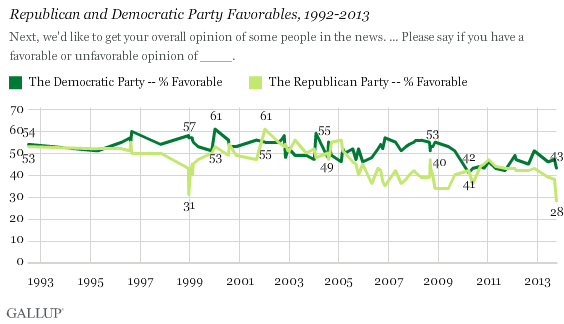
On the great Republican hold-up, there were some tentative signs that the tide may be turning against the extremists, as the GOP’s ratings went into free-fall. Dumbo got shot down by Syrian Jihadists. And submarine smugglers!

The most popular post of the day was this one. The close runner-up? This one.

As I write this, we have 29,986 subscribers. Get us to 30,000 by subscribing [tinypass_offer text=”here”].

And see you in the morning.

Where’s The Liberal Tea Party?

Waldman explains why the Tea Party has no left-wing equivalent. A key point:

Many Tea Partiers are people who hadn’t run for office before 2010, or maybe had served briefly in a state legislature where they were bomb-throwers, not legislators. They won their primaries by promising to be the most conservative, Obama-hating member of Congress the folks of their district had ever seen. In contrast, almost none of the safe Democratic members got elected just by saying that they were the most liberal candidate in their race. Most of them worked their way up through the lower political ranks, getting used to cutting deals, making compromises, and solving problems for constituents. They may be very liberal ideologically, but they’re also old-school pols in many ways.

That gives them a practicality that their conservative counterparts don’t have.

Scott Galupo wants the Republicans to purge itself of the Tea Party:

The very nature of Tea Party opposition, whether it issues from the likes of Bazooka Ted and His Gang in the Senate or the unappeasable Jacobins in the House, is to throw weight without consequence. They evince no interest in actually wielding power from the inside, which would require restraint, conciliation, and moderation. They are hysterics on the brink of utter demoralization. The danger they pose to democratic norms, institutional comity, and political functionality is precisely why they can’t be bargained with; they must be marginalized.

Shutting Down The Safety Net

Adam Serwer worries about the shutdown’s effects on food aid:

If the shutdown lasts into November, Americans reliant on SNAP could find themselves without aid, depending on the fiscal health of the state or the priorities of state leadership. A spokesperson for the Indiana Family and Social Services Administration told MSNBC that “If the shutdown continues beyond October, the State of Indiana will assess its resources and consider its options for continuing to provide SNAP benefits.” Similarly, a spokesperson for Mississippi’s Department of Human Services said they would look to the USDA for guidance.

Sasha Abramsky considers the mental toll this takes on the poor:

We don’t know how long the shutdown will last, and that uncertainty, too, is harder on the poor. The stress of not knowing what tomorrow will bring can be debilitating.

If you’re on food stamps, the fact that the Department of Agriculture believes that it can fund the program through the end of October is better than nothing—but the prospect of not being able to pay for food in November is anxiety-provoking in a way that puts even more pressure on families that already have their fair share of it.

When I was reporting my book “The American Way of Poverty,” several people talked to me about the impact that the stress associated with poverty had on them: on their ability to focus, on their mood, on their blood pressure, on their energy level. In late 2011, an ex-accountant who had lost her job at the start of the recession and spiraled downward spoke of losing weight due to her worries. A man who had lost the business he had owned talked of how his plight made him feel “worthless.” A hungry teen-ager in a suburb east of Los Angeles told me that he cried daily.

Is The Tide Turning?

mmj6rr5b6kem323wnfrlvaThat last vertical line from a usually GOP-friendly polling outfit is one more factor in thinking that the GOP is isolating itself to a truly remarkable extent. No one is winning in this – Obama’s numbers are tanking too, though not as dramatically. The GOP is at their worst level in recorded polling. As Charlie Sheen would put it: “Winning!”

Then the Kochs are distancing themselves from the Cruz strategy that Boehner has adopted as his own, after welching on his deal on a sequester-level continuing resolution. And key business groups, suddenly aware that the GOP is no longer a pro-business party so much as a populist rage-machine, are lobbying hard to end the shutdown and lift the debt ceiling pronto:

The National Retail Federation joined other business groups like the U.S. Chamber of Commerce and the National Association of Manufacturers in asking House Republicans to relent.

“We strongly support passage of both a continuing resolution to provide for funding of the federal government into the next fiscal year and a measure to raise the nation’s debt ceiling,” the group’s president, Matthew Shay said in a letter to Congress that highlighted economic indicators showing that the shutdown has already hurt consumer spending and depressed consumer confidence.

Some are interpreting Paul Ryan’s op-ed today as some kind of olive branch. Sargent dispenses with that rather efficiently. The issue is not about how to balance the budget in the long term through a Grand Bargain. I’d love that, and would probably be more sympathetic to some GOP ideas on it than Obama’s. But the issue now is the economic terrorism that the GOP is using as an unprecedented lever to re-litigate the last election. Take the gun away from our heads, and lay it on the ground. Then we can negotiate – and if a bigger, better Grand Bargain comes from that negotiation, the Dish will cheer it on.

But first: put down your gun and leave it on the ground. And walk slowly away so we can see you have nothing left to harm the country or the world with.

Shutting Down Government Won’t Shrink It

Daniel McCarthy believes that the shutdown is doing serious damage to the cause of small government:

Reducing and restructuring government is going to take time and careful planning, but what we see from the Republicans—abetted by certain activist groups and entertainers who feed off over-emotional listeners, viewers, and donors—is a party whose leadership and record in power is big government and whose committed small-government faction is crippling rather than augmenting its appeal to the country as a whole. This is a recipe for defeat of the small-government faction in future presidential nominating contests—where the Republican Party has shown a longstanding preference for candidates who seem like they can win over centrist voters—and that means even if a Republican can win the White House again in the near future, he’s more likely to be a Republican in the Bush mold.

Larison nods:

Toying around with default threatens to impose greater costs on American taxpayers rather than reduce them. It is the perfect example of striking a symbolic blow against fiscal irresponsibility while adding to the country’s fiscal problems. If one seriously wants to control and reduce government debt, raising the debt ceiling ought to be the last thing that one worries about, since refusing to raise it simply makes paying off the debt that has already been incurred more expensive. Making useless “stands” of this kind not only make small-government conservative ideas unappealing to many other Americans and provoke backlashes against them, but they make even those that agree with many of those ideas conclude that their representatives are ill-suited to governing.

Would A Clean Bill Pass The House?

David Karol is unconvinced that moderate Republicans would deliver the votes required to pass a clean CR, even is Boehner allowed a vote:

In general, Congressional moderates are more closely aligned to their parties than is understood. Often their defections from party ranks occur when it is clear that their party does not need their votes to prevail on a given issue. Moderates frequently represent constituencies in which their parties are not very popular. This gives them a political incentive to create the impression of a certain distance between themselves and their party. Leadership understands this and does not punish legislators for such behavior.

John Dickerson agrees:

There’s a big difference between telling a reporter in your home district that you would vote for these measures and actually voting for them. To cast such a vote would expose these House Republicans to withering heat from their colleagues, the grass roots, conservative bloggers, and high-net-worth individuals willing to fund primary opponents. They would be responsible for a stunning defeat for Boehner and a victory for the president their constituents dislike.

This Isn’t 1996 All Over Again

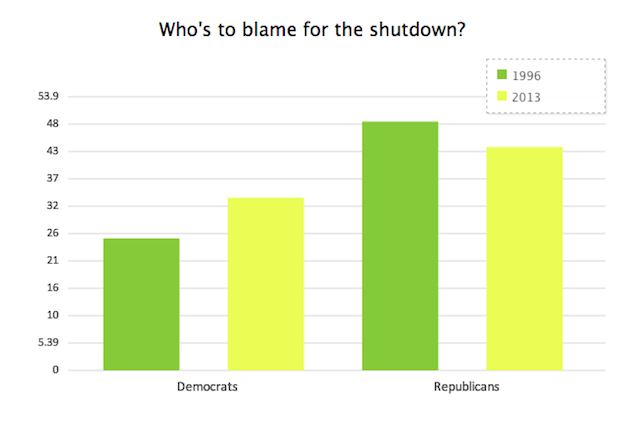
shutdown blame

Republicans are weathering this shutdown better than they did the last one:

At left, the proportion of people who blame Democrats for the shutdown: It’s bigger now than it was then. At right, the number who blame Republicans: It’s smaller! With all the talk about how John Boehner’s blunderous perpetuation of the crisis might jeopardize the GOP’s congressional majority, these numbers add a few additional grains to the mound of salt Nate has already thrown on the idea of a congressional upheaval.

Nevertheless, Gross expects the current shutdown to do more damage than the one in 1996:

When you look back over the past 18 years, one of the unavoidable conclusions is that, for a variety of reasons, the federal government is much more involved in the economy than it was. What’s more, the economy is now more dependent on certain sectors that can’t operate at their fullest capacity without the government being entirely open.

As this chart shows, the federal government has become a larger part of the economy over time. In 1995, federal spending accounted for about 19 percent of GDP. Now, it accounts for about 22 percent of GDP. Entitlements like Medicare and Social Security, which have yet to be affected, account for a big chunk of this rise. But the fact remains that federal government spending accounts for a significantly larger chunk of GDP than it did 18 years ago. So if you slam the brakes on that spending, it will have a bigger direct impact than it did 18 years ago, for example in the effect the furloughs of defense contractors is having on the private sector.

How The GOP Defines Surrender

Chait rips into Boehner’s recent debt-ceiling comments:

Boehner dismissed the notion of lifting the debt ceiling and then negotiating the budget as “unconditional surrender.” How it could be unconditional surrender when he publicly favors lifting the debt ceiling, Boehner did not say. Obama and Boehner disagree on a wide array of budget policies. They agree that the debt ceiling needs to be lifted. Doing the thing both parties agree upon is a bizarre definition of unconditional surrender. If Boehner was an actual debt-ceiling truther, who argued that lifting the debt ceiling somehow worsens the fiscal position of the U.S. government, then lifting the debt ceiling would be surrender. But he isn’t. He agrees with Obama on the merits of the debt ceiling. Unconditional surrender is when one party agrees to do something it opposes but the other party wants — say, delaying Obamacare, as Boehner is proposing.

Douthat partially blames Republican unreasonableness on sequester spin:

One of the underappreciated dynamics making the current mess worse is the fact that both left and right, for somewhat different reasons, have embraced the idea that the outcome of the last debt ceiling deal  — sequestration, with its butcher-knife cuts to domestic programs and defense — was a straightforward win for Republicans, and a huge concession by the Democrats.

For liberals, this idea has fed into the widespread “never again” attitude where debt ceiling negotiations are concerned. (“We can’t get blackmailed like that a second time!”) For conservatives, it’s encouraged deeply implausible ideas about what they can expect the White House to offer them this time. (“We basically won outright in 2011, so why not try to go for Obamacare repeal this time around?”)

The reality, though, is that sequestration really was a genuine, almost old-fashioned sort of compromise — one that bit deeply into a lot of Republican interests and constituencies, and left the liberal ringwall around entitlements unbreached.

At this point, Cassidy is hoping for a stock-market crash:

Once the markets started tanking, investors, the banks, and the media would besiege Congress for action. The political environment would change drastically. Refusing to acknowledge reality, including the reality that every country has to pay its creditors or face ruin, would no longer be an option. Within days, or even hours, the two sides would come up with some face-saving device to calm the markets. (Finding a more lasting solution would still be a big struggle.)

To sum up, Congress needs adult supervision. Since the President can’t provide it and the Republican leadership won’t, the market might well have to step in and do the job. Such a resolution wouldn’t be pretty, but history suggests it would be reasonably effective. And once the immediate crisis was resolved, the market would probably [recover] pretty sharply.
Why The President Can’t Save Us By Fiat

Sean Wilentz claimed yesterday that Obama has the power to unilaterally raise the debt ceiling and avoid default. Balkin pushes back:

Wilentz assumes that Obama could stabilize the crisis by acting on his own. But there is good reason to believe that the opposite would occur.  If Obama is impeached, then the issue will shift from the constitutionality of what the House has done (using the validity of the debt as hostage) to the legality of what Obama has done. He will lose the higher ground in the debate, and the country’s focus will be taken over by an impeachment trial for months, as the economy spirals ever downward.  In the meantime, the validity of debt issued by the President will be repeatedly attacked in the courts by allies of the Republicans–who could purchase the new bonds and then demand a refund in order to create standing for a lawsuit.

Obama made similar points in his presser yesterday. Balkin’s argument makes me queasier, even as default, which is the likeliest alternative, remains unthinkable. The key section from the transcript:

 I know there’s been some discussion, for example, about my powers under the 14th Amendment to go ahead and ignore the debt ceiling law. Setting aside the legal analysis, what matters is — is that if you start having a situation in which there — there’s legal controversy about the U.S. Treasury’s authority to issue debt, the damage will have been done even if that were constitutional, because people wouldn’t be sure. It’d be tied up in litigation for a long time. That’s going to make people nervous.

So — so a lot of the strategies that people have talked about — well, the president can roll out a big coin and — or, you know, he can — he can resort to some other constitutional measure — what people ignore is that ultimately what matters is, what do the people who are buying Treasury bills think? And again, I’ll — I’ll just boil it down in very personal terms.

If you’re buying a house, and you’re not sure whether the seller has title to the house, you’re going to be pretty nervous about buying it. And at minimum, you’d want a much cheaper price to buy that house because you wouldn’t be sure whether or not you’re going to own it at the end. Most of us would just walk away because no matter how much we like the house, we’d say to ourselves the last thing I want is to find out after I’ve bought it that I don’t actually own it.

Well, the same thing is true if I’m buying Treasury bills from the U.S. government, and here I am sitting here — you know, what if there’s a Supreme Court case deciding that these aren’t valid, that these aren’t, you know, valid legal instruments obligating the U.S. government to pay me? I’m going to be stressed, which means I may not purchase. And if I do purchase them, I’m going to ask for a big premium.

So there are no magic bullets here.