When Will The US Run Out Of Money?

Debt Limit Estimate

Barro looks at the best estimates we have:

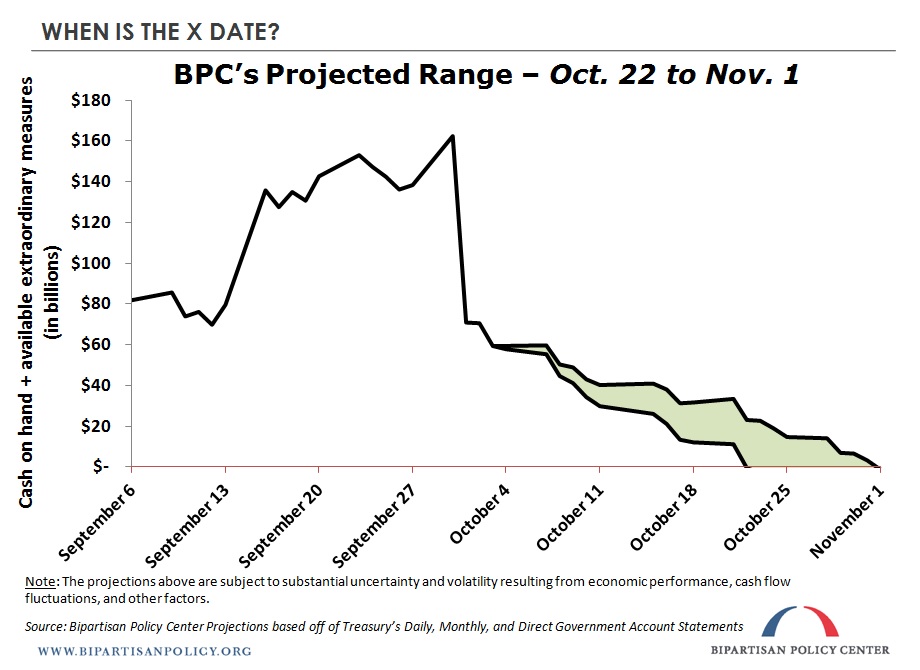
People have been talking a lot about Oct. 17. That’s the day the Treasury Department expects to exhaust ”extraordinary measures” that allow the government to finance itself without issuing Treasury bonds, such as borrowing from various government trust funds. But even when that happens, the federal government will have about $30 billion in cash left on hand, and every day it will collect more revenue. That means it will be able to go a few more days, or possibly as long as two weeks, without missing payments. The Bipartisan Policy Center has projected daily cash inflows and outflows and has narrowed the possible range for the “X date” — the first day the government can’t make all its payments due — as Oct. 22 to Nov. 1.

Matthew O’Brien also examines the government’s balance sheet and uses it to argue that debt prioritization won’t work:

[E]ven if the government is completely competent, the Treasury could still miss a debt payment. Why? Well, payments and revenues are lumpy. We owe more on some days, and we have more cash come in on some days. More importantly, we owe bondholders more on some days. So the question is whether there could ever be a particular day when we owe more in interest than we have in cash on hand. And there is.

Larison adds:

So the Republican members of Congress telling the public that they don’t need to worry about the danger of default if the debt ceiling isn’t raised are simply wrong. They are misinformed, and they are misinforming the public. They need to stop, but unfortunately many of the sources that they rely on for their news and analysis are recycling the same bad information.

Yglesias Award Nominee

“It is true that, according to Real Clear Politics, Americans disapprove of ObamaCare, 51 percent to 40 percent. It is unpopular. But it is not wildly, devastatingly unpopular — though given the fact that it is now rolling out and appears to be as incompetently executed as it was badly conceived, it may yet become so.

If ObamaCare had been as unpopular as conservatives believed, their plan for the shutdown — that there would be a public uprising to force Democratic senators in close races in 2014 to defund it — would’ve worked. It didn’t. Not a single senator budged. Their tactic failed, and now what they are left with is House Speaker John Boehner basically begging the president of the United States to negotiate with him,” – JPod.

It’s been interesting to me to see gung-ho New York Republican stalwarts like Pete King and John Podhoretz lead the charge against the Randian Cruzniks. These are not usually faint-hearted types. My sense is that they are motivated mostly by national security issues, crime, Islamism, and similar neoconnish hot-buttons. And they are getting a feeling that the libertarian surge that is now intertwined with the Tea Party and Christianist take-over of the GOP is not their natural ally. But there are precious few Republicans behind them.

When The Elephant Went Rogue

A Surabaya Zoo health worker checks the

Bernstein blames laziness for the current Republican madness:

The truth is that Republicans can pretty much say whatever they want, no matter what the bizarre logic and no matter what connection it has to what they were saying five minutes ago, and Fox News will totally accept it and blast it for hours or days. The result? Republicans have become incredibly lazy. After all, why bother constructing a coherent argument if you don’t need one.

So why is it a problem? Well, for one thing, it means that it’s easy for Republican politicians to fall deep within an information feedback loop, not even realizing that what everyone within that loop is excited about is unpopular, or perhaps just irrelevant, to the other 80 percent or so of the nation. Or to put it another way: Benghazi!

That’s potentially bad for Republicans if they lose a bit of popularity that way, but it’s worse for the system as a whole, because the system depends on parties and their politicians trying to do things that appeal to voters. The problem here is that Republican politicians deep enough in the loop might not even realize that they are espousing unpopular or irrelevant ideas.

Frum lists other factors that have crippled the party. Republicans’ rage at Obama is a big one of course:

Barack Obama was never likely to be popular with the Republican base. It’s not just that he’s black. He’s first president in 76 years with a foreign parent—and unlike Hulda Hoover, Barack Obama Sr. never even naturalized. While Obama is not the first president to hold two degrees from elite universities—Bill Clinton and George W. Bush did as well—his Ivy predecessors at least disguised their education with a down-home style of speech. Join this cultural inheritance to liberal politics, and of course you have a formula for conflict. But effective parties make conflict work for them. Hate leads to rage, and rage makes you stupid. Republicans have convinced themselves both that President Obama is a revolutionary radical hell-bent upon destroying America as we know it and that he’s so feckless and weak-willed that he’ll always yield to pressure. It’s that contradictory, angry assessment that has brought the GOP to a place where it must either abjectly surrender or force a national default. Calmer analysis would have achieved better results.

(Photo from Getty Images)

Chart Of The Day

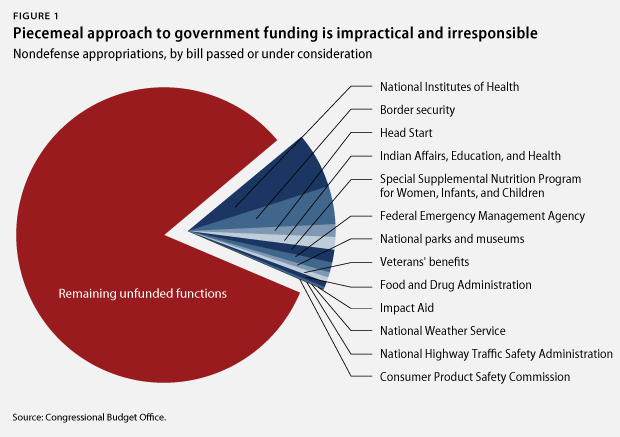
Michael Linden visualized the parts of government that the GOP wants to fund:

Piecemeal

Derek Thompson captions:

Obama wants to fund the whole pie below. The GOP, which would like to pair government funding with Obamacare’s defunding or delay, is asking him to fund the blue slices only. The White House’s logic is that passing the blue stuff makes it more likely that we go even longer without the larger, redder part of the pie.

But doesn’t the GOP actually want the entire government shrunk to that blue size? And isn’t this massive over-reach part of that completely delusional strategy?

A Shutdown Outbreak?

The USDA reported last night that 278 people have fallen ill with salmonella, “likely” due to eating chicken from a California-based poultry firm. Maryn McKenna describes the outbreak as “the exact situation that CDC and other about-to-be-furloughed federal personnel warned about last week”:

As a reminder, a CDC staffer told me at the time: “I know that we will not be conducting multi-state outbreak investigations. States may continue to find outbreaks, but we won’t be doing the cross-state consultation and laboratory work to link outbreaks that might cross state borders.” That means that the lab work and molecular detection that can link far-apart cases and define the size and seriousness of outbreaks are not happening. At the CDC, which operates the national foodborne-detection services FoodNet and PulseNet, scientists couldn’t work on this if they wanted to; they have been locked out of their offices, lab and emails. (At a conference I attended last week, 10 percent of the speakers did not show up because they were CDC personnel and risked being fired if they traveled even voluntarily.)

While the USDA has yet to link the outbreak to a “specific production period,” Robert Gonzales notes that the shutdown has hampered the CDC’s ability to respond to such threats:

Foster Farms’ food safety chief Robert O’Connor insists that the USDA’s food inspection process “has not been affected by the recent government shutdown.” But according to the Associated Press, the CDC, which helps monitor multi-state outbreaks of food poisoning, “was working with a barebones staff because of the federal government shutdown, with all but two of the 80 staffers that normally analyze foodborne pathogens furloughed.” While the AP reports “it was not immediately clear whether the shortage affected the response to the Salmonella outbreak,” shutdown memos issued last week by the U.S. Department of Health and Human Services and the USDA both indicated staff relating to food inspection would be furloughed, further indicating that the government was ill-prepared to prevent and respond to a food-borne outbreak.

Reality Check, Ctd

Various polls on the shutdown find that American disapproval is highest for Congressional Republicans. Kilgore warns against over-interpreting these numbers:

[T]he big differentiator is that self-identified Democrats approve of Obama’s handling of the budget fight by a 77/21 margin, while self-identified GOPers approve of their congressional party’s positioning by a mere 52/45 margin. … What we know beyond the numbers is that despite John Boehner’s forced march towards Ted Cruz’s position on the government shutdown and Obamacare, quite a few conservative opinion-leaders don’t think GOPers have gone far enough. In particular, the Senate Conservative Fund and Heritage Action—along with RedState’s Erick Erickson—have been loudly unhappy with Boehner’s “watering down” of the bedrock “defund Obamacare” position on the continuing resolution.

So it’s entirely possible that a portion of the “blame gap” is represented by conservatives who wouldn’t side with Obama or congressional Democrats on the appropriations or debt limit issues if pigs learned to fly—just as a sizable portion of the people claimed by Republicans as “repeal Obamacare” fans actually favor a single payer system and wouldn’t back GOPers on health care issues if their lives depended on it.

Enten remains focused on the economy:

[T]he political arguments over the shutdown and debt ceiling fight may not matter that much at all.

As University of North Carolina political scientist Jim Stimson found (via Mark Blumenthal of the Huffington Post), it’s consumer sentiment that tends to have the greatest impact on approval ratings and hence elections.

After the last go-round on the debt ceiling, the economy had started to pick up by the end of October 2011, and Obama’s approval rating followed. But the lesson for Democrats who may be thinking smugly that the Republicans will take the biggest hit for the federal shutdown and government default angst is that if the economy goes south as a result, then it’ll likely be the Democratic president who sustains the most damage.

Could The GOP Lose The House?

Relying on PPP’s latest polling, Sam Wang thinks it’s possible:

If the election were held today, Democrats would pick up around 30 seats, giving them control of the chamber. I do not expect this to happen. Many things will happen in the coming 12 months, and the current crisis might be a distant memory. But at this point I do expect Democrats to pick up seats next year, an exception to the midterm rule.

Nate Cohn throws some cold water:

Democrats aren’t yet poised to mount serious challenges to a clear majority of the Republicans running on competitive turf, let alone actually win. So you should probably take this morning’s PPP poll with an additional grain of salt: it’s about how House Republicans would fare against a “generic” Democrat, not the mediocre one they’ll face in 2014. Perhaps the shutdown will trigger a wave of GOP retirements and Democratic recruits. But without both, Democrats will probably crest short of 218.

Enten also tackles PPP:

This “generic” bias might have been balanced in vulnerable seats for Democrats, except PPP didn’t poll any. If PPP and MoveOn had any real interest in seeing what the state of the House was, they’d poll Democratic controlled seats too. After all, the Rothenberg Political Report finds a nearly equal number of Democratic and Republican seats in play.

Theodore Arrington explains why retaking the House is so difficult for Democrats:

To get half the seats, Democrats will have to garner about 53% of the two-party vote. This is not impossible, as they performed above this level in 2006 and 2008, but it makes the task of winning a majority of the House seats an uphill climb.

Kyle Kondik adds:

[I]f Republicans do open the door to the Democrats in the House, it’s not going to be the “Ted Cruz Republicans” who will pay the price. Rather, it’s the House Republicans in marginal districts who could see their ranks decimated, just like the House Democratic moderates whose anti-Obamacare votes couldn’t save them in 2010.

Meanwhile, Kornacki notes that Republican recklessness could create “fallout for the party in Senate races, where the excesses of Tea Party-ism have already cost the GOP winnable races in 2010 and 2012 and could do so again next year.”

How High Must The Ceiling Be Raised?

Unlike Chait, Noam Scheiber is wary of a short-term debt-ceiling solution:

The problem with a short-term debt limit increase is it muddies everything you’re trying to make clear. Suppose Congress reopened the government for six weeks under a temporary funding bill known as a continuing resolution (CR) while at the same time raising the debt limit for six weeks. Obama has said he’s happy to negotiate a fiscal deal once the government is reopened, even as he refuses to negotiate the debt limit. Under this scenario, how would he differentiate between the two? Even if the White House were absolutely scrupulous about not trading anything for the debt limit increase (that is, not making more concessions for a budget deal that includes a debt-ceiling increase than they’d make for a budget deal without one), Boehner could always turn around and tell his rank-and-file that some of the concessions came in return for the debt-ceiling measure. It wouldn’t matter if he were right or wrong. The mere belief among Republicans that they’d extracted concessions for raising the debt limit would encourage them to try again.

Can The Senate Save Us?

The Senate is attempting to pass a clean debt ceiling bill. Ezra hopes it will allow us to avoid default:

House Republicans don’t want to fold completely, of course. But it’s possible, given the beating they’re taking on the shutdown, that they won’t want to risk an actual default. One possible endgame with the debt ceiling, then, is that it gets lifted even as the shutdown continues, perhaps because Boehner and Ryan persuade House Republicans that the shutdown is their real leverage and a default is something Democrats want them to do because it will destroy the Republican Party for a generation. It’s possible to imagine the Senate’s debt-ceiling bill passing even as their reopen-the-government bill languishes.

Beutler adds:

House Republicans might be an ungovernable mess. But the people who control the floor understand the real dangers of breaching the debt limit. And Democrats don’t need more than 15 or 20 Republican votes to cut the right loose and increase the debt limit. As weak as John Boehner is, he’s not that weak. If we breach, it will be because he chose not to deliver them.