Can We Pay The Debt First?

Yglesias shakes his head:

Because payment prioritization is illegal, Treasury’s payment system is not designed to allow prioritization to happen. Cardiff Garcia has an in-depth roundup of coverage of this angle, but the best simple explanation comes from the Treasury inspector general, who explains that on a technical level, the systems “are designed to make each payment in the order it comes due.” Of course systems could always be changed. But look at all the problems Health and Human Services is having in getting the Affordable Care Act computer systems to work. They can’t just whip up an entirely new computer system in the next two weeks. (And, of course, given the government shutdown, it would be illegal for them to hire someone to try.)

Caroline Baum disagrees:

The Treasury makes 100 million payments each month, but the idea that it has no ability to determine what it pays to whom doesn’t pass the smell test.

… The Government Accountability Office has said the Treasury secretary has the authority to prioritize payments. Former budget Director David Stockman says it can be done. Former Treasury Secretary Paul O’Neill tells me Treasury “could prioritize, and it’s a lot easier today than when people were doing payrolls in advance.” But any such actions “would start eating into things that would cause a revolution,” he says.

Felix adds:

[W]hile the systems are designed to make payments in the order they come due, they have also been designed so as to effectively insulate bond repayments from all other payments. Bond repayments are made through a system called Fedwire, while all other payments are made through the standard banking ACH system. Logistically, it’s entirely possible to keep up to date on all Fedwire payments without making any ACH payments at all. … Could Treasury decide to prioritize Fedwire payments, and then turn on the ACH payments sporadically, only insofar as they didn’t eat up enough cash to endanger bond repayments? I don’t see why not.

Even if we can avoid default, Plumer cautions against hitting the debt ceiling:

So it’s possible, though not certain, that the Obama administration could avert a default and complete meltdown of financial markets in the event of a debt-ceiling breach. But avoiding a recession would be extremely difficult. And markets would likely react badly in either case: A recent note from Deutsche Bank’s David Bianco estimates that if we blow past the debt ceiling and Treasury starts prioritizing payments, the S&P 500 could lose 10 percent of its value … And that’s without an actual default on the debt

I do not understand who anyone calling himself a conservative would be willing even to entertain this kind of risk. But then “conservative” does not mean what it used to mean any more, does it? It now means revolutionary risk-taking and brinksmanship.

Obama’s Presser

It’s scheduled to begin at 2pm. You can watch it live here (Update: the presser is now over but you can still watch it below; it begins around 34:27):

How Chait advises Obama to tweak his messaging:

Yesterday, reporters asked Obama adviser Gene Sperling if he would accept a short-term debt-ceiling hike. Sperling replied that yes, he would. Reporters — okay, Politico reporters — portrayed this as a crack in the wall of Democratic unity. …

Opening up the issue of a short-term debt-ceiling hike solves Obama’s messaging problem by giving him something to negotiate over. Do Republicans want to negotiate the length of a debt-ceiling increase? Let’s talk! He’ll negotiate how much to increase the debt ceiling, he’ll negotiate when the vote takes place, he’ll negotiate what snacks are served when they meet. So much to negotiate. Just no concessions. But the point is, this is a different public message: Yes, let’s negotiate the debt ceiling itself, but let’s not hold it hostage. Sperling probably didn’t mean to make news any more than John Kerry did when he proposed eliminating Syria’s chemical weapons. In both cases, an unplanned offhand comment is the perfect lifeline.

What Moderate Republicans?

A Surabaya Zoo health worker checks the

Barro believes they’re all talk:

If you look at members’ actions and votes instead of their statements, the number of Republicans in the House who favor a clean CR and oppose the Cruz-driven strategy of shutdown and hostage-taking is not 21. It’s 0. The entire House Republican caucus is responsible for its shutdown-based legislative strategy. The only difference among the members is that Tea Party conservatives have the decency to admit what they’re up to.

Elias Isquith piles on:

If [Peter] King were half the maverick the media’s made him out to be, he’d have more to show for himself than a handful of headlines from liberal outlets cheering at the sight of internal GOP dysfunction. He’d have some votes to back it up. But as Brian Beutler has demonstrated, tangible evidence of real opposition to the Tea Party order is exactly what Peter King lacks. At nearly every critical juncture, at almost every moment when he could’ve taken a stand against his party’s recklessness, Peter King did exactly nothing. Take away the media spotlight, the salacious pull-quote, and the hard-eyed glare. Leave the legislative record — both before and during the shutdown crisis. Stop and take a gander at what’s left to see. You’ll find one procedural vote of dissent: little to look at, much less to praise.

The purge has worked, hasn’t it? There is effectively no Republican party any more. There is a radical movement to destroy the modern American state and eviscerate its institutions in favor of restoring a mythical, elysian, majority-white, nineteenth-century past. This crisis is proving that more powerfully than even watching Fox. We need to see what is in front of our nose: a cold civil war has broken out between those properly called conservatives, defending the credit of the government, empirical reality, and adjustments to modern life and those properly called radical reactionaries declaring our current elected president and Senate as illegitimate actors, bent on the destruction of America, and therefore necessitating total political warfare, even to the point of threatening to destroy the global economy.

There is a really tough choice for the president to make – almost as tough as the choices Lincoln had to make.

Does he try to negotiate with those who simply wish to nullify his election or does he reluctantly declare war in return in order to save the republic from an economic catastrophe? I’m glad I’m not president at a moment like this. But I sure hope the president reads Sean Wilentz today and listens to former president Bill Clinton from last July:

He pointed to an obscure provision in the 14th Amendment, saying he would unilaterally invoke it “without hesitation” to raise the debt ceiling, “and force the courts to stop me.”

Would this lead to impeachment? Surely it would in the House. Which would make it a historical fact that the GOP has impeached the last two Democratic presidents who dared to get a second term. I have a feeling that reasonable Americans in the middle – if there are any left – would regard that as clear evidence that we have a rogue element in the polity that needs to be drummed out of office in 2014.

But I remain queasy about this, as anyone who cares about preserving the regular order of things should. But when one party is threatening an economic catastrophe because it lost the last election, the regular order of things has clearly already come unglued.

(Photo: Getty Images.)

Is Negotiation Possible?

Obama pointed out yesterday that the Democrats have already compromised:

He’s having a presser today at 2 pm. Stay tuned. Meanwhile, Douthat thinks the president’s refusal to negotiate is a mistake:

It makes it sound like the very idea of negotiating around the debt ceiling is unprecedented (which it isn’t) and a threat to the constitutional order (which it hasn’t been), and makes it seem like the Republican Party’s grave sin is the politicization of the debt ceiling per se (even though both parties have regularly politicized it), rather than the fact that the G.O.P. is trying to enter into debt ceiling negotiations in pursuit of politically-impossible goals.

Chait counters:

Douthat proceeds to argue that debt-ceiling extortion would be fine if Republicans had attainable policy demands. It’s somewhat of a characteristic flaw of Douthat’s style that he dwells inordinately on the imagined world in which the sane, technocratically reasonable Republican Party he wishes existed actually exists. … Ultimately, Douthat is not grappling with any of the structural problems inherent in leaving the weapon of default lying around the political system, waiting to be picked up by any sufficiently ruthless actor. He’s subsuming the problem in a fantasy world in which nobody would ever use such power irresponsibly.

I’m waiting for Ross to unload on the GOP, which he should, given the rationale of his post. But he appears to be rhetorically lying low – the position “reasonable” Republicans have taken as their party has become more and more galvanized by the crazy. In my view, the cowardice of Republican elites and Republican moderates is at least a big a problem as the fanaticism of the Republican base. George Will, for example, has gone from being a calm conservative to being a climate change denialist who is now going to work for Fox News. And people wonder why we are in a deep crisis of governance. First Read suggests a compromise:

[H]ere is a POTENTIAL resolution to this entire stand-off: Congress could pass a clean debt-ceiling for a few months, meeting the president’s requirement of doing it without negotiating. But after that, there’s a negotiation over a longer raise (or ending the debt limit altogether), with the sequester, entitlements, etc. thrown in. Everybody wins: The president gets to say he got Congress to act without negotiating; Boehner can claim he got Obama to the negotiating table.

Some in the GOP are now proposing yet another super-committee along those lines. Dickerson sees the rationale:

House would pass a “clean” debt limit increase and clean continuing resolution to keep government funded, which is what the president wants. Then there would be a side agreement cooked up by Senate Majority Leader Harry Reid and House Speaker Boehner that would include something that Republicans want. That agreement would name budget conferees to debate the big issues of spending, taxes, entitlements, and economic growth, and it would include some guarantee—probably in the form of a stick—to make sure the conferees did their work. …

Both sides need an escape hatch. When Boehner has told members he won’t allow a breach of the debt limit, this is the kind of jerry-rigged deal he’s envisioning. Such an agreement would also allow President Obama to stand firm on his position that he won’t negotiate, but it also rescues him from the potential downside of looking like he’s refusing to act during a crisis that could cripple the economy. In return, House Republicans could tell their supporters that they earned a real chance at future reductions in government spending.

Ezra doubts that yet another budget commission would produce anything of value. But it could be a way out of the current crisis:

The White House’s view is that they’ll compromise on process but not on policy. A new commission counts as a process compromise. If that’s enough for Republicans to save face, then it’s a low-cost way out of this mess. But it’s hard to believe anyone in Washington will buy the idea that yet another budget commission has even a shadow of a chance at success. And even if they do, what happens when the commission fails, and the next CR and debt-ceiling increase needs to be passed?

Steinglass urges Obama to stop being so damn reasonable:

The problem Republicans are having right now is an outgrowth of a longer-term issue they’ve had ever since the 2008 elections: the GOP does not really have much of a policy agenda. For the past five years, the party has been defined almost entirely by everything it is against. ….

When Mr Obama stops speaking as a partisan advocate of ambitious liberal goals, adopts his mature school-principal voice, and demands simply that political players adhere to reasonable norms of democratic governance, Republicans are left with nothing to oppose except the reasonable norms of democratic governance. At the moment, Republicans need to be reminded that Democrats do not want the government to reopen and the interest on our debt to be paid. They want the government to reopen, double its infrastructure spending and guarantee pre-school from age three to poor Americans; they want to pay the interest on our debt, then borrow more to run larger deficits right now and for the next couple of years, and lock in higher taxes five to ten years down the road to handle the long-term deficit problem. A fight between Democrats and Republicans over whether or not those are good ideas is a fight America can survive and even thrive with. A fight over whether or not to default on our debt isn’t.

If You Wonder Why I’m Shitting Myself

“President Obama waived a ban on arming terrorists in order to allow weapons to go to the Syrian opposition. Your listeners, US taxpayers, are now paying to give arms to terrorists including Al Qaeda. … This happened and as of today the United States is willingly, knowingly, intentionally sending arms to terrorists, now what this says to me, I’m a believer in Jesus Christ, as I look at the End Times scripture, this says to me that the leaf is on the fig tree and we are to understand the signs of the times, which is your ministry, we are to understand where we are in God’s end times history. … Rather than seeing this as a negative, we need to rejoice, Maranatha Come Lord Jesus, His day is at hand,” – Michele Bachmann, a sitting member of Congress.

The Debt Ceiling Denialists

Bouie watches their ranks grow:

No one knows exactly what would happen if the United States breached its debt ceiling—an artificial limit on what the Treasury can borrow to pay its bills—but almost everyone agrees it would be disaster. I say “almost” because a growing chorus of Republicans insist the opposite, that hitting the debt limit wouldn’t cause a default, and even if it did, it’s no big deal for the nation or the world.

Some of the current GOP delusions: the deficit is rising (it isn’t); the debt is currently unsustainable (it isn’t); the public wants Obamacare ended (it’s split on even delaying it); climate change has nothing to do with human-produced carbon emissions (it is, according to almost every single reputable scientist examining the issue). Why are we surprised that the people who predicted a Romney landslide a day before he was trounced might actually be prone to believing in things that simply are not true by any empirical, objective standard? That’s the true danger here. Their epistemic closure is now not just threatening them, but all of us.

Bruce Bartlett has a must-read on the whole topic here. It’s exhaustive and careful and irrefutable. The GOP is currently threatening not just the core stability of the American economy but of the entire global economy. And the ultimate sign of their craziness is that they deny that – against universal agreement among economists for whom the word “catastrophe” keeps popping up – there is any threat at all. A reality check from Bruce:

Wells Fargo Bank economist Scott Anderson has said of a default, “It would be an earth-shattering event. It’s taken as given that U.S. Treasuries are a safe asset. Once you question that assumption, it shakes the foundations of global finance and the way it’s been established over the last 50 years.”

University of California, Berkeley, economist Barry Eichengreen, a world-renowned expert on the international monetary system, warned that a debt default could lead to a run on the dollar if foreigners come to feel that the U.S. is being run by irresponsible leaders. As he put it:

“If there is a threat to the dollar, it stems not from monetary policy, but from the fiscal side. What is most likely to precipitate a dollar crash is evidence that U.S. budgets are not being made by responsible adults. A U.S. Congress engaged in political grandstanding might fail to raise the debt ceiling, triggering a technical default. Evidence that the inmates were running the asylum would almost certainly precipitate the wholesale liquidation of U.S. Treasury bonds by foreign investors.”

A “wholesale liquidation of US Treasury bonds by foreign investors.” This is becoming a national emergency of economically existential proportions. Weigel identifies a source of this delusion:

[Republicans] were told for years that a shutdown would be a disaster for the economy and their party. They were told the same thing about sequestration. Neither crisis has really lived up to the end-of-times hype, especially not in their districts. … Republicans have a new, cold confidence that the president, and the press, are lying to them about the downsides of these crises.

As an example, here’s Hannity downplaying the danger of hitting the debt ceiling:

It sounds a little bit like sequestration. Predictions of doom and gloom, and none of it ever happened. The world isn’t collapsing … I’m really not that afraid of it.

And here is a list of other debt-ceiling denialists. Krugman frets:

Given all the forms of debt denial, I really wonder about the confidence many people still have that there will be an 11th-hour resolution.

I don’t believe there will be. American pseudo-conservatism is about to achieve its paramount goal: the wholesale destruction of the American government and economy. It is, indeed, the only way to return to the nineteenth century. And that, after all, is what they want.

Detonating An Economic Nuclear Bomb

Daniel Gross warns that the impact of a default would be massive:

A U.S. debt default, or the whiff of one, would be a much more significant financial event [than the Lehman disaster]. As Yalman Onaran of Bloomberg noted, “The $12 trillion of outstanding government debt is 23 times the $517 billion Lehman owed when it filed for bankruptcy on Sept. 15, 2008.” True. But the increase in damage wouldn’t be arithmetic, it would be exponential—Lehman to the 10th power rather than Lehman times ten.

A debt default, even if momentary and partial, wouldn’t be like blowing up a much bigger stick of dynamite. As Warren Buffett suggests, it would be like detonating a nuclear bomb.

Why would a default be so much worse than Lehman Brothers? It has largely to do with who owns U.S. government debt and how much debt those companies and institutions have. Lehman caused a company to fall, a sector to fall, and stocks to fall a bunch. A U.S. government default—or again, even the whiff of one—would cause all that to happen, plus it would bring down a bunch of governments and possibly ignite a revolution and a couple of wars.

Where Republicans And Democrats Agree

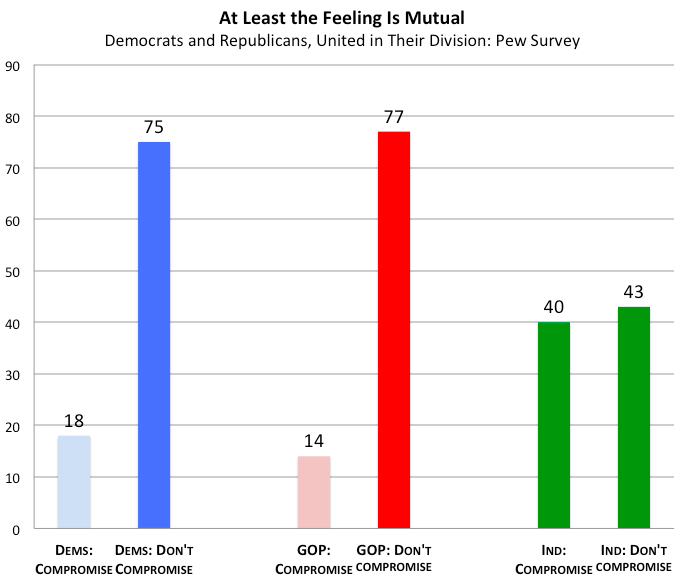
Neither want to back down to end the shutdown:

Don't Compromise

Derek Thompson sees it as “another reason why this shutdown isn’t likely to end any time soon”:

As Molly Ball reported today, Democrats told pollsters for The Economist that they value compromise, much more than Republicans conceded. But in this specific debate, at least one poll has Americans practically perfectly divided on the issue of compromise.

Collender bets that the shutdown will continue for some time:

I see the shutdown lasting at least another week…and two or three more weeks after that are becoming increasingly likely. I’m also raising the likelihood of the debt ceiling not being raised by October 17 — the date Treasury says it will be needed — to 1 in 3 instead of my previous estimate of 1 in 4.

The View From Your Shutdown

Stories for our popular series continue:

I’m a federal employee furloughed from my job teaching at one of the military academies. Our academy leadership decided to keep classes running while the 30% of our faculty who are civilian had to stay home. That means not only that civilian faculty like me have no work and no pay, but military faculty are teaching two or three sections of cadets combined. Some upper-level classes have been suspended, and fourth-year cadets who need these classes to graduate may be in danger of not meeting their course requirements for graduation. But pretty soon it will be hard to give them credit for the courses.

Another:

I am yet another furloughed employee in the DC area. I am frustrated. I am sick of being demonized. I have had to turn off the news because I just get a lump in my throat every time someone asks why the government even has nonessential employees or a Congressman says he is keeping his paycheck because he earned it. I felt like Congressman Neugebauer was talking to me when he was yelling at that poor park ranger. Since when was doing your job something to be ashamed of?

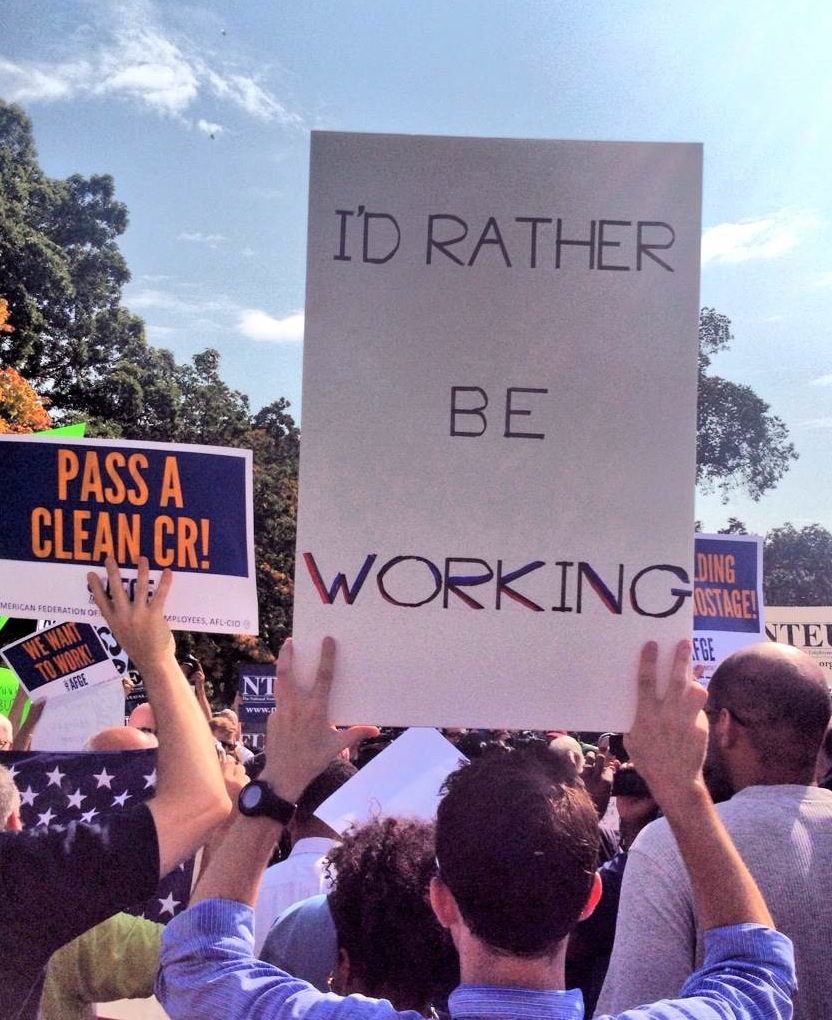
Yesterday I got an email from my employees union saying they would be rallying at the Capitol photo (27)today. Since I can’t be at work, I wandered down there this morning. I saw hundreds of employees from the various federal employee unions chanting “We want to work!” and “Let them vote!” I’m a little embarrassed to say it, but I teared up. I’ve been a union member for years, but it wasn’t until this year that I realized just how important they are. They are looking out for us when no one else is. There were numerous members of Congress out at the rally, too, expressing support. I didn’t see one Republican though. Not one. They hate us. For doing our jobs. And their behavior has just made a big union supporter out of me!

I read to my son every night. Lately he has been asking for us to read a children’s Bible he got for his Baptism. Last night I read the story of how Jesus was so kind to Zacchaeus the tax collector. I know the federal government isn’t perfect, and I fully support making improvements. I just wish these nominally Christian right-wingers would stop demonizing all of us and start looking at the logs in their own eyes.

Another:

My husband is a real estate agent and recently sold a house that was owned by a federal government employee.  The government was paying for the relocation, but as a result of the shutdown, the payment of the real estate commission is being held up.  In his case, it is $14,000 he was expecting at the first of this month, but won’t get until the shutdown is over and then know who knows how long after that.

One of several more readers:

I do not now work for the federal government and am following my usual schedule, but the environmental change in DC is huge.

It took me less than 30 minutes to get to my destination in downtown DC today, unheard of for a Monday morning even when Congress is not in session. At Union Station, most of the restaurants have substantial amounts of their dining areas closed off and the remainder sparsely populated – they have to be hurting.  The Starbucks, whose line usually extends at least 20 feet out into the station, had half a dozen people waiting. The whole place was hushed – and it’s usually a three-ring circus on weekdays at lunch hour.  Dupont Circle looks dead.

But I had to smile this weekend.  Some roads in Rock Creek Park have been left open as they really are major traffic routes, but most are blocked off, as are all picnic and recreation areas.  But on this sunny Sunday, cars were parked right up against those barriers and on nearby level grass, and people were having picnics, playing frisbee with dogs and otherwise enjoying THEIR park.  I saw one young woman in riding clothes exit her car near a barrier and stride off defiantly in the direction of the stable.  The parks belong to the people.  Dammit, the whole country belongs to the people.  This is a farce.  Just hope it ends before becoming a tragedy.

Another:

A point yet to be brought up is that American students living abroad are coming to that time of having to pay for their terms. I’m currently an overseas student, who thanks to school support and financially well-off parents, does not have to worry about this. But I have more than a few friends who are currently abroad with ZERO loan money being disbursed out, even though it’s being reported that this should not be a problem for a majority of loan programs.

This is not only an issue from an education standpoint, but a livelihood one,as well. These people are having to rely on infrequent, and expensive money wires or close friends to get by. Furthermore, if you want to talk about US prestige in the eyes of the international community, nothing looks worse than the government being a deadbeat dad and failing to pony up funds for education. All is not lost, as some universities are developing schemes of directly loaning American students money against what they say they will pay. But this is still deplorable state of affairs being largely ignored by those most responsible.

Another:

As I read these stories of the effects of this shutdown on employees of the federal government and the businesses like hotels adjacent to national parks, and how the effects cascade down to the people who depend on those employees and businesses for their livelihoods, the phrase “trickle-down economics” keeps coming to mind. It would seem that “trickle-down” actually works after all, but not in a very good way.

Reality Check

The Washington Post finds that Americans are increasingly unhappy with the GOP:

WaPo Polling

Larison analyzes the poll:

It’s true that most voters aren’t pleased with Congressional Democrats or Obama, either, but both the extent and the intensity of disapproval are significantly worse for the GOP. (Strong disapproval of Republicans’ handling of things among registered voters is a little higher still at 53%.) That’s not a surprise when no one, including Republicans in Congress, can explain what the GOP hopes to achieve at this point.

Pew’s latest (pdf) shows that a plurality of Americans blame Republicans for the shutdown and that fewer Americans are blaming Obama:

Pew Polling

JPod tries to talk sense into GOP partisans: