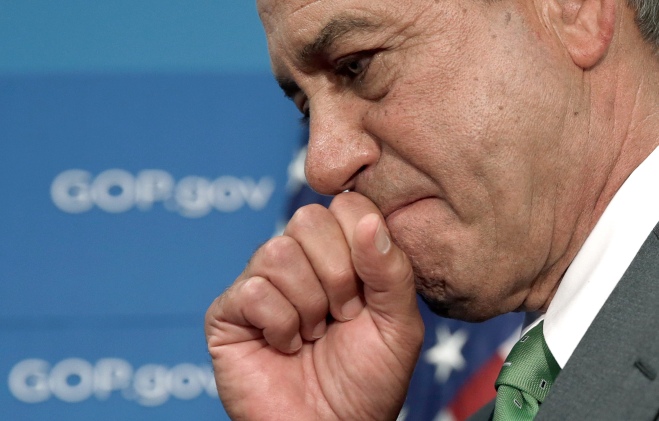
The Illogic Of The GOP’s Spin

Beutler observes that the GOP’s shutdown and debt ceiling strategies are at odds:

Once the Treasury can no longer borrow to finance deficits, it will have to arbitrarily slash spending on everything the government does — from defense, to social insurance, to medical research, and eventually to debt service.

The government currently borrows about 30 cents on every dollar, which means that irrespective of the impact on U.S. creditworthiness and global financial markets, the effects on these services will be enormous. … [T]he House has already attempted to force Treasury to prioritize interest payments to U.S. creditors — to “Pay China First,” as Democrats say — and benefits for Social Security recipients in the event of a breach. That effort failed. But if it had succeeded, it would mean everything else — all the things Republicans are rallying around right now — would take a harder hit if U.S. borrowing authority lapses this month.

The GOP’s current position thus boils down to to the laughable idea that nothing’s more important than reopening federal monuments, funding clinical trials, and spending money on veterans services for two weeks, until we breach the debt limit and they have to be shut down again.

The Tea Party Doesn’t Want Compromise; It Wants Surrender

Supreme Court Hears Arguments On Constitutionality Of Health Care Law

Christopher Parker, co-author of Change They Can’t Believe In: The Tea Party and Reactionary Politics in Americaexplains why the Tea Party caucus is immune to compromise:

They refuse to compromise because, to them, compromise is capitulation. If you go back to [Paranoid Style of American Politics author Richard] Hofstadter’s work when he’s talking about when the John Birch Society rode high, he talks about how conservatives would see people who disagree as political opponents, but reactionary conservatives saw them as evil. You can’t capitulate to evil.

McKay Coppins makes related points:

From its genesis in 2009, the Tea Party movement has been fueled by the rhetoric of revolution. True believers attend rallies unironically dressed in colonial garb.

Their early organizers preached earnestly from Saul Alinsky’s left-wing activist handbook Rules For Radicals — a book that advises just the sort of procedural disruption they’ve imposed this week. And while Nevada Senate candidate Sharon Angle outraged mainstream political observers when she suggested people may start looking for “Second Amendment remedies” to the country’s problems, one recent survey showed that nearly half of Republicans believe armed insurrection might be necessary “in the next few years.”

Data points like those have long been Democrats’ bread and butter as they work to cast the Tea Party as “extreme.” But they also show just how extreme conservatives consider America’s current peril to be. To believe an armed revolution could realistically be on the horizon is to live with the genuine suspicion that your government could, at any point, be overtaken by tyranny. In that context, some temporary furloughs seem like a small price to pay.

Kilgore adds:

71% [of Tea Party conservatives] think Obama is “destroying the country.” Wow. So is it any great surprise that these same people, and the House members who identify with them, are willing to go to dangerous lengths to mess up Obama’s signature policy achievement and force a significant change in the federal government’s direction? Who cares about the risk of destroying the economy if the destruction of the country itself is the current trajectory?

(Photo: Wearing what she calls ‘war paint,’ Susan Clark of Santa Monica, CA rings a bell while demonstrating against Obamacare outside the U.S. Supreme Court on March 28, 2012 in Washington, DC. By Chip Somodevilla/Getty Images)

How The Shutdown Hurts Our Museums

US-POLITICS-ECONOMY-BUDGET

Federally-funded museums receive about 30 percent of their funds from private sources, but as Katherine Boyle notes, the shutdown may cause those donors to be less generous in the future:

This week, the National Gallery of Art turned away the prime minister of Greece, Antonis Samaras, and Adrienne Arsht, the philanthropist who underwrote the gallery’s most recent blockbuster exhibition, “Diaghilev and the Ballet Russes.” Samaras was supposed to view a Byzantine art exhibit co-sponsored by groups from his country. Arsht was set to throw a large party for patrons who wanted to visit “Diaghilev” one last time. Both were canceled due to the government shutdown.

And therein lies a lesson about why the shutdown is even worse for Washington’s museum sector than you might think. In short: The Smithsonian and other federally funded museums rely in significant part on private funding – but the shutdown inhibits their ability to raise even the private funds. … One of the big selling points at the Smithsonian and the National Gallery is that these museums are funded by the federal government, and because of that, will always be free and open to visitors who otherwise couldn’t afford an entrance fee of $15 or more. Shutdowns are a reminder that there are drawbacks to federal reliance, and that Smithsonian leadership is beholden to the whims of Congress. Prolonged closure could lead some patrons to send their gifts to the Met or MoMA …

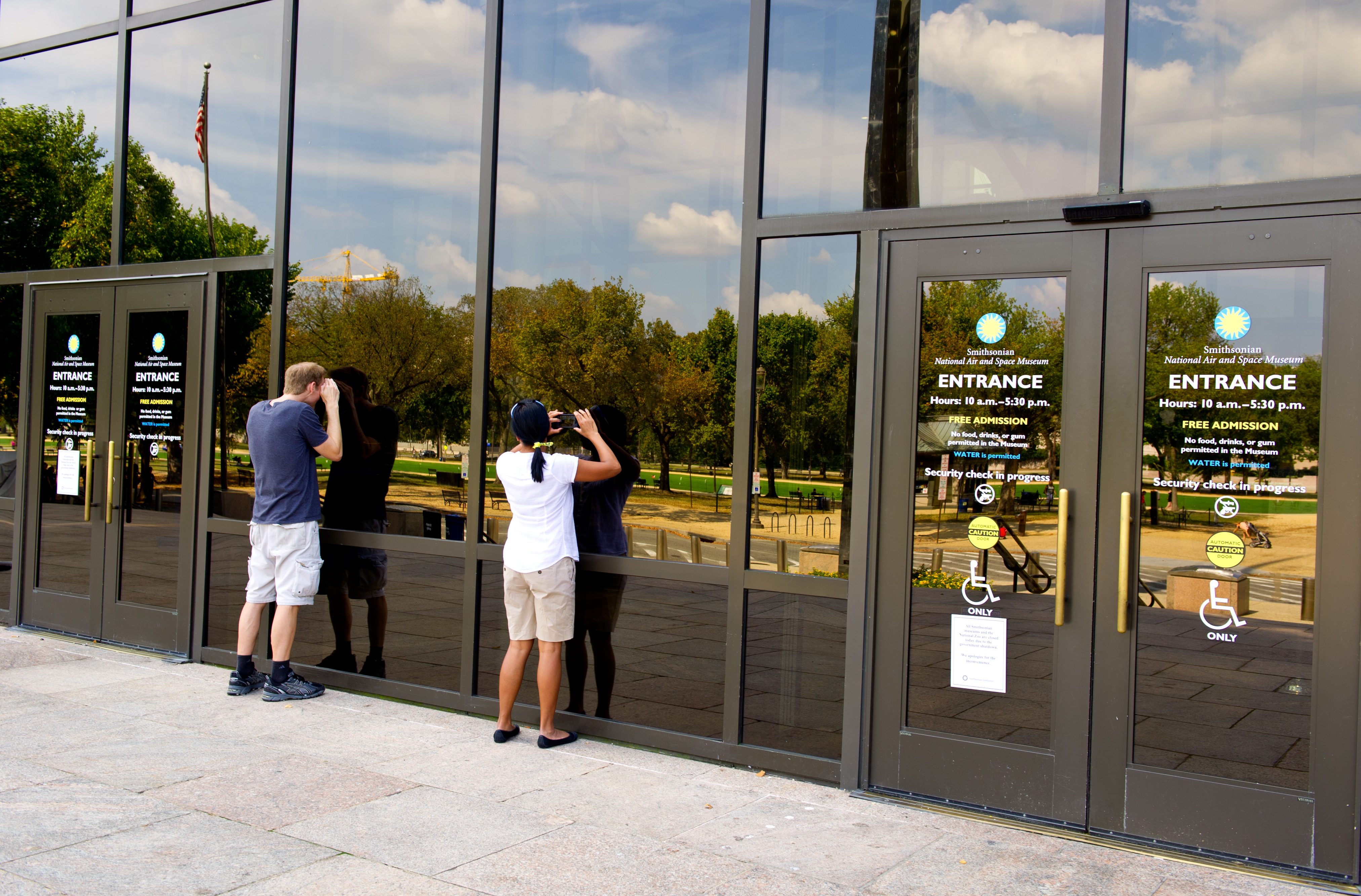
(Photo: Tourists peer into the closed Smithsonian National Air and Space Museum on October 5. By Karen Bleier/AFP/Getty Images)

Default Isn’t The Only Danger; A Global Depression Is

Markets Watch As Government Shutdown Continues

If the debt ceiling isn’t raised, a Goldman Sachs paper argues that the Treasury could probably prioritize debt payments and avoid default. Krugman is not reassured:

They don’t sound too confident. But even if they’re right, the government would still go into arrears on many other payments, from contractor bills to medical bills. And it would be forced into savage spending cuts, around 4 percent of GDP, that wouldn’t just cause hardship (Surprise! No Social Security for you this month!) but amount to a severely contractionary fiscal policy, sending us into recession if it lasted any length of time.

I think this is important. Lots of people have been focusing on the possibility of a mega-Lehman event, but even if we somehow avoid that, this will be a catastrophe.

Neil Irwin cautions against finding comfort in the relative calm of the financial markets:

Market sentiment can barely move for a very long time — and then take a dramatic shift all at once.

There were warnings that Lehman Brothers could collapse throughout the summer of 2008, but only after its bankruptcy on Sept. 15 of that year did the financial world come unglued.  In 2011, the warnings that the debt ceiling negotiation could get ugly had been sounded for months — but only turned into an extraordinary bout of volatility about a week before the bill came due for the U.S. government.

Markets are prescient, in other words, except when they’re not.

Ezra’s take:

Analogies between the finances of families and government are typically pretty flawed. But there’s one worth drawing here: That moment when a family realizes it’s broke and stops paying their mortgage, credit card bill, etc? It’s not a good moment for them. It’s a moment that wrecks their credit score and makes it harder for them to be “not-broke” ever again. To try and improve the U.S.’s finances by sharply and permanently increasing its borrowing costs is like trying to prove to your sister that her house is a firetrap by actually setting it on fire.

(Photo: A trader works on the floor of the New York Stock Exchange on October 7, 2013. As the impasse continues between the Republicans and Democrats in Washington, the Dow Jones Industrial Average, the S&P 500, and the Nasdaq all dropped by nearly 1% Monday. By Spencer Platt/Getty Images)

The Impeachment Scenario

Should Obama raise the debt ceiling himself, Humphreys expects that the GOP House would attempt to impeach the president and that impeachment proceedings would blow up in the GOP’s face:

[I]f the Tea Partiers impeach President Obama, it will be hard to persuade anyone not suffering from epistemic closure that two Democratic Presidents in a row just happened to deserve impeachment. The public’s attention and attributions would shift to the radicals in the Republican ranks: Why have these people impeached every Democratic President elected in the last 20 years?

… Presidential impeachment would thus, like everything else the Tea Party is currently doing, be popular in their echo chamber but help convince the rest of the country that they are a dangerous and irresponsible force in U.S. politics. It’s not therefore something that Obama should fear. Indeed, he might even welcome it.

Eric Posner reviews the ways Obama could justify unilaterally raising the debt ceiling. Perhaps the most promising option:

[T]he president can declare an emergency and justify borrowing by citing reasons of state. What exactly he should say is a political, not legal, matter. The declaration could be garlanded with quotations from the founders, or festooned with solemn appeals to the examples of Lincoln and FDR who also acted unilaterally in the face of crisis. The president could invoke his “inherent” executive powers under Article II of the Constitution (which vests the president with mostly undefined “executive” powers); he could even cite the 14th Amendment or offer a strained interpretation of the relevant statutes or don whatever other leaves his lawyers pluck from the potted fig trees kept at the ready in the White House Counsel’s office.

But whatever he says, the reality and the implication will be that the law has run out and he is acting in the common good because Congress has plunged the nation into a crisis.

There Is No There There

Boehner, House Leaders Speak To Press After Republican Conference Meeting

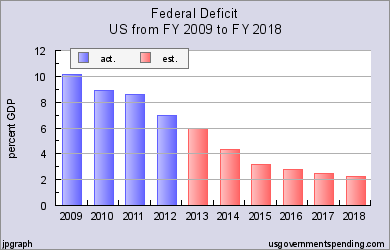
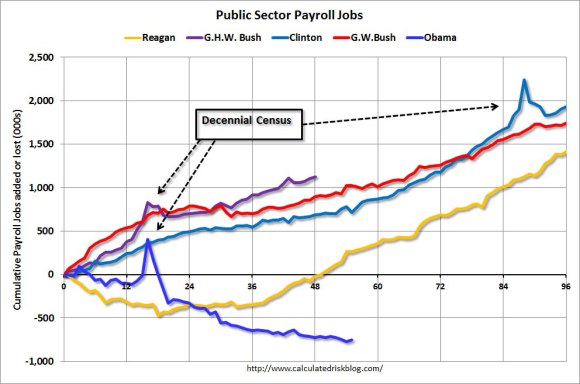
What does the GOP want? It’s a question I keep asking myself. They say they want to kill Obamacare because it is allegedly killing jobs. But in order to do that, they are threatening a default that would wipe out more jobs than the collapse of Lehman. They say they want to reduce the deficit, but the deficit has been falling extremely fast these past few years – in part because of the sequester they got out of their last hostage-taking event in 2011. Government spending has already been pummeled in this recovery – far more so than in past recoveries.
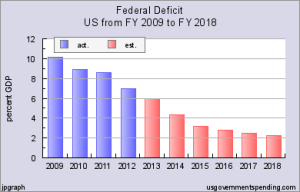
usgs_line.phpThey say they want to reverse what they see as the end of American freedom because of the dawn of public subsidies for private insurance policies, based on a Heritage Foundation idea and implemented by their last presidential nominee in his home state. Okay, so how about running a campaign for Congress and presidency that explicitly promises to repeal Obamacare entirely? Oh, yes, they already did that and lost. How about upping the ante and making it explicit in the campaign that this is the very last chance to end Obamacare and save America? Oh, yeah, I forgot. They did that too.  So what do they want? I’m not sure they even know.

My best guess is that since they failed to make Obama a one-term president, they now intend to do what has become their custom with second-term Democratic presidents: impeach him. How to do it? Risk blowing up the entire global economy, bet on Obama caving at the end by some kind of dubious executive action, and then prosecute him for it. And what would that do exactly? It would not end Obamacare. But it would throw us instantly into both a Second Great Depression and a severe constitutional crisis.
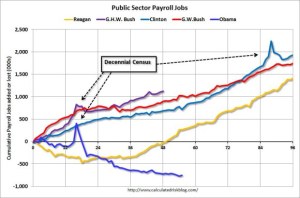
public-sector-jobsI simply do not see here any actual constructive strategy to help the country recover from the worst recession in decades. I see absolutely no strategy to deal with what everyone agrees is a deeply dysfunctional and grotesquely inefficient healthcare system. I see no viable way to bring down the long-term debt, because such a goal can only be achieved in our system with compromises from both parties, and the GOP is offering nothing that only the Democrats want. That’s why this is such a serious crisis, because the key driver of it has no real idea what it wants to do except destroy a re-elected president.

This is a function of many factors the Dish has covered for years – the intellectual bankruptcy of conservatism under George W Bush; the rise of fundamentalist thinking in religion, economics and politics; the cultural marooning of the white rural conservativesoulpbc.jpg poor; the substitution of a political party with a media-industrial complex that simply wants conflict for ratings and money; the collapse of anything that might be called a conservative intelligentsia able to converse with a liberal intelligentsia on common, empirical grounds; the cowardice of Republican elites in the face of their know-nothing wing, epitomized most brutally by John McCain’s selection of a delusional crazy person as his vice-presidential candidate in 2008; and the recourse to purism of an almost absurdist variety on the right – see Mark Levin’s influential view that the entire Constitution needs to be made over.
The GOP vacuum – for what else can we call such a nihilist temper tantrum? – was best encapsulated for me by a story in yesterday’s NYT. It featured a district gerry-mandered for Palinism, one that seems very reminiscent of the Greenberg-Carville focus groups cited here. This is where my heart sank:

Mr. Tripcony, the surveyor, said he underwent heart surgery not long ago without health insurance, “a bad blow.” He has been making payments against the cost. He had heard of the online marketplace for insurance that opened on Oct. 1 under the Affordable Care Act.

“I just don’t trust it,” said Mr. Tripcony, who has an equal distrust of President Obama. “I don’t like him, and I don’t feel comfortable with anything he’s got to do with.”

Mr. Tripcony said he had a better idea for a system to provide health care at a fair price. “I think it should be the same for everybody,” he said. “One big company, whether owned by the government or private.” Informed that he had described the single-payer system that Mr. Obama abandoned when Republican critics called it socialized medicine, he said, “Yeah, I know, it’s crazy.”

He said he might eventually seek health insurance under the new system. “In a couple of months, when they get the Web sites working, I may do it.”

Mr Tripcony is doing us a favor. He is telling us the truth. This crisis has almost nothing to do with actual policy – as you can see from a base Republican’s rational support for a single-payer healthcare system and willingness to get Obamacare insurance. There is nothing to the current Republican strategy but blind, irrational hatred for a re-elected president: “I don’t like him, and I don’t feel comfortable with anything he’s got to do with.” Somehow, this “feeling” must be granted some “relief”, or they will bring down the world economy. But any relief granted on these terms would simply pave the way for more economic terrorism and blackmail in the future, which would mean an end to our system of government.

The GOP have driven themselves into a tight, airless corner of ideological purity and self-destruction. The trouble is: their own self-destruction means ours as well. And the world’s.

(Photo by Getty Images; graphs by US Government and Calculated Risk; cover from The Conservative Soul)

The Democrats Already Compromised

Tomasky makes an important point:

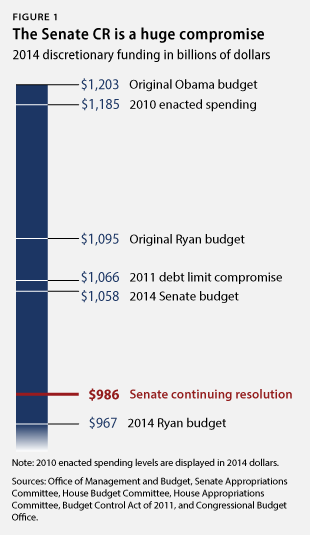
The Senate CR funds the government in the coming weeks at aCR_compromise level of $988 billion. The Democrats wanted $1.058 billion. But they passed a bill at Republican levels. Senate Majority Leader Harry Reid said late last week: “My caucus really didn’t like that. We took a real hit…So that’s one of the largest compromises since I’ve been in Congress.”

Now why did they pass a bill at the GOP’s preferred levels? Because, Reid said late last week, he had assurances from Boehner that the House speaker wouldn’t attach demands to the Senate CR if Reid brought it in at $988 billion. So this whole thing started with a significant Democratic compromise. But once the Republicans decided that they were going to use both the shutdown and the debt ceiling to try to defund and/or delay Obamacare, they couldn’t even vote for a bill that gave them a major fiscal victory. That’s how dug in and crazy they are.

Benjamin Wittes blames the shutdown on the GOP:

I am, generally speaking, a pox-on-both-houses kind of guy, but I have trouble seeing it that way this time.

It was the House Republicans, after all, who attached these conditions to the continuing resolution, thus putting the President in an impossible situation—one in which he either lets the government shut down or both gives up a signature domestic initiative and, along the way, makes clear the presidency’s vulnerability to the most grotesque types of brinksmanship and extortion. No president worth his salt would negotiate under these circumstances—and the responsibility for the situation is thus not even between the parties. One side, and only one, created this crisis.

Richard Posner – a sane libertarian – agrees:

Republicans are not in a position to repeal or even amend the law by constitutionally authorized means, because repeal or amendment would require a majority vote in both houses of Congress (actually a two-thirds vote in both houses, for given a lesser majority Obama could veto a repeal or amendment without fear of being overridden). The intention, which is contrary to the structure of the federal legislative process ordained by the Constitution, is to coerce Congress to repeal (or by amendments to defang) Obamacare by threatening to precipitate an economic crisis by refusing to vote for an increase in the debt ceiling. If the tactic succeeded, it would mean that a minority in Congress had succeeded in amending a federal statute.

(Chart from the Center For American Progress)

The GOP’s Demands Aren’t The Issue

Costa passes along the GOP’s latest offer:

What I’m hearing: There will be a “mechanism” for revenue-neutral tax reform, ushered by Ryan and Michigan’s Dave Camp, that will encourage deeper congressional talks in the coming year. There will be entitlement-reform proposals, most likely chained CPI and means testing Medicare; there will also be some health-care provisions, such as a repeal of the medical-device tax, which has bipartisan support in both chambers. Boehner, sources say, is expected to go as far as he can with his offer. Anything too small will earn conservative ire; anything too big will turn off Democrats.

They still don’t get it, do they?

Look: I favor a more aggressive long-term look at, say, means-testing Medicare and chained CPI. I do not believe the debt is a burden now – it may well be a vital asset for a bit – but I do think getting it down is a top priority for the future. But that kind of big future debt compromise cannot and must not be linked to a threat to blow up the global economy.

Pass a clean CR, get rid of the entire debt ceiling process, and then negotiate a Grand Bargain. Such a Grand Bargain would require a give from both sides. There’s no way Democrats should agree to tax reform without more revenue, for example. That was key to the 1986 reform. As for the lesser items being demanded, like the medical device tax, under normal circumstances, you might think of it as a trade-off worth being part of the negotiations. But, as Drum notes, these are not normal circumstances:

A month ago, Democrats might have shrugged over the device tax. Today, they know perfectly well what it would mean to let it go.

It means that when the debt ceiling deadline comes up, there will be yet another demand. When the 6-week CR is up, there will be yet another. If and when appropriations bills are passed, there will be yet another. We’ve already seen the list. There simply won’t be any end to the hostage taking. As their price for not blowing up the country, there will be an unending succession of short-term CRs and short-term debt limit extensions used as leverage for picking apart Obamacare—and everything else Democrats care about—piece by piece.

Schumer put it well over the weekend:

Someone goes into your house, takes your wife and children hostage and then, says, let’s negotiate over the price of your house.

While trashing it with a party of Miley-level nihilism.

“A Domestic Cuban Missile Crisis”

That’s how Chait aptly describes the situation in Washington right now:

The standoff embroiling Washington represents far more than the specifics of the demands on the table, or even the prospect of economic calamity. It is an incipient constitutional crisis. Obama foolishly set the precedent in 2011 that he would let Congress jack him up for a debt-ceiling hike. He now has to crush the practice completely, lest it become ritualized. Obama not only must refuse to trade concessions for a debt-ceiling hike; he has to make it clear that he will endure default before he submits to ransom. To pay a ransom now, even a tiny one, would ensure an endless succession of debt-ceiling ransoms until, eventually, the two sides fail to agree on the correct size of the ransom and default follows.

This is a domestic Cuban Missile Crisis. A single blunder could have unalterable consequences: If Obama buckles his no-ransom stance, the debt-ceiling-hostage genie will be out of the bottle. If Republicans believe he is bluffing, or accept his position but obstinately refuse it, or try to lift the debt ceiling and simply botch the vote count, a second Great Recession could ensue.

I’m afraid I agree. And the causes are deeper than can be overcome by a man of Boehner’s limited skills.

The Best Of The Dish This Weekend

Like many of you, I bet, I took cover this weekend, after a politically terrifying week. Except there is no cover, as today, Speaker Boehner insisted he’d keep the entire federal government shut down and default on the nation’s debt unless the president agreed to suspend universal healthcare and agree to some kind of entitlement reform with no new revenue. He seemed to think this was a routine kind of thing, rather than a completely unprecedented act of economic terrorism to subvert our system of government. But, hey, he’s not in charge is he? No one is.

Meanwhile, Bibi Netanyahu tried to reach out to Iran’s people – who all want a nuclear program – with his trademark charm. His money quote:

“If the people of Iran were free, they could wear jeans, listen to Western music and have free elections.”

For the general response, see above, and here. Does Netanyahu know that Iranians have Twitter? Or does he really believe it’s 1938 again?

Meanwhile, several gems from the weekend: this face; Oakeshott’s description of religion; why Kubrick is so much greater an artist than King (Aaron and I watched The Shining and Room 237 last night); the joy of poetry for children.

The most popular post? Why They’ll Die On This Hill, made more relevant by this chilling piece in the NYT. The second? The Nullification Party, amplified today by the great Colbert King.

See you in the morning.