Why Hasn’t Big Business Stopped The Shutdown?

Josh Green examines the rift between the GOP and the U.S. Chamber of Commerce, a major GOP donor:

On Oct. 1, House Republicans ignored the Chamber’s pleas to keep the government running. The shutdown is costing the U.S. economy $300 million a day, according to IHS (IHS), a global market-research firm, and it’s only the latest sign suggesting that the old adage, “Republicans are the party of business,” no longer holds true. From the austerity imposed by sequestration to the refusal to reform immigration laws to the shutdown and now, as appears likely, another debt-ceiling showdown when U.S. borrowing authority expires on Oct. 17, the GOP’s actions have put a strain on one of its most valuable partners: the business community.

Drezner asks, “given the Chamber of Commerce’s tilt, why aren’t GOP representatives listening more closely?” Larison’s answer:

Because the Chamber of Commerce leans so heavily towards the GOP, Republican politicians may conclude that they can ignore some of its complaints without provoking the group to shift more of its support to the other party. Consistently and overwhelmingly favoring one party over another signals to party leaders that your group’s concerns can be dismissed more easily when the leaders have other priorities. The Chamber’s support for Republicans is being taken for granted because that support is so lopsided in the GOP’s favor, and as a result it sometimes has much less influence with what the party does in Congress than one would expect.

Hewitt Award Nominee

“President Obama will negotiate with the Syrian butcher Assad and erase his red line, will capitulate to Vladimir Putin, and he will negotiate with the happy face of the killer regime in Iran, President Rouhani, but not with Republicans over issues all presidents have always negotiated over,” – Hugh Hewitt. (Award glossary here.)

It’s worth noting Hewitt’s constant lies. What president has ever “negotiated” repealing a duly enacted law because one faction in one House has decided that it will shut down the government and destroy the US and global economy if he doesn’t? When has such a thing ever happened before? What are the Republicans offering in return? Nothing but the maintenance of basic government functions. As Ponnuru has noted:

Many [House Republicans] want to force President Barack Obama to make major changes to his health-care law, and in return give him nothing but the debt-limit increase. There is no precedent for the satisfaction of such demands.

In contrast, Hewitt baldly states that all presidents have always done this. Hewitt is not a fool, just one of the most shame-free liars and propagandists in the public arena. And he intends to keep lying, to keep calling this the Democrats‘ shutdown, to keep repeating lies until they can gain some patina of truth among his followers.

Who’s Blamin’ Who?

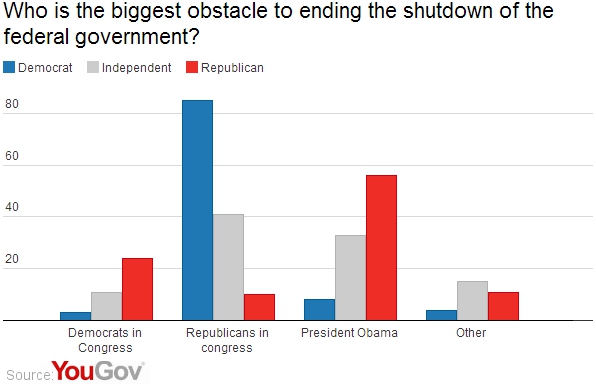
Shutdown Obstacle

YouGov’s latest:

The latest research from YouGov, conducted in the first two days of the shutdown, shows that half (50%) of Americans blame Republicans in Congress for the continuing shutdown. 11% blame Democrats in Congress while 29% blame President Obama for not ending the shutdown. This divides along partisan lines, with Democrats tending to blame Republicans and Republicans tending to blame the President or Democrats. Independents, however, are largely split, with 41% blaming Republicans in Congress and 33% blaming the President.

I’d find the narrow split among Independents unnerving, if I were the president. 33 percent blame the president for the shutdown and impasse? Given that he has already conceded sequester-level spending, and has cut the deficit in the last three years by the swiftest amount since the end of the Second World War, what else do they want him to do? If he were to abandon his signature domestic achievement after re-election, because of blackmail, we might as well give up on elections and representative government altogether. All round, this does not seem to me as a battle either side will “win” as such. Right now, as Harry Enten notes in a review of the polls, “no side is winning, one side is just losing by less”:

More Americans disapprove than approve of the job being done by all three actors in the dispute over the federal budget. President Obama comes out “ahead” in the ABC News/Washington Post poll with a -9pt approval rating. Both parties in Congress are much lower. Democrats in Congress manage to maintain a net approval of -22pt, while Republicans in Congress fall to a -37pt approval rating. These are all awful. …

A new CNN/ORC poll puts the net favorability rating of the Democratic party at -9pt: its lowest since CNN started asking the question in 2006. Republicans, too, are at their lowest level since 2006 as well, with -30pt favorability. A large portion of the difference between the parties’ favorability is that Tea Party supporters are less likely to hold a favorable view of Republicans than Tea Party opponents are of Democrats.

Meanwhile, Weigel highlights a Fox News poll with some bad numbers for Republicans. This one – compared with the last Fox News poll – stood out to me:

A tumble in the GOP’s favorable rating to 35–59, with 59 percent unfavorable marking the highest level in the history of the poll.

Of course that just might be the Tea Partiers frustrated that the GOP isn’t being radical enough in bringing the government and the economy into collapse.

What A Functional Republican Party Might Offer

Ramesh admits that the GOP’s debt ceiling demands are unprecedented:

Look back at every previous piece of legislation that raised the debt limit while also making changes to other government policies, and almost always the debt limit was the occasion for a bipartisan deal rather than the achievement of only one party’s goals.

As part of a debt-limit deal, he encourages Republicans to “offer a temporary increase in spending from the levels of sequestration in order to delay the time when the Internal Revenue Service starts fining people for not buying insurance.” His other suggestion:

[A] deal should include policies that minimize the potential damage of a future debt-limit standoff. The most important one would be a law stipulating that even if the debt limit is breached in the future, the government will still be authorized to make debt-service payments in full, taking a default off the table. Republicans in the House have already passed a bill that would come close to doing this. Once this change is enacted, hitting the debt limit would mean having a partial government shutdown — which isn’t great, but not the disaster a default would be.

The GOP Doesn’t Know It’s Losing

That’s the suspicion of First Read:

Despite polls showing that more Americans are blaming Republicans than Democrats for the shutdown, and despite establishment Republicans admitting they aren’t winning this fight, conservatives aren’t backing down. In fact, they feel they have survived the fallout from the first few days. Case in point is Sen. Rand Paul’s (R-KY) admission in that hot-mic moment that “We’re gonna win this, I think.” Is that the reality of this standoff? Or it is simply due to the conservative echo chamber? After all, one of the major differences between the last shutdown (in 1995-1996) and now is the rise of FOX News, Drudge, and Breitbart News. As the New York Times recently wrote, “a fervent group of conservatives — bloggers, pundits, activists and even members of Congress — is harnessing the power of the Internet, determined to tell the story of the current budget showdown on its terms.” It explains why conservatives aren’t as convinced as many others are that this will do significant damage to the party.

Larison connects shutdown spin to the larger GOP misinformation problem:

Some Republicans are making all of the same mistakes that they made when they ignored all of the evidence suggesting that the GOP was likely to lose in 2012. Most of the time, the echo chamber hurts conservatives and Republicans by making them oblivious to inconvenient facts and ideas, but in this case it is leading them to believe in an alternate political reality with its own set of rules.

In a follow-up, he tackles Kristol’s latest nonsense.

Democrats’ Message Discipline

It could use improvement, starting with the ever-insufferable Harry Reid:

Drum face-palms:

Democrats need to have better answers, and they need to explain just why the Republican CRs are such contemptuous exercises in trying to gull the American public. … [Reid] sounds as though he’s comparing some furloughed civilian workers in his home state with kids who have cancer. Fair or not, that’s going to sound bad.

Weigel describes the current GOP strategy as “take credit for trying to save cancer kids from heartless Democrats”:

Reid had made a mistake—a gaffe, if you will. He could have said something about how his Democrats had passed several continuing resolutions that would have funded the NIH, or that the sequestration cuts also tagged the NIH, or that the Republican budget recommendations also cut back NIH funding, or that there were probably plenty of poor kids with TV movie ailments in states where Republicans had opted out of the Medicaid expansion—well, whatever, instead he rejected the premise and insulted the reporter. He did not actually say “I don’t care about kids with cancer,” but his partial quote was enough to make the Drudge Report, Hannity, and the rest of the reliable wurlitzers of conservative opinion.

Snowballing Dysfunction

Gleckman worries about the consequences of any surrender to economic and fiscal blackmail:

Just take a look at what’s happened to the Senate in recent years. Once, filibusters were rare exceptions. Now, they are constant. Nearly every bill, no matter how trivial, requires 60 votes for passage in a body that historically required a mere majority.

Similarly, presidential nominations are now routinely blocked for reasons only occasionally having to do with the qualifications of the nominee. Lawmakers have learned that they can take a nominee hostage in order to send an ideological message or convince an administration to change a regulation.

As a result, behavior that was once rare has become as routine as the Senate’s daily prayer. … I fear the same is about to happen with government shutdowns. Once those who would use the shutdown as a useful legislative lever succeed, it will become a tool of choice. True, it couldn’t be used in every circumstance, but there would be enough opportunities to make it the next filibuster.

Which is why the fightback for constitutional governance and political moderation begins now.

Why The President Won’t Cave

Beutler spells it out:

The whole point of Obama’s refusal to negotiate is that what Republicans are actually demanding is to fundamentally alter the power balance between the legislative and executive branches of government. If Obama caves and offers concessions to Republicans in exchange for a debt limit increase, it will clearly weaken the presidency. By contrast, if Republicans “cave” and increase the debt limit cleanly, Congress will lose none of its fundamental power.

Moreover, senior administration officials are confident that if Obama establishes the precedent that the president should yield concessions to the opposition on a threat of default, eventually the opposition will demand something so impossible that a default will happen anyhow. Taking a hard line now is the only way to prevent that.

A more concise description of Obama’s thinking:

[I]t would be a complete abdication, in [Obama’s] mind, to leave the next president vulnerable to the nullification of his or her election.

Yes, that is indeed where we are: nullification again.

The View From Your Shutdown

A reader writes:

My 80-year-old father-in-law is a Korean War vet and was 11 when we invaded Normandy. He has not been abroad since he returned from his tour in 1956. As part of his 80th birthday celebration, my wife asked that we find a way for me to take him to Europe to see all the WWII sights he’s been reading about since he was a young boy. For over a year now I’ve been planning and saving for this trip, and we leave one week from today.

But we might be forced to miss it because of GOP obstructionism. The American cemetery at Normandy and Patton’s grave at the US cemetery in Luxembourg, you see, are administered by the American Battlefield Monuments Commission, so they are essentially national parks overseas and closed due to lack of funding. Sixty-nine years of waiting to see one of our nations most sacred sights, and most likely his only opportunity, and this good and decent man may miss it because a congressional leader doesn’t have the will to stand up to his radical fringe.

Another reader:

I know this doesn’t qualify under the window rules, but I wanted to share it anyway regarding the IMG_1586government antics. I’m out here in San Francisco on long vacation. Today, I hiked from the wharf out to the ocean. At my starting point, I saw confused and pissed-off tourists, locked out of Alcatraz, waiting in line to get refunds. One lady from Leeds, here with family on vacation, said, “Even our government isn’t this messed up.”

I ended my hike four hours later at my favorite bar, Louis’s at Land’s End. Despite its stellar view of the Pacific, it was deserted. A waitress told me that everyone was scared off because technically Louis’s, which leases its little aerie from the U.S. Parks Service, was supposed to be closed. “But the owner said screw ’em and opened anyway.” So thanks so the House Republicans, I had my Anchor Steam beer – and this view – all to myself.

Another:

I might just be one of the only federal employees who is saving money from being furloughed.

I’m an attorney with a very very long commute, and I’m not getting paid for my year-long fellowship.  So I’m not concerned about how this impacts me personally.  I am concerned, however, about the work that is getting put on hold.  I spend my days enforcing and investigating violations of civil rights laws, primarily the Americans with Disabilities Act and Fair Housing Act.  I’ve had to put a number of settlement negotiations on pause as the victims of discrimination wait patiently on the sidelines. It’s a very small group of us in our office doing this work, and we’re all sitting at home.  And believe me, our district is in dire need of a vigorous enforcement of these laws.

Another:

I work for a company that does a significant amount of business with the federal government. Our client list includes the EPA, Department of Energy, Centers for Disease Control and Prevention, Housing and Urban Development, and the National Institutes for Health. These are the kind of agencies that many on the right would likely target as non-essential under any circumstance and that they are comfortable with shutting down now.

But here are some of the things that these agencies do, just from the perspective of our work with them: reduce pollution in our water system, lower energy usage in buildings in a cost-effective manner, prevent people – especially children and the aged – from being exposed to chemicals and other hazards that could jeopardize their health or kill them, and encourage builders to construct homes that are environmentally sound and energy efficient. Just to name a few things.

So, I laugh (sort of) when those who support the shutdown talk about how we can get by without most of this stuff. I guess they don’t breathe, drink water, live in homes, work in buildings or have any illnesses in their families. They’re pretty lucky, I guess.

I feel a general sense of low-level anxiety at our company. We’re keeping busy right now with internal tasks but how long that can last, I have no idea. I suspect the next step will be asking/encouraging people to use vacation time, if they can. Then, who knows?

It’s really nice that some of the Republican “leaders” decided to make sure the old vets could visit the World War II Memorial. Maybe they could do something a little more constructive that doesn’t also constitute a photo opp.

Another:

I’m an Aerospace Engineer who evaluates safety issues for the FAA. A couple of my coworkers and I have been excepted to keep up on the highest priority tasks, and evaluating new potential issues as they come in. But 90% of my coworkers (most of whom don’t work full time on operational safety) are furloughed. If this extends for much longer we’re going to have to bring back more people, because as lower priority issues sit for too long, they tend to bubble up the risk scale, and we don’t want to have to start grounding airplanes. Luckily, we have the flexibility to initiate call backs.

Three years ago, before becoming a civil servant, I would’ve shrugged off the folks who claim these absolute minimum staffing levels constitute the proper amount of government. I might have even conceded the principle. But having seen the sausage being made, it’s amazing how little these small-government fetishists know about what gets done day to day. Oftentimes, zilch.

One more:

I’ve been reading the various iterations of your blog since the Pleistocene era of the blogworld. I finally [tinypass_offer text=”subscribed”] today. I’ve been meaning to for a long time, but today I pulled the trigger. Your blog is the only place where I’ve seen all these stories of people actually affected by the shutdown brought on by the virulent clown-show that is the modern Republican Party. This is the bit from one of your readers that pulled me in: “While the Neo-Confederate toddlers stamp their feet and hold their breath, it is America that is turning blue.”

I’ve long since fallen under the spell of your writing. But today made it clear to me that I’ve also fallen under the spell of your readers’ writing as well. It is this extraordinary back and forth between writer and reader – which is not to be found anywhere else on the intertubez – which is ultimately irresistible to me.

And us as well. Read the whole series here, as well as unfiltered response from readers on our Facebook page. Our ever-growing archive of reader threads is here.

The View From Your Shutdown

A reader writes:

I’m trying to bring my fiancee, who currently lives in Mongolia, to the United States on a K-1 visa. We were both ecstatic when my K-1 visa application was recently approved by U.S. Citizenship and Immigration Services. The next step is for the approved visa application to be forwarded to the National Visa Center, and from there to the U.S. Consulate in Ulaanbaatar, Mongolia. As I watched the news about the attempt to pass a CR, I thought that it was unfortunate, but wouldn’t affect me directly.

Then suddenly it occurred to me that visa processing was almost certainly considered a “non-essential” government service, so I looked it up, and sure enough, immigration services is one of the things that will be severely curtailed or completely halted by the government shutdown. Which means that my reunion with my fiancee, which had looked to be on track to happen by the end of the year, is now being postponed indefinitely until the shutdown is resolved.

Update from a reader:

I work for USCIS and I can assure you that this is not true. Immigration services within DHS and DOS are entirely fee based. Immigration paperwork is being processed as normal. The only delay will be the normal processing delay that accompanies any application or petition.

Update from the first reader:

It may be true that will USCIS will continue to operate as normal, but as I stated, my visa application has already been approved, which means that USCIS is no longer involved. The visa application has already been moved to the National Visa Center, and from there to the State Department. Per this document, guidance from State in anticipation of the 2011 shutdown indicated that State would severely curtail non-emergency visa-related activities.

I appreciate your effort to put a human face on this political farce.

One more update:

I am a Foreign Service Officer currently serving abroad.  In 2011, State Department guidance stated that visa services would be curtailed. This time around, we were given new guidance stating that all visa and citizenship services were fee based and would stay open (see Chapter 2, part C).  I hope that your reader can be reunited with his fiancee soon, and thankfully the shutdown should not slow down their reunion.

Another reader:

I work for the Indian Health Service on the Navajo reservation. My rural hospital is “essential” and we are still open for business. We are continuing to get paid, although we cannot take sick leave or vacation. It was heartbreaking to see one of our medical records employees coming back into work on Tuesday less than two weeks after having a baby. Like most of our staff, she is Navajo. The unemployment rate on the reservation nears 50%, so anyone with even a low wage job supports many extended family members. She could not afford to take unpaid leave.

As much as the shutdown impacts our staff, it hurts our patients more.

On October 1st, we got an email stating that we do not have funds to pay for medical care outside of our system. We do not employ cardiologists, oncologists, neurosurgeons, etc. All pending appointments that are not urgently life or limb threatening are cancelled until further notice.

Today, October 3, we got another email stating that our pharmacy does not have funds to buy medicines. We are only ordering medications that are “of a life saving and sustaining nature.” We already work hard to keep medication costs low. But now, for just one example, we are no longer able to stock medications to treat rheumatoid arthritis, a disease with particularly high rates in our population.

The United States government is bound by treaty to provide health care for Native Americans. The lack of a budget is gravely impacting our ability to honor that that obligation.

Another:

I am a furloughed government employee.  This government shutdown is so disheartening. I work in an office that deals with international issues and coordinates with the equivalent agencies in other countries.  We send delegates frequently to conferences to coordinate cooperative pilot programs, capacity building exercises for developing countries, and the negotiation of international agreements.  International meetings are on-going despite the shut-down, and the United States has lost its voice, investments, and subject matter experts for the time being.

It pains me that we have all be locked out of our offices and the missions we serve.  However, it’s merely the final step in a long line of insults: no cost of living increases for four years, endless budget uncertainty due to a revolving door of continuing resolutions, hiring freezes, cuts, and the still-continuing sequester.  My agency has not seen a Senate-confirmed leader in four years.  We have endured audits of 15 years worth of travel and conferences because of the GSA Law Vegas Scandal, though we had nothing to do with it. We are cautioned to not do anything that could be perceived as partisan in the wake of the IRS non-scandal, and have to make unnecessary, inconvenient, expensive accommodations to ensure that our office’s activities ensure money/attention flowing towards the states of the chairmen and ranking members of the congressional committees that oversee us.  We’re called leeches and ne’er-do-wells and told we “never created a single job.”

I hate the stereotypes that the Tea-Party has assigned government workers and greatly wish that Speaker Boehner and his party could come and meet us.  My office is so diverse: we have grandparents, thirty and forty-somethings, and childless millennials.  We have veterans from all five armed service branches, including those who saw active combat in Vietnam, Desert Storm, Kosovo, and the Iraq and Afghanistan wars.  We come from almost every state, and numerous colleges, universities, and career paths.

We don’t always agree on everything, but everyone works hard to pursue our office’s mission as a group, and navigate the sometimes draconian regulations that reflect an inherent distrust of us.  We all value public service, and there are several co-workers who cannot speak about 9/11 without getting emotional.  This is a very painful time emotionally as well as financially/logistically.  Some of my co-workers with decades of experience are actively looking for other work, which would be a huge loss to my agency’s institutional memory.  I can only imagine how many more across the entire government workforce are now doing the same.

I know I’m probably just a chump, but I believe it’s an honor to serve the People of the United States, and I got teary-eyed when I took my oath to “support and defend the Constitution…”  I wonder if the Republicans really believe they are upholding the Constitution as they strive to bring the U.S. to default to invalidate a legitimately passed and judicially-reviewed law?

Read the entire “View From Your Shutdown” series here.