The Path The GOP Is On

Douthat considers where it leads:

[T]he strategy that Republicans choose today doesn’t only shape the landscape for 2014: It has consequences for the Republicans’ broader position and brand identity, and for how everything from ongoing gubernatorial campaigns to the ’16 presidential election wile_e_coyote1plays out. The G.O.P.’s problem at the moment is that it’s a congressional party with no clear ability to win presidential-level majorities. In that context, a faction that’s trying to gain control of the party — as the right’s populists currently are — should be demonstrating why its preferred approach and preferred policies are winning ones, and why a more populist turn can actually help Republicans avoid a replay of 2012 in 2016 and beyond.

But the strategy that the populists are currently pursuing — narrowing the definition of True Conservatism to a point where tactics rather than ideology are the only working litmus test, pursuing those tactics even when they put conservatives squarely on the wrong side of public opinion, and then denouncing any alternative approach as a sell-out that justifies bolting for a third party — is likely to deliver one of two alternatives instead: Either a successful populist/Tea Party takeover, à la Goldwater in ’64, that leaves the party in no position to actually contest a national election and secures Obama’s legacy instead, or a backlash that elevates a Republican nominee who runs against Congressional conservatives, à la George W. Bush in 2000, and in the process re-empowers all the interest groups that the populists detest.

My bet is on a Goldwater moment. Meep meep.
Maybe The Shutdown Won’t Be A Turning Point

Nate Silver entertains the possibility:

Most political stories have a fairly short half-life and won’t turn out to be as consequential as they seem at the time. … None of this applies if the United States actually does default on its debt this time around, or if the U.S. shutdown persists for as long as Belgium’s. But if the current round of negotiations is resolved within the next week or so, they might turn out to have a relatively minor impact by November 2014.

He goes on to argue that, even “if the shutdown were to have a moderate political impact — and one that favored the Democrats in races for Congress — it might not be enough for them to regain control of the U.S. House”:

First, there are extremely few swing districts — only one-half to one-third as many as when the last government shutdown occurred in 1996. Some of this is because of partisan gerrymandering, but more of it is because of increasingly sharp ideological divides along geographic lines: between urban and rural areas, between the North and the South, and between the coasts and the interior of the United States.

So even if Democrats make significant gains in the number of votes they receive for the House, they would flip relatively few seats because of the way those votes are distributed. Most of the additional votes would come in districts that Democrats were already assured of winning, or where they were too far behind to catch up.

Nate Cohn agrees:

[I]f Democrats do as well in 2014 as they did in 2006, they’ll gain far fewer seats, simply because the best pick-up opportunities are already held by Democrats. Or put differently: without 8 or 9 pick-ups in lean-Democratic districts, a 2006-esque wave would only barely get the Democrats over the 17 seat threshold they need to take back the House in 2014.

All of this ignores, I think, a central factor. Will this experience traumatize enough Republicans to begin to inch back from the precipice of far right Southern nullification politics they now favor? We have to wait and see. My fear is that their cultural alienation and economic vulnerability and religious fundamentalism has gone too far to be turned back any time soon. Maybe a presidential candidate who runs against the Tea Party could do it. But the climate of fear is hard to pierce; and the epistemic closure is close to hermetic at this point.

The GOP Hates Itself

Republican Dissaproval

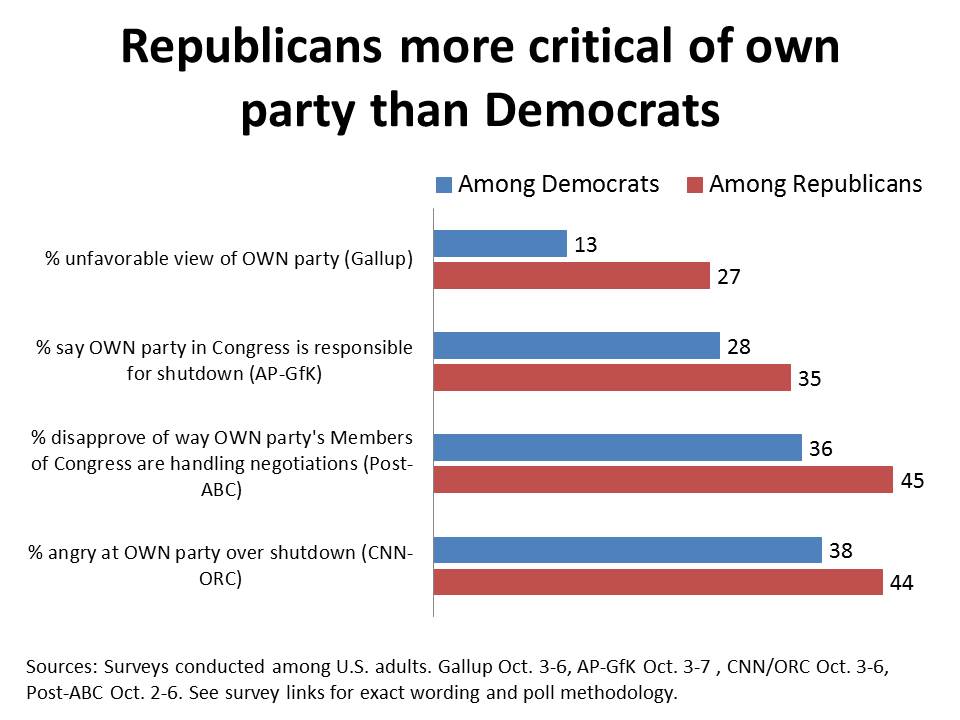
The Fix highlights the above chart:

The last thing the GOP needs as it seeks to unify, expand its reach and attract new voters is anger directed inward. But that’s the reality of what it’s dealing with.

The trouble is: I don’t think this is primarily moderate Republicans, if they actually exist, blaming Tea Party hostage-taking for their party’s fate. I think it’s base Republicans hating on their leadership’s alleged moderation! As someone who has read, edited or written countless “Republicans’ Coming Crackup” pieces, it might just be true this time that it’s happening. As so often, Obama is causing his enemies to self-destruct. How else to interpret a public statement like this one from the head of the National Federation of Independent Businesses:

There clearly are people in the Republican Party at the moment for whom the business community and the interests of the business community — the jobs and members they represent — don’t seem to be their top priority.

McCain (see below) and now Peter King have emerged from the shadows again. This is King on Cruz:

How did a guy eight months in the Senate be able to dominate the House Republicans, Senate Republicans, tie up the country, and bring the government to a halt with no end game, no strategy, and then now just sort of walk away, as if he’s done his job?

Meanwhile, a study finds that the government shut-down is hurting the red states most of all. Much of which prompts the usually sober John Judis to declare that the current GOP is pining for the fjords:

What is happening in the Republican Party today is reminiscent of what happened to the Democrats in the late 1960s and early 1970s.

At that time, the Democrats in Washington were faced by a grassroots revolt from the new left over the war in Vietnam and from the white South over the party’s support for civil rights. It took the Democrats over two decades to do undo the damage—to create a party coalition that united the leadership in Washington with the base and that was capable of winning national elections. The Republicans could be facing a similar split between their base and their Washington leadership, and it could cripple them not just in the 2014 and 2016 elections, but for decades to come.

Seth Masket doubts that we are in the middle of a realignment:

Obviously, it’s hard to know how the current rift will play out. There seems to be a consensus emerging that the current Tea Party-inspired crisis over health reform, the shutdown, and the debt ceiling has been an unmitigated disaster for the Republican Party, costing it in terms of policy and popularity. If that is the dominant interpretation a few weeks and months from now (especially among Republicans), Tea Party affiliates will get much of the blame, and this may represent an opportunity for the more traditional establishment types to reassert themselves and to ignore Tea Party demands in the future.

What more traditional establishment-types? Name one in the House with any clout or on Fox News with any regularity.

Should Obama Have Taken The Deal?

Noam Scheiber believes so:

Boehner’s idea was pure genius—at least if you’re rooting for the Democrats. It essentially solved the problem I just laid out. After all, polls show the GOP taking on massive amounts of water over the shutdown. There’s simply no way Republicans can hold out for over a month without reopening the government. Boehner wanted to use the shutdown to ensure that Obama negotiated a budget deal in good faith. But the enforcement mechanism he insisted on—government closure—is one that hurts Republicans far more than it hurts Obama politically. That means the GOP would have likely sued for a budget agreement* long before the debt ceiling had to be raised again in six weeks, very likely in the next week.

I sure hope Obama isn’t getting cocky. But we’ll soon see if the polls do all the work for him. Watching Cruz and Lee sink like stones in their home states is somewhat gratifying. But their margins are comfortable enough for Cruz to keep going, as his tub-thumping speech at a Christianist Summit this morning reveals.

The Farce Of Food Inspection

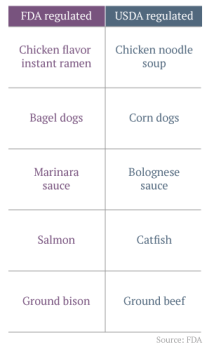
Amid fears that the shutdown will compromise food safety, Ritchie King and David Yanofsky look into the two major organizations that inspect food for the federal government:

Screen Shot 2013-10-10 at 11.42.10 AMA disproportionate number of the furloughed inspectors work at the Food and Drug Administration—one of the two US government organizations that inspects farms and production facilities—rather than the US Department of Agriculture, where 87% of the food safety staff is still going to work.
So what’s getting inspected, and what isn’t? The answer is far from straightforward. Each agency is responsible for different foods: the USDA generally covers meat, poultry, and products made with egg, while the FDA covers everything else…kind of. As it turns out, their jurisdictions are divided in a way that seems totally arbitrary in some cases. In others, it’s downright farcical.

Take eggs:

The chickens that lay them are monitored by the USDA, as is the facility that they lay them in. The processing plant that washes, sorts, and packages the eggs is regulated by the FDA, and so is the carton that they’re sold in. Once that egg is cracked, the USDA is back in charge whether the contents are dried, frozen, or still in liquid form. That is, unless they are used in eggnog mix, french toast, or egg sandwiches; those items are in FDA territory.

The good news: the USDA, which conducts inspections more frequently than the FDA, hasn’t been hit as hard by the shutdown.

Stuck With The Status Quo?

Waldman bets on divided government for the foreseeable future:

[W]hat you could have is a party stubbornly alienated from the national electorate, but stubbornly able to keep control of the House of Representatives. Which would mean that we just go on in this current vein. The GOP’s descent into madness helps Hillary Clinton or Joe Biden or Martin O’Malley become president, and stalemate politics in Congress continues. The image of the Republican party doesn’t recover, convincing most Americans that they’re too irresponsible to be trusted with governing, making it all but impossible for them to win the presidency or take control of the Senate. Yet they keep holding the House indefinitely, or at a minimum until a post-2020 redistricting reduces their stranglehold on the House.

Barro sees Christie as the GOP’s only hope. He points out that, in New Jersey re-election polls, Christie is “drawing about a third of the black vote, an unheard of level for a Republican candidate”:

Republicans are worried about how to appeal to voters in a country that is decreasingly white. Christie has shown how much credibility Republicans can gain with black voters simply by showing respect to the president, even while disagreeing with him on a broad swath of policy issues. This shouldn’t be hard, but for most Republican politicians, it is. Much of the party’s energy today is based on animus toward the man who happens to be the first black president. Christie is one of the few Republican politicians who understands how damaging that has been to the party’s brand.

Why The GOP Is Relenting

Screen Shot 2013-10-10 at 7.02.47 PM

And why the president just turned their latest gambit down:

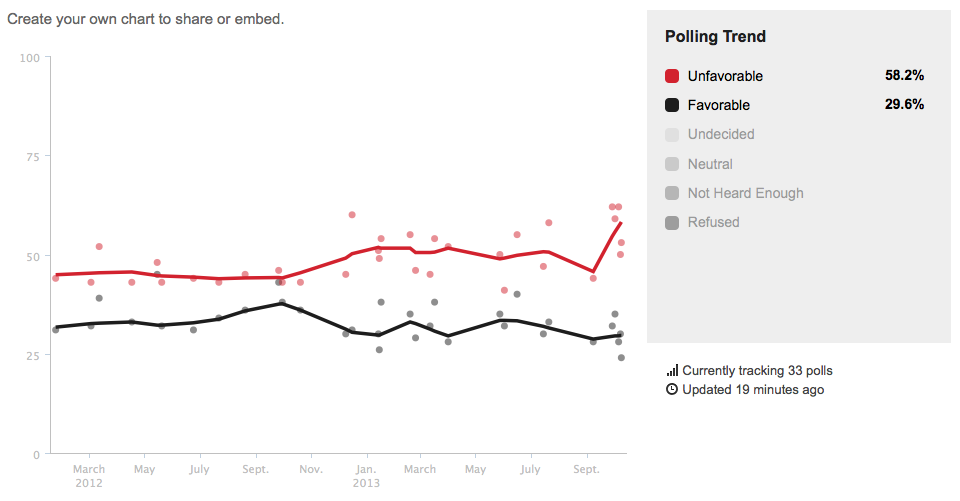
By a 22-point margin (53 percent to 31 percent), the public blames the Republican Party more for the shutdown than President Barack Obama – a wider margin of blame for the GOP than the party received during the poll during the last shutdown in 1995-96. Just 24 percent of respondents have a favorable opinion about the GOP, and only 21 percent have a favorable view of the Tea Party, which are both at all-time lows in the history of poll.

Obama’s ratings are pretty stable, in comparison. And this is the cherry on the top:

Thirty-eight percent see the Affordable Care Act (or “Obamacare”) as a good idea, versus 43 percent who see it as a bad idea – up from 31 percent good idea, 44 percent bad idea last month.

(Chart: poll of polls for Republican party favorability.)