Scott Horton recently snagged an interview with the reclusive, ornery philosopher I mentioned today. It’s a beaut. Question 6 is on writing for money. But the questions on Nietzsche, and racism get some fascinating answers.
Tag: Sponsored Content
Mike Allen: The Smithers Of Roger Ailes
Erik Wemple has another blockbuster piece on the corporate public relations newsletter known as Mike Allen’s Playbook at Politico. This time, it’s about the constant, fawning press releases Allen writes for his favorite news channel and personal idol, Roger Ailes. The latest piece of puffery from Allen is a summary of the new Gabe Sherman book on the Republican operative running the Republican Party’s propaganda outlet. For some reason, almost none of the critical details about Ailes made it into Allen’s account, merely anything that Ailes himself would be happy with:
He chose far more flattering stuff, like the part about Ailes being “The Most Powerful Man in the World,” about Ailes’s rough childhood, about Ailes winning over Rupert Murdoch, about Ailes winning over employees, about Ailes’s marketing genius, about Politico scoring a presidential debate at the Ronald Reagan library, to Ailes’s dismay. Save for a nod to Fox News’s alleged deception over an infamous anti-Obama video from May 2012, Allen all but “Zevved up” the Sherman book. That is, he made it sound a lot like the very favorable Ailes biography that author Zev Chafets last year published with the network boss’s full cooperation.
To take a fair but highly critical book and make it seem like a hagiography is Allen’s mojo when it comes to Politico’s advertizing clients (including those whose sponsored content appears within Allen’s daily suck-up to power and money in Washington). But the Ailes-worship is close to pathological. Just read it all yourself and make up your own mind. But, to my mind, Wemple proceeds to cite case after case after case of fellatial coverage of Fox and Ailes from the perkiest team-player in the Washington Media-Corporate Village. Now, you might think that this is too easy. Selective pickings from Allen’s daily, lucrative plugs for the rich and powerful could find anything. But what makes Wemple’s pieces persuasive is that he also includes any examples he can also find of faintly-critical coverage. They’re there, but in such minuscule proportion to the relentless positive p.r. for Fox that they almost seem designed to bolster its credibility. And that’s why Allen’s disgracefully tardy response to this is so lame:
Over the past seven years, there have been more than 8 million words of Playbooks, including hundreds of announcements from every group under the sun. You could cherry-pick items to make any case you wanted: that I’m a conservative hack, or a liberal tool, or a bad writer or a good guy.
No you can’t. The mountain of evidence and counter-evidence that Wemple has assembled is proof that Allen will flatter anyone with power for access and suck up to anyone with money for cash. Now that does not mean that Allen does this in a conscious way. My own sense is that he is so eager to please the powerful, so desperate to be included in their circles, so obsessed with remaining a player in DC, that he may simply not see that his constant cooing into the power vortex of Washington is at best an exercise in public relations, rather than journalism, and at worst, an obvious inversion of the journalist’s core role, which is to challenge power rather than to celebrate it. In other words, subjective naivete and a desire to be accepted is not incompatible with objective corruption.
But Wemple has a coup de grace. He notes how odd it is that, given Allen’s constant suck-ups, Politico’s stars very rarely show up on Fox News. And yet it isn’t that odd at all, as Fox’s response to the charge reveals:
Former Fox News PR ace Brian Lewis told Jim Romenesko in 2012, “We do not have a do-not-deal-with-Politico policy. We deal with Mike Allen.” As they should.
And, when they need a mouthpiece to rebut telling criticism, they still do.
Schopenhauer On The Age Of Sponsored Content
The Dish constantly links to and loves Maria Popova. For me, she represents the best that the Internet has to offer. She gets paid by reader  donations and affiliate income. She writes what she loves. She reads books. She has seized the limitless potential of the web – but by bucking the cult of contemporaneity, by digging up the old and true rather than the new and buzzy, by building a community of readers who flock to an oasis far away from what she has called the “Buzzwashing” of our collective online minds.
In some ways, her appeal is pretty straightforward as a writer. She is unmistakably genuine. Nothing she writes is obviously designed purely for getting money (although, of course, she has done really well by simply writing tirelessly about what she loves). And so you can see why re-reading some of Schopenhauer’s essays on writing and journalism appealed to her. His brutal take-down of writing for money is about as good a case for that position as I’ve read:
The author is cheating the reader as soon as he writes for the sake of filling up paper; because his pretext for writing is that he has something to impart. Writing for money [is], at bottom, the ruin of literature. It is only the man who writes absolutely for the sake of the subject that writes anything worth writing. What an inestimable advantage it would be, if, in every branch of literature, there existed only a few but excellent books! This can never come to pass so long as money is to be made by writing. It seems as if money lay under a curse, for every author deteriorates directly [whenever] he writes in any way for the sake of money. The best works of great men all come from the time when they had to write either for nothing or for very little pay.
When I was very young, I used to wonder why the newspaper had the same size every day – as if what was actually news didn’t vary, when it obviously did. As a working writer for much of my adult life, I understand now why the economics of journalism operates that way, and probably has to. But an economics that directly rewards eyeballs at the expense of any other criterion – i.e. the current economics of most of the web – or a “journalism” that is paid for by corporations – i.e. sponsored content – would horrify Schopenhauer. His standards are impossibly high; his judgments overly broad and caustic. But he was onto something, as is Maria. And our culture could learn a lot from it.
(Painting by Jules Lunteschütz)
A Sign Of The Times, Ctd
A reader testifies to the local impact of national news brands going the way of sponsored content:
I work at a newspaper in flyover country, and Wolff’s column on the NYTimes’ embrace of “low advertising” hit me like a brick. Not that my organization has anything resembling the cachet of the Times – far from it. But like every other newspaper in America, we’re undergoing head-snapping changes that, at times, feel as if the ultimate goal is to turn us into Buzzfeed, or a local-level clone.
Five things you can do to avoid traffic jams! Here are 10 things you should do when the mercury drops below zero! More and more, our publication and web site are filled with the “cheesy come ons” that Wolff describes – and that’s the supposed NEWS content. I can’t help but think this ultimately devalues us as a legitimate source of real news, even if it drives web traffic higher. Maybe this is the democratization of content, where content that generates clicks is considered the “best” type of content, but best for whom? It’s as if we’re replacing meat and potatoes with Cheetos – delicious but ultimately frivolous and unsatisfying.
When you see the metrics every day, and it’s clear that quick-hit crime stories or freak-show stories generate as many clicks as an investigative piece that took weeks to report, what rationale can there possibly be for doing the investigative work, the longer-form stories that actually help explain the workings of a community to the people who live there? That’s what I fear; that in our relentless pursuit of clicks, in our mania to remake ourselves in the image of Buzzfeed, we’ll ultimately make ourselves less relevant. And then what would differentiate us from any other aggregator or producer of cheesy come-ons?
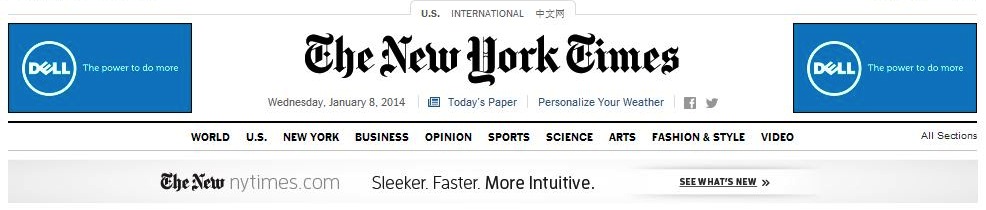
Another sends the above screenshot:
I saw this when I went to the New York Times website a few minutes ago. “The New nytimes.com” – it’s “Sleeker. Faster. More Intuitive” – just like a Dell?
I should add that I do think that the design – especially the light blue and the blunt disclosure “PAID FOR AND POSTED BY DELL” – put the NYT in a different league than, say, Buzzfeed. But I get queasy reading another disclosure that reads:
This page was produced by the Advertising Department of The New York Times in collaboration with Dell. The news and editorial staffs of The New York Times had no role in its preparation.
This is what we were told yesterday:
The labor and cost of creating native ads is a hurdle, and the Times made it clear that it sees the product as suited to only a limited number of advertisers. It won’t come cheap for the Times, either, which is looking to hire a dozen or so people for a “content studio” to staff the effort.
So I guess the NYT employees who will be writing the copy for a sponsored page with the New York Times brand at the top are not part of the news and editorial staffs. So what kind of staffers are they exactly?
The NYT picked Dell in part because the chief copy-writer has “journalistic chops.” So I assume the new “content studio” employees will also have journalistic chops. What department will they be regarded as being in? Advertizing? I don’t think employees with journalist skills have ever been used at the NYT to help corporations write ad-copy designed to read like NYT articles. What do we call them? Neither pure copy-writers nor independent journalists, they are, I suppose, “content providers.” The deeper you go into this miasma in which public relations and journalism become close to indistinguishable, the more the newspeak has to proliferate. Another reader:
When you first started swinging at Buzzfeed about all of this blurring of journalism and ad revenue, I was thinking “Meh, I hate Buzzfeed. Buzzfeed’s stupid, why would you go there unless to waste some time and braincells anyway?” But Time, Inc. and the NYTimes?! That is bad. Bad for all of us. If the NYTimes morphs into fucking ad copy we’re at a very, very low point of our culture. For this, you guys get more than the $25 I gave last year. I’ll give The Dish as much as I can afford next month at renewal time. Because independent journalism MUST THRIVE.
When we picked a pure subscription model over a year ago, I honestly wouldn’t have believed that a year later, even the NYT was knee-deep in corporate propaganda with the NYT logo and other articles at the top of the page. Especially after their great pay-meter success, why sacrifice something so special as the integrity of the NYT for what cannot yet be big bucks? My fear is that one day – soon – it will be. And your ability to look at a random NYT page on the web and know for sure it’s not a gussied-up ad will slowly atrophy. As, I fear, will whatever reputation for integrity journalism has left.
The NYT Follows Buzzfeed

The pinnacle of American journalism is now hiring a Dell employee to write its “articles”:
“We wanted to start with someone who we thought really understood how to be a great storyteller,” said Meredith Kopit Levien, evp of advertising for the Times. “And [Dell global communications managing editor] Stephanie Losee was [a writer] at Fortune. She has deep journalistic chops herself. So this was a very deliberate choice to go with Dell.”
Let me get this straight: the New York Times is hiring a copy-writer as a pseudo-journalist because she used to work as a real journalist. Time Inc is now having its “editors” report directly to the business side and the NYT is opening its elegant blue-stocking legs as wide as it decently can to accommodate a computer company. This passage was particularly revealing:
Dell used its launch ad to spotlight stories on topics like millennials in the workplace, marketing tech and women entrepreneurs. The campaign, which is set to run for three months, contains a mix of content from its own newsroom, articles from the Times’ archives and original stories by Times-contracted freelancers on Dell-chosen topics.
My italics. So Dell is now a “newspaper” partnering with the New York Times. By which I mean that the New York Times will actually hire people to write Dell’s ad copy and make it look as close to the rest of the paper as possible. Then this:
After Dell, a handful of other clients whom the Times wouldn’t name have committed to using the product in the coming months. But the labor and cost of creating native ads is a hurdle, and the Times made it clear that it sees the product as suited to only a limited number of advertisers. It won’t come cheap for the Times, either, which is looking to hire a dozen or so people for a “content studio” to staff the effort.
Always follow Orwell to the language. Have you ever heard of a newspaper having a “content studio” before?
Note that the NYT is not simply taking Dell’s ad-copy and gussying it up to deceive casual readers into thinking this advertizing is editorial (with a firm disclosure as a fig leaf). They are creating an in-house team to write the fricking ad-copy and calling it “content”. So what is the rest of the paper? Non-content? What is a newsroom but a content-studio?
Yes, they will add a clear identifier – and better than most. But, as Adweek notes, since the whole point of native advertizing is to deceive the inattentive readers into reading it because it looks an awful lot like regular copy – this is a very wobbly and blurry distinction. And when viral pages get completely disconnected from the rest of a news-site, the clear contrast between ads and journalism is close to invisible.
So look: it’s time to congratulate Jonah Peretti. He sure is winning. The business of journalism is now indistinguishable from the business of public relations. The New York Times has a newsroom. And so does Dell. Dell has an advertizing department – and the New York Times helps staff it. In the future, most big companies will have their own newsrooms (read: propaganda/advertizing outlets) and independent journalistic institutions will just have competing newsrooms, increasingly dependent on the corporate in-house “content studios” and answerable to them. At some point, and certainly at the rate we’re seeing, the distinction will soon evaporate altogether.
We are all in public relations now. Thanks, Mr Sulzberger.
Quote For The Day
“Many of the most successful new content sites –Buzzfeed, Huffington Post, Gawker, Business Insider, and Glam Media, among them – are such an amalgam of aggregated content, partnership sharing agreements, pay per click modules, user generated contributions, and, as well, the blitherings of novice journalists (sometimes heralded as a return to long form), that it’s very hard, if not pointless, to separate real content from phony stuff,” – Michael Wolff.
But that’s the point, innit?
A Sign Of The Times
https://twitter.com/jetpack/status/420135305820131328
We are all perfectly aware of the terrible pressures on the media industry right now. We’ve all but lost the physical thing we used to sell entirely. Advertizers have so many other options. Readers are used to reading for free online (however economically nuts that is for media); and newspapers are in free-fall. Any sane person would expect some radical experiments in getting the whole thing to work again. What I didn’t fully expect was the sheer speed and totality of the editorial surrender to the business side; and the almost rapacious move toward handing over the very fonts and headlines and by-lines to advertizers and p.r. merchants as if there were no real difference between writing to sell something and writing because it’s true and your opinion or product of independent reporting. After all those speeches and papers and conferences and J-School lectures, the media jumped immediately into an area once deemed verboten, and rolled around like Cartman in Kyle’s money.
In a rare exploration of this in mainstream media (which is busy become mainstream p.r.), the Guardian’s Emily Bell takes stock:
This week the New York Times unveils a new website design. Part of it will be a new native advertising push, with posts clearly labelled “paid post” and bearing a blue line of demarcation. In a detailed memo timed perfectly to coincide with the holiday break, its publisher, Arthur Sulzberger Jr, told staff that the new native advertising platform for the organisation would be digital and very clearly marked. It followed an announcement a month earlier by Time Inc., that the magazine publisher would dramatically increase the amount of native advertising it carries. The question that the FTC is concerned with is that of transparency in the mind of the consumer. Is it clear where funding for programmes and articles is coming from?
Separating the church of editorial from the state of advertising is more difficult in digital media; everything is necessarily melded together more closely, and the context or “furniture”, which is hard to miss in a newspaper or during a broadcast, is stripped away as files zip round the web. The anxiety over transparency is understandable, particularly when it comes to vulnerable markets and toxic products, like loan companies, insurance schemes, lobbying and gambling products.
Two question marks hang over native advertising, which will become more significant this year.
For the producers it is the longevity of the trend. At the moment the curve of enthusiasm for the approach, and ignorance about its benefits or impact, are both at a high, which is the point at which companies make money. This is unlikely to last.
For the consumer it is the issue of transparency. It is easy to become very exercised by the potential of native advertising for good and ill. It is arguably a relatively benign part of a much more embedded trend.
Every person and institution can now make their own messages and potentially have as much impact as the largest corporation. The occlusion of motive is becoming more problematic in many areas of communication, but at least in native advertising there is an identifiable commercial transaction. When CBS’s primetime current affairs show 60 Minutes recently ran an exclusive interview with Amazon boss and new newspaper owner Jeff Bezos, it pitched him no hard questions and allowed him to demonstrate his potty scheme for deliveries by drone. This was not advertising, but nor was it really journalism; the access the programme gained reduced its appetite for inquiry and analysis. Advertising is everywhere, as fluid and malleable as the streams it inhabits. And increasingly there will be no lines, blurred, blue or otherwise.
The NYT public editor is already sensing the blurred lines. From her assessment of a NYT advertizer using a manipulated A.O. Scott tweet without his permission:
This is not native advertising. However, on the very week that native advertising is scheduled to begin in The Times, this episode does give one pause about keeping the lines between editorial content and advertising perfectly clear and well-defined.
A reader chimes in:
Perhaps this would be of interest in light of the Dish’s recent interest in “native advertising”: In David Foster Wallace’s famous 1994 essay in Harper’s, “Shipping Out” (later re-titled A Supposedly Fun Thing I’ll Never Do Again in the book of the same name), the author wrote about the pernicious effect of advertising posing as art – not for its threat to journalistic ethics, but for the psychological effect it has on those exposed to it. In the brochure for the luxury cruise on which he is about to embark, Wallace found an experiential essay written by the late author and former director of the Iowa Writer’s Workshop, Frank Conroy:
Conroy’s “essay” appears as an inset, on skinnier pages and with different margins than the rest of the brochure, creating the impression that it has been excerpted from some large and objective thing Conroy wrote. But it hasn’t been. The truth is that Celebrity Cruises paid Frank Conroy up-front to write it, even though nowhere in or around the essay is there anything acknowledging that it’s a paid endorsement, not even one of the little “So-and-so has been compensated for his services” that flashes at your TV screen’s lower right during celebrity-hosted infomercials.
And below Wallace expounds the real dangers of this “essaymercial”:
In the case of Frank Conroy’s “essay,” Celebrity Cruises is trying to position an ad in such a way that we come to it with the lowered guard and leading chin we reserve for coming to an essay, for something that is art (or that is at least trying to be art). An ad that pretends to be art is—at absolute best—like somebody who smiles at you only because he wants something from you. This is dishonest, but what’s insidious is the cumulative effect that such dishonesty has on us: since it offers a perfect simulacrum of goodwill without goodwill’s real substance, it messes with our heads and eventually starts upping our defenses even in cases of genuine smiles and real art and true goodwill. It makes us feel confused and lonely and impotent and angry and scared. It causes despair.
Journalism’s Surrender, Ctd
A reader writes:
Thank you for continuing to cover the state of journalism today. I thoroughly enjoyed what you had to say about Time Inc’s remodeling – a development that I would not have known about were it not for the Dish – as well as your continued attention to the Mike Allen fiasco. It is disturbing that the media hasn’t covered the rise of revenue-based journalism more, and I’m glad that you keep drawing our attention to the issue.
To pile on, I just read the Playboy article by BuzzfeedBen about how social media – by which he really means Buzzfeed, with its tens of thousands of viral, share-worthy listicles – will “save journalism,” and I’m very much looking forward to your take on it. I say that not just because you’re mentioned briefly in that piece (as one of the pioneers of the political blogger revolution), but because he has some truly interesting defenses of Buzzfeed’s journalism/business model, including one section where he says that sponsored content is like the “beautiful, well-produced” advertizing one might see in Vogue and actually enhances the product rather than detracts from it. In another section, he seems to compare – bizarrely – the popularity of lists like “108 Reasons Corgis Really Are That Great” to the renewed interest in long-form journalism.
Of course, BuzzfeedBen doesn’t actually address any of the arguments against sponsored content (other than noting that it is “controversial” in some parts) or the virality-at-all-costs mindset of sites like Buzzfeed. The only criticism that he spends any time considering is the reader preference for sharing warm, fuzzy, inspirational news over more sobering items, but he also pooh-poohs that away as a “small-bore complaint” – because hey, in the end, Buzzfeed hires a lot of journalists and gets people to read a lot of “news,” and that’s what we all want for the industry, right?
To that end, I found Luke O’Neil’s Esquire essay, “The Year We Broke The Internet,” to be a great companion piece for the Playboy article. (O’Neil’s piece actually came out about a week before BuzzfeedBen’s, but I found it more informative to read Smith’s first, and then O’Neil’s.) Whereas BuzzfeedBen insists that Buzzfeed still values the same things old journalism valued – speed, hilarity, accuracy, originality – without ever acknowledging how that site’s business model has compromised the latter two values in favor of the first two, O’Neil skewers Buzzfeed’s hypocrisy (while admitting that he has also played a part in this race to the bottom). My favorite quote from his piece:
Among all the things I’ve written this year, the ones that took the least amount of time and effort usually did the most traffic. The more in-depth, reported pieces didn’t stand a chance against riffs on things predestined to go viral. That’s the secret that Upworthy, BuzzFeed, MailOnline, Viral Nova, and their dozens of knockoffs have figured out: You don’t need to write anymore – just write a good headline and point. If what you’re pointing at turns out to be a steaming turd, well, then repackage the steam and sell it back to us.
So much of the O’Neil essay encapsulates what bothers me about the accountability-free, pageviews-first mentality of Buzzfeed, even if the site does have some credible journalists who do good, original work (a point that O’Neil also addresses). I enjoy and am grateful for Chris Geidner’s tireless coverage of LGBT issues, for example, but I absolutely hate when he churns out some listicle whose sole effect is to pull eyeballs away from another journalist’s work, like his 13 highlights of Jennifer Senior’s New York interview with Justice Scalia – which was literally just a bunch of screenshots off the NYMag site, with no extra commentary.
Anyway, that’s the end of my rant. Happy New Year to you and the rest of the Dish Team! I’m really looking forward to another year of excellent coverage from you guys, and I’m definitely going to re-subscribe in February.
Meanwhile, another reader smells something fishy from another corner of the Internet:
Just in time for the new year, here’s another addition to the hall of shame of “sponsored content” posing as online journalism. The top spot on the new, confusingly re-designed website for the online magazine Slate features a story by one Jordan D. Metzl with the fast-breaking news that exercise is good for you. The story’s content usefully summarizes a new book on the subject by none other than … Jordan D. Metzl. In case the reader misses the mentions of the book in the article itself, or in the blurb about the author at the end (all with links to the book’s page on Amazon), the text is accompanied by a large photo of the book’s cover, which is also clickable to the Amazon page, and features a smiling photo of … Jordan D. Metzl.
Nowhere is this piece of blatant puffery tagged as “sponsored content,” yet it is impossible to believe that Slate paid money to its author. And so the insidious infiltration of online journalism by prepaid material continues. We should all resolve to exercise more in the new year. But I’d like to hope that Slate, which was such an early pioneer of online journalism, would make a new year’s resolution to back away from this pernicious practice before its credibility with faithful readers like me is lost forever.
Update from a reader:
The reader who considers the Jordan D. Metzl article in Slate to be a kind of “sponsored content” is all wet. Authors summarizing their arguments or excerpting from their new books in periodicals are taking part in a time-honored practice that benefits everyone. The author gets a chance to sell a book. The magazine gets some potentially valuable content. Readers get the chance to learn about a book they may want to read in its entirety, or to learn after a few paragraphs that it is a turkey to be avoided, or to absorb the essence for free and decide that’s enough. No one is pulling the wool over anyone’s eyes. Such stories are a feature of the magazine form, now extended to the web.
Another also doesn’t seem a problem:
Oh, come on, this kind of promotion is at least the second oldest profession. Remember when so many featured articles in Tina Brown’s New Yorker were outtakes from upcoming Random House books, a company run by her husband Harold Evans? It’s everywhere, all the time. I find it useful: it saves me buying, borrowing or even reading the book.
Journalism’s Surrender
I should end the year on an upbeat note, shouldn’t I? But Time Inc. ruined it. The surrender of journalism to advertizing and public relations – not alliance with, but surrender to – was the biggest media story of 2013 that the media almost didn’t cover at all. But it’s right there in black and white, if buried on the slowest news day of the year:
Time Inc. will abandon the traditional separation between its newsroom and business sides, a move that has caused angst among its journalists. Now, the newsroom staffs at Time Inc.’s magazines will report to the business executives. Such a structure, once verboten at journalistic institutions, is seen as necessary to create revenue opportunities and stem the tide of declining subscription and advertising sales.
Now remember this is not some desperate trade magazine; this is Time Fucking Inc. Journalists at Time will report directly to those on the business side (or is that now an anachronism?) seeking advertizing revenues and sponsored content contracts. That’s what the editors now are. And listen to the howls of outrage swirling around every other journalistic institution, read the columns decrying the end of independent journalism, witness the mass exits of outraged editors, observe the talking heads fulminate and readers rebel!
Actually, there was one resignation, and it was a deeply honorable one:
Among those who expressed concern was Martha Nelson, the recently departed editor in chief. Before Mr. Ripp came aboard and brought on Mr. Pearlstine, the magazines’ editors all reported to Ms. Nelson, who was seen as a staunch defender of newsroom autonomy. Late last summer, Mr. Ripp invited Ms. Nelson to Nantucket to discuss his plans, according to several current and former Time Inc. executives. Troubled by the idea of reporting to the business side, she resigned. “When Joe suggested a new structure that required editors to report to the business heads, I wasn’t comfortable being part of it,” Ms. Nelson said. “You can’t take apart what you have promoted and built.”
This is the way the press ends. Not with a bang but a “revenue opportunity.”
Is This Tweet An Ad?
And you thought native advertizing was just for what used to be called magazines. The truth is: following the Peretti-fueled takeover of journalism by public relations, social media is now fast becoming a blur of p.r. and, you know, real messages from real people. The growth is staggering:
Native social advertising is growing significantly faster than social display, with native revenue growing 77% this year, according to the fall update to BIA/Kelsey’s U.S. Social Local Media Forecast. The native category is expected to generate $2.4 billion this year, up from $1.4 billion in 2012, driven primarily by the surge in social media activity across mobile platforms, the firm says … Social display ad revenue in the U.S. will grow from $4.3 billion in 2013 to $6.8 billion in 2017, or 12.6% annually, according to the forecast. During the same period, native social advertising — propelled by the category’s main players, Facebook’s Sponsored Stories and Twitter’s Promoted Tweets — will more than double, from $2.4 billion to nearly $5 billion, a 20.3% annual growth rate.
If that pace continues, there may be no old-school advertizing left: just countless tweets and posts created by corporations to sell things. Good luck finding out where the real world begins.
 The Dish