Dissent Of The Day

A reader tires of our comprehensive coverage of “enhanced advertorial techniques”:

I don’t usually write, but your rants on ad-sponsored content are REALLY getting tired (and the latest dig at The Atlantic in an unrelated article dealing with telepresence robots was a little childish). Please stop bashing other companies that aren’t doing as well as you are and that are forced to resort to advertising to make money.  There are great people at The Atlantic and David Bradley and Co. are doing their best to stay in business and generate the same excellent content provided by Fallows, Goldblog, and others.  Traditional ads don’t generate sufficient revenue for those companies.  What’s more, I don’t particularly care if I’m being marketed to and manipulated, because I’m getting their service for FREE.

All else equal, I’d gladly take The Atlantic‘s model, where I have to deal with ads, manipulative or otherwise, than yours, where I have to pay.

Of course, because I enjoy your blog so much, all else isn’t equal here, but the point stands that you’re doing well in your new system (at least from my perspective) because of you and your team and in SPITE of your model, not the other way around.

You’ve done remarkably well for yourself, which is the primary reason your model is working. Good for you, and I of course remain a devoted Dishhead. That said, I have been meaning to pay for your service since your model went pay-for, but this “holier-than-thou” attitude makes me feel like I’ll just be feeding this ego/arrogance and perpetuating this non-stop torrent of bitterness. The whole thing seems a little transparent and self-serving, and I think you’re better than this.

Bitter?

My one and only concern is that in an era when advertisers have publishers by the short and curlies, that we do not give away the village in order to keep it. It’s the crafty fusion of advertising and editorial content that troubles me – and that risks the integrity of the core content. If we really are going to merge advertizing and journalism in the coming years, as seems an increasingly popular idea, I think it’s worth resisting and asking some core questions. Not out of smugness. It’s far too soon to declare our venture as a success. But because there are some principles at stake here, important ethical ones, and they are not being aired in the rest of the media – because no one wants to undermine their future commercial viability.

So I’m doing what only a truly independent blog can: raising an issue the MSM cannot or won’t. And it isn’t childish to note a simple example of how the decline of trust between publisher and reader caused by sponsored content can affect an otherwise good piece. If your magazine is partly under-written by IBM and your cover-story is about IBM’s brilliant new computer, you are doing the writers and editors a disservice by the appearance of a conflict of interest.

The Darkest Corners Of Sponsored Content

Christian Caryl digs into the backstory of the recent revelations surrounding the Malaysian government’s sponsored content. The paid editorials of Josh Treviño and Ben Domenech were apparently part of a larger campaign to discredit Clare Rewcastle-Brown, a blogger critical of the country’s corruption:

One company, the lobbying firm APCO Worldwide, hired Texas-based conservative blogger Josh Trevino and a range of other writers to come up with content designed to blacken the opposition. His work included setting up a sock-puppet site bearing the title “Sarawak Reports” (only that final “s” distinguished it from the British journalist’s own blog) stuffed with positive stories about [government minister] Taib. (The bogus site has since been removed, though Rewcastle-Brown cites it in this expose on her own site.)

Trevino heatedly denied working for the Malaysians when challenged on the same point back in 2011; a few weeks ago, he was compelled to retract his denial when paperwork emerged showing that he had indeed taken money from the Malaysian government.

“It’s Not An Ad, It’s Thought-Leadership”

Shafer tackles sponsored content:

When Web publishers deliberately blur the visual and textual divide that separates editorial from advertising, as The Atlantic did, they force readers to judge whether a page is news/opinion or a commercial advertisement. But they’re not confused; it’s the publisher and the advertiser who are confused. The publishers and advertisers have polluted their own tradition by erasing the traditional line. Suddenly, it’s completely reasonable for readers to blame controversial news stories directly on advertisers and blame controversial advertisements directly on reporters and editors, because publishers and advertisers have essentially merged operations. Such calamities injure both publisher and advertiser, even already controversial advertisers like Scientology …

I’m not an absolutist. I’ve never feared advertising that advertises itself as advertising. I’m prepared to accept that an advertiser could produce content worthy of my time, though I’ve yet to witness that miracle. I don’t even fear “thought leadership,” as long as the wallet financing the composition and promulgation of the thoughts can be identified, as was the case when Herb Schmertz, Mobil Oil’s vice-president for public affairs, routinely published his company’s “low-key advocacy ads” on the New York Times op-ed page beginning in the early 1970s. Just make sure I can see the line.

As a great wag once said, a newspaper is nothing but an advertisement with a news story printed on the back. That arrangement has worked well for American publishers, readers and advertisers for two centuries. But can it work if you have to guess which side contains the ad?

Three cheers for Shafer writing that stuff for Reuters. It’s amazing how little public debate this media-corporate whoring has generated … in the press. Writers at the Atlantic have been formally warned not to talk to anyone from the press. And you can see why: the “sponsor-content” press doesn’t want to expose its sordid desperation. Which itself lends credibility to the idea that the Fourth Estate – if it cannot easily be distinguished from corporate and government power – is fast disappearing.

This is not about media narcissism. It’s about a critical independent pillar of our democracy, a truly independent press, a pillar that is being demolished even by magazines with as distinguished a past as the Atlantic.

The Dish’s sponsored content thread can be read in full here.

Freelancing In The Digital Age, Ctd

Screen shot 2013-03-08 at 3.02.51 PM

Gregory Ferenstein, unlike Nate Thayer, has no problem with The Atlantic‘s approach to freelancing:

I’m thrilled there was an opportunity to be a poor freelance blogger … I would have done it for free. Putting CNN, The Atlantic, and Fast Company on my resume gave me extraordinary access to the top rungs of the business and political world. I was addicted to meeting fascinating people and writing (hopefully) compelling stories. It eventually gave me the credentials to get my first paid gig back at Fast Company.

I’m a libertarian. If it’s all voluntary, I don’t have a huge problem per se. What I would like to know, though, is: who is being asked to work for free on the business side? Or how many times does a business honcho there ask another businessman to donate his services for free? The question answers itself. And you know what that tells you: the management of the Atlantic now cares more about money than writing – and in the process, they are damaging the most precious commodity they have, editorial integrity. That’s been clear for a while now, as has the silencing of dissent among writers and commenters. Clay Shirky puts the systemic problem well, in a reply to Alexis:

I think you missed another of the reasons this blew up yesterday (the one you and I talked about in email a while back.) We don’t trust the Atlantic as much as we used to.

Your willingness to rent out your brand to Scientology, and then to silence the readers who tried to comment on that bit of infotainment (which, the official apology notwithstanding, was not a marketing mistake, but a conscious decision to censor your readers on behalf of your advertisers) put a bunch of us on edge, and we began to ask ourselves whether that was an out of character fuck-up, or a culture slowly going to shit.

I hope for the former, as you know, but you have to understand that when something like this happens, it’s not just that something went awry, it’s another thing that went awry at The Atlantic. I know the issues are complex and the editor was new, but there was a lot of circumstantial pleading for the advertorial cock-up as well. You guys have very little slack before people start publicly unsubscribing.

Here’s one personal anecdote.

The Atlantic.com reads, at times, like an IBM propaganda sheet (see the screen shot above – where, yes, the “sponsor content” is from IBM as well as the banner ad and video). Throughout the site, there are ads after ads by IBM, videos after videos, and “sponsored content” posts of horrible prose and worse jargon promoting the latest corporate management bullshit. And then I’m reading the new Atlantic cover-story on robotic medicine, by Jon Cohn, a superb journalist, edited by great editors. I do not doubt for an instant that this piece was fully ethical.

But then, on the first page or two, for the first time ever reading the Atlantic, my doubts arose. Why? The whole piece is centered on … wait for it … IBM’s super-computer Watson. Money quote:

IBM’s Watson—the same machine that beat Ken Jennings at Jeopardy—is now churning through case histories at Memorial Sloan-Kettering, learning to make diagnoses and treatment recommendations. This is one in a series of developments suggesting that technology may be about to disrupt health care in the same way it has disrupted so many other industries. Are doctors necessary? Just how far might the automation of medicine go?

From the piece itself:

IBM didn’t build Watson to win game shows. The company is developing Watson to help professionals with complex decision making, like the kind that occurs in oncologists’ offices—and to point out clinical nuances that health professionals might miss on their own.

I still trust that the Atlantic did not run this cover-story as a way to curry favor with an advertiser that is also running “sponsor content” articles extolling their innovation. I do not believe this was product placement. But I can no longer say that those who wonder about that are crazy. When you rent out your name, prose, font, logo and pages to corporations’ “sponsored content” and then write cover-puff-pieces about the technology of exactly those companies, a reader has every reason to wonder whether they can trust a magazine that was only recently almost a symbol of such trust. As a deep lover of the Atlantic, it’s distressing, to put it mildly.

Spot The Sponsored Content, Ctd

Buzzfeed’s Rosie Gray uncovers a more clear-cut and troubling example of paid content (without even Buzzfeed’s and the Atlantic’s fig-leaf disclosures) masquerading as editorial:

A range of mainstream American publications printed paid propaganda for the government of Malaysia, much of it focused on the campaign against a pro-democracy figure there. The payments to conservative American opinion writers — whose work appeared in outlets from the Huffington Post and San Francisco Examiner to the Washington Times to National Review and RedState — emerged in a filing this week to the Department of Justice. The filing under the Foreign Agent Registration Act outlines a campaign spanning May 2008 to April 2011 and led by Joshua Trevino, a conservative pundit, who received $389,724.70 under the contract and paid smaller sums to a series of conservative writers.

Let’s name the offenders, shall we?

Trevino’s subcontractors included conservative writer Ben Domenech, who made $36,000 from the arrangement, and Rachel Ehrenfeld, the director of the American Center for Democracy, who made $30,000. Seth Mandel, an editor at Commentary, made $5,500 (his byline is attached to the National Review item linked to above). Brad Jackson, writing at the time for RedState, made $24,700. Overall, 10 writers were part of the arrangement.

Treviño, amazingly, maintains he did not cross any lines:

“It was actually a fairly standard PR operation,” Trevino told BuzzFeed Friday. “To be blunt with you, and I think the filing is clear about this, it was a lot looser than a typical PR operation. I wanted to respect these guys’ independence and not have them be placement machines.”

Rich Abdill pushes back:

If “a fairly standard PR operation” involves paying off columnists to write about certain things, it seems journalists at every other publication ever were just misinformed about what was “ethical.” Jayson Blair stole quotes, made up stories, reported on events he never went to, then put it all in the New York Times, and he still did not take any bribes.

Joyner takes a similarly skeptical approach:

I’m more than a little leery of a pay-for-play arrangement. It’s hard for opinion writers, even good ones, to get paid. So I’m not four-square against bloggers taking money for writing posts supporting causes they already agree with. But it’s problematic, not to mention rather weird, for writers to suddenly start crusading on an issue they never cared about previously and which seems remote to their natural interest.

This is bribery and unethical journalism in my book. It also raises questions about the good faith of other work by the journalists involved. When there is no disclosure we can never know what is paid propaganda and what is actual journalism. Which, of course, is the point.

Spot The Sponsored Content, Ctd

DevourNativeAdvertising

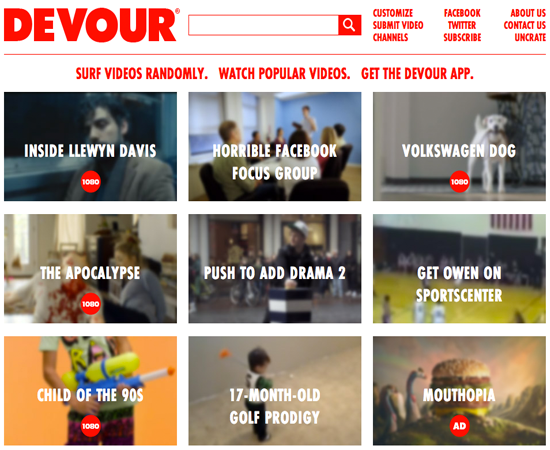
A reader passes along the “Examples of Native Advertising” entry on WikiExample. It’s a terrific guide to some of the tricks of the trade. The caption for the above screenshot:

Devour’s video ads are integrated with all of their curated videos and clearly marked as an “AD.” In the bottom right corner there is an ad for “Mouthopedia,” which is an entertaining video by Mcdonalds about their Bigmac. This allows the advertiser to get a similar CTR [Click-through rate] as the other spots as it is right in line to the other curated videos.

But at least it clearly says “AD”. I’d rather the word “ADVERTISEMENT”. It’s what we’re used to in understanding the difference between editorial and advertizing. Update from a reader:

I think Wiki is using an old method of Devour IDing ads. The site doesn’t even mark them anymore, so it’s even worse now. For example, a Grey Poupon ad the site is hosting as “Sponsored Video” (a small label in the same color font as the video’s description, thus barely noticeable) is not even labeled as such on the front page

A reader adds to this post about Buzzfeed using Fark to direct traffic to its ads:

I’m a long-time Farker and I’ve noticed these new Buzzfeed links, too. The existence of sponsored links isn’t new to Fark, actually. We’ve seen sponsored headlines for a few years (e.g., from Cracked). What makes these new ads really different is that there isn’t a link to comments. Fark is a comment-driven site and the lack of ability to comment on a link like this really makes it stand out, and not in a good way. When Cracked sponsors a link, there’s a risk that they’ll draw in snark if the link sucks. In a weird way, that makes me respect those links more, even though they’re just as commercially driven and, if anything, more stealthy. The lack of ability to talk about the Buzzfeed links signals, to me, a lack of confidence, and I’m sure that I’m not the only Farker who feels the same. Because of this, I don’t think that they’re doing their advertisers much of a favor with this trick.

Several more examples from readers below:

I don’t know if you saw it but at the bottom of the “sponsored content” IBM ad on The Atlantic you linked to it states that “comments for this thread are now closed”. I wanted to leave a comment expressing my displeasure with the ad. Alas, I cannot, but there are no other comments in there anyway. Were comments ever open?

I also notice the article was tweeted 37 times. I wonder how many of those twitter uses knew/did not know that this was an ad.

I wonder how many of them work for IBM or the Atlantic. Another:

Check out one of the more popular tech sites, Techmeme. It says “Sponsor Posts” but I used to click on them without realizing it until it hit me recently.

Still, the Techmeme sponsored ads are clearly not Techmeme once you get past the homepage. They have a different font, look, design and feel. Again, with enough clarity and disclosure, you can create ads that are not like, say, the Atlantic’s blatant tactics of making its ads almost indistinguishable from its editorial content. Another:

This “sponsored content” on Deadspin was written by a real writer with a byline. The word “sponsored” only appears twice on the page. And there are no comments.

But that’s Gawker. It doesn’t even pretend to be ethical about anything. Another turns the tables:

I’d like to remind you of a post of yours from a few months ago, “A Bigger, Hairier Rom-Com,” about the premiere of Bear City 2. Your disclosure is pretty weak here. “Aaron’s in it” is only sufficient for people who are regular readers who pay attention to your personal life and totally discounts readers who started reading your blog since the last time you mentioned your husband Aaron. I can miss this detail just as easily as glancing over “Sponsored by Brand X” in a by-line.

While there’s a HUGE difference between the advertorials you’ve posted here and your post, it’s not unreasonable to assume that you have a financial incentive to encourage more people to see your spouse’s movie by giving it free publicity. I’m not calling you out, and I don’t think for a second that Aaron twisted your arm or that you had some motive for the post other than “people will like this movie that I liked,” but at the end of the day, your editorial content was advertising. I’m just trying to keep you honest.

Here’s the line in the post in the first paragraph:

Full disclosure: Aaron’s in it. Provincetown is the star. Hence my review.

I don’t know why that is weak. And Aaron has received no money from the movie since it ended production.

“Sponsored Content” Now Infiltrating Fark

Jeff Bercovici has the goods. Bottom-line: Buzzfeed is using “featured partner links” on Fark to direct traffic to its “sponsored content.” I love this quote from Buzzfeed’s spokesperson:

We’re working with a number of sites, including Fark, to extend our content-driven social advertising to third party sites.

So now it’s “content-driven social advertising”. The damage these people do to the English language is as great as their undermining of ethical distinctions between advertising and writing. Unless you look very closely at the small print, you’ll soon be getting links and posts you may think are journalism – with the Atlantic and Buzzfeed and others branding the page. But all you’re reading is corporate propaganda. Just keep your eyes open.

Guess Which Buzzfeed Piece Is An Ad, Ctd

This embed is invalid

A bunch of readers are still sounding off:

Thought I’d bring this to your attention, vis-a-vis your back-and-forth with Buzzfeed: the Native Advertising Summit, “The first conference dedicated to defining and discussing the future of native advertising.” Unfortunately, the summit is mostly over, but I’m hoping there’s a stream of it. I know a lot of these people. They mean well, but try as one might, they have trouble understanding what the problem is with Native Advertising, starting with that atrocious name.

Another points to a troubling detail:

One big difference with Buzzfeed’s sponsored articles is that they appear in searches and are, still, undifferentiated from “real” articles. What other sites show the ads along with the editorial content? Up until now ads were ephemeral. They appeared on a site and were clearly ads. When the site is archived the ads were not (though the archives may also display ads). This extends the confusion far down the road. With sponsored content that is archived the ad, and any bias, extends well into the future. I am not sure what the consequences are but I doubt they are good.

Another reader isn’t too concerned:

Buzzfeed’s convolution of content and advertising seems like a pretty minor sin in the grand scheme of our modern media. Our media has been replete with sponsored content for decades in the form of DC elites leaking information and using journalist mouth pieces to win political arguments. The articles that Judith Miller wrote in the run up to the Iraq war are sponsored content, just not in the way we typically think about it. That kind of sponsorship is far more insidious than an advertisement made to look like content.

Another goes in depth with a helpful and revealing screenshot below:

Nobody expects BuzzFeed to be the standard bearer of modern journalism. But I think most people would want them to be honest brokers of their product.

If their product is cool stuff they found on the internet, then that should be presented as such. And unlike The Atlantic, almost nothing on BuzzFeed is original content – and that’s okay (kind of) because they almost always point that out and provide a link to the original source. Think of BuzzFeed as the Huffington Post of cat videos (it’s no coincidence that they both have the same founder – Jonah Peretti). But the problem is that BuzzFeed is scraping content from other sites and then using it to promote their sponsor’s products and they are doing so without sharing revenue with the actual creator of the content. Perhaps the content creator may get a ‘bump’ in internet traffic, but that’s all they’re ever going to get.

To illustrate the point (problem?) I took a screenshot of BuzzFeed today (February 22, 2013). In those spaces you can explicitly see the words “partner” or “featured partner” and brands that you recognize like Honda, Fuze, IFC and The Daily Beast. These are obviously ads. Maybe the content looks just like all the other stuff, but they aren’t fooling anyone.

But that is not all of the sponsored content on your screen. Not even a little bit. Most of the sponsored content is BF_022213_SC_ADS_Yellowhidden. Look at the posts I’ve highlighted in orange. The ‘Hot on the Web’ section is simply a collection of links to partner sites like The Onion, People Magazine and The Atlantic. The story about cyberbullying is an excerpt from a book by Emily Bazelon and sponsored by Random House – but you don’t find out about that until after you’ve read the whole article. That picture of Bert down at the bottom is an ad for Halls lozenges and the article about some guy selling his socks on ebay is just some guy pushing his own webpage. The music section is brought to you by streaming music company radio and the FTW badge is brought to you by Fuze – a registered trademark of Coca-Cola.  But I think the greatest offender is the headline story about Best Picture nominees which is brought to you by (Dunh! Dunh! Dunh!) The Academy Awards.
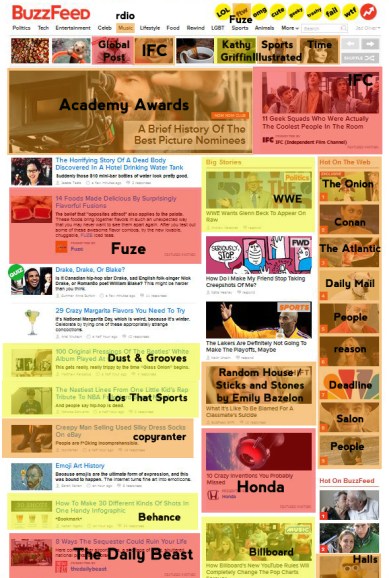
But on top of the ads marked as ads and the ads masquerading as content there are some gray areas where scraped content and advertising cross paths again, but the content isn’t necessarily sponsored by anyone. In these situations I’ve marked the content yellow.  In this grey area (yellow area?) we have Andrew Kacynski “writing” what is simply a repurposed press release from the WWE, another repurposed press release from Billboard magazine and another glorified press release about an innovative use of the White Album from website Dust and Grooves. There’s a suspiciously in depth description of an incident on the Kathy Griffin show, as well as posts which are lifted almost verbatim from their sources – a liquor infographic taken in its whole from an artist on the Behance network and a video of some kid dissing the NBA that’s been lifted from Los That Sports.

BuzzFeed’s problem isn’t that there’s an unmarked article here or there that’s just a glorified advertorial, like The Atlantic. BuzzFeed’s problem is that it’s all glorified advertorials, with the occasional piece of ‘original’ content (and by ‘original’ content, I mean something they scrape from somewhere else and only casually make reference to the actual original, if they make mention at all).

Update from a reader who objects to the problematic previous entry:

The reader may take offense with the re-appropriation of content on BuzzFeed found on other websites, but the posts marked in orange and yellow are not sponsored stories. That is to say, BuzzFeed received no compensation from any of the so-called “sponsors” of any of those stories. Every piece marked in orange or yellow was either written independently by editorial staff at BuzzFeed or, in the case of the stories from other publishers in the “Big Stories” column or the row of thumbnails on top, link directly to those publisher’s websites.

Suggesting that these are “ads” or toeing the line into advertising is a fairly ridiculous standard – the cover story that is supposedly “sponsored by the Academy Awards” is a timeline of each Best Picture nominee’s path from conception to actually being made, written by Richard Rushfield, a veteran entertainment reporter formerly of the LA Times. “Copyranter” is a paid blogger at BuzzFeed (his writing is no more sponsored than your “Cool Ad Watch”), and since when is publishing book excerpts or covering press releases considered advertising? Held to this standard, much of the entire blogosphere would be considered advertising, including the Dish.

I work in the business department at BuzzFeed and spent most of the day following your talk defending the valid points I thought you made. But do please try to avoid publishing unfounded accusations (like the suggestion that the writer of the Sony ad wrote its subsequent product review on the site). It hurts your credibility and takes attention away from the much more pertinent, and important, criticisms you have to make.

Another reader:

Longtime reader, new subscriber to the Dish. Like you, I am also suspicious of the sponsored posts on Buzzfeed, but I’m not sure it’s unprecedented. My mother spent many years working at Newsweek in charge of producing the magazine’s special sections.  These sections were written in a different font than the magazine, but were in center of the book and were essentially advertorials.  Special sections were on subjects as varied as heart health, fall fashion, the national parks, etc.  My mother got writers who were experts on these subjects to write articles, and the sections drew in advertisers who wouldn’t normally buy ads in a general interest publication.

The articles in these special sections was not written by the advertisers per se, but they definitely were not written by Newsweek’s journalists.  The purpose of the special sections was too draw ad dollars, so they usually weren’t hard hitting,  And there’s no question that they emerged from the business side of the magazine. It’s not an exact analogue to what Buzzfeed is doing, but it isn’t that much of a departure either.

Another:

This blurred line isn’t new; it’s just new to the Internet. Radio announcers have been doing it for nearly a century. You listen to local DJs with a wide audience, and in between jokes and gags they launch into a 3-minute soliloquy about the newest Italian joint in town, live on air as part of the “show”. At no point do they reference that it’s sponsored content or an advertisement. But regular fans of the show catch on mostly due to repetition and the fact that the content slides into an “uncanny valley” of entertainment. Buzzfeed readers will figure out the cues too. I’ve already begun to.

Update from a reader, who counters the previous one:

This may have been true a century ago, but for decades it has been illegal.  Fine-and-imprisonment illegal.  A sponsored mention must be identified as such, as part of the mention itself.  Radio staff must not only sign affidavits saying they understand this policy, they also must annually view presentations about the policy and pass an exam about it.  That’s how illegal it is.

Are there still blurred lines?  Yes; you’ll still hear a DJ thank Taco Bell for dropping off samples of that new item on their menu, it tasted great.  But that will last 15 seconds or less, it will be recorded and logged.  3-minute soliloquies about ANYTHING on a music radio station are the kiss of death anyway.

Another on radio ads:

I had an interesting realization this morning on the way to work: I listen to moderately disguised sponsored content on the radio all the time. I love Philly Sports radio and tune in any time I’m in a car. Their ad model includes their popular personalities endorsing products in their own voice without a clear delineation between content and ads. The ads are unmistakeably about products, but sometimes are so woven into the discussion at hand and so tonally similar that it’s hard to tell.

The interesting realization, given my general agreement with you on the issue, is that in that context I honestly don’t mind at all and – egad! – I’ve actually purchased some products that were advertised. I can’t recall ever buying anything because of a web ad, but our mortgage, wedding rings, and some home electronics are all from “sponsored content” I heard. Sure, radio is a totally different medium, but I now find myself much less offended by sponsored ads in general. My only remaining caveat (and The Atlantic’s giant screw up) is that the editors need to have no problem associating their good name with the product at hand.

One more:

As a paid up Dish-head, I wanted to email in about my total boredom with your series on Buzzfeed. Every time I read one of your pieces, I want to scream the same thing over and over again: If anyone is unhappy with what Buzzfeed (and the like) is doing, don’t bloody read it! No one is holding a gun to your head.

Like many Internet users, I occasionally visit Buzzfeed. There’s the decent item here and there, they do a mean gif round-up and their reactions to big events always give me a minute or two of amusement. As a user of a free site, obviously you expect ads, and if they happen to be a bit more clever than the usual dirge offering pills, penis enhancements and amazing ways to make money, in the grand scheme of things, who gives a damn? No one who visits Buzzfeed is going there for thought-provoking, independent journalism – they do some decent political titbits, but titbits are all they are.

Why the hell are you taking it so seriously? The market will soon sort them out if their advertising strategy turns out to be be a sea of deep, insidious evil. Please drop this silly subject – there’s far more important things going on that we want your insight and input on.

Spot The Sponsored Content

A reader writes:

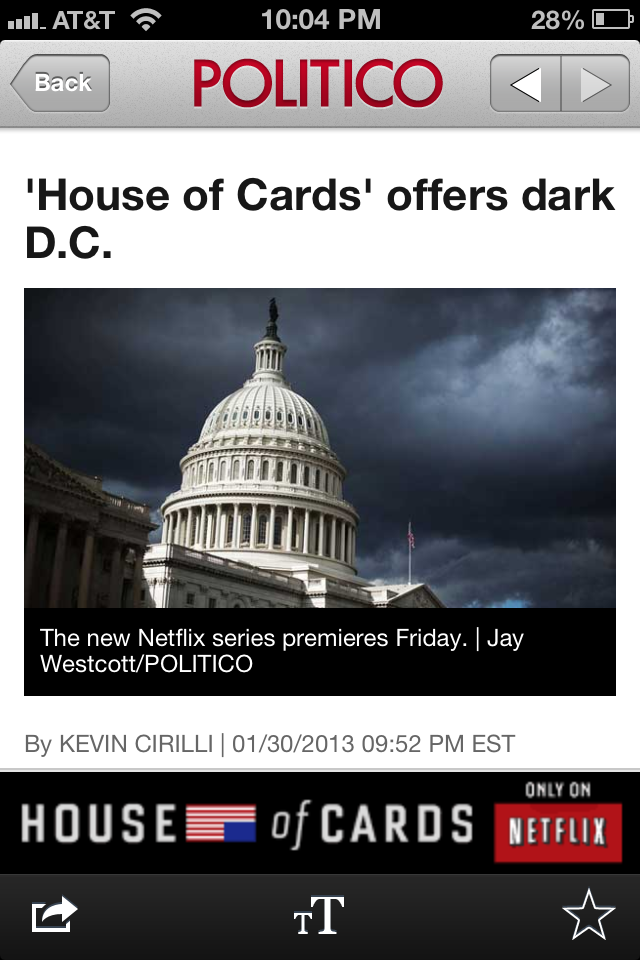
This discussion about blurring the lines of advertising and journalistic content reminded me of the House of Cards ad campaign on Politico. For weeks leading up to the Netflix premiere, the political news site had a pop-up ad for House of house-of-politicoCards plastered all over their site and app. Then they started running articles with interviews from the creator and Kevin Spacey that were also preceded by the same ad as well as the banner at the bottom of the page. Then the day prior to the show’s premier they did a follow-up story, again with the banner ad at the bottom of the article (see attached screenshot). Politico even gets a shout-out on the show when Zoe leaves the world of old media to take a job with the new media site Slugline: “Six months from now, Slugline will be what Politico was a year and a half ago. Everyone at Politico reads it because Slugline’s breaking stories before they are.”

Obviously I don’t know what the contractual agreement is between the two parties, but this stuff just reminds me of shit that the right-wing media pulls when they scare their audience about out-of-control inflation and economic doomsday scenarios during a segment that segues into commercials for gold and survival seed packs. I’m all for new revenue streams, but content created in conjunction with the advertisers can be a slippery slope. One only needs to look at the cozy relationship between the tobacco companies and cable networks during the ’50s to see how a myopic deference to advertisers can do the public a disservice.

A bleg to readers: email us with more examples you find of editorial content and advertising placed perilously close together.