Why Intervene In Iraq And Not Syria? Ctd

by Jonah Shepp

Aki Peritz believes that ISIS poses a genuine terrorist threat to the US, and on that basis, suspects that Obama will eventually see fit to target the group in Syria as well as Iraq:

It is well and good that the president said he won’t “rule out anything,” but the reality is that multiple jihadist groups already have a permanent foothold in Syria. … Will ISIL, or another Syria-based jihadi group, try to strike American targets before Obama leaves office in January 2017? If past actions predict future behavior, then the answer is probably yes. Would the administration respond to a terror attack on America or Americans with airstrikes—or perhaps more—of its own? That too is likely in the cards, given that the United States just bombed Islamic State positions to help our Kurdish allies.

Hopefully, America’s airstrikes near Irbil will prove to be the high-water mark for ISIL’s ability to export its fanatical ideology. But the group has shown itself to be an adaptable, ruthless foe bent on destroying its enemies—including the United States. Since that’s the case, it’s only a matter of time before this White House decides that America must strike Syria as well.

And maybe it will, but the argument that it should fails on two levels. First, if ISIS wants to attack Americans, deploying more American soldiers in its areas of operation makes the targeting of Americans more likely, not less (and creates a justification for it, at least in the militants’ own view). And second, if ISIS wants to carry out an attack on US soil, it won’t do so with the soldiers and materiel in Syria that Peritz would have us bomb. Rather, that threat would likely take the form of a few fanatics with American or European passports, and I don’t see how airstrikes would address that, short of killing every single ISIS member and sympathizer in Syria and Iraq (and not only there – Peritz might want to start ginning up support for airstrikes on London and New Jersey as well).

No, this conflict is not ultimately about US homeland security; it remains, first and foremost, a regional power struggle. Certainly, some of the Syrian rebels would like us to get involved:

Moderate Syrian rebels argue that, in order to challenge ISIS in Iraq, it would be necessary to tackle them in Syria too. “To protect [the Iraqi city of] Irbil from ISIS, you need to hit ISIS hard in the Euphrates river valley in Syria,” said Oubai Shahbandar, spokesman for the opposition Syrian National Coalition. “Stopping ISIS expansion requires a ground game. U.S. needs to coordinate with the tribes and the Free Syrian Army that have been fighting ISIS since January.”

“Airstrikes won’t deny ISIS territorial gain,” Shahbandar said. “U.S. needs to support those forces like FSA and tribes in Syria already on the ground fighting ISIS.”

But others, Hassan Hassan reports, appear to have joined forces with the jihadists:

According to Samer al-Ani, an opposition media activist from Deir Ezzor, several fighting groups affiliated to the western-backed Military Council worked discreetly with Isis, even before the group’s latest offensive. Liwa al-Ansar and Liwa Jund al-Aziz, he said, pledged allegiance to Isis in secret, with reports that Isis is using them to put down a revolt by the Sha’itat tribe near the Iraqi border.

He warned that money being sent through members of the National Coalition to rebels in Deir Ezzor risks going to Isis. Another source from Deir Ezzor said that these groups pledged loyalty to Isis four months ago, so this was not forced as a result of Isis’s latest push, as happened elsewhere. Such collaboration was key to the takeover of Deir Ezzor in recent weeks, especially in areas where Isis could not defeat the local forces so easily.

This complication reveals how facile and ignorant the neo-neocon case for intervention in Syria is. Simply sussing out who our friends and enemies are within the fragmented rebel “coalition” has always been a much more daunting task than the hawks were willing to admit. We don’t have the intelligence to conduct such an intervention, well, intelligently, and there’s just no getting it now. Compare that to Iraq: it’s a mess, sure, but at least our friends (Kurds), enemies (ISIS), and liabilities (Baghdad) are much more clearly defined. That’s why Michael Totten finds the question in the headline of this post sort of boring:

The Kurds of Iraq are our best friends in the entire Muslim world. Not even an instinctive pacifist and non-interventionist like Barack Obama can stand aside and let them get slaughtered by lunatics so extreme than even Al Qaeda disowns them. There is no alternate universe where that’s going to happen. Iraqi Kurdistan is a friendly, civilized, high-functioning place. It’s the one part of Iraq that actually works and has a bright future ahead of it. Refusing to defend it would be like refusing to defend Poland, Taiwan, or Japan. We have no such obligation toward Syria.

That’s it. That’s the entire answer. Washington is following the first and oldest rule of foreign policy—reward your friends and punish your enemies.

In any case, ISIS’s positions in eastern Syria are already being bombed by the Assad regime, with much collateral damage:

Militants from the Al-Qaeda splinter group are fighting on a multitude of fronts in Syria’s complex civil war – against an array of rebel groups, regime forces, and the Kurdish YPG militia – while also being targeted by locals in the eastern province of Deir al-Zor. When ISIS entered Deir al-Zor last month, it seized a number of towns and villages along the Euphrates River, often by making agreements with locals. Since then, attacks have been staged against the jihadists, who have been accused of breaking their word and detaining residents of the area. Regime forces have only recently begun targeting ISIS positions in several provinces, while anti-regime activists say the strikes have led mainly to civilian casualties.

That’s another reason why, I suspect, Obama remains set against getting involved. A war of attrition between Assad and ISIS is very bad news for the Syrian people, but as soon as American bombs begin to fall, those civilian deaths accrue to us, and those terror attacks on Americans that Peritz fears start looking like a much more attractive option for ISIS and its allies.
Why Intervene In Iraq And Not Syria?

Rodger Shanahan distinguishes between the two situations:

There will of course be accusations that Obama is a hypocrite for intervening in Iraq but not Syria. That argument is simplistic and wrong. If the US is obliged to intervene militarily everywhere there is a humanitarian need, it would never stop intervening. Obama said as much in his speech. He is one of the few US leaders to understand the limits of American power.  Moreover, the situation in Syria is far more complex. To have assisted one side would have meant breaching a nation’s sovereignty (no big deal) and potentially assisting the very Islamist forces that pose a security threat to the region and the West (a very big deal). The intervention in Iraq requires Obama to do neither of those things, so the calculus is completely different.

Ryu Spaeth elaborates:

As Obama made clear, this authorization of force has modest goals: 1) to protect U.S. personnel in the Kurdish city of Erbil and 2) to facilitate a humanitarian mission for 40,000 Yazidi Iraqis who are trapped without food or water and face imminent slaughter at the hands of the Islamic State in Iraq and Syria. There is no equivalent situation in Syria with such clear, executable goals.

Furthermore, the Iraqi government is a U.S. ally, as is the regional government in Kurdistan, where the latest action is happening. The U.S. has an interest in bolstering the regime and keeping it together; that is not the case in Syria. While Obama said he would prefer the Iraqi government to take the lead in this endeavor, the U.S.’s hand was forced after ISIS took advantage of gridlock in Baghdad to sow chaos in Kurdistan, which had once been an oasis of stability in Iraq.

Finally, the U.S. is partly to blame for the situation in Iraq. This is what happens when you recklessly invade other countries.

Also, Congress isn’t stopping Obama this time:

Last year, the Syrian government launched a chemical weapons attack that killed thousands of Syrians, crossing a red-line that Obama had previously laid down. In response, the Obama administration began laying out the case for launching airstrikes against positions in Syria, arguing that international norms and the word of the U.S. needed to be upheld. Congress, however, was quick to slam the brakes on that effort, arguing that their authorization was necessary before any new U.S. force could commence. The vote count soon slid heavily against Obama, with only the deal between the U.S. and Russia to remove Assad’s weaponssalvaging the situation. In contrast, Congress has yet to protest the actions, with Speaker of the House John Boehner (R-OH) saying that Obama’s proceeding with airstrikes “is appropriate.”

Abducted By ISIS

A harrowing account from a 14-year-old Kurd in northern Syria:

They would be taken to the torture room downstairs, one by one. When it was Lawand’s turn, he was first put in a car tire and beaten. Then he was hung from the ceiling by his hands, and beaten again. He could take this punishment for only half an hour before admitting that the list of his YPG relatives was accurate. He was taken back to the cell upstairs, where his time in detention would span 20 days. The kids were allowed to spend an hour each day in the yard; older prisoners got only five minutes. …

When the Muslim holy month of Ramadan began, in late June, Lawand was allowed to leave the prison. He rejoined the other students at a nearby school. The kids were forced to observe the holiday’s daily fast in the July heat. When one was caught taking a sip of water, the militants tied him to the goalposts of a soccer field, making his body into a cross. Then they scalded him with hot water and beat him with sticks.

Some kids tried to escape. One was successful. When the rest were caught, they were put through mock executions, and more torture. Some had knives pressed against their throats for what seemed like an hour.

ISIS Gains Ground In Northern Iraq

Screen Shot 2014-08-04 at 2.26.16 PM

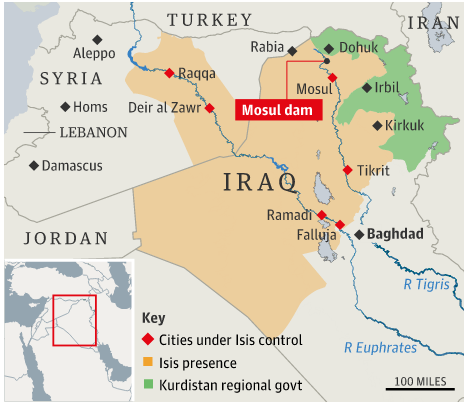
The Islamic State has taken over the town of Sinjar in the country’s northwest, near the Syrian border. Sinjar is the homeland of the Yazidis, a religious minority that Joshua Landis warns is now in grave danger of persecution:

One of the few remaining non-Abrahamic religions of the Middle-East, the Yazidis are a particularly vulnerable group lacking advocacy in the region. Not belonging to the small set of religions carrying the Islamic label “People of the Book,” Yazidis are branded mushrikiin (polytheists) by Salafis/jihadists and became targets of high levels of terrorist attacks and mass killing orchestrated by al-Qaida-affiliated jihadists, following the instability brought about by the War in Iraq.

Today’s IS assault is already bringing about devastating consequences for Yazidis, who make up about 340,000 of Sinjar’s 400,000 inhabitants (this is a high estimate). Many have fled on foot through the desert, without food or water. Others fleeing in cars for Dohuk have been unable to make a clean escape, due to the inability of the roads to accommodate such a large flux of people. Thousands of cars are currently stranded west of the Tigris River.

Andrew Slater also fears for Sinjar’s religious minorities:

By the afternoon of Sunday, August 4, with ISIS in full control of Sinjar, terrified families from the area began their dangerous exodus. The speed with which ISIS engulfed the entire mountain range attests to the large numbers of fighters they brought to bear for this major offensive. Villagers in the Sinjar area gave accounts of girls and young women from their families being abducted by ISIS fighters and carried away. Countless families fled to the mountains above their villages where they are currently surrounded by ISIS controlled areas and are desperately calling friends and family members who escaped, pleading for help. Pictures of families hiding in the mountains have circulated widely on Iraqi social media.

Besides the Sayyida Zainab mosque, ISIS forces were reported to have blown up the Sharif Al-Deen shrine on the Sinjar mountainside, a holy place for Yezidis. The ISIS flag was also raised over the only remaining church in the Sinjar area. Within 24 hours, Sinjar has been transformed from a bustling community into a string of ghost towns.

In its rampage through northern Iraq, ISIS may also have captured Iraq’s largest dam:

Capture of the electricity-generating Mosul Dam, which was reported by Iraqi state television, could give the forces of the Islamic State (Isis) the ability to flood Iraqi cities or withhold water from farms, raising the stakes in their bid to topple prime minister Nuri al-Maliki’s Shia-led government. “The terrorist gangs of the Islamic State have taken control of Mosul dam after the withdrawal of Kurdish forces without a fight,” said Iraqi state television of the claimed 24 hour offensive. Kurdish officials conceded losses to Isis but denied the dam had been surrendered. A Kurdish official in Washington told Reuters the dam was still under the control of Kurdish “peshmerga” troops, although he said towns around the dam had fallen to Isis.

Meanwhile, jihadists affiliated with ISIS and the Syrian jihadist rebel group Jabhat al-Nusra have taken over the Lebanese border town of Arsal, but Zack Beauchamp assures us that this isn’t as scary as it seems:

ISIS’s actions in Arsal aren’t part of a deliberate expansion of the caliphate into Lebanon. Rather, Lebanese forces picked a fight with ISIS fighters who’d been pushed out of Syria. In purely geographic terms, this interpretation of the fighting makes more sense. … Lebanon, down near Damascus in the west, is really far from ISIS’ bases in north-central Iraq and northern Syria. It would be very, very hard for ISIS control territory far away in Lebanon in the same way it controls the caliphate proper.

That said, ISIS’ presence in Lebanon really could be destabilizing all the same. The Arsal fighting alone has already displaced 3,000 people and killed at least 11 Lebanese soldiers. And while ISIS is not trying to seize territory in Lebanon outright (not yet, anyway), the group is ramping up terrorist attacks there. “They’ve been bombing things, trying to get cells in Tripoli [and] Damascus,” Smyth says. “They’ve tried to use these different cells to bomb Iranian and Hezbollah targets there.”

In any case, Keating remarks that these developments are changing the calculus regarding ISIS’s staying power:

A few weeks ago, it seemed unlikely that ISIS could hold out for that long given the sheer number of regional actors it had picked fights with. But it seems like it’s not only holding out, it’s expanding its activities into new areas and taking on new rivals. It’s hard to imagine how it will be contained unless the various forces fighting it can somehow find a way to coordinate. For now, the center of the conflict seems to be the Mosul Dam. Will the prospect of power cuts or catastrophic flooding be enough to get Maliki’s government to work with his Kurdish rivals?

Siddhartha Mahanta notices that ISIS’s recent gains have prompted the Baghdad government to start cooperating with the Kurds:

That massive setback — which the peshmerga claim is a strategic retreat — reportedly led Maliki to back up the peshmerga with air support, as Reuters reported on Monday. “We will attack them until they are completely destroyed; we will never show any mercy,” a Kurdish colonel told the news agency. “We have given them enough chances and we will even take Mosul back. I believe within the next 48-72 hours it will be over.” So while Maliki is making good on his threat to use legal power to seize Kurd-claimed oil, he’s also sending in the planes to back the Kurds just as the myth of their apparent invincibility takes a potentially serious hit. It’s either a shrewd political move or a truly desperate cry for help. Baghdad and Erbil. These days, theirs is a tale of two frenemies.

And Dexter Filkins argues that we should be helping the peshmerga, too:

The militants in ISIS have swept across much of northern and western Iraq, and there is no sign that they have any intention of slowing down. In a surprising—and encouraging—turn, Maliki has apparently ordered the Iraqi Air Force to carry out air strikes to help the Kurds. That said, the Iraqi Army has proved itself utterly ineffectual in combating ISIS. If the U.S. decided to help the Kurds, there would be no guarantee that the Kurds wouldn’t later use those weapons to further their own interests. But what other choice is there? If anyone is likely to slow down ISIS, it’s going to be the Kurds—regardless of whatever they’re planning to do later on.

“Crimes The Likes Of Which We Have Not Seen Since Auschwitz”

A mysterious Syrian defector known only as “Caesar” testified to Congress yesterday that he had documented the torture and murder of 11,000 people by the Assad regime, and that 150,000 more were currently imprisoned and facing the same fate:

After spending two years meticulously documenting the systematic torture and murder of thousands of men, women, and children, he carefully planned his escape with the photos and the files that accompany them. The FBI is near complete in its effort to verify them, increasing their evidentiary value for future war crimes prosecutions. “I saw pictures of young children and the very elderly as well, and pictures of women. Sometimes I would come across the pictures of some of my own neighbors and people that I recognized. I was horrified but I would not tell them the fate of their children,” out of fear of the regime’s retaliation, Caesar sad. “My religion did not allow me to be quiet about these horrendous crimes that I have seen.” …

International war crimes prosecutor David Crane, who led the first large research project looking at the Caesar photos, said that the atrocities evoked memories of the Holocaust, a sentiment expressed last month by the State Department’s Ambassador-at-Large for War Crimes, Stephen Rapp. “We rarely get smoking gun evidence in my business… but what we found was just that,” said Crane. “The photos show crimes the likes of which we have not seen since Auschwitz.”

Some of Caesar’s gruesome photos can be viewed here. One example after the jump:

140731_2

John Hudson suggests that Caesar’s testimony is part of a renewed effort to drum up support for US intervention in Syria:

Supporters of the Syrian opposition in Washington hope that the gruesome images will catalyze efforts to boost U.S. military support for Syria’s moderate opposition. The briefing was in part facilitated by the Coalition for a Democratic Syria, an umbrella group that lobbies for additional U.S. support to the rebels. “This brings it to a whole new level,” Oubai Shahbandar, an advisor to the Syrian Opposition Council, told Foreign Policy after the briefing. “This is genocide with a capital ‘G.’ You can’t ignore this. You can’t say there are no good options. We have rows and rows and rows of naked emaciated bodies.”

Meanwhile, Back In Syria …

Hassan Hassan suspects that Assad is poised to recapture Aleppo, which would be a potentially fatal blow to the rebels:

The regime’s recent gains mean that it may be able to strangle the opposition’s strongholds in Aleppo, and threaten its support networks outside the city. Sheikh Najjar is a strategic gateway for the regime into Aleppo’s northern countryside, and if it can capture the still rebel-held Infantry School and Handarat camp, it can secure northeastern Aleppo and encircle the rebels. It can also disrupt the rebels’ supply lines to Turkey, which represent their main source for arms and supplies.

Thus, the rebels in Aleppo find themselves squeezed from all sides:

They are facing pressure from much of the city’s surrounding countryside, the loss of strategic territory on the outskirts of Aleppo, and now regime incursions into the city’s internal districts. The regime has also successfully opened a supply route into Aleppo from the southern countryside, which activists say was one of the key reasons for the regime’s latest advances in the city. To make matters even worse, the Islamic State (IS), previously known as ISIS, is advancing toward Aleppo from the east, from its strongholds in the cities of Raqqa and al-Bab.

Aleppo’s recapture by the regime would be catastrophic for the opposition. From the opposition’s point of view, the city is too big to fall: The takeover of the country’s northern economic hub in 2012 helped the opposition to establish itself as a viable challenge for the regime. If it now falls to the regime, the opposition would have lost four main provinces — after Raqqa, Deir Ezzor, and Homs — to its rivals in the regime and the Islamic State.

All Wars Are Important, But Some Wars …

Goldblog wonders why the press is paying so much attention to Gaza and so little to Syria, when the implications of the latter conflict are, in his view, much broader (and the death toll much higher):

[T]he Arab Spring (or Awakening, or whatever word you choose) has given lie to the idea—shorthanded as “linkage”—that the key to American success in the broader Middle East is dependent on finding a solution to the Israeli-Palestinian conflict. This idea, that all roads run through  Jerusalem, has traditionally motivated a great deal of journalistic and foreign policy expert interest in this conflict. Finding a solution to this conflict is very important to the future of Israelis and Palestinians, of course, but not nearly so much to Americans. A peaceful resolution to this conflict would do little to bring about good governance in Arab states, or an end to Islamist extremism in the greater Middle East. Which brings me back to Syria. The war in Syria (and Iraq, since it is more or less a single war now) is of greater national security importance to the United States than the war in Gaza, and it should be covered in a way that reflects this reality.

It’s a familiar, ancient device for Israel apologists: there are worse massacres elsewhere; solving Israel-Palestine won’t help us much in foreign policy anyway; so let’s move right along, shall we? And don’t mention the settlements, except in asides that are designed to credentialize the writer as someone who naturally opposes them – even as he also opposes any serious pressure on Israel to stop the provocations. He attributes the discrepancy to the Western world’s weird obsession with criticizing Israel, which is subtler version of the accusation of anti-Semitism.

One reason, of course, which Goldblog mentions, is that the US is partly paying for the slaughter in Gaza and for the clean-up afterwards. More to the point, condemnation of Assad is universal in the US (while Netanyahu is lionized and egged on by one political party), and the conflict there is an evenly matched civil war, rather than one more relentless pounding of a weak mini-state under Israeli control with casualties massively lop-sided in one direction. This is not to say that what is going on in Syria isn’t unbelievably awful and worse in many ways than what’s occurring in Gaza. We noted the massacre here that Goldblog says the NYT ignored. It is simply to say that we would be far more involved if we were supplying the weapons that were killing Syrians en masse.

Keating, on the other hand, agrees that the world is paying attention to the wrong events, but thinks the reason has more to do with how we react to short-term vs. long-term conflicts:

One big problem with the now prevalent “arc of global instability” narrative is that it lumps together short-lived flare-ups of long-running local conflicts with much larger and more transformative events. Sooner or later, the violence in Gaza will be resolved by a cease-fire, though the question is how many more people will die before it happens. The violence in eastern Ukraine flares up and dies down, but despite the understandable wariness in Eastern Europe, it seems unlikely to spread beyond its immediate region.

The twin civil wars in Iraq and Syria are another story: a long-running and increasingly chaotic situation without an obvious political solution, even a short term one. The violence challenges long-standing borders in the region and could increase the risk of international terrorism, and the refugee crisis it has created will continue to place strain on surrounding countries. Given the Iraq war and the deepening U.S. involvement in Syria, I would also argue that it’s the crisis the U.S. bears the most direct responsibility for. This week’s most discussed tragedies will eventually come to an end. But the chaos in Iraq and Syria isn’t going anywhere.

No Quiet On The ISIS Front

Hanna Kozlowska provides an update on Syria, where as many as 700 people were killed last Thursday and Friday in fighting between ISIS and regime forces – the highest death toll in 48 hours since the start of the war in 2011:

The Shaar gas field in central Syria saw some of the heaviest fighting. It is a crucial gas supply facility for the country’s central region and among the largest in Syria. Islamic State fighters attacked the field Wednesday night — just hours after Bashar al-Assad was sworn in for a third, seven-year term as president —  and seized it Thursday, killing 270 government soldiers, guards, and staff. According to the Syrian Observatory for Human Rights, a Britain-based NGO, at least 40 militants from the group formerly known as ISIS were killed. Over the weekend the body count grew by 100. More than 170,000 people have died since began in March 2011. And the war created an unprecedented refugee crisis displacing 2.8 million people, including many women and children.

On Monday, Islamic State fighters clashed in Damascus with other anti-Assad rebels who initially embraced the group but now are trying to expel it from the city. They’ve successfully ousted the organization from sections of the capital and its outskirts but the Islamic State’s influence has recently expanded, encompassing an oil-rich area in the eastern Deir Az Zor province. The organization controls much of Syria’s east.

The conflict also continues to have a severe impact on its neighbors. Alice Su takes stock of the ever-heavier burden the Syrian refugee crisis is imposing on Jordan, which is also host to thousands of refugees from Iraq and other war-torn countries:

A year passes, then two, then three. Rents rise—up to 300 percent in some areas—along with gas, electricity, and water bills. The Jordanian economy, already destabilized by disrupted trade and transit routes across the region, wobbles. GDP growth declines. Foreign direct investment shrivels. Budget deficits and public debt grow.

Jordan’s government has drafted a National Resilience Plan to mitigate this kind of damage for its citizens, 14 percent of whom live below the national poverty line. But the plan, along with all the humanitarian work in the country, depends on international funding, which is dwindling. To date, UNHCR has received 33 percent of its 2014 regional appeal for the Syrian crisis, leaving a gap of nearly $2.5 billion.

Jordan is not meant to be a host country indefinitely. Refugees are supposed to stop here for relief until they reach a “durable solution”—meaning returning home or resettling somewhere with permanent residence. So far, 22 countrieshave pledged to receive almost 35,000 Syrians, with UNHCR calling for a further 100,000 pledged spots by 2016. But there are more than 2.6 million Syrian refugees total, and only some of the pledges— just 121 resettled in America and 24 in the U.K., for example—have been fulfilled. The remaining refugees are stuck here, lives frozen, told to wait for a resolution that may not come.

Getting By In Aleppo

SYRIA-CONFLICT

A resident provides a glimpse into her day-to-day life in the war-ravaged city:

I make my coffee while reading Facebook to see what damage last night’s bombings caused. I am lucky to have the money to pay for a satellite internet connection. This is the only way to get online here in the rebel-held areas of Syria because for almost two years all means of communication have been cut—landlines, the mobile network and the internet—as collective punishment for areas that rebelled against the regime. Fighters and activists use walkie-talkies but as a woman I am not allowed to use one. This area of the city has long been very conservative and women don’t participate in public life; now it is also a frontline in a warzone, even more of a male-only domain.

The electricity is on for around four hours a day, so many people have paid to get an alternative source of power. Local traders invest in huge generators and they distribute electricity to others for a monthly fee. Sometimes the electricity is completely cut off for a week and the generator breaks, like today.

I have breakfast and wash the dishes with a trickle of water to save what is left. The water comes on for an hour per week. That is enough to fill the tank on my roof and with careful use I won’t run out this week. If I do, I will have to buy water from a well. New wells are being dug randomly, without engineers or studies—I recently saw one being dug in the middle of a crowded neighbourhood.

It is 11 am and I put on a hijab (not something I wore before the war) and a loose knee-length sweater and leave to go to a field hospital where a friend I am filming is living. She is the only female citizen journalist working in the northern rebel-held areas and I am doing a profile of her. As well as being dressed conservatively, I have to make sure I have a male “guardian” with me. This area of Aleppo has always been conservative, but before the war visitors could wear what they wanted. That is no longer the case now the social tradition is armed.

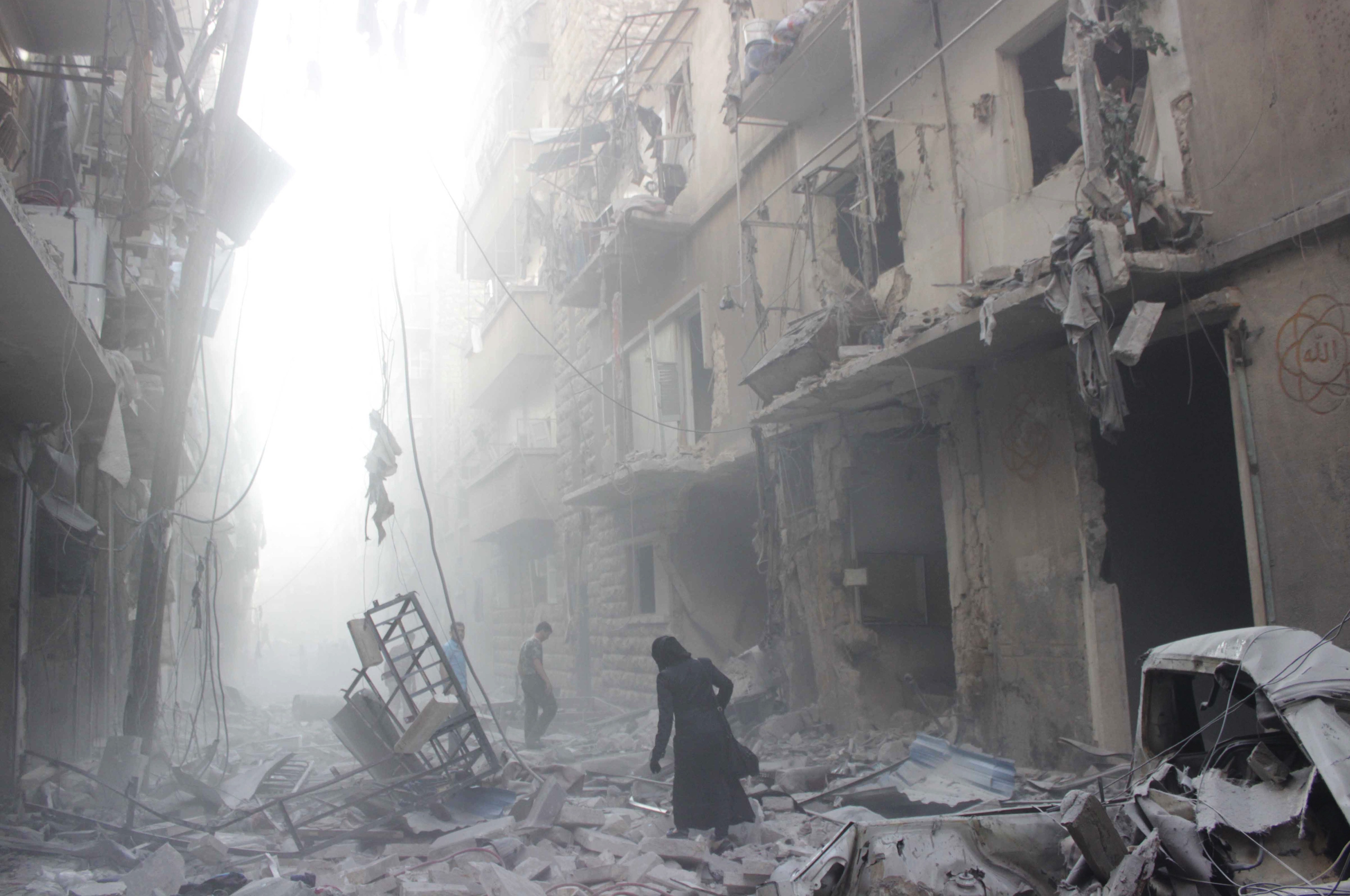
(Photo: A Syrian woman makes her way through debris following an air strike by government forces in the northern city of Aleppo on July 15, 2014. More than 170,000 people have been killed in the three-year war, one third of them civilians, according to the Syrian Observatory for Human Rights. By Karam Al-Masri/AFP/Getty Images)

Syria’s Hidden Suicide Crisis

Lauren Wolfe warns that self-harm is “rapidly becoming a very real fallout of this [Syrian] war — one that is so taboo, it is rarely spoken of within families, let alone publicly”:

“Suicide is strictly forbidden in Islam,” said Haid N. Haid, a Beirut-based Syrian sociologist and Middle East program manager at the Heinrich Boll Foundation. Scholars often forbid the recitation of a funerary prayer for people who’ve committed suicide, as a way to punish the families of the dead and to deter others from taking their own lives. The cause of death is usually obscured — it is called an “accident” or “natural.” Suicide, Haid emphasized, is always “a big scandal that people will talk about for a long time.”

Despite the taboo, doctors I spoke with said they are seeing more and more cases of people with suicidal impulses – a trend confirmed by the number of reported instances in which, because of a feeling of being unable to provide for one’s family as a refugee, or because of the shame of rapepregnancy through rape, or sexual humiliation, it has been carried out. Hard data are difficult to come by. But while I was unable to find formal statistics on suicide in the Syrian war, the picture painted by doctors working in and near the country is decidedly bleak — and given how precious few mental health services are available to Syrians affected by the war, it is probably just the tip of the iceberg.

Meanwhile, a UNHCR report on female refugees from Syria illuminates the unimaginable daily struggles these women contend with:

With their husbands, fathers, and brothers dead, missing, or still in Syria — many of them denied entry to the neighboring countries — these women compose a particularly vulnerable segment of a population caught in a humanitarian catastrophe that the United Nations has described as the worst since the genocide in Rwanda. Tuesday’s report, which is based on interviews with 135 women between February and April, paints a desperate picture of their lives as refugees in Lebanon, Jordan, and Egypt. …

According to UNHCR, 40 percent of refugees in Lebanon live in substandard dwellings, which include both unfinished buildings and makeshift settlements. And female-headed refugee families — which in Jordan, Lebanon, and Egypt include on average 5.6 members — are particularly vulnerable to life in an inadequate shelter. When Suraya, a mother of seven, arrived at Jordan’s Zaatari camp, she stood guard outside her tent. “I would dress and act like a man so that my children could sleep in peace and feel safe,” she told the UNHCR. Another woman, Zaina, who also lives in Bekaa, said: “When there is no man, people are like animals.” Their children aren’t the only ones vulnerable to predators. The women must also defend themselves from sexual harassment and gender-based violence, often perpetrated by their landlords.