The Syria Dodge

Have you noticed how almost all of Obama’s critics on Syria have berated him for the optics, but have never said what they would have done in each particular moment? Greg Sargent has. Money quote:

What this whole dodge comes down to is that one can’t admit to thinking that going to Congress and pursuing a diplomatic solution are the right goals for Obama to pursue, without undermining one’s ability to criticize Obama for betraying abstract qualities we all know a president is “supposed” to possess. It’s simply presumed to be a positive when a president shows “strength” by “not changing his mind,” and it’s simply presumed to be a negative when he shows “weakness” by changing course in midstream. That’s “indecisive,” and that’s bad, you see. But it’s a lot harder to sustain these “rules” if you admit you agree with the actual goals Obama is pursuing with these changes of mind. After all, if Obama’s changes of mind have now pointed him towards goals you agree with, how was changing course a bad thing?

People should come clean about what they really believe about all this stuff.

But that would require them leaving Politico-style bullshit and actually looking at the situation and trying to figure out the best way forward for US interests. And that’s hard. It’s sooo much easier to talk in crude and spectacularly dumb terms like “strong” or “weak” without any reference to the goals at hand. The dirty truth: pundits are so much more comfortable examining style because they’re actually too lazy or terrified of actually tackling the substance, let alone taking a stand on it.

America’s Agreement With Russia: Reax

Eli Lake calls it “very ambitious”:

The first step of the U.S.-Russian framework agreement requires President Bashar al-Assad’s regime to submit to the United Nations “a comprehensive listing, including names, types, and quantities of its chemical weapons agents, types of munitions, and location and form of storage, production, and research and development facilities.” Press reports say Secretary of State John Kerry and Russian Foreign Minister Sergei Lavrov agreed in private talks in Geneva last week that Syria possessed about 1,000 metric tons of chemical agents, including nerve gas and blistering agents. But the devil is in the details. After the first submission from Syria, the U.S.-Russia plan says an initial round of inspections is supposed to be complete by the end of November, and Syria’s chemical stocks should be destroyed by the middle of 2014.

Jay Newton-Small sizes up the deal:

The framework did not address Assad’s demand in a Russian television interview on Friday that in exchange for his cooperation the U.S. stop arming the Syrian rebels. And Assad could drag the process out for years, as former Iraqi strongman Saddam Hussein did, if at any point he stops cooperating. Syria experts worry that the deal could empower Assad and undermine the opposition. “If [Assad] becomes our interlocutor how do we square that with our statement that he’s no longer legitimate? How do we square that with our statements that he has no future role in Syria?” says Steve Heydemann, a Syria expert at the U.S. Institute for Peace. “In effect this reinforces his future role in Syria.”

Shadi Hamid is furious about the agreement:

For his part, Syrian President Bashar al-Assad is effectively being rewarded for the use of chemical weapons, rather than “punished” as originally planned.

He has managed to remove the threat of U.S. military action while giving very little up in return. Obscured in the debate of the past few weeks is that chemical weapons were never central to the Syrian regime’s military strategy. It doesn’tneed to use chemical weapons. In other words, even if the regime does comply with inspections (which could drag on for months if not years), it will have little import for the broader civil war, which Assad remains intent on winning.

Marc Champion has a different perspective:

[T]he odds of limited U.S. missile strikes ending the slaughter in Syria or toppling Assad are slim-to-zero. In 1999, 78 days of bombing Serbia didn’t remove Slobodan Milosevic, another monster. It took that long to persuade him to pull troops out of Kosovo. … The anger that Hamid and others feel over the U.S.-Russian deal is a displaced fury over the failure of the international community to do zip to end this conflict. That failure is set to continue, with or without airstrikes.

Cassidy weighs in:

For the next few months, at least, events are likely to proceed along three tracks—none of which involve direct U.S. military action. Inside Syria, Assad will continue his efforts to bludgeon the rebels and their supporters, using conventional high explosives and bullets rather than mustard gas and sarin. Meanwhile, and probably under the auspices of the United Nations, the process of identifying, verifying, and securing at least some of the Syrian C.W. stockpiles will begin. Having gone this far, Putin will certainly insure that Assad does enough to prevent an immediate collapse in the disarmament effort. Finally, and most significantly, diplomatic efforts to end the civil war will intensify.

Win-win-win-win. Unless you are the rebels and thought you could get the West to ensure your victory – something that would bring with it another host of questions the neocons haven’t bothered to think through, just as they never thought through the end-game in Iraq.

Can Obama Pull A Reagan On Iran?

IRAN-POLITICS-EXPERTS-ROWHANI

Last night, I wrote that “Syria is the proof of principle for an agreement with Iran”. But that the second phase of dealing with regimes harboring WMDs in the Middle East will require real courage and boldness from the president – Reagan at Reykyavik boldness. Beinart sees the same comparison:

Since Syria is caught in the middle of an American-Iranian (and to a lesser degree, American-Russian) cold war, it’s worth remembering what ended the last Cold War. In the 1980s, Mikhail Gorbachev decided that the Soviet Union could no longer afford to prop up unpopular regimes in Eastern Europe. But to cut Eastern Europe free, Gorbachev had to answer hard-liners who had long argued that the USSR needed a ring of clients to protect it against another attack from the West. That’s why Ronald Reagan’s willingness to embrace Gorbachev and negotiate far-reaching arms-control deals—despite bitter criticism from conservative politicians and pundits—proved so important. As Reagan himself argued, “I might have helped him see that the Soviet Union had less to fear from the West than he thought, and that the Soviet empire in Eastern Europe wasn’t needed for the security of the Soviet Union.” By helping show Gorbachev that he could safely release Eastern Europe, Reagan helped end the Cold War. And when the Cold war ended, so did civil wars across the globe because the U.S. and USSR no longer felt that their own security required arming one side.

Today, President Obama’s real strategic and moral imperative is not killing a few Syrian grunts to punish Assad for using chemical weapons. It is ending the Middle Eastern cold war that fuels Syria’s savage civil war, just as the global Cold war once fueled savage civil wars in Angola, El Salvador, and Vietnam. It’s possible that strengthening Syria’s rebels and sanctioning Iran could further that goal, just as Reagan’s military buildup showed Moscow the cost of its Cold War with the United States, but only if such efforts are coupled with a diplomatic push that offers Iran’s leaders a completely different relationship with the United States, one that offers them security and status absent a nuclear weapon and no longer requires them to cling to Bashar Assad. By striking Syria, Barack Obama is making that harder. By doing so in alliance with groups that oppose any thawing of the U.S.-Iranian cold war absent total Iranian capitulation, he’s making it harder still.

This will not be easy, as Suzanne Maloney explains, but the potential for win-win-win is there:

Rouhani was elected to rescue Iran from its ruinous spat with the United States over its nuclear ambitions. He and those around him are sophisticated enough to appreciate that this objective will be much further out of their reach if all parties get tied up in a U.S.-Syrian military engagement. It would be difficult, if not impossible, for Tehran to insulate its assets and personnel in Syria from any military strike against the regime, and it would be even more challenging for Iran’s president to restrain the hard-liners in Iran’s security establishment from responding with force. So it comes as no surprise that, in hopes of advancing his mandate to rehabilitate Iran’s place in the world, Iran’s pragmatic president has thus been trying to modulate Iran’s public posture on Syria.

Russia’s diplomatic option may temporarily salvage Tehran’s investments in Assad and Syria. And perhaps that would disappoint those hoping to use intervention in Syria to set Tehran back on its heels. Still, the presumption that only a robust show of U.S. force in Syria can dissuade Iran from weapons of mass destruction is false. Using diplomacy to defang Assad would boost Iran’s readiness to work with the international community on the nuclear question.

Mohammad Ayatollahi Tabaar’s piece on the rise of Iranian pragmatism is on the same page:

In a recent interview with Iran’s state-controlled TV, Rowhani said he has been in touch with leaders of several countries and his foreign minister has spoken with his counterparts from 35 states to prevent a war. He emphasized that Iran would support “any initiative” to avoid a strike against Syria and pointed out that Tehran in principle agrees with the proposal for international control of Assad’s chemical arsenal. Moving to the nuclear issue, he said Iran’s approach for a “win-win solution” will begin during his upcoming trip to New York, where he will meet with foreign ministers of some of the P5+1 countries. He added that if the other side is serious, the “nuclear question will be resolved in a not very long period of time.”

Both the United States and Islamic Republic view the situation in Syria as a means to signal to the other side. The Obama administration claims that its serious handling of Syria will send a message to Iran and its nuclear program. The Rowhani administration, on the other hand, intends to show its diplomatic handling of Syria will pave the way for a diplomatic solution of the nuclear issue.

And why cannot both be right? Larison looks at the situation from Iran’s perspective:

 Imagine for a moment that the U.S. were in Iran’s position: a much more powerful government hostile to ours had waged two wars of regime change on our borders, it defined its policy towards our country solely in terms of grossly exaggerated fears of the threat that we ostensibly posed to them, most of the surrounding region was filled with governments aligned against ours, and one of our only remaining allies on the planet was threatened with attack from that same government. Wouldn’t we see this government as deeply hostile to us, perceive it as a major threat to our security, and do what we could to discourage an attack on our country? In such an environment, hard-liners would usually benefit and prevail in internal policy debates. If Iranian hard-liners benefit from an attack on Syria, the effect will be the opposite of the one that many Syria hawks predict, and it will make it that much more difficult to reach an agreement on the nuclear issue.

Which is why a Russian-backed UN process is so preferable to the other options. And why this is but a preliminary to the real event.

(Photo: Iranian President Hassan Rowhani attends a session of the Assembly of Experts in Tehran on September 3, 2013. By Behrouz Mehri/AFP/Getty Images)

Meep Meep, Motherfuckers

obamasmug

“Had we rolled out something that was very smooth and disciplined and linear, they would have graded it well, even if it was a disastrous policy. We know that, because that’s exactly how they graded the Iraq war,” – president Obama.

Oh, snap!

It’s been awesome to watch today as all the jerking knees quieted a little and all the instant judgments of the past month ceded to a deeper acknowledgment (even among Republicans) of what had actually been substantively achieved: something that, if it pans out, might be truly called a breakthrough – not just in terms of Syria, but also in terms of a better international system, and in terms of Iran.

Obama has managed to insist on his red line on Syria’s chemical weapons, forcing the world to grapple with a new breach of international law, while also avoiding being dragged into Syria’s civil war. But he has also strengthened the impression that he will risk a great deal to stop the advance of WMDs (which presumably includes Iran’s nukes). After all, his announcement of an intent to strike Assad was a real risk to him and to the US. Now, there’s a chance that he can use that basic understanding of his Syria policy – and existing agreement on chemical weapons – to forge a potential grand bargain with Iran’s regime. If that is the eventual end-game, it would be historic.

To put it plainly: Syria is the proof of principle for an agreement with Iran. And an agreement with Iran – that keeps its nuclear program reliably civil and lifts sanctions – is the Holy Grail for this administration, and for American foreign policy in the 21st Century.

As for the role of Putin, I argued last week that it was the Russian leader who had blinked, the Russian leader who had agreed to enforce Washington’s policy, and that the best response was to welcome it with open arms. So it was another treat to hear the president say, in tones that are unmistakable:

“I welcome him being involved. I welcome him saying, ‘I will take responsibility for pushing my client, the Assad regime, to deal with these chemical weapons.’ ”

Meep meep.

(Photo: President Barack Obama in the Oval Office on September 13, 2013. By Dennis Brack-Pool/Getty Images.)

The Best Way To Help The Syrian People, Ctd

Morton Abramowitz insists that when it comes to the massive number of Syria refugees, there “is room and need for a greater effort by the U.S. and its friends and allies”:

[T]he West must demonstrate its willingness to bear part of the burden. So far this fiscal year, the U.S. has admitted just 33 Syrian refugees. The new fiscal year will permit President Barack Obama to provide for a significant number of Syrian refugees within the 70,000 total allotted to the U.S. refugee program. In turn, the U.S. willingness to accept more refugees can also help accelerate resettlement efforts by other Western countries. Under normal U.S. procedures, resettlement could take a few years. So as the U.S. has done with Indochinese and other refugee groups, it must expedite processing. …

The refugee burden, not surprisingly, has fallen mostly on four bordering countries: Iraq, Jordan, Lebanon and Turkey. Turkey is managing well and is more capable than its neighbors of taking in more refugees, although an increase would stoke sectarian differences and political tensions. The opening for those allowed by the government to cross the border, however, continues to narrow. The biggest burden falls on a very weak Lebanese state, where the Syrian war has already provoked considerable internal violence. If Damascus were to fall, refugees would inundate Lebanon.

Earlier Dish on the Syrian refugee crisis here.

Assad’s Terms, Ctd

Before destroying Syria’s chemical weapons, Assad wants the US to agree to stop arming Syria’s rebels. Larison wishes the administration would take the deal but suspects it won’t:

It costs the U.S. nothing to agree to these terms, but these terms will likely be viewed as unacceptable in Washington. The administration will want to treat its support for the opposition as separate, and it will always want to reserve the option to attack. That isn’t because either position makes any sense for the U.S., but because the administration has trapped itself into commitments that it won’t easily repudiate. The Syrian government may not truly be willing to give up its chemical weapons, but it is doubtful that the U.S. would be willing to accept the exchange that might be required to make the deal work.

Where’s The Line On Intervention?

A reader writes:

I have watched a bit of Anderson’s new show, and I am so excited to see you on as a regular guest. The revelation for me so far (with my limited viewing) is Christiane Ahmanpour. I’ve not known her as an opinion journalist, but she is quite compelling to watch. Might I add that she is not the least bit intimidated by her male counterparts at the table, which I love. I saw a clip of her very emotional appeal for Syrian intervention (which, by the way, I think is perfectly fine as long as it is coupled with the kind of intellectual heft and reflection that someone like Ahmanpour can bring to bear), and I think it raises a legitimate question that I have posed here before. Where is the moral line for humanitarian intervention? Does a situation have to reach Holocaust proportions or are we talking Srebrenica before we act?

America is arguably the world’s only superpower. There are obligations that come with that privilege, and we now live in an era in which that is simply not a welcome burden thanks to the abuses of the Bush/Cheney years. Why am I not hearing this obligation being debated? Isn’t there a line out there that we don’t want crossed for myriad reasons? Where is that line?

Christiane’s passion is admirable and I respect her enormously. But of course, our decision matrix on whether to intervene to stop moral atrocities has to take into account the cost, context, and consequences of such a decision every time we approach it. The impulse to intervene in Somalia was a decent and good one, for example, just as Christiane’s impulse to stop these horrifying attacks is a good and decent one. But it led to a military and strategic disaster which forced us to leave in a hurry. Ditto the moral impulse to save tortured children in Saddam’s Iraq. But does the gravity of the crime matter? Of course it does, as Reuel Marc Gerecht pointed out.

To be honest, as a function of being on vacation when the attack happened, I did not experience the shock that many experienced in real time. That may have made me seem more callous than I am. I also have to say that the images of the slaughter I subsequently watched affected me deeply, as they would anyone with a heart or soul. I shifted a little because of it. But I insist nonetheless that unless there is a way to prevent that kind of horror without intervening in Syria’s civil war, we shouldn’t intervene. Maybe Obama’s “unbelievably small but not a pinprick” strike could do that, and I was open to persuasion. But now that Assad has caved on that specific issue with no missiles fired, the issue for me now is moot. If he attacks with poison gas again, we may have to reassess.

There is no eternal line defining when or when we should not intervene in these circumstances. We have to judge each incident as it occurs. Christiane and I have different judgments about that. It’s up to readers and viewers to decide which one makes the most sense to you. That’s the messy way we do it in democracies – but it’s better than any moral “red lines” without any practical consideration of the costs involved.

Dead Children As Talking Points, Ctd

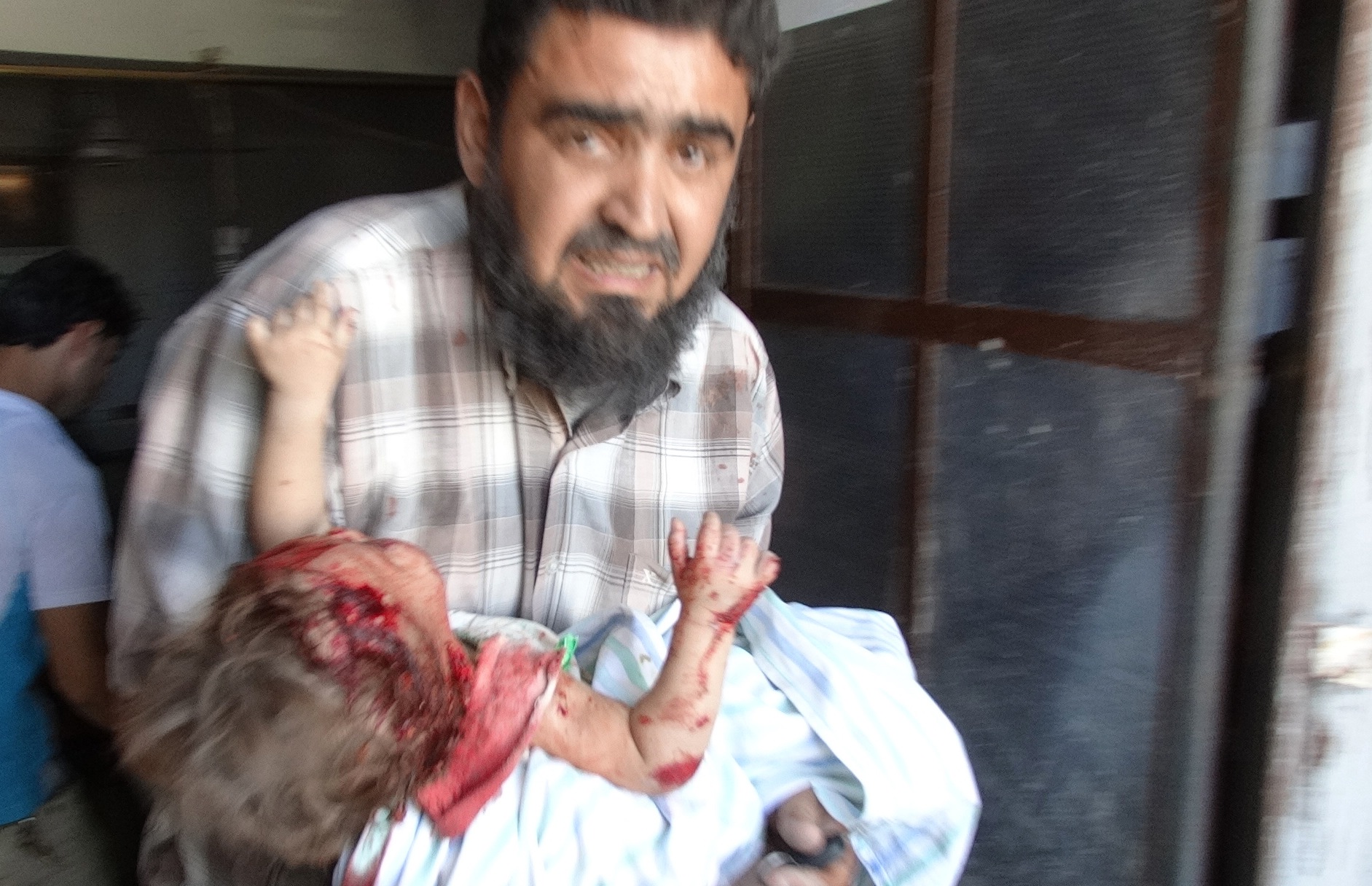
SYRIA-CONFLICT

A reader writes:

The card Obama didn’t play“?  Then what does this passage from Obama’s national address mean?

But when, with modest effort and risk, we can stop children from being gassed to death and thereby make our own children safer over the long run, I believe we should act.

It certainly isn’t as brazen as “fight em there so we don’t fight em here,” but it’s a difference of degree and emphasis, not kind.

I don’t care about the arguing over whether Obama bumbled here or there, and it’s tilting at windmills for me to be offended by using the good old “it’s for the children” emotional manipulation. But Obama still hasn’t explained how this enforcement of international norms is going to be upheld with some targeted bombings. In a specific way, this reminds me of the Bush justifications for Iraq: throw out every justification you can, see which one people will buy, and pretend that was the real reason all along.

Another reader:

I get Fallow’s point about using the emotionally-charged imagery of murdered children as talking points, but when it comes to Obama, I honestly doubt this is some mere political strategy. It seems to me that, as with gun control and Newtown, nothing so affects Obama as the murder of children. I think of his statement after Newtown and how raw and emotional he was.

His adoration for his own children can’t be denied, and a simple Google search can return a myriad of pictures of Obama interacting with children. Sure, these are photo ops, but time and again you can see an easiness, something that the aloof Obama doesn’t always achieve easily with adults.

He likes kids. I think above all things he considers himself a father. I think the preventable harm of children motivates him above all else. So I don’t think these are mere talking points to him.

I don’t either. But it should not have overwhelmed his strategic sense. Tough, I know. Almost inhuman. But that is what a moral man in an immoral society sometimes has to accept.

(Photo by Abu Amar Al Taftanaz/Getty. It was our Face of the Day last Thursday, a reminder that the Dish hasn’t looked away from the heartbreaking violence in Syria.)

“Syria Is Not A Country” Ctd

A reader writes:

Wow. You’ve really dug yourself into a deep hole. The country of Syria was given its name by the Greeks before Alexander, and aside from its shifting borders, Syria has remained constant from Greek toRoman to Umayyad to Abbasid to Ottoman to Arab to French to Syrian rule. There 655px-mpk1-426_sykes_picot_agreement_map_signed_8_may_1916as even a Syrian Roman emperor in 244. If Syria isn’t a country, then neither is Turkey, the UK, or any other country. A few seconds on Wikipedia or with the classics confirms all this, with ancient maps of Syria that are as close to modern Syria as is Sykes-Picot’s or T.E. Lawrence’s maps. Compare the map of Roman Syria from the first century BC to the 19th century map of Ottoman Syria. Aside from Palestine, they’re the same province, which is now the same country.
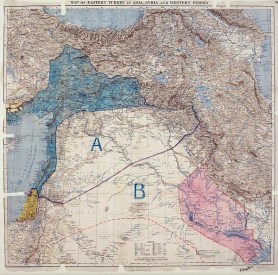
And the theory (which is yours) that the Ottomans gave the minority Shia and Christians “pools of self-governance” and that modern Syria “was precisely constructed to pit a minority … against the majority” is all absurd non-history. Both the Ottomans and the French protected their minority sects, but neither gave them self-governance or control over the majority. The straight line you draw from Sykes-Picot to brutal al-Assad rule does not exist. What’s more, and ironic for your argument, the very name of the al-Assad family comes from Hafez’s father’s opposition to modern Syria! The Syrian military coups that happened 40 years later that ultimately led to Alawite dominance have nothing to do with Sykes-Picot.

There are of course excellent reasons to avoid a foreign entanglement in a sectarian civil war, but unfortunately you’ve badly mangled history and logic to make this point.

It is not “absurd non-history” to note that modern Syria is comprised of a complex mix of extremely different sectarian and ethnic groups who have fought each other for a very long time, and that under French colonial rule, the Alawites were the favored sect. In independent Syria, the Alawites gained real power especially through the military, and ran the country under the Assad dynasty as a deeply sectarian, Shi’a force against the majority Sunni. That also explains their alliance with Iran, the region’s major Shiite power, if you don’t include post-Saddam Iraq. That dynamic means that Syria as a modern state is inherently unstable, unless sectarian identity recedes (fat chance after two years of brutal civil war), and was designed to be inherently unstable. Again, my point was not that Syria is not a name that was attached to the entire region, but that as a unitary state, in its current borders, it is a colonial contraption unfitted to multi-sectarian self-government.  Another informed reader:

I have a Ph.D in anthropology and spent decades working in Syria both with archaeological projects (for fun) and as a researcher in social anthropology studying contemporary society in Syria. I was also a Fulbright Fellow there. Anyway, I have not only read immense amounts of Middle Eastern history but lived at archaeological projects out in the Syria Jazeera as well as done ethnographic research in Damascus. I stumbled on this insight as a grad student (and as some one who had to take long-haul buses around the country). I largely agree with your post on Syria.

Any potential natural “nations” (of course, all nation states are largely imaginary) of the Middle East can best be found in the old Ottoman provinces, which were much more closely aligned with communities of common interest than the Sykes-Picot nation-states. Of the course the Brits/French pissed all over those separations and alliances. Which is the problem.

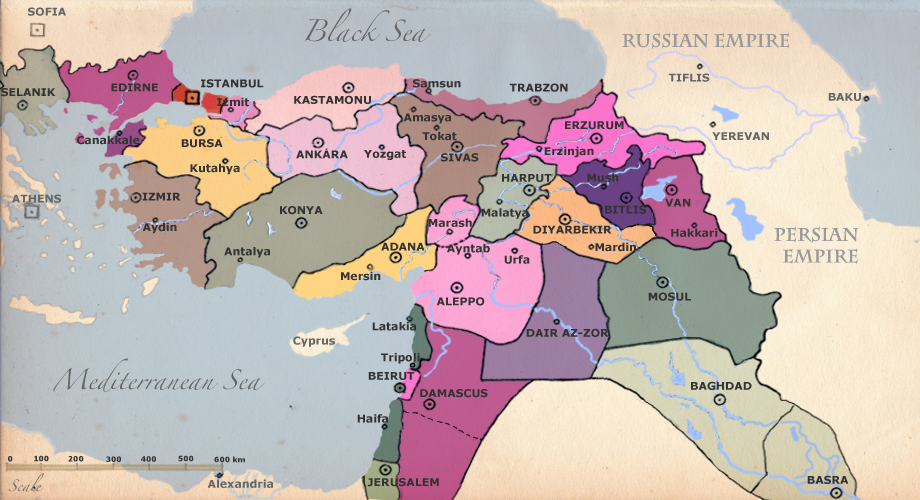
You should get some true Ottoman scholars to chime in – I am not an Ottoman expert. Also, it’s hard to find a good online map with the detail needed. Perhaps unsurprisingly, the best I found is from an Armenian advocacy group which has a vested interest in understanding the administrative units of the Ottoman Empires:
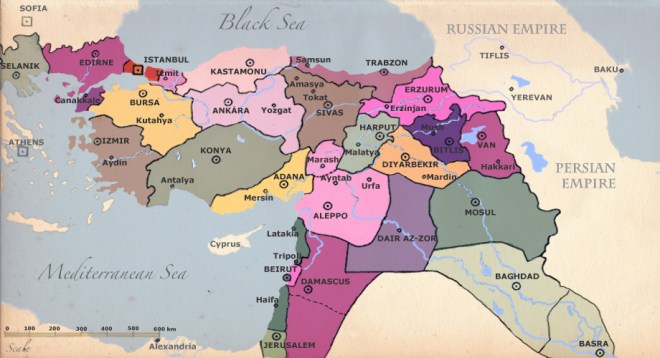
Mapa_osmanian_empire_22_02

But the Ottomans ran a big empire and the provinces were created to make administration easier. So they tended to fall along natural lines of communication with rivers, mountain passes, changes in elevation or whether or not the land was agricultural or only suited for grazing determining what was part of one province and what areas belonged to another. The Ottoman Empire was in existence for a long time and the provincial borders were fluid and changed over time and were often subdivided into smaller units and these sub-units often had governors drawn from the local population. So the province of Mosul was always quite independent, more likely than not to have locals in administration. Before naval power made control of harbors key, the Ottoman province of Basra might have had a local Arab leader. Once the British peeled away Kuwait in 1899 when it became a protectorate, then Basra became more important to the Ottomans and had rulers sent directly from the capital.

Anyway, the Sikes-Picot treaty collected the Ottoman provinces of Basra, Baghdad, and Mosul into Iraq. Just the part of Mosul that possibly had oil made it into Iraq. Much of its hinterland was sliced away and left in what would become Syria. What is now northeastern Syria – and seems to be largely under the control of the Syrian Kurds at the moment – largely traded with Mosul and Aleppo to the east and west with some trade down the Khabur river to Deir-ez-Zor. These are areas that have been linked by trade since the empires of ancient Mesopotamia! These areas have always contained tremendous ethnic and religious diversity (Arab Sunni Muslim, Arab Shia Muslim, Chaldean and Assyrian Christian, Jews – of both Arab and Kurdish ethnicity – Armenian Christians, Yazidis, as well as tribal structures that often divided and reunited these areas in surprising ways) but the natural landforms united these areas as trading partners. You can see this in the patterns of the Akkadian and Babylonian Empires as well as in the route of the Berlin-Baghdad Railroad!

Notice the southern part of the route with stations in Aleppo, Nusaybin, Mosul, Baghdad, then Basra. That’s the unit in which common economic interest and trade patterns allowed diverse populations to work together. That’s what Sikes-Picot cut apart. Notice also that Damascus, Jerusalem, Beirut, Latakia are not part of that economic/trade cluster at all. Damascus (es-Sham) and its immediate countryside was cut off from the broader territory that made up the Ottoman province of es-Sham by Sikes-Picot too. Even in the 1990s, many more buses ran each day from el-Hasake to Aleppo than from el-Hasake to Damascus, and the bus would only fill up after reaching Deir-ez-Zor.

The Ottoman provinces make more sense because pre-modern limits of communications divided the territories not European interests. The diversity of the population within the Ottoman provinces were often able to work together peacefully because they shared a common economic interest. Sikes-Picot severed and distorted those ties. One quick example, the division of Nisibis, an ancient and prosperous city, into the Turkish city of Nusaybin and the Syrian city of Qamishli. Read its history. The idea that Turkish or Syrian nationalism is strong enough to pull this city apart into two nations is laughable. Yet an international border divides it.

The terror (and the hope) of the civil war in Syria has always been that the country would come apart and with it the punishing dividing lines of Sikes-Picot.

That may be necessary for the Middle East to recover from the toll of colonialism. But it will take a lot of time and probably a lot of blood. It seems insane to me that a distant super-power should be involved in mediating something we cannot even begin to fully understand, let alone control. That fact alone buttresses the case for leaving it to its own devices.

Update from a reader:

I’ve been following the debate with interest. It seems to me that is the perfect opportunity to have someone who REALLY knows this history weigh in. In particular my good friend Scott Anderson, author of Lawrence in Arabia: War, Deceit, Imperial Folly and the Making of the Modern Middle East, currently on the NYT bestseller list. Scott has fascinating stories to tell, as the many amazingly great reviews have noted [here, here, here].

Why Syria Could Be Another Iraq

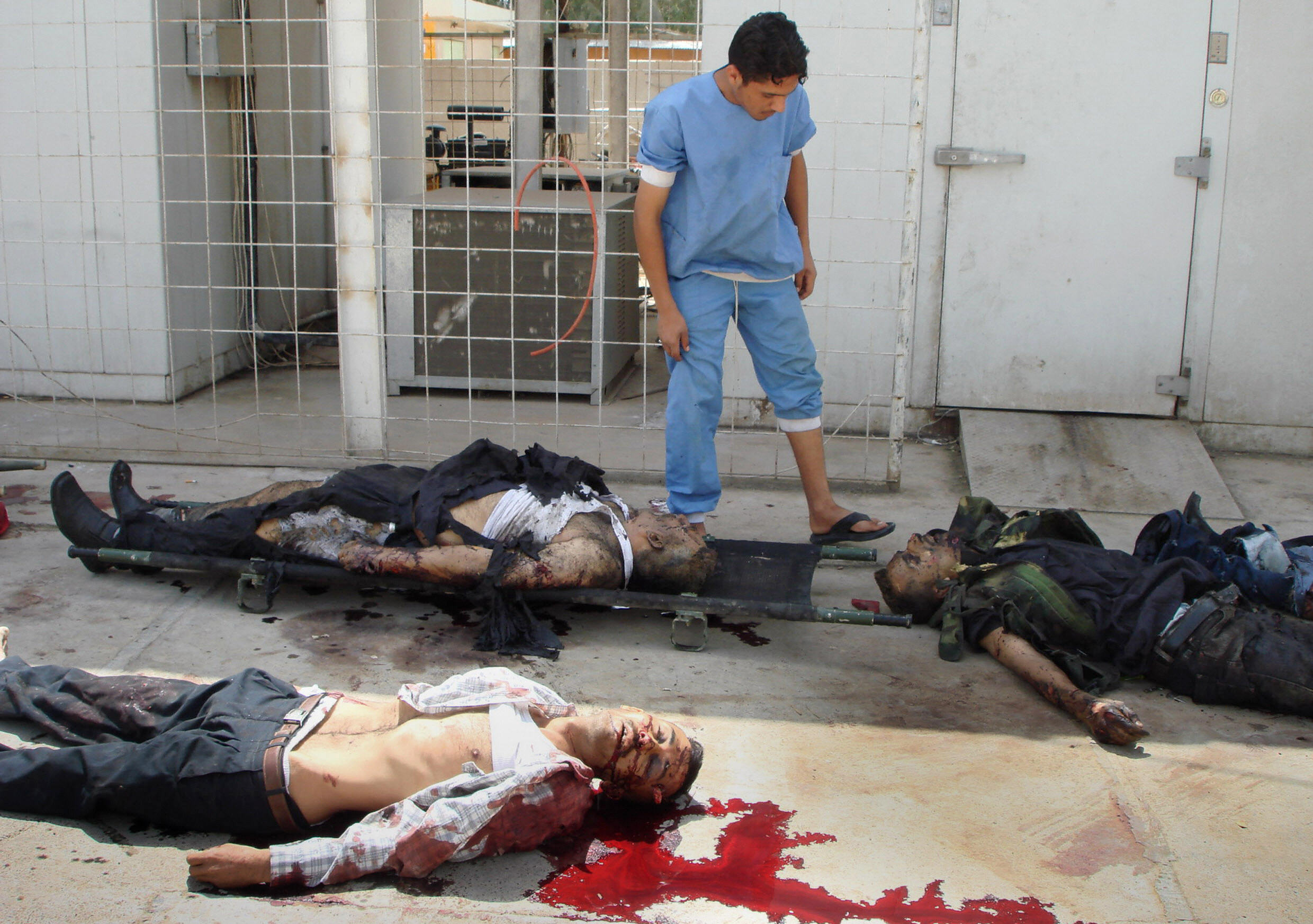
An Iraqi hospital worker inspects burned

Robert Kaplan considers the parallels:

The supporters of robust military intervention are not sufficiently considering how things could become even worse after the demise of dictator Bashar al Assad, with full-scale anarchy perhaps in the offing; how Assad might still serve a cold-blooded purpose by containing al Qaeda in the Levant; how four or five steps ahead the United States might find itself owning or partially owning the situation on the ground in an anarchic Syria; how the American public’s appetite for military intervention in Syria might be less than they think; and how a long-term commitment to Syria might impede American influence in other regional theaters. The Obama administration says it does not want a quagmire and will avoid one; but that was the intention of the younger Bush administration, too.

He admits that “each war or intervention is different in a thousand ways than any other” and that “Syria will unfold in its own unique manner.” But he can’t help but see the similarities:

[A] happy outcome in Syria usually requires a finely calibrated strategy from the beginning. The Bush administration did not have one in Iraq, evinced by the absence of post-invasion planning. And, at least as of this writing, the Obama administration seems to lack one as well. Instead, it appeared until recently to be backing into a military action that it itself only half-heartedly believes in. That, more than any of the factors I have mentioned above, is what ultimately gives me pause.

The key issue to me is what plan do we have for the demise of Assad? None, so far as I can see. Bob is absolutely right to see anarchy as the most logical result.

And it’s truly outrageous for unrepentant supporters of the Iraq war to make the very same mistake as they did last time – not thinking through the full consequences of action. If you remove a Shiite dictator who has run a brutally sectarian regime against a Sunni majority – after the kinds of atrocities we have seen so far – you will get a cycle of massive revenge. You will get ethnic cleansing of the Alawites; mass murder of Christians; and appalling violence. In that climate, Sunni Jihadists will thrive. I simply cannot see how any political resolution is possible in a country designed to make such resolutions impossible. Which is why, not deposing or helping to depose Assad is, it seems to me, the least worst option for the foreseeable future.

And this is the conservative position. History matters; culture matters. You cannot by force of arms undo decades of history or centuries of religious conflict. We saw that so plainly in Iraq. And yet some seem criminally blind to it now – and dare to call themselves conservatives.

(Photo: An Iraqi hospital worker inspects burned bodies outside the morgue of a hospital in the restive Iraqi city of Baquba, northeast of Baghdad, 23 April 2007. The victims were killed when a bomber exploded his car near the city council building, killing four policemen, police Lieutenant Ahmed Ali from Baquba said. The attack wounded another 25 people, many of them policemen, he added. By Ali Tueijri/AFP/Getty Images.)