How Hyperinflation Happens

Syria Inflation

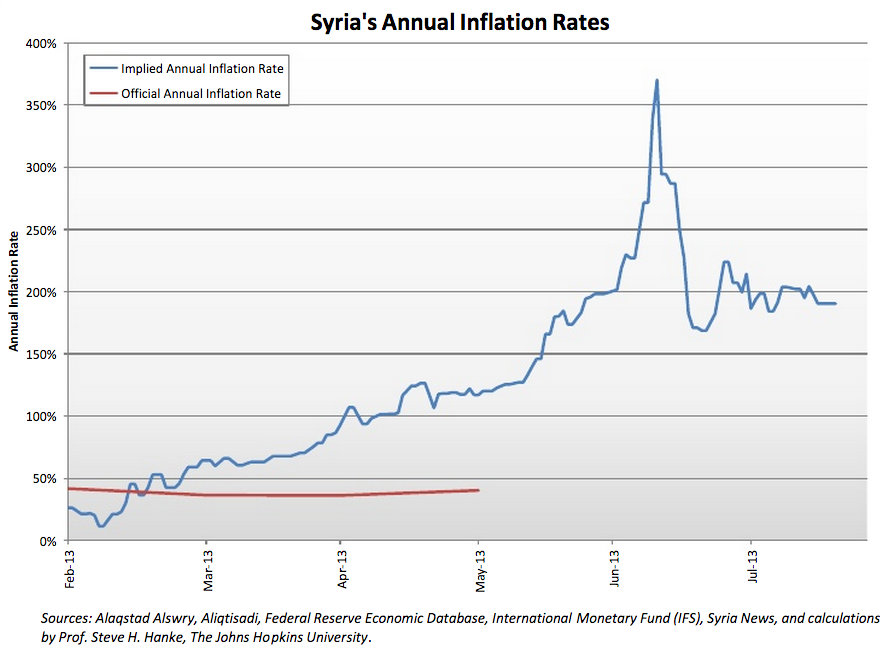
Matthew O’Brien highlights Syria’s hyperinflation:

It turns out you can’t have much of an economy when your country is a war zone, and the regime is attacking civilians. But functioning economy or not, the government still has to pay its bills. So what does it do when there’s nothing to run or tax? Easy: It prints what it needs. That’s what the pariah Assad regime has done to cover the difference between what it has to pay, and what its few remaining patrons have paid it. The predictable result of all this new money chasing fewer goods has been massive inflation.

This is in keeping with the history of hyperinflation:

Hyperinflations tend to happen following wars or revolutions. Now, Weimar Germany and Zimbabwe look like exceptions to this rule, but they’re not really – the former’s resistance to reparations, and the latter’s botched land reform halted economic activity as much as any conflict.

The Best Way To Help The Syrian People

Pascal-Emmanuel Gobry advocates granting asylum to all refugees who apply:

Even from the most cynical perspective, you can and should view tragic conflicts such as Syria as moments where countries and regions are selling their human capital on the cheap, and where opportunistic buyers should swoop in to take advantage of the bargain. Sweden has recently said that it would grant asylum to all Syrian refugees who apply. The US should do the same. As Hayes suggests, the model here should be the expedited procedure that the US grants to Cuban refugees. Welcoming Cuban refugees has been the right thing to do and a boon to America’s standing in the world, its economy and its culture. It was the right thing to do then, and it’s the right thing to do for Syria now.

Lydia DePillis agrees:

To actually alleviate the refugee crises in Jordan and Lebanon, the United States could dramatically increase the number of people it accepts from Syria. Sweden has already accepted 14,700 since 2012, and just threw open its doors to all comers. If a country with fewer than 10 million people can handle tens of thousands of refugees, surely the U.S. can, too.

The Virtue Of Steel And Silence, Ctd

Like Fareed, Daniel Larison speaks up about the need for the US to pipe down about lousy foreign situations:

Future presidents and this one would do well to abide by a few basic guidelines for how and when to comment on foreign conflicts and disputes. First, there should be an overall aversion to having the president comment at length on another country’s internal conflict or dispute. If that is unavoidable for some reason, the president ought to refrain from making any declarations about the legitimacy of the foreign government, and as a general rule he shouldn’t call for the removal of a foreign leader unless he wants to be saddled with the responsibility for removing him. There should be no indications made that the U.S. intends to offer material or military aid to the government’s opponents when that aid is not likely to be forthcoming, and statements to that effect should be made only after carefully considering whether providing any kind of aid would be useful and in the American interest. There has been a default assumption in Washington over the last decade and more that the U.S. should usually side with foreign protest movements and political oppositions, and thereby adopting their political goals as our own. That impulse to take sides in foreign disputes and conflicts needs to be curbed if not banished entirely.

Assad And The Eschatologists

Tim Murphy notes that bestselling novelist Joel Rosenberg (see his rant below) thinks the Syrian conflict was foretold in the Bible. More troublingly, some politicians are listening:

On Saturday, Rosenberg will travel to Topeka, Kansas, at the invitation of Republican Gov. Sam Brownback, to discuss the situation in the Middle East. The idea behind the prophecy is a fairly straightforward one. In Isaiah 17, the prophet explains that, in the run-up to Armageddon, “Damascus is about to be removed from being a city, and will become a fallen ruin.” The implication is that it will be leveled by God on behalf of Israel as part of the last great struggle for mankind. How exactly that will happen is a bit less clear.

“The honest answer is that the Bible does not say,” Rosenberg wrote on his blog last June. But in Rosenberg’s Twelfth Imam series, he postulates that the emergence of the Mahdi, the Muslim messiah, leads to the rise of a new Islamic caliphate in the Middle East that prepares to decapitate Israel by launching nuclear warheads from Damascus. As the top-rated Amazon review for the final book in the series, Damascus Countdown puts it, “This is a great read for anyone interested not only in the prophetical future of Israel but for Iran and Syria as well.”

Rosenberg may seem like a fringe figure, but he has a large base of support and friends in high places.

Damascus Countdown was, like the two preceding books in the series, Twelfth Imam and Tehran Initiative, a New York Times bestseller. He has been cited as an expert on nuclear policy by Fox News, where host Shannon Bream noted that he had been referred to as a “modern-day Nostradamus.” Former (and future) Republican presidential candidate Rick Santorum wrote a blurb for the hardcover edition of Damascus Countdown and brought the author onto his radio show, Patriot Voices, to discuss the book last spring. In March, Rosenberg met privately with Texas Gov. Rick Perry and Rep. Louie Gohmert in Austin. Gohmert was such a big fan of the novelist he brought a copy of Damascus Countdown as a gift to Israeli prime minister Benjamin Netanyahu in 2011.

They’re all out of their tiny minds.

The Radical Right Gets Something Right

Drum is repulsed while “watching Republican pols and conservative pundits get on their high horses about Syria”:

There are some Republicans who are perfectly serious about their desire not to get entangled in yet another Middle Eastern conflict. But most of them couldn’t care less. Obama is for it, so they’re against it.

I know. It’s deranged. But they get all their news from Fox. Tyler Cowen makes peace with the Republican obstructionists:

[T]he net effect of having unreasonable, obstructionist Republicans could well be welfare-improving on a massive global scale, all things considered. You might prefer to “have your cake and eat it too,” namely by having “reasonable but wise on Syria” Republicans, but that was never on the menu.

I’m fine with it too.

What If Congress Votes No?

Larison declares that there “is no way to know what long-term effect the defeat of the Syria resolution might have on the actions of future presidents, and it is even less certain how other governments would interpret a Congressional rejection of the resolution”:

It is always possible that other presidents will view this episode as proof that going to Congress is an avoidable risk that they won’t want to take, in which case it will result in the opposite of what many opponents of the resolution prefer. On the other hand, some may take it as a reminder that presidents should not propose taking military action without having a much stronger case for doing so than Obama has, and that could make future administrations more reluctant to wage unnecessary wars.

Waldman guesses that Obama will go to war with or without Congressional support:

It’s hard to imagine the Obama administration will pull back. After all, they’ve said quite clearly that they believe they don’t need Congress’ approval, and they will have spent weeks making the case that striking Syria is utterly vital to U.S. national-security interests. It would seem likely they’d go ahead and launch some missiles anyway.

Peter Baker’s sources in the administration suggest otherwise:

Although Mr. Obama has asserted that he has the authority to order the strike on Syria even if Congress says no, White House aides consider that almost unthinkable. As a practical matter, it would leave him more isolated than ever and seemingly in defiance of the public’s will at home. As a political matter, it would almost surely set off an effort in the House to impeach him, which even if it went nowhere could be distracting and draining.

The result? A return to constitutional democracy and a huge, vital rebuff to the military-industrial complex that has been on steroids since 2001. The president can still, as I have argued, insist on collective action and use the UN to expose the indifference to gassing children in their scores by the thugs in Moscow and the opportunists in Beijing. And that kind of scrutiny will likely force Russia and Iran to tell Assad to cool it. Not bad a set of consequences when you think about it.

Quote For The Day

“The president does not have power under the Constitution to unilaterally authorize a military attack in a situation that does not involve stopping an actual or imminent threat to the nation, – Barack Obama, 2008.

David Corn offers an Occam’s razor answer to why Obama chose to go to the Congress: Because he believed it’s the right constitutional thing to do. As it is. In all my criticism of the president in the last week, his decision to go to the Congress was a high-point. The truly high point for the Constitution, of course, will be if Congress turns him down.

Whom Would We Be Helping?

SYRIA-UNREST-IDLIB

In a new war, who would benefit from US intervention? Rania Abouzeid is one of the few reporters to make it in there. So take a deep breath as you read her account of the most militarily effective rebels:

The men were openly disdainful of the Free Syrian Army units, saying they were engaged in “tourism” well behind the front, and were also openly hostile to the Alawites, or Nusayris, as they called them. “Even the Shiites have declared them kuffar [nonbelievers],” said one. “They are all the same. They view us Sunnis as the enemy; they are all involved in the war against us,” said another. “They won’t want to stay here after this,” said a third, meaning after they’d swept through the villages. The men also mocked the Muslim Brotherhood as inadequately committed to its faith …

“The decision-makers in this country will be those with military power,” Mohammad said. “If they”—the F.S.A. and Syrian political opposition—“want a secular state and have the military power to create one, let them. If they are going to confront us because of our project, we will confront them. We are fighting for religion, what are they fighting for?”

Why is the United States taking a position on an ancient schism in the Muslim world – picking sides, Shia and Sunni – and embittering both at the same time? Why do the citizens of Ohio have to take a position on whether the Alawites or the Sunnis should run a crumbling French colonial remnant? It’s like walking into a bar in a foreign country, seeing a brutal fight going on, walking up to the parties slugging it out and saying: “Why not hit me instead?” It’s not so much the Ugly American any more. It’s the Really Dumb one.

And the hits would keep coming. Already Shiite forces in Iraq are aiming to hit American targets; we will endure another wave of terror at home, and surrender another round of freedoms to the behemoth of the intelligence-surveillance state. Putin? He won’t have to worry.

(Photo: Fighters loyal to the Free Syrian Army pose with their weapons in a location on the outskirts of Idlib in northwestern Syria on June 18, 2012. By D. Leal Olivas/AFP/Getty Images)

AIPAC Wants This War, Ctd

Former Netanyahu aide Joel C. Rosenberg – surprise! – lambastes the president for dithering on intervention in Syria and thereby jeopardizing Israel’s war to remain the sole nuclear power in the Middle East:

If President Obama is so distrusted by the American people and her representatives in Congress that he cannot build solid support for limited military strikes against Syria’s chemical-weapons facilities, the Israelis are coming to the painful realization that there is no chance for the president to pull together support for preemptive military action against Iran’s nuclear facilities. Zero. Nada. Zilch. … That means one thing: The Israelis are on their own, and now they know it.

Enter AIPAC. Next week, that formidable group will storm the Hill for another war, even as Israelis themselves are content to allow the civil war to burn both sides in Syria out. It’s not in Israel’s interests that either Assad or the Jihadist rebels gain the upper hand. And yet they will happily ask the United States to risk its own potential enmeshment in a wider war – just to keep the conflict going. But AIPAC is fixated in forcing Obama to start yet another major war in the Middle East; and AIPAC never loses. They’ll threaten Democrats with de-funding and ostracism; they’ll win over Christianist Republicans with religious arguments about the need for Israel and America to stand together Muslim Jihadists. Goldblog takes things down a notch:

I believe it would be a mistake to assume that just because the president is hesitant on Syria he will be hesitant on Iran. Why? Because the president has defined Iran’s nuclear program as a core threat to U.S. national security. He has made it clear that only two challenges in the Middle East rise to the level of core American national interests: The mission to destroy al-Qaeda and the goal of stopping the Iranian nuclear program. He has stated repeatedly, over many years, that it is unacceptable for Iran to cross the nuclear threshold, and his administration has worked assiduously to sanction Iran in the most punishing of ways.

I hope Netanyahu listens to Jeffrey on this. And Rouhani does as well.

The Ghosts Of Iraq Haunt Syria

Larison dismisses the argument that anti-interventionists are suffering from “Iraq Syndrome”:

[T]his is becoming a common way to describe the absolutely justifiable and sane reaction of the public and even many in Washington to the disaster of the Iraq war. Interventionists call this a syndrome because it is supposed to be seen as an affliction or something from which Americans need to recover, as if there were something unhealthy or harmful in becoming extremely wary of waging wars of choice in countries that we don’t understand very well for dubious and often unobtainable goals. On the contrary, the existence of this so-called “syndrome” is proof that the public is very sensibly recoiling from the repeated misjudgments and mistakes of their political leaders.

Most Americans are firmly against making yet another major foreign policy error, and what they keep hearing from Washington and from much of the media is that they are suffering from some kind of malady that needs to be cured with another war.

This truly is becoming a battle between the Washington war-machine and the people it is supposed to protect. And yes, Iraq is relevant. Of course it is relevant. And no, as Daniel argues, this is not a syndrome. It is not a syndrome to look twice before crossing the street, when you have been run over by a truck twice in the last decade. In any case, the parallels are so close as to be almost absurd. The president is trying to get support for a military campaign against a Baathist leader in a murderously divided Middle Eastern country in order to prevent the use of WMDs and to send a message to Iran. I mean: is there any more obvious analogy? Now I know the president has ruled out “boots on the ground”. But there are already boots on the ground, in a covert war the war-machine has already launched. And, as John Kerry was forced to concede, entering this conflict could quite easily require troops in the near or distant future if we are not to be seen as having empowered Assad rather than removed him.

And the same people and factions that backed that war are now backing this one: the full neocon chorus, AIPAC, the liberal internati0nalists, the Clintons, McCain, and on and on. Since no true accountability for that catastrophe was ever exacted, we are forced to endure the utterly discredited Bill Kristol and Paul Wolfowitz and Fouad Ajami make exactly the same arguments they made then. And yet this time, the man we elected not to repeat the Iraq disaster, the man who only holds the office he does because of his wise opposition to that war, is now apparently eager to risk a repeat of it.

Let’s be clear. The administration is losing this argument, and looks likely to lose the Congress. There are four times as many anti-war votes right now as pro-war ones in the House. The public remains opposed. Only neocons are backing the president forcefully, if he assents to their full-war agenda. The minute he doesn’t launch a full-scale war, they will abandon him. That’s already a horrible reminder that if the president decides to risk his entire second term on this quixotic act of neocon symbolism, he will be very alone very fast, with no country and no Congress behind him and not even the Brits offering some fig leaf of international support.

But in every crisis there is an opportunity.

Lose the vote, don’t go to war, but go to the UN repeatedly and insistently. Gather more and more evidence. Get Ambassador Power to pummel the Russians and Chinese with their grotesque refusal to do anything about this ghastly mass murder. Expose Putin for the brutal thug that he is. And focus on the huge challenges at home: a still-weak economy, a huge overhaul of healthcare, a golden opportunity for immigration reform. That’s why he was elected. And his domestic legacy is at a pivotal point.

I know opposing this president is painful for so many who want him to succeed. It’s painful – agonizing – for me. I understand his genuine and justified revulsion at this use of chemical arms and the wanton, hideous brutality of the Assad regime. I deeply respect his moral stand. He is right that the international community should not stand by. But America cannot be the sucker who is responsible for countering all evil in the world and then blamed for every success and failure. We must not become the sole actor against evil in the world, and not only because, at this point, after GTMO and Abu Ghraib and pre-emptive war, we have no standing to do so. We simply do not have the ability or the resources to do it. We’re as fiscally bankrupt as we are militarily incapable of fighting other people’s wars for them. And asking the military to do another impossible job in another Middle East hell-hole is grotesquely irresponsible.

We should make our case to the world and if we fail, as Obama clearly is, we should accept that and move this drama to a diplomatic stage. Yes, I know the horrors endure. I am not looking away. But if you cannot end someone else’s brutality without profoundly wounding yourself and empowering this vicious little creep at the same time, you should simply keep making your case – until Putin and Assad are close to indistinguishable, and moderate elements in Iran begin to gulp at the barbarism in plain sight.

That will take time; and patience, and resolve. But it’s a far wiser path forward than another unpredictable, horrible, bankrupting war.