Face Of The Day

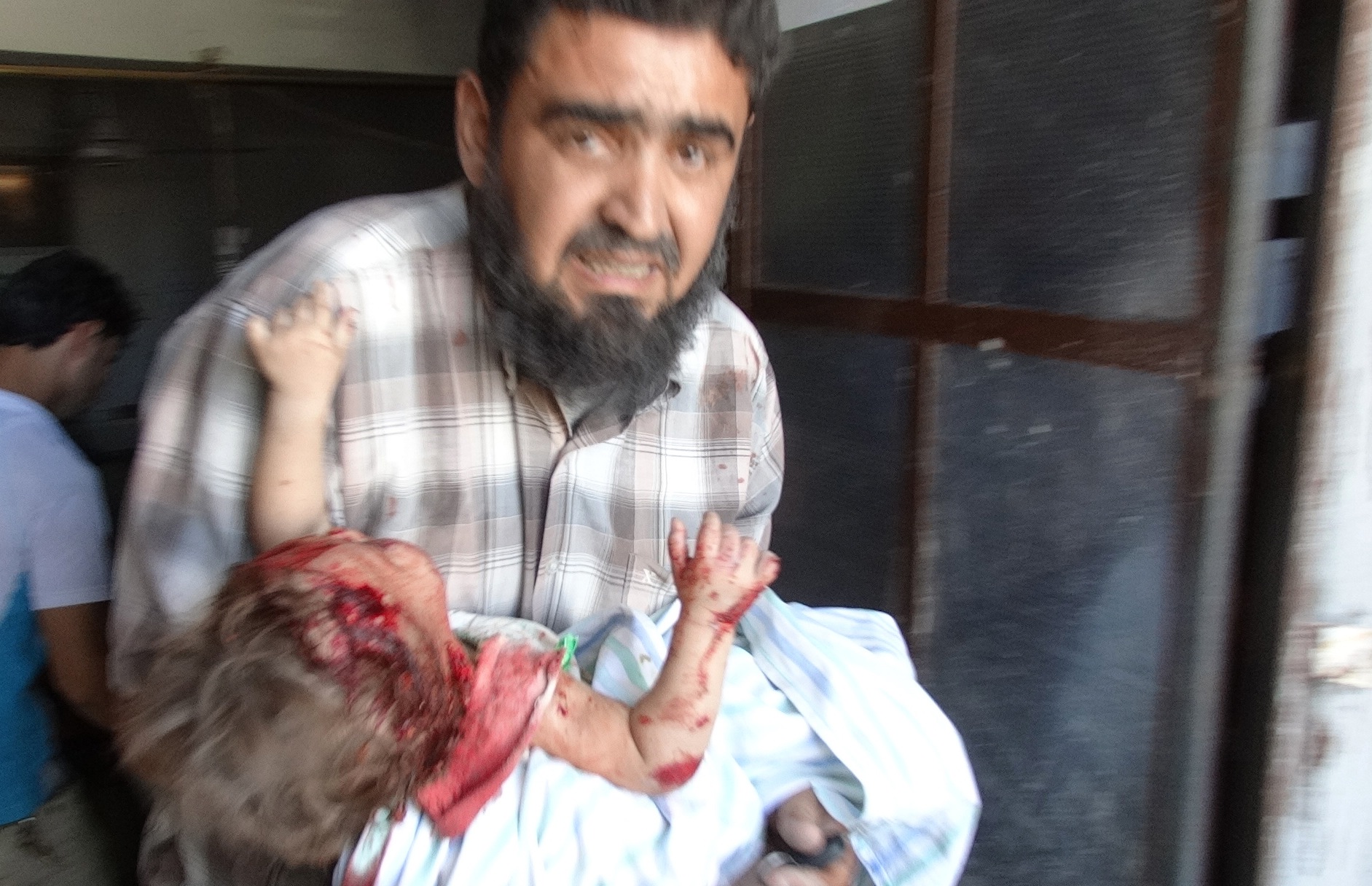
SYRIA-CONFLICT

A man carries a wounded child after a reported air strike by Syrian government forces in the rebel-held northwestern Syrian province of Idlib on September 5, 2013. The Syrian Observatory for Human Rights watchdog said Syrian war planes bombed rebel held areas in Idlib, Aleppo, Hama and Lattakia. By Abu Amar Al-Taftanaz/AFP/Getty Images.

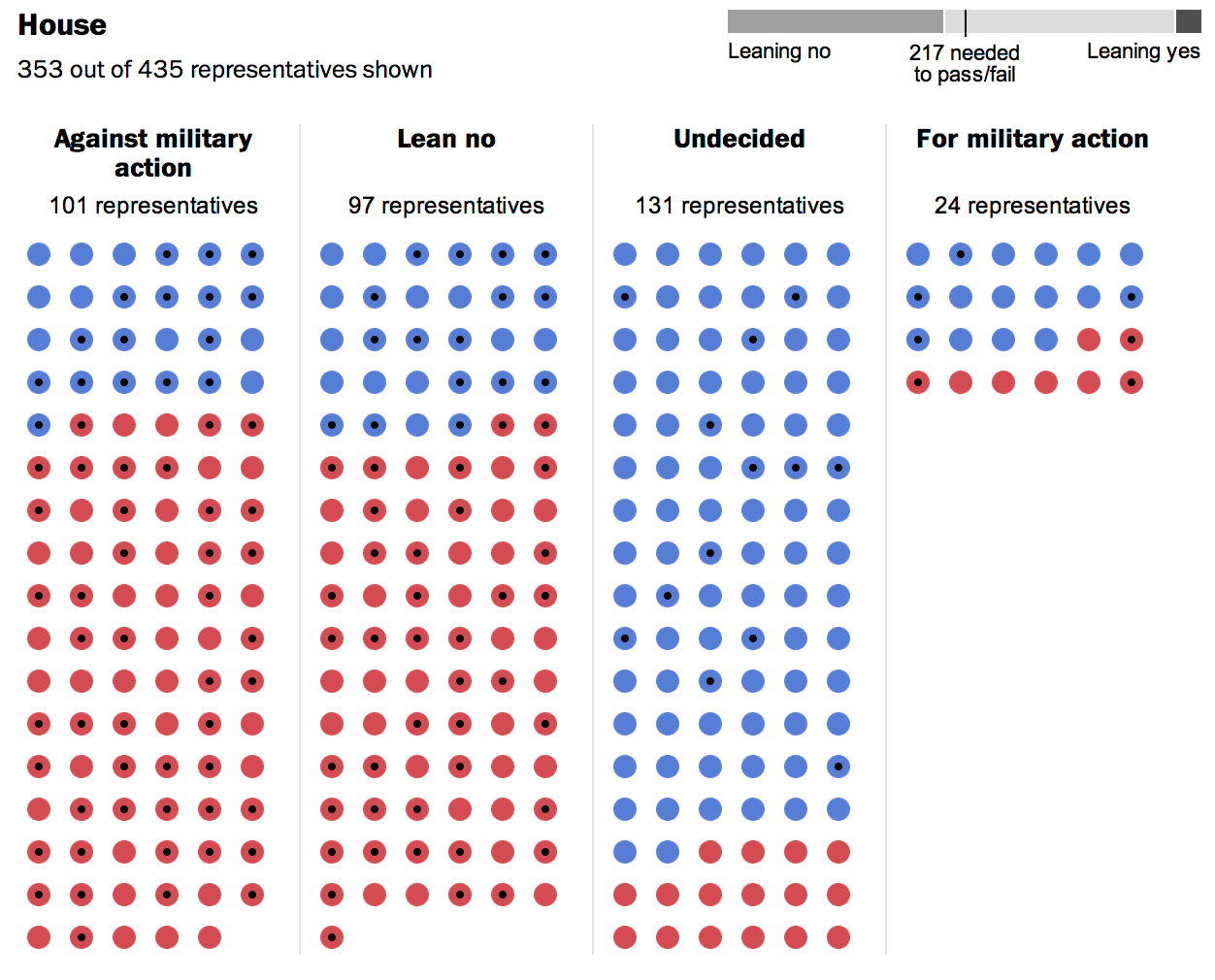
The Current Vote Count

House Syria Votes

The Fix is keeping track of Congressional supporters and opponents of intervention in Syria. The above numbers from the House include only 353 of the House’s 435 members because not every representative has made a statement yet:

There are now more than four times as many opponents of military action in the House as supporters. And that doesn’t even factor in the dozens of members who have expressed skepticism about Syria.

Where Do Red Lines Come From?

Roff Smith offers a history of the expression:

The phrase “red line” appears to be an adaptation of a much older metaphor – a “line drawn in the sand,” according to Ben Yagoda, a professor of English and journalism at the University of Delaware. One of the earliest recorded instances of anyone drawing a line in the sand took place in ancient Rome around 168 B.C., during a conflict that, curiously enough, involved Syria. A Roman envoy named Popillius was sent to tell King Antiochus IV to abort his attack on Alexandria. When Antiochus tried to play for time, Popillius drew a line in the sand around him and told him he had to decide what he was going to do before he crossed it. He acceded to the Roman demands.

But just how the venerable line in the sand came to be red is a little unclear.

One possibility is that a pundit borrowed the idea of the warning line on a gauge beyond which it is unsafe to rev up the machinery. Another explanation comes from the Battle of Balaclava on October 24, 1854, when the hopelessly outnumbered Sutherland Highlanders, the 93rd Highland Regiment, were told by their commander Sir Colin Campbell: “There is no retreat from here, men. You must die where you stand.” And so they stood firm, wearing their scarlet tunics and awaiting the charge. In his breathless account of the battle, London Times correspondent William Russell wrote that all that remained between the charging Russians and the British regiment’s base of operations was “a thin red streak tipped with steel.”

And now it’s a dick-measuring ribbon.

Dissents Of The Day, Ctd

The pushback from readers continues:

Words are important, so you should use them carefully. You call the proposed action in Syria “war.” Okay, I understand the point that weeks of bombing could be considered a war even though it’s not a traditional ground invasion. No need to quibble there. But you then recklessly compare Syria to Iraq and Afghanistan as if they are close to the same thing (“Or, when push comes to shove, are you actually weaker than McCain and Clinton – and your legacy will be not doomed wars in Iraq and Afghanistan but doomed wars in Syria and Iran?”)

Let’s set aside that nothing has happened in Iran (or Syria) yet. Let’s assume the President gets what he’s asking for in Syria, which is 60 to 90 days of strikes with no troops on the ground. How is that anything – ANYTHING – like Iraq and Afghanistan? Both were full-scale ground invasions costing hundreds of billions of dollars (are we over a trillion?), thousands of American lives, and hundreds of thousands of lives in country. Make the argument you have – that there is no reason to think these limited strikes will accomplish anything – not these stupid rants.

I remember when our entry into Afghanistan would just be for a few months. Ditto Iraq. I can go back right now and read posts assuming just that. And we have boots on the ground in Syria already, as even the president has now conceded. Neither Iraq nor Afghanistan was a “traditional ground invasion” either. The first was conducted with minimal forces alongside the Northern Alliance; the second was accomplished with far fewer troops than required because, yes, we’d be home by Christmas. No one in power anticipated a ten-year occupation. So why do we assume that having entered this awful conflict, we can so easily walk out of it?

I’m sorry but if I’m asked to defend another “this-will-be-over-quickly-no-troops-on-the-ground-ever” war, I have every right to say no. Nothing in my reader’s emails suggest any possible reactions to this war, as if this is entirely a static intellectual exercize. It isn’t. Our opponents can act as well – with a round of possible terrorist attacks in the US, Assad’s forces becoming even more brutal, Iran being forced to support its client state, emboldening its most reactionary elements, attacks on American military targets in the region, and so on. Any single incident could trigger a wider conflict. A little perusal of how the Crimean war broke out would be a useful reminder that what politicians say will happen is usually not what happens, and what they intend can be the last thing they actually accomplish.

Now, of course, not acting could also trigger a conflict, since Israel may infer from the Congress’s refusal on Syria that there is no appetite for war with Iran either, and attack Iran alone. But I doubt Israel will launch a war unilaterally, because it would not do the job. And, besides, at some point, in a democracy, the people must support – preferably overwhelmingly – any war we decide to enter. They don’t in Britain or the US.

Another reader:

Your argument against a Syria strike seems to amount to the assumption that it is an “open-ended” war due to the inherent unpredictability of war and the fact that we can’t guarantee that future circumstances wouldn’t lead to escalation. But by that definition, all war is open-ended. Are you therefore saying that military force is never justified (short of, say, a direct attack on the United States)? If not, I’d like to hear you elaborate more as to when, if ever, a military intervention would be sufficiently close-ended to meet your standard.

Right now, with respect to America’s global interests, I see no war worth fighting. That includes preventing Iran from deterring Israel’s nukes. Another quotes me:

“My point is that foreign policy is not about going around the world preventing bad.” Wow. This is similar to the “America First” arguments used to stay out of WWII and the arguments used to ignore Cambodia and, of course, Rwanda. The US can not be the world’s cop, and I get that. But holy crap – get ready to handle more pictures of dead children and just keep saying “bummer, but we can’t concern ourselves with it.”

I will and have. I opposed intervention in Rwanda and Somalia. Somalia is very instructive. Just a humanitarian mission, which became a war, which became a nightmare. And if only we had only ignored Cambodia instead of waging Kissinger’s vast and vile war crimes against the people of that poor country. Another reader:

I am struck by the lack of discussion of the similarities between the international community’s failed response to the 1995 Srebrenica massacre and the current situation in Syria.

By using chemical weapons, the regime in Syria has indicated that it will use whatever depraved means at its disposal to carry out its policies.  There is no reason to believe that the 8/21 attack will not be repeated, perhaps on a larger scale.  The regime has a the capability to do so and appears likely to do so unless checked by outside forces.

This strikes me as similar to the lead up to the 1995 massacre.  The international community sat by and watched the events unfold in Srebrenica over a period of weeks, and did nothing to intervene, even though it had the capability to stop Serbian armor and artillery that was used to carry out the massacre (actually a series of smaller massacres).  The international community’s inaction in 1995 is rightfully remembered as a grave error – an error that should not be repeated in Syria.  The regime has “crossed a line” and it should be prevented from going further over the line so that the 1,400 dead do not become the 8,000 dead from 1995.  This seems like a blindingly obvious lesson from history to me.

If you genuinely believe that Syria is like Bosnia, fine. I don’t. Europe – even in the Balkans – is a repository of some basic humanitarian norms. The Middle East isn’t – and never has been. And how many people would the Syrian opposition murder if they won this war? They are talking openly about “liquidating” the Alawites. Here’s a little taste of who we’d be supporting:

The Syrian rebels posed casually, standing over their prisoners with firearms pointed down at the shirtless and terrified men. The prisoners, seven in all, were captured Syrian soldiers. Five were trussed, their backs marked with red welts. They kept their faces pressed to the dirt as the rebels’ commander recited a bitter revolutionary verse.

“For fifty years, they are companions to corruption,” he said. “We swear to the Lord of the Throne, that this is our oath: We will take revenge.” The moment the poem ended, the commander, known as “the Uncle,” fired a bullet into the back of the first prisoner’s head. His gunmen followed suit, promptly killing all the men at their feet.

Reader dissent continues into my most recent long post:

“Obama’s case for war is disintegrating fast. And his insistence on a new war – against much of the world and 60 percent of Americans – is easily his biggest misjudgment since taking office.” Really? His case for war? You should be ashamed for saying this repeatedly, like some back bench Republican thinking if only I say it enough, it just might become the truth. He is looking to go to war with Syria as much as he has already declared war on Pakistan by invading it and killing OBL. Has he declared war on Pakistan? Not that I know of. He had a specific intent, and he carried it out. I trust him with this. Yeah, much more than all of you naysayers combined.

It would be a lot better to let the tyrants of the world know that among the undecideds and the “tired of war” criers, there are some who truly will take you to the woodshed for doing something so extraordinarily dreadful to kill over 1400 including 430 children gasping and dying. Will you be saying the same platitudes if Assad dropped a mini nuke on these people – either on purpose or on accident?

Don’t let your enormous bad judgement on the Iraq war cloud your perspective.

If Obama were organizing a meticulously planned and sourced operation of a few men to capture and kill the mass murderer of Americans in Syria, I might agree. He is not. And the resolution Obama sent to the Senate would give him lee-way to do whatever he wanted with respect to chemical weapons. That proposed resolution – and Kerry’s gaffe in the Senate hearing – was clearly open to a broad conflict in the Middle East. As it would have to be. Once you set a train of events in motion, you have to be responsible for the outcome. And we will be.
How Useful Is The UN?

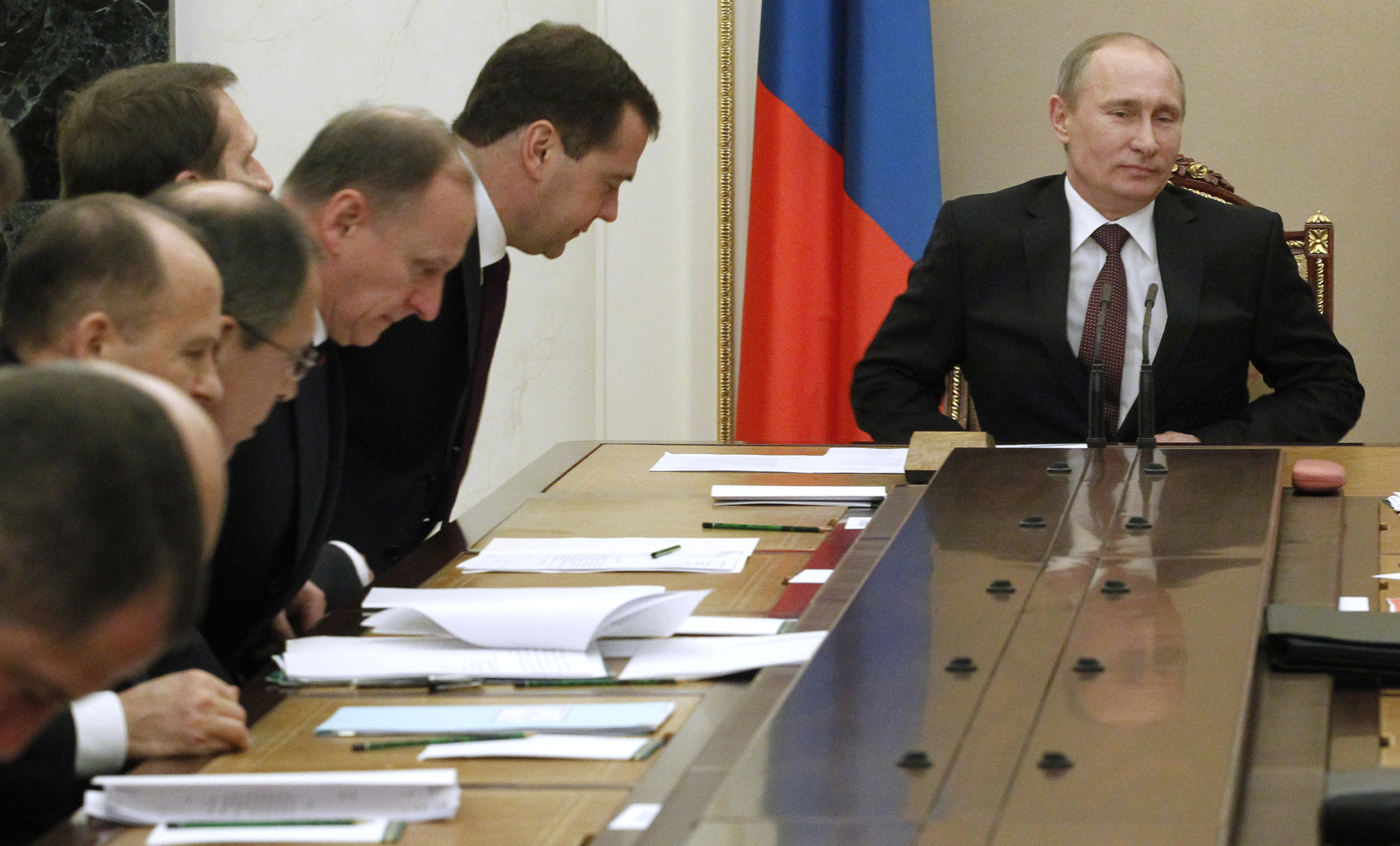
RUSSIA-PUTIN-SECURITY-COUNCIL

A reader writes:

Like you, I’m against military action in Syria. I work in the human rights field, so the ongoing bloodshed in Syria tears me up on a daily basis (or it would, had I not become numb to it long ago). But what you wrote is disingenuous:

The only true disincentive for use of chemical weapons is for the UN to achieve a consensus on that fact and initiate collective action involving all members of the Security Council. And yet Obama has explicitly ruled that out.

We’ve been trying to get the Security Council to act for two years now. There have been several attempts to pass resolutions referring the situation to the ICC, and lately to authorize an intervention, but they’ve been stopped each time by Russia and China. Even the mildest statements of condemnation have been blocked or watered down. So it’s not as though Obama could have gone to the UN but refused it out of hand. He has simply accepted that the Security Council will not be able to reach a consensus on any action he might suggest.

He shouldn’t. He should keep trying. And he has the perfect UN ambassador for it. Another reader:

“The UN to achieve a consensus”? Do you mean to say that we should get all 15 members of the council to agree and contribute to military force in launching a low-risk punitive strike? Including Rwanda, Luxembourg, Togo, and Guatemala? Good luck with that shit.

A few more readers drill down on the issue:

Stop pretending the issue here is that Obama needs to rely more on the United Nations.

The UN does a bunch of great stuff, but at the end of the day, it’s made up of actors representing all the countries of the world, the vast majority of which are incredibly selfish and many of which are flat-out evil. The idea that the United States should not act unless Russia gives us the OK, or unless we cobble together forces from random African or Central American countries with no military power, is bullshit. And it’s a particularly ironic critique, given that Bush checked all these boxes, sought UN approval, assembled a coalition … and Iraq was still a disaster.

There are many reasons to avoid getting drawn into this, but needing the approval of  disjointed, morally empty body like the United Nations sure as hell is not one of them. I would hope Obama, Clinton, Bush – whoever – can and would act in the best interests of the country without having to seek Vladimir Putin’s disgusting approval.

Another:

I’m afraid I’m with your dissenters on this one. I just don’t see how the use of chemical weapons against civilians can simply be allowed to go unchallenged by the world community. I’d dearly love to see the UN take decisive action, but I don’t see the Security Council accomplishing anything. I don’t subscribe to the view that Obama simply decided to ignore the UN. He realizes the reality of Russian intransigence. Sadly, if Putin were a more reasonable man, I think it’s possible that the US and Russia might be able to work together and use the threat of US military action to drive Assad to a Russia-brokered negotiating table. Which seems like the only possible long-term solution.

Perhaps a bigger issue for me is yet one more example of UN paralysis. If the atrocity of chemical attacks on civilians cannot elicit a UN response, what’s the point?  The UN seems to be devolving into a charitable aid organization with no ability to hold accountable those who violate basic human rights (yes, I realize they also failed in this regard during the Bush-Cheney years).

You used the argument that if this was simply about the principle that the use of these weapons should never go unpunished, Obama should have acted months ago. But surely the president’s decision to hold off until now simply reflects his reluctance to resort to military action, which is why he was elected.

Let me turn this around and present you with the same dilemma. For Obama, the scale of the recent attack has clearly changed his calculus. You disagree with his math. Is there any point at which you believe that intervention would be warranted? What if Assad gassed an entire city? Part of Obama’s reasoning must be the real fear that a much larger chemical attack is possible if the Syrian rebels were to make further progress.

There is no point at which I think it would be wise to intervene unilaterally. If Assad were to up the ante even further, the pressure should not be on the US but on Russia and China. If a UN sanctioned intervention is to occur, it will need such an appalling event to galvanize it. But it is emphatically not the responsibility of the United States to be the United Nations for the UN. It’s a mug’s game. It’s bankrupting us, and only isolates us even further in the world. We have to cut this impulse to hold ourselves responsible for everything evil in the world. We are not. We need to hand this disaster to Putin – and let the Jihadists target him for their mass murder, not us.

(Photo: Russian President Vladimir Putin chairs a Security Council meeting at the Kremlin in Moscow, on November 21, 2012. By Mikhail Metzel/AFP/Getty Images)

The Virtue Of Steel And Silence

Fareed chastises Obama for reckless rhetoric on Syria:

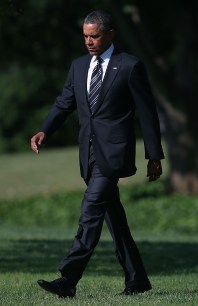
The reality is, the U.S. has now put its credibility on the line. It will find it extremely difficult to keep its actions limited in a volatile situation. And were it to succeed in ousting Assad, it would President Obama Departs The White Housebe implicated in the next phase of this war, which would almost certainly lead to chaos and the slaughter or ethnic cleansing of the Alawite sect (to which Assad belongs) and perhaps of other minorities, as happened in Iraq.

Obama has said repeatedly that the President he most admires for his foreign policy is the elder George Bush. Bush’s signature achievement was to manage the end of the Cold War peacefully and without major incident. But he was sharply criticized at the time for refusing to speak out in support of the ongoing liberation of Eastern Europe as the Iron Curtain cracked and crumbled. He later explained that he was always conscious that with hundreds of thousands of Soviet troops still in Eastern Europe, there could have been reversals, crackdowns, even full-scale conflict. He didn’t want to signal American commitments that he couldn’t fulfill. Better, he thought, to have people think he was dispassionate or even cold-blooded. The first President Bush had his flaws, but he did understand that in foreign policy, words have ­consequences.

For a long time I thought Obama had the kind of steel necessary to be another GHWB. That requires preternatural coolness in the face of evil. That impression has, alas, collapsed with the Syria folly. In the end, his liberal internationalism got the better of him – and by appointing figures like Kerry and Power, he set himself up for just such a fiasco. Yes, I’m saying that an American president in the 21st Century has to accept that gassed children do not necessitate a military response. This is a fallen, awful, horrible world. But you cannot change what you can until you have accepted your limits. And ending the horror in Syria is far, far beyond them, while so many things we can actually accomplish remain undone.

The President’s Constitutional Precedent

Douthat is disappointed with it:

The official “lesson” that the president’s words and choices are delivering is not one that actually elevates Congress back to its Article I level of authority. Rather, it’s one that treats Congress as a kind of ally of last resort, whose backing remains legally unnecessary for warmaking (as the White House keeps strenuously emphasizing, and as its conduct regarding Libya necessarily implies), and whose support is only worth seeking for pragmatic and/or morale-boosting reasons once other, extra-constitutional sources of legitimacy (the U.N. Security Council, Britain, etc.) have turned you down. The precedent being set, then, is one of presidential weakness, not high-minded constitutionalism: Going to Congress is entirely optional, and it’s what presidents do when they’re pitching wars that they themselves don’t fully believe in, and need to rebuild credibility squandered by their own fumbling and failed alliance management. What future White House would look at that example and see a path worth following?

Very few. But it remains a great opportunity to rein in the imperial presidency as it has evolved, with the military-industrial complex, over the last few decades. I agree that Obama is not making that case; but Rand Paul is. And Paul can advance that argument in the country at large. That is the precedent I’m hoping for. And it’s in our grasp, if we can stop this war in its tracks.

Can Iran Bring Syria To The Table?

Omid Memarian reports on the question:

“Iran can be helpful in resolving the Syrian crisis and bringing the civil war to an end,” Hooman Majd, an Iranian-American journalist and the author of Ayatollahs’ Democracy, told The Daily Beast in an email. “As long as the US goal is not regime change, almost as a precondition, I think the Iranians and the Russians probably see it in their interests to bring the civil war to an end, and help manage the transition to a representative government, as long as that government has no elements openly hostile to Iran, to Shias, or to Russia (such as Al-Qaeda affiliated or sympathetic groups).”

“Iran has shown a willingness, (particularly the new administration in Iran) to be involved in a diplomatic solution—it would make sense for the US to take Iran up on that,” Majd added.

But Karim Sadjadpour argues that “successful diplomatic engagement with Iran is hampered by the fact that outside powers — be it the U.S., Russia, or the Arab world — cannot offer Tehran assurances that a post-Assad government in Syria will remain friendly to Iranian interests”:

Ironically, the collapse of the Assad regime would produce a common interest for Washington and Tehran in making sure that radical Sunni Islamists, who hate Shiite Iran even more than America, do not rule Damascus. Until then, as long as Iran sees itself embroiled in a zero-sum game in Syria, a half-way meeting point, however desirable, will likely remain elusive.

Regardless, Juan Cole believes that American intervention will kill any chance of negotiations between the Syrian government and rebels:

By striking Syria, Obama has all but guaranteed that a negotiated solution becomes impossible for years to come. In the absence of serious negotiations, the civil war will continue and likely get worse. The US should give serious thought to what the likely actual (as opposed to ideal) reaction in Syria will be to the landing of a few cruise missiles. The anti-regime elements will celebrate, convinced that it will all be over quickly if the US gets involved. The last thing they will want will be to negotiate with the regime.

The Massacre Of Christians We Might Unleash

Philip Jenkins fears that Assad’s downfall could doom Syria’s Christians:

To describe the Ba’athist state’s tolerance is not, of course, to justify its brutality, or its involvement in state-sanctioned crime and international terrorism. But for all that, it has sustained a genuine refuge for religious minorities, of a kind that has been snuffed out elsewhere in the region. Although many Syrian Christians favor democratic reforms, they know all too well that a successful revolution would almost certainly put in place a rigidly Islamist or Salafist regime that would abruptly end the era of tolerant diversity. Already, Christians have suffered terrible persecution in rebel-controlled areas, with countless reports of murder, rape, and extortion.

Under its new Sunni rulers, minorities would likely face a fate like that in neighboring Iraq, where the Christian share of population fell from 8 percent in the 1980s to perhaps 1 percent today. In Iraq, though, persecuted believers had a place to which they could escape, namely Syria. Where would Syrian refugees go?

Dreher applauds Rand Paul for consistantly speaking out about Syria’s Christian minority (an example from December of last year is seen above). Julia Ioffe, on the other hand, thinks Paul’s remarks reflect a view that “some lives, Christian lives, are simply more important than other, Muslim ones”:

Yes, this is a legitimate concern—Christians make up some 10 percent of the Syrian population, and have largely backed Assad—and the Egyptian example is a widely reported one; and, given the reports of jihadis brutally establishing Sharia law in the areas they’ve secured, Paul raises a fair question. The only problem is that it seems it’s all he’s talking about. Aside from his standard non-interventionist caution, and the how-do-we-really-know-anything-about-anything epistemological exercises of the kind we saw in his confrontation with Kerry, the paramount concern for Rand Paul, a member of the Senate Foreign Relations Committee, is not the question of chemical weapon use, or the 100,000 dead, but the Christians.

The American People Tell Washington A Few Things

I have yet to talk to anyone – even in this super-liberal little ash-tray of a town – who supports the president’s proposed new war. The polls tell the same story. The NYT has this revealing nugget from the left:

Representative Elijah E. Cummings, who represents a district that includes parts of Baltimore and has not decided how he stands on attacking Syria, said the pressure from his constituents to oppose the president’s plan is unmistakable. When he visited a grocery store on Wednesday, he said, almost a dozen people told him they thought intervening in Syria was a bad idea. None of them expressed support.

“If you’ve got 95 percent of them saying one thing, it becomes far more difficult to go against them,” he said, adding that the president needed to make a more forceful and convincing case to the public if he wanted Congressional consent for an attack. “As a good friend of his and someone who supports him, I think he’s got to help the Congress help him.”

Ezra’s impression?

“The active public is against this,” Rep. Brad Sherman, who supports intervention, told me. “I don’t know a member of Congress whose e-mails and phone calls are in favor of this.” …  Jonathan Allen and Jake Sherman report that House Republicans are not inclined to back President Obama on Syria. “Several lawmakers and aides who have been canvassing support say that nearly 80 percent of the House Republican Conference is, to some degree, opposed to launching strikes in Syria. Informal counts by Obama allies show that support in Congress for Obama’s plans is in the low dozens.”

House Republican leadership, meanwhile, isn’t inclined to change their members’ minds. “Speaker John Boehner’s spokesman said that he ‘expects the White House to provide answers to members’ questions and take the lead on any whipping effort.’”

This ship is sinking fast. And a new constitutional order may be emerging. Call your Senator and representative and let them know you’re against it, if you are. Now is the time for the people to save their president and their country from another Bush-Cheney-style folly.