Saving Obama From Himself

The next couple of weeks will be full of surprises, twists and turns, as this country debates in its Congress and media and living rooms whether to launch another war in the Middle East. But I think it’s fair to offer a preliminary assessment of where the wind is blowing. Obama’s case for war is disintegrating fast. And his insistence on a new war – against much of the world and 60 percent of Americans – is easily his biggest misjudgment since taking office. His options now are not whether to go to war or not, but simply whether he has the strength and sense to stand down and save his second term before it is too late.

Here’s what we know now for sure already: even if the president were somehow to get a majority in House and Senate for entering into RUSSIA-G20-SUMMITSyria’s vortex of sectarian violence, it will be a profoundly divided one. The 10-7 vote in the most elite body – the Senate Foreign Relations committee – is an awful omen. To make matters worse, there is currently a clear national majority against war in the polls and the signs from the Congress suggest a nail-biter at best for the president. Under these circumstances, no president of any party has any right or standing to take this country to war. He is not a dictator. He is a president. Wars are extremely hazardous exercises with unknown consequences that require fortitude and constancy from the public paying for them. Even with huge initial public support for war, as we discovered in the nightmare years of Bush-Cheney, that can quickly turn to ashes, as reality emerges. To go to war like this would be an act of extreme presidential irresponsibility.
And on one thing, McCain is right. To launch strikes to make a point is not a military or political strategy. It will likely strengthen Assad as he brazenly withstands an attack from the “super-power” and it would not stop him using chemical weapons again to prove his triumph. We either lose face by not striking now or we will lose face by not striking later again and again – after the initial campaign has subsided and Assad uses chemical weapons again. McCain’s response, as always, is to jump into the fight with guns blazing and undertake a grueling mission for regime change. Let him make that case if he wants – it is as coherent as it is quite mad. It’s as mad as picking a former half-term delusional governor as his vice-president. There is a reason he lost the election to Obama. So why is Obama now ceding foreign policy to this hot-headed buffoon?

The only conceivable way to truly punish Assad and assert international norms would be to get a UN Resolution authorizing it. That is, by definition, the venue for the enforcement of international norms. The US Congress cannot speak for China or Russia, Germany or Britain. And in Britain’s case, the people – through their representatives  – have spoken for themselves. That means that, if we go through the proper route, nothing will be done. But that is the world’s responsibility, not ours’. And we are not the world.

The US has no vital interests at stake in the outcome of a brutal struggle between Sunni Jihadists and Alawite thugs. None. Increasingly, as we gain energy independence, we will be able to leave that region to its own insane devices. Our only true interest is Saudi oil. And they will keep selling it whatever happens. Israel is a burden and certainly not an asset in our foreign policy. The obsession with the Middle East is increasingly a deranged one. Taking it upon ourselves to ensure that international norms of decency are enforced in that hell-hole is an act of both hubris and delusion. We can wish democrats and secularists well. But we can control nothing of their struggle, as the last few years have definitively shown. And when we try, we create as many problems as we may solve. Look at Libya.

My own fervent hope is that this is the moment when the people of America stand up and tell their president no.

I support and admire this president and understand that this impulsive, foolish, reckless decision was motivated by deep and justified moral concern. But the proposal is so riddled with danger, so ineffective in any tangible way (even if it succeeds!), and so divorced from the broader reality of an America beset by a deep fiscal crisis, a huge new experiment in universal healthcare, and a potential landmark change in immigration reform, that it simply must not be allowed to happen.

We can stop it. And if Obama is as smart as we all think he is, he should respond to Congress’s refusal to support him by acquiescing to their request. That would damage him some more – but that damage has been done already. It pales compared with the damage caused by prosecuting an unwinnable war while forfeiting much of your domestic agenda.

This is not about Obama. It’s about America, and America’s pressing needs at home. It’s also about re-balancing the presidency away from imperialism. If a president proposes a war and gets a vote in Congress and loses, then we have truly made a first, proud step in reining in the too-powerful executive branch and its intelligence, surveillance and military complex.

In other words, much good can still come from this.

If Congress turns Obama down – as it should – Obama can still go to the UN and present evidence again and again of what Assad is doing. Putin is then put on the defensive, as he should be. You haven’t abandoned the core position against the use of chemical arms, and you have repeatedly urged the UN to do something. Isn’t that kind of thing what Samantha Power longs for? Make her use her post to cajole, embarrass, and shame Russia and China in their easy enabling of these vile weapons. Regain the initiative. And set a UN path to control Iran’s WMD program as well.

Obama once said his model in foreign policy was George H W Bush. And that president, in the first Gulf War, offers a sterling example of how the US should act: not as a bully or a leader, but a cajoler, a facilitator and, with strong domestic and international support, enabler of resistance to these tin-pot Arab lunatics. Obama, in a very rare moment, panicked. What he needs to do now is take a deep breath, and let the people of this country have their say.

Democracy is coming to the U.S.A.
Why Did Assad Do It? Ctd

Alastair Smith, co-author of The Dictator’s Handbook, has a theory:

First of all, using chemical weapons has absolutely cemented that for Assad there can be no soft landing. That has two effects: Domestically, it has signaled to his coalition that they should stick with him. He’s there for the long run and there’s no easy way out for him, so they know he won’t desert them. These crimes against humanity have also made it very clear that it’s going to be very bad for the Alawites if there’s any political transition, which makes them even more loyal to him. They have nowhere else to go.

It’s also been a brilliant play internationally. The extent of the chemical weapons has not been so much that Obama’s willing to put ground forces in. The airstrikes they are discussing are unlikely to be a decisive military factor. And Russia and Iran would love to snub the nose of the U.S. and this is a perfect way to do it. The U.S. is going to have to go it alone if they do it, and this is a great way for Russia and Iran to make the U.S. look impotent and pathetic. Russia’s going to continue supplying [Assad] with weapons and Iran’s going to keep supplying him with money. So this was actually a brilliant play from him.

And a terrible, awful, no-good play for Obama. This does explain better the big hike in the stakes Assad just gambled on. And it does not appear to be an accident. This piece in the NYT is pretty definitive proof that the greater reach and power of the weapons delivered to ghouta was absolutely deliberate, and integral to the very design of the rockets used. A reader relays another theory:

I was going to send this email yesterday but figured somebody must have heard this; it must be common knowledge: I heard an NPR interview with retired general Jack Keane, who said that the rebels had acquired anti-aircraft weapons and shot down two of Assad’s aircraft recently.  Assad tried to destroy the rebels using conventional means and was unable to, so he resorted to gas.  I have not heard this anywhere else. The Keane interview sounds plausible, but it makes me wonder how a retired general has info no one else has.

We’ll keep tabs on this question of motive. Earlier debate on the question here.

The View From Tehran

Juan Cole points out the Islamic Republic is conflicted over its ally’s use of chemical weapons:

Although he later had to walk it back, former Iranian President Akbar Hashemi-Rafsanjani deplored the Syrian government’s use of gas against its own people, and Tehran-watchers are convinced that the Baath army’s action has provoked a heated debate within the closed Iranian elite. Current Iranian President Hasan Rouhani has condemned all chemical weapons use. Because Tehran backs the Syrian Baath government, it has publicly taken the same position as Russia, that the rebels gassed themselves. That allegation is not plausible, and it is clear that even some high ranking Iranian political figures have difficulty saying it with a straight face.

On the other hand, Scott Lucas notes that Iran’s Revolutionary Guards seem ready for vengeance should the US decide to strike:

While the Guards are careful not to say that they will respond with direct attacks against American interests — e.g. through troops in Syria, anti-aircraft support to the Assad regime, or blockage of the Straits of Horumz — its leaders are [signaling] that the Islamic Republic would respond via allied groups by carrying out unspecified attacks against American interests in the Middle East. Revolutionary Guards commander General Mohammad Ali Jafari threatened on Saturday: “The US imagination about limited military intervention in Syria is merely an illusion, as reactions will be coming from beyond Syria’s borders.” Jafari’s warning extended to any countries who joined Washington in the attacks, saying they would face “immediate crises in their national security”.

Alireza Nader examines the struggle between Rouhani and Iran’s hardliners:

Could Rowhani win them over, or even manage to outmaneuver the most recalcitrant Guards officers? This is a possibility considering Rowhani’s sharp political skills and the economic pressures faced by Tehran. But we shouldn’t underestimate the capability of U.S. military strikes against Syria to undermine nuclear negotiations, especially if they inflict significant damage on Assad. …

The key question is whether [the hardliners] will prevent [Rowhani] from adopting a softer line. Supreme Leader Ayatollah Ali Khamenei is a stalwart supporter of the Assad regime, which he views as the frontline of “resistance” against Israel and the United States. Khamenei, despite his supposed fatwa against nuclear weapons, is less likely to care about Assad’s chemical use. He appears to view Syria through a very cold and calculating lens; Tehran must support Assad, as the regional influence and even the existence of the Iranian regime would be in jeopardy without him. Khamenei may also fear a retreat from this steadfast position could endanger Iranian deterrence vis-à-vis the United States in the future. Today Damascus, tomorrow Tehran.

Sune Engel Rasmussen thinks Iran would be better off if it abandoned Assad:

Iran’s support for Assad [is] financially costly and strains an economy already suffering under sanctions, inflation, and widespread mismanagement. This is partly why Iran wouldn’t be able to afford a proportionate response to a U.S. attack on Syria. As Meir Javedanfar has argued, Iran wouldn’t want to risk the loss of hard-to-replace anti-aircraft systems and fighter aircrafts, or to expose its nuclear facilities to attacks from Israel. …

[T]here are plenty of reasons Iran might have already cut Assad loose, were it not for the fact that Syria is Iran’s most important regional ally. But that relationship is changing. The fall of Saddam Hussein has paved the way for much friendlier relations between Iran and Iraq and rendered Syria less vital for Iran than it used to be. So there is a good chance that Supreme Leader Ali Khamenei would be willing to “cut the head off the snake” in Damascus and keep the body. Assad is not as important for Tehran, as is ensuring that Syria’s power structure is friendly to Iran’s interests. Aware that a negotiated solution is the only way to achieve that, Iran has long called for political reforms in Syria.

Karl Vick adds that Iran could dramatically improve its image by working to end Assad’s use of chemical weapons: 

If, as a crucial ally of Assad, Tehran can help coax the Syrian dictator to amend his behavior — perhaps by a dramatic gesture such as surrendering its stockpiles of WMDs to a third party, like Russia — the implications would be immense. Not only would chemical and biological weapons exit the Syrian theater, where combatants include Islamist extremists, but the West would also have an encouraging answer to the question of whether the Iranians, represented by a newly elected leadership, can negotiate in good faith on the question of controlling weapons of mass destruction.

Dissents Of The Day

Libyan Rebels Sieze Control Of Tripoli From Gaddafi Forces

A reader writes:

I’m getting that sickening feeling that you weren’t paying attention when you listened to the president’s statement last week. You last night: “But if we cannot resolve the question without entering another full-scale, open-ended war on the basis of murky intelligence about WMDs, then we should resign ourselves to not resolving the question.” Obama’s statement:

I have decided that the United States should take military action against Syrian regime targets. This would not be an open-ended intervention. We would not put boots on the ground. Instead, our action would be designed to be limited in duration and scope …

Congratulations, you’ve successfully argued against an open-ended war that the administration is clearly and emphatically not proposing.

Read the administration’s proposed resolution. Obama can say whatever he wants. He is not immune to the unpredictable dynamics of war. He can barely handle the unpredictable dynamics of peace – and I don’t blame him at this point in history. But if he thinks he can control something no one has ever been able to control, he really is becoming a second Bush in this particular instance. Another reader:

Enough with the war hysteria. We did not accidentally get drawn into either Iraq or Afghanistan; we went in quite deliberately.  So the apt comparison here is not with either of those wars but with Libya, where despite your overblown concerns, we got through it with the loss of four people.  That’s a tragedy, but it isn’t exactly Antietam.

The object of a punitive strike is to dis-incentivize the use of chemical weapons. That’s it. Now, as it happens, I oppose this action.  But opposing it does not require me to rend my clothing and tear out my hair.  We are a superpower proposing to fire some cruise missiles at a vicious little thug who violated international norms by using chemical weapons. That’s it. It’s the kind of thing the Royal Navy used to do on the authority of a given ship’s captain back in the 19th century.  It is really not that big a deal. Really. Obama has already proved he can strike without getting entangled. He’s not George W. Bush.  And this is not Iraq or World War 3.

The only true disincentive for use of chemical weapons is for the UN to achieve a consensus on that fact and initiate collective action involving all members of the Security Council. And yet Obama has explicitly ruled that out. Another drills down on the Libya comparison:

For my own part, I am deeply conflicted about US intervention in Syria.  I had been inclined to side with the administration’s stance, but many of the arguments you made in your post this evening have caused me to reconsider. That said, when you ask whether “anyone else in Washington” learned what you learned “in the brutal decade after 2000,” have you considered whether you might have taken the lessons of our recent Iraq fiasco too much to heart? Whether, having struggled to make amends with your support for that disastrous enterprise, you are now emotionally biased in the opposite direction?

Let me say: I made the same mistake.  I took the Bush Administration at their word.  I was only a senior in high school at the time, but I was behind the Iraq invasion in 2003.  I watched Colin Powell’s presentation to the UN and I was persuaded.  I bought it.  And, like you, I was eventually forced to face up to my failure in judgment.  So I’m not hating, I’m just asking: have you, perhaps, taken your own failure a bit too hard?

Again, I think most of the points you make hit the mark, but I ask the question because of a couple things that I did take issue with.  It starts with your characterization of Libya: “[Obama] gave in to the hysteria because of an alleged, planned massacre that never happened.” I mean, at the absolute minimum, don’t you have to acknowledge that it’s at least possible that said massacre never happened because Obama “gave in to the hysteria”?

After all, preventing a massacre was, ya know, kinda the whole point of the thing.  Obama had what he judged to be reliable information that Qaddafi was advancing on the city of Benghazi, with its 700,000 or so inhabitants, and was intent on attacking with “no mercy” – the late dictator’s own words.  So Obama acted, with the support of NATO, the Arab League, and a UN Resolution, to prevent the massacre – without any American casualties.

But you seem to suggest that because there was ultimately no massacre, the president’s motives and/or judgment are suspect.  He acts to prevent a massacre he says is imminent, then there is no massacre, but since there was no massacre, you’re skeptical that it was ever imminent. That hardly seems fair,  considering that Qaddafi had already killed plenty of innocent people, had pledged to show no mercy, and had sent a large military force to Benghazi our involvement was limited; and also because we put no troops on the ground, and our military forces suffered no casualties.

That leads to the bigger point: Libya was not Iraq.  Syria isn’t Iraq.  See Mr. Chait: everything isn’t Iraq.

It’s true; our limited intervention didn’t magically precipitate the formation of a thriving Western democracy, any more than did our full-scale occupation of Iraq.  But my point is that it’s possible to deploy our military in the service of good without being inexorably dragged into an endless spiral of wasted money and wasted lives. Limited good is still good.

In Libya, we paid around $1 billion to prevent a murderous despot from deploying his superior military force in the wanton slaughter of a city populated by 700,000 people.  That amount of money will almost buy you seven F-35 fighter jets – of which we currently plan to buy 2,443.  We didn’t end all the bloodshed.  We didn’t usher in an era of peace and prosperity.  We didn’t buy ourselves meaningful influence or a powerful ally.  But I am persuaded we did good, at a reasonable price, and without sacrificing the life of a single American soldier.

Of course you can still argue that it wasn’t worth it; that the billion dollar price tag was still too high; that the good we did comes with too many caveats; or that you just don’t believe Obama and NATO and the UN and the Arab League were being honest in their characterization of the situation.  But the discussion should be on those terms.

And to the extent that it informs our perspective on Syria, I think the example of Libya merits rather more than a curt and implicitly cynical dismissal.  I think it lends credence to the idea that we can plausibly intervene in order to advance certain limited objectives that do limited good -but real, true good – without automatically leading us down the failed path of the second Gulf War.  This is the part of the argument that speaks to me, and you seem not to engage it, preferring instead to insist on the idea that only the lesson of Iraq is that foreign intervention leads inescapably to hopelessly tragic disaster.  What I wonder is whether you still feel the sting of having been wrong – as I was – about it last time.

My point about Libya is not that it was somehow cynical or ill-intentioned. I think it was a genuine concern at a possible massacre. My point is that foreign policy is not about going around the world preventing bad. It is about weighing the interests and values of the United States now and in the long-term. What we created in Libya is a failed state which has helped fuel Jihadism in North Africa. And that may very well lead to more deaths than if Qaddafi were still in power or if the Libyan civil war had not been hijacked by the great powers. Jumping all over the world to prevent massacres is not foreign policy. It’s CNN-driven synapses firing. Another reader references an earlier post:

I’m puzzled. You start out by proclaiming that “the principle of forbidding chemical weapons use against civilians and rebel fighters is a vital one for the future of civilization” and that “to do or say nothing now would have given Assad a green light to exterminate more people without any cost” – but then you explicitly call for the US to do, well, nothing. You want Congress to shoot down the president’s request for authorization, and you want the president to accept that decision.

Like you, I would welcome a better explanation of why Assad used the chemical weapons, and I’d certainly like to know if the US has already undertaken any covert operations in Syria. But no possible motivation (not even the desire to respond to covert US action, if it turns out that’s what happened) can justify the Assad regime’s use of chemical weapons against civilians. President Obama’s argument is the same as yours: something must be done to send Assad – and other dictators – the message that violating the principle of forbidding chemical weapons use against civilians is unacceptable. He has explicitly said that his goal is not regime change – presumably because he shares your worries about what a rebel victory could look like.

So how do you respond in such a way as to deter the future use of chemical weapons without fully joining the war against Assad? A limited military strike. Such a strike might not work, but it would not be merely symbolic, nor would it lack a clear goal. The explicit goal would be to deter the future use of chemical weapons against civilians and rebel fighters. It might not work; the Assad regime might use chemical weapons again. But the US would then have the option of responding again, more strongly, and repeating that pattern until Assad stopped. The only thing guaranteed not to deter Assad from future chemical weapons use is for the US to do nothing.

Listen to yourself: “The US would then have the option of responding again, more strongly, and repeating that pattern until Assad stopped.” So there goes your limited strike! And what of the responses of other actors in the region and world? If Obama misreads the British parliament, then I don’t have a huge amount of confidence he can read the various Jihadist factions in Syria, or the machinations in Tehran or the eery silence from Jerusalem. Another reader notes:

At least one of the senators yesterday made a reference to the possibility that there have been multiple gas attacks, prior to the most deadly one that has garnered the world’s attention. Kerry seemed to confirm it, but then referenced discussing it more during the classified briefing. I have been against any military action against Syria precisely because an isolated lone attack seemed too convenient for the war hawks and too pointless for Assad to have risked the backlash. But if it’s just one of a series of Syrian WMD attacks, and Assad is using these weapons regularly, and we can prove it, then to me that changes the debate considerably.

So why did we not do this when we first had evidence of a chemical attack? The answer is the sheer scale of this one. If the principle is about chemical weapons, period, then the scale should not matter. There is no coherence here. One more reader:

Going to war or striking Syria is not necessarily something that should be put to public vote or sentiment. Public officials were elected to lead and make tough decisions not just reflect public opinion.  Sometimes elected officials need to do what is against public opinion because they are leaders.

But entering into an open-ended conflict in Syria without massive public support would guarantee failure.

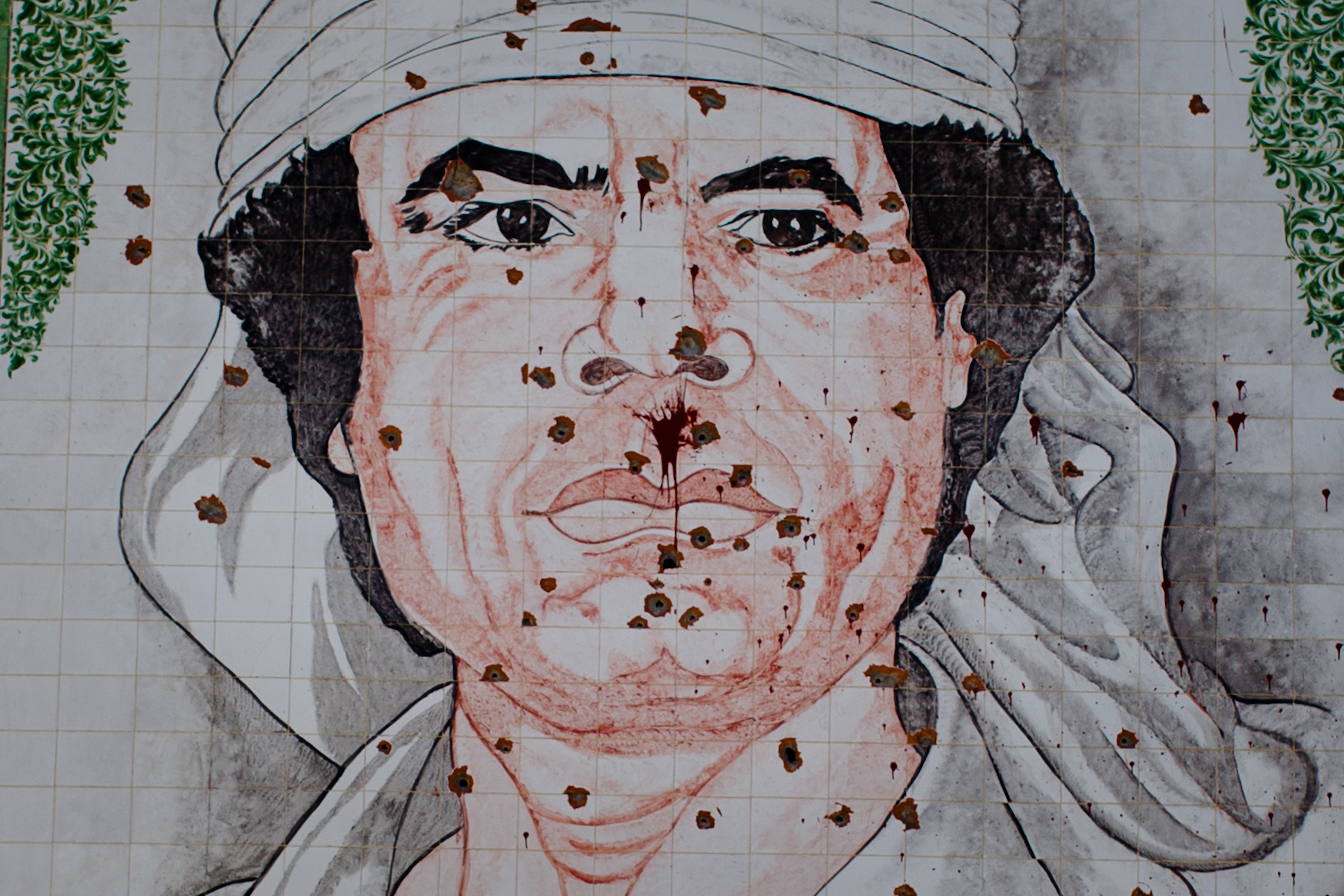
(Photo: A mosaic of Gaddafi is seen on the wall of a building, riddled with bullet holes on August 29, 2011 in Tripoli, Libya. By Daniel Berehulak/Getty Images)

AIPAC Wants This War

Eli Lake dutifully delivers the news, and its obvious meaning:

One reason AIPAC has decided to engage in the congressional fight over the Syria war resolution is that it sees a direct connection to Iran. “We see a direct link to this vote and dealing with the Iranian nuclear issue,” this [senior AIPAC] official said. “Our view is that if this vote goes down, it will be devastating to American credibility and send a very clear message to Iran that they can press the accelerator on moving forward with their program. At this point Assad and Hezbollah are merely franchises for Iran.”

Make no mistake: this is about also making Obama go to war against Iran. And since when do leaders of Congressional lobbies demand and get anonymity from journalists? You’d think they’re afraid of being exposed or something.

At this point, alas, the collapse of Obama’s realist nerve means he has lost the thread. Unless he reasserts a coherent policy – and blaming “red lines” on others is absurd when you used the very fucking words yourself is not a coherent policy – he will seem increasingly weak as a leader and his war less and less likely to gain the domestic support it needs if it is to succeed. The ambiguities he relied on have been wiped away into a binary choice in real time. So McCain and AIPAC will be swift in resurrecting a neoconservative foreign policy that will effectively undo a huge amount of the progress this president has so far managed to build.

Maybe Obama can get out of this somehow. But I don’t see quite how – and McCain now feels emboldened enough to oppose the current Senate Resolution on the grounds that it isn’t sufficiently like the Iraq resolution. The only hope I can see is for the House to turn the president down. That is something many Republcians and perhaps a few Democrats will be prepared to do. But turn down AIPAC? That’s another matter entirely.

What, Exactly, Will Congress Authorize? Ctd

Jack Goldsmith analyzes the Senate’s draft Authorization for Use of Military Force (AUMF), which is narrower than the administration’s AUMF. The Senate’s language on ground troops:

Ground Troops “Limitation.”  Section 3 of the draft provides: “The authority granted in section 2 does not authorize the use of the United States Armed Forces on the ground in Syria for the purpose of combat operations.”

This is a limit on the authority conferred by Congress in Section 2, and not a limit on the President’s independent constitutional power to send ground troops into Syria, even for combat purposes.  Section 3 merely says that the congressional approval of the use of presidential force in Syria does not entail approval for the use of ground troops in Syria.  But it does not speak to, much less prevent, the President from using ground troops on his own authority.

Moreover, even the ground troop limitation on Congress’s authorization contains an exception for ground troops introduced into Syria for a purpose other than “combat operations.”  In other words, Sections 2 and 3 in combination affirmatively authorize the President to introduce U.S. ground troops in Syria for non-combat purposes if he thinks they are necessary and appropriate to achieve the purposes of the authorization. Section 3 is probably written this way to capture the fact DOD Special Operations Forces are being used in Syria, or will be used there, for intelligence-related and other “preparation of the battlefield” tasks.  (I imagine, but of course do not know, that this is a nod to operational reality, since DOD has probably already sent Special Operations Forces into Syria, under the President’s Article II power, to prepare the battlefield.) It is also probably meant as a carve out for search-and-rescue missions, and the like, if necessary.

Andrew Rudalevige also parses the document. On the time limitations:

[T]he resolution says in one of its “whereas” clauses that “the President has authority under the Constitution to use force in order to defend the national security interests of the United States.”  If not quite as broad as the parallel clause in the September 2001 AUMF (“the President has authority under the Constitution to take action to deter and prevent acts of international terrorism against the United States”) it nonetheless seems out of place in a series of “whereases” justifying the resolution in the first place.

If the president does have such authority under the Constitution, unfettered by others’ judgment about what the national security interests of the United States might entail, putting it in statutory language has no effect. If he does not, the clause does not make it so—but it does provide another useful piece of ‘legislative intent’ presidents can point to in future iterations of this interaction. Since in the resolution at present what expires after 60 (or 90) days is the congressional authorization for the operation, not the operation itself, there seems to be a backdoor permission here to continue the latter even after that time, under ongoing claims to “national security interests.”

Obama vs “International Norms”

Richard Price, author of the The Chemical Weapons Taboo, discusses how strikes against Syria might affect it:

Bombing Syria would be the strongest possible upholding and reinforcement of the norm. Will the norm fall by the wayside if that doesn’t happen? No, I don’t think it will. But if there was a strike to enforce it, that would be a watershed moment in many respects. Norms regarding warfare have often been quite effective, like the treatment of prisoners of war. They’re sometimes violated, of course, but a lot of them are treated with a minimal level of decency. These norms trudge on, despite violations, because of beliefs about reciprocity and decency. One violation does not destroy a norm. What matters is how people respond to it.

And you’ll notice something strange about this episode. It’s not as if Syria is defending their use of chemical weapons. They’re denying it. And that helps contribute to the notion this is an unacceptable process. In World War I, the Germans argued that gas might be more humane than bayonets or getting blown up. Some people think that the Bush administration’s view on enhanced interrogation techniques struck a real blow against norms against torture. No one is defending chemical warfare. All the dynamics here have served to highlight that this is a salient norm in global politics today.

Here, again, we keep ignoring what the Bush administration did. They tore up international norms. They made it clear that they had nothing but contempt for them. They occupied a country and failed to provide minimal security for its citizens thereafter, a violation of Geneva. They authorized and practiced grotesque torture of prisoners. They showed contempt for allies. They went to war without full UN permission. They established a torture-and-detention camp in no-man’s and in Cuba precisely to flout international norms.

The idea that America is the only thing standing between chaos and international norms simply ignores the entire history of this rogue, sole super-power in the first decade of the 21st Century. Obama had a chance to restore those norms, but on torture, he simply refused to uphold very clear Geneva imperatives that torturers and their commanders be prosecuted for war crimes. So to take Price’s point:

One violation does not destroy a norm. What matters is how people respond to it.

We know how Obama has responded to it. By doing nothing. Torture is as grave a violation of international law as the use of chemical weapons. I fail to see why a president who refuses to enforce international norms against torture in his own country has any right to tell anyone else on the planet what they can and cannot do in observance of international norms. He has trashed them in the case of torture for domestic political reasons. Why shouldn’t Assad – when he is facing a fight for survival?

We have, in other words, not a leg to stand on when we claim we are enforcing international norms. We only enforce them when we want to. (On chemical weapons, we actively allowed Saddam to use them when it suited us.) In any case, I don’t see how this Syrian adventure will do anything serious to reinforce those norms, as Isaac Chotiner notes:

Does anyone think if Saudi Arabia, say, develops and uses chemical weapons to put down a revolt a decade from now that the United States would go to war? Of course not. (Hypocrisy is not a reason to avoid action, but massive hypocrisy does mean the messages and signals a country thinks it is sending tend to be muddled.) It’s possible that regimes we dislike will hesitate before using these weapons, although that too seems unlikely if those regimes face an existential threat. The possible benefit—i.e. the range of possible bad actors that would be dissuaded by a limited war in Syria—seems awfully small.

Drum argues that most supporters and opponents of war with Syria aren’t focused on chemical weapons:

Enforcing a century-old ban against the use of chemical weapons may sound high-minded in the abstract, but down on the ground there’s virtually no one who (a) actually cares about that and (b) would view a U.S. strike through that lens. You’re for it because you’re a Democrat or a Sunni or an Israeli or a member of the rebel army. You’re against it if you’re a Republican or a Shiite or an Egyptian or Vladimir Putin. Hardly anyone truly cares about American credibility or international norms or foreign policy doctrines or any of the other usual talking points. They’ve just chosen sides, that’s all.

Washington vs The American People, Ctd

UN Syria

The gulf between popular and elite opinion of Obama’s new war is staggering. Americans, like the Brits, do not favor their own countries bearing the entire burden of preventing systemic abuses in the global system like the use of chemical weapons. They believe – rightly – that that is a role for the UN, a body Obama did not even think of engaging. Yes, in that respect, he is just another McCain and Clinton on this one. An enlightening poll from YouGov:

The opposition to intervention does not mean that Americans approve of the Syrian government’s use of chemical weapons: 77% say it qualifies as a war crime. Only one in ten disagree. By more than three to one, Americans believe the international community has a responsibility to stop the use of such weapons.

However, for most Americans, Democrats and Republicans, the job of intervention belongs to the United Nations, not to the United States. By more than two to one, Americans say that the U.N. has a responsibility to intervene in trouble spots around the world. In last week’s poll, the public took the opposite position when asked whether the United States had such a responsibility.

Our only hope, as in Britain, is that the American people will stop this. Because they have a lot more sense than John Kerry or Samantha Power.

It Depends What The Meaning Of “War” Is

Yesterday, Kerry said:

“We don’t want to go to war in Syria either. It is not what we are here to ask. The President is not asking you to go to war.”

Yes. He. Is.

We have so degraded the seriousness of armed conflict against other regimes and countries that we no longer regard massive bombing campaigns, destruction of other people’s infrastructure, and deaths of civilians and enemy soldiers as somehow “not war”. And it is this very logic that enables this war machine to present itself ludicrously as “defense”. The war in Syria has nothing whatsoever to do with the territorial integrity of the US. We are emphatically under no threat at all. Which is why this elective war – without UN support – is so deeply corrosive of this country’s democracy. Peter Beinart notes:

The United States is reportedly considering launching several hundred Tomahawk missiles against various Syrian military units and installations. General Martin Dempsey, chairman of the Joint Chiefs of Staff, has acknowledged that “there is a probability for collateral damage.” The Obama administration, in other words, is planning to kill and maim an unspecified number of Syrians in order to deter Bashir al-Assad from again using chemical weapons or to uphold the credibility of a potential American military strike against Iran. That’s war.

So how can Kerry say it’s not? Because the ships launching the Tomahawks will be far from Syria, and thus apparently impervious to Syrian retaliation. War, in other words, is what happens when other nations kill Americans, not the other way around.

Larison observes that this abuse of the English language is nothing new:

This was the fiction that the administration promoted during the Libyan war, when it offered the pathetic defense that the U.S. was not involved in hostilities because there was no real chance that the Libyan government’s forces could harm any of the Americans participating in the bombing of Libya. If U.S. involvement in a war is lopsided enough, and if it can be waged from a great enough distance, it isn’t counted as war or “hostilities.” This is a risible argument, but it is one that Kerry was quite comfortable making yesterday. Perhaps he assumes that most members of Congress think of these things in the same way, or perhaps he has convinced himself that the U.S. can carry out acts of war without waging war and can commence hostilities against another state without being engaged in hostilities.

The Joke On The Hill

Ezra passes it along:

Privately, Hill aides joke that everything is going exactly to President Obama’s plan. It’s just that that plan is to stay far, far away from Syria.

march-as-to-war-sdThis is the (tongue-in-cheek) 12-dimensional chess interpretation of the Obama administration’s Syria strategy. Boxed in by red-line rhetoric and the Sunday show warriors, the Obama administration needed to somehow mobilize the opposition to war in Syria. It did that by “fumbling” the roll-out terribly. …

The Obama administration’s strategy to cool the country on this war without expressly backing away from the president’s red lines has been brilliant, Hill aides say (just look at the polls showing overwhelming opposition!). If they are going to go to war, their efforts to goad Congress into writing a punitively narrow authorization of force that sharply limits any potential for escalation have worked beautifully.

Believing anything else — like this is how the administration is actually leading the United States into conflict — is too unsettling.

Yes, it is. We elected Obama over McCain and yet Obama is now ceding foreign policy to that discredited blowhard. We believed Obama was a realist, and yet we hear the most abstract and unreconstructed poems to liberal interventionism from his secretary of state. I certainly was led to believe – from a ridiculously high-level source – that intervening in Syria was the very last thing the president wanted to do. And yet here we are. He seems genuine.

Is this some brilliant strategic design? Force the House to acknowledge that there is no public support for war against Syria … and move fast and unilaterally first to force the UN to become more aggressive, and even get Putin’s possible assent to future action if more inspections prove Assad’s use of CWs to be deliberate and undeniable?

I wish I could believe it. The sheer weakness of the case for war is so obvious perhaps Obama is waiting for us to make him pull back before it’s too late. The delay could put more pressure on Putin ahead of the G-20. There are many twists and turns possible. But I am afraid I don’t believe it. Occam’s razor is the best bet here. Obama made a foolish pledge to go to war if chemical weapons are used and now his bluff has been called by Assad.

It may soon be called by Tehran too. And what then, Mr president, what then? Do you have the fortitude to stand down and truly transform American foreign policy? Or, when push comes to shove, are you actually weaker than McCain and Clinton – and your legacy will be not doomed wars in Iraq and Afghanistan but doomed wars in Syria and Iran?