Questions About Syria

Frum lists four. Among them, “What will it cost?”

A Syria campaign is being advertised as comparatively cheap in money and American lives. We’re promised “no boots on the ground.” But there’s another cost in danger of being overlooked: the opportunity cost.

The president, the secretary of state, the secretary of defense and other top officials have only so much time and energy. If they commit to resolving the Syrian civil war, inevitably they give second shrift, or third shrift, or worse to many other concerns of arguably greater importance to the region and the world.

Egypt, for example, seems to be heading toward the same civil strife as Syria. Who is developing the plan for helping to prevent that outcome? How much high-level support and attention are they getting?

Dave Schuler rattles off other questions:

Assume an attack on Syria is unsuccessful in the sense that Assad continues to use chemical weapons after the attack. What then?

Assume an attack on Syria is successful, Assad stops using chemical weapons (he might have done so anyway), but he is able to defeat the rebels without them. What then?

Assume an attack on Syria is successful, Assad stops using chemical weapons (he might have done so anyway), he is unable to defeat the rebels outright, and the civil war just continues. What then?

Assume an attack on Syria is successful and Assad, hamstringed in his attempts to preserve his regime, is ousted by the rebels. The rebels are radical Islamists. What then?

We attack Syria. Syria, Iran, or both retaliate by attacking Americans or American interests in the Middle East using asymmetric warfare techniques. What then?

We attack Syria. An American aircraft carrier is sunk by asymmetric warfare techniques (that’s actually occurred in war games of conflict in the Middle East). What then?

What, Exactly, Will Congress Authorize?

Jack Goldsmith analyzes the administration’s proposed Authorization for Use of Military Force (AUMF):

The proposed AUMF focuses on Syrian WMD but is otherwise very broad.  It authorizes the President to use any element of the U.S. Armed Forces and any method of force.  It does not contain specific limits on targets – either in terms of the identity of the targets (e.g. the Syrian government, Syrian rebels, Hezbollah, Iran) or the geography of the targets.  Its main limit comes on the purposes for which force can be used.  Four points are worth making about these purposes.

First, the proposed AUMF authorizes the President to use force “in connection with” the use of WMD in the Syrian civil war. (It does not limit the President’s use force to the territory of Syria, but rather says that the use of force must have a connection to the use of WMD in the Syrian conflict.  Activities outside Syria can and certainly do have a connection to the use of WMD in the Syrian civil war.).  Second, the use of force must be designed to “prevent or deter the use or proliferation” of WMDs “within, to or from Syria” or (broader yet) to “protect the United States and its allies and partners against the threat posed by such weapons.”  Third, the proposed AUMF gives the President final interpretive authority to determine when these criteria are satisfied (“as he determines to be necessary and appropriate”).  Fourth, the proposed AUMF contemplates no procedural restrictions on the President’s powers (such as a time limit).

Jeez. No wonder Larison thinks the authorization is too broad:

As it is currently written, the resolution likely wouldn’t pass because it requests authorization for what could potentially be much more than a few “limited” strikes. If this resolution passed, Congress would be effectively signing off on U.S. strikes against targets both in and outside of Syria for as long as the war in Syria lasts. That isn’t what the administration claims that it wants to do, but why would anyone take their word for it?

Daniel Nexon argues that broad authorizations are necessary:

In fact, successful compellence against Syria almost certainly requires a credible threat of escalation. The biggest threat posed by potential US intervention? That it directly or indirectly leads to the overthrow of the current regime. Crafting an AUMF that undercuts that threat will almost certainly be counterproductive when it comes to the Administration’s preferred outcome in Syria: forcing the regime to accept a negotiated settlement with the rebels.

The Senate is already revising the administration’s AUMF to make it more limited. Goldsmith believes that this will prove difficult. With any luck, this could be the sticking point – or the way toward a deal.

How Solid Is Our WMD Intelligence On Syria? Ctd

David Kenner reviews some newly declassified intelligence from the French, who support a strike on Syria:

While U.S. officials have conceded that they don’t know if Assad himself ordered the use of chemical weapons, the French assessment rebuts claims that the Aug. 21 attack could have been the work of a rogue officer. France traces Syria’s chemical weapons program to “Branch 450” of the innocuously named Center of Scientific Studies and Research, which Israel bombed in May. Only Assad and top members of his regime, the report says, have authority to order the branch to employ its deadly weapons. Nor does the report give credence to the idea of a rogue element within Branch 450 itself: The unit, it says, is “composed solely of Alawite military personnel … [and] distinguished by a high level of loyalty to the regime.”

Kenner also reviews the possible logic behind such a brazen attack:

While some analyses suggested the rebels were making gains in Damascus, the conventional wisdom was that Assad was making military progress without the use of chemical weapons. The French report, however, suggests that Assad’s position in the capital was weaker than had been supposed: “Our information confirms that the regime feared a large-scale opposition attack in Damascus,” the assessment reads. The attack, it says, was intended to “secure strategic sites” that would allow Assad to control the capital, such as the Mezze military airport.

The French also insist that Assad launched an additional assault to destroy the evidence. Meanwhile, Matthias Gebauer reports on a phone call intercepted by Germany’s foreign intelligence agency:

[Bundesnachrichtendienst (BND) head Gerhard Schindler] said that the [agency] listened in on a conversation between a high-ranking member of the Lebanese militia Hezbollah, which supports Assad and provides his regime with military assistance, and the Iranian Embassy. The Hezbollah functionary, Schindler reported, seems to have admitted that poison gas was used. He said that Assad lost his nerves and made a big mistake by ordering the chemical weapons attack.

The new information from the BND could become important in the coming days. Thus far the US has only noted that after the attack, intelligence agencies had intercepted internal government communications indicating concern about a possible UN inspection of the site. The telephone conversation intercepted by the BND could be an important piece in the puzzle currently being assembled by Western intelligence experts.

Earlier Dish on the intel question here.

Will The Anti-War Movement Return?

Antiwar Protests

Joe Weisenthal explains why it fizzled out:

In 2011, Professors Michael T. Heaney and Fabio Rojas published a study titled: The Partisan Dynamics of Contention: Demobilization Of The Antiwar Movement In The United States 2007-2009 which looked at nearly 6,000 surveys of anti-war demonstrators between January 2007 and December 2009.

This one chart [above] basically tells the whole story. The percentage of Democrats attending anti-war protests collapsed at the end of 2008, and in early 2009. As Democrats are the biggest block of any of these groups, this desertion of the Democratic party was the major blow.

Garance thinks Democrats may oppose Obama:

Obama never has to stand for election again, but the jockeying for 2016 is well under way. It’s possible Obama’s intervention in Libya would have earned louder opposition from Democrats and liberals if the president had not also still faced reelection, which doubtless tempered some voices. That he won’t again opens up the floodgates of criticism from people who expect to be standing on the political stage long after he is gone, as well as by some who hope to take his chair.

Pareene, on the other hand, doubts that Democrats will take a stand:

[A] Syria campaign probably won’t create the conditions for a future Obama to stake out an opportunistic left-wing position and ride it to the presidential nomination in 2016. Americans won’t be dying by the hundreds and we won’t be committing ourselves to a drawn-out and bloody occupation. (Well, let’s hope we won’t be, I guess.) We’re going to launch missiles for a few days and then quit, according to the latest plans. That’s not quite a war you can hang a presidential campaign on. Probably not even a congressional campaign.

Right now liberals (and the political press) are letting people like Rand Paul meet the demand for America to have a less “muscular” foreign presence. (This isn’t really surprising: Liberal antiwar voices are pretty much always marginalized in the United States, by both hawkish Democrats and the press,) The right-wing interventionists are terrified at how much his position resonates with people. But I’d put money on the next presidential election involving two supporters of military action against Syria

Did Obama Need To Go To Congress?

Marty Lederman thinks “that President Obama’s decision to ask Congress for authorization for the use of force in Syria is to be commended, and welcomed”:

Presidents will certainly continue to assert the power to act unilaterally, subject to statutory and international law constraints.  But if and when a President wishes to act for a reason that has not previously been the basis for unilateral action (such as to degrade another nation’s ability to use certain weapons), and/or in a manner that violates a U.S. treaty obligation, past practice will support obtaining congressional authorization, even as the question of the President’s unilateral authority in such circumstances remains untested and unresolved.

I agree – and in fact, think this move could make this moment in US history a possibly pivotal one. Jack Goldsmith weighs in:

The constitutional problem with pure humanitarian interventions – and especially ones (like Kosovo and Syria) that lack Security Council cover, and thus that do not implicate the supportive Korean War precedent – is that Presidents cannot easily articulate a national interest to trigger the Commander in Chief’s authority that is not at the same time boundless.  President Obama, like President Clinton before him in Kosovo, had a hard time making that legal argument because it is in fact a hard argument to make.  That is one reason (among many others) why I think it was a good idea, from a domestic constitutional perspective, for the President in this context to seek congressional approval.

Andrew Rudalevige notes that, since the 1973 War Powers Resolution (WPR), “actions where prior congressional authority was not sought have some characteristics in common not present in the Syrian case”:

First, they have a rationale in self-defense, even imaginatively defined. In the WPR, presidents are given authority to use force when there is (1) a declaration of war; (2) a specific statutory authorization; or (3) ”a national emergency created by attack upon the United States, its territories or possessions, or its armed forces.” Obviously options (1) and (2) can be based on any rationale, or none; but they do not – yet – apply to the Syrian situation. So one question facing Obama was whether (3) would cover sufficient ground. Some cases are easy, as with the (failed) rescue attempt of the American hostages in Iran in 1980 or the 1998 missile strikes after the African embassy bombings. In other cases presidents have been very generous in their interpretation of “attack upon the United States.”  The 1989 invasion of Panama was explained by President Bush as a response to General Manuel Noriega’s “reckless threats and attacks upon Americans in Panama [which] created an imminent danger to the 35,000 American citizens” there. The 1983 invasion of Grenada was publicly justified by President Reagan along similar lines: “first, and of overriding importance, to protect innocent lives,” and not just any lives: “American lives are at stake.” Still, it’s hard to stretch to this from the Syrian rationale, sold before today largely as punishment for the violation of international norms.

Second – in addition or instead—they had multilateral support, a cause of action endorsed by the international community, normally with a humanitarian component. Even Reagan in Grenada was careful to stress that the US had been invited to respond, that it was doing so in concert with other nations in the region (whose battleship inventory was perhaps a bit thin), and that ”this collective action has been forced on us by events that have no precedent in the eastern Caribbean and no place in any civilized society.” Likewise in Somalia (1992), Kosovo (1999), and Libya (2011), one could cite both humanitarian concerns, and treaty obligations (e.g. with the United Nations, NATO, or both). The WPR specifically rules out inferring authority to use force from such obligations (see Section 8(a)(2).)  Nonetheless, they muddy the legal waters.

In Syria, Obama has neither of these covering contexts to justify action.

Drum wishes that Obama had gotten authorization on all of his interventions abroad:

The real reason I’m disappointed is that Obama had a chance to set a new precedent in foreign policy and didn’t take it. Whatever else we liberals might think about George Bush’s military acumen, he left office having explicitly asked Congress to authorize both of his major military actions before he undertook them. If Obama had acknowledged the War Powers Act as good law, acknowledged Congress’s constitutional role in warmaking, and then voluntarily asked Congress for authorization of his proposed military operations in both Libya and Syria without being pressured into it, there’s a good chance that future presidents would feel bound to do the same. This is the way norms become settled, and this is a norm that would have truly changed Washington DC for the better.

But he didn’t do that, despite his apparent belief in 2007 that it was the right thing to do. It was a missed chance, and a disappointing one. I had hoped for better.

Me too. But that doesn’t mean sacrificing the opportunity now.

Quote For The Day

“The consummate interventionist Robert Kagan wrote in his recent book that the American military “remains unmatched.” It’s unmatched in the sense that the only guy in town with a tennis racket isn’t going to be playing a lot of tennis matches. But the object of war, in Liddell Hart’s famous distillation, is not to destroy the enemy’s tanks (or Russian helicopters) but his will. And on that front America loses, always. The “unmatched” superpower cannot impose its will on Kabul kleptocrats, Pashtun goatherds, Egyptian generals, or Benghazi militia. There is no reason to believe Syria would be an exception to this rule. America’s inability to win ought to be a burning national question, but it’s not even being asked,” – Mark Steyn.

Well, we’ve been asking it here at the Dish – ever since Iraq revealed what an anachronism American global power actually is. If you cannot break your enemies’ will, it matters not how much weaponry you have. The 20th Century is over.

The Covert War Already Under Way In Syria

We get a glimpse of it in the NYT today:

Officials said that in the same conversation, which included Senator Lindsey Graham, Republican of South Carolina, Mr. Obama indicated that a covert effort by the United States to arm and train Syrian rebels was beginning to yield results: the first 50-man cell of fighters, who have been trained by the C.I.A., was beginning to sneak into Syria.

“Beginning to sneak”? What the fuck does that mean? And how has this covert war affected Assad’s calculation with respect to WMDs? We don’t know – which, of course, is the point of covert wars. But we absolutely have a right to know. Until the Obama administration tells us about the war it is currently waging in Syria, we should refuse any further authorization for them to expand it.

How Solid Is Our WMD Intelligence On Syria?

US-SYRIA-CONFLICT-CONGRESS

Gregory Djerejian rightly requests “hard confirmation” on who used chemicals weapons in Syria:

[W]e require conclusive proof of the origins of the attack, beyond horrific footage of the grisly aftermath. After all, this speaks only to something horrible having happened, as did reports by respected NGOs like Doctors Without Borders (MSF), but it does not firmly evidence regime culpability. Similarly, sarin samples obtained from first responders proves the existence of said neurotoxic agent on the scene, but not necessarily who delivered it, precisely how, and exactly where.

After the Iraq fiasco, we need to ensure that we do not simply “trust” the guarantees of our democratic leaders and the security state that is feeding them intelligence:

[W]e have no choice but to reckon that we labor under the legacy of the terrible blunder that was the ginned-up intelligence that caused trillions of dollars wasted, hundreds of thousands of Iraqi lives, thousands of American ones, the epic disgraces of Abu Ghraib, and such grievous harm dealt the United States’ global repute. We must recall all this was premised on lies. So, like it or not, evidentiary hurdles moving forward must be higher.

Amen.

(Photo: A photo of alleged chemical weapons victims in Syria is seen before a hearing of the Senate Foreign Relations Committee on Capitol Hill on September 3, 2013. US Secretary of State John Kerry, Chairman of the Joint Chiefs of Staff Gen. Martin Dempsey, and Defense Secretary Chuck Hagel appeared before the committee to present the Obama Administration’s views on Congressional authorization for the use of military force in Syria. By Brendan Smialowski/AFP/Getty Images)

Marching As To War?

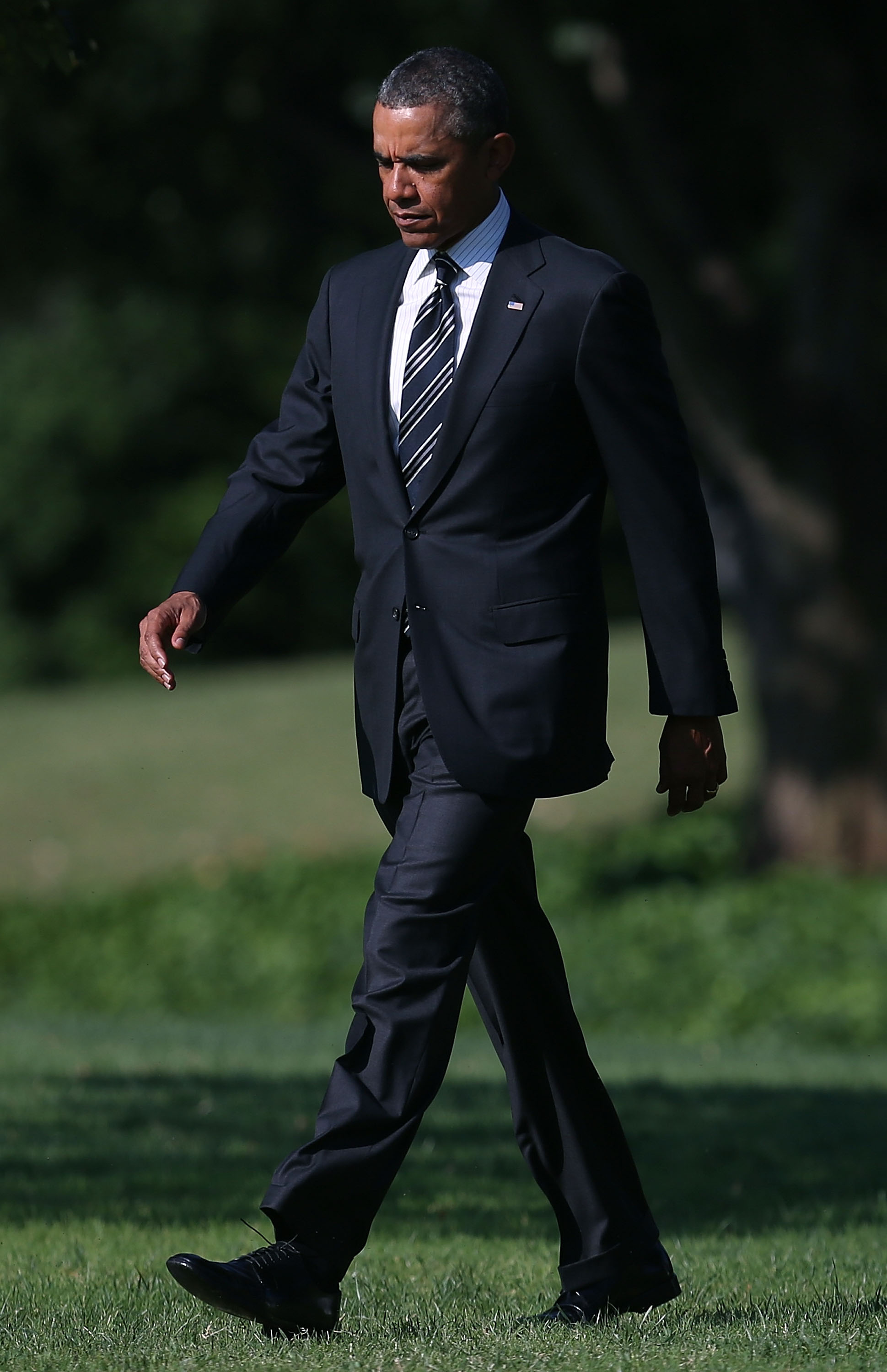
President Obama Departs The White House

This morning, I finally watched the visual evidence of the Assad regime’s chemical attack on hundreds of children. There is a reason, these awful videos prove, behind our fear of these kinds of weapons, even if they follow over 100,000 far bloodier deaths. They kill silently in the dark. Heavier than air, poison gas can sink into the basements and cellars civilians use for protection during wartime. The crippling efficacy of such weapons, once used to propel the mass extermination of European Jews, should draw us all short. It is not that the victims of chemical attacks are any more dead or crippled than the 120,000 or so other victims of the sectarian bloodbath in Syria. It is that the use of such weapons signals that the regime is now prepared to use this final trump card, if it suits its purposes. The Alawites have always had the power to kill their sectarian foes (Hafez al Assad committed a mass murder of 10,000 civilians); but now we know they also have the will to use the most silently lethal chemicals at their disposal. There’s a reason so many millions are now fleeing. The prospect of a sectarian Holocaust from the skies is no longer a dystopian illusion. It is an historical fact.

This makes Obama’s shift explicable, whatever the debating points scored at various junctures in the Syria debate in the last few years. I don’t buy the criticism that he should have intervened much earlier in Syria (there would have been zero public support); and the principle of forbidding chemical weapons use against civilians and rebel fighters is a vital one for the future of civilization. To do or say nothing now would have given Assad a green light to exterminate more people without any cost. So the core question really emerges: what would doing something look like?

Obama has proposed doing something and nothing at the same time. And, sure, a military strike on Syria will exact a cost for Assad for his sectarian extermination program. But it is highly unlikely to bring him down or, unless I am mistaken about the situation on the ground, shift the course of the war. After the dust settles, a US strike may even give Assad more lee-way to use his poison gases against his foes, and enable him to portray himself as a victim of Western intervention. If he got away with it once, and gained ground in the war, why not again and again? And what then?

The McCain faction is obviously right about one thing: the only option that would ensure Assad’s ouster would be a full scale war and invasion conducted by some kind of alliance between the US and the rebel groups. And they are obviously wrong, it seems to me, on one thing as well: there is no way on earth that this country or its armed forces should jump into such a brutal, sectarian vortex of violence, with only the goal of deposing a dictator. Have we learned nothing from Iraq? Our core interests are not affected by the result of the Syrian civil war, and we have simply no assurance that the replacement for Assad would be less monstrous than he is. If our concern is the security of chemical weapons stockpiles – and Syria has the third most in the world – then it seems to me that our cold interests actually lie with Assad’s victory. At this point, his faltering regime is more stable than the opposition and less allied with Sunni Jihadists.

But here, it seems to me, is where we should stop, and demand more clarity and transparency from the president. The Congressional debate – in my view, a constitutionally indispensable procedure – is a great opportunity for this. We all get the gravity of chemical weapons use – and Kerry can stop embarrassing himself by calling his former dining companion another Hitler. What we don’t yet fully know is what the Obama administration has already been doing in Syria and what it hopes specifically to achieve now – by militarily joining one side in Syria’s sectarian meltdown.

I want, first up, a better explanation for this quantum leap in the use of chemical weapons by Assad. My impression is that he was winning this brutal war slowly. Why play your trump card then – with all the risks associated with it? More to the point, why do it when UN inspectors are close by? Yes, Assad is evil – but he has long been that and the Ghouta mass murder has scrambled the situation in ways that indicate reckless, even desperate, stake-raising. So, first up, what I’d want first of all is a clear statement that the US has not been engaged in a covert war in Syria that might in any way have prompted this horror. I would like a clear, emphatic and truthful refutation of the reporting in Le Figaro that implies that a new anti-Assad offensive was launched at the start of last month, as part of a covert war, headed up by the US’s covert war machine. Is this paranoid? Maybe. But I remember Iraq and, forgive me, I have learned the value of deep skepticism about various US administrations’ accounts of reality.

Second, I want a clear explanation of what the goals are of this proposed strike.

If it is merely a symbolic act, then we should understand that we are risking American lives, money and values for moral optics, with no clear goal. If it is an attempt to shift the direction of the civil war, then we should know how the US attempts to win this sectarian struggle in the Middle East, when it could not impose sectarian peace in a country it occupied with over 100,000 troops for a decade (and where the sectarian murderousness endures and thrives). If we “win”, are we sure this isn’t just another move in an eternal cycle of sectarian vengeance? Look at Libya – the other place Obama decided to intervene. Obama’s reward? The attack on the Benghazi CIA facility and a fractured non-state that has allowed al Qaeda to regroup in north Africa. You can more easily see how a rebel victory on Syria could turn into a worse nightmare. If Jihadist nutcases end up in control of the third largest chemical weapons stockpile in the world, the first step toward that result would be this war against Assad.

I’m not denying the moral atrocity. I’m not denying the gravity of this breach of international norms. But military intervention in Syria? For me, the administration hasn’t even begin to present a coherent, let alone a persuasive argument. The congressional debate is absolutely the best forum for this debate to take place – just as the House of Commons was in Britain. If the Congress votes no – which, given the current arguments, it obviously should – then the president should accede to the wishes of the American people as voiced by their representatives. If he were to do that, the kind of transformation Obama promised in America’s foreign policy would be given a huge boost. This would be a president who brought Congress back into the key decisions of war and peace as the ultimate authority on them, as the Founders intended. It would be seen by history as the first key step away from the imperial presidency and the beginning of democratic accountability for the permanent war machine.

This could, in other words, be the dawn of a new, realist and constitutional age. Or the final death-throes of an empire that won’t quit until it bankrupts us both fiscally and morally. That’s why next week’s debate is so critical. And why Obama can still come out ahead on this, even as the conventional Washington wisdom will surely be all about his humiliation in a zero-sum narrative whose attention span is the next five minutes. If he defers to Congress on a new war in the Middle East, we are definitively in a new era.

It’s called 21st Century democracy. And not a minute too soon.

(Photo by Mark Wilson/Getty Images)

Obama Asks Congress For A New War: Reax

by Patrick Appel

Obama’s Saturday speech declaring his intention to attack Syria and to request Congressional approval beforehand:

Amy Davidson applauds Obama’s decision to get Congress’s input before attacking Syria:

This may be the first sensible step that Obama has taken in the Syrian crisis, and may prove to be one of the better ones of his Presidency—even if he loses the vote, as could happen. Politically, he may have just saved his second term from being consumed by Benghazi-like recriminations and spared himself Congressional mendacity about what they all might have done.

Fallows is also happy that Congress will get its say:

This is the kind of deliberation, and deliberateness, plus finding ways to get out of a (self-created) corner, that has characterized the best of his decisions. It is a very welcome change, and surprise, from what leaks had implied over the past two weeks.

Larison hopes that Congress will vote against using force:

Presumably, Obama is gambling that he can cow Congress into granting authorization by having publicly committed the U.S. to military action. When presidents have gone to Congress to seek this kind of authorization, they have typically received it and usually by a large margin. I am cautiously hopeful that there are enough members in the House at least that know how deeply unpopular war with Syria is that this will not be the case this time, but I fear that few Democrats will be willing to vote against the White House and too many Republicans will be only too happy to vote yes. If members of Congress judge the proposed attack in terms of U.S. interests or international law, they should definitely reject it. If they judge it in terms of bogus “credibility” arguments or an obsession with wounding Iran, I am less sure that most of them will vote no.

Barro believes that the House might reject Obama’s request for intervention:

Democrats: In the current political environment, they have little reason to think voting against an attack will make them look “soft on terror,” which is what they were most afraid of during the Iraq authorization vote 10 years ago. But they have good reason to fear the Hillary example: voting yes could cost them a primary election if things go wrong.

Republicans: War hawks are a far weaker force in GOP politics than they were 10 years ago. You don’t have to be Ron Paul to defend a skeptical position on intervention anymore. And it’s not that hard to make a case to a Republican primary electorate for why you opposed one of Barack Obama’s initiatives.

Julia Ioffe notes that Obama isn’t rushing the vote:

Obama has clearly learned something from Cameron’s blunder: he’s not rushing this thing. Cameron was dealing with an incomplete Parliament, as some MPs just didn’t bother to come back for the vote. He didn’t spend the time laying out his case, lobbying and whipping the vote in to shape. Obama, by contrast, is not summoning Congress back early. He’s scheduled a second briefing with lawmakers, and there have been reports that he is already personally lobbying the people in his party, like Carl Levin, who have been skeptical of intervention in Syria.

Fisher worries about the delay:

The U.S. Congress is not known for its speed with urgent issues – particularly ones that come during their vacation. It is also not an institution known for compromise or cooperation on issues that are, like this one, daunting, difficult and that have few political upsides. Whether or not you think that off-shore strikes are a good idea, this adds more delays and uncertainty after a week of both. It increases the likelihood, probably already significant, that the Assad regime will see the international community as unable or unwilling to hold him accountable. If strikes are likely to happen anyway, the uncertainty is not good for Syria. And if they don’t happen, Syria would have likely been better off if the U.S. had never signaled otherwise in the first place.

David Rothkopf has similar fears:

If the administration persuades Congress to support military action, it will be seen as a victory for the president, to be sure. But it may also have given the Assad regime another two or three weeks to redeploy assets and hunker down — so that the kind of limited attack currently envisioned has even more limited consequences.

Jack Goldsmith differs:

I am still unconvinced that military action in Syria is a good idea.  And there will be those who complain that the President’s request to Congress harms presidential power, or hurts our tactical position vis a vis Syria (because of the delay, etc.), or reflects poor planning, and the like.

The President is indeed still in a pickle.  But in light of the constitutional questions, the lack of obvious support in the nation and Congress, and the risks of sparking a broader conflict in the Middle East, and for the other reasons I stated in my post last week, it would have been terrible for the President and the nation if he had engaged in strikes in Syria without seeking congressional approval.

Michael Scherer and Zeke Miller report that Obama may ignore Congress’s decision:

Obama’s aides made clear that the President’s search for affirmation from Congress would not be binding. He might still attack Syria even if Congress issues a rejection.

Greenwald pounces:

It’s certainly preferable to have the president seek Congressional approval than not seek it before involving the US in yet another Middle East war of choice, but that’s only true if the vote is deemed to be something more than an empty, symbolic ritual. To declare ahead of time that the debate the President has invited and the Congressional vote he sought are nothing more than non-binding gestures – they will matter only if the outcome is what the President wants it to be – is to display a fairly strong contempt for both democracy and the Constitution.

Drum doubts that Obama would defy the will of Congress:

As for whether or not Obama will go ahead with an attack even if Congress rejects it, I can hardly imagine he would. Am I wrong about that? Is there even the slightest chance he’d go ahead even if Congress votes against it?

Judis is concerned about Congress voting against action:

If he loses, and unlike Cameron, goes ahead anyway, he will increase his troubles at home. Cries of imperial presidency will be heard. But equally important, the military action he undertakes will have less intentional force behind it. One reason why a military strike could deter Syria’s Bashar al Assad from further use of chemical weapons, and perhaps even contribute to a negotiated settlement, is that Assad would have to fear that if he were to escalate in response to the American action, the United States would escalate in kind. But if Obama appears embattled at home, and barely able to act, that threat will not be as credible, and the American action may be less likely to accomplish its objective of deterring Assad.

And Bruce Riedel feels that the “President’s decision to ask for a Congressional mandate should also serve as a precedent for any decision to use force against Iran to halt its nuclear weapons project”:

A war with Iran would be vastly more dangerous and costly than one with Syria, even if both are intended to be limited. Wars always have unintended consequences. If time permits, the people’s representatives should be part of the decision to take on the risks of action. President George H.W. Bush did that before the liberation of Kuwait. As a senior intelligence officer, I spent days explaining the CIA’s estimates of the risks to the Congress. The process sharpened our analysis. There are no good options in Syria. Sliding into the conflict by baby steps and partial measures is the worst approach. Even worse would be to do so without a national debate and Congressional action.