Intervention Usually Does More Harm Than Good

by Patrick Appel

Yglesias flags research finding that, in general, “intervening on behalf of rebels increases the number of civilians who are killed by increasing the desperation of government forces”:

Now of course just because intervention typically fails to reduce civilian deaths doesn’t mean that intervention fails in all cases. But proponents of helping-by-killing seem to me to be mighty blithe in their estimates of the upsides of these endeavors. And you can see why that is. A mission is undertaken to help the good guys and stop the bad guys. If the bad guys kill even more good guys once your mission starts, the tendency is to put that in the “evidence that the bad guys are really bad” file rather than the “evidence that this intervention didn’t work very well” file. By the same token, proponents of helping-by-killing are generally very eager to assert that killing bad guys (and their subordinates) will set valuable precedents for the future and tend to discount the risk that interventions create perverse incentives for rebel groups. For example, did this fierce civil war in Syria break out in part because the intervention in Libya led opposition figures to believe that even a low-probability-of-success military uprising stood a good chance of receiving a NATO bailout?

Obama Wants A Little War

by Patrick Appel

SYRIA-CONFLICT

Fisher outlines what appears to be the administration’s Syria plan:

[W]hat the Obama administration appears to want is a limited, finite series of strikes that will be carefully calibrated to send a message and cause the just-right amount of pain. It wants to set Assad back but it doesn’t want to cause death and mayhem. So the most likely option is probably to destroy a bunch of government or military infrastructure – much of which will probably be empty.

Drum labels this course of action “useless”:

All the evidence suggests that Obama is considering the worst possible option in Syria: a very limited air campaign with no real goal and no real chance of influencing the course of the war. You can make a defensible argument for staying out of the fight entirely, and you can make a defensible argument for a large-scale action that actually accomplishes something (wiping out Assad’s air force, for example), but what’s the argument for the middle course? I simply don’t see one.

Franklin Spinney argues that this plan relies on the “marriage of two fatally-flawed ideas”:

1. Coercive diplomacy assumes that carefully calibrated doses of punishment will persuade any adversary, whether an individual  terrorist or a national government, to act in a way that we would define as acceptable.

2. Limited precision bombardment assumes we can administer those doses precisely on selected “high-value” targets using guided weapons, fired from a safe distance, with no friendly casualties, and little unintended damage.

This marriage of pop psychology and bombing lionizes war on the cheap, and it increases our country’s  addiction to strategically counterproductive drive-by shootings with cruise missiles and precision-guided bombs.

Fallows seconds Spinney:

For 20 years now we have seen this pattern:

1. Something terrible happens somewhere — and what is happening in Syria is not just terrible but atrocious in the literal meaning of that term.

2. Americans naturally feel we must “do something.”

3. The easiest something to do involves bombers, drones, and cruise missiles, all of which are promised to be precise and to keep our forces and people at a safe remove from the battle zone.

4. In the absence of a draft, with no threat that taxes will go up to cover war costs, and with the reality that modern presidents are hamstrung in domestic policy but have enormous latitude in national security, the normal democratic checks on waging war don’t work.

5. We “do something,” with bombs and drones, and then deal with blowback and consequences “no one could have foreseen.”

Larison suspects that a bombing campaign will quickly escalate:

Since almost everyone concedes that the planned strikes are virtually useless, it is hard to believe that the administration won’t feel compelled to launch additional attacks on the Syrian government when the first strikes fail to change regime behavior. There will presumably be increasing domestic and international pressure for an escalation of U.S. involvement once the U.S. begins attacking Syria, and once Obama has agreed to take direct military action of one kind he will have greater difficulty resisting the pressure for even more. There is also always a possibility that Assad and his patrons could retaliate against U.S. forces or clients, in which case the pressure to escalate U.S. involvement will become much harder to resist.

And Gregory Djerejian, who is conflicted over whether or not to intervene in Syria, argues that we “should not simply bomb for 36 hours, and then go away again”:

This would likely prove worse than doing nothing. We need to re-engage in a holistic Syria policy that squarely grapples with broader regional dynamics and that ultimately leads to a negotiated solution, a task we’d shirked, but where Assad’s use of [chemical weapons (CW)] appears to have forced a reluctant President to more forcefully engage. So if we are going in, we’re going in for more than a few Tomahawks so everyone can get a late August pat on the back that ‘something was done’. It’s not quite Colin Powell’s old so-called Pottery Barn rule: ‘you break it, you own it’. It’s perhaps more here, ‘you bomb it, the breakage is yours too’. Are we up to this? Our national security team? The strategic follow-through? The countless hours of spade-work with allies and, yes, foes? I just don’t know.

I am straddling the fence and unsure, but it is one man ultimately who will decide. My thoughts are with him, this may be a more momentous decision than he may wholly realize. I would not begrudge him standing aside, if he feels the ‘roll-in the cavalry’ noises to date have caused Assad to blink already creating a sufficient enough deterrent impact (though this is dubious). He must also ask himself, when he thinks honestly taking his private counsel, whether he believes he and his team really have the appetite and abilities once embarking on this course to actually succeed in it. These are not easy questions. Yet they demand answers and realistic appraisal. As part of that analysis, one must honestly reckon too with the emerging school of thought that we can bifurcate a military action aimed purely to deter on CW, but without enmeshing ourselves in the conflict and attempting to influence broader outcomes. One doubts it could play out so neatly, and such assumptions should be amply stress-tested.

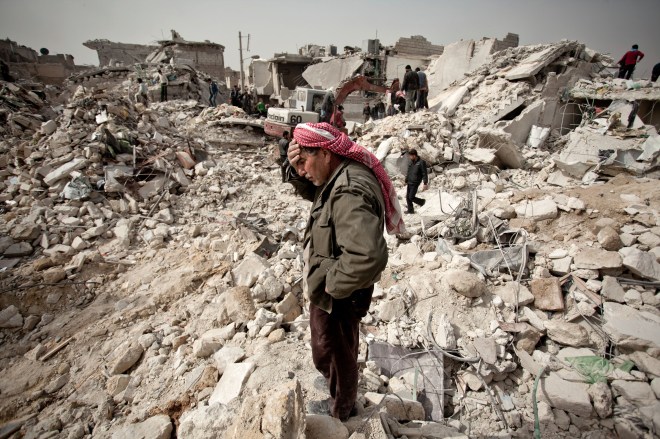
(Photo: A Syrian man reacts while standing on the rubble of his house while others look for survivors and bodies in the Tariq al-Bab district of the northern city of Aleppo on February 23, 2013. Three surface-to-surface missiles fired by Syrian regime forces in Aleppo’s Tariq al-Bab district left 58 people dead, among them 36 children, the Syrian Observatory for Human Rights said on February 24. By Pablo Tosco/AFP/Getty Images)

YouTube In The War Room

by Patrick Appel

Matt Steinglass thinks the “decisive factor” propelling America’s to intervene in Syria is “the rapid availability of mesmerisingly horrifying video imagery of the gas victims” (such as the video above):

In Iraq, video imagery of Saddam’s Kurdish gas victims ultimately came out, but it took years; there was no sense of urgency or an ongoing threat. Even so, the imagery of the massacres ultimately seeded a longstanding American sympathy for the Kurdish cause and remained the clearest indictment of Saddam as a mass murderer. The impact of such video images rests partly on the unique horror of poison gas in the Western imagination.

Waldman makes an important point about these images:

If you’ve watched the coverage of these events on television, you’ve no doubt heard the warnings from anchors: “The images we’re about to show you are disturbing.” And indeed they are, particularly the ones of children—a child being washed down in a dingy hospital while crying out in anguish, rows upon rows of dead children’s bodies, and so on. But it’s precisely because chemical weapons leave no visible injuries that these images can be shown. If the same number of children had been blown apart by bombs, you’d never see the pictures at all, because the editors would have considered them too gruesome to broadcast. And not having seen the images, we might be just a little less horrified.

Erik Voeten identifies one reason the taboo against chemical weapons exists:

Historically, chemical weapons have been heavily associated with poison; the quintessential weapon of the weak, which undermines proper battles for political power based on physical strength. This makes chemical weapons usage easy to associate with cowardice.

Earlier Dish on chemical weapons here.

Does America Plan To Oust Assad?

by Patrick Appel

Micah Zenko asks:

Even a limited cruise missile strike will not be merely an attack on Assad’s chemical weapons capabilities, but an attack on the regime itself.

Subsequently, the United States will be correctly perceived by all sides as intervening on behalf of the armed opposition. From there, it is easy to conceive how the initial limited intervention for humanitarian purposes – like Libya in 2011 – turns into a joint campaign plan to assure that Assad is toppled.

If this is the strategic objective of America’s intervention in Syria, President Obama should state it publicly, and provide a narrative of victory for how the United States, with a small number of partner countries, can and will achieve this.

Bret Stephens, for one, wants Assad eliminated:

The world can ill-afford a reprise of the 1930s, when the barbarians were given free rein by a West that had lost its will to enforce global order. Yes, a Tomahawk aimed at Assad could miss, just as the missiles aimed at Saddam did. But there’s also a chance it could hit and hasten the end of the civil war.

Larison pushes back:

One of the persistent flaws in hawkish thinking about foreign conflicts is that the foreign strongman is treated as the embodiment of everything wrong with the country, and consequently hawks tend to think that by removing the strongman the country’s problems will be remedied very easily. Killing off the leadership of the regime likely wouldn’t hasten the end of the conflict.

Would killing Assad prevent the U.S. from being drawn into the conflict? That seems implausible. If the U.S. killed regime leaders, it would probably invite retaliation that sooner or later would make U.S. involvement in the conflict almost unavoidable. Having taken the dramatic step of striking at the top levels of the Syrian government, would the U.S. then be content to leave Assad’s successor in peace? Not very likely. Stephens’ proposal is a recipe for sucking the U.S. deeper into an intense sectarian conflict.

Gillespie :

I don’t doubt Stephens desire to kill Bashar Assad; indeed, the world would not weep a single tear over that tyrant’s death, or the demise of his regime. But the cavalier attitude toward war is stunning, isn’t it, as is the foam-flecked invocation of “civilization.”

Indeed, if the best case for a U.S. war with Syria is that “the future of civilization” is at stake, it’s clear that pro-war forces have no argument other than overheated rhetoric. The simple fact is that Syria’s civil war (and that’s what we’re facing here) is not the test case for civilization, Western or otherwise.

Interior Monologue Of The Day

by Patrick Appel

George Packer’s argument with himself over Syria is worth reading in full. It begins:

So it looks like we’re going to bomb Assad.

Good.

Really? Why good?

Did you see the videos of those kids? I heard that ten thousand people were gassed. Hundreds of them died. This time, we have to do something.

Yes, I saw the videos.

And you don’t want to pound the shit out of him?

I want to pound the shit out of him.

But you think we shouldn’t do anything.

I didn’t say that. But I want you to explain what we’re going to achieve by bombing.

Continued here.

War With Syria Is Massively Unpopular

by Patrick Appel

Reuters found that only 9 percent of Americans support using force against Syria. Nate Cohn claims that “it’s far too early to draw conclusions about public opinion on a hypothetical strike on Syria”:

The public isn’t fully informed about Syria’s behavior, and the administration and its senate allies haven’t made the case for strikes. Given that well-regarded polls have shown that the use of chemical weapons could sway public opinion, it wouldn’t be wise to discount the possibility that a plurality or majority of Americans might ultimately support some sort of military operation.

But support for striking Syria compares badly to previous wars. Joshua Keating digs up polling on past conflicts:

47 percent of Americans supported the U.S. intervention in Libya in 2011, which Talking Points Memo noted at the time was the “lowest level of support for an American military campaign in at least 30 years.” Seventy-six percent of American initially supported the Iraq War, and 90 percent supported U.S. action in Afghanistan in 2001.

On the eve of NATO military action in Kosovo in 1999, Gallup described public support as “tepid” at 46 percent. By contrast, 81 percent of Americans thought that George H.W. Bush was “doing the right thing” prior to the beginning of Operation Restore Hope in Somalia. Fifty-three percent initially supported in the invasion of Grenada. Even at their worst points, support for the wars in Iraq and Vietnam hovered around 30 percent.

I recognize there’s always a Rally ‘Round the Flag Effect and the level of support for action in Syria could change once the cruise missiles start flying and Americans feel the need to support the military action out of patriotism, but the baseline here is still pretty dismal.

Even if support spikes after America launches its missiles, that support is unlikely to be particularly solid. Support for intervention in Libya fell from 47 percent at the beginning of the conflict to 39 percent a few months later. And that was before the Benghazi attack.

The Sarin On Our Hands In Iraq

by Brendan James

Declassified documents reveal that Saddam “relied on U.S. satellite imagery, maps, and other intelligence” when he deployed mustard gas and sarin during the Iran-Iraq war:

“The Iraqis never told us that they intended to use nerve gas. They didn’t have to. We Chemical Weapons Iraq-Iran Waralready knew,” [retired Air Force Col. Rick Francona] told Foreign Policy.

According to recently declassified CIA documents and interviews with former intelligence officials like Francona, the U.S. had firm evidence of Iraqi chemical attacks beginning in 1983. At the time, Iran was publicly alleging that illegal chemical attacks were carried out on its forces, and was building a case to present to the United Nations. But it lacked the evidence implicating Iraq, much of which was contained in top secret reports and memoranda sent to the most senior intelligence officials in the U.S. government. The CIA declined to comment for this story.

The disclosure obviously has relevance to our current moral posture on chemical warfare inside Syria:

If, as is looking increasingly likely, the U.S. does conduct a military intervention in Syria it is worth remembering that the U.S., while condemning the use of chemical weapons now, once supported a dictator knowing that he intended to use chemical weapons on his enemies, another example of how policy makers too often justify ugly and obscene policies in order to pursue what are considered desirable ends.

Chotiner insists our dirty hands in Iraq shouldn’t prevent action against Assad:

If anything, America’s previous support for Saddam Hussein made it more imperative that the country take some action to remove him. I certainly don’t think this was a sufficient reason to support a disastrous war, but it gives ammunition to the opposite case than the one that anti-war activists were making. The same argument cropped up when Mubarak lost United States support in 2011. Would it have been better to go on supporting him? …

This time around [with Syria], look for a similar focus. Haven’t we looked the other way during previous atrocities? Didn’t we previously reach out to Assad and try to make deals with him? And, given the latest revelations, how can America condemn the use of chemical weapons when we aided Saddam Hussein’s crimes? For these questions to have any merit, someone needs to explain why having previously aided an atrocity is a reason for ignoring the next one.

Meanwhile, Friedersdorf understands our assistance to Saddam as a lesson about government secrecy:

Most people in the Reagan Administration would’ve been mortified to stand in front of TV cameras and say, “I decided that we should help Saddam Hussein to kill Iranians with chemical weapons.” Forced to embrace that approach openly or not at all, policy may have been different.

But the policy never had to be explained to the American people or the world. The American personnel who carried it out never needed to defend their actions to a critical press or the public. Some people believe America did right back then. The rest of us should reflect on the lessons to take from our wrongs. Taking sides in a war like Iraq versus Iran almost inevitably meant sullying ourselves. Acting in secret all but guaranteed questionable actions would be carried out in our names. And hindsight hasn’t been kind to those who claimed our morally dubious acts were necessary.

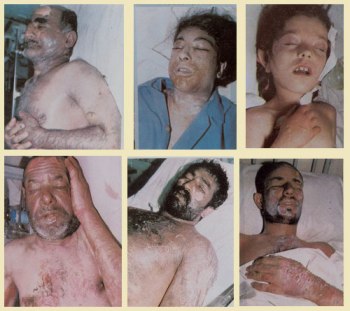
(Photo: Victims of Iraq’s attacks on Sardasht with chemical weapons from Wikimedia Commons)

Are Chemical Weapons Cause For War?

by Patrick Appel

Fisher identifies the administration’s primary objective in Syria – discouraging the future use of chemical weapons:

The idea is that, when the next civilian or military leader locked in a difficult war looks back on what happened in Syria, that leader will be more likely to conclude that the use of chemical weapons isn’t worth the risk.

If the Obama administration follows through on strikes, it’s fine to argue that America’s aim should be to force Assad from power, as many surely will. And it’s fine to argue that cruise missile strikes will or will not be effective at changing Assad’s calculus on chemical weapons, or that of future military leaders. But we should at least be clear, before it gets lost in the inevitable, worthy debates, that the United States has set a specific goal with its response to what Kerry called Syria’s “undeniable” use of chemical weapons, and it’s not winning the war.

Judis sees this as a worthy goal:

I think a nation’s credibility is important, but alone it is not enough to justify an intervention. In this case, what’s at stake is America’s willingness to enforce an international norm that is of benefit to the entire world.

Nick Gillespie disagrees:

If you think the U.S. should intervene militarily in even more places than we have already in the past dozen years, then please don’t hide behind the false threat or unique evil of chemical weapons.

The Assad regime is every bit as evil and rotten as the Hussein regime was. Instead of drawing lines in the sand over WMDs and all that, plead your case on the grounds that superpowers should try to stop the slaughter of innocents. I think that case is ultimately difficult to prove (or rather, it’s difficult to explain how American intervention will not ultimately lead to more problems than it might solve). But don’t rely on unexamined premises that one sort of weapon underwrites a response more than carnage itself.

Walt makes related points:

Proponents of action argue that the U.S. must intervene to defend the norm against chemical weapons. Using nerve agents like sarin is illegal under international law, but they are not true “weapons of mass destruction.” Because they are hard to use in most battlefield situations, chemical weapons are usually less lethal than non-taboo weapons like high explosive. Ironically we would therefore be defending a norm against weapons that are less deadly than the bombs we would use if we intervene. This justification would also be more convincing if the U.S. government had not ignored international law whenever it got in the way of something Washington wanted to do.

Kerry Beats The War Drums

by Patrick Appel

Max Fisher calls Kerry’s Syria speech today a “war speech”:

It’s difficult to find a single sentence in Secretary of State John Kerry’s forceful and at points emotional press conference on Syria that did not sound like a direct case for imminent U.S. military action against Syria. It was, from the first paragraph to the 15th, a war speech.

That doesn’t mean that full-on war is coming; the Obama administration appears poised for a limited campaign of off-shore strikes, probably cruise missiles and possible air strikes. President Obama has long signaled that he has no interest in a full, open-ended or ground-based intervention and there’s no reason to believe his calculus has changed. But Kerry’s language and tone were unmistakable. He was making the case for, and signaling that the United States planned to pursue, military action against another country. As my colleagues Karen DeYoung and Anne Gearan wrote, “Kerry left little doubt that the decision for the United States is not whether to take military action, but when.”

You can watch the speech above or read the transcript here. Kerry’s speech hinges entirely on the moral depravity of chemical weapons and our alleged responsibility to enforce the taboo against them. Larison sees this as a bad reason to start a new war:

There is a broad, almost universally shared taboo against the use of chemical weapons. Attacking Syria doesn’t strengthen or reinforce that taboo.

Choosing not to bomb a country whose government has used these weapons does not signal approval of that use, and launching some cruise missiles at government forces in response to that use isn’t going to keep them from being used in the future. All that it does do is potentially invite Syrian retaliation against the U.S. and its clients and allies. At best, it is a reaction designed to show that the U.S. will “do something” while achieving nothing, and at worst it is the beginning of the slide towards escalation to a major war.

Earlier today, Fisher spelled out the cases for and against intervention in Syria. One of the arguments against military force:

Military intervention in a protracted foreign conflict can take on its own logic that makes escalation very difficult to stop. The Obama administration might have the intention of launching just one series of strikes and then backing off, but in practice that’s rarely what happens. Domestic politics, international pressure and short-term military thinking can all lead a very limited campaign to snowball into a more open-ended one. That’s particularly true if the goals of the initial strikes are vague or poorly defined.

Drum argues that half-measures against Assad are unlikely to succeed. Preventing him from using chemical weapons would require “committing ourselves to full-scale war against Assad”:

It’s possible that enforcing international norms against chemical attacks is important enough to make that worth it. But that’s the question we should be asking ourselves. A “punishment” air strike is a joke, little more than a symbol of helplessness to be laughed off as the nuisance it is. If we want to change Assad’s behavior, we’ll have to declare war against him.

Why The Kosovo Model Won’t Work

by Patrick Appel

A reader rejects the comparisons of Syria to Kosovo:

Kosovo may be a good model for a military intervention carried out in the face of Russian opposition, domestic skepticism, and lacking UN approval, but it hardly offers a roadmap for success in the case of Syria. Kosovo worked because Milosevic’s ouster was not the purpose of the operation. He could relent in the face of our airstrikes because he had a way out, literally: all he had to do was withdraw Serbia military and paramilitary forces from Kosovo. And it wasn’t the Kosovars that eventually took out a weakened Milosevic: it was the Serbian people who decided over a year later that they’d had enough of him.

This is not a model for Syria unless we are willing to declare a de facto partition of the country and demand that Assad withdraw forces from this rebel safe zone. Given that the fighting is taking place within some major cities, I don’t see how such a partition is possible. Moreover, if such a safe zone is expected to be a launching point for further attacks against the regime (in a way that Kosovo was not), then Assad has little reason to agree to it.