Another War Is Brewing

by Patrick Appel

Only 9% of the American people want to go to war with Syria. Even when chemical weapons are mentioned, a growing plurality is against intervention:
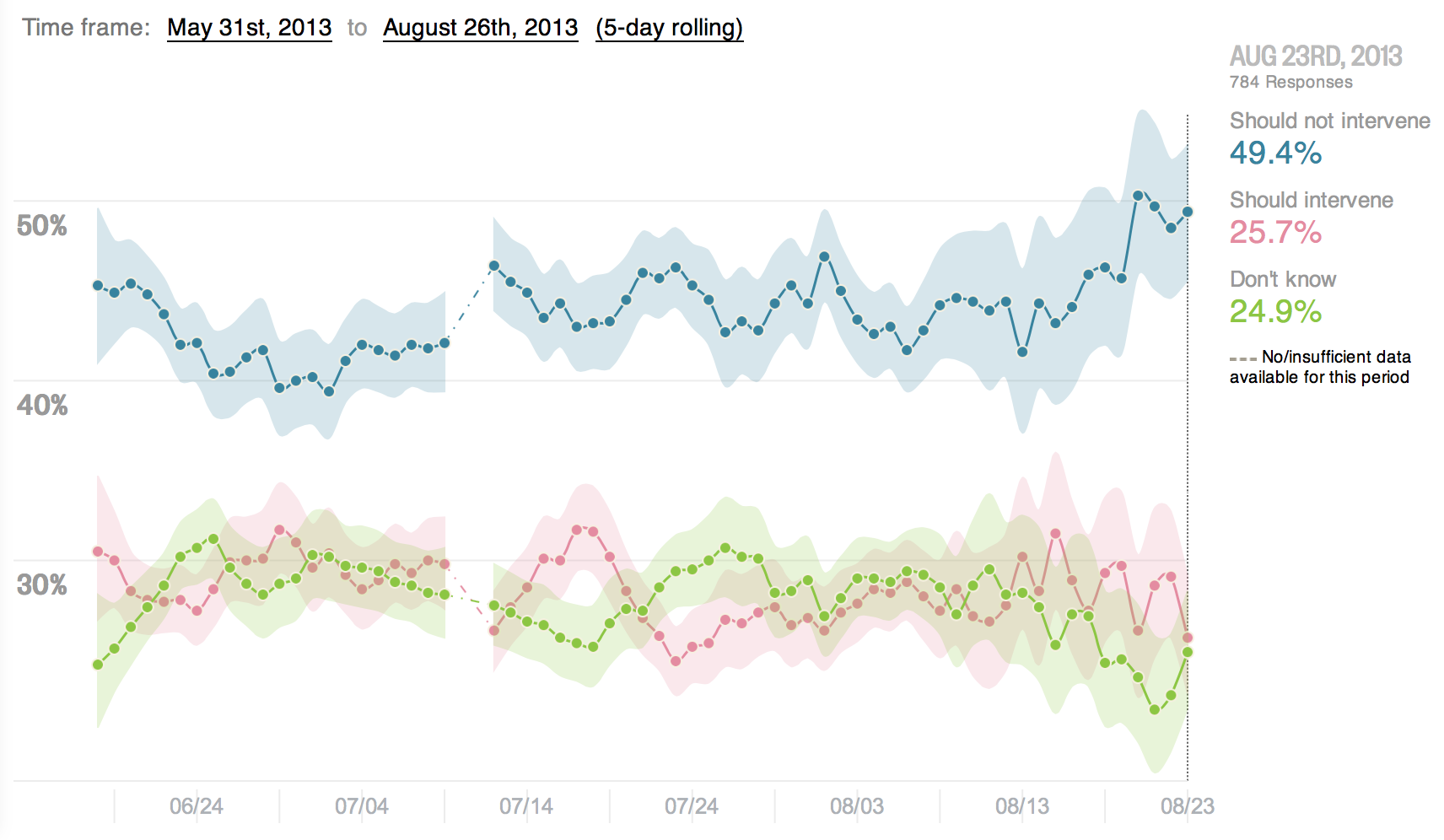
Syria Intervention

But First Read believes that the US will use force:

All the action and body language over the weekend suggests that the United States is preparing for some kind of military response to the suspected chemical weapons attack in Syria. The question is: Just what kind of response will it be? On Saturday, President Obama met with his national security team, and he called British Prime Minister David Cameron. “The two leaders expressed their grave concern about the reported use of chemical weapons by the Syrian regime… The United States and UK stand united in our opposition to the use of chemical weapons,” the White House said per a readout of the call. And on Sunday, the president spoke with French President Hollande. (These are the types of calls a president makes to both build support and inform of upcoming plans. Also of note, Secretary of State John Kerry spent the weekend briefing and speaking with a slew of Arab allies, particular the folks in the Gulf States, who could drive an Arab League decision that gives the U.S. the international legal justification it is currently looking for.) Indeed, as NBC’s Andrea Mitchell reported on “TODAY,” the United States and its allies are considering military options — most likely, cruise missiles from Navy destroyers and submarines in the Mediterranean or U.S. fighter jets targeting Syrian airfields from where chemical attacks could be launched. “I do think action is going to occur,” Sen. Bob Corker (R-TN) said on “TODAY.” The question no longer seems to be “if”; rather, it’s “when,” “how,” and “how long.”

War is the one area where the normal rules of politics are suspended. A president need not convince the American people or Congress that war is advisable. He need not explain the costs and benefits of force. Popular domestic policy proposals are routinely killed thanks to the fillibuster or the House’s ideological fanaticism, but deeply unpopular foreign policy interventions are carried out without haste. Mark Thompson notes how Congress avoids debate over going to war:

The last war Congress declared was World War II. Everything since — Korea, Vietnam, Grenada, Panama, Iraq, Bosnia, Afghanistan, Iraq (again!) and Libya — has been fought with something less than a full-throated declaration of war by the U.S. Congress.

Generally speaking, the President likes this, since he doesn’t have to convince Congress of the wisdom of his war, and Congress likes it even more. Under the current system, lawmakers get to wink at the White House by passing an authorization for the use of military force or other purported justification as a fig leaf they can abandon if things go sour. A declaration of war demands more, and Congress is leery of going on the record with such declarations for its own political reasons.

Hawkishness is Washington’s default setting – it remains one stubborn bit of bipartisan agreement in an era of deepening partisanship. But the disconnect between Washington’s foreign policy consensus and the nation’s has grown larger in the wake of Iraq and Afghanistan. If bombing Syria devolves into a quagmire or it draws us into a war with Iran, the backlash could erase the gains the Democrats made on foreign policy by belatedly coming out against the Iraq War. Obama risks starting one of those “dumb wars” he so famously railed against. Crowley argues that Obama can accomplish his goals through “limited strikes on a handful of military targets, probably by means of cruise missiles that involve no risk to U.S. personnel.”:

The goal would be to impose a cost on Assad that outweighs whatever he thinks he gained by gassing hundreds of people near Damascus last week, as he is accused of doing. In doing so, Obama could hope to deter Assad from using his chemical arsenal again. And to demonstrate to the rest of the world, and especially to Iran, that he means what he says. Anyone hoping for more will likely be disappointed.

Larison fears that, if such measures fail to prevent further chemical weapons use, that “the U.S. will be pressured to continue escalating its involvement until the Syrian government is overthrown”:

After the regime is defeated, Syria’s chemical weapons arsenal will no longer be secure, and these weapons will go to whichever group can seize or buy them first, and it is even less likely that these groups will respect the taboo against their use.

Syrian blogger Maysaloon wants a Kosovo-like intervention:

The Kosovo model for intervention is not perfect, but it stopped the bloodshed and today Kosovo is limping along and people are rebuilding their lives at least. Of course it is still not a recognised state thanks to Russia blocking its recognition, but the important thing is that militias are not slaughtering whole families and villages. The same thing needs to happen in Syria and the country must be given as much support as possible to get back on its own two feet. This is not because Syrians need the world’s charity, but because if that does not happen then Syria will become a Somalia on the Mediterranean and bordering Europe. It is in the world’s interest to stop this wound from festering, and it is in Syria’s neighbour’s interests – all of them – that this country not implode. Because when it implodes all of Assad’s toys are going to end up in the wrong hands, however “careful” the West is and however pervasive Israel’s intelligence tries to be. A poisoned atmosphere and water table is not something anybody in the region can afford. Syria is a big puddle that can splash a lot of people, Assad knows this and he has been using this to stay in power, but it does not mean he cannot be toppled.

Fred Kaplan also compares Syria to Kosovo:

Given the threat, the humanitarian crisis, America’s standing in the region, and the importance of preserving international norms against the use of weapons of mass destruction, the best option might be to destroy huge chunks of the Syrian military, throw Assad’s regime off balance, and let those on the ground settle the aftermath. Maybe this would finally compel Assad to negotiate seriously; maybe it would compel the Russians to backpedal on their support (as NATO’s campaign in Kosovo compelled them to soften their support for Milosevic). Or maybe it would just sire chaos and violence. But there’s plenty of both now, and there might be less—a road to some sort of settlement might be easier to plow—if Assad were severely weakened or no longer around.

Tomasky worries that strikes against Syria could lead to war with Iran:

[T]here are reasons to act. But there’s one massive difference between Kosovo and Syria. Milosevic didn’t have a major regional power watching his back. Syria does. Iran complicates this immeasurably. Also over the weekend, the Iranian armed forces’ deputy chief of staff said the following: “If the United States crosses this red line [of intervention], there will be harsh consequences for the White House.” And this: “The terrorist war underway in Syria was planned by the United States and reactionary countries in the region against the resistance front (against Israel). Despite this, the government and people of Syria have achieved huge successes. Those who add fire to the oil will not escape the vengeance of the people.” Getting sucked into a situation that could lead to war with Iran is unthinkable. Of all the bad options, that is without question the most bad.

Walter Russell Mead wishes we had struck sooner:

Unfortunately, the policy of delay has made all the options worse without, it now appears, succeeding in keeping the US out of war. Instead of the choice we had at one time between American intervention and a humanitarian disaster, we now have American intervention AND a humanitarian nightmare, with a revival of a serious Al Qaeda presence in the heart of the Middle East thrown in for good measure.

And W. James Antle III is against a new war:

The only lesson Obama seems to have learned from Iraq is that large, expensive military occupations with American casualties are politically unpopular. The long-term, unintended consequences of regime change and the question of whether we are arming people today who will shoot us tomorrow do not seem to have left much of an impression.

Syria In The Red, Ctd

by Brendan James

Andrew J. Tabler advises the White House move to preempt further chemical violence:

Washington should make clear to Russia and Syria that, absent convincing evidence of the regime exercising control over all C.W. [chemical weapons] on its territory, episodes such yesterday’s will require the United States and its allies to take military action to prevent future use. Given the practical difficulties of locating and seizing C.W. stocks and the danger to nearby civilians from attacks on C.W. storage sites, such a warning would presumably mean airstrikes on regime units responsible for using chemical agents and, perhaps, on C.W.-related facilities.

The Post’s editorial board also opts for intervention, through a no-fly-zone. Larison shoots down the idea:

A no-fly zone isn’t going to target the missiles and artillery that the regime would use to launch more chemical weapons. As such, a no-fly zone might be imposed over southern Syria and civilians would still come under attack anyway. Establishing a no-fly zone creates the illusion of protection without offering the real thing. Foreign attacks on the Syrian military would give Assad another incentive to use more chemical weapons, and they certainly wouldn’t be able to prevent future use of those weapons.

U.S. military action wouldn’t reduce the likelihood of more chemical weapons being used against civilian targets, and to the extent that it succeeded in weakening regime forces it would increase the chances that those weapons are captured by jihadists.

More Dish on the renewed debate over intervention here and here.

Syria In The Red, Ctd

by Chas Danner

https://twitter.com/DarthNader/status/370221107862700032

Michael Hirsh connects this week’s chemical attack to how the US has handled Egypt:

[W]e may now be at a historic turning point in the Arab Spring—what is effectively the end of it, at least for now. Assad, says Syria expert Joshua Landis, is surely taking on board the lessons of the last few weeks: If the United States wasn’t going to intervene or even protest very loudly over the killing of mildly radical Muslim Brotherhood supporters, it’s certainly not going to take a firmer hand against Assad’s slaughter of even more radical anti-U.S. groups. …

What began, in the U.S. interpretation, as an inspiring drive for democracy and freedom from dictators and public corruption has now become, for Washington, a coldly realpolitik calculation. As the Obama administration sees it, the military in Egypt is doing the dirty work of confronting radical political Islam, if harshly. In Syria, the main antagonists are both declared enemies of the United States, with Bashar al-Assad and Iran-supported Hezbollah aligning against al-Qaida-linked Islamist militias. Why shouldn’t Washington’s policy be to allow them to engage each other, thinning the ranks of each?

Andrew Tabler predicts that if Assad is allowed to win, it will lead to a perpetual problem:

The most realistic scenario [for] a postwar Assad-led Syria is a state in which multiple sponsors of terror — Assad himself, the Iranian regime, Sunni offshoots of al Qaeda — are simultaneously pursuing their own ends alongside one another. It would likely be the source of instability, as well as the site of brutal crimes against humanity, for years to come. That’s why it is in the West’s interest to prevent Assad’s survival by ordering airstrikes on regime targets, pressuring Moscow and Tehran to stop supporting him, and aiding moderate members of the Syrian opposition. Otherwise, the only upside of Syria’s future will be that it will finally put the lie to the adage “Better the devil you know than the devil you don’t.”

Earlier Dish on the US response to Syria here.

Syria In The Red

by Brendan James

More images and testimonials of this week’s purported chemical attack flood in, with Human Rights Watch currently placing the death toll at several hundred. Jay Newton-Small sums up the administration’s tepid response, despite previous red-line rhetoric:

[T]he White House isn’t exactly springing into action. “We are calling for this U.N. investigation to be conducted,” said Obama spokesman Josh Earnest on Wednesday. “This is a situation that is ongoing, and our efforts to work with the international community and to work with the Syrian opposition to remove [President Bashar] Assad from power are ongoing.” Earnest upgraded his rhetoric slightly Thursday morning, telling reporters aboard Air Force One en route to Buffalo where the President was scheduled to give a speech about making college more affordable, that the images out of Syria “are nothing short of horrifying.”

Still, the translation amounts to: Don’t hold your breath waiting for air strikes.

Jon Western wonders if this latest attack will serve as “Syria’s Srebrenica”:

If you recall, Srebrenica did not fundamentally change the traditional, realist strategic logic on the ground during the Bosnian conflict — yet all of the internal notes on White House deliberations (as reported in Ivo Daalder’s Getting to Dayton or Derek Chollet’s history of Dayton) reveal how conceptions of interests and ideals became intertwined with the scale of the atrocity.   Domestically, there was some Congressional pressure to do more in Bosnia, but very little pressure from public opinion. Srebrenica was a game changer.

I think this is what we are likely to see happen now in Syria — and I think it changes the equation regardless of whether or not there is definitive proof as to who perpetrated the attack.  The mere fact of such a large scale loss of life in a chemical attack — along with changing dynamics throughout the region — will produce significant pressure on, and within, the administration to commit resources — airstrikes on key Syrian military installations and probably no-fly, no missile zone over Syria — something, anything, to move the conflict to some kind of end-game.

Still, Max Fisher lists off the reasons not to expect a new agenda from the White House:

Any White House cares first and foremost about domestic politics, and this administration was punished severely for its leadership on Libya; many of the same political voices that demanded the intervention spent months hammering the White House when, in the foreseeably dangerous post-conflict disorder of Benghazi, a militant group succeeded in attacking the local U.S. diplomatic outpost and killing the ambassador. You might think that Libya would have been considered a political success for the Obama administration, but it became a major political liability.

The White House’s efforts to reach out to Islamist groups in Egypt and Tunisia, meanwhile, received condemnation and criticism at home. Pragmatic, long-view Middle East watchers turn out to represent a fairly narrow slice of the American electorate. And political figures who ask the White House to take big foreign policy risks appear quite willing to punish the administration if anything goes wrong.

The Worst Chemical Weapon Attack In Decades? Ctd

by Chas Danner

https://twitter.com/michaeldweiss/status/370244842716020736

Earlier this week, Noah Shachtman and Colum Lynch filed a report on the Assad regime’s previous use of chemical weapons. It may shed some light on last night’s attack, which, like earlier Syrian chemical weapons attacks, left victims with a variety of symptoms both consistent and inconsistent with exposure to an deadly agent like Sarin gas:

U.S. analysts speculate that some of these atypical effects may be the result of Assad’s military using an atypical mix of chemical arms, so-called “riot control agents,” and conventional munitions on the battlefield. In December, one former chemist for the Syrian regime told Al Jazeera that this blending of weapons was done, in part, to create a confusing blend of symptoms — and mask their source. …

Contributing to confusion is the long-standing suspicion that Assad’s forces are brewing up their unconventional weapons in unconventional ways. One of sarin’s two main precursors is isopropanol — rubbing alcohol, basically. But the material used for chemical attacks can’t be purchased in any drug store. While the commercial stuff typically is 70 percent water, the weapons-grade isopropanol is highly concentrated, with less than 1 percent water. That makes it extremely hard to obtain. Some outside observers believe the Syrians are using less isopropanol than usual in their sarin in order to preserve their precious stockpile of the precursor. (It would also produce milder-than-normal effects in a victim.) If the dilution theory is true, it could be an indication that Assad intends to hold on to his chemical arsenal for a long, long time — and unleash it only when his rule is once again under threat.

Shachtman also rounded up analysis of last night’s attack.

The Worst Chemical Weapon Attack In Decades?

by Chas Danner

https://twitter.com/michaeldweiss/status/370216269804367872

https://twitter.com/lizobagy/status/370209257569804288

Syrian rebel groups claim that hundreds have been killed in what may have been a chemical weapon attack by Assad on the suburbs east of Damascus. The attack may be the beginning of a larger offensive by regime forces. David Kenner gives his summary:

The information coming out of the Ghouta region, where the rebels enjoy significant support, is still unconfirmed by independent observers. But videos allegedly taken Wednesday in the area showed Syrians lying on the floor gasping for breath, medics struggling to save infants, and rows of bodies of those who had reportedly died in the attack (warning: the footage above is graphic). Syrian state media denied that chemical weapons had been used, attributing such stories to media channels that “are involved in the shedding of the Syrians’ blood and supporting terrorism.”

The opposition Local Coordination Committee, however, reported that at least 755 people had been killed in the attack. If that figure is true, what is happening on the outskirts of Damascus today is the worst chemical weapons attack since then-Iraqi President Saddam Hussein unleashed poison gas on the Kurdish town of Halabja in 1988, killing an estimated 5,000 people.

One report even says the death total could be over 1,300. Chemical weapon expert Ralph Trapp compares this attack to previous ones:

It is possible a gas was involved, but the images I’ve seen were not clear enough to see other symptoms beyond difficulty in breathing and suffocation. It certainly looks like some sort of poisoning. … [But] this is one of the first videos I’ve seen from Syria where the numbers start to make sense. If you have a gas attack you would expect large numbers of people, children and adults, to be affected, particularly if it’s in a built up area.

Jean Pascal Zanders’ analysis:

I am not sure whether the claims of nerve agent use accompanying the footage and images are correct. The people are not convulsing (except for one man shaking his legs while shouting out, but the remainder of his body does not suffer from involuntary contractions) and I have not seen anybody applying nerve agent antidotes. Nor do medical staff and other people appear to suffer from secondary exposure while carrying or treating victims.

It is clear that something terrible has happened. The scenes could not have been stage managed.

Jeffrey Goldberg weighs in:

Two questions are raised by reports of this attack. The first, of course, is whether or not it happened the way Syrian rebels said it happened. That is why immediately dispatching the UN team, already in-country, to the affected areas is so vital. If this process worked the way it should, they would be there already. If the Syrian regime denies the UN inspectors permission to visit these areas, well, that is kind of an answer in itself.

The second question is, why would the Assad regime launch its biggest chemical attack on rebels and civilians precisely at the moment when a UN inspection team was parked in Damascus? The answer to that question is easy: Because Assad believes that no one – not the UN, not President Obama, not other Western powers, not the Arab League – will do a damn thing to stop him.

There is a good chance he is correct.

Guardian live-blog here. A Reddit page is collecting information and videos here.

Leaving Europe For Jihad

Sebastian Rotella takes note of the unprecedented wave of radicalization driving Muslims in Europe to join jihadists in Syria:

“Imagine this: Between 2001 and 2010, we identified 50 jihadists who went from France to Afghanistan,” said a senior French counterterror official who also requested anonymity. “Surely there were more, but we identified 50. With Syria, in one year, we have already identified 135. It has been very fast and strong.”

The statistics are even stronger in adjoining Belgium, one-sixth the size of France. Between 100 and 300 jihadis have journeyed from Belgium’s extremist enclaves to Syria, according to a veteran Belgian counterterror official. Other significant fighting contingents represent Britain, Denmark, the Netherlands, Canada, Central Asia, Libya, Tunisia, and Saudi Arabia. The senior French official estimated the total number of Europeans to be at least 400. Others say it could be double that, but counterterror officials warn that precise numbers are difficult to establish.

Update from a reader:

While there can be no doubt that the conflict in Syria has stirred the passions of radical elements within Islamic culture, I think it’s worth casting a suspicious eye on Rotella’s statistics on the “jihadists” who have fled France and Belgium for the war in Syria, and the comparison he makes to the Afghan war. Syria was, after all, a French colony for years, and French is a commonly spoken language there.

That there are a substantially higher proportion of immigrants of Syrian descent living in both France and Belgium than those of Afghan descent. France doesn’t even make the top-10 list of countries playing host to Afghan refugees.

Rotella’s use of the indifferentiate term “jihadists,” imagining a unified front of de-nationalized, radical Muslims bent on the destruction of the West, hides the most logical cause of these departures for the battlefields of Syria: a lot of these young men are culturally connected to Syria. Do you honestly think the European police forces distinguish between “jihadists” of the Al-Qaeda sort, and other politically motivated Arabs…say those whose families were harmed by the current Baathist regime in Syria? Nuance has never been the strong suit of those characterizing the motivations for action among Arabic speaking Muslims.

Again, I don’t question that a portion of those who have joined the fight in Syria see this as step-one in a battle against the Great Satan. But to characterize this as an “unprecedented wave of radicalization” rather than a not-unsurprising response to cultural connections in that same, mundane way that the Irish Catholics of Boston were more interested in the goings-on of the IRA than the German Catholics of Missouri, is rhetorically inflammatory and sheds more heat than light.

Al Qaeda Strikes Back In Iraq – And Syria

Over the weekend, al Qaeda-linked insurgents staged well coordinated attacks on Taji and Abu Ghraib prisons, freeing at many as 500 inmates, including senior al Qaeda members:

Suicide bombers drove cars packed with explosives to the gates of the [Abu Ghraib] prison on the outskirts of Baghdad on Sunday night and blasted their way into the compound, while gunmen attacked guards with mortars and rocket-propelled grenades. Other militants took up positions near the main road, fighting off security reinforcements sent from Baghdad as several militants wearing suicide vests entered the prison on foot to help free the inmates.

Hayes Brown thinks the consequences go beyond Iraq’s borders:

The sudden influx of a large number of trained fighters and convicted terrorists into Iraq would be a problem even if there wasn’t a civil war next door. Given the ongoing conflict in Syria, however, this could mark a radical shift in how the war proceeds.

While talks of a merger between the two have gone back and forth, AQI and Syrian rebel group Jahbat al-Nusra have been cooperating for months, to the point that the State Department has listed Nusra as a subsidiary of the terrorist group. Aaron Zelin, Richard Borow Fellow at the Washington Institute for Middle East Policy, told ThinkProgress that it will be interesting to see if those who escaped do go to Syria, whether they will bring with them some of their more radical tactics. At present, according to Zelin, there are jihadi groups who provide social services to civilians and perform other acts that could see themselves undermined by an influx of “hardened fighters” captured during the U.S. “surge” in Iraq.

Michael Crowley worries that Iraq is “living on borrowed time”:

“[Al Qaeda’s fighters have] got the wind at their backs from the Syrian rebellion,” where Sunni rebels are fighting an Alawite Shi‘ite regime, says Kenneth Katzman, a Congressional Research Service analyst who recently completed a detailed report on Iraq. “Their goal is to destabilize and bring down the Maliki government, and they think igniting sectarian conflict might accomplish that.”

Sectarian violence in the country has killed at least 2500 people since April. More evidence that nothing – not even the surge – produced anything of any long-term benefit to the US, Iraq or the Middle East. Just carnage and chaos.

Armed With Ingenuity

SYRIA-CONFLICT

Matthieu Aikins profiles the Syrian rebels’ arms makers:

More than in any of the other Arab nations riven by war in recent years—more than in Egypt, Libya, or Iraq—the rebels here have taken a DIY approach to arming themselves. This has been born out of a combination of necessity (other rebellions have been better supplied) and uncommon opportunity, as rebels have been able to hold significant territory where workshops can be set up and kept safe from regime attacks. Though regional countries like Saudi Arabia and Qatar have supplied arms to the rebels—and the US decided in June to begin its own limited program—weapons have been scarce enough that the rebels continue to manufacture their own. The whole region around Aleppo, which had been the center of Syria’s heavy industry, quickly became particularly fertile ground; as the rebels captured machine shops, steel mills, and power plants, they began adapting them to the task of war.

Some of the rebels’ creations verge on the outlandish. When I ask about one odd-looking, 15-foot-long wooden trebuchet, which its proud creator is using to hurl 4-pound fragmentation bombs, he tells me he got the idea from the videogame Age of Empires. Another Aleppo inventor gained fame with an armored car called Sham II (an improvement on an earlier Sham). Two crew members sit inside the car, an old diesel chassis with steel panels welded around the outside, and look at TV screens. While one drives, the other uses a PlayStation controller to aim and fire a machine gun mounted on the roof.

Hannah Lucinda Smith also toured the rebel workshops:

By taking apart weapons they’ve captured from the regime’s checkpoints, the rebels’ manufacturing team has worked out how to reverse-engineer them, meaning Assad’s troops are getting carbon copies of their weapons fired back at them.

(Photo: A rebel fighter holds an improvised mortar shell, one of many stacked at a factory in the city of Aleppo, Syria’s commercial capital, on July 7, 2013. Syria’s 27-month war between rebel forces and pro-government troops has killed more than 100,000 people, a monitoring group group estimates. By JM Lopez/AFP/Getty Images)

Meep-Meeped On Syria

I harrumphed and stamped my foot upon hearing that the Obama administration had agreed to some small arms sales to some Syrian rebels. I called the decision a “betrayal.” It seems more and more that it was instead just a canny sop to the allies until they came to their senses, which they seem to have finally done:

British newspaper reports on Monday said British military commanders had advised Mr. Cameron that there was no purpose to be served by sending small arms, since such modest arms supplies were unlikely to sway the outcome of the conflict, which is now in its third year. British officials declined to confirm the reports that Mr. Cameron had abandoned the idea of arming the rebels, saying that since no formal decision had been made to send weapons in the first place, it was not clear how he could be cast as retreating from it.

Of course, one reason to have a blog is to sound off loudly enough to send a message. So I don’t regret publicly going after Ben Rhodes et al. But I was empirically wrong to over-read what was a minimalist gesture in a longer game plan. And not for the first time.