This Is A Religious War

It’s sometimes hard for Westerners to understand the ferocity and passion behind sectarianism in the Middle East. I’m not an expert either – but the period of history I studied most exhaustively at Oxford was England and Europe in the sixteenth and seventeenth centuries. The town I grew up in has memorial grave-stones for the Protestants burned alive on the Tudor-era high street, as cheering Catholics gathered around. As an Irish-Catholic in England, I was taught the brutal history of the Protestant-Catholic wars that played out over three centuries – and were still killing people in my lifetime.

America never experienced this – which may explain in part the utopianism that led us into Iraq (and makes my own support of the fiasco even more indefensible in retrospect). I say this to introduce this video. I found it on a terrific new blog which is arguing for intervention in Syria, “Notes On Error“:

This scene is from Egypt, where a great meeting of political, economic, and religious rot is conspiring to sink the country. It is from June 23, was shot on the outskirts of Cairo, and depicts the reaction of Sunni mob – long inculcated in sectarian hate – to the news that a group of around thirty Shiites were praying to the successors of Ali in a private residence.

Here’s what it looks like when people really believe in religious distinction.

You can look at the barbarism and violence and ardent murderousness in this scuffle and see the imperative to stop it, or look at it and see the impossibility of intervening from the outside. I fear the Muslim world may have to go through much more of this before it gets past it. The wise foreigner stays out.

A Civil War Within A Civil War

SYRIA-CONFLICT

Al Qaeda just killed one of the Free Syria Army’s top commanders. The Syrian opposition now has to defeat the Jihadist maniacs and the Assad machine. It reveals to me just how nuts it is to intervene in that almighty and intractable mess. But it also reveals a possibly positive dynamic we have seen in the past: giving al Qaeda enough rope to hang themselves with the resident population has often led to their defeat. It did in Anbar and in Jordan. And far better for Arabs to suppress al Qaeda than Westerners.

Meanwhile, a reminder of how quixotic the attempt is to reconcile the irreconcilable in the current Arab moment:

New attacks on Iraqi Shiites killed at least 24 people while assaults Friday against policemen killed five, officials said, as insurgents press their campaign to exacerbate the country’s renewed sectarian tensions.

And the beat goes on.

(Photo: An opposition fighter stands over seven year old Ahmad Jabir, who was injured alongside some his family members by a shell, as he lies on a X-Ray machine after he brought the boy to a hospital in the town of Al-Bara, in Syria’s northwestern province Idlib on July 8, 2013. The town of Al-Bara has been under regular shelling during the past few weeks after clashes between rebel forces and the Syrian army started around the highway that connects the Idlib and Latakia provinces. By Daniel Leal Olivas/AFP/Getty Images.)

Understanding Inhumanity

A trauma studies scholar who interviewed members of the Chukiren, a group of war criminals, describes the difficulties of his work:

I recently wrote a piece for CNN about a Syrian rebel who carved out a man’s heart and began to eat it. The editor had asked me to explain what could make a man do such a thing. I tried to explain, and many people were outraged by what I wrote. In one way or another, they were all saying: You think when you try to understand why men do evil things, you are going to learn something that might help prevent atrocities in the future. But really you are just excusing the perpetrators, justifying unjustifiable actions. The only thing you need to understand about evil is how to punish it.

Many of the Chukiren have died since I last spoke with them. The others are failing rapidly. I’m not sure I ever really came to understand them. But that is not because what they did is beyond understanding, not because evil is some kind of mystery. In some ways, it is all quite simple. If I had been a 19-year-old when my country entered into a genocidal war, I would have done the same thing everybody else did. That’s true for most of us. Making monsters is a straightforward process, and ­nation-states are expert at it.

Why the war criminals did what they did—in the end, that is not what I find hard to understand. What I find hard to understand is what must it be like to be the person who did those things. When we imagine getting perpetrators into our hands, the first thing we think about is punishment, what we as a society are going to do to them. But I think the real and final punishment is having to be the person you are.

Syria, Our New Nineteenth Century Proxy War

The Economist is on board with Syrian intervention, from arms to a no-fly zone, largely because it means curbing the influence of Iran:

The growing risk of a nuclear Iran is one reason why the West should intervene decisively in Syria not just by arming the rebels, but also by establishing a no-fly zone. That would deprive Mr Assad of his most effective weapon—bombs dropped from planes—and allow the rebels to establish military bases inside Syria. This newspaper has argued many times for doing so on humanitarian grounds; but Iran’s growing clout is another reason to intervene, for it is not in the West’s interest that a state that sponsors terrorism and rejects Israel’s right to exist should become the regional hegemon.

The leader fails to persuade me for a few reasons. There is no analysis of the consequences of entering a civil war as decisively as The Economist wants. And there is an assumption, not an argument, that Iran is obviously the biggest threat in the region, and that a nuclear Iran cannot be contained, as every other new nuclear power in history has 853624-gulliver1been. And I suspect crippling a rising Shia power – by brutal sanctions – will not end well for the US and has already failed to achieve its stated goal.

I’m also unsure whether it is better for the US for the Sunni or the Shia factions of Islam to prevail in the growing regional religious war. I’m only sure that we should not care enough to ask the question. These are not our religious wars. We had ours in the 16th and 17th centuries. No one intervened to police ours  – and because of that, we arrived at our own liberal evolution. Non-intervention can be a blessing in resolving core internal conflicts that need to be resolved internally before a new order can arise. That may take decades or centuries. And if we are yanked by every outbreak into intervention, we shall indeed soon be like Gulliver.

One useful way of thinking about this is to ask oneself: what would China do? They’re our main competitor and only likely challenger in global power. And they merrily look the other way, while getting the bulk of the Iraqi oil American soldiers in part died for. Yes, the humanitarian horrors are there. So were they in Iraq, where today, after democratization and an elected government, 24 people were murdered and an insurgent cell making chemical weapons was busted. We were there for a decade and this is what we left behind. How on earth does anyone think we’d do better with a fraction of the resources in Syria?

Larison rolls his eyes at The Economist:

The fact that Iran’s ally in Syria has been fighting off an internal rebellion backed by several other regional governments for the last two years suggests that Iranian power in the region isn’t waxing. It is at best holding steady, and it has clearly declined from where it was a few years ago. Put simply, Iran is in no danger of becoming the region’s hegemon.

Iran and its allies are on the defensive, and even if Assad holds on to power for the next few years Iran and Hizbullah will be preoccupied with propping him up. If an important American client or ally somewhere were wracked by civil war and its government was in danger of being overthrown, no one would be claiming that U.S. regional influence was on the rise. So there’s not much merit to the idea that Iran is gaining in regional influence and strength. On the contrary, it is desperately trying to stave off a serious setback. Even if Iran “wins” in Syria, it won’t be in a better position than it was two years ago. Its regional influence would almost certainly be reduced.

Steve Clemons agrees and wishes the administration would return to the sober calculus preceding the Libyan intervention:

With Syria, Obama is behaving in ways that run counter to the decision criteria he applied in Libya. He is committing intelligence and military resources to a crisis that does not have UN Security Council sanction, and he is not framing his response to the chemical weapons use in terms of either punishing the commanders who authorized their use — or to security those weapons. Instead, Obama is joining the rebel forces and committing to a regime change formula that could potentially falter. And that is before calculating the global strategic costs of getting in a nasty stand-off with Russia whose support is needed on other global challenges.

Larison fires back that “Clemons gives the intervention in Libya more credit for coherence and planning than it deserves”:

[T]he main problem with the analysis here is that it fails to account for how the administration’s muddled Syria policy is in many respects a product of the decision to intervene in Libya. The Libyan war created false hopes of similar action elsewhere, but it also applied a standard for intervention that the conflict in Syria would not be able to meet. Partly to placate critics at home, the administration emphasized the unique, virtually unrepeatable conditions that made direct intervention in Libya feasible.

Recent Dish on Syrian intervention here and here.

The Purging Of Syria’s Moderate Rebels

Reuters reports that Jihadist rebels are sidelining and even disarming more moderate rebels within Syria. Allahpundit asks how the US plans to address this issue:

If the jihadis are intent on isolating and purging the moderates, what exactly is the strategy for getting them to fight in concert against Assad? The assumption thus far has been, I guess, that once U.S.-armed units start to put a hurt on the regime, the jihadis will leave them alone and will try to multiply the effect by focusing on the regime themselves. But in light of this story, maybe that’s naive. Maybe the jihadis will launch a two-front war, one against Assad and one against the proxy army of their western archenemy, which in turn will make things easier for Assad’s forces by letting them fight a divided enemy. That would be the exact opposite of what the U.S. is out to do here, i.e. help the rebels beat up on the regime and drag out the war until Assad sues for peace.

The British public, by the way, is overwhelmingly against their leaders’ current posture. Only 24 percent back Cameron’s loony idea. My impression among friends in London is that they are terrified that this could lead not just to a regional but global war, if Russia, Britain, France and the US go to war old-school by elbowing their way into Syria’s civil war. Allahpundit continues:

Even in a best-case scenario, in which the CIA somehow builds a small moderate force and turns it into an effective army, what’s the plan for the obviously inevitable civil war after the Assad falls between the U.S.-backed Sunni moderates and the Sunni jihadis? You’re going to have to fight and kill them too, apparently, or else they’ll fight and kill you. That means committing to years of supplying one side here, and maybe doing more than that if/when things don’t go their way. How long, roughly, is all of this going to take?

Nicholas Thompson wishes the US had stayed out of the war altogether:

There were other options. Obama could have continued imposing sanctions and sending non-lethal aid to rebel groups. If the goal is to save lives and give comfort to the victims, we should give further support to the refugee camps. Joining the battle, though, transforms it. Now our weapons will be killing people. We will be tied by blood to one side in a sectarian civil war that seems likely to spread in an unpredictable fashion. We are now part owners of the pain it will cause—in Syria, Lebanon, and elsewhere.

Moderates In Islamist Clothing?

SYRIA-CONFLICT

Goldberg runs through the reasons hawks in the State Department want to bomb Syria. Among them:

The State Department has been working for some time with the more moderate leaders among the fractured and disputatious rebel alliance. It believes not only that it can do business with many of these leaders, but also that by doing business with them it will strengthen them. Several months ago, when I ducked across the Jordan-Syria border and met with some of the rebels, I took note of their long beards, a sign of religious intensity. The rebels were quick to tell me that they only grew beards because the more radical Islamists among them had the best weapons, and would only supply these weapons to like-minded rebels. In other words, the beards were simply a marketing tool, not an expression of sincere radicalism. If the more moderate among the rebels suddenly began receiving heavier weapons from the Americans, they would be empowered, and the Islamists marginalized.

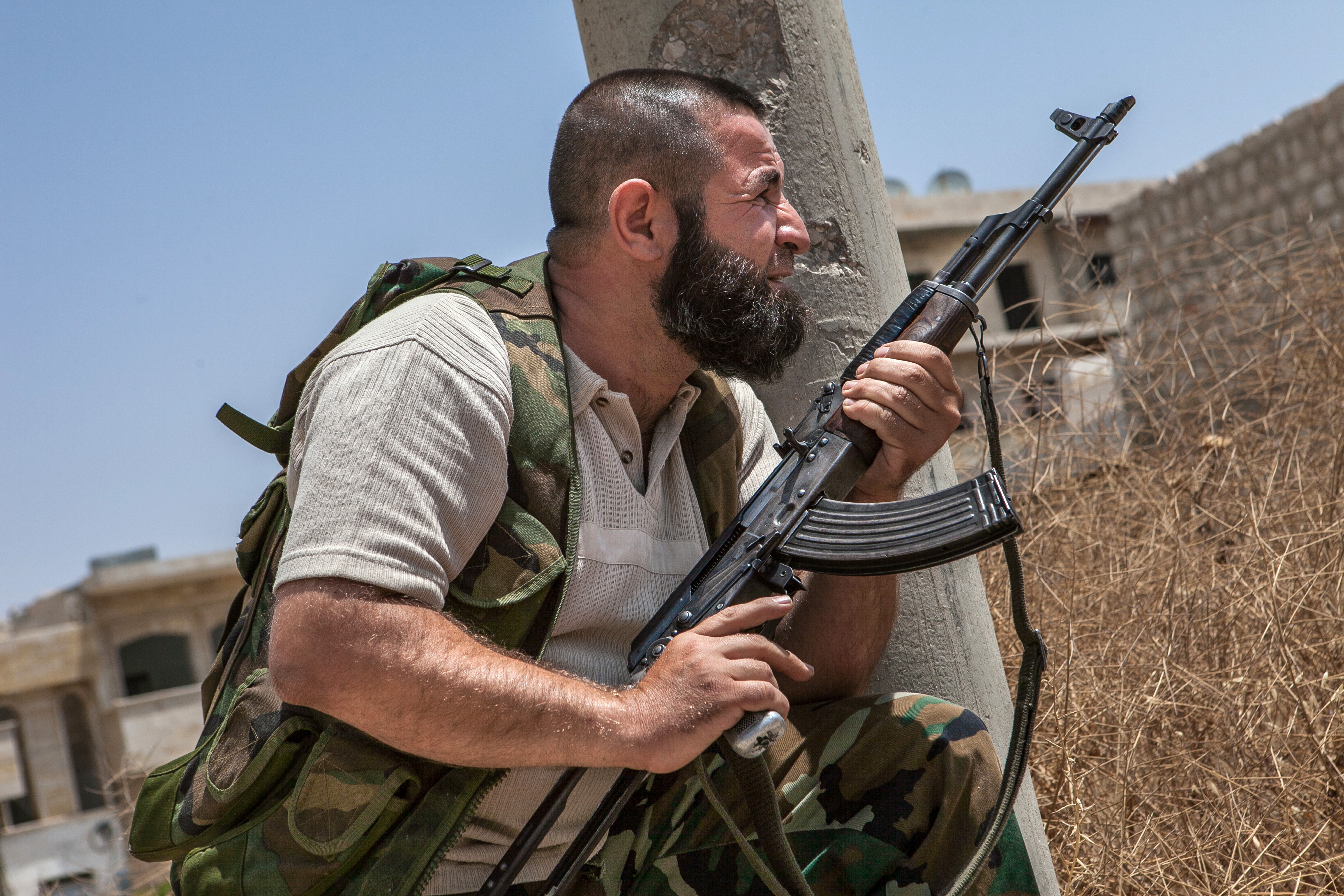
You need some pretty sharp beard antennae for that (check out the Sunni musclebear above. You think the State Department knows what’s in his head?). And if they were extremists, why would they tell an American that? Either they are extremists or they function at the mercy of extremists. I’d steer clear. Then there’s the argument that inaction will somehow hurt our interests more. That, apparently, is what Kerry believes. Here’s Goldberg’s version of that argument:

The U.S. must play a leadership role in the Mideast or the vacuum left by its departure will be filled by radicals, of both the Shiite and Sunni varieties.

To which I would counter: isn’t that going to happen whatever we do? And how do we intend to prevent that? I think democracy in that region will empower the extremists for a while until the logic of their backwardness compels an adjustment. This will take time. I think our interests are far better served by not trying to mold things we cannot understand and cannot control. Again: you’d think that Goldberg had never heard of the Iraq war reading his column. It goes un mentioned, even as he makes very similar arguments to those he made then. It’s Etch-A-Sketch. Larison counters forcefully as well:

Considering how eager many American politicians are to believe in the “rehabilitation” of groups as fanatical as the MEK simply because they have the “right” enemy, we should consider the possibility that the U.S. could just as easily be duped into arming groups that conveniently say all the right things.

But then you see Jeffrey’s real objective, stated up-front:

Whether we like it or not, we are in a conflict with Iran, and our credibility is on the line.

Just as it was to prove Saddam’s WMDs. And if we do not like the conflict, we shouldn’t simply acquiesce. We should challenge it – because containment is a real option, and war would be a body-blow to the Iranian people. Israel has shown it can take care of itself in this sectarian clusterfuck. We should take care of ourselves too – by not taking the Jihadist bait.

(Photo: A Syrian rebel fighter belonging to the ‘Martyrs of Maaret al-Numan’ battalion holds a position on June 13, 2013 in the northwestern town of Maaret al-Numan in front of the army base of Wadi Deif, down in the valley. By Daniel Leal-Olivas/AFP/Getty Images.)

Whither The Weaponry?

Marc Herman wonders how well the US will be able to keep tabs on the weapons it has committed to Syrian rebels. He notes that we’re still trying to figure out how many foreign weapons “ended up in Libya in violation of their original terms of purchase”:

Scholars who study small arms proliferation have looked at the 2011 war in Libya as a guide and found evidence of illegal arms transfers and poor tracking of weapons. More than a year after the war ended, no overall accounting exists of the total amount of lethal material allies like France and Qatar imported to Libya.

The doesn’t mean the same will be true in Syria. And the U.S., which has some of the world’s most stringent weapons tracking rules, was not a key supplier of lethal material to Libyan rebels.

But the parallels worry scholars. In a series of interviews begun last year, several investigators who follow small arms transactions argued that weak international rules for tracking transfers make it nearly impossible to account for weapons sent to non-government actors—like rebel militias in Libya and, now, Syria.

In Defense Of Obama On Syria

A Republican reader writes:

Once again, you have put me in the awkward position of defending the President. Though I wanted to laugh out loud when he said this wasn’t a new policy and “consistent with the policy I have had all along,” I have to say that he came off to me as US-POLITICS-OBAMA-LGBTprincipled. His principles are not my own. His stated objectives are a winged unicorn. He is for me far too cautious and far too existential about unforeseen ramifications; yes it’s complicated. We have to do it anyway, so says me. Because, in the words of Clarence Darrow “If you want to predict the future, you need to have a hand it its creation.”

But it is just as clear that for him the US to enter into a Sunni war with Shi’ism is not in the US interest. Period. He doesn’t see it as helping allies or not helping them – he is perfectly willing to shore up Jordan for instance – but he’s not going to yoke himself to Qatar-Saudi plowshares. His manner and body language on “another war in the Middle East” was quite telling – it is clearly the last thing he is going to let happen – he is going to fight escalation tooth and nail and is signaling that to his public, his liberal interventionists (Rice, Power,) and his generals exactly that. This is all frankly quite presidential. He is showing his own decided pattern of measured, thoughtful, leadership-from-behind.

Not what I want personally – I voted for Romney – but it’s a perfectly valid and reasoned response, even courageous when seen in the light of what I am sure he’s getting from all sides.

His “for example” on being in the situation room is already being pilloried for its “trust me, I know more than you” thing, and it plays into perceptions of his aloof arrogance – but in reality what he actually said is a very important insight into his thinking: he plays the tape to the end.

He is looking at each option all the way through to its consequences. Which is actually why our policy is so hesitant, because there are no good options and no clear results. Syrian teleology doesn’t exist. But there are times when you have to act to achieve clarity. Sometimes you have to poke the sleeping monster with a stick and see what happens – this is often in the presidential wheelhouse.

This president does not want to go into Syria in any inextricable way. He’s going to consistently resist escalation, and I think in some potentially interesting ways this will give him clout with the generals and European allies as not rushing into something we will most assuredly not control. He will ask questions that a President Bush would not. And his measured response allows a broader view. Indeed, getting bogged down in Syria obscures the real threat to Middle East stability: Iran’s nuclear program.

Right now, with French and British support beforehand, I would crater the runways, destroy every aircraft Assad has, and remove his armor from the earth and do all of it in a single afternoon. This would terrify and likely topple Assad, hobble Russia, and shock the Iranians to the core, perhaps even changing their nuclear calculus. It would impress the Saudis and Qataris – making them more amenable to ceasing support for the al-Qaeda groups. The Syria opposition would coalesce around non-Islamists as the rest are frozen out of aid. It would almost overnight restore American initiative, and put the U.S. military back on a take-the-war-to-the-enemy footing psychologically (where it belongs). Even Morsi and Erdogan would take note and likely fall in line. Our enemies need to be afraid of what we can do – right now the only world leaders afraid of US resolve are our allies.

But I’m not the president and I could be wrong about all of it. Assad could respond with chem/bio against Aleppo, or US targets, or Israel. The Syria opposition collapses. Two million more refugees walk to the Jordanian border, only to be refused entry. Iran could launch hundreds of Fateh 110s and Shehabs and Yakhonts against carrier groups. Egypt, Iraq and Jordan crumble into Islamist-exploited civil disorder. Hezbollah could fire 60,000 rockets at Israel.  Latin America Hezbollah units could cross over into Texas and bomb the Galleria in Houston. Russia could announce Syria is under their nuclear umbrella.

President Obama has picked his path through this minefield. It’s not my path and perhaps not yours, but that’s his job. He’s President of the United States and has to decide each day what is the true scope of US interests under his executive administration. I don’t think he’s “caved” to either of us.

Arming The Rebels Isn’t Realist. It’s Surrealist.

Noah Millman attempts to make sense of Drezner’s view that Obama’s wading into Syria is a realist calculus:

Longstanding conflicts don’t weaken extremist groups, they add to their resources – even as they drain the overall resources of the society. A prolonged civil war will certainly weaken Syria, but I don’t see how it will materially weaken Hezbollah in Lebanon. And I’d be curious to see numbers on just how much of a drain the Syrian conflict is on Iran, even in monetary terms. Most importantly, what about the radicalizing effect of a prolonged civil war on Sunnis in Iraq, Saudi Arabia, Yemen, Egypt, etc? I was under the impression that preventing that radicalization was a really big foreign policy objective. And last, there’s Daniel Larison’s point that if the goal is to prolong the civil war, it’s counter-productive to put American credibility on the line by publicly choosing sides. It would be far more sensible for us to covertly support the rebels while publicly advocating a peaceful resolution of the conflict. Drezner’s argument feels like an attempt to impose coherence on a policy that is driven by other factors.

I cannot see any sane realism here – just improvised weakness. Obama’s foreign policy seems, at this point, to be going in two directions at once. It both seeks to create the change we wanted – away from neo-imperialism and entanglement in places where our core national interests are not at stake – and yet simultaneously clings to Clinton-Bush remnants, i.e. obsessive paranoia about Iran, and impulsive humanitarian interventions like Libya. It feels like a transitional administration rather than one that has the courage of its own post-imperial convictions. Larison contends that the Ben Rhodes’ defense of the move is simply delusional:

According to the extremely broad definition, the U.S. has an interest in inflicting damage on Iran and its allies as part of a competition for influence in the region, and to that end the U.S. is supposed to aid anti-Iranian forces wherever they might be found. It treats Iran as if it were a major threat whose influence has to be rolled back. There is some internal coherence to this view, but its core assumptions are delusional. They are based on an obsession with limiting Iranian influence that doesn’t actually seem to promote U.S. or regional security, and as I believe we’re seeing in Syria this obsession is contributing to making the U.S. and the region less stable and secure. That is what many Syria hawks think the U.S. can and should be doing, and to the extent that the administration agrees with their underlying assumptions that is what explains Obama’s very bad decision.

Fred Kaplan isn’t worried about a slippery slope into war but remains skeptical of any realist interpretation of the move:

There is no notion here of a rebel victory; nor is Obama doing anything to suggest that this is his goal. A successful outcome, Rhodes said, would be a “political settlement”—preferably forged and imposed by the United States and Russia together—that pushes Assad out of power but “preserves some elements of the regime” while also bringing in “the opposition, who we believe speaks for the majority of the country.” This is, to say the least, far-fetched. Russia regards Assad as an ally, his regime as a bulwark of Russian geostrategic interests, and any opening to the opposition as a source of dangerous instability. In fact, regardless of one’s viewpoint or nationality, it is hard to imagine a “political settlement” that shares power between Assad’s henchmen and the various rebel factions as anything but a formula for continued murder and mayhem.

More Dish on intervention in Syria here, here, and here.

The Syrian Christians

53026747

Dreher counters my post chiding Rand Paul for bringing religion into the debate over Syria, arguing that “Paul makes a tremendously important point that is rarely heard in mainstream American political discourse”:

Middle East Christian communities are anonymous in American political life. We never pay attention to them. American Jews understandably focus their concerns about the Middle East on the welfare of Israel. I don’t blame them. I don’t blame American Muslims either for prioritizing the interests of Islamic countries when it comes to US foreign policy. …

As evil as Bashar Assad is, his regime has been a defender of Syrian Christians. If Assad falls, it will likely be a bloodbath for the country’s Christians, at the hands of Islamists. Even so, I don’t advocate intervening in Syria on behalf of the Christians. We cannot and should not fight every fight. That said, it is important for American Christians to understand what’s at stake in this fight. Sen. Paul was speaking to a Christian audience. It is perfectly legitimate, even necessary, for him to point out to that audience that by taking the side of the Islamist rebels, the US would be aligning itself against the interests of the country’s Christians, who have been a constant presence in Syria since the very beginning of the Christian faith. The baptism of St. Paul, one of the most consequential events in world history, happened in Damascus, on the street called “Straight,” which is still there.

And that war against Christians is being waged by a “liberal elite”? Please. This is a genuine issue – but if you believe Rand Paul wasn’t blatantly pandering, you need your rose-colored glasses adjusted a little.

(Photo: Brother Putros, a Syrian monk, swings incense durring mass in the church of the Monastery of St. Moses the Abyssinian east of Nebek, Syria on May 19, 2005. The 11th century Syrian monastery of St. Moses the Abyssinian (Deir Mar Musa el-Habashi) overlooks a harsh valley in the mountains east of the small town of Nebek, 80 km north of Damascus. The ancient monastery was restored in 1983 by an Italian Catholic priest Paolo Dall-Oelio, who in 1991 established a new monastic community devoted to, amongst other things, to Moslem-Christian dialogue. More than 50 000 people from their different religions and different countries visit the monastery every year. By Ghaith Abdul-Ahad/Getty Images)