Panetta’s Plaint

Panetta Gives Speech On  Leadership and Public Service

In his new book Worthy Fights: A Memoir of Leadership in War and Peace, the former defense secretary harshly criticizes Obama’s handling of Iraq and Syria:

Mr. Panetta, who was C.I.A. director before taking over the Pentagon, recounted decisions that he disagreed with, including the withdrawal of all troops from Iraq in 2011, the failure to intervene in Syria’s civil war by arming rebels and the abrupt reversal of Mr. Obama’s decision to strike Syria in retaliation for using chemical weapons on civilians. Mr. Obama “vacillated” over the Syria strike and “by failing to respond, it sent the wrong message to the world,” he wrote. Had the president followed different courses, Mr. Panetta said in the interview, the United States would be in a stronger position as it now tries to counter the rise of the extremist Islamic State in Iraq and Syria. He added that he believed the president has turned a corner and “is going a long way in terms of repairing some of the damage I think took place as a result of the credibility issue that was raised on Syria.”

Beinart finds the “credibility” argument about Syria silly:

Since he declared war on ISIS, the Obama administration has been recruiting other countries to join the United States. And whatever you think of the war itself, that diplomatic effort has been remarkably successful. Ten different Arab countries have agreed to participate in the anti-ISIS campaign. Even John McCain and Lindsey Graham have praised the administration’s coalition-building skills. All this illustrates the silliness of Panetta’s claim.

It was one thing to speculate a few months ago that Obama’s chemical-weapons about-face would make it harder for the U.S. to convince allies to join a military coalition the next time. But the next time is now here. Roughly a year after supposedly squandering America’s credibility by standing down on chemical weapons, Obama has mustered enough credibility to convince a bevy of Arab countries to help us bomb fellow Arab Muslims in the heart of the Middle East.

And Drum responds to Panetta’s assertion about working in the Obama admin, that “for the first four years, and the time I spent there, I thought he was a strong leader on security issues. … But these last two years I think he kind of lost his way”:

Think about this. Panetta isn’t even a super hawkish Democrat. Just moderately hawkish. But his basic worldview is simple: as long as Obama is launching lots of drone attacks and surging lots of troops and bombing plenty of Middle Eastern countries—then he’s a “strong leader on security issues.” But when Obama starts to think that maybe reflexive military action hasn’t acquitted itself too well over the past few years—in that case he’s “kind of lost his way.”

That’s the default view of practically everyone in Washington: Using military force shows strong leadership. Declining to use military force shows weakness. But most folks inside the Beltway don’t even seem to realize they feel this way. It’s just part of the air they breathe: never really noticed, always taken for granted, and invariably the difficult but sadly necessary answer for whichever new and supposedly unique problem we’re addressing right now. This is what Obama is up against.

Panetta also believes that the fight against ISIS could turn into a “30-year war” and will likely require the deployment of ground forces. That statement understandably upsets Greenwald:

Only in America are new 30-year wars spoken of so casually, the way other countries speak of weather changes. He added that the war “will have to extend beyond Islamic State to include emerging threats in Nigeria, Somalia, Yemen, Libya and elsewhere.” And elsewhere: not just a new decades-long war with no temporal limits, but no geographic ones either. … At this point, it is literally inconceivable to imagine the U.S. not at war. It would be shocking if that happened in our lifetime. U.S. officials are now all but openly saying this. “Endless War” is not dramatic rhetorical license but a precise description of America’s foreign policy.

Panetta is, of course, not the first former cabinet member to come out with a book critical of the president’s leadership. Dana Millbank wonders why this is:

The lack of message discipline is puzzling, because Obama rewards and promotes loyalists. But he’s a cerebral leader, and he may lack the personal attachments that make aides want to charge the hill for him. Also, as MSNBC reporter Alex Seitz-Wald tweeted in response to a question I posed, Panetta, Gates and Clinton didn’t owe their careers to Obama. Clinton was a rival, Gates was a Bush holdover, and Panetta is a Democratic eminence grise. Loyalty didn’t trump book sales — or Clinton’s need to distance herself from Obama before a presidential run.

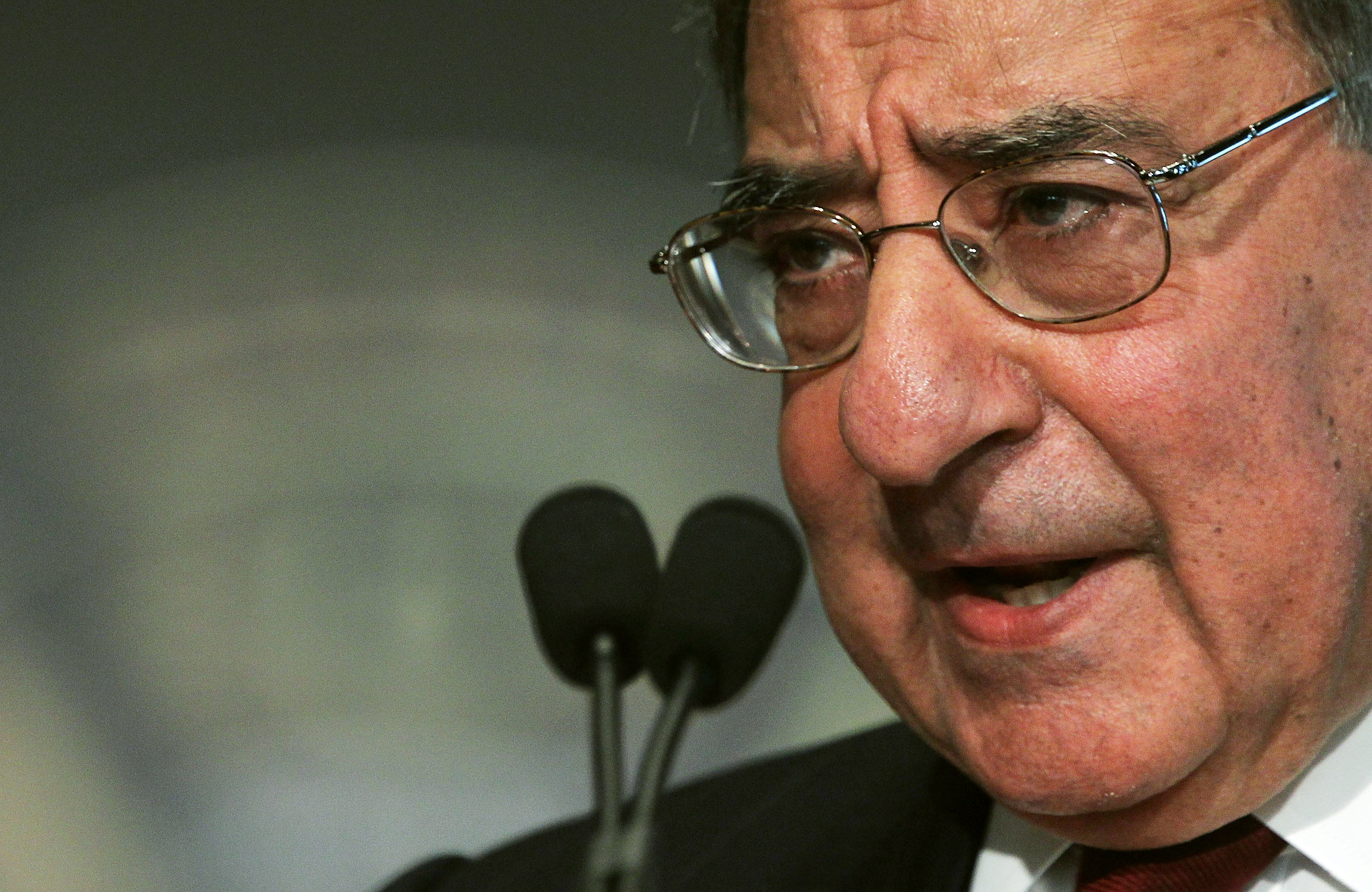
(Photo: Leon Panetta delivers remarks at Gaston Hall of Georgetown University February 6, 2013 in Washington, DC. By Alex Wong/Getty Images)
The Battle For Kobani, Ctd

US-led coalition strikes ISIL in Kobane

Stepped-up air strikes have apparently begun to drive back ISIS fighters from the Syrian Kurdish border town, which they had all but captured as of yesterday, though it’s not clear whether this will be enough to turn the tide in the battle:

“They are now outside the entrances of the city of Kobani. The shelling and bombardment was very effective and as a result of it, IS have been pushed from many positions,” Idris Nassan, deputy foreign minister of Kobani district, told Reuters by phone. “This is their biggest retreat since their entry into the city and we can consider this as the beginning of the countdown of their retreat from the area.” Islamic State had been advancing on the strategically important town from three sides and pounding it with artillery despite fierce resistance from heavily outgunned Kurdish forces. Defense experts said it was unlikely that the advance could be halted by air power alone.

The Obama administration, meanwhile, is getting fed up with Turkey:

“There’s growing angst about Turkey dragging its feet to act to prevent a massacre less than a mile from its border,” a senior administration official said. “After all the fulminating about Syria’s humanitarian catastrophe, they’re inventing reasons not to act to avoid another catastrophe. “This isn’t how a NATO ally acts while hell is unfolding a stone’s throw from their border,” said the official, who spoke anonymously to avoid publicly criticizing an ally.

Steven Cook turns a critical eye on Ankara’s reasoning here:

The Turkish analysis of the situation is different from that of the United States and the Europeans. Ankara believes that IS emerged as a result of the Syrian civil war, which in turn is the result of Syrian President Bashar al-Assad’s intransigence and brutality. The Turks thus insist that getting rid of Assad is the only way to get rid of IS. This is both simplistic and self-serving: Given that Ankara has been vocal in its support for regime change in Syria, anything less would be a profound embarrassment to Erdogan and Davutoglu. Inasmuch as Erdogan does not believe that the United States is going to do in Assad and may even sometime down the road tacitly agree to some sort of deal that leaves the Syrian dictator in place, the Turks remain cool to taking part in the anti-IS coalition.

Finally, though it may be hard to believe, there are elements of the AKP’s constituency that regard IS as a legitimate group seeking to protect Sunni interests in Syria and Iraq amid ongoing sectarian bloodshed.

Semih Idiz solicits some expert views, which all coalesce around the notion that Erdogan wants the coalition war to be against Assad rather than ISIS:

“Davutoglu is saying in effect that IS is the product of rage and if the source of that rage, namely the Syrian regime, goes, then such groups will also go. I don’t know if he believes this himself, though,” [lecturer on international politics at Istanbul’s Kadir Has University, Soli] Ozel told Al-Monitor. Ozel also wonders if there is an ulterior motive to Ankara’s insistence on a no-fly zone and buffer zone in Syria even though there is no international support for them. “If IS engages in a massacre in northern Syria this will provide an excuse for Ankara doing little to prevent it. It can say, ‘I warned the international community, but it refused to act.'”

Nihat Ali Ozcan, a security expert at the Ankara-based Economic Policy Research Foundation of Turkey and a columnist for Milliyet, believes the real problem for the Turkish military in Syria is that it cannot decide who the enemy is. “If the target is Assad, the answer to this question is simple,” Ozcan argued in his Oct. 7 column. “Otherwise it is not clear who and where the enemy is. It wears no uniform and is a part of the civilian population.”

Larison reminds us, again, of how dangerous it would be for the US to start a two-front war in Syria:

If “destroying” ISIS is already an unrealistic goal, and it is, setting out to defeat both ISIS and the Assad regime at the same time is even more fanciful. Destroying the latter would probably be relatively easier, and we know that the U.S. is capable of overthrowing established foreign governments by force, but in doing so the U.S. would plunge all of Syria into even greater chaos. If the war against ISIS also requires the U.S. to go to war with the Syrian government now or later, there is no way that the outcome will be worth the costs to the U.S., and those costs continue to grow with each new goal that hawks want to tack on to the ever-expanding war.

Kurds in southeast Turkey are protesting the government’s inaction. Some of the protests have turned violent:

Nineteen people have been killed in fighting between supporters of the Kurdish PKK party and police and local Islamist groups, according to media reports. Turkey’s Agriculture Minister Mehdi Eker said ten were killed and 45 injured in Diyarbakir, the main city in Turkey’s mostly Kurdish southeast. The city of Diyarbakir is “calm” as citizens “generally abide by the curfew,” imposed last night, Eker said today at a televised press conference.

Jamie Dettmer channels more outrage from the Kurdish refugees and fighters amassed on the Turkish side of the border:

“There will be consequences for this,” an activist with Turkey’s outlawed Kurdistan Workers’ Party, or PKK, tells me. “We aren’t going to forget,” the curly-haired woman, who declines to give a name, says sitting cross-legged on a blanket pulled up under Pistachio trees. PKK activists and defenders in Kobani claim the course of battle could have been changed with just some modest assistance: if they could have gotten anti-tank missiles the Americans have been handing out to rebel battalions in Aleppo and Idlib provinces, and if Turkey had allowed Kurdish reinforcements to cross the border.

Cale Salih examines how the US has dealt with the Kurds differently in Syria and Iraq, which she argues “is reflective of Washington’s general mistaken tendency to presume distinctions between the two countries that do not actually exist”:

In Iraq, the US not only carried out air strikes but also armed the Iraqi Kurdish peshmerga and sent military “advisors”. As a result, the peshmerga were able to provide ground intelligence to guide US air strikes, and, in conjunction with Kurdish fighters from Turkey and Syria, they followed up on the ground to retake important territories lost to Isis.

In Syria, the US has been more hesitant to develop such a bold Kurdish partnership. At first glance, the Kurdish fighting force in Syria – the People’s Defence Units (YPG), linked to the Kurdistan Worker’s Party (PKK), which the US designates as a terrorist group due to its decades-long war with Turkey – is a less natural partner than the widely recognized Kurdistan Regional Government (KRG) in Iraq. Yet it was YPG and PKK forces that provided the decisive support on the ground to the Iraqi Kurds, allowing KRG peshmerga to regain territory lost to Isis in Iraq. The US in great part owes the limited success of its airstrikes in north Iraq to the PKK and YPG.

But Jake Hess reveals that Washington has held back-channel talks with the Syrian Kurds:

The United States has rejected formal relations with the Democratic Union Party (PYD), the party that is essentially the political wing of the YPG. The PYD, which has ruled Kobani and other Kurdish enclaves inside Syria since President Bashar al-Assad’s forces withdrew in July 2012, is affiliated with the Kurdistan Workers Party (PKK), a militant organization that has fought Turkey since 1984 — and has consequently been listed as a terrorist organization by both Turkey and the United States. But interviews with American and Kurdish diplomats show that Washington opened indirect talks with the PYD years ago, even as it tried to empower the group’s Kurdish rivals and reconcile them with the Free Syrian Army (FSA).

Though Washington has declined PYD requests for formal talks, the United States opened indirect talks with the group in 2012, former U.S. Ambassador to Syria Robert Ford told Foreign Policy.

Meanwhile, Canada will be launching its own airstrikes soon, and another report suggests coalition ground troops are being discussed:

Military chiefs from more than 20 countries — many already involved in the fight against the Islamic State and some who are considering joining the group — will meet in Washington early next week to discuss progress on airstrikes in Iraq and Syria as well as plans to create a ground force to consolidate gains against the group.

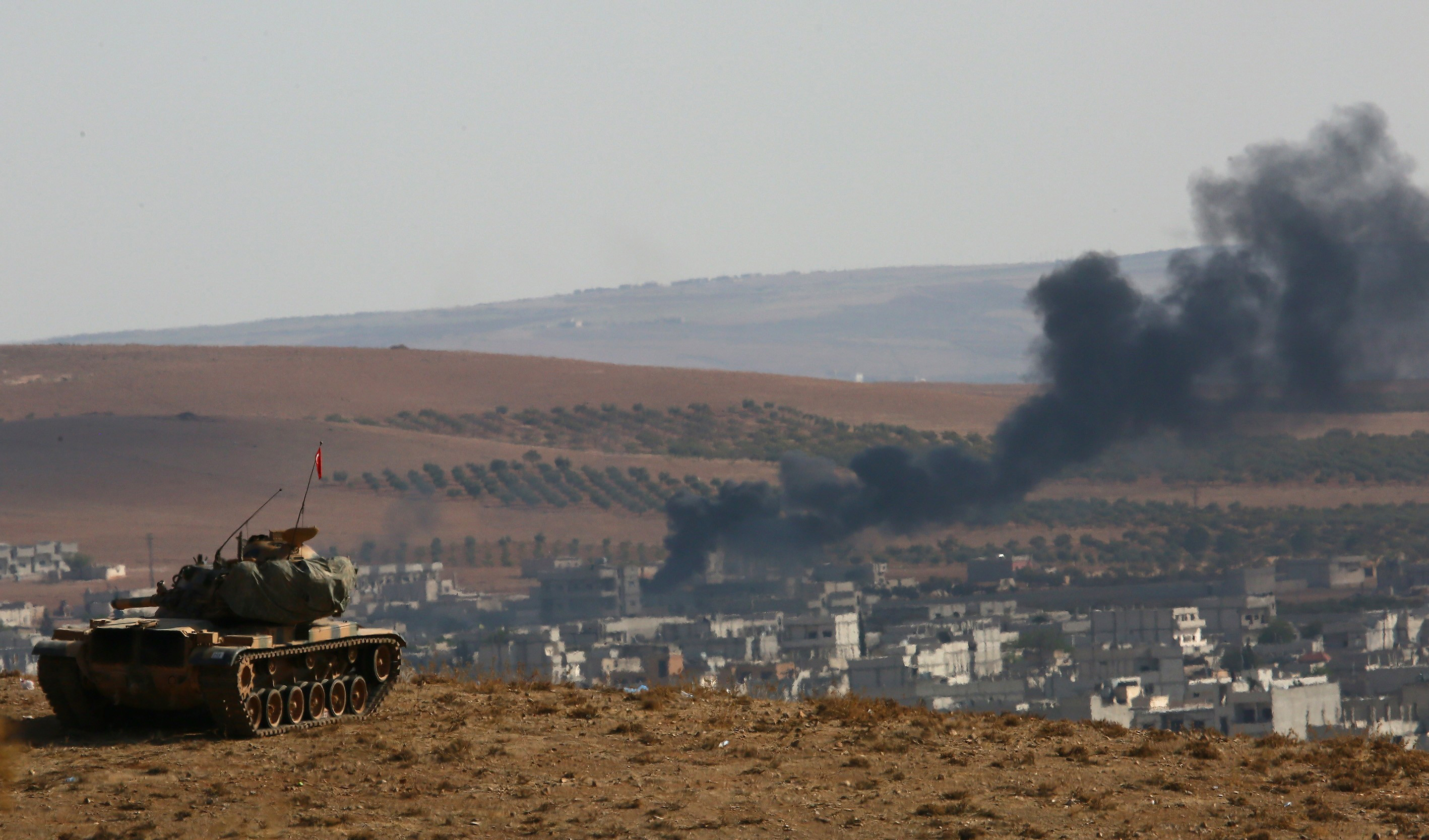
(Photo: A photograph taken from Suruc district of Sanliurfa, Turkey, shows that Turkish army forces patrol while smoke rising from the Syrian border town of Kobani (Ayn al-Arab) after US-led coalition airstrikes against the Islamic State of Iraq and the Levant (ISIL) on October 8, 2014. By Emin Menguarslan/Anadolu Agency/Getty Images)

The Battle For Kobani, Ctd

Since yesterday, ISIS militants in northern Syria have penetrated farther into the town of Kobani (also known as Ain al-Arab) on the Turkish border, driving back the Kurdish militias defending it and sending thousands of civilians fleeing for their lives to safe havens in Turkey:

Mustafa Bali, a spokesman for Kurds in Kobane, told Agence France-Presse that 2,000 civilians were evacuated on Monday and that all civilians were ordered to leave. More than 180,000 refugees from around Kobane have already poured over the border into Turkey since the siege on the city started three weeks ago, the Wall Street Journal reports. IS fighters have already captured more than 300 Kurdish villages around Kobane, but the street-to-street fighting on Monday put them within a mile of the city center. They now surround the city on three sides.

New coalition air strikes reportedly launched today may not be enough to turn the battle against the jihadists, but there are signs that Turkey is preparing to act:

President Recep Tayyip Erdogan of Turkey suggested Tuesday afternoon that the strikes may have come too late, telling Syrian refugees at a camp in Gaziantep Province, near the border, that Kobani was about to fall, The Associated Press reported. “There has to be cooperation with those who are fighting on the ground,” he was quoted as saying, while adding that airstrikes might not be enough. The latest fighting is taking place in full view of Turkish forces who have massed tanks with their cannons pointing toward Syria but who have not opened fire or otherwise intervened.

Marc Champion urges more support and arms for the Syrian Kurds:

Kobani is the main town in the Westernmost of three areas that make up the self-proclaimed Kurdish-run autonomous region of Rojava. Kobani sits across the main road that runs along the Turkish-Syria border, and if Islamic State can take it, the group can pass through it to get directly from Aleppo in the West to other territories it holds in the east. Plus, the area controls a border crossing. So Islamic State wants to take Kobani, followed by the other parts of Rojava, to make their safe haven safer. Denying Islamic State this victory should therefore be important to the coalition’s goals.

But an effective defense would require assistance from Ankara, and “Erdogan appears to be holding the town, and the coalition, hostage to his broader fights with the PKK and with Syrian President Bashar al-Assad”:

I’m not sure what the answer is for the Kurds of Kobani. They deserve sympathy for their plight, but their leaders are making a choice, too: To fight and die rather than give up their dream of Kurdish self-rule in a pocket of Syria. It seems clear that without Turkish support, the coalition can’t or won’t unleash its full air power to save Kobani, and that this support won’t materialize until the Kurds agree to a buffer zone. That, surely, is by now Rojava’s least bad option.

Goldblog fears a massacre in Kobani if ISIS is not beaten back:

I just got off the phone with a desperate-sounding Kurdish intelligence official, Rooz Bahjat, who said he fears that Kobani could fall to ISIS within the next 24 hours. If it does, he predicts that ISIS will murder thousands in the city, which is crammed with refugees—Kurdish, Turkmen, Christian, and Arab—from other parts of the Syrian charnel house. As many as 50,000 civilians remain in the town, Bahjat said.

“A terrible slaughter is coming. If they take the city, we should expect to have 5,000 dead within 24 or 36 hours,” he told me. “It will be worse than Sinjar,” the site of a recent ISIS massacre that helped prompt President Obama to fight ISIS. There have been reports of airstrikes on ISIS vehicles, but so far, Bahjat said that these strikes have been modest in scope and notably ineffective.

Zack Beauchamp explains how the jihadists advanced on the town so rapidly:

Why did things change? Most analysts say it’s about Iraq. When ISIS swept northern Iraq beginning June 10, its militants captured enormous amounts of advanced, American-made military equipment that had been dropped by the Iraqi army, including mortars and frontline battle tanks, which they’ve brought to the fight in Syria. The Kurdish forces are now outgunned. And because they’re surrounded, they can’t resupply.

But William Gourlay believes that “the brave fight of the PYD has demonstrated the military shortcomings of ISIS”:

That local militias – with only light arms and little outside support – can hold off a major ISIS offensive, including a great deal of heavy weaponry of US and Russian origin, indicates that ISIS’s military prowess is vastly overstated. The PYD militias are tenacious and are fighting to hold their homeland, to be sure, but one can only wonder how easily ISIS may have been defeated in this arena if the might of the US-led coalition had been effectively brought to bear.

The Battle For Kobani

Kurdish fighters in northern Syria, who are desperately trying to hold off an ISIS advance on the border town of Kobani, are pleading for heavy weapons, saying US air strikes are not really helping:

The jihadis, who this weekend generated further outrage with the murder of the British hostage Alan Henning, are simply too numerous to be cowed by the air assault by US fighter jets, the Kurds say. “Air strikes alone are really not enough to defeat Isis in Kobani,” said Idris Nassan, a senior spokesman for the Kurdish fighters desperately trying to defend the important strategic redoubt from the advancing militants. “They are besieging the city on three sides, and fighter jets simply cannot hit each and every Isis fighter on the ground.”

He said Isis had adapted its tactics to military strikes from the air. “Each time a jet approaches, they leave their open positions, they scatter and hide. What we really need is ground support. We need heavy weapons and ammunition in order to fend them off and defeat them.”

Jamie Dettmer reviews the weekend’s events from his vantage point on the Turkish side of the border:

Although the weekend air raids were hardly intense, the effect of even limited U.S. bombing runs was telling. The missiles launched on Friday and Saturday night interrupted what had been salvo after salvo of tank and mortar fire from the jihadists during daylight hours and forced Islamic State militants to move half-a-mile back from the besieged town. They also emboldened the Kurdish defenders, who are lightly armed and fending off heavy armor. On both nights the Kurds counter-attacked and had some successes, destroying at least one ISIS tank.

Despite the airstrikes, the town’s fate hangs in the balance, says Ismat Sheik Hasan, a commander in the YPG Kurdish self-defense forces, whose vanguard is formed by an offshoot of Turkey’s outlawed Kurdistan Workers Party (PKK). Even so, the point of American airpower was made, adding further poignancy to the Kurds’ questioning about why the U.S. is not being more forthright in assisting them to defend the town from an enemy President Barack Obama says he wants to “degrade and defeat.”

Jeremy Bender attributes the ineffectiveness of US airstrikes in Syria to a lack of intel and coordination on the ground:

The US simply doesn’t have the same kind of on-the-ground intelligence presence and capabilities in Syria that it has in neighboring Iraq, where coordination with the Kurds and the Iraqi government allowed American airstrikes to help dial back a major ISIS assault. The US lacks those kinds of partnerships in Syria, and the resulting shortage of intelligence is a major strategic shortcoming — something that may plague the coalition’s overall goal of disrupting and destroying ISIS’ network within Syria.

Liz Sly explains why Turkey hasn’t rushed to save the city:

Turkey remains ambivalent about joining the coalition against the Islamic State, despite a vote in parliament Thursday authorizing military intervention. Turkey is anxious not to take any action that would embolden its Kurdish foes on either side of the border, and the resolution named the Kurdish Workers’ Party, or PKK — the parent organization of the Kurdish militia fighting in Kobane — as one of the targets of any future military intervention, along with the Islamic State and Syria’s President Bashar al-Assad.

Turkish Prime Minister Ahmet Davutoglu signaled late Thursday that Turkey might be prepared to act. “We wouldn’t want Kobane to fall. We’ll do whatever we can to prevent this from happening,” Davutoglu told Turkish journalists. But it remains unclear what Turkey is prepared to do.

Michael Stephens worries:

https://twitter.com/MStephensGulf/statuses/519174472872787968

Adam Chandler presents the battle over Kobani as a sign of how ISIS is adapting to the presence of American air power:

The advance of the Islamic State fighters into a strategically important Syrian city is a development that U.S.-led airstrikes were supposed to preclude. But as many are suggesting, the coalition efforts to stem the Islamic State onslaught have been ineffective. This is, at least in part, because ISIS has changed its tactics.

“In Syria and Iraq, they took down many of their trademark black flags, and camouflaged armed pickup trucks,” The Wall Street Journal wrote of ISIS. “They also took cover among civilians.” The group is also said to have decentralized some of its command structure, adjusted its movements to nighttime, and eschewed the frequent use of cellphone and radio communications.

Australian Defense Minister David Johnston also sees ISIS adapting rapidly:

Johnston acknowledged the potential for Isis extremists to adapt to the expanded air strike campaign by presenting fewer targets to the air forces. “I think that’s pretty certain that they will adapt very quickly not to be out in the open where the Iraqi security forces can call in an air strike.” The embedding of Isis militants in towns was “a much more difficult proposition and I think we’ve started to see adaptation already”, Johnston said. “It was always going to be that the Iraqi security forces would have to step up and go into these towns and clean them out,” he said. In a separate interview on Sunday, Johnston said Isis could be “extremely adaptive” and Iraq could be “quite a long campaign”.

Our Allies Have Their Own Ideas

SYRIA-UNREST-IDLIB

Mohammed Ghanem urges the US to coordinate more closely with Syrian rebels in the fight against ISIS, arguing that doing so would help defeat the group in Iraq as well:

Airstrikes alone will not defeat the Islamic State. Despite nearly two months of strikes in Iraq, Islamic State fighters attacked Iraqi army checkpoints close to Baghdad last weekend, and reports this week indicate a strong Islamic State presence just a mile west of the city. Although Obama administration officials are correct that the anti-Islamic State campaign will take time, they need to accelerate and significantly modify the effort to prevent further advances toward Baghdad. Close coordination with Syrian rebels would accomplish this. By enabling rebels to escalate ground attacks on the Islamic State’s western front, coordination would force the group to divert resources from Baghdad. And unlike the Iraqi army, moderate Syrian rebels have a proven record of rolling back Islamic State forces. But no coordination of any significance is occurring.

But Shane Harris questions Ghanem’s premise that Baghdad is at risk:

But if Baghdad were to fall, it would effectively put the Islamic State in control of Iraq and spell political disaster for the White House. That the Syrian rebels are connecting the fate of Iraq with their fight next door underscores how desperately they want help from the United States, and how unsuccessful they’ve been in securing it.

Dettmer attributes the Free Syrian Army’s growing disillusionment with the US to a clash of priorities:

While the Kurds see the American intervention as one that can be parlayed into their independence, the Sunni Muslims of northern Syria express deep anger towards America. They see themselves being set up as a sacrifice for a U.S. policy meant to prop up Iraq. They are furious with what they view as the cynical U.S. decision to enter this war not with President Bashar Assad as the target—not to help topple a dictator whose refusal to permit reforms triggered a conflict that has left nearly 200,000 dead—but to focus instead on ISIS alone. Across the dizzying, fragmented spectrum of rebel factions—from moderates to Islamists—commanders insist that since the start of the U.S.-led coalition’s air offensive on September 23 Assad has increased the tempo of his own airstrikes on rebel positions, reassured that he is not the butt of American rage and is now free to let the U.S. deal with ISIS.

The rebels aren’t the only ones quibbling with our choice of targets. In Sinan Ülgen’s view, Turkey’s hesitation in joining the anti-ISIS coalition owes partly to a belief that Syria’s problems can’t be solved without getting rid of Assad:

Turkey’s leaders believe that the international community’s response to the Islamic State should be far more ambitious, seeking to redress the underlying causes of the current disorder. Such a strategy would have to include efforts to compel Iraq’s new government to break with the sectarianism of former Prime Minister Nouri al-Maliki, while supporting the new leadership’s efforts to provide basic health, educational, and municipal services to all of Iraq’s citizens. As for Syria, the only plausible route to normalcy begins with forcing President Bashar al-Assad to cede power. To this end, the US and its allies should consider striking Assad’s strongholds in Syria, while establishing safe havens for the moderate opposition under the protective cloak of a no-fly zone.

Juan Cole sees Ankara’s recent moves in a similar light:

Turkey has gotten enormous pressure from President Obama, French president Francois Hollande and UK PM David Cameron to join. For their part, they need the region’s largest Sunni Arab country on their side to avoid having the campaign against ISIL look like a Christian-Shiite Jihad against Sunnis. Turkey values its NATO membership and will want to fulfill obligations to other NATO members. President Tayyip Erdogan also very much wants Turkey to be accepted into the European Union, and may figure that proving Turkey’s worth in fighting a Muslim extremism that seems threatening to Europe may gain him some good will in the EU. Also, Turkey fears that if the West does manage to inflict attrition on ISIL, the Baathist regime of Bashar al-Assad might benefit, but Turkey wants to see it overthrown. Being in the coalition allows Turkey to demand that pressure be kept on al-Assad to step down.

Discussing the potential pitfalls of military coalitions, Micah Zenko identifies such conflicting agendas as a major concern and concludes with an important question:

In the months after 9/11, Defense Secretary Donald Rumsfeld often pointed out how 90 countries were participating in “the largest coalition in human history” in the global war on terrorism. That initial level of commitment dissipated as time passed and as the United States pursued its war on terrorism in a manner that many former coalition members fundamentally opposed. Rumsfeld also liked to say, “The mission determines the coalition; the coalition must not determine the mission.”

An easy prediction is that at some point, some members of this coalition will want to redirect their airstrikes against Bashar al-Assad’s regime. When that becomes the mission, what becomes of the coalition?

(Photo: Fighters loyal to the Free Syrian Army (FSA) pose with their weapons in a location on the outskirts of Idlib in northwestern Syria on June 18, 2012. By D. Leal Olivas/AFP/Getty Images)

Turkey’s Stake In The ISIS War

TURKEY-SYRIA-KURDS

As expected, Turkey’s parliament today authorized the government to take military action against jihadists in both Syria and Iraq, but Ankara has yet to say what, if anything, that action will be. With ISIS on its border, though, we might find out soon:

Kurdish fighters backed by US-led air strikes were locked in fierce fighting Wednesday to prevent the besieged border town of Ain al-Arab from falling to the Islamic State group fighters. “There are real fears that the IS may be able to advance into the town… very soon,” the Syrian Observatory for Human Rights warned, with the jihadists within three kilometres (two miles) of the strategic town.

Or an attack on the tomb of Suleiman Shah, a Turkish enclave in northern Syria, might be what finally draws Ankara into the war:

Deputy Prime Minister Bulent Arinc said Tuesday that the militants were advancing on the white stone mausoleum, guarded by several dozen Turkish soldiers and perched on a manicured lawn under a Turkish flag on the banks of the Euphrates. The tomb was made Turkish under a treaty signed with France in 1921, when France ruled Syria. Ankara regards it as sovereign territory and has made clear that it will defend the mausoleum if it is attacked.

Jamie Dettmer relays the suspicions of diplomats in Ankara that “Turkey will limit its military role—doing a bare minimum as a NATO member to avoid embarrassing the Western alliance but not enough to undermine the anti-Western narrative that thrills Erdogan’s Islamist supporters and other religious conservatives in the country”:

“As much as Turkey enjoys the protection of NATO’s Patriot missiles against the Syrian regime, Ankara is perhaps not willing to appear an active member of a war operation against what was initially a Sunni insurgency movement in Syria,” according to Marc Pierini, a former ambassador of the European Union in Ankara. “Turkey under the Justice and Development Party (AKP) has never wanted to appear to be aligning itself with Western policies.”

Erdogan’s domestic critics say he has to some degree helped the rise of ISIS, as well as other Islamic militants. At the very least Turkey has turned a blind eye to them as they emerged in the Syrian civil war and increasingly formed the vanguard in the fight to topple Syrian President Bashar Assad. Some critics argue that Turkey’s intelligence agencies have gone farther and actively channeled arms supplies to the jihadists.

Koplow also explores how the spillover effects of the conflict in Syria stand to influence Turkey’s domestic politics. For one thing, the government’s non-response is alienating the country’s Kurdish population, threatening to undo what had been a fairly successful rapprochement:

Many Kurds blame Ankara for allowing ISIS to fester and even for empowering the group through its previous see-no-evil-hear-no-evil border policy. The more half-hearted the Turkish government has been about getting rid of ISIS, the harder it is to successfully conclude the Kurdish peace process. In southeastern Turkey, funerals for Kurdish fighters who have been killed fighting ISIS across the border are a regular occurrence, and they contribute to growing discord between a naturally restive population and the Turkish government. The ongoing battle between ISIS and Kurdish fighters for the town of Kobane on the Syria-Turkey border — and Turkey’s apparent reluctance to get involved for fear of empowering Kurdish militants in Turkey — is inflaming passions and contributing to antigovernment rhetoric in ways that will reverberate well beyond this particular fight. …

An economy burdened by refugees, renewed unrest among Turkish Kurds, resurgent nationalism, and policy run by unaccountable intelligence services makes for an unstable brew. ISIS has presented the United States and the entire Middle East with a new set of problems, but its immediate legacy may be an end to what has been a remarkable period of Turkish domestic stability.

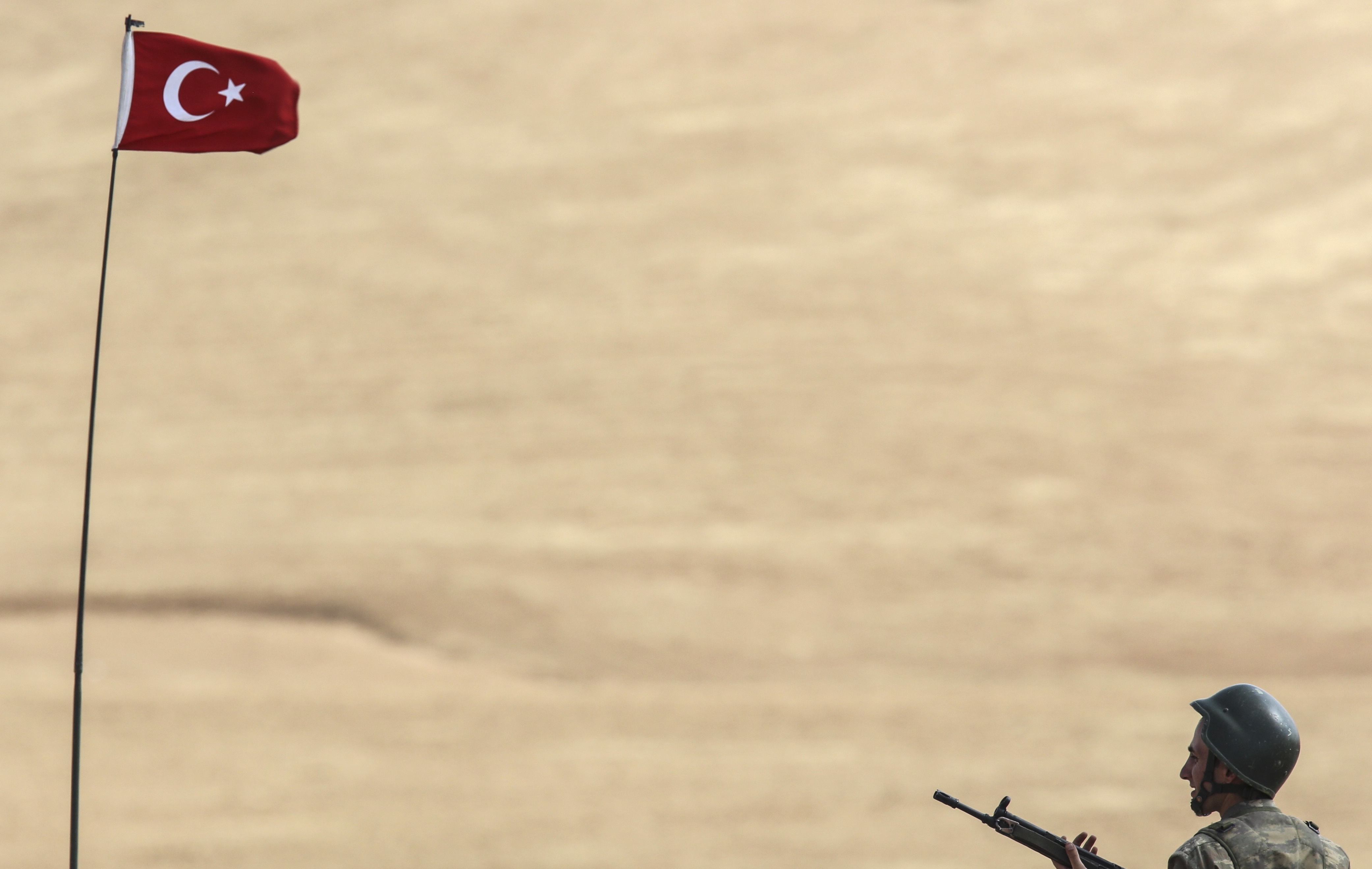
(Photo: A Turkish soldier stands on a hill in Suruc, Turkey on October 2, 2014, facing the Islamic State (IS) fighters’ new position, 10km west of the Syrian city of Ain al-Arab (Kobani). By Bulent Kilic/AFP/Getty Images)

Whom Exactly Are We Bombing In Syria? Ctd

SYRIA-CONFLICT

David Kenner has more on our Syrian allies, who for some reason aren’t all that grateful for the bombs we’re dropping on their country:

Foreign Policy interviewed six FSA commanders from [Deir Ezzor] who are currently exiled by the Islamic State and hiding out in southeastern Turkey. All of them were arrested at some point by the jihadist group; some were tortured. They all agree that the U.S. airstrikes in their home country are a bad idea. FSA fighters and commanders complained to Foreign Policy that they have received no increase in support since the international effort to combat the Islamic State began, despite promises from the Obama administration that the United States would begin supplying arms to the rebels. The FSA fighters also disparaged the airstrikes, saying they would mainly kill civilians and give the Assad regime a chance to gain ground.

Anti-Assad Syrian civilians have echoed this opposition. While Islamists have seized on the attacks to brand U.S. President Barack Obama as an “enemy of God,” even the traditionally secular protesters in the town of Kafr Anbel held a poster blasting the coalition for killing civilians.

Zack Beauchamp calls these civilian deaths “not an inevitable feature of any sort American involvement in Iraq and Syria” but rather “a direct product of the maximalist goals the Obama administration has set for its war on ISIS”:

By choosing only to provide limited help to Iraq in critical situations, the United States had enormous control over targeting. It could focus only on ISIS targets where airpower was likely to be effective, such as disrupting supply convoys between Iraq, that also were unlikely to kill a lot of civilians.

But now, the United States has committed itself to helping both Iraqi and Syrian rebel soldiers take back all of ISIS-held territory. That’s a more ambitious strategy that takes on a lot more risk, including toward civilians. If and when Iraqi military and Syrian rebel forces move on ISIS positions in heavily populated areas, they will expect and may very well depend on American close air support. The US will be forced to rely on sketchy Syrian intelligence and strike dangerously close to civilian population centers. It’s this simple: the more aggressive the American objectives are in the war against ISIS, the more likely American forces are to kill civilians.

Erika Solomon and Geoff Dyer back up previous reports that our targeting of the Nusra Front is alienating our friends and encouraging the al-Qaeda franchise to seek out Western targets:

[M]oderate rebels on the ground fear Washington’s decision to widen its attacks could not only weaken them, but create a larger pool of fighters who believe the west – and its partners on the ground – are their enemy as much as Mr Assad. Nusra fighters insist they had no interest in foreign attacks before the coalition strikes. But since then the group appears to have shifted its position: Jabhat al-Nusra’s leader, known as Abu Mohammed al-Golani, recently put out a statement warning western civilians to demand an end to strikes to avoid becoming victims of attacks in their own countries. Nusra fighters have been a critical partner to other rebels fighting to end four decades of Assad family rule. Their targeting by the US outraged some opposition forces.

And Joshua Hersh observes that most of the pro-democracy activists who launched the 2011 revolution are no longer there, having been killed, silenced, or driven into exile either by the regime or by ISIS:

Not all revolutionary civil activity has ceased inside Syria. In the town of Kafranbel, in Idlib province, a clever and merry band of activists continue to create humorous banners that comment on recent events, and seek to bring attention to their ongoing plight. (Recent banners have quoted Robin Williams, honored the murdered journalist James Foley, and mocked the world’s obsession with the World Cup.) And in Aleppo, there are revolutionary councils and civilian activists networks, not to mention a noble brigade of volunteer rescuers who risk their lives daily to pull survivors from the rubble of regime airstrikes. But for so many other would-be do-gooders, the rebel-held countryside, not to mention the major cities still under government control, has long proven unwelcome terrain. Going home remains a distant illusion.

“The sense of despair and the sense of loss is so powerful,” one longtime Syrian activist and humanitarian worker told me by Skype last week from his asylum in London. “For the people still inside, even if they are activists, they are under so much pressure—the pressure of the war, the militarization, the abuse.” He added, “At this point, if you want to be an activist, it’s basically to call for the fighting to stop, the bloodshed to stop.”

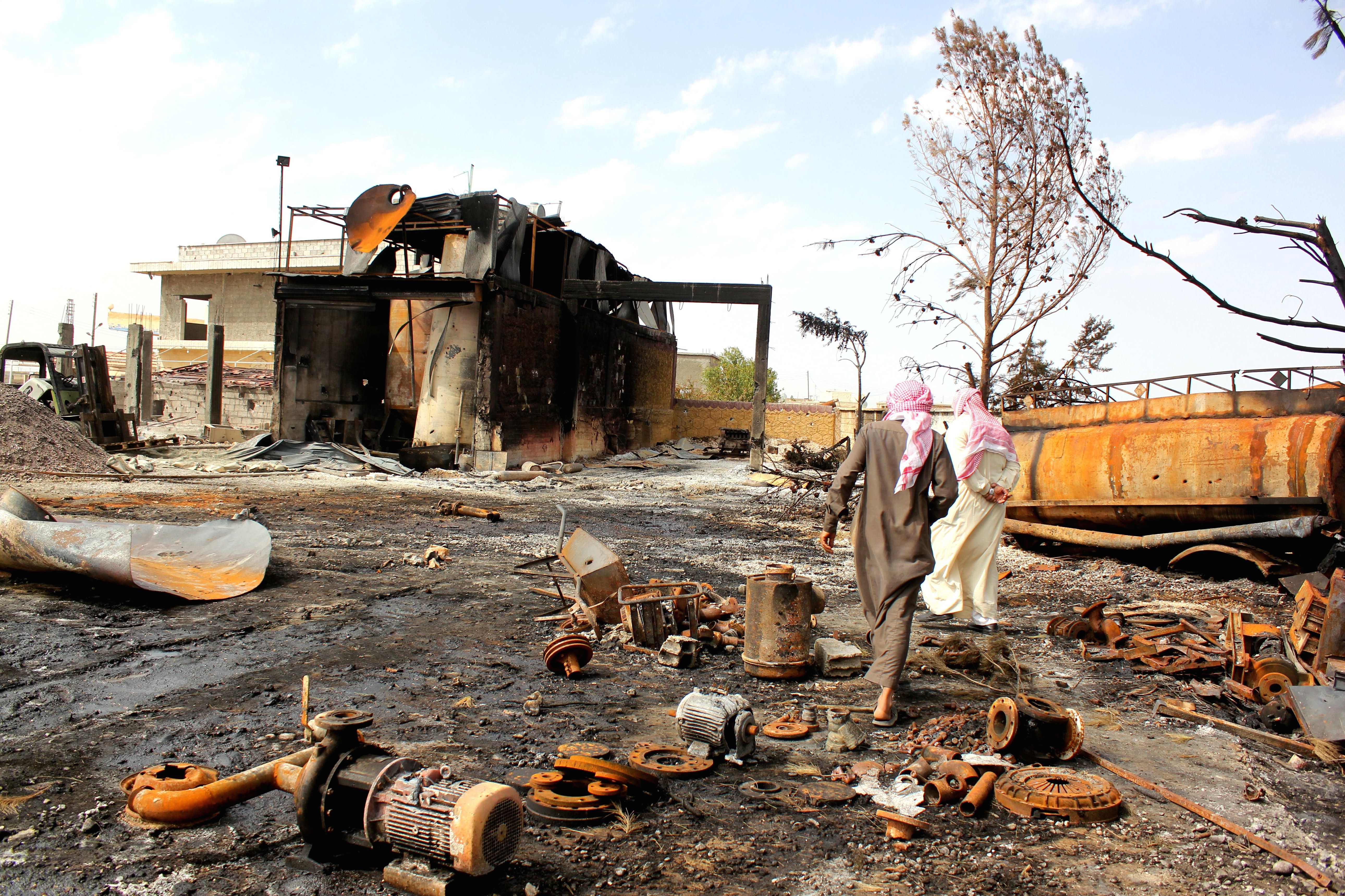
(Photo: On October 2, 2014, men walk through the rubble of an oil refinery that was reportedly targeted by the US-led coalition on September 28, in the northern Syrian town of Tal Abyad near the border with Turkey. By AFP/Getty Images)

Whom Exactly Are We Bombing In Syria?

Last week, a US air strike meant to hit a base held by the al-Qaeda affiliated Nusra Front almost hit a Free Syrian Army facility instead:

Since U.S. airstrikes against ISIS in Syria began on Sept. 22, there has been no coordination between the U.S. military and its alleged partners on the ground, according to FSA leaders, civilian opposition leaders, and intelligence sources who have been briefed on the U.S. and allied military operation. It’s this lack of communication that led to an airstrike that hit only 200 meters from an FSA facility in the suburbs of Idlib. One source briefed on the incident said multiple FSA fighters were killed in the attack.

“Unfortunately, there is zero coordination with the Free Syrian Army. Because there is no coordination, we are seeing civilian casualties. Because there is no coordination, they are hitting empty buildings for ISIS,” Hussam Al Marie, the spokesman for the FSA in northern Syria, told The Daily Beast.

Shocking that things can go awry like this during a war “effort”. Allahpundit rightly sees downsides to targeting both ISIS and other jihadist groups at the same time:

What’s at risk of happening here, as ISIS and the Nusra Front congeal, is our allies in the Free Syrian Army suddenly getting it on all sides. Assad has every reason to keep killing the “moderates”; the west has always eyed them as a potential governing regime in Syria once Assad is gone, so by eliminating them Assad makes himself the only anti-ISIS game in town. And now both ISIS and the Nusra Front have a strong reason to target the FSA.

Notwithstanding this week’s mishap, Nusra will suspect that the “moderates” are either already [feeding] intelligence to the Pentagon about their locations or will be soon. The smarter strategic play here, surreal though it may seem, might have been to leave Al Qaeda alone at first and concentrate on ISIS, so as to better isolate the latter group.

But then, maybe that was impossible. Once ISIS is gone, who’s likely to replace them in control of Sunni areas? Right — Al Qaeda. We’re holding the weakest hand on the field with the FSA. To clear a path for them to rule, we’ll have to eliminate … everyone, basically.

And the quicksand will get deeper and deeper. As if that’s not enough, Fred Hof insists that the US treat Assad as our enemy as well:

The salient fact governing today’s situation in Syria is that there would be no Islamic State were it not for the criminally sectarian manner in which the Assad regime chose to respond to peaceful political protest. This would be true even if the Assad regime had had nothing to do with sustaining Al Qaeda in Iraq during the years of American occupation. This would be true even if regime-IS collaboration on the ground in western Syria were merely happenstance: an accident produced by the existence of a common enemy.

Aaron David Miller illustrates why all of this is nuts:

So, here’s my latest worry. Looking at our Syria policy, it has begun to dawn on me that we really face a two-part conundrum that we will have difficulty unpacking. First, there’s the obvious: hitting the Islamic State (IS) strengthens Syria’s President Bashar al-Assad. Second: If we choose to hit him, we’ll buck up IS, al-Nusra, and the rest of the swell groups who are in the Syrian opposition, not to mention alienating our new friends, Iraq’s prime minister, and of course, Iran, and a few of our old acquaintances like Putin.

That two-part conundrum only reinforces my real concern: the new and potentially slippery slope that is at the heart of our approach. And it’s not boots on the ground. Instead, it’s the reality that we’re being pulled inexorably like a moth to a flame not just toward a military conflict with Assad, but toward bearing the responsibility for fixing — or worse for creating — the new Syria. Indeed, under the realist’s rubric of striking IS to keep America safe, we may well end up in the very place U.S. President Barack Obama has willfully tried to avoid: nation-building.

And the beat goes on, and on, and on …

A Terrorist Brand War

Vera Mironova worries that’s what we have on our hands:

The only way for Al-Qaeda to get back to the top of the list of terrorist organizations would be to outbid ISIS on its own field (excessive brutality), to prove that they are still the reigning terrorist organization. This does, unfortunately, look to be the plan of the Al-Qaeda. Although they have co-existed with the Yemen government for years, this “peace” however was shattered on August 9th in the southern Yemeni province of Hadramawt, when fourteen military personnel were brutally slaughtered for no reason. A group of armed men stopped and boarded a civilian bus, identified the military personnel, and proceeded to slit their throats. Following in the ISIS traditions, the armed men identified themselves as Al-Qaeda in Arabian Peninsula, videotaped the mass slaughter and published it online.

Although it is hard to predict the future, evidence would suggest that we can expect to see even more brutality in Middle Eastern conflict while Al-Qaeda tries to regain its title. And after the last incident in Hadramawt, Yemeni government pressed Al-Qaeda to look for a “refuge” in other Middle Eastern countries, like Syria and Iraq, the current strongholds of the ISIS. Therefore, the return of Al-Qaeda to the top of the list of terrorist organizations, an extremely violent scenario, is possible.

Is Obama Pulling A Bush?

United Nations Hosts World Leaders For Annual General Assembly

Tomasky insists no:

The first and most important difference, plainly and simply: Obama didn’t lie us into this war. It’s worth emphasizing this point, I think, during this week when Obama is at the United Nations trying to redouble international support to fight ISIS, and as we think back on Colin Powell’s infamous February 2003 snow job to Security Council. Obama didn’t tell us any nightmarish fairy tales about weapons of mass destruction that had already been destroyed or never existed. He didn’t trot his loyalists out there to tell fantastical stories about smoking guns and mushroom clouds.

The evidence for the nature of the threat posed by the Islamic State is, in contrast, as non-fabricated as evidence can be and was handed right to us by ISIS itself: the beheading videos, and spokesmen’s own statements from recruitment videos about the group’s goal being the establishment of a reactionary fundamentalist state over Iraq, Syria, Jordan, and Lebanon. That’s all quite real.

The in-tray has been full of similar sentiments. My response is: sure, so far as it goes. But Tomasky’s argument doesn’t go very far. And the way in which Obama supporters have lamely acquiesced to this reckless war fomented by a dangerous executive power-grab is more than a little depressing. It strikes me as uncomfortably close to pure partisanship. I can’t imagine them downplaying the folly of this if a Republican president were in charge.

Sure, we are indeed not being grotesquely misled this time about non-existent WMDs. But we are going to war despite the fact that ISIS is no more a direct threat to the United States than Saddam was – arguably much less, in fact. We have no answer this time to the unanswered question last time: what if our intervention actually galvanizes Islamist extremism rather than calming it? And the Arab coalition that Tomasky cites as evidence that this war is a far less American-centric one than 2003 has some issues when you confront reality. Here’s the latest:

Jordan said that “a number of Royal Jordanian Air Force fighters destroyed” several targets but did not specify where; the Emirati Ministry of Foreign Affairs said that the air force “launched its first strikes against ISIL targets” on Monday evening, using another acronym for the Islamic State. American officials said that Saudi Arabia and Bahrain also took active part in the strikes, and that Qatar played a “supporting” role.

This may be important window-dressing, but window dressing it still is. It sure isn’t close to the coalition George H W Bush assembled in 1990 – and it’s much smaller than George W Bush’s coalition in 2003. More to the point, the key element of any successful strategy will be the position of the Sunni Arab tribes – and they are still sitting on the sidelines. Turkey is AWOL so far. And the fact that the Arab states do not want their contributions to be broadcast more widely reveals the depth of the problem. Obama has Americanized the problem. Once you do that, the regional actors get even more skittish, because the only common thing for so many of the populations represented by these autocrats is loathing of the United States. This is the Arab world. The US will never get anything but hatred and cynicism and contempt from it.

Then there’s the question of authorization.

George W Bush got a few Security Council resolutions (if not the final, vital one). Obama hasn’t even bothered – he’s bombing a sovereign nation without even feigning a request for formal authorization. GWB – against Cheney’s wishes – procured a clear declaration of war from the Congress. Obama seems to have decided that he is more in line with Cheney’s views of executive power than George W Bush’s – and has blown a hole so wide in any constitutional measures to restrain the war machine that he has now placed future presidential war-making far beyond any constraints. If that isn’t an outright abandonment of almost everything he has said he stands for, what would be?

Bush’s war had a vague and utopian goal: the establishment of a multi-sectarian democratic republic in Mesopotamia. He had close to no plans for the occupation; and no real understanding of how quixotic a project he was promoting. Obama’s goals are just as quixotic – “ultimately destroying” ISIS from the air alone – and he has no Plan B for failure. Bush tried to defeat a Sunni insurgency with a multi-sectarian government in Baghdad. It never happened – and we had to bribe the Anbar tribes instead, and, even then we needed 100,000 troops to keep the lid on the whole thing.

Obama says he is fighting a Sunni insurgency with a broadly based Baghdad government – but replacing Maliki has led to no such thing. There is still paralysis in Baghdad over the interior and defense ministries, no cross-sectarian national entity to take the fight to ISIS, and the real risk of a Shiite government actually reinforcing the Sunnis’ sense that the US and the Shiites are now intent on persecuting them even further. That makes the prospects for this attempt at pacification even worse than in 2006.

And look: I think Obama is sincere in doing what he can with the Baghdad mess; but we have to be crazy to buy this line of argument in counter-insurgency at this point in history. We are fighting a Sunni insurgency on behalf of a Shiite government and a near-independent Kurdistan, a fight which might well empower Iran and even Assad. This is about the worst formulation for this struggle as one could come up with. It does not bring Sunnis into the struggle; it may well keep them out.

Of course I wish I didn’t have to write this. And it is, of course, true that we are not torturing prisoners with the sadism and insanity of the Cheneyites. It is true we are not sending in 140,000 troops into another country. We are sending almost none – but to achieve the same result! To do the same thing we did last time and hope for a better outcome is the definition of insanity. But to do the same thing with even less of a chance to achieve it takes things to a new level of incoherence.

This is an illegal war, chosen by an unaccountable executive branch, based on pure panic about a non-existent threat to the United States, with no achievable end-point. Apart from all that, it’s so much better than Bush, isn’t it?

(Photo: Obama holds a bilateral meeting with Prime Minister of Iraq Haider al-Abadi during the 69th United Nations General Assembly in New York City on September 24, 2014. By Allan Tannenbaum-Pool/Getty Images.)