What’s The End Game In Syria?

Hussein Ibish is actively hoping for “mission creep” in Syria in light of America’s new commitment of small arms:

For once, “mission creep” provides the hope of a successful outcome rather than a terrifying threat to a major foreign policy initiative. Typically, American hubris has meant overreaching, and “mission creep” has historically been synonymous with disaster. In this case, a new and uncharacteristic American risk-aversion has been crippling.

Crippling for whom? Not the US. Shadi Hamid figures Obama will have to up the ante soon:

The fact of the matter, and one the administration seems intent on eliding, is that the only way to help the rebels regain the advantage and force the Assad regime to make real concessions is with a credible threat of military intervention through airstrikes against regime assets and the establishment of no-fly and no-drive zones.

We’re told this is not Iraq – because it such a tiny intervention. Okay, then it’s Vietnam, in a country that is as chaotic as Iraq. Meanwhile, a new Pew poll released today shows that 70 percent of Americans are against intervention, though 41 percent of those opposed favor some form of humanitarian action:

The 20% of the public that favors arming anti-government groups in Syria also expresses concerns about the U.S. getting involved. More than half (56%) of those who favor arming rebels agree with the statement that U.S. military forces are too overcommitted to get involved in another conflict, and 55% agree that the opposition groups in Syria may be no better than the current government.

I’ve heard the ludicrous argument that the Obama surrender to the McCain-Clinton-Saudi position will somehow engineer a negotiated settlement with Assad. If anyone believes that, they need their head examined. The more you look at this, the more you realize that the only possible explanation for this is the president’s core weakness. No strategy; no end-game; and now, not even coherence.

Obama Caves On Syria, Ctd

In a post noted yesterday, Marc Lynch predicts that the president’s decision “will have only a marginal impact on the Syrian war — the real risks lie in what steps might follow when it fails”:

The Syrian opposition’s spokesmen and advocates barely paused to say thank you before immediately beginning to push for more and heavier weapons, no-fly zones, air campaigns, and so on.  The arming of the rebels may buy a few months, but when it fails to produce either victory or a breakthrough at the negotiating table the pressure to do more will build. Capitulating to the pressure this time will make it that much harder to resist in a few months when the push builds to escalate.

In response to Lynch, Larison observes that neither hawks nor doves endorse the president’s decision:

It is telling that virtually no one thinks it is worth doing by itself. Most Syria hawks have been demanding this measure only as the first step towards greater U.S. involvement, and everyone else in the debate has been rejecting it as useless or harmful, but there is no one that believes that this is what U.S. Syria policy ought to be. That is why the decision is so disturbing and foolish. The U.S. almost never scales back a foreign commitment and sooner or later opts for increased direct involvement. The administration has put itself in an untenable position of promoting a policy that no one can defend in good faith while ceding the initiative to the hawks that want a much bigger commitment. Syria hawks recognize the capitulation for what it is, and have wasted no time in clamoring for much more.

Rania Abouzeid points out that other countries’ attempts to organize the rebels by supplying arms have failed:

For the past year or so, Saudi Arabia and Qatar have sponsored a structured effort, with U.S. and Turkish backing, to funnel weapons—mainly light armaments like rifles, rocket-propelled grenades, and ammunition—to select rebel groups. The conduits have been the rebel F.S.A.’s various hierarchical structures, including military councils in each of Syria’s fourteen provinces. These were supposed to be the main tap for weapons, and an instrument of control over the men on the ground; they never were. The Saudis and the Qataris had conflicting ideas about which groups should be armed, and sent weapons in different directions. The operation was plagued, too, by claims of favoritism in the distribution process. Instead of being a model, the experience may provide a cautionary tale of what might go wrong with a U.S. effort to arm the rebels.

John Dickerson looks back:

The president has already confronted this complexity in Libya, where he tried to justify intervention to a war-weary nation on the basis of norms. In that instance, the president said that the international community had the responsibility to intervene when a state fails to protect its population from mass atrocities. The president described protecting the innocent in Libya as an American value. And allowing Qaddafi to massacre his people would have “stained the conscience of the world.”

But he added a second variable to the equation—the United States was taking action in Libya because it had the unique military capability to do so. In Syria, it doesn’t look like the president is going to add that second element; his advisers say he has ruled out boots on the ground or a no-fly zone (although that may be slipping, too).

Is The US Pro-Sunni? Or Pro-Shia?

This paragraph from the WSJ’s helpful account of all the forces combining to revive the foreign policy of George W Bush strikes me as salient:

King Abdullah, Saudi Foreign Minister Saud al-Faisal and Turkey’s Prime Minister Recep Tayyip Erdogan also argued to Mr. Obama that the U.S. was allowing three of its chief historic rivals in the Middle East—Iran, Russia and the Lebanese militia Hezbollah—to dominate the battlefield in Syria and help President Assad push back recent rebel gains. Mr. Assad’s survival, they said, would tip the regional balance of power in Tehran’s favor.

So fucking what? You’ll notice the usual suspects: Sunni autocrats ganging up on the Shiite resurgence. My point is and was: the US has no reason to side with Shia or Sunnis in the Middle East. The notion that the US needs to take a position on a question of doctrinal division within Islam is, in a word, absurd. Backing the torturing dictators of Jordan and Saudi Arabia and the man who just razed Taksim Square against the Shiite dictators in Iran, Syria and Qatar furthers no interests of the United States.

The Anti-Quagmire President?

For balance, here’s an argument that Obama’s record of not sliding into intractable conflicts so far is a reason to trust him not to slide on Syria. I just worry that Rice and Power – combined with liberal interventionist Tony Blinken – is too strong a faction for the president to resist. He’s already foolishly committed himself rhetorically to war with Iran – rather than containment and engagement – if it gains a nuclear weapon; and his “red line” comment about Syria was red meat to the Clintonite tendency. Once a president has said such things, he can be dragged further into the mire.

To my mind, the key components of a successful Obama presidency – an actual change we can believe in – is the ability to resist war in Syria or with Iran under almost any circumstance. And I have to say I think he has put himself into a dangerous corner on both. After Libya and this execrable volte-face, I’m fast losing confidence he has the core strength to trust his own judgment against all the war mongers around him.

Obama’s Worst Foreign Policy Decision

US-POLITICS-OBAMA-LGBT

MoDo today summed up the wisdom of everyone who championed the Iraq war and endorsed those arguments all over again. As if it never happened.

She even cites its two most persuasive proponents, McCain and Clinton. The argument is that something bad is happening in the world and because you are the American president, you need to stop it. If you don’t, you are “a wuss”. Worse, other actors, like Putin and Khamenei are intervening in Syria, so we must too – or appear “weak.” The entire scope of this argument, as with Iraq, is limited to the moral posture of the United States, the existence of an evil, the imperative of acting, and then trying to sell the American public on the action. The argument is actually weaker than for Iraq, because at least Clinton and McCain insisted at the time that Saddam had weapons of mass destruction that he wanted to use against America; at the current moment, no one is saying that about Syria’s chemical arsenal. In fact, the only scenario in which the US might be the target of such weapons is if we do exactly what these “statesmen” are demanding: side with one faction or another. Then at least one side has a reason to hate us.

Does Dowd have any argument as to where such “leadership” would take us? Does she argue that arming Sunni Jihadists against Alawites and Shiites is a good thing because those Jihadists would never use such weapons or be an enemy of the US? No. Who does she want to win the Syrian civil war and why? She doesn’t say. Does she support the theological claims of Sunni Islam against Shiite Islam? I don’t know. In fact, she doesn’t explain at all what the point of her new war is, or what her preferred outcome would be. These are simply to be figured out, or in Clinton’s words, “sold” later. This foreign policy “doctrine”, if it even deserves such a designation, is essentially an endorsement of George W Bush’s presidency. Yes, MoDo hates Obama that much that in this column she has actually gone full circle and endorsed the arguments that gave us the catastrophe in a very similar country, Iraq.

Clinton also accuses the president of taking his previous, coherent and strong position on Syria not because staying out of this conflict is obviously the sanest thing to do; but because Obama is apparently just listening to the polls. The gall of Clinton of all people to accuse anyone of that level of cynicism! And the American people, he assumes, are obviously wrong. The job of a president is not to listen to them on matters of war and peace, especially if they have a collective memory longer than that of a gnat, but to ignore them, forget the lessons of the very recent past, wing it, and hope to “sell” the war later.

I write all of this in acute frustration, of course. Because I thought I understood Barack Obama’s strategy and obviously I don’t, and because I want this president to succeed and I cannot possibly see how this can lead to anything but failure. And I’m frustrated because MoDo is right about the substance and the timing of Thursday’s stomach-churning presser. How dare a sitting president delegate the explanation of such a dangerous, portentous step to anyone but himself? The sheer arrogance of that delegation of a core duty is shocking. Here’s what the president had to do that day that was more important, in his mind, than explaining why he had just committed the US to the folly of another war in another Middle Eastern country:

He spent time at an LGBT Pride Month celebration, a Father’s Day luncheon and a reception for the W.N.B.A. championship Indiana Fever basketball team.

I presumed at first this was another version of the Libya fiasco:

self-righteous hand-wringing followed by removal of a tyrant, leading to more regional destabilization and the murder of an ambassador and other Americans. Only this time, the president didn’t even muster his lame defense of the Libya mess. Or perhaps it was, as Marc Lynch calls it, a version of the Afghan surge – an act that sacrificed American lives for no conceivable end but face-saving for an exit and protecting his right flank at home. The Afghan surge remains, to my mind, morally cold. Sending mother’s sons to their death when you know it won’t work is not something even Niebuhr would endorse. But as Marc notes, at least that surge had an end-date. Not this time. So perhaps this was just a minor concession to the Sunni allies who want to win the war for their version of Islam or the European allies who keep stupidly wanting to pull off another Suez. If so, it’s an insult to them as well as to us. It won’t do anything to change anything, but will mean the US will find it progressively harder and harder to avoid more and more commitment.

So let’s posit “our side” wins. What good could possibly now come of a Sunni Jihadist victory? We’d see a mass slaughter of Alawites at best, and a metastasizing sectarian war across the Middle East in which the US would be entangled. By staying out, on the other hand, we make Putin and Iran the targets for Sunni hatred, we do not add fuel to the sectarian fire, and we do not hurt any of our strategic interests. I thought I had supported Obama over McCain and Clinton in 2008. Why are we now getting boomer-era interventionism?

For a kinder, gentler version of this screed, read Fareed. Or watch this space if and when the president deigns even to explain why he has just done what he promised never to do again.

Obama Caves On Syria

US-POLITICS-OBAMA-LGBT

[Re-posted from earlier today]

Well, we don’t yet quite know what’s in the works – but once you start arming one side of a civil war, you become part of that civil war; the other side may target you; and as this sectarian conflict deepens across the region, the US will be seen as a Sunni power fighting Shiites. I cannot think of a worse policy position for this country – to take stand on the sectarian fault-line of the Muslim world and back one side over another. You think the other side won’t notice? You think Americans wouldn’t be targeted for this kind of meddling? Let Putin get bogged down in this hell, if he remains so 19th Century he feels he must. But we should have zero interest in that ancient religious dispute; zero.

And you can say you’re only arming them with anti-tank weapons and the like. Ben Rhodes was very careful not to say too much. But of course he did say far too much. Once you have committed to one side in a civil war, you have committed. The pressure from the neocons and liberal interventionists to expand this war will only increase – because either you fight to win or you shouldn’t fight at all. Yes, it’s the same coalition that gave us the Iraq catastrophe.

My strong view, vented last night as I absorbed this stunning collapse of nerve, is that we shouldn’t fight at all. We are damn lucky to have gotten every GI out of Iraq, and the notion of being sucked back into that region again – and to join sides in a sectarian conflict – is a betrayal of everything this president has said and stood for. It’s a slap in the face for everyone who backed him because he said he wouldn’t be another Bush or McCain or Clinton. If he intervenes in Syria, he will have no credibility left with those of us who have supported his largely sane and prudent foreign policy so far. Libya was bad enough – and look at the consequences. But Syria? And the entire Middle East? Is he out of his mind?

And can you think of a dumber war than this one?

The man who said he would never engage in a dumb war is apparently preparing to join the dumbest war since … well, Iraq. And by the way: who would you rather have in control of chemical weapons – Assad or the al Nusra brigades? Because it will be the al Nusra brigades who would seize the country if Assad falls. And you think those fanatics have the slightest loyalty to us?

One reason I supported Obama so passionately in 2008 and 2012 was because I thought he understood this and had the spine to stand up to drama queens like McCain and armchair generals like William Jefferson Clinton. But it is beginning to appear that this president isn’t actually that strong. We voted for him … and he’s giving us Clinton’s and McCain’s foreign policy. If Cameron and Hollande want to pull another Suez, for Pete’s sake be Eisenhower – not Kennedy.

My cri de coeur is here. Don’t do it, Mr President. And don’t you dare involve us in another war without a full Congressional vote and national debate. That wouldn’t just be a mistake; it would be a betrayal.

(Photo: Saul Loeb/Getty.)

Obama’s Betrayal On Syria: Reax II

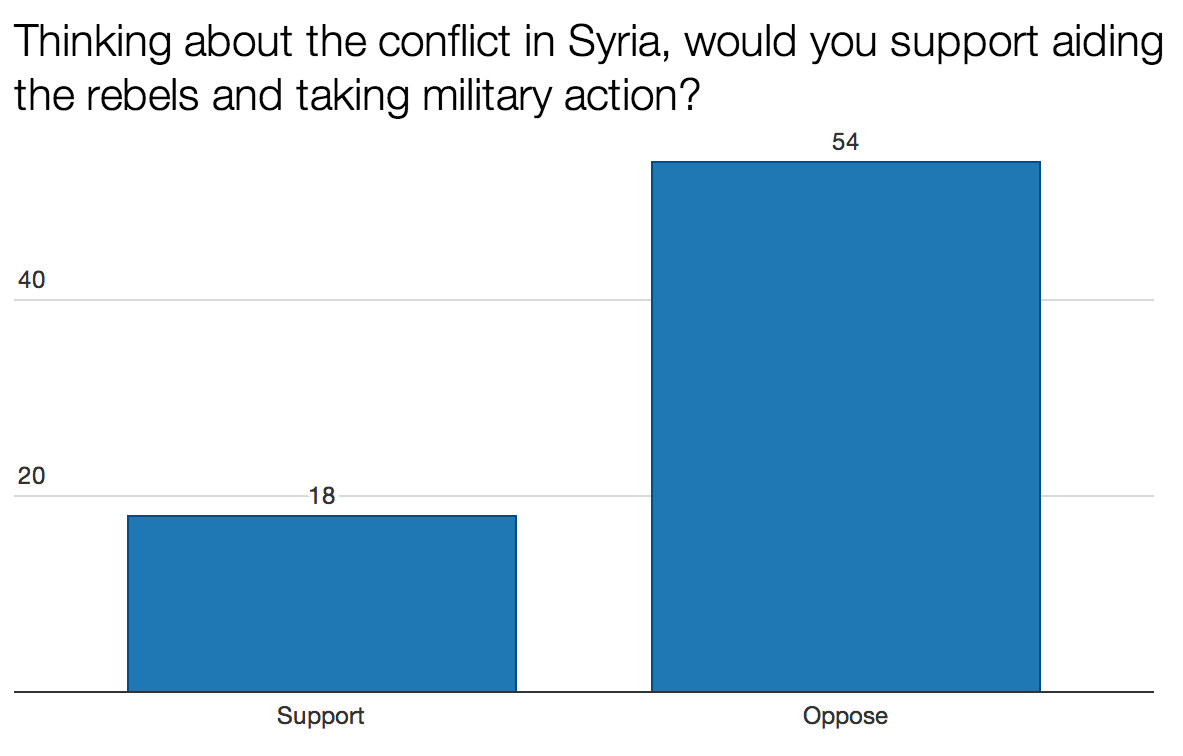
YouGov finds that Americans oppose intervention in Syria:

Syria Public Opinion

Jeffrey Goldberg thinks that Clinton’s remarks forced Obama’s hand:

From the president’s perspective, in fact, it would be best not to get involved at all. But the pressure on him this week became too much to bear. Former President Bill Clinton essentially called Obama a dithering coward because of his unwillingness to enter the Syrian conflict, and the intelligence community found evidence that Assad’s regime has definitively crossed the chemical weapons “red line” the president had spoken of — surely to his everlasting regret — last year.

Obama sees no clean way out, and no clear rationale for deepening U.S. involvement. He also sees a rebel coalition that is both dysfunctional and radicalized, and he knows that there is an outcome to this war that is worse than the continuation of Assad’s rule: the dissolution of the Syrian state and its replacement, in some locations, with al-Qaeda havens. Even an all-in move by Obama to make the rebels’ cause his own probably wouldn’t prevent the country’s collapse (it has, in fact, already collapsed as a unitary state). And he knows that if terrorist groups establish footholds in Syria — geographically close to our crucial allies, Jordan and Israel — he will have to act against them.

Matt Steinglass hopes that Clinton’s comments didn’t play a role:

I dearly hope that the policy documents the State Department is now drawing up regarding American military aid to Syrian rebel groups do not read “Goal: Keep POTUS from looking like a wuss.”

Larison rejects arguments, like Drezner’s, that Obama’s actions qualify as Realpolitik:

As long as the war goes on, the demands for “decisive” action will increase every week, and the administration has just decided to do something that is intended to prolong the war. Meanwhile, containing and limiting the effects of the war on Syria’s neighbors, which is what ought to matter far more to the U.S., will become more difficult as the U.S. directly contributes to regional instability. I suppose one could call this Realpolitik, except that it ignores U.S. interests, the stability and security of allies and clients, and commits us to the losing side in a civil war where we have nothing at stake. I wouldn’t expect this realist policy to please many realists.

Justin Logan agrees that intervention in Syria isn’t realist foreign policy in action:

I don’t think it’s right to read realists as advising Washington to fuel the Syrian civil war in the hopes of bleeding Hezbollah and Iran white. It’s this sort of operationally realist but strategically grandiose foreign policy that has given realism a bad name. Sometimes, in the name of conservatism and defraying the costs of war, realists advise deeply cynical policies that force those costs onto others. But in a similar spirit of conservatism, and indeed ethics, they tend to define the national interest in such a way that a profoundly secure country like the United States doesn’t have to do terrible things across the globe all the time.

Max Fisher doubts that giving the rebels small arms will accomplish much:

Rebel leaders say that small arms will do them little good and that they need heavier weapons. Whether or not greater U.S. involvement is a good idea, two things appear to be true: that the rebels are losing ground against Assad’s forces, backed by Iran and Hezbollah, and that small arms would not turn the tide.

Michael Weiss and Elizabeth O’Bagy are already calling for a no-fly zone:

Any swift and decisive decision to materially aid the Free Syrian Army will necessarily include degrading or destroying the runways and infrastructure of Syria’s military airbases and commercial airports. The fact is, Assad’s warplanes and helicopters aren’t just bombing rebel strongholds, civilian homes and bakeries, they’re also being used for domestic and international resupply efforts. Whenever the regime wants to bolster its conventional military presence in restive areas in the north or northwest of Syria, it dispatches reinforcements of crack troops via air transport. (Ground transport is still dangerous for Damascus given the supply routes now controlled by the rebels).

James Traub claims that Obama won’t commit American troops to Syria:

Obama has now crossed a line that he had hoped not to cross. Those who wish he had not done even that much will say that a slippery slope leads to U.S. boots on Syrian soil. That’s not a serious argument; this is a president who is focused on reducing American troop deployments, not finding new pretexts for combat. The real question is how much the United States and other outside actors can do to stop the killings, to force Assad to reconsider, to stabilize a region now facing the threat of sectarian war. You can’t help feeling that Obama is trying to simultaneously satisfy incompatible moral and strategic calculations. There’s a very real danger that he will fail on both counts.

And Josh Marshall comes out against intervention:

The only thing which gives me some pause are the advantages the US and US allies would gain by severing the Syrian-Iranian alliance. That’s a big thing. But to put it in really surgical terms, I think we’ve learned, at great pain and loss, that the US doing surgery on the Middle East creates scar tissue and complications way out of proportion to the hoped for gains.

Earlier reax here. My thoughts here and here.

What Do We Hope To Accomplish In Syria?

Prior to yesterday’s announcement, Marc Lynch asked, “What does it mean for U.S. policy to ‘work’ in Syria?” One strategy he outlined:

If Washington endorses the goal of bleeding Iran and its allies through proxy warfare, a whole range of more interventionist policies logically follow. The model here would presumably be the jihad against the Soviet occupation of Afghanistan — a long-term insurgency coordinated through neighboring countries, fueled by Gulf money, and popularized by Islamist and sectarian propaganda.

“Success” in this strategy would be defined by the damage inflicted on Iran and its allies — and not by reducing the civilian body count, producing a more stable and peaceful Syria, or marginalizing the more extreme jihadists. Ending the war would not be a particular priority, unless it involved Assad’s total military defeat. The increased violence, refugee flows, and regionalization of conflict would likely increase the pressure on neighboring states such as Turkey, Jordan, Lebanon, Israel, and Iraq. It would also likely increase sectarianism, as harping on Sunni-Shiite divisions is a key part of the Arab Gulf’s political effort to mobilize support for the Syrian opposition (and to intimidate local Shiite populations, naturally). And the war zone would continue to be fertile ground for al Qaeda’s jihad, no matter how many arms were sent to its “moderate” rivals in the opposition.

Quote For The Day

It’s from Juan Cole:

Clinton compared what the US could do in Syria to Ronald Reagan’s effort against the Soviets in Afghanistan in the 1980s. But that covert operation of giving billions of dollars and high-tech weaponry to Afghan jihadis was a huge catastrophe, contributing to the creation and rise of al-Qaeda and setting the background for the emergence of the Taliban. It surely would have been far preferable to let the Soviets try to build a socialist state in Afghanistan, as they tried in Uzbekistan. The whole thing would have fallen apart in 1991 anyway. (There is no truth to the notion that the Afghanistan war bled the Soviet Union or contributed to its collapse. Soviet military spending was flat in the 1980s). The Reagan jihad destabilized both Afghanistan and Pakistan and left us with a long term terrorism problem. We let the Soviets alone in Kazakhstan, and we never worry about today’s Kazakhstan.

You never, ever want to encourage the rise of private militias and flood a country with high-powered weaponry.

Unless you’re John McCain. What Bill Clinton did in backing McCain – and his wife’s neocon instincts – was a real case of the establishment fighting back. But that establishment – including both Clintons and McCain – backed the Iraq catastrophe. Funny they talk about Bosnia and Afghanistan in the 1980s but never mention that, isn’t it?

Obama’s Betrayal On Syria: Your Thoughts

SYRIA-CONFLICT

A reader writes:

I doubt the use chemical weapons was the sole “red-line”. My step brother is 82nd Airborne and he’s been drilling in preparation for Syria since last fall. I realize that sometimes we prepare for battles we’ll never fight. But he’s pretty certain we’re going in.

I’m with you – this is very concerning. I supported Afghanistan and the Iraq invasion. In retrospect, I believe invading Iraq was a mistake and not just because of the absence of WMD. On a larger scale, I believe the original sin in the War on Terror was the original authorization of the use of military force with no sunset provision or geographical limitation. We’ve decided to wage war against a tactic. I think that any president, regardless of party, will be tempted and strongly encouraged to maintain this perpetual war. And it is this perpetual war combined with advances in communication technology that is eroding our rights. As much as I respect Rand Paul, I wonder if even he could resist the temptation to continue this misbegotten war. No doubt Hillary will continue it. McCain would have continued it. And it’s no surprise to me that Obama has continued it. Only someone who can resist the temptation to punch back when we’re punched by radical islamist will stop this cycle. But I have no idea who that person is.

(To protect my step brother, please don’t publish my name … but I guess the NSA already knows.)

Another reader:

You asked: “Is there a conceivably dumber war to intervene in than Syria’s current civil one? I can’t see one.” I can: A war with Iran.  Consider this:

Right now Iran is going through their elections which have been widely derided as a “selection” because of the fraudulent nature of the whole process.  With the main opposition leaders silenced, this round may not turn into a rerun of the Green Movement but it’s definitely going to keep tensions simmering and probably stoke a fair amount of unrest.  In the past, one of the main ways that Iran has dealt with this is by playing around with its nuclear program and lambasting the West.

Now, suppose they follow that same script and Netanyahu starts to make noises towards military action against them.  In the past, Obama has been able to make the necessary promises to Netanyahu to stop him from being an idiot, but if Obama went back on his word in Syria because of the obvious quagmire, what assurance does Netanyahu have that Obama wouldn’t do the same thing to him?  It becomes much more likely for Israel to make a strike on Iran, and if that happens, we’d certainly get drawn in. I would submit that this is not at all a far-fetched possibility.

Another:

While I too don’t agree with arming Syria and ramping up our involvement there, one argument I’m not sure I see as being wholly relevant is your assertion that we shouldn’t be seen “(taking) a stand on the sectarian fault-line of the Muslim world and back one side over another.” This is true in principle, but in practice, our involvement in Syria isn’t what has already shown to the Arab world where we stand.

Who are the Shi’a’s in Syria that we are ostensibily fighting a proxy war against? Iran and Hezbollah. Does anyone really think that we weren’t already engaged in a shadow war with them? Through our loud support for Israel in the face of Hezbollah intimidation, through the sanctions we’ve inflicted on Iran, and our public assertions that we won’t tolerate them holding a nuclear program? Does anyone think that by having Saudi Arabia, Qatar, and Jordan as our three closest partners in the region that we haven’t already thrown in our hat with Sunni powers against Shi’a powers? Now, our complicated relationship with the Shi’a regime we helped prop up in Iraq complicates our relationship to the broader sectarian conflict, but no one has ever accused the United States’ relationship with the Middle East as not being rife with contradictions.

I think that arming the Syrian rebels is a mistake that opens the door for further mission creep, and that we are trying to take control of a situation we have no way of controlling. However, I don’t think that arming the rebels says anything new about our take on the game of power politics going on in the region. On the side of Assad are Iran, Hezbollah, and a Russian government that has actively sought to undermine our diplomatic initiatives. It won’t break new ground to say that we are coming out on the side of the Syrian rebels in this sectarian war when that has been the policy all along. It’s a different strategy, but it’s a policy shift meant to achieve the same ends that we’ve been actively pushing for behind the scenes for two years.

Another:

I found Bill Clinton’s comments on Syria yesterday shocking – feckless, narcissistic and condescending. He actually compares Syria to Afghanistan in the ’80s, as an argument for intervention, implying that if we’d only handled the war’s aftermath better, we wouldn’t have ended up with the mess that was a Taliban-run fundamentalist state and a murderous Al Qaeda led by our former BFF Osama bin Laden. It boggles the mind.

Another disagrees with my stance:

You make it sound as though President Obama just ordered 500,000 troops to parachute into Damascus by noon tomorrow. As far as we know, he has only agreed to ship arms – guns and stuff – to the ragtag Syrian rebels. I’m as wary of Middle Eastern involvement as you. However, if there’s ever a time to intervene in such a God-forsaken place, it’s when a dictator is using chemical weapons against his own people. That is evil and brutal by any calculation. Personally, had I been in the Oval Office, I would have ordered Daisy Cutters into the bedroom windows of every presidential palace in the country. Shipping a few thousand M16s and hand grenades? Humanitarians should be outraged at the flaccidity of this response.

Obama is not stupid. He knows his public is war weary and not willing to get embroiled in another Middle East quagmire. But he also knows that the killing in Syria is fundamentally, morally wrong. Still, this looks to me like a half-measure.

Am I all that thrilled about it? Nope. But I also recognize that there comes a time when a President believes that some level of intervention is the right – or the human – thing to do. He drew a line in the sand (at chemical weapons!), and is now tip-toeing into something that can be construed politically as action. I am only sad for the innocent men, women and children, who have been gassed by their own leader, for whom this “betrayal” you speak of is far too little, too late. I fear that this won’t change a thing in Syria, let alone the evil bastard who currently runs that shadow of a nation-state.

Of course, there may be a political calculus here: The McCain Wing of the GOP (whose fissure with the Rand Paul faction is turning into a full blown fault line by the day) has been screaming at him to “arm the rebels” since long before the election. Now he can say, “What else do you want? American boots on the ground? Really?” Is there some meep-meep potential here?

Another is also trying to stay positive:

Let me be clear that this is a reading based on hope, and that I think your reading of a slow cave to the imperialists is as likely or more likely to be the accurate one. The hopeful look for Obama is that he sees diplomacy and force through a completely different lens than the Bush administration did (and than Clinton and McCain do). Under Bush, diplomacy was a fig leaf. It was something you did in order to check the “tried diplomacy?” box before going to the UN and declaring that you were engaging in warfare after having “exhausted all other options” or some other white lie. All of the real action happens with boots on the ground, and if you don’t push over a government or kill some people, then nothing real happened.

If Obama is different, and I still have some hope that he is, force is a very heavy and unwieldy tool in the diplomat’s toolbox. Diplomacy, rather than a fig leaf, is the primary channel through which everything else, including force, operates. In the chess game that is trying to unwind the conflict in Syria, arming the rebels is akin to advancing the bishop into an attacking position. It’s something you don’t do lightly, but it’s also not the endgame.

If this reading is right (and again, I’m not convinced it is), then what Obama is doing is undergirding the credibility of the “credible threat of force” stick without overcommitting it, with the end goal remaining a diplomatic solution. I don’t agree with this tactic, and I don’t like it at all, but in it I see some hope that this isn’t the beginning of another imperialistic adventure.

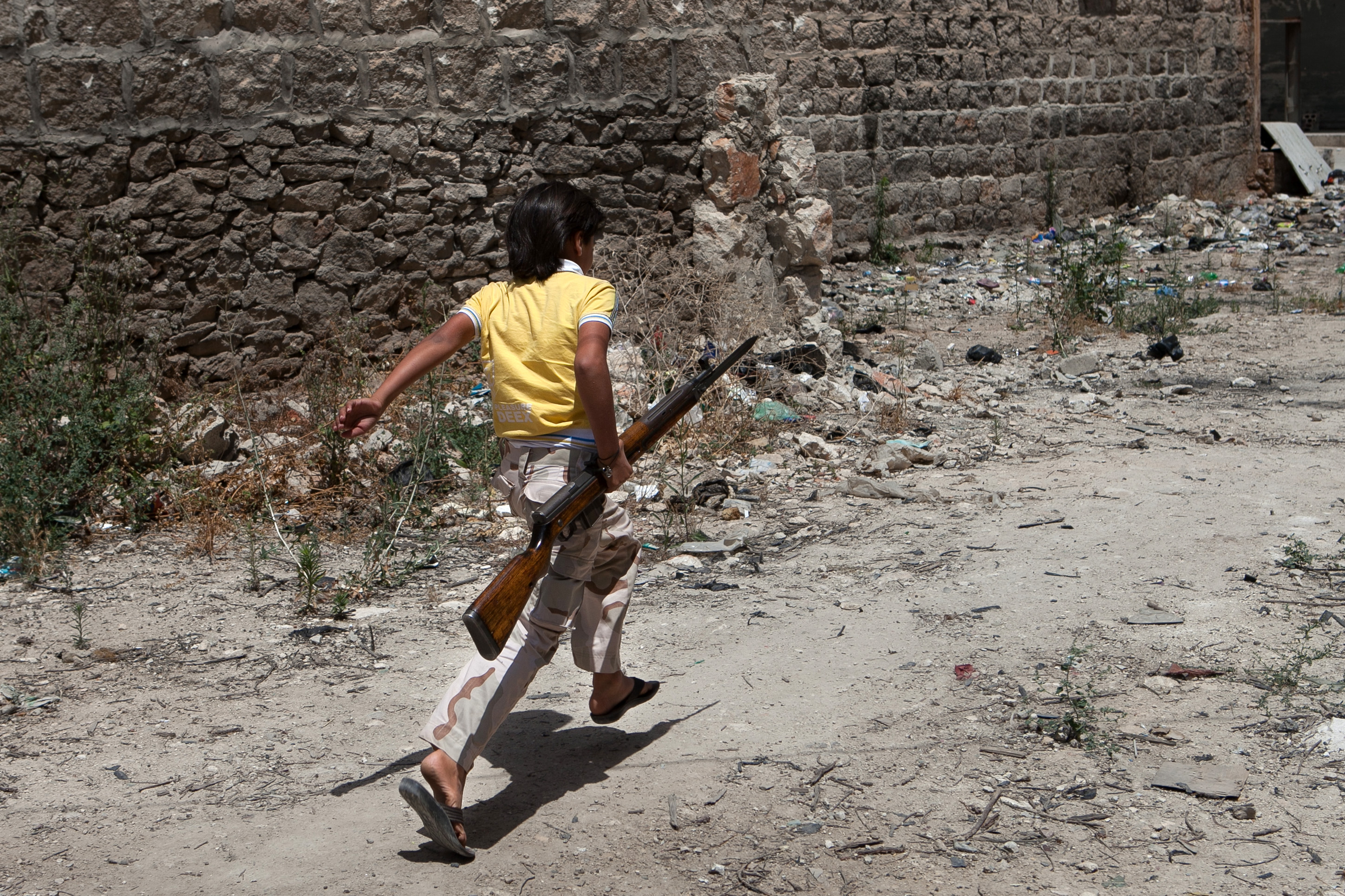
(Photo: A Syrian young boy runs holding an old rifle as he helps fighters belonging to the ‘Martyrs of Maaret al-Numan’ battalion on June 13, 2013 in the northwestern town of Maaret al-Numan in the Idlib province. By Daniel Leal-Olivas/AFP/Getty Images)