Bill O’Reilly’s Dumb Plan To Defeat ISIS

Oreilly

Oy vey:

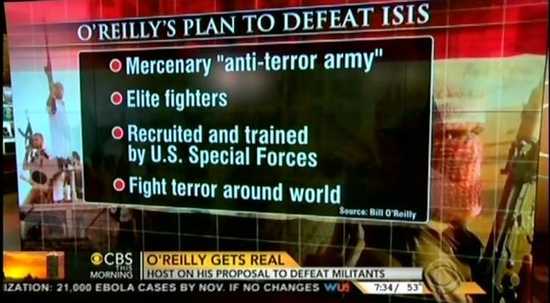
[O’Reilly] knows advocating for American troops to take up the fight themselves is extremely unpopular. O’Reilly, problem solver that he is, has a solution: “elite fighters who would be well paid, well trained to defeat terrorists all over the world.” Since that worked so well in Iraq last time around. What we need is more Blackwater. In the O’Reilly fantasy, the 25,000-person force would be English-speaking, “recruited by the USA and trained in America by our special operations troops,” and dubbed “the Anti-Terror Army,” because the Avengers is already taken.

Allahpundit dismantles O’Reilly’s pipe dream:

The flaw is that there’s no obvious next step if the mercenaries succeed in routing ISIS from Raqqa and eastern Syria. Who takes over and rules that half of the country if that happens? Assad? He’ll butcher the Sunni civilians there and the Sunnis know it. A new sectarian rebellion against the regime would spring up overnight. Some sort of multinational Sunni force of Saudi, Turkish, and Jordanian troops? Iran will never let the Saudis have that kind of foothold, and besides, none of those countries want the headache of pacifying radicalized Sunni Syrian civilians. NATO doesn’t want it either, of course; an army of western peacekeepers would be even more culturally estranged from Syrian Arabs than a multinational Sunni force would.

The theoretical virtue of Obama’s “arm the Syrian moderates” plan is that if the moderates were to defeat ISIS, they’d be comparatively well positioned to take over as rulers of eastern Syria. They’re natives and they’re Sunnis; they’re probably acceptable to the locals. But of course, the moderates aren’t going to defeat ISIS, which puts us back at square one.

(Image via Barbara Morrill)

A Hundred Thousand Displaced

TURKEY-SYRIA-KURDS-REFUGEES

The Guardian explains how this state of affairs came to be:

The border region of Kobani, home to half a million people, has held out for months against an onslaught by Islamists seeking to consolidate their hold over swaths of northern Syria. But in recent days, Isis extremists have seized a series of settlements close to the town of Kobani itself, sending as many as 100,000 mostly Kurdish refugees streaming across the border into Turkey. “I don’t think in the last three and a half years we have seen 100,000 cross in two days,” the representative for the UN refugee agency (UNHCR) in Turkey, Carol Batchelor, told Reuters. “So this is a bit of a measure of how this situation is unfolding, and the very deep fear people have about the circumstances inside Syria and, for that matter, Iraq.”

A Kurdish commander on the ground said Isis had advanced to within 9 miles (15km) of Kobani. A Kurdish politician from Turkey who visited Kobani on Saturday said locals told him Isis fighters were beheading people as they went from village to village. “Rather than a war this is a genocide operation … They are going into the villages and cutting the heads of one or two people and showing them to the villagers,” Ibrahim Binici, a deputy for Turkey’s pro-Kurdish People’s Democratic party (HDP), told Reuters.

Juan Cole marvels, “I lived to see the day when thousands of Kurds take refuge in Turkey”:

For anyone who knows the history of the Turkish government’s dirty war against Kurdish separatists in the 1970s and 1980s, it is a startling reversal to see Syrian Kurds flooding for refuge into Turkey. The influx was not smooth and Turkish security did at points try to stem it. But actually Turkey has something like a million Syrian refugees already.

The Kurds have since halted ISIS’s advance, it seems. Meanwhile, Aki Peritz doubts the US has the political will to defeat ISIS:

[I]t remains unclear whether America has the popular stamina to take on this group for what clearly will be a years-long struggle. The latest polling from the New York Times and CBS News show clear majorities approving airstrikes against ISIL fighters in both Iraq and Syria, but only 48 percent of Americans are in favor of training and providing military equipment to rebels in Syria—the fighters who would actually have to hold the ground presumably vacated by ISIL. Congress may have given President Obama the green light to arm the rebels, but it’s not clear the American people are behind him.

As the United States expands its air campaign and put more “advisers” on the ground in and around Iraq, will Americans continue to support this effort – and probable casualties? After all, without sustained public support, any extended military campaign is doomed to fail. And people are anxious about the lengthy time horizon: Some 83 percent of Americans are either “very concerned” or “somewhat concerned” with a long and costly involvement in Iraq and Syria.

Josh Rogin and Eli Lake examine the administration’s “mission to build an ISIS-killing army in Syria”:

Many lawmakers don’t see how training 5,000 Syrian rebels a year, assuming trustworthy, vetted brigades can be found, can defeat an ISIS army that the CIA estimates may already have 31,000 fighters and growing. “The goal is not to achieve numerical parity with ISIL, but to ensure that moderate Syrian forces are superior fighters trained by units,” Hagel said.

Even some lawmakers who support the plan don’t believe the administration’s claims that the Syrian rebels will only fight ISIS after being trained by the U.S., rather than focusing on their real enemy, the regime of Syrian President Bashar al-Assad. After all, that’s what the FSA is saying openly it plans to do.

Larison rolls his eyes:

No one seriously thinks that arming and training a few thousand rebels will make much of a difference or do much good, but it is the relatively risk-free option (for Americans) that provides a temporary sop to insatiable hawks while also providing cover for fence-sitters that want to be considered “serious” on foreign policy without having to take big political risks by backing more aggressive measures. Finally, many members of Congress endorsed this policy just so that they could get it off the agenda before the elections, so majority support in Congress for arming Syrian rebels may be shown to be illusory much sooner than we might have guessed.

(Photo: Syrian Kurds wait near Syria’s border at the southeastern town of Suruc in Sanliurfa province, on September 20, 2014. Tens of thousands of Syrian Kurds flooded into Turkey on Saturday, fleeing an onslaught by the jihadist Islamic State group that prompted an appeal for international intervention. By Bulent Kilic/AFP/Getty Images)

An Actual War On Women, Ctd

Ariel Ahram goes deep in exploring ISIS’s use of sexual violence, arguing that it represents “as much an undertaking in state-making as in war-making”:

The power to control or manipulate sexual and ethnic identity is a key component of all state power. In the Middle East, the regulation of sexual relations is often used as a means to create or reinforce ethno-sectarian boundaries.

In the 19th century the Ottoman authorities prohibited marriage between Shi’i men and Sunni women in the provinces of Iraq for fear that Shi’i Iranians were gaining a demographic foothold in the region. Since Islamic law privileges male prerogative over children, the move was meant to block the propagation of Shi’ism within the Ottoman domain. Marriage of Shi’i women to Sunni men was still permitted, since the children of such a union were deemed Sunni. Saddam Hussein took similar measures in the 1970s and 1980s. In late 1970s, in the immediate wake of the Islamic Revolution in Iran, the government moved to deport some 40,000 people deemed to be of “Iranian” (i.e., Shi’i) origins.  Thousands of families were interned in prison or prison camps for months, where they were subject to rape and torture, before being transported to the border. …

ISIS’s violence is a heinous crime of war, but also represents a particular form of statecraft. At first glance, it might appear that these practices, though justified by selective interpretations of Islamic law, serve only to satisfy prurient sexual urges. Much like its manipulation of water and oil resources, though, ISIS’s use of sexual and ethnic violence has both ancient and modern antecedents. By selectively reinforcing, creating, and severing ties of kinship, these violent practices can affect bonds of loyalty and obedience far more substantially than the simple distribution of resource rents.

Thirteen Years Of Strategery

IRAQ-CONFLICT

Micah Zenko calls out Obama’s strategy against ISIS as another example of “political leaders presenting totally unrealistic and implausible end states”, which has been a hallmark of US counterterrorism since 9/11:

Given that two administrations have failed to achieve their end states of defeating the Taliban and al Qaeda and its affiliated organizations, we should be extremely doubtful of the Obama administration’s strategic objective of destroying IS or its ability to threaten the United States or any of the world’s 1.6 billion Muslims. Furthermore, it is difficult to ascertain what the Obama administration has learned from the total failure to eliminate the Taliban and al Qaeda and all affiliates. Based upon White House statements, it appears that its sole lesson from the post-9/11 era is to avoid massive ground invasions, and to emulate the policies from Yemen and Somalia, which again, according to U.S. government data, have not worked.

On Friday, Pentagon spokesperson Rear Admiral John Kirby was asked how IS would be destroyed, beyond airstrikes and supporting partners on the ground. He replied: “It also is going to take the ultimate destruction of their ideology.” If this is truly the ultimate pathway for IS’s destruction, then it was strange that it did not appear anywhere in President Obama’s strategy speech. Furthermore, altering the interpretation that others hold of a religious ideology is something that governments are really bad at.

A million amens to that. Meanwhile, Allahpundit responds to the CIA’s pessimism about arming the Syrian rebels:

Increasingly, I think this whole arm-the-rebels plan is just a perfunctory mad-libs answer to an obvious question about O’s ISIS strategy.

Everyone understands that we can put a hurt on them from the air; we can probably also pull together a force in Iraq between the Iraqi army and the peshmerga to push ISIS back into Syria. But what happens then? If the plan is to destroy them, how do we get them once they’re back inside their home base and hunkered down in Syrian cities? We don’t. In reality, we’re practicing a containment strategy, the first step of which is to shove ISIS out of Iraq and the second step of which is to drone their key leaders and terror camps once they’ve returned to Syria. Destroying ISIS will be left to the Shiites who are really motivated to do it, be it Assad, Iran, Hezbollah, or, most likely, Shiite militias from Syria and Iraq. This FSA pipe dream is less an actual plan than a rhetorical one, so that O has an out-of-the-box answer handy when someone asks him “Who’s going to fight our battle in Syria?” What’s he supposed to say, “Shiite death squads”? That may be the correct answer but it’s not a politic one.

Discussing the CIA’s recently revised estimate of how many fighters ISIS has, which rose dramatically from 10,000 to somewhere between 20,000 and 31,500, Carl Bialik points out how hard it is to count them:

Intelligence experts outside the CIA cast some doubt on the precision of the estimate. Michael O’Hanlon, a senior fellow at the Brookings Institution, a centrist think tank in Washington, said even the wide range of numbers may understate the uncertainty in the count. “I’d say the estimates are no better than +/- 50%,” O’Hanlon said in an email. Anne Stenersen, a research fellow at the Norwegian Defence Research Establishment in Kjeller, Norway, said the accuracy of the estimates depends on the CIA’s sources. “For a country like Afghanistan, I would trust their estimates because they have access to many different sources on the ground,” Stenersen said in an email. “In Iraq/Syria and for a group like ISIS, it is really hard to know where they get their numbers from, and how reliable they are.”

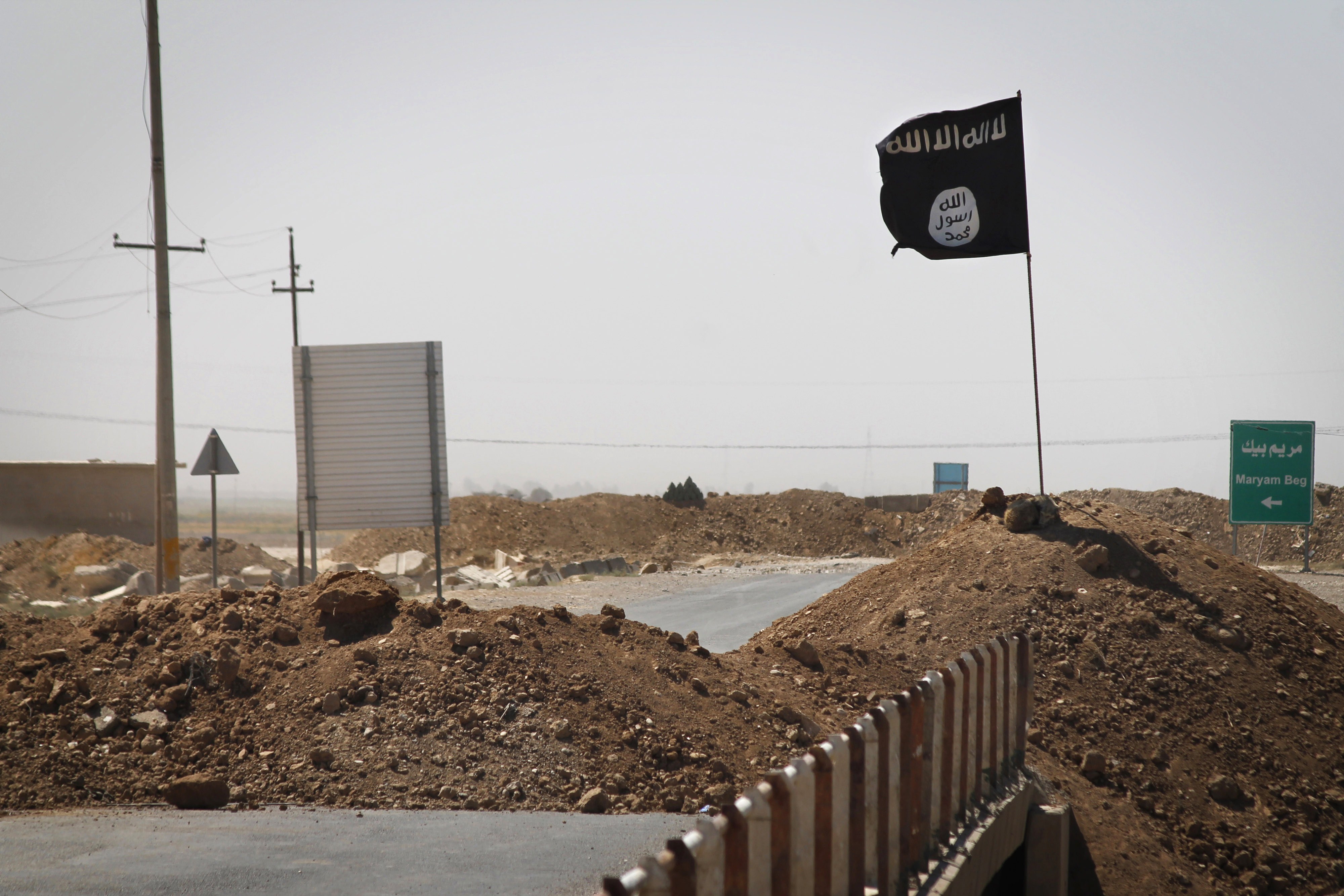
(Photo: A flag of the Islamic State (IS) is seen on the other side of a bridge at the frontline of fighting between Kurdish Peshmerga fighters and Islamist militants in Rashad, on the road between Kirkuk and Tikrit, on September 11, 2014. By JM Lopez/AFP/Getty Images)

ISIS’s War Games

Murtaza Hussain introduces the jihadists’ latest propaganda innovation, which looks to court fans of the Grand Theft Auto video game series:

A new video purportedly released by supporters of the group to Arabic language news media appears to show Islamic State, or ISIS, propaganda mocked up in the style of the popular “Grand Theft Auto” franchise. The video shows footage of explosions, sniper rifle attacks and drive-by shootings all rendered in the style of the GTA series. Arabic commentary included as subtitles contain quotes along the lines of targeting U.S. forces and “the Safavid Army”, a reference to Iranian or pro-Iranian forces. They also show images of an assault rifle riddling a police car full of bullet holes — a scene that would not be altogether unfamiliar to Grand Theft Auto players. …

Though the new video appears to constitute a trailer, there’s no indication yet that a real, playable game is in the offing anytime soon. Nonetheless, coupled with the group’s release yesterday of a new propaganda trailer directed at the United States, it appears that the ISIS media war is continuing to evolve in new and weird directions.

But the viewer is clearly meant to understand that the “real, playable game” is available only in Iraq and Syria. At least, that’s what Jay Caspian Kang suspects:

The similarities between ISIS recruitment films and first-person-shooter games are likely intentional. Back in June, an ISIS fighter told the BBC that his new life was “better than that game Call of Duty.” Video-game-themed memes traced back to ISIS have been floating around the Internet for months, including one that reads, “THIS IS OUR CALL OF DUTY AND WE RESPAWN IN JANNAH.” (“Respawn” is the gamer word for reincarnate.) Another ISIS video, as the Intercept notes, looks like a deliberate homage to Grand Theft Auto. Audio clips that sound much like ones in Call of Duty have been spliced into other ISIS videos. Many of the ISIS recruitment videos are dedicated to showcasing rocket launchers, mines, and assault rifles, as if to say, “If you join us, you’ll get to shoot these things.” …

In their recruitment of Western jihadis, ISIS has used a broad, pop-culture-laden campaign that seems to be aimed at turning what once might have been a radical religious message into something more worldly. During the World Cup, an ISIS Twitter account posted an image of a decapitated head with the message “This is our football, it’s made of skin #WorldCup.” That ISIS would try to access Western kids through such avenues speaks to a deep cynicism that discards the religious and the political for adrenaline and gore.

This Is What Passes For A War Authorization These Days

Yesterday, the House voted 273-156 to let the president arm the “moderate” Syrian rebels to help fight ISIS:

The administration’s request was an amendment to a must-pass, stopgap measure to keep the government running through mid-December. Although the amendment had the early support of House Speaker John Boehner, R-Ohio, and House Minority Leader Nancy Pelosi D-Calif., a number of lawmakers in both parties began defecting, prompting a last-minute push by party leaders to build support.

New York’s Steve Israel, chairman of the Democratic Congressional Campaign Committee, said a range of top Democrats worked to the last minute to gather votes for the president’s plan, which would train some 5,000 Syrian rebels in the first year at facilities in Saudi Arabia. … Having secured approval in the House, the bill now moves to the Senate, where it may receive a skeptical reception. In testimony Wednesday before the Senate Foreign Relations Committee, Secretary of State John Kerry came under intense questioning about the White House’s plan to train and equip moderate Syrian rebels.

The idea is as doomed now as it long has been. The US trained the entire Iraqi army in country for years – and they still scarpered. The problem is political; almost certainly unsolvable except in the long run by the parties themselves; and made utterly solvable by US intervention. The Senate is set to vote on the measure today. Weigel notes who voted “aye”:

Everybody in competitive races. Georgia Rep. John Barrow, Minnesota Rep. Collin Peterson, and West Virginia Rep. Nick Rahall are among the very last Democrats in districts that voted for the Romney-Ryan ticket in 2012. They went “aye.” So did Iowa Rep. Bruce Braley and Michigan Rep. Gary Peters, both Senate candidates in tough races. On the Republican side, Senate candidates Tom Cotton and Steve Daines voted “aye,” as did Colorado Rep. Mike Coffman and Florida Rep. Steve Southerland. They’re the only two Republicans in seats that appear now to be toss-ups, with strong Democratic challengers cutting through the headwind.

Most Democratic leaders. The top three Democrats in the House — Nancy Pelosi, Steny Hoyer, and Jim Clyburn — were ayes, as was DNC Chairwoman Debbie Wasserman Schultz. The only leadership figure to break with the president was Maryland Rep. Chris Van Hollen.

Every Republican leader. From John Boehner to the deputy whip team, the GOP was on board.

And Alex Rogers relays what the “nays” had to say:

Lawmakers who opposed the bill said the President’s strategy to arm so-called moderate Syrian rebels is misguided. The Obama Administration is hoping these fighters can help beat back the militant group Islamic State of Iraq and Greater Syria (ISIS). “I’ve never been satisfied that we’re not going to end up fighting people that we’ve armed at some point in the future,” Representative Mick Mulvaney, Republican of South Caroline, said. “No one ever defined victory to me that made any sense whatsoever.”

The bill even lost the support of Representative Chris Van Hollen, Democrat of Maryland, a top Democratic leader. “I support the President’s overall strategy; I support what he’s doing in providing air support for the Iraqi forces and the Kurdish rebels,” Van Hollen said. “I have misgivings about this piece because the priority of the so-called Syrian rebels is to defeat [Syrian strongman Bashar] Assad. And I understand that, but it’s hard at this point to see how defeating Assad strengthens the mission against ISIS.”

To Allahpundit, the vote doesn’t look like such a ringing endorsement:

Here’s the roll. Obama ended up getting many more Republican votes than Democratic ones (159 versus 114), including Kevin McCarthy, Steve Scalise, and Paul Ryan. It was tea partiers like Justin Amash, Michele Bachmann, and Louie Gohmert who ended up in the opposition. Truth be told, though, no faction within the House is keen on O’s train-the-rebels strategy; this resolution, in fact, will expire on December 11th, the same day that the new continuing resolution would expire. What the two sides are doing here is simply punting the issue until after the midterms, when the GOP won’t have to worry about any electoral blowback if they try to block O on a war effort that’s surprisingly popular for the moment.

Ryan Grim and Sam Stein pick up chatter in Washington that the CIA, which already tried arming the rebels, is not too sanguine about trying again:

One Democratic member of Congress said that the CIA has made it clear that it doubts the possibility that the administration’s strategy could succeed. “I have heard it expressed, outside of classified contexts, that what you heard from your intelligence sources is correct, because the CIA regards the effort as doomed to failure,” the congressman said in an email. “Specifically (again without referring to classified information), the CIA thinks that it is impossible to train and equip a force of pro-Western Syrian nationals that can fight and defeat Assad, al-Nusra and ISIS, regardless of whatever air support that force may receive.”

He added that, as the CIA sees it, the ramped-up backing of rebels is an expansion of a strategy that is already not working. “The CIA also believes that its previous assignment to accomplish this was basically a fool’s errand, and they are well aware of the fact that many of the arms that they provided ended up in the wrong hands,” the congressman said, echoing intelligence sources.

Francine Kiefer notes that the procedure the House followed allowed a fair amount of debate over the amendment:

For surer passage, the White House wanted the Syria authorization and the spending bill, known as continuing resolution, to be one piece of legislation. No one would want to shut down the government, and so Syria would pass. But House members strenuously objected: Because of its seriousness, Syria deserved to be debated and voted on separately. Leadership listened. Members got six hours of debate and a vote, passing the amendment 273 to 156. Then the amendment was attached to the spending bill and voted on as a package. It passed 319 to 108.

Alas, for procedural reasons, senators will not have that option and will have to vote on the welded package sent from the House. Some senators plan to vote no, but it is expected to pass.

By the way, Senator Tim Kaine has drafted an actual war authorization, but Waldman doubts it will go anywhere:

[E]verything Obama says he is committed to is incorporated in Kaine’s proposal. It even leaves the 2001 AUMF in place, which is either a sensible choice allowing for flexibility in fighting terrorism or a loophole you could drive a truck through, so long as the White House maintains that ISIS and al Qaeda are allied. Will it go anywhere? It may be too soon to know, but I’m guessing that the White House will say, privately if not publicly, that they don’t want to “tie the president’s hands.” Democrats will be responsive to that pressure (if it comes) from the White House, while Republicans will probably be uneasy about anything that could constrain the war-making ability of this president or a future one.

And the beat goes on …

An Actual War On Women

Aki Peritz and Tara Maller want to know why ISIS’s use of rape and sexual slavery as weapons of war isn’t getting more press:

The Islamic State’s (IS) fighters are committing horrific sexual violence on a seemingly industrial scale: For example, the United Nations last month estimated that IS has forced some 1,500 women, teenage girls, and boys into sexual slavery. Amnesty International released a blistering document noting that IS abducts whole families in northern Iraq for sexual assault and worse. Even in the first few days following the fall of Mosul in June, women’s rights activists reported multiple incidents of IS fighters going door to door, kidnapping and raping Mosul’s women.

IS claims to be a religious organization, dedicated to re-establishing the caliphate and enforcing codes of modesty and behavior from the time of Muhammad and his followers. But this is rape, not religious conservatism. IS may dress up its sexual violence in religious justifications, saying its victims violated Islamic law, or were infidels, but their leaders are not fools. This is just another form of warfare.

Even women and girls who escape these horrors still face sexual exploitation in refugee camps. Chandra Kellison reports on what she observed while working with Syrian refugees in Lebanon this summer:

Three-quarters of those displaced in Lebanon are women and children who have lost a family member to war and remain vulnerable inside and outside of their new community. A generation of Syrian kids have the far-away gazes of battle-hardened soldiers returning from war. Displaced girls, especially, face the triple jeopardy of war, domestic violence and attacks from neighboring men. Only the immediate threat of war diminishes during the journey from Damascus to Beirut. Their new normal is neighbors, single women, engaging in survival sex with a series of resourceful men and widows pretending to call husbands who are really dead, all in a bid to seem less vulnerable to kidnappers, harassers, and attackers in their Lebanon. …

Not even the most fertile imagination could have conjured a better monster-in-the-dark than IS. The Brothers Grimm could not compete with stories spreading from city to city of savages that force children to use severed heads as soccer balls. By comparison, the terror caused by IS had reduced the perceived danger of a few opportunists who punch down the dignity and emotional integrity of refugee women and girls through offers that cannot be refused, because the needs of their families are too dire.

Counterterrorism, Containment, Or Conquest?

Juan Cole argues that containment is the superior strategy for answering the challenge posed by ISIS, noting that “the most effective campaigns in which the US air force has been involved have been more or less defensive”:

A minimalist, defensible position for the US could have been to say that the US will intervene aerially to ensure that Erbil and Baghdad don’t fall, but that recovering the Sunni Arab areas that Nouri al-Maliki had alienated was up to Iraqi politicans and forces. And a minimalist strategy could have simply ignored the Syrian side of the border. It is true that ISIL has a big base in Raqqah and uses its Syrian assets to support its operations in Iraq. But ISIL successes in Iraq were in any case not mainly military but rather political. Since this is so, the military position of ISIL in Syria isn’t really so central to its taking of Mosul, Tikrit, etc. Nor would holding Raqqah help it to hold Mosul if Mosul turned against it.

The US was very good in the Cold War at containing Stalinism but very bad at defeating a guerrilla group like the Vietcong. It was the former that mattered in the end.

He’s right. And I say that not from any ideological position, but simply by observing US policy failure this past decade. To try and do the same thing again when it didn’t work before is the mark of insanity.

Meanwhile, former congresswoman Jane Harman wants to go to war with the ideology of extremism rather than the terror groups themselves:

What’s much more challenging is to confront—and defuse—the ideologies that underpin these groups. The jargon for this is “countering violent extremism” (CVE), a crucial part of the strategy that’s underfunded and hard as all get-out to accomplish. If we lump both al Qaeda and ISIL into one bucket labeled “terror,” we’ll never pull it off.

An example: The State Department recently put out an exceptionally violent video that used some of ISIL’s own promotional materials. The point was to highlight that Abu Bakr al-Baghdadi’s thugs kill Muslims—which is an important point to make. Osama Bin Laden cautioned ISIL’s ancestor, al Qaeda in Iraq, that its slaughter of fellow Muslims made for bad optics. But what might have worked against al Qaeda won’t necessarily work against this new enemy. ISIL glamourizes violence, the notion that its caliphate is worth dying and killing for. The group celebrates death. We need to undermine that pitch with a positive narrative, not amplify its negatives.

Paul Pillar cautions against returning to “war on terror” rhetoric:

Names matter, even if it is not so much the term itself but associated concepts that dominate public discourse and thinking. To the extent that efforts to curb the expansion of ISIS are thought of as War on Terror II, this has unfortunate effects, including the mistaken belief that seizure of territory in the Middle East constitutes a terrorist threat to the United States, and insensitivity to counterproductive effects of the use of military force.

The Obama administration isn’t calling its effort War on Terror II, because it does not want to be seen as copying the approach and the mistakes of its predecessor. Whatever the administration’s motives, eschewing the war metaphor is good for public understanding. What the United States is doing against ISIL is a continuation—albeit more intensively for right now, because of the public alarm—of counterterrorism that has been going on for a long time and, unlike wars, will not end.

And J.M. Berger and Jessica Stern find it “hard to escape the feeling that our policies still come from the gut, rather than the head”:

Bin Laden once said, “All that we have to do is to send two mujahideen to the furthest point east to raise a piece of cloth on which is written al Qaeda, in order to make the generals race there.” Abu Bakr al-Baghdadi, the emir of ISIL, may be counting on just that response, and for the same reason—to draw the United States into a war of supreme costs, political, economic and human.

A limited counterterrorism campaign may insulate us from those costs, but it is not likely to be sufficient to accomplish the goals laid out by the president. ISIL is a different enemy from al Qaeda. It has not earned statehood, but it is an army and a culture, and more than a traditional terrorist organization. Limited measures are unlikely to destroy it and might not be enough to end its genocidal ambitions. Our stated goals do not match our intended methods. Something has to give—and it’s probably the goals.

Obama vs The Obama Administration On War

Could the messaging get any worse? Eli Lake and Josh Rogin wonder how the president will maintain his light-touch approach to fighting ISIS when his people, specifically his top military brass, keep hinting that they favor a more direct intervention:

The internal dissent is likely to intensify with Obama’s choice of John Allen to lead the international campaign to persuade U.S. allies to pony up troops, money, and arms for his new war. Allen, a retired general beloved by Washington’s neoconservatives, has called for a robust U.S. war against ISIS since June. Obama and Allen sat down together Tuesday at the White House. Soon after he retired in 2013, Allen took a veiled shot at his old and now new boss, observing that in the wake of Obama’s withdrawal from Iraq, “the body count is going up, the bloodletting is going up.”

As the details of the president’s new war plan leak out this week, many of Allen’s former colleagues and lawmakers wonder whether the president’s new special envoy will be able to convince Arab and European states to get behind a strategy they see as amounting to a half-measure.

Friedersdorf points out that if Obama didn’t want his administration going off-message and calling for more war, he shouldn’t have staffed it with hawks:

That momentum would build behind war is no fluke. What else did Obama expect when he staffed his entire administration with hawkish Iraq War proponents? Any attempt to measure the momentum for war must include Defense Secretary Chuck Hagel calling ISIS “beyond anything we’ve ever seen,” heated rhetoric from Secretary of State John Kerry, and Vice President Joe Biden vowing that the United States will follow ISIS “to the gates of hell.” Former Secretary of State Hillary Clinton has also been a prominent hawk. This is not a surprise. Obama elevated a faction of hawkish Democrats, despite purporting to believe that they all favored a “stupid” war. Little wonder that elites seem so overwhelmingly in favor of intervention.

Mark Thompson thinks Dempsey’s statement yesterday was telling:

[W]hile he caveated what he told the panel about the escalating fight with the Islamic State in Iraq and Greater Syria, his message was clear: if the U.S.-led effort to defeat ISIS and oust it from its self-proclaimed Islamic State straddling the Syrian-Iraq border falls short, Dempsey will go back to the Oval Office and ask Obama for a green light to send at least a limited number of American ground-combat forces to help get the job done.

What was striking was how he delivered the message. Pentagon officials are forever saying they won’t speak in “hypotheticals”—things that might happen in the future—yet Dempsey dropped an atomic what-if into his opening statement. “If we reach the point where I believe our advisers should accompany Iraq troops on attacks against specific ISIL targets,” he said, “I’ll recommend that to the President.”

And to Zack Beauchamp, it indicates that our commitment in Iraq and Syria could easily snowball:

Obama has final say on America’s Iraq policy and is free to reject Dempsey’s “recommendation” to send troops into combat. Given the president’s wariness about ground wars after George W. Bush’s Iraq War and Afghanistan, and his own consistent promise to the American public, he might reject any plan to send US troops into a direct combat mission. But here’s the third thing: this war is escalating quickly. We went from a targeted mission to protect American citizens in Kurdistan and save Iraqi Yazidis from genocide to a full-scale mission to destroy ISIS in both Iraq and Syria in the span of, roughly, a month. Despite his promises, Obama did indeed consider sending ground troops into combat to rescue Yazidis trapped on a mountain.

Internal pressure from leading advisers like Dempsey could very well push the president towards even larger escalations. So, too, could the internal logic of war.

And Obama appears as if he is a spectator to this dangerous escalation – not someone strongly tamping it down. I fear he has lost control of events – by attempting to appease them.

Searching For A Defense Of Obama’s “Strategy”

US-POLITICS-CLINTON

Yishai Schwartz offers up one, arguing that the president’s approach to ISIS has been perfectly coherent, and not just a reaction to the beheading videos or polls:

Obama began ramping up interventions in Iraq well before these murders, and he did so in response to substantive strategic realities. It was in mid-June that Islamic State militants routed the far larger and better-equipped units of the Iraqi army. Only days later, reports began to surface that President Obama had offered air strikes in support of the Iraqi military, but made them conditional on Prime Minister Nouri al Maliki’s resignation. On August 7, IS militants seized the crucial Mosul Dam.

The same day, profound humanitarian and strategic considerations forced President Obama to compromise somewhat on pressuring Maliki, as he authorized his first air strikes to protect the besieged Yezidi population and to bolster buckling Kurdish forces. Around the same time, the U.S. began to build the international coalition against IS that would emerge weeks later. On August 15, Maliki finally caved to international and internal pressure and stepped aside, and on August 17, American forces helped the Kurds retake the Mosul dam. All of this occurred well before the video of Foley’s murder went online.

This chain of events does not look like a sudden reversal after pressure from post-beheading opinion polls. It looks like a roadmap to war …

I guess you can take this to be reassuring – if you believe in a sustained, perpetual US war in Iraq (currently a war that has lasted from 1990 – 2014). Schwartz’s reading of the chronology is also problematic:

a steadily deteriorating strategic situation, an expressed American willingness to strike predicated on the meeting of a condition, the fulfilment of the condition …

But a clear-eyed assessment of the actual situation does not lead many to believe that IS was about to take over all of Iraq. If it were, do you think Turkey would be hanging back? In fact, its capture of Mosul may well have been its high watermark – unless Americanizing the war  gives IS a new lease on life. Then “the meeting of a condition”. I think that refers to getting rid of Maliki. But that was not the condition. The condition was a unified, multi-sectarian government in Iraq – which was the point of the “surge” as well. It never happened under the surge – which is why it failed; and it hasn’t happened even as these loons have come close to Baghdad.

Today, the Iraqi parliament could not confirm the new prime minister’s nominations for the defense and interior ministries – the two that really count, and the two that are still a function of Iraq’s permanent sectarian divides. So as the US president commits this country to war in defense of “Iraq”, the same “Iraq” is so divided it cannot form the government that Obama explicitly said was a prerequisite. Which means it was not a prerequisite. It was more bullshit for an open-ended war with no Plan B that had already been decided upon.

To me, that does not seem something that we elected Obama to do. Au contraire. I will add a couple more points: General Dempsey today filled in the blanks for what happens after the current “strategy” fails:

“My view at this point is that this coalition is the appropriate way forward. I believe that will prove true,” he said. “But if it fails to be true, and if there are threats to the United States, then I of course would go back to the president and make a recommendation that may include the use of U.S. military ground forces.”

You heard that right. And the neocon chorus will continue to fight for another invasion of Iraq – and why not Syria? – as you can see from this classic disingenuous editorial from the Washington Post. Or check out John Boehner, who wants to relive 2003 – 20011 all over again:

“I just think that if our goal here is to destroy ISIL, we’ve got to do more than train a few folks in Syria and train a few folks in Iraq and drop some bombs,” Boehner told reporters Tuesday morning in the Capitol. “I just don’t know that it’s enough to achieve the objective the president announced.”

Neither John Boehner nor the neocons at the Washington Post actually call for ground troops – Obama has allowed them to cavil and complain from the sidelines, without getting them to vote for a new war – but you can see the general drift. The Beltway never truly believed it had screwed up in Iraq – bloviators like McCain actually believe the Iraq war was a success! – and so the notion that a new Iraq War would be obviously a terrible thing does not truly occur to them. This is the price we pay for there being no accountability in Washington – the very war criminals and ideologues that gave us that catastrophe now want to repeat the entire thing, by fanning the flames of panic and hysteria.

Steven Cook gets it right:

[Last Wednesday’s] speech, which was clearly intended to alter the perception of helpless incompetence, merely reiterated the ad hoc approach to Iraq that his administration has pursued since early June. There may be good reasons to go to war against ISIS, but no one has actually articulated them.  Are we protecting Erbil and American personnel? Undertaking a humanitarian mission? Fighting evil? Helping the Free Syrian Army? Assisting Washington’s regional allies against the ISIS threat? No one knows, but we are nevertheless turning the aircraft carriers into the wind.  This is no way to go to war.

The disheartening aspect of this episode is that the White House’s instincts were initially correct: Foley’s beheading, that of Steven Sotloff, and most recently the murder of David Haines may be horrible, but they are not very good reasons to commit the United States to the conflict in Iraq and inevitably, Syria—two countries that are likely to be at war with themselves for decades. That may be unavoidable, but before the United States leaps in, policymakers should actually develop a strategy.  In other words, identify realistic national goals and determine what resources are necessary to achieve those aims.  I am not sure anyone has articulated those goals yet, which means that we are still at step one.

I know many of you disagree. But I fear this is Obama repealing a core pillar of his candidacy and presidency. And there is nothing we can do about it. The Congress has effectively abdicated its democratic responsibility – and Obama is happy about that. So sit back, get some popcorn, and watch successive emperors extend that AUMF into perpetuity. And if you think the Iraq Wars from 1990 – 2014 have been a great success, what’s not to love about that?

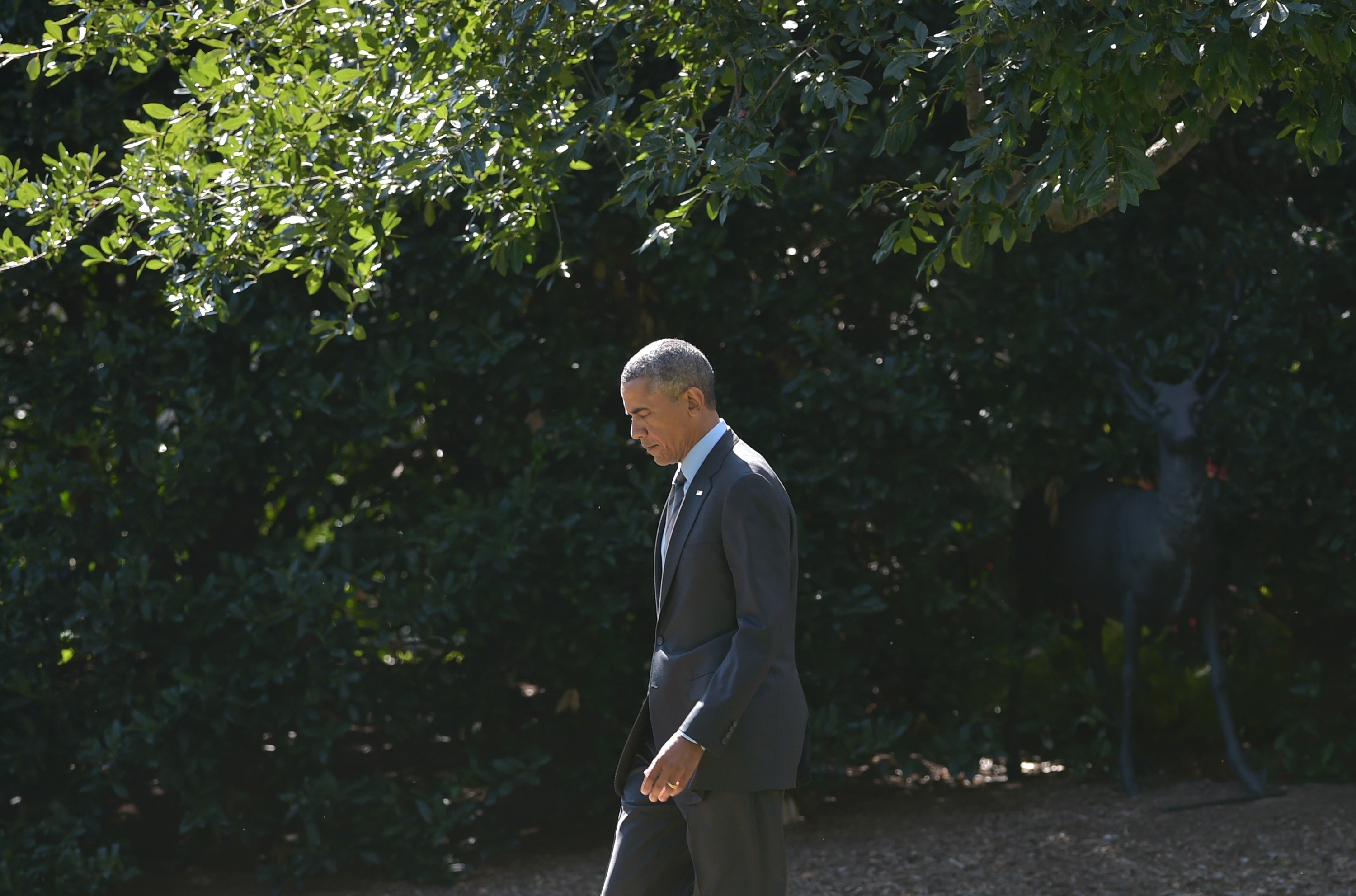
(Photo: US President Barack Obama makes his way to board Marine One on the South Lawn of the White House on September 12, 2014, in Washington, DC. Obama is heading to Baltimore, Maryland to visit Fort McHenry and to attend a fundraiser. By Mandel Ngan AFP/Getty Images.)