Will The ISIS War Come To A Vote? Ctd

by Dish Staff

Jay Newton-Small doubts an authorization would pass Congress in the run-up to midterm elections. For that reason, she argues, Obama probably won’t bother asking for one:

“Congress does not have the political will to approve a War Powers Resolution when the American people have very little appetite for war,” said Ron Bonjean, a former senior Republican congressional aide. “Getting the approval of Congress before the November elections to bomb ISIS targets in Iraq would likely require an attack on American soil or a very imminent threat of danger. Members of Congress want to secure their own re-elections and this type of vote could be the defining factor in several tight Senate races across the country.” …

The most likely path here is that Obama will continue to do what he’s been doing, and probably expand attacks into Syria, using the Article II justification. As the White House has argued, he’s protecting Americans in Erbil, the Kurdish capital in northern Iraq. By that measure, wherever America has an embassy, or citizens in peril, Presidents in the future will now have the precedent to engage in hostilities to protect them.

Damon Linker is dismayed, if not exactly surprised, that members of Congress are putting political considerations before Constitutional duty here:

Bombing a nation — even when it’s mainly to attack substate actors operating within it — is unquestionably an act of war. And debates about whether to go to war should be taking place in Congress, with our elected representatives taking a stand one way or another. The refusal to take that stand is a monumental evasion of Congress’s constitutionally delineated responsibility. That this shirking of responsibility is a product of abject cowardice and self-protectiveness makes it especially contemptible.

Serving in Congress has become so cushy that our representatives would rather protect their jobs than take a risk in defense of the public good or the prerogatives of their branch of government. Sure, they’ll support demagogic partisan stunts, like House Speaker John Boehner’s lawsuit against President Obama. But actually take responsibility for war and peace? Nah. Much better to stay silent now and then reserve the right to attack the president if military action goes badly — or benefit from the outpouring of national good will if it goes well.

Conor Friedersdorf lists some more reasons why a Congressional authorization would be a good idea, other than, y’know, how it’s required by law and all:

• The legislature is in a better position than the executive branch to carry out the will of the American people, which ought to dictate United States foreign policy.
• A congressional debate can help to test the arguments for intervention, which may well be wanting given the dearth of public scrutiny they’ve gotten.
• Every two years, Americans decide whether to keep or oust their representatives in the House. Knowing where they stand on hugely consequential matters of national policy is integral to the American system functioning.
• A war to defeat ISIS would be a huge undertaking. Embarking without the support of the citizenry casts doubt on whether the country would see the effort through.
• It is dangerous to give a single man the power to take a nation to war without anyone being able to do a thing to stop him. It is, in fact, anti-Madisonian.
As War Reporters Die, So Dies War Reporting

by Dish Staff

George Packer unpacks what the world lost in the murder of James Foley, and continues to lose as journalism in the Syria-Iraq war zone becomes ever more dangerous:

Among the many reasons to mourn Foley’s death is the loss of his reporting, and of reporting in general, from Syria. News of the civil war from Western media organizations has been dwindling as security has deteriorated, and it is now likely to dry up. Local Syrian reporters face an even greater threat. The Committee to Protect Journalists says that at least eighty journalists have been kidnapped since the start of the war and at least seventy have been killed, almost all of them Syrians, and almost all in 2012 and 2013. So far this year, the confirmed number of journalists killed is down to six, Foley being the most recent. (Solid information is increasingly difficult to get.) This cannot be because working conditions in Syria have improved. One likely explanation is that few reporters, and even fewer who reach Western audiences, are still covering the war. This would be disastrous under any circumstances, but it is especially calamitous now.

He also laments how thoroughly the chattering class has politicized the crisis:

The debate about ISIS almost automatically becomes a debate about who’s to blame for it: who started the Iraq War, who withdrew from it, who supported Nouri al-Maliki, who didn’t support the Syrian rebels, who helped to create ISIS, who failed to see ISIS coming, whose policies turned Muslims into jihadists, who has a right to say anything at all. These arguments are a sweet substitute for the thankless task of formulating honest answers to the questions raised by ISIS, which would inevitably mean advocating morally dubious actions with no certainty of a good outcome, as well as having to repudiate many of one’s earlier views.

Reflecting on his own experience as a war reporter, Tom Peter concludes that collecting facts that will only be doubted, disbelieved, and repackaged into partisan discourse is no longer worth risking one’s life for:

Covering wars for a polarized nation has destroyed the civic mission I once found in journalism. Why risk it all to get the facts for people who increasingly seem only to seek out the information they want and brand the stories and facts that don’t conform to their opinions as biased or inaccurate? And without a higher purpose, what is a career as a reporter? It may count among the so-called “glamor jobs” sought after by recent graduates, but one careers website has listed newspaper reporting as the second worst job in America, based on factors such as stress, pay, and employment uncertainty; toiling as a janitor, dishwasher, or garbage collector all scored better. Even if you love the work, it’s hard not to get worn down by a job that sometimes requires you to risk life and limb for readers who wonder if maybe you suffer all the downsides and hazards just to support some hidden agenda.

Ally With Assad? Ctd

by Dish Staff

Fred Hof points out that an American air campaign against ISIS in Syria would serve Bashar al-Assad’s material and propaganda interests whether or not we officially declare a partnership with him. He worries that we are walking into a trap:

How to avoid the ambush? Demonstrate real hostility toward Assad, whose removal for the sake of neutralizing ISIS is even more justified than the ouster of Iraq’s Nouri Al Maliki. If, in the course of U.S. anti-ISIS air operations over Syria, regime air defense radars lock onto U.S. aircraft, the relevant air defense site or sites should be engaged decisively. Robust and timely aid for Syrian nationalist rebels fighting both the regime and ISIS is a must. Relevant security assistance for a Syrian National Coalition trying to set up an alternate governing structure in non-Assad, non-ISIS Syria is mandatory. Building an all-Syrian national stabilization force in Turkey and Jordan for eventual anti-regime and anti-ISIS peace-enforcement is essential. American leadership in creating mechanisms that can one day bring Bashar Al Assad and his principal enforcers to trial for war crimes and crimes against humanity is vital. These are the steps that can put the lie to Assad’s libel.

Larison has another idea: don’t start the war at all:

Fighting wars of choice is bad enough, but it is simply perverse to insist on making deals with ugly regimes in order to facilitate the war of choice. If the most effective way of fighting ISIS requires the U.S. to go to war in Syria in concert with the Syrian government, that is just one more argument against waging a war on ISIS in the first place. The supposed need to ally with such a horrible government against ISIS depends entirely on grossly exaggerating the threat that the group poses to the U.S. and its allies. The one error flows from the other, and if put into practice would produce an indefensible policy.

And Assad might not be much help in the fight against ISIS even if he wants to be, Zack Beauchamp adds:

Here’s a big problem with the help-Assad case: it’s not clear that he’s actually strong enough to take on ISIS. Around August 19th, ISIS launched an offensive targeted at the government-held Tabqa airbase, in north-central Syria. Assad fought hard to keep the base, directing punishing airstrikes and ground forces at ISIS. On August 24th, ISIS took Tabqa anyway. The fact that Assad is already using airpower against ISIS, and failing, makes it hard to imagine that supplementing the Assad campaign with some US air strikes would be enough to push back ISIS. The US Air Force is obviously orders of magnitude more capable than its Syrian counterpart, but airpower can’t take and hold territory on its own. It needs to be done by competent ground troops. Assad simply doesn’t have the ground forces to spare, given that he’s also fighting other Islamists and moderate rebels around the country.

Mark Kleiman muses on how he might eventually be ousted:

Assad is a mass murderer, by character and by heredity. Maybe if the rest of the Syrian security forces and political players were scared enough, they’d take a polite hint from the U.S. and kick Assad out in order to qualify for assistance; providing a little bit of intelligence in the meantime is one way of giving that hint. But I wouldn’t count on it. No, if Assad is going to go, he probably has to be kicked out the same way Maliki was, by losing the support of his key foreign sponsor. That would be our old friend Volodya. Does Russia really want to see an actual Islamist state willing and able to help support the Chechen rebels? Maybe not. Whether, suitably supported, the new Iraqi and Syrian governments could actually get their act together and squash ISIS remains to be seen. But getting rid of the Thief of Baghdad and and the Butcher of Damascus in one summer wouldn’t be a bad score all by itself.

To Greenwald, the fact that we are talking about this at all is a sign of the times:

It seems pretty clear at this point that U.S. military action in the Middle East is the end in itself, and the particular form it takes – even including the side for which the U.S. fights – is an ancillary consideration. That’s how the U.S., in less than a year, can get away with depicting involvement in the war in Syria – on opposite sides – as a national imperative. Ironically, just as was true of Al Qaeda, provoking the U.S. into military action would, for the reasons Fishman explained, help ISIS as well. But the only clear lesson from all of this is that no matter the propagandistic script used, U.S. military action in that region virtually never fulfills the stated goals (nor is it intended to do so), and achieves little other than justifying endless military action for its own sake.

Let Someone Else Defeat ISIS

by Jonah Shepp

Doug Bandow wants us to stand back and let regional actors take care of the Islamic State, which threatens them much more directly than it threatens us:

Rather than turn ISIL into a military priority and take America into war against the group, Washington should organize an Islamic coalition against the Islamic State.  Even Gen. Dempsey called for a regional effort to “squeeze ISIS from multiple directions,” but that actually requires Washington to do less militarily.  ISIL’s rise has set in motion the very forces necessary for its defeat. Rather than hinder creation of a coalition by taking charge militarily, Washington should encourage it by stepping back.  The U.S. already has gone to war twice in Iraq. There’s no reason to believe that the third time will be the charm.

And indeed, that seems to be (NYT) what the administration is trying to do, although Syria is not on its list of potential coalition members:

As Mr. Obama considered new strikes, the White House began its diplomatic campaign to enlist allies and neighbors in the region to increase their support for Syria’s moderate opposition and, in some cases, to provide support for possible American military operations. The countries likely to be enlisted include Australia, Britain, Jordan, Qatar, Saudi Arabia, Turkey and the United Arab Emirates, officials said.

The officials, who asked not to be named discussing sensitive internal deliberations, said they expected that Britain and Australia would be willing to join the United States in an air campaign. The officials said they also wanted help from Turkey, which has military bases that could be used to support an effort in Syria.

Bobby Ghosh argues that the recent airstrikes in Libya by Egypt and the UAE open the door to such a regional alliance, and were perhaps intended to do so:

If the UAE and Egypt can collaborate to can bomb Islamists in Tripoli, then the Sunni nations can do likewise in IS strongholds in Raqqa and Mosul. Of course, they might hesitate, especially before doing anything that helps Syria’s dictator, Bashar al-Assad. But the taboo on intervention has been lifted. Political space is beginning to open up for just such a coalition. IS’s barbaric treatment of fellow Muslims has been greeted with alarm and revulsion in Sunni Arab nations. Saudi Arabia’s Grand Mufti declared IS Islam’s greatest enemy. The highest spiritual authority in Egypt has issued a similar denunciation.

Meanwhile, the UK continues to play hard to get:

Britain, like Australia, has taken part in humanitarian operations on Mount Sinjar as well as deploying Tornado fast jets and a spy plane to gather operational and tactical-level intelligence. But David Cameron, who has said that Britain and its European allies will provide equipment to Kurdish forces fighting Isis, has played down the possibility of air strikes and has categorically ruled out any use of ground troops. “Britain is not going to get involved in another war in Iraq,” he told BBC1′s Breakfast programme last week. “We are not going to be putting boots on the ground. We are not going to be sending in the British army.”

Here’s a little thought experiment: what about Israel? If Netanyahu claims that Hamas and ISIS are indistinguishable, why is he only at war with the lesser of the two? Everyone talks about how Maliki and Assad don’t have the military strength to effectively combat the Islamic State, but Bibi does. And Israel is already technically at war with both Syria and Iraq, so there’s nothing stopping the Israelis from dropping bombs on either country (they have attacked both in the past when they believed their existential security demanded it). Israeli strikes on the “caliphate” would also confound the emerging conspiracy theory that ISIS is an American-funded project to advance the global Zionist agenda, and wreak havoc on the talking points of Israel’s greatest enemies. Just imagine how Iran would react to the news that an Israeli operation had saved thousands of Shiites from persecution.

I know it’s not going to happen, for a number of reasons, but would it really be a bad idea? If someone has to do it, and if we’re clearly committed to paying for it, and if we’ve already paid for Israel’s military supremacy, wouldn’t it make sense to ask them to take on some regional leadership here and participate in getting rid of this threat?

Mission-Creeping Toward Syria

by Dish Staff

Obama has authorized surveillance flights over Syria, in what looks like a first step toward some kind of military engagement there:

On Monday evening defense officials said the reconnaissance flights had already started, and told the New York Times that they include both manned and unmanned aircraft. President Obama has yet to approve any military action in Syria, but White House officials said he wouldn’t notify Syrian President Bashar al-Assad if he was — though the country’s foreign minister warned that “any strike which is not coordinated with the government will be considered as aggression.” …

There’s no way that destroying the terrorist group won’t benefit Assad’s forces (and humanity in general), but the U.S. is trying to find a strategy that aids the moderate Syrian rebels more. The Pentagon is said to be working on options that would target ISIS near the Iraqi border, rather than deeper in Syria. The U.S. is also considering increasing its support for the moderate rebels. Rear Admiral John Kirby, the Pentagon press secretary, said Defense Secretary Chuck Hagel is “looking at a train-and-equip program for the Free Syrian Army.”

Aaron David Miller believes the Syria air campaign is coming, and lists a number of reasons why it’s a bad idea. For one thing, he says airstrikes simply won’t do what we want them to do:

To have a chance of hitting the right targets with any consistency, those 500-pound American bombs require local allies on the ground to provide forward spotters and good intelligence. Airstrikes, as we saw in the open desert of Libya during the 2011 intervention, are better suited against militaries concentrating and moving in open areas than against local militias that have taken root. Take [for] instance Raqaa, the headquarters of the Islamic State’s caliphate. There’s no way an air assault in that urbanized and populated environment would work.

The idea that a bombing campaign alone — even if it’s devastating and sustained — will seriously check, let alone defeat, IS in Syria is a flat-out illusion. And I say this knowing all of the Islamic State’s many weaknesses: a governing ideology that alienates; weak or nonexistent opponents; and the absence of deep roots and legitimacy in Syria.

Adam Taylor examines our options for local partners if we rule out an alliance with the Syrian regime:

Right now … its not clear exactly how plausible U.S. strikes against Islamic State within Syria would be without some kind of approval, tacit or otherwise, from Assad. The Syrian government has warned that unilateral strikes against Islamic State on Syrian soil would be seen as an act of “aggression,” though it has indicated it is open to some kind of cooperation. Assad’s regime has anti-aircraft capabilities and an air force which could be used to hinder any U.S. intelligence gathering or strikes in Syria. Another factor is Russia, a prominent supporter of the Assad regime, which has also voiced criticism.

Joshua Landis, director of Center for Middle East Studies at the University of Oklahoma, argues that a key problem is that the more secular rebel groups don’t have the support they would need to actually control Syria. … Ultimately, Landis argues that the only way for the U.S. to truly destroy the Islamic State and the sectarian extremism it espouses would be to offer some kind of two-state solution for Syria, or get involved in extensive (and extremely expensive) state building exercise. There’s little political support in the U.S. for either. Instead, Landis suspects the U.S. will likely end up “mowing the lawn” with the Islamic State – a reference to the Israeli policy for keeping Hamas weak with periodic and limited strikes. It’s a policy that may be far more acceptable than working with Assad and more practical than a wider intervention, but it won’t necessarily be any more successful.

On the other hand, Pat Buchanan thinks we should go all-in on an alliance of convenience with Assad, which he argues would negate the need for ground troops:

We need no boots on the ground in Syria, for it is the presence of “Crusaders” on Islamic soil that is the principal recruiting tool of the jihadists. What we need is diplomacy beyond the simple-minded, “Either you are with us or you are with the terrorists!” a diplomacy that invites old enemies into a coalition for a cause on which we all agree. If Assad is willing to go in for the kill on ISIS, let us work out a truce and amnesty for the Free Syrian Army and call off that part of the rebellion, so Assad’s army can focus on killing ISIS. George H.W. Bush made an ally of Hafez al-Assad in Desert Storm. Why not make an ally of his son against ISIS?

We should next tell the Saudis, Qataris, and Kuwaitis that any more aid to ISIS and they are on their own. We should inform the Turks that their continued membership in NATO is contingent upon sealing their border to ISIS volunteers and their assistance in eradicating the terrorist organization. We should convey to Iran that an end to our cold war is possible if all attacks on the West stop and we work together to exterminate the Islamic State. Why would they not take the deal? As for Abu Bakr al-Baghdadi, the self-proclaimed successor to Muhammad, my bet is that he closes out his brief career as caliph at an unscheduled meeting with Seal Team 6.

But Peter Beinart thinks such an alliance would be politically disastrous:

[G]iven that President Obama called on Assad to leave power three years ago and last year almost bombed him for using chemical weapons, even a tacit alliance with the Syrian dictator would make Obama’s past flip-flops look trivial. In Washington, the outcry would be massive, especially because of Syria’s close ties to Iran. Regionally, it might be worse. If relations between Washington and long-standing Sunni allies like Saudi Arabia are frayed now—in part because the U.S. hasn’t intervened against Assad strongly enough—it’s hard to imagine the impact on those relationships were the U.S. and Assad to actually join forces.

From Somalia to Kosovo to Libya, the problem with America’s humanitarian interventions has never been ascertaining the nastiness of the people we’re fighting against. It’s been ascertaining the efficacy and decency of the people we’re fighting for. That’s a particular challenge in the case of ISIS in Syria. I’d love to believe our government is wise enough to surmount that challenge. I’d love to, but I don’t.

In any case, John Cassidy stresses that the US “can’t bomb its way to victory over the jihadists”:

The real keys to success lie in mobilizing the Kurdish and Iraqi forces to repel the jihadist fighters, engineering some sort of resolution to the disastrous Syrian civil war, and closing down ISIS’s international support network. That means keeping up the pressure on Iraqi politicians to form a more representative national government, trying to resurrect the Syrian peace talks, and, perhaps, sending more U.S. military trainers into Iraq. It also means exerting some real pressure on U.S. allies in the region that have been enabling and financing the jihadists inside Syria: Qatar, Saudi Arabia, and Turkey come to mind. Without the support, or the tacit encouragement, of any sovereign state, ISIS would be a much weaker force.

Will The ISIS War Come To A Vote?

by Dish Staff

If Obama wants to secure the public’s backing for the fight against ISIS, Jack Goldsmith recommends that he bring it to Congress for a vote:

The President must eventually educate the nation about why the United States is going to be deploying significant treasure and possibly some blood in Iraq and probably Syria to defeat IS.  As noted above, the case in theory is not hard to make.  But a mere speech from the Oval Office will not do the trick if the President wants the nation to understand the stakes and risks, and wants to get the American People truly behind the effort.  Only an extended and informed and serious national debate can do that, and such a debate can only occur if the President asks for Congress’s support.

Will Inboden also believes it’s time for a new, ISIS-specific Congressional authorization for the use of force:

Even before the Islamic State’s resurgence, some national security legal scholars were arguing that the Obama administration ‘s campaign against al Qaeda and its proliferating franchises was skating on increasingly thin legal ice. … Substantively, a new AUMF, especially focused on IS and its affiliates, could take into account the evolution and adaptation of militant jihadist groups in the 13 years since the Sept. 11 attacks, as well as the shifts and drawdowns of American ground force deployments in Afghanistan and Iraq. The Islamic State’s nihilistic wickedness may be generating the headlines now, but over time even more danger may be posed by its magnetism towards other al Qaeda franchises and its potential leadership of militant jihadist groups spanning the broader Middle East and points beyond in Africa and South Asia.

Ashley Deeks, meanwhile, explores the various ways in which the administration might kosherize an intervention in Syria under international law:

A UN Security Council Resolution would provide the clearest basis for action. This option was a dead letter back in July 2012, when Russia and China refused even to approve economic sanctions against Assad, let alone the use of military force. One question would be whether the politics on this have changed: there might be some reason to think that Assad is coming under pressure from his own supporters to take on ISIS. It seems unlikely that Assad would affirmatively embrace a UNSCR authorizing a coalition of the willing to target ISIS in Syria, but if Russia senses that Assad might tolerate such action, the Security Council dynamics could change. Then again, the U.S.-Russia relationship is so toxic right now that this option seems remote. …

Second, Assad could secretly give consent to foreign governments (including the United States) to use force against ISIS in Syria. This, too, seems improbable, given the longstanding animosities between Assad and various Western governments. But having one government give secret and reluctant consent to another to conduct strikes in its territory is not without precedent.

It’s 2003 Again

by Jonah Shepp

What else can one possibly take away from this Noah Rothman exegesis of Peggy Noonan’s and Charles Krauthammer’s cases for expanding the new Iraq war to Syria? Here’s the crux of the argument:

The mission Krauthammer describes does not appear to require a significant American ground force, though it would be one which would only be effective in Iraq. The Islamic State’s stronghold in Syria will require an entirely different strategy, one far more robust and which may require putting American service personnel in harm’s way. But rolling back the Islamic State in Iraq is an acceptable short-term goal, and the American people should be informed that this is the mission in which their military is presently engaged. Those opposed to going to war to rid the world of ISIS worry that achieving that objective will require more commitment than most are willing to admit. And it is possible that the American national interests at stake in this region, while appreciable, are not threatened to the degree that would merit a return of tens of thousands of American troops to Iraq. At least, not yet.

These are worthwhile debates to have, and Americans need to have an honest discussion about this threat. It is a discussion that must be led by their president. It seems, however, that some conservatives are beginning to observe that those who object to a military solution to the Islamic State threat rest their argument on the claim that it heralds a new occupation of Iraq. This is a straw man argument. The vast majority of Americans of every political stripe do not want to reoccupy that country, and this is not on the table. Destroying ISIS, however, is.

Right, because we all remember what happened the last time right-wing hawks sold the American public on a war that they alleged would have no long-term consequences. After the past decade, I suppose I shouldn’t be all that surprised that the cheerleaders for this new war are demanding that their opponents make a probative case against intervention, while the neo-neocons’ contention that a light-touch war with no “significant” ground force is presented as obviously true. (By the by, how many soldiers constitute “significant”? 1,000? 10,000? 100,000? No one wants to say…) For more of the same, see Elliott Abrams here. Brian Fishman wishes advocates of an all-out, two-front war on ISIS would stop bullshitting the public already about what that would entail:

No one has offered a plausible strategy to defeat ISIL that does not include a major U.S. commitment on the ground and the renewal of functional governance on both sides of the Iraqi-Syrian border. And no one will, because none exists.

But that has not prevented a slew of hacks and wonks from suggesting grandiose policy goals without paying serious attention to the costs of implementation and the fragility of the U.S. political consensus for achieving those goals. Although ISIL has some characteristics of a state now, it still has the resilience of an ideologically motivated terrorist organization that will survive and perhaps even thrive in the face of setbacks. We must never again make the mistake that we made in 2008, which was to assume that we have destroyed a jihadist organization because we have pushed it out of former safe-havens and inhibited its ability to hold territory. Bombing ISIL will not destroy it. Giving the Kurds sniper rifles or artillery will not destroy it. A new prime minister in Iraq will not destroy it.

Please do not step in here with the fly-paper argument: that the conflict will attract the world’s would-be jihadis to one geographic area where we can target them all and thereby solve the problem. Notice that no authorities on jihadism ever make this argument. That is because they understand that war makes the jihadist movement stronger, even in the face of major tactical and operational defeats.

There is a case to be made for this war. It is not the case that its backers are making. They still seem to inhabit the same alternate universe as Donald Rumsfeld, in which the only limit to what American power can accomplish is the imagination of the Commander-in-Chief. I may not support all of Obama’s foreign policy choices, but I find it reassuring that he is nowhere near as prone as his predecessor was to flights of imperial fancy. As Fishman rightly points out, one cannot make the argument that the withdrawal of US forces from Iraq precipitated the current crisis without also acknowledging that the 2003 invasion set the ball rolling. The honest case for more intervention now, it seems to me, is that Bush’s Iraq adventure obligated the US to accept responsibility for maintaining the new Iraqi order we created and protecting the people of the Middle East from the jihadist menace our war unleashed.

But the usual suspects can’t make that argument, because to do so, they’d have to admit that they were wrong in the first place.

Ally With Assad?

by Dish Staff

Hassan Hassan argues that we shouldn’t, because he hasn’t really been fighting ISIS in the first place:

One might argue that Assad’s strategy was a cynical game and that once he is assured of his survival, he would be well-positioned to fight the group. But even that argument ignores basic dynamics: If Assad genuinely wants to fight ISIS today, he is as capable of doing that as Prime Minister Nouri al-Maliki was when ISIS took over three Iraq provinces. ISIS controls large swathes in rebel-held Syria, areas that have been outside the regime’s control for one to three years. How could the Assad regime fight against ISIS in Raqqa or Deir Ezzor, for example? Would the local population fight side by side with the regime? That is extremely unlikely, given that people have condemned reports that the United States intends to strike against ISIS in Syria while ignoring the regime’s atrocities for more than three years.

A more prudent approach is to look at the rise of ISIS as a long-term menace that can only be addressed through a ground-up pushback. The opposition forces are not only possible partners, they’re essential in the fight against ISIS. After all, they’re the ones who have been fighting ISIS since last summer, and drove it out of Idlib, Deir Ezzor and most of Aleppo and around Damascus. It cost them dearly: more than 7,000 people were killed. Fighting ISIS should be part of a broader political and military process that includes both the regime and the opposition, but not Assad.

Max Abrahms sees the situation differently:

Our national security ultimately depends on crushing ISIS not only in Iraq, but also in Syria. In the past, Assad’s forces were reluctant to engage ISIS directly. But the gloves have come off in the last couple of weeks. If Assad perceives ISIS as an existential threat, he will tolerate — even secretly welcome — U.S. military assistance. This is an opportunity Washington should seize not for him, but for us.

But James Antle seeks out the genuinely “realist” position:

Contrary to the BuzzFeed headline, few foreign-policy experts want a full operational alliance with Syria or Iran. Some have called for what Crocker, Luers, and Pickering have described as “mutually informed parallel action” against ISIS. Others have merely suggested the U.S. not destabilize ISIS’s enemies in the region, while the al-Qaeda offshoot is beheading American journalists and terrorizing religious minorities in Iraq. Even without any practical cooperation, it is hard to see how Syria and Iran wouldn’t to some extent be beneficiaries of any successful military action against ISIS. But for all the tyranny and terror ties of those regimes, ISIS is most directly the progeny of those who toppled with twin towers and attacked the United States on 9/11. After more than a decade at war in Afghanistan in response to the Taliban providing a safe haven for Osama bin Laden, wouldn’t an ISIS state in parts of Iraq and Syria be a worse outcome?

Keating believes Assad has played his cards perfectly and gotten just what he wanted:

There’s been speculation for some time that the Syrian leader would seek to use the crisis in Iraq to his advantage. It’s pretty apparent that Syrian forces tolerated the rise of the group in a bid to divide the rebels and scare off wary Western supporters, and only began attacking it after the Iraq crisis began this summer. It was a high-stakes gamble given that ISIS now reportedly controls about a third of Syrian territory, but one that could finally be paying off for the internationally isolated Syrian leader. …

Even if the U.S. doesn’t coordinate with Assad’s government—the White House position as expressed by Deputy National Security Adviser Ben Rhodes is still that he’s “part of the problem”—the shift in priority to ISIS does make it more likely that the American government is going to accept Assad remaining in power. Or at least it makes it less likely that the U.S. will take any major steps to remove him. Assad played the long game with a pretty weak hand and now appears to be winning.

Although they don’t necessarily make the case for an alliance, Ishaan Tharoor observes that the events of the past three years have sort of proven Vladimir Putin right about the folly of pushing regime change in Syria:

In his New York Times op-ed, Putin reminded readers that from “the outset, Russia has advocated peaceful dialogue enabling Syrians to develop a compromise plan for their own future.” That “plan for the future,” the Russians insisted, had to involve negotiation and talks between the government and the opposition, something which the opposition rejected totally at the time. In November 2011, Putin’s foreign minister Sergei Lavrov criticized other foreign powers, including the United States, for not helping pressure opposition forces to come to the table with the Assad regime. “We feel the responsibility to make everything possible to initiate an internal dialogue in Syria,” Lavrov said at a meeting of APEC foreign ministers in Hawaii.

The Arab Spring was in full bloom and U.S. officials thought regime change in Syria was an “inevitable” fait accompli. That calculus appears to have been woefully wrong. Now, the conflict is too entrenched, too polarized, too steeped in the suffering and trauma of millions of Syrians, for peaceful reconciliation to be an option.

Is ISIS A Threat To Us?

by Dish Staff

Chuck Hagel thinks so:

The group “is as sophisticated and well-funded as any group that we have seen. They’re beyond just a terrorist group,” Hagel said in response to a question about whether the Islamic State posed a similar threat to the United States as al Qaeda did before Sept. 11, 2001. “They marry ideology, a sophistication of strategic and tactical military prowess. They’re tremendously well-funded. This is beyond anything that we’ve seen,” Hagel said, adding that “the sophistication of terrorism and ideology married with resources now poses a whole new dynamic and a new paradigm of threats to this country.”

Hagel’s comments added to the mismatch between the Obama administration’s increasingly aggressive rhetoric and its current game plan for how to take on the group in Iraq and Syria, which so far involves limited airstrikes and some military assistance to the Kurdish and Iraqi forces fighting the militants. It has also requested from Congress $500 million to arm moderate rebel factions in Syria. But for now, the United States is not interested in an Iraqi offer to let U.S. fighter jets operate out of Iraqi air bases.

Retired Gen. John Allen seconds Hagel’s assessment, arguing that the US has the means to destroy ISIS and a moral and security-based obligation to do so:

IS must be destroyed and we must move quickly to pressure its entire “nervous system,” break it up, and destroy its pieces. As I said, the president was absolutely right to strike IS, to send advisors to Iraq, to arm the Kurds, to relieve the suffering of the poor benighted people of the region, to seek to rebuild functional and non-sectarian Iraqi Security Forces and to call for profound change in the political equation and relationships in Baghdad.

The whole questionable debate on American war weariness aside, the U.S. military is not war weary and is fully capable of attacking and reducing IS throughout the depth of its holdings, and we should do it now, but supported substantially by our traditional allies and partners, especially by those in the region who have the most to give – and the most to lose – if the Islamic State’s march continues. It’s their fight as much as ours, for the effects of IS terror will certainly spread in the region with IS seeking soft spots for exploitation.

Observing how the official rhetoric on ISIS has escalated, Eli Lake picks up on a choice of phrasing by Obama that he interprets as revealing:

In the aftermath of the 2012 attack on the U.S. diplomatic compound in Benghazi, Obama vowed to bring the attackers to justice. This week Obama struck a different tone, saying: “When people harm Americans, anywhere, we do what’s necessary to see that justice is done.” The difference between bringing suspects to justice and seeing that justice is done is roughly the same as the difference between treating terrorism as a crime and as an act of war.

Even though special operations teams were dispatched to Libya after Benghazi to target the jihadists suspected of carrying it out, Obama chose to treat the attack, which cost the lives of four Americans, as a crime. It took until June of this year for the FBI in conjunction with U.S. special operations teams to capture one of the ringleaders of the attack and bring him to the United States to face trial. A different fate likely awaits the leaders of ISIS.

Larison is steaming, of course:

The good news so far is that the administration doesn’t appear to be taking its own rhetoric all that seriously, but the obvious danger is that it will trap itself into taking far more aggressive measures by grossly exaggerating the nature of the threat from ISIS in this way. The truth is that ISIS doesn’t pose an imminent threat to the U.S. and its allies, unless one empties the word imminent of all meaning. Hagel made the preposterous statement today that the group poses an “imminent threat to every interest we have.” That is simply a lie, and a remarkably stupid one at that, and it is the worst kind of fear-mongering. Administration officials are engaged in the most blatant threat inflation with these recent remarks, which is all the more strange since they claim not to favor the aggressive kind of policy that their irresponsible rhetoric supports.

If the group can be contained, as Gen. Dempsey states, then it can be contained indefinitely. If that is the case, then the threat that it poses is a much more manageable one than the other ridiculous claims from administration officials would suggest.

Allahpundit figures it’s only a matter of time before ISIS attempts an attack on American soil:

ISIS has every incentive to do it, too. Nothing would lift their prestige in the jihadiverse more than an attack on American soil. They have nothing to lose at this point by holding off either; quite rightly, we’re going to bomb them whether they do it or not. They have the motive and they most certainly have the means, flush with cash to pay traffickers handsomely for smuggling them across and well supplied with men who can melt into the U.S. population more easily than the average ISIS neckbeard. If you want to knock Perry for something, knock him for understating the threat: Why would ISIS send a jihadi to cross the border, where he might be caught, when they could put one with a British passport on a plane and have him waltz into the United States instead?

By engaging the jihadists in battle, Keating points out, the US creates that incentive:

ISIS and its predecessor organization, al-Qaida in Iraq, have long held hostile views toward the United States and its presence in the Middle East. It has issued threats against the U.S. before, including a promise to “raise the flag of Allah in the White House.” U.S. and European governments have also warned for some time that the large numbers of international fighters who have traveled to Syria to fight with ISIS could return with the means and know-how to carry out attacks in their home countries. So far there hasn’t been much evidence of this actually taking place. … This has arguably been to ISIS’s strategic benefit. It’s hard to believe the U.S. would have taken quite this long to send in the drones had there been evidence that ISIS was actively plotting attacks against the U.S. homeland or even U.S. facilities in the Middle East. Now, that’s obviously changed. With the U.S. bombing its forces in Iraq, there’s no benefit for ISIS in refraining from attacks against Americans.

Fighting The Islamic State In Iraq And Syria?

by Dish Staff

SYRIA-CONFLICT

The border between Iraq and Syria is meaningless to ISIS, and may soon become meaningless to the US as well, with administration officials dropping hints right and left that the air campaign against the “caliphate” might eventually cross it. The hints began with deputy national security advisor Ben Rhodes on NPR early yesterday morning:

“We don’t rule anything out when it comes to the protection of Americans and the disruption of terrorist plotting against the United States. So we would not restrict ourselves by geographic boundaries when it comes to the core mission of U.S. foreign policy, which is the protection of our people.” … When Kelly McEvers floated an idea put forth by Ryan Crocker, former American ambassador to both Afghanistan and Iraq, that the U.S. work with Syrian dictator Bashar Assad against ISIL, Rhodes dismissed the idea out of hand. Citing a “vacuum” caused by Assad’s policies and “barbarism against his people,” Rhodes explained that ISIL was able to grow because of Assad, not in spite of him.

Joint Chiefs of Staff Chairman Gen. Martin Dempsey rounded out the suggestion in a press conference:

So far the airstrikes against ISIS have been successful, but the New York Times notes that the military’s current strategy is to contain the group, not destroy it. ISIS has been building up its base in Syria for more than a year, and General Dempsey said the threat would eventually have to be “addressed on both sides of what is essentially at this point a nonexistent border.”

That isn’t necessarily happening anytime soon. “That will come when we have a coalition in the region that takes on the task of defeating ISIS over time,” Dempsey said. “ISIS will only truly be defeated when it’s rejected by the 20 million disenfranchised Sunni that happen to reside between Damascus and Baghdad.” When pressed on whether the U.S. is considering conducting airstrikes in Syria, Defense Secretary Chuck Hagel would only say “we’re looking at all options.”

Allahpundit wonders exactly what options they’re looking at:

A year ago at this time, Obama was getting ready to bomb Syria to weaken Assad; a year later, here’s his deputy National Security Advisor refusing to rule out bombing Syria to weaken Assad’s chief opposition. Droning jihadis in places we don’t have boots on the ground is SOP for Obama, though. How big this news is depends on what sort of air assets Rhodes imagines us using in Syria and what sort of ISIS targets Obama’s willing to engage. If all he means is droning jihadi terror camps, that’s no great shakes. Why would we hold off on doing that in Syria when we don’t hold off in Pakistan and Yemen, two nominal allies of the United States? If he means using more muscular — and manned — aircraft, though, and if he’s imagining bombing ISIS’s front lines, that’s more significant. (It would also kinda sorta make us Assad’s air force, wouldn’t it?)

The Economist suggests that an air campaign over Syria would be an easier sell if regional leaders were on board with it:

Assad has previously tended to leave IS alone, happy to let it hurt the more moderate rebels. But recently his air force has struck the group’s base in Raqqa. The Americans have so far decided that they cannot do likewise, deeming that they must not be seen to operate on the same side as the man whose overthrow they have repeatedly demanded.

But they may be persuaded to change their mind if the most influential governments in the region, including Saudi Arabia, Egypt, Turkey and even Iran, were able in joint or parallel statements to endorse the bombing of IS in Syria—or at least to abstain from opposing it. So far the West has lacked a policy that spans national borders. Yet [Atlantic Council analyst Fred] Hof points out that “IS is a problem that transcends national boundaries and has to be approached as a problem that transcends nationalist boundaries.”

Rosie Gray takes up the question of whether striking ISIS in Syria would entail an alliance with Bashar al-Assad:

“What if, due to a deal [Assad] stopped slaughtering his own people?” former CIA analyst Nada Bakos said on Twitter on Wednesday night. Journalist Michael Weiss had asked, “To those advocating a deal with Assad to defeat ISIS, explain how this is any less barbarous” with a link to an article about new evidence of regime atrocities. Bakos said in an email to BuzzFeed that the goal should be to stabilize the situation in Syria, giving actors in the region a better chance at vanquishing ISIS.

“I don’t believe Assad’s forces can achieve that single-handedly and we aren’t about to partner with him, nor should we,” Bakos said. “However, arming the rebels at this point just means a longer, protracted war that is already full of proxies. It would be almost endless. If we can identify why we are taking action, we can then decide on our best course of action (which is likely still pretty awful). Our goal should be to stop the chaos, but sometimes all we can do from the outside is just help contain it.”

But at least for the moment, the administration is vociferously denying that such an alliance is in the offing:

“The Obama administration can’t partner with Assad overtly at this time, but the logic and trajectory of White House policy in Syria leads in that direction,” Tony Badran, a research fellow specializing in Syria and Hezbollah at the Foundation for Defense of Democracies, told Fox News. “White House policy in Syria is predicated on preserving so-called regime institutions.”

In public, the administration is not changing its position on Assad. And State Department spokeswoman Marie Harf disputed that the U.S. and Syrian governments share a common goal in defeating ISIS. “I would strongly disagree with the notion that we are on the same page here,” Harf said on Monday, while later admitting to Fox News, “We may be looking at some of the same targets.”

Keating’s perspective:

Even if the U.S. doesn’t coordinate with Assad’s government—the White House position as expressed by Deputy National Security Adviser Ben Rhodes is still that he’s “part of the problem”—the shift in priority to ISIS does make it more likely that the American government is going to accept Assad remaining in power. Or at least it makes it less likely that the U.S. will take any major steps to remove him.

Assad played the long game with a pretty weak hand and now appears to bewinning. Meanwhile, the death toll in his country just passed 191,000.

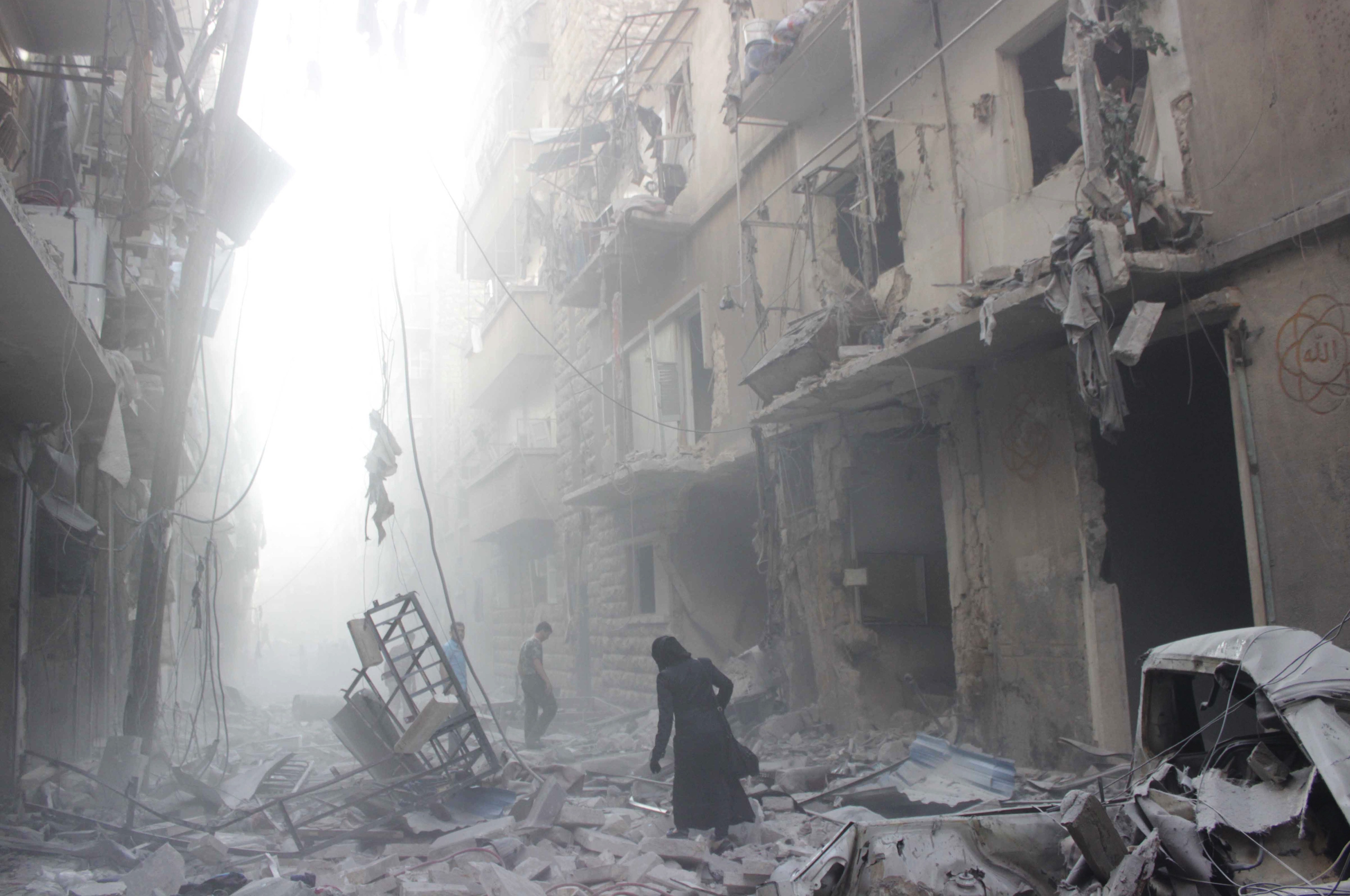
(Photo: A Syrian woman makes her way through debris following a air strike by government forces in the northern city of Aleppo on July 15, 2014. By Karam Al-Masri/AFP/Getty Images)