Continuing our discussion, a reader submits the following exchange from Dan Jenkins’s Life Its Ownself:
“How do you feel?”
“Like I’ve been et by a coyote and shit off a cliff.”
Another reader: “I would nominate Vera Charles in Mame, who stumbles down the stairs around, pulls aside a drape at the window and moans, ‘My God, that moon is bright.'” Many more below:
The following bit from Cheever’s Bullet Park isn’t written as well as Amis’s famous hangover description. But it’s more terrifying:
When the alarm rings he mistakes it for the telephone. Their children are away at school and he concludes that one of them is sick or in trouble. When he understands that it is the alarm and not the telephone he puts his feet onto the floor. He groans. He swears. He stands. He feels himself to be a hollow man but one who has only recently been eviscerated and who can recall what it felt like to have a skinful of lively lights and vitals. She whimpers in pain and covers her face with a pillow. Feeling himself to be a painful cavity he goes down the hall to the bathroom. Looking at himself in the mirror he gives a loud cry of terror and revulsion. His eyes are red, his face is scored with lines, his light hair seems clumsily dyed. He possesses for a moment the curious power of being able to frighten himself.
He soaks his face with water and shaves his beard. This exhausts his energies and he comes back down the hall to the bedroom, says that he will take a later train, returns to bed and pulls the blankets over his face to shut out the morning. She whimpers and cries. She then leaves the bed, her nightgown hooked up over her comely backside. She goes to the bathroom but she shuts her eyes as she passes the mirror. Back in bed she covers her face with a pillow and they both lie there, groaning loudly. He then joins her on her side of the bed and they engage in a back-breaking labor of love that occupies them for twenty minutes and leaves them both with a grueling headache.
He has already missed the 8:11, the 8:22, and the 8:30. “Coffee” he mutters, and gets out of bed once more. He goes downstairs to the kitchen. Stepping into the kitchen he lets out another cry of pain when he sees the empties on the shelf by the sink. They are ranged there like the gods in some pantheon of remorse. Their intent seems to be to force him to his knees and to wring from him some prayer. “Empties, oh empties, most merciful empties have mercy upon me for the sake of Jack Daniels and Seagram Distillers.” Their immutable emptiness gives them a look that is cruel and censorious. Their labels—scotch, gin and bourbon-have the ferocity of Chinese demons, but he definitely has the feeling that if he tried to placate them with a genuflection they would be merciless. He drops them into a wastebasket, but this does not dispose of their force.
He puts some water on to boil and feeling for the wall like a blind man makes his way back to the bedroom where he can hear his wife’s cries of pain. “Oh I wish I were dead,” she cries, “I wish I were dead.” “There, there, dear,” he says thickly. “There, there.” He sets out a clean suit, a shirt, a tie and some shoes and then gets back into bed again and pulls the blankets over his face. It is now close to nine and the garden is filled with light. They hear the schoolbus at the corner, sounding its horn for the Marsden boy. The week has begun its splendid procession of days. The kettle begins to whistle.
He gets out of bed for the third time, returns to the kitchen and makes some coffee. He brings a cup for them both. She gets out of bed, washes her face without examining it and then returns to bed. He puts on some underwear and then returns to bed himself. For the next hour they are up and down, in and out, struggling to rejoin the stream of things, and finally he dresses and racked by vertigo, melancholy, nausea and fitful erections he boards his Gethsemane—the Monday-morning 10:48.
Another good one:
I am a little slow on the trigger for this, but Kerouac’s descriptions in Big Sur should be on any short list of hangovers in fiction. The following is taken from portions of chapters one and two:
The church is blowing a sad windblown “Kathleen” on the bells in the skid row slums as I wake up all woebegone and goopy, groaning from another drinking bout and groaning most of all because I’d ruined my “secret return” to San Francisco by getting silly drunk [….] instead of going thru smooth and easy I wake up drunk, sick, disgusted, frightened, in fact terrified by that sad song across the roofs mingling with the lachrymose cries of a Salvation Army meeting on the corner below “Satan is the cause of your alcoholism, Satan is the cause of your immorality, Satan is everywhere workin to destroy you unless you repent now” and worse than that the sound of old drunks throwing up in rooms next to mine, the creak of hall steps, the moans everywhere Including the moan that had awakened me, my own moan in the lumpy bed, a moan caused by a big roaring Whoo Whoo in my head that had shot me out of my pillow like a ghost.
And I look around the dismal cell [….] the rucksack sits hopefully in a strewn mess of bottles all empty, empty poor boys of white port, butts, junk, horror… “One fast move or I’m gone, ” I realize, gone the way of the last three years of drunken hopelessness which is a physical and spiritual and metaphysical hopelessness you cant learn in school no matter how many books on existentialism or pessimism you read, or how many jugs of vision producing Ayahuasca you drink, or Mescaline take, or Peyote goop up with — That feeling when you wake up with the delirium tremens with the fear of eerie death dripping from your ears like those special heavy cobwebs spiders weave in the hot countries, the feeling of being a bent back mudman monster groaning underground in hot steaming mud pulling a long hot burden nowhere, the feeling of standing ankledeep in hot boiled pork blood, ugh, of being up to your waist in a giant pan of greasy brown dishwater not a trace of suds left in it… The face of yourself you see in the mirror with its expression of unbearable anguish so haggard and awful with sorrow you cant even cry for a thing so ugly, so lost, no connection whatever with early perfection and therefore nothing to connect with tears or anything: it’s like William Seward Burroughs’ “Stranger” suddenly appearing in your place in the mirror — Enough! “One fast move or I’m gone.”
Another:
I think my favorite hangover description in fiction must be from Sir Henry at Rawlinson End by the late, great Vivian Stanshall. Sir Henry embodied all that was reactionary in the English aristocracy, taken to absurd extremes. Stanshall, a fascinating and sadly underappreciated character who died in 1995 and was perhaps the purest example of a Genuine English Eccentric, created the character and his equally odd extended family (including his loyal manservant “Scrotum, the wrinkled retainer”) for John Peel’s radio show. After a number of broadcasts and an LP or two, Sir Henry was immortalized on film by Trevor Howard. Stanshall’s mastery of numerous English dialects was put to good use here, as well as his wonderful Edward Lear-like facility with words. His work inspired Stephen Fry, among many others. Here’s a taste (transcribed from a broadcast):
“Filth Hounds of Hades!” Sir Henry Rawlinson surfaced from the blackness hot and fidgety. Fuss, bother, and itch. Conscious mind coming up too fast with the bends – through pack‑ice throbbing seas. Boom – sounders – blow‑holes – harsh croak – Blind Pews tip‑tap‑tocking for escape from his pressing skull. With a gaseous grunt he rolled away from the needle-cruel light acupuncturing his pickle-onion eyes, and with key-bending will slit-peered at the cold trench Florrie had left on her side of the bed. Baffling? At the base of his stomach – great swaddled hillock – was pitched a perky throbbing tent. This was so unusual he at first feared rigor mortis, but Madame Memory’s five lovely daughters jerked him to boggling attention. With grim‑mouthed incredulity he snatched for a riding crop and thrashed his impertinent member into limp submission. Bah! To Henry’s way of thinking, waking up was not the best way to start the day.
Another reader takes the thread in a new direction:
Screw the discussion about the best hangover in fiction. What about the best word for hangover in any language? The Latin for it is hard to beat: it’s crapula. Because, hey, that’s how you feel!
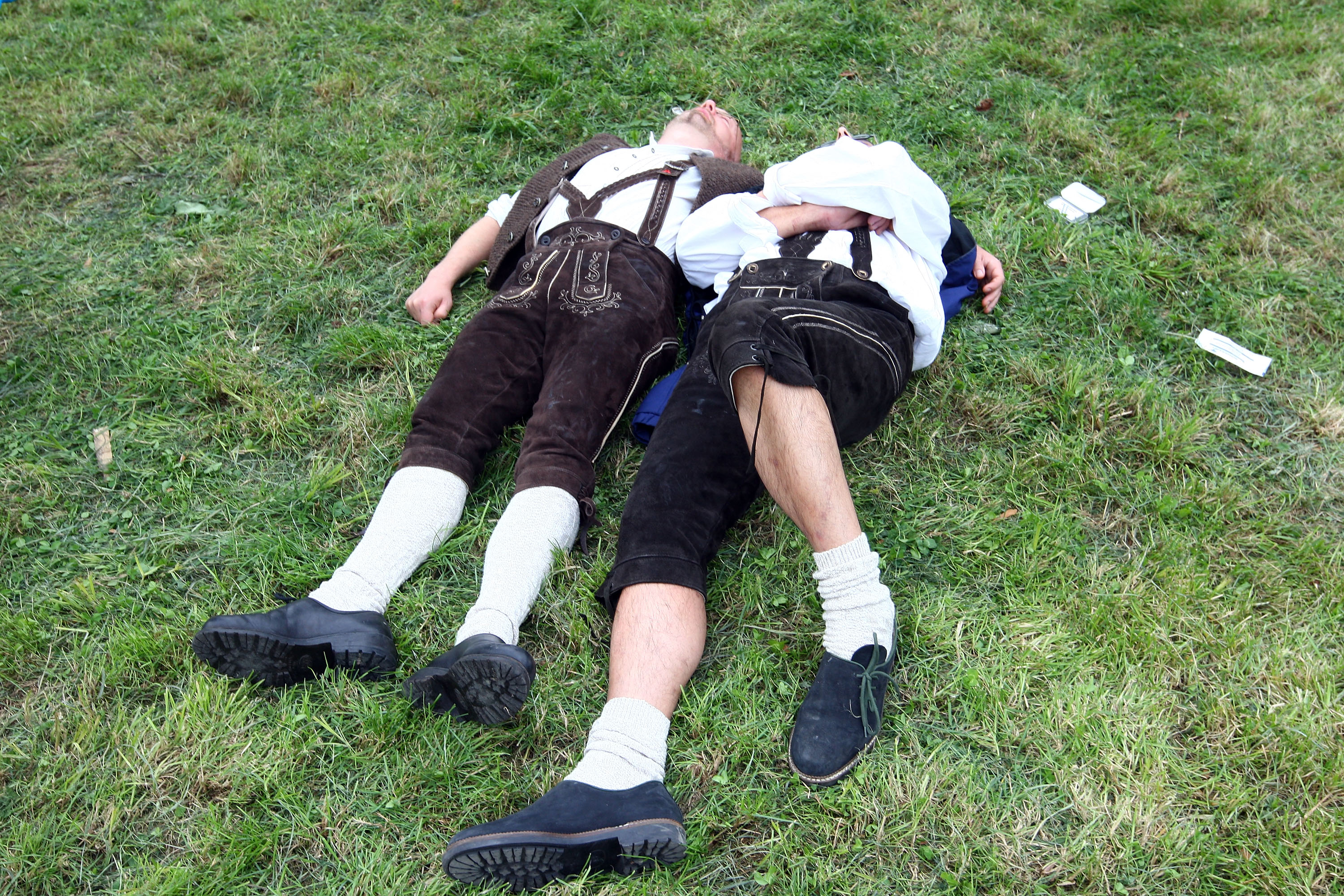
(Photo: Day 2 of the Oktoberfest beer festival on September 21, 2008 in Munich, Germany. By Johannes Simon/Getty Images)
 The Dish