Is The Political Blog Dying?

Enhanced-buzz-15678-1323718376-55

Ben Smith, the blogosphere's most talented political reporter, is leaving Politico to helm the web's most popular meme generator:

It is a tenet of BuzzFeed that the Web pages users like to click are different from the pages they like to share with others. BuzzFeed encourages the second case, the sharing of links, articles and photos on Facebook, Twitter and other social sites. The reporting by Mr. Smith and his staff will be produced with that sharing strategy in mind. "I already write for the social Web and consume most of my news on the social Web," said Mr. Smith, who calls Twitter his main source of news.

Ben indicated his discontent with blogging in an AdWeek piece by Dylan Byers a few months ago:

Since the early days of the 2008 campaign, Smith has distinguished himself by being first to the news. Having a jump on the competition of even just five minutes has made all the difference, he says. But a lot has changed since 2008. Twitter, Smith says, is "sort of draining the life from the blog."

"Where people were hitting refresh on my blog because they wanted to see what my latest newsbreak was, now they’ll just be on Twitter, and I’ll tweet it out and they’ll see it there," he says. "What I’m doing right now is just incredibly old school. I might as well have ink all over my fingers and be setting type."

Adam Clark Estes sizes up the "burgeoning BuzzFeed model for journalism":

Instead of just reporting on a major story, [Buzzfeed co-founder Jonah] Peretti explained, BuzzFeed's new editorial team will "refract that story in a lot of different ways." Instead of just reporting that a teenager won the Siemens prize for developing a potential cure for cancer, we'd imagine, BuzzFeed would cover the news as well as the Internet memes that the story spawns as well as other fun, shareable reactions. …

Somehow refreshingly, we couldn't get Peretti to engage in the we're-gonna-kill-print dialogue we heard earlier this year when Arianna Huffington and former executive editor Bill Keller got into a public argument about aggregation. After all, Smith will continue to write a weekly column at Politico, and we wouldn't be surprised to see BuzzFeed start sending traffic to the wonkier sites that Smith frequently links to. It all sounds so… welcoming.

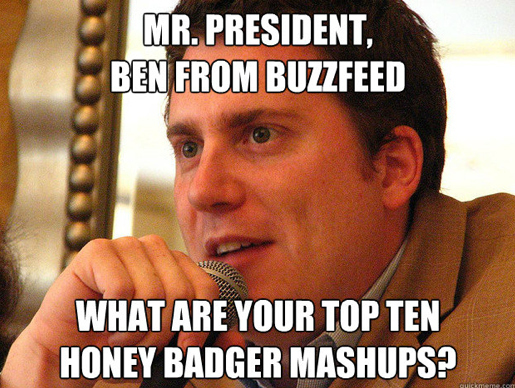
What we try to do at the Dish is all of the above. There's politics up front, but also Internet memes, YouTubes, reader threads, window views, etc. It's less like a blog than it was five years ago – and more like a blogazine. Ben's own announcement here. The above image is from Buzzfeed's announcement:

[W]e wanted to reassure you all that our new classy political coverage won't mean the end of our Internet silliness. So with that in mind, here is your newest meme: "Ben From BuzzFeed."

More examples here. Honey badger meme explained here.

Dissent Of The Day

A reader writes:

Thank you for your excellent 9/11 article in Newsweek. But please allow me to raise one important question for further explanation on your blog: why exactly did you support the war in Iraq?

I know you have reconsidered your position, and in your article you "tip your hat" to those who got it right. Since then you have led the fight publicly against neocon thinking and paid a professional price (I guess) by being ostracized by the Republican party for challenging Bush-era terrorism policies. And, I suspect, you may be tired of "apologizing" for this episode. But as a devoted reader, who didn't read your blog back then (it was 10 years ago!), I never really understood why you supported the Iraq war and, over the last few years of my readership, I haven't heard a satisfying explanation on your blog as to why you did originally.

I also suspect that many of your current readers also would be curious as to why you were in favor of the Iraq war. But, your explanation in the Newsweek article was both very short and (frankly) unsatisfying. By your words, the explanation is straightforward: you were "fooled" because of understandable post-9/11 anxiety. You write of your "psychic terror," "swamping of reason in [my] frontal cortex," "panic," "fear . . . spiraling upward," "minds . . . flooded with dread," "panic," "overwhelmed . . . judgment," and "fear dominated my being," and thus you trusted in "what our government told us, in tones that certainly sounded sincere."

Look, you are an admirable straight shooter, and it is plausible that you became overcome by 9/11 fear. But, candidly, that doesn't feel right. I mean, we got hit on September 11, 2001 and we didn't invade Iraq until March 20, 2003 – 18 months later. By the time we went to war in Iraq, it was widely reported that 70% of the American population mistakenly thought that Saddam Hussein had a connection to 9/11 (a percentage which I assume did not include you), there were high-level dissenters as to the supposed WMD intelligence, there was no evidence that Saddam posed a threat to the U.S. homeland, we knew that senior Bush people previously had issued public pre-9/11 statements in favor of invading Iraq, etc.

Honestly, this was not an environment where you could be fooled. It was an environment where you could make an informed choice. And it is hard to believe that 18 months after 9/11 that you were in a state of debilitating panic.

I have gone over this many times. But here's as succinct answer as I can muster today: no, the debilitating panic did not disappear. But it hardened into a political and rhetorical position, which I resisted changing in a highly emotional and volatile environment. I did believe that Saddam had WMDs; I also believed they could be handed to Jihadists; I did believe that democracy in Iraq could transform the Middle East, and that only such a transformation could get at the roots of Jihadism and adequately respond to the 9/11 crisis. I think I was broadly right about the latter but blind as to the competence and morality of the Bush administration, and woefully clueless about the distinction between democracy imposed from outside and a democracy that bubbles up from within. That last misjudgment is about as grave as a Burkean can admit.

In the daily mudfight of the blogosphere, I also dug in. And if I doubted, far left elements of the anti-war movement (think ANSWER) kept me too sure of myself (a classic epistemic failing). When I spoke with them, some instinctively blamed the US itself for an indefensible mass murder, and some seemed more consumed with hatred of George W Bush than Osama bin Laden. I got into a camp and doubled down. And if you want to know where the impulse for a blogazine that routinely presents dissent, that is open to self-doubt, that has become less a one-man pedestal than a collective thought process, then that experience may help explain the Dish's evolution.

None of this is an excuse. But I hope it is more of an explanation.

An App For The Dish, Ctd

Many readers are asking about an Android app. One writes:

"The Dish app is now up and running." More accurate would be: "The Dish iPhone app is now up and running."

I'm curious why, when Android has a larger market share than the iPhone, publications more readily roll out iPhone apps? My guess would be that iPhone has a more attractive demographic. But perhaps other forces are at work: a greater PR value from associating with the sexy iPhone; a more available pool of iPhone app developers; better intellectual property protections on the iPhone; better contractual terms from Apple?

Not sure, but we asked the Beast techies about getting an Android app and they said "it's definitely a priority for us, and we're hearing that feedback loud and clear." Stay tuned.

We Edit, You Decide

A reader illustrates "why I love (and sometimes hate) threads on The Dish":

April 28th: "Yeah. Why hasn't the pill evolved?"
April 29th: "True. It is hard to imagine a drug that alters the body that much without any negative side effects."
April 29th: "Birth control for men? That's the ticket!"
May 5th: "Oh, that's right. The IUD is a superior form of birth control that exists right now. People should know more about it. Except … what? A kind of IUD is known to have injured many women. Hence, some women and doctors worry about its safety and Big Pharma is afraid to innovate. That makes sense."
May 5th: "Oh, that was just one kind of IUD that really was a dangerous product. IUDs in general are AMAZING!"
May 9th: "Hmm, IUDs sound amazing, but this person had a HORRIBLE experience. There's a whole support network for problems associated with IUDs? The pill seems safer/better/more familiar."
May 11th: "IUDs are more like abortion than the pill? I'm not sure I'm comfortable with that. Am I comfortable with that?"
May 12th: "Oh, what a relief. Everything I learned about the IUD being a form of abortion isn't true. The IUD is AWESOME, again!"

I'm starting to realize that I should never feel strongly about a topic until I have all the information … and I will NEVER have all the information.  I look forward to learning more soon.

Drum roll:

With regard to the emails that have been posted about IUDs, I don't see anyone complaining about the drawback for men; namely, the excruciating pain that occurs when the head of the penis rams up against the silk thread coming out of the cervix.  Double ouch!

Update: A reader responds:

An IUD should not be painful! If it is, something is wrong with the placement of the string (which isn't silk, but some sort of plastic wire that is actually pretty sharp). After a while of having no problems with my IUD, its string suddenly started stabbing my partner. Then it started stabbing me. (That's when fixing it became extremely urgent! I can't imagine any birth control any more effective than sharp pain during sex, but that's not really an ideal contraceptive method.) The stabbing can happen if the string was cut too short, so that it can't curl around the outside base of the cervix. When this happens, a gynecologist can try to fix it by cutting the string even shorter so it sits only inside the cervical canal, or they can remove the IUD altogether and replace it. They just cut my string shorter, and then I was free and clear again!

I guess it's worth noting an editorial principle that has increasingly guided this blogazine. It is that what a chronological blog format can do, better than any other, is to unfold the aspects of an issue or argument or experience in real time through an actual conversation between intelligent, reasonable people. That's opposed to an authoritative take on any particular matter, gathered in advance over time and presented as settled fact or opinion.

This may sound very pomo, but, in fact, I think of it as the opposite. The aim is to reach a settled body of fact. We do not allow people their own facts – just encourage those that we may not have absorbed yet or known about. But we do allow people their own perspectives, experiences and arguments around these settled facts. The goal is to flesh out the reality through a conversation, rather than a monologue. Sometimes, these threads will end ambiguously; at other times they will convince any reasonable individual of a particular line of argument. My goal is to host the conversation, as well as present my own view as an occasional anchor for the discussion. And to allow my own attempt to better understand the world be the thread that keeps the whole thing, with any luck, coherent.

But the longer I have engaged this medium the more I have appreciated its potential for truth through honest conversation. We're biased but balanced. At least, that's the goal.

The Dish’s New Home

David Gura of American Public Media did a short Marketplace segment on The Dish's move from The Atlantic to The Daily Beast. You can listen to it or read the transcript here. If you're reading this, your bookmarks should have automatically redirected you. In the transition there are obviously some hiccups. My bookmark was dead for half an hour or so. It's a bit like climbing from out of the window of one fast car and trying to get into another fast car alongside it.

Please let us know if you come across glitches that might need to be fixed.

Home News

As most of you know, we’re migrating on Monday to the Sullivan-banner We should appear at the Beast at some point mid-morning Monday. The good news is: you do not have to change your bookmark, and you should be automatically redirected to the new page, where the familiar cartoon will confirm you’ve reached the right place. So now would be a good time to bookmark this page if you don’t want to go searching for us on the Interwebs.
The final design is not far off this one, and I know everyone will have issues. That’s natural. And we’ll be tweaking it in the coming weeks, and welcome your suggestions. We’ve also dropped the “Daily” from the “Daily Dish.” I didn’t want it to jar with the Daily Beast, and it is also untrue. We are not daily – and haven’t been for seven years. And we always refer to the blogazine as the Dish colloquially, so it seemed like a good moment to change it.

We’re also sad to say that Conor will stay at the Atlantic from his perch in Southern California.

Conor has been a Dishtern and an editor here, and we will miss him badly. But he yearns for more than underblogging and will doubtless thrive in a new role at his old home. By the way, NPR’s Marketplace will be running a story on the Dish Monday, and I’ll be on Bill Maher’s show next Friday (with Eliot Spitzer!).

I just want to say on this last full weekday at the Atlantic how grateful I am and we are for the support and opportunities that David Bradley and James Bennet gave us these last several years. I have a deep attachment to the magazine and its staff and am very proud to have played a part in its digital reinvention. Have no fear that I will continue to link to TNC, fight with Goldblog, quibble with Megan, and learn from Jim, Josh and Clive. As for Alexis, we hardly knew each other. But if you are not checking out his wonderful tech blog, you’re missing something.

Oh, and wish us luck.

Home News: Your Take

Ivydusty

Dusty remains indifferent. But she is always indifferent, except when a potato chip falls to the floor. A reader writes:

I took immense pleasure in using The Daily Dish as an excuse to avoid The Daily Beast and HuffPost. Now I fear your identity will get sucked into theirs and you won't be allowed to keep doing fun posts about hot hot bears.

Oh ye of little faith. I would hope my identity is strong enough to survive. TNR, The Sunday Times, The NYT magazine, Time, the Atlantic … I am, as the lyric has it, what I am. And I retain editorial responsibility. So if you hate our blogazine after it moves, blame me and no one else, least of all our new host. Another:

OK Beast move. Just don't give up VFYW contest.

Are you kidding? Of course we won't. Another:

Well, I feel like when my parents divorced, and my trying to get used to Dad's new girlfriend (which by the way never happened, until the 2nd girlfriend post-divorce ;-)… So, okay, Andrew, I'm trusting this is a good thing for you, and I'm happy for you and the Team.

Another:

Probably the Lone Ranger here, but this feels sad to me. Newsweek came into my family's home for 50 years but after they all passed, I abandoned its increasingly malnourished content. Picked it up again when Ezra Klein signed on but found even a young hero of mine wasn't enough to maintain subscription. 

I'm left wondering how much more financially secure you and Aaron are going to be with this move, and whether (please, Lord, no) you will be expected to appear occasionally on Morning Joe.

I will not be appearing on Morning Joe. I am asleep during most of Morning Joe, and intend to remain so. But trust and verify. If you feel we are straying from our standards in any way, let us know. Another:

And not to make it about readers like me but what happens now to readers like…well…me? Unimportant, terribly opinionated readers like me. (Whimpering pathetically.) Will you still get our emails? Or will it become something now we read but don't feel need to respond because there will be A) A message board or B) Some secretarial person who puts it in a file and know you'll never hear opinion anyway or C) Well I don't know what else. But something else.

I don't do change well obviously. And The Dish has become a daily fixture. It will still be The Dish right? The wonderful Dish. Or will it be … something not The Dish?

I have to go tend pot pies. I don't know whether to have an appetite. I'm still happy for you though.

Please. I and Patrick, Zoe, Chris and Conor will always be reading your emails, selecting the best and most persuasive and doing what we have always done. I'll be working from my blog-cave on the same blogging platform with the same amazing little team we've put together. We'll be having our weekly editorial lunch at the local diner. I'll be larding the place up with beards and MHBs and beagles and Pet Shop Boys lyrics. I didn't send a decade evolving the Dish to throw out our model. I'm sure we'll change – but we changed radically at the Atlantic.

Very gradual change we can believe in. That's the concept.

The Rise Of Blogazines, Ctd

Ezra continues the thread:

[B]logging is the more derided medium, but it's unquestionably superior for conveying information. You can give a reader much more on a blog than in an article. But for all that, I'm fiercely committed to articles, because they make sure I'm writing in a way that's accessible to people who don't read the blog — which is, let's face it, the vast, vast majority of the world. So though the technology underlying blogs and articles is beginning to converge, I don't think the forms are going to become one anytime soon. It will always be the case that your regular readers are a small fraction of your pool of potential readers, and the likely outcome here is that more and more organizations end up running two kinds of content: one aimed at regulars and the other written for drop-ins.

I just believe that the web is going to win over print (duh) and that the web favors an intimate form of discourse rather than an institutional one. Facebook illustrates this. We relate to individuals online, not organizations or collectives. And so, in the long run, if a personal blog can actually be a filter for articles, reporting, conversation, then I think it has a future much greater than some think. Ezra's right that it's not imminent. But my gut tells me it's inevitable.