The Rise Of Blogazines, Ctd

A reader writes:

I noticed while reading your post that the Dish is sort of a mirror of the “composite state” or republic, mixing Monarchy (Sully), Oligarchy (Patrick, Chris, Conor, Zoe) and Democracy (readers). Just like our own system of checks and balances, the mixture of contributors provides anchors and much needed reality checks to each element. It blends the strengths of the individual, the small group, and the vast collective while helping the manage the weaknesses of each.

Well, that’s the hope: what the ancients called “a mixed regime.” But it’s the result of no theory; just gradual improvisation and experiment.

The Rise Of Blogazines

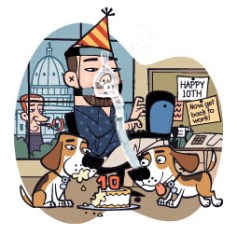
Sullivan_10thbanner

Farhad Manjoo notes an overlap:

The design shifts—with blogs looking more like magazines, and magazines looking more like blogs—aren’t just superficial. These changes in presentation are collapsing all distinctions between “blog posts” and “articles.” Over the last few days I contacted various bloggers and editors at big sites around the Web to ask how they define each term. The answers I got were surprisingly diverse—while each of these organizations has its own rules for what it calls a “blog post” and an “article,” the rules aren’t at all consistent across newsrooms. What’s more, the lines are blurring—blog posts are looking more like articles, and articles are looking more like blog posts.

Further thoughts over at Chloe Veltman’s place.

I’ve thought of the Dish as a blogazine for quite a while now. The model we’ve groped our way toward combines the agility of a pond-skater with the ability to deep dive at any moment. And its reader-generated content makes it a product of a collective mind as well as an individual one, a bull-session as well as an individual’s thinking out loud. Who knew this evolution was possible even a year or two ago?

And I have to say, our new “read on” feature has helped us evolve this more quickly and intuitively than I thought it would.

See?

You get the choice to skim or dive in – at your leisure, and with minimal hassle. Then the links help you explore even more, if your nose takes you there. So the Dish becomes as much a mediator as an individual thinker, as much a collective mind as a single one, as much a biased broadcast as a communal debate. With videos, art, quotes, thoughts, provocations, jokes, and photography thrown in for good measure – some prompted by you, some by me, some by Patrick, Chris, Conor and Zoe. And all, in the end, channeled through what’s left of my fried frontal cortex. That’s much more than this blog was in, say, 2002.

But that’s the joy of this new medium. We still don’t know where it will go next. And we’re all  improvising like mad. What’s not to love?

The Dish At Ten: Jonathan Cohn

Jonathan caps off the Dish's anniversary week:

Andrew was no longer editor when I arrived at the New Republic in 1997, so I knew him only from his written work. And, to be honest, I was not such a fan. Yes, he was a brilliant writer. But he was too much of a provocateur for my taste–somebody who seemed to relish outrageousness for the sake of outrageousness. 

Then I got to know Andrew a little bit. And I came to appreciate what I suspect most Daily Dish readers already know: Andrew simply has an uniquely aggressive mind. He genuinely enjoys challenging what other people think, even when that means challenging himself. That's what makes his blog such a bracing and illuminating read: You get to see this intellectual process as it is taking place. 


The Dish At Ten: David Frum


I've been arguing with Andrew Sullivan online since "online" existed. Andrew has invented and defined so many of the Internet's creative possibilities: for politics, for journalism, and for personal reflection. The rest of us admire or criticize or both, but ultimately … we emulate. In a decade that started with a second 1941 and ended with a second 1929, Andrew has been a voice that future historians will quote endlessly and tirelessly as a representatives of the thoughts and emotions – passions and regrets – brilliant insights and terrible mistakes of this generation of Americans.

Read David at FrumForum.

The Dish At Ten: Jonathan Bernstein

Jonathan joins the party:

I do remember very well what the world was like for political junkies before the Daily Dish, and it pretty much stunk compared to the world now.  Then as now, there were plenty of long-form articles and essays.  But intelligent political conversation?

I remember when I first watched Crossfire on CNN when it was new, and thinking it was more intelligent than whatever else was available (no, really.  Not joking)..  People watched the McLaughlin Group because it was more entertaining than other political shows.  And then Sullivan and Kaus showed up, and as far as I was concerned most TV talk shows became instantly obsolete.  They weren't nearly as intelligent or entertaining as the blogs. And then, the blogs got better, and Andrew Sullivan deserves a lot of credit for that, too.

So from Plain Blog, a hearty Mazel Tov to the Daily Dish, and I hope to be reading it for a long time to come.

The Dish At Ten: Grant Gallicho


Is he doing this for free? So wondered the crass capitalist in me when I started soaking up Andrew’s daily musings, genre-benders, analyses, hiccups, tours de force. Then: When does he eat? Then: When do his dogs eat? And occasionally: Are they ghostwriting for him? Much of the time I read in awe of his output. But most of the time it’s simple admiration for his pit-bull persistence, his moral compass, and his catholic range of interests. We don’t always agree—for example, I believe Trig Palin is animatronic—but isn’t that the point? I don’t tune in to have my opinions reinforced. I visit the Dish for the same reasons everyone else does: to be challenged, to laugh, to learn, to nod, and to get my back up. And, of course, to reinforce my embarrassment over not being able to grow a real beard. Here’s to the past ten years of showing the rest of us how to blog, Andrew.

Read Grant at Commonweal.

The Dish At Ten: Juan Cole


The sign of an honest thinker is the ability to re-examine deeply-held beliefs and premises and, where necessary, to reverse himself or herself.  The sign of a smart writer is the ability to get to the bottom of the story and make it clear to the public.  Put them together and you get that most rare and precious of commodities, intellectual dynamism.  Andrew Sullivan and the Daily Dish have it. Few others do.

Read Juan at Informed Comment.

The Dish At Ten: Dan Drezner

I will always be indebted to Andrew for his generosity, his philosophy and his model of online writing. Guest-blogging for him was a generous signal from Andrew that I might have things to say that were worth reading. That week was also an opportunity to experience the crush of florid humanity that is Andrew’s e-mail inbox. It makes me all the more impressed that Sullivan has maintained almost 95% of his sanity for the past decade (sorry, Andrew, I have to deduct points for the Trig obsession).

Sullivan’s “politics of doubt” is also worthy of note. Too many writers let their opinion congeal into a black mass that cannot be penetrated by any counter-intuitive insight or data point. Sullivan has been willing to change his mind when the facts change; I can only hope I’ve been as intellectually honest.

Finally, Andrew created the template for today’s political bloggers –react to the news that is interesting, follow up on the news that is really interesting, and never let go of the stories that really exercise some part of the brain. All bloggers who aspire to the influence of The Daily Dish consciously or unconsciously use this template. What Sullivan does better than the rest of us is to write so well while infused with such strong emotion. Here’s to another ten years of perspicacious blogging.

Read Dan at his eponymous blog.

The Dish At Ten: The View From Your CPAP

A reader writes:

I too suffered (unknowingly) from Cpap study – and was informed I had an average 150 disturbances an hour. I too tried the CPAP, but couldn't stand the Darth Vader aspect of it.
I found a doctor who fit me with a clamp that fits over my teeth, top and bottom – sort of inside-out false teeth  The clamp keeps my mouth closed, and prevents my jaw slacking back, so my tongue won't slip back down my throat.  Altogether more discreet and more comfortable than the CPAP – indeed, I'm happy to leave the device in after I wake up in the morning until I need to talk or eat, it's that comfortable.

What's it called? Another writes:

I also was diagnosed with sleep apnea a couple of years ago. My experience was very different from yours.

My wife said that sometimes I stopped breathing in the night. So at her urging I went to my doctor and he arranged a sleep study. I too had numerous tentacles attached to my body, my head, and my legs. I was unable to fall asleep and for the first time I took sleeping pills. After a couple of doses of pills any many hours of staring at the ceiling I fell asleep. I was told I had severe sleep apnea and would need a CPAP. I dutifully got fitted with a mask and bought the machine. (The machines cost over $1200 for those that do not know. Masks start at $100 and go up from there.)

I spent weeks trying to get a mask that fit. I could never get a seal with my face. The constant rushing air made such a noise in my skull I could never fall asleep. There is no way to dampen the sound when it's inside your head. If I did finally fall asleep – from total exhaustion – the poor seal of the masks would crank the air pressure all the way up and would wake me.

The "cure" was driving me insane. I tried the machine every night for months, always with the same results. I'd eventually fall asleep and about an hour later the mask would unseal and I would tear the machine off my head and rip the power cord from the wall. About two minutes later I'd be fast asleep.

Of course I told this to my doctor and the "sleep therapist". I was referred to a doctor that was a sleep "specialist" and he made adjustments to the machine that made things even worse. Using the machine was completely intolerable. I was prescribed sleeping pills. Taking them made things worse yet. Now I had to fight off the feeling of being drugged in the morning in addition to getting no sleep.

I kept trying the machine and the pills and complaining to my doctors. I was then referred to a Ear, Nose, & Throat surgeon to see if anything could be done surgically. After a brief exam she said that I did have a very soft palate and that is why I snore. Nothing can be done about that. Upon looking into my nose she asked how long I had played hockey. I told her I never played and she said she asked because it was clear my nose had been broken very badly and because of the way the bone healed I had severely obstructed nasal passages. She recommended surgery to fix this.

The surgical procedure was interesting to say the least. They don't use general anesthesia because it's too dangerous so I was drugged just enough so I was on the verge of passing out. I could hear the doctors talking and could feel the chisel blows in my head. I remember a few sharp pains but not too much else.

This was the first time I had ever had cocaine. Yes, medical grade cocaine. It's used to constrict the blood vessels in the nose so when the incisions are made the bleeding is kept to a minimum.

After the surgery I am now able to breathe through both nostrils. I no longer get nosebleeds. My wife tells me I snore much less and the sleep apnea has almost completely stopped. While I get more rest I am not experiencing a profound change in my energy levels but I feel somewhat better.

I know this rambled a lot. I really do wish you the best of luck your treatment. I bet your husband gets a better night's sleep from now on too.

I'm still addicted to mine, and go nowhere without it. Not great for one's love-life, of course. And I hear countless stories like the one above of just not being able to handle it. But it's time for me to go back and get re-tested. My reader's first option is intriguing. The second: not so much. I've never had my sinuses or nostrils examined although I'm pretty sure they're screwed up. But I'm leery of surgery like this. I've met people who have described real trauma with the surgery and minimal success. The best advice is to get a sleep study and if you have apnea, try a CPAP first.

(Remix of Terry Colon's cartoon created by a Dish reader.)

The Dish At Ten: Matt Yglesias

Yglesias's contribution:

I know this has a bit of an air of “village” circle jerk to it, but I think [Andrew's] very un-village integrity is underscored by the fact that literally the first time I met him was over lunch when he was recruiting me to join the Atlantic. Part of the essence of village dysfunction is that it’s extremely unusual to get assistance in moving up the professional ladder from someone who you’re not tied into through some kind of crony network and the world would be a better place if more people had his kind of approach to such matters.