Ukraine? Where’s That?

Most Americans can’t find it on a map, according to this survey and an accompanying map:

Ukraine_Full-1024x535

Details on that survey:

About one in six (16 percent) Americans correctly located Ukraine, clicking somewhere within its borders. … However, the further our respondents thought that Ukraine was from its actual location, the more they wanted the U.S. to intervene militarily. Even controlling for a series of demographic characteristics and participants’ general foreign policy attitudes, we found that the less accurate our participants were, the more they wanted the U.S. to use force, the greater the threat they saw Russia as posing to U.S. interests, and the more they thought that using force would advance U.S. national security interests; all of these effects are statistically significant at a 95 percent confidence level.

These findings don’t surprise Larison:

It makes sense that ignorance about a country’s location and its importance to U.S. security would be associated with a preference for more aggressive policies. Those that know the least about the country and U.S. interests presumably would be more likely to accept arguments that exaggerate the threat to the U.S., especially if they are relying on news sources that sensationalize the events and hype the threat in order to attract an audience. Because these respondents have a poorer understanding of the most basic facts, the more likely they are to fall for alarmist demands for “action” and the less likely they are to have considered the considerable dangers and costs that a hard-line response would almost certainly entail.

But John Patty complains that the survey is being used to ridicule people who don’t deserve it:

There are a lot of clicks in Greenland, Canada, and Alaska.  … clicking farther away from Ukraine means that you are, with some positive (and in this case, significant) probability clicking closer to the United States. So, suppose that the study said “those who think the Ukraine is located close to the US are more likely to support military intervention to stem Russian expansion?”  Would that be surprising? Would that make you think voters are irrational?

The Annexation Of Eastern Ukraine, Ctd

ukrine_pro_russian_troops

Following up on the weekend’s troubling events in Donetsk, Luhansk, and Kharkiv, Alexander Motyl calculates that Russia would need a large military force to occupy Eastern Ukraine, especially in the event of an insurgency:

In light of Russia’s estimated current force levels on Ukraine’s borders (50,000–80,000), the best Russia could do under low- and medium-violence assumptions would be to invade a few southeastern provinces. If those assumptions are changed to medium or high, only one or two provinces would be within its grasp. These conclusions assume that an invasion would entail no force deterioration as a result of the Ukrainian army’s resistance. Change that assumption, and Russia’s capacity to occupy southeastern Ukraine declines even more.

In sum, Kyiv is right to worry about an invasion of all or part of its southeast—but only if Russia makes optimistic assumptions about the extent of resistance. Accordingly, Ukraine’s immediate goal should be to strengthen its southeastern defenses—preferably with American help—so as to deter a focused attack or, at the very least, to make such an attack so costly as to raise the conditions of expected violence in individual provinces. (Ukraine’s medium-term priority should of course be to develop a full-scale defensive capacity.) But, unless Putin decides to deploy most of Russia’s armed forces (which number about 750,000) against Ukraine and thereby place all of Russia on a war footing, readying bomb shelters in Kyiv may not be a Ukrainian priority.

(Map from Max Fisher, who sees an invasion as more and more likely.)

Russian Exceptionalism

Bershidsky examines a leaked draft of the Russian culture ministry’s forthcoming “Foundations of the State Cultural Policy”:

“Russia must be viewed as a unique and original civilization that cannot be reduced to ‘East’ or ‘West,’” reads the document, signed by Deputy Culture Minister Vladimir Aristarkhov. “A concise way of formulating this stand would be, ‘Russia is not Europe,’ and that is confirmed by the entire history of the country and the people.”

Russia’s non-European path should be marked by “the rejection of such principles as multiculturalism and tolerance,” according to the draft. “No references to ‘creative freedom’ and ‘national originality’ can justify behavior considered unacceptable from the point of view of Russia’s traditional value system.” That, the document stresses, is not an infringement on basic freedoms but merely the withdrawal of government support from “projects imposing alien values on society.”

The draft goes on to explain that certain forms of modern art and liberal Western values in general are unacceptable and harmful to society’s moral health.

Angus Roxburgh fears what may come of the country’s burgeoning chauvinism:

The question is, where will it end, this new-found Russian confidence? The concept of the Russian World (“Russkiy Mir”) has been gaining strength, especially since 2006, when Putin exhorted young people to “use this phrase more often.” Now there is a Russian World Foundation, which aims to promote Russian language and culture, as well as something more amorphous—a sense of “Russianness” and a community that covers the entire Russian-speaking world. That includes territory in Ukraine, Moldova, Kazakhstan and elsewhere. Is that where Kremlin eyes are gazing?

It is only a small step from nationalism to chauvinism. In the wake of the Ukraine crisis, it is rampant—and it already ran deep in Russian veins. I recall hearing a very senior member of Putin’s circle (one of those whom foreign journalists describe as sophisticated and westernised) privately describing the Ukrainians as a nation of devious, untrustworthy crooks.

Related Dish here.

The Annexation Of Eastern Ukraine

Stay tuned:

Pro-Russia demonstrators who seized a building in the Eastern Ukrainian city of Donetsk have declared a new “republic” and are seeking their own Crimean-style independence vote. The declaration came soon after the interim leaders in Kiev blamed Russia for spurring unrest in eastern Ukraine, where pro-Russian activists have been storming government offices in a number of cities. Interim Prime Minister Arseniy Yatsenyuk said during an emergency cabinet meeting on Monday that “the [Kremlin’s] plan is to destabilize the situation, the plan is for foreign troops to cross the border and seize the country’s territory, which we will not allow.” This morning, pro-Russia groups took control of state security buildings in Luhansk.

Stefan Wolff and Tatyana Malyarenko analyze the protests in Kharkiv, Luhansk, and Donetsk:

There is little doubt that these events are being orchestrated by Moscow to increase pressure on the interim government in Kyiv and its Western backers. With presidential elections scheduled for May 25 alongside 27 mayoral contests, the political situation is becoming ever more tense.

Anti-Russian sentiment in western and central Ukraine is likely to reach new heights; this will in turn raise the levels of unease among the more pro-Russian minded populations in eastern Ukraine. While anti-Russian protests have continued to demonstrate resistance to the Kremlin’s continued meddling, there is therefore also a genuine base of resentment into which Moscow can easily tap.

Linda Kinstler explains the significance of the protesters chanting “Novorossiya,” or “New Russia”:

Novorossiya is the name of the formerly Ottoman territory that Catherine the Great conquered in the Russo-Turkish Wars, which is now much of southern and eastern Ukraine. Led by Prince Grigory Potemkin, Russian forces colonized the land in the late 18th century and established the cities of Sevastopol, Simferopol, Tiraspol, and Odessa. …

If the Kremlin isn’t after re-establishing Novorossiya, it’s certainly looking to create something like it—and the first step in that direction is federalizing Ukraine. In an interview last week, Russian Foreign Minister Sergey Lavrov said that federalization is the only “absolutely correct way” to proceed, and that it’s “what the eastern and southern regions request.” If the Kremlin has its way, Ukraine might either become a federation of regional governments, each with wide-ranging authority to act virtually autonomously, or the “independent” southern and eastern regions would become Russian oblasts.

Morrissey considers the bind the Ukraine PM is in:

The problem for Yatsenyuk is that he can’t afford a military confrontation, which leaves his hands tied to a large extent in the eastern provinces. First, what forces he does have need to fortify the border rather than impose order in Donetsk and Lugansk. Even more to the point, the use of the military to suppress the Russian-speaking population would give Putin exactly the pretense he wants to send his far more powerful military into eastern Ukraine to protect the oppressed Russian minority.

But Adam Taylor points out that Donetsk is not Crimea:

While the city does have a slim Russian majority (48.15 percent vs. 46.65 percent Ukrainians, according to the 2001 census), it’s at the center of an Oblast with a clear Ukrainian majority (56.9 percent Ukrainians to 38.2 percent Russians, according to the same census).

The different circumstances here may well prompt a different response from Kiev, who offered little more than stern words when Crimea voted for annexation by Russia (it could certainly be argued that the anger over Crimea’s referendum wasn’t so much due to Crimea joining Russia, but rather the flawed way the referendum was held). The Ukrainian government has so far refused to contemplate letting Ukraine’s fifth-largest city and a major economic hub secede.

The Ukrainian Federation?

Frum fears that when Russian officials speak of a “federal” solution for Ukraine, they really mean partition:

In the context of Ukraine and its already-dysfunctional institutions, “federalism” is code for rule by local oligarchs in tandem with their Moscow overlords. Such an approach would dash any hope of Ukraine developing transparent and responsive institutions, honest policing, and an economy that offers something like opportunity to more than a well-connected few. …

As Putin said in his speech justifying the annexation of Crimea, he cannot accept Ukraine as a distinct nationality. In tsarist times, the preferred Russian term for Ukraine was “Little Russia,” with all the condescension that phrase implies. The New Yorker’s David Remnick reports that Putin told President George W. Bush that Ukraine is “not even a country.” Putin, it seems, views Ukrainian independence as fundamentally absurd, as well as wrongheaded and dangerous.

Putin’s machinations notwithstanding, Ilya Somin points out that federalism might actually be a good idea:

Federalism has often been a successful strategy for reducing ethnic conflict in divided societies. Cases like Switzerland, Belgium, and Canada are good examples. Given the deep division in Ukrainian society between ethnic Russians and russified Ukrainians on the one hand and more nationalistic Ukrainians on the other, a federal solution might help reduce conflict there as well by assuring each group that they will retain a measure of autonomy and political influence even if the other one has a majority in the central government. Although Ukraine has a degree of regional autonomy already, it could potentially would work better and promote ethnic reconciliation more effectively if it were more decentralized, as some Ukrainians have long advocated.

In any case, Posner thinks Ukraine is doomed:

Ukraine has never shown itself able to exist as a viable independent nation. Throughout nearly all of its history, it has been a province of Russia, or divided between Russia and other neighbors. The major period of independence from 1991 to the present–a blink of an eye–has been marked by extreme government mismanagement that has resulted in the impoverishment of Ukrainians relative to Poles, Russians, and other neighbors. In the 1990s, many experts doubted that Ukraine would survive. Now that Russia is back on its feet, their doubts seem increasingly realistic.

The Silencing Of Russian Journalism

Julia Ioffe focuses on Dozhd, the last independent TV channel in the country, and its struggle to stay alive:

Given the youth and often shoestring budget of the staff, its shows can feel raw and unprofessional, but the steady pressure on the channel has instilled fear in their advertisers, not letting Dozhd expand, despite having the most educated and wealthy audience in Russia. And why do high-grossing urban professionals tune in, despite the sometimes high-school paper feel of the channel? There’s nothing else on television in Russia that isn’t controlled by the Kremlin in one way or another. On Dozhd, you can actually get information, rather than propaganda.

Now Dozhd has months to live. Earlier this month, Natalia Sindeeva, the channel’s owner, drastically cut salaries and announced that Dozhd had, at most, three months left. Then the building’s owners told her that Dozhd had to vacate its headquarters by June. Sindeeva said it’s not clear that the lights would or could come back on after such an expensive move. And that’s if anyone decides to let in a liberal entity that’s fallen from the Kremlin’s favor.

Joshua Yaffa also chronicles the crackdown on Russia’s opposition media:

As the space for independent journalism shrinks, the propaganda apparatus is working at feverish speed. Dmitry Kiselyov, a television host and media executive who represents the id of the state propaganda machine at its most grotesque, blamed this same fifth column for the sanctions imposed against more than thirty Russian and Ukrainian officials by the European Union. Kiselyov, who was among those sanctioned, cited Putin’s speech as evidence to blame the fifth column for compiling the blacklist. “Putin legalized that term in the political language of Russia,” he said. “We know their names. We know how they wrote our names and sent them to these Western embassies.”

Irina Kalinina looks at Russian TV’s portrayal of Ukraine:

Perhaps the most vivid propagandist on Russian television, especially these last few weeks, is Vladimir Zhirinovsky, the vice chairman of the Russian Duma, who recently proposed to divide Ukraine between Russia, Poland, Romania, and Hungary. Most Ukrainians and a lot of Russians as well have long considered Zhirinovsky a fool for his tendency to make exceedingly strange proposals. He has advocated, for example, that Russia seize Alaska and use it as a deportation dumping ground for Ukrainians. Not long ago, he claimed that a meteor shower was a test of a new American weapon.

These days, Zhirinovsky is no less surreal in his predictions—but we find ourselves wondering if there just might be a suggestion of Russian policy in his pronouncements. “If you want presidential elections in Ukraine,” he said on Russian television, “you want fascists to win them.” There is a certain twisted logic to this. Russian policy in Ukraine is based upon the strange premise that only Russia can protect the world from Ukrainian fascism. (In fact the opposite is true: The only way radicals in Ukraine would have a chance is if Russia continues its invasion of the country.)

Ukraine’s Candyman Candidate

Polly Mosendz profiles billionaire Petro Poroshenko, now the front-runner in the race for the presidency:

Put simply, he is the Willy Wonka of Ukraine. His company, Roshen, is Ukraine’s leading sweets brand and a household name in Eastern Europe. Roshen produces over 450,000 tons of confections a year, fueling his personal net worth to $1.79 billion. And unlike most billionaires in the former-Soviet bloc, he came by it honestly.

Ukrainian politics are so lathered with corruption that the country has a non-profit organization — “CHESNO” (which translates to ‘honest’) — dedicated to examining the root of politicians’ wealth. Svitlana Zalishchuk, the spokesperson of CHESNO, confirmed that “We [CHESNO] couldn’t find any instances of corruption” in the amassing of Poroshenko’s fortune. In this sense, Poroshenko is the anti-Yanukovych.

In an interview with Poroshenko, Anna Nemtsova takes stock of his style as well as his positions:

[A]s I listened to Poroshenko speaking in his office there were echoes of an old-school Soviet diplomat being very, very careful about what he says. When Poroshenko talks about Putin, for instance, his language is never hateful, always calculated. In a political landscape filled with populist provocateurs, Poroshenko has never played that game, and that may well be why he’s leading all other announced and potential candidates for the critically important presidential elections to be held May 25. …

Poroshenko reminded me that for the last decade and a half his aim has been to bring Ukraine into the European Union while at the same time keeping good relations with Russia. And according to the Ukrainian media Poroshenko’s strong position in the polls comes from widespread hopes that he is the candidate who can find a way to make peace with Russia even now.

Robert Coalson points out that the chocolate baron’s viability as a candidate may be due to this video:

Perhaps the high point of Poroshenko’s performance in the latest political crisis came on March 12. That night, Poroshenko visited the Crimean capital, Simferopol, in a quixotic bid to prevent the peninsula from holding a referendum on joining Russia. Widely seen amateur video showed the stoic Poroshenko walking through the dark streets of the city being hounded by hundreds of chanting, pro-Russian demonstrators:

That night in Simferopol may have elevated Poroshenko to the front ranks in the eyes of many Ukrainians, says Andreas Umland, an associate professor of political science at Kiev-Mohyla Academy. “Him being chased by these pro-Russia militiamen or Russian soldiers—that, perhaps, played a role in making him look credible and a serious politician and not just an oligarch,” Umland says.

But Peter Turchin is not looking forward to an election battle between two oligarchs, Poroshenko and Yulia Tymoshenko, who made her fortune in shady gas deals in the 1990s:

Not anybody who is super wealthy is an “oligarch,” of course. The sources of true oligarchic power must include both a huge fortune and the access to the highest levels of political power. Both Tymoshenko and Poroshenko fit this definition perfectly, since both have been in and out of government, occupying a variety of posts. Since 1999 Tymoshenko has been the Deputy Prime Minister for Fuel and Energy and Prime Minister (twice). Poroshenko hasn’t climbed quite as high as that, but he occupied the two next most powerful posts in the government: Minister for Foreign Affairs and Minister of Trade and Economic Development. Just as Kevin Philips wrote, political power begets economic power, and economic power begets more political power. At least, that’s how it works in oligarch-dominated countries.

Emerging, But Not Engaging

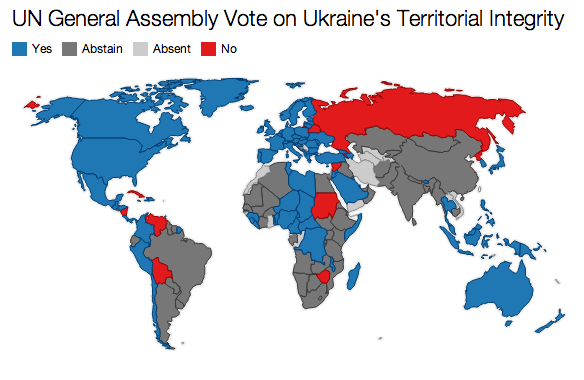
Screen Shot 2014-03-31 at 12.05.36 PM

Analyzing the breakdown of last week’s UN vote to condemn Russia for violating Ukraine’s territorial integrity, Matt Ford notices that most of the world’s rising stars abstained:

Four of the five BRICS countries—Brazil, India, China, and South Africa—chose to not take a side on the resolution, as did many African, South American, and Asian countries. Some observers argue that the abstentions show a wariness among developing nations to choose sides in a confrontation between Russia and the West. “India and China have deep reservations on sovereignty and territorial integrity and in the past have not hesitated to slam US for Libya, Syria etc.,” wrote The Times of India after the vote. “With Russia doing exactly the same thing, the dilemma in the developing world is acute.” Other countries avoided participating in the vote altogether, including Iran, one of Russia’s closest allies, and Israel, one of America’s.

Suzanne Nossel argues that Obama should work on turning emerging democratic powers into anti-Putin allies:

India and Indonesia, respectively, are the world’s first and third most populous democracies, and they are centerpieces of Washington’s “pivot to Asia” and approach to handling China’s rise. Brazil and Argentina are the most influential players in Washington’s near abroad, and South Africa and Nigeria are key to countering terrorism and fostering trade and development across Africa. Reflecting their importance, the Obama administration has included these countries in an array of treaties, strategic dialogues, and commissions all aimed at improving relations — partly as a counterweight to China and Russia. …

In the drama over Ukraine and Russia’s relationship to the West, the supporting actors could ultimately matter nearly as much as the stars. Russia is boasting that it will survive the West’s sanctions because it has alternative trading partners. Having been blacklisted by the West, Putin will either be left friendless or will succeed in turning the BRICS, a coalition of Brazil, Russia, India, China, and South Africa, into a tight new clique. These countries’ warmth toward him may affect his calculus on whether to push further on eastern Ukraine or call it a day with Crimea.

Where Will Putin Stop? Ctd

Michael Weiss thinks an invasion of Eastern Ukraine is imminent:

As of this writing, Russia has amassed as many as 50,000 troops at various points along the Ukrainian border, including in Russian-occupied Crimea. Videos uploaded to the Internet show armored vehicles being taken off flatbed freight trains in Voronezh, a city northeast of Ukraine’s Kharkiv, and in Novozybkov, which is 50 miles north of Kiev. (Tanks there are already rolling on the ground, in fact.) The Russians have also moved food, medicine, and spare parts into position, which would not be needed for any short-term military “springtime exercises,” as the Defense Ministry now claims is all they’re up to.  A field hospital has been erected in the Bryansk region, as Voice of America reported: that’s just 12 miles away from Ukraine’s eastern border, which is now heavily monitored by Russian drones. Furthermore, Moscow has resorted to subterfuge to hide its activities — not a terribly good sign of its sincerity.

But Fred Kaplan points out that an invasion would be very costly for Putin:

Politically, Putin would find himself on very shaky ground. Already, he mustered only 10 other countries—the likes of Belarus, Cuba, North Korea, Nicaragua, Sudan, and Syria—to oppose a U.N. resolution condemning the annexation of Crimea. If he invades Ukraine, a sovereign nation with a United Nations seat, his isolation will widen and deepen politically, diplomatically, and economically.

If he crosses that line, he will also do more than anyone ever has to rouse the European nations out of their post-Cold War stupor. He can count on Britain, Germany, and France to boost their defense budgets, and in a way that confronts Russia. He can also count on the United States to station more troops, fighter jets, maybe even armored weapons in Poland and the Baltics—to hell with concerns about provocation. And he must know the lesson that other nation-states have learned in recent years: that if he prompts a conventional conflict with the United States military, he will lose badly.

Kirchick relays the concerns of Ukrainian Interior Minister Arsen Avakov:

Avakov … is concerned about Russian meddling in the country’s East, where he says there are anywhere from 2,000 to 3,000 people working on behalf of Moscow to stir up trouble. He shared pictures of weapons and propaganda materials seized by Ukrainian police, allegedly found in the possession of pro-Russian provocateurs, including posters of the late Ukrainian nationalist leader Stepan Bandera. Vladimir Putin specifically mentioned Bandera in his speech last week to formally announce the annexation of Crimea. Following an attack by members of a pro-Russian organization on a Ukrainian nationalist group in the eastern city Kharkiv in which two people died, Avakov says, “Russian broadcasters were there before the fight started and before the police arrived. We have a radio interception of telephone conversations on the subject, certifying that it was provoked by the Russian secret service.”

Meanwhile, Robert Farley passes along this news about Ukraine’s navy:

Ukraine’s maritime forces have been dealt a heavy blow by the Russian intervention in Crimea with 12 of its 17 major warships, nearly 40 support vessels, and much of its naval aviation assets now falling under Moscow’s control. In the eight days following the controversial referendum on 16 March that opened the door for Crimea to be absorbed in the Russian Federation, almost every Ukrainian naval base and ship on the peninsula has been seized by Russian forces or local pro-Moscow self-defence units.

He adds:

That probably understates the overall loss, which also includes infrastructure, communications, and training equipment. More captures may come, as the Russians continue to blockade Ukrainian ships in Lake Dunuzlov. I can think of two long-run upsides; first, the ships and equipment lost are relatively old, poorly maintained, and largely a drag on the Ukrainian defense budget. Two, Ukrainian military spending needs to be heavily refocused on land and air capabilities in any case, so a rump fleet (based in Odessa) is probably appropriate.

Previous Dish on Putin’s intentions in Ukraine here.

How Do We Keep Russia In Check?

Over the weekend, Douthat recommended “a more realistic assessment of both Russian intentions (which are plainly more malign than the Obama administration wanted to believe) and Western leverage (which is more limited than Obama’s hawkish critics would like to think)”:

Unless we expect an immediate Russian invasion of Estonia, for instance, we probably don’t need a sweeping NATO redeployment from Germany to the Baltics. Unless we’re prepared to escalate significantly over the fate of eastern Ukraine, we shouldn’t contemplate sending arms and military advisers to the unsteady government in Kiev. Unless we’re prepared to go to war for Abkhazia and South Ossetia, we shouldn’t fast-track Georgia’s NATO membership.

In response, Noah Millman asks what our options are:

Given that there’s no obvious way to walk back the annexation, and that accepting the annexation would amount to opening the pandora’s box of wholesale revision of the post-Cold War settlement, I suspect that the real choices are outright war with Russia (which nobody wants) or a persistently high level of tension. But high levels of tension make conflict more likely. Douthat mentions two things that America should not do in response to the situation in Crimea, specifically because they would be provocative: deploy troops to Estonia or send arms to Kyiv. I don’t disagree – but how should we respond if Ida-Viru (which is over 70% Russian, and which contains over a third of Estonia’s Russian population, and also most of Estonia’s natural resources, such as they are) starts talking about seceding from Estonia, with Russian encouragement? How should we respond if outright civil war erupts in Ukraine and Russia moves in to “keep the peace”? Those are not rhetorical questions – we need to know what our answers would be. My point being, “containment” is not a condition of peace.

I suspect that the brutal truth is that we can do very little if Putin continues to act this way.

We haven’t had a major country with nukes invading other countries in order to annex them since, well, 2008, when we did nothing. There is no way that a full-scale war with Russia over its near-abroad is something we can or should contemplate. The key thing, so far as I can see, is keeping the West united, and urging the Europeans to ready economic sanctions that could truly hurt Putin’s grip on power, if he keeps on keeping on. And the latest grim news is that the troops massing on Ukraine’s Eastern border are beginning to seriously worry US intelligence:

American intelligence agencies have told Obama administration officials and key congressional staffers that there is mounting evidence that Russia is putting the pieces in place for an invasion of eastern Ukraine, and that the possibility of an imminent assault cannot be ruled out, according to people with direct knowledge of the matter.

Rogin follows up:

“At this point, they are amassed and they could go at a moment’s notice if Putin gave the go ahead,” the official said. “Don’t do it,” the official added, in a comment directed at Putin.

I’m afraid I’m beginning to fear the worst.