Why Is Putin Doing This?

by Jonah Shepp

A 2007 interview with Adi Ignatius offers a clue:

Putin argued then, as now, that the United States was on dangerous ground in its approach toward Ukraine. “The United States somehow decided that part of the political elite in Ukraine is pro-American and part is pro-Russian, and they decided to support the ones they considered pro-American,” he said. “We believe this is a mistake.”

He gave voice to the motivation that drives him now in Ukraine (beyond, of course, the possibility of extending Russian influence and perhaps territory). The breakup of the Soviet Union, in his view, was hasty and ill-conceived, and it cut off many ethnic Russians from mother Russia. He seemed to be testing an argument for the irredentist push Russia is now pursuing in Crimea and eastern Ukraine. “What did the collapse of the Soviet Union mean?” he asked. “Twenty-five million Soviet citizens who were ethnic Russians found themselves beyond the borders of new Russia. Nobody gave a thought to them. Is it not a tragedy?”

But Lucian Kim believes Putin’s true concerns are his own grip on power and his paranoid attitude toward the West:

Convinced that the new authorities in Kiev will finally pull Ukraine out of Russia’s orbit, Putin is hacking off as much of the country as he thinks he can get away with. He doesn’t want to re-create the Soviet Union as much as form a ring of buffer territories to ward off Western influence from the Russian heartland. For Putin, it’s the beginning of the endgame for his regime’s survival.

As Michael Totten sees it, the Ukraine debacle is all about checking the expansion of NATO:

What he most fears is that Ukraine might join NATO, removing yet another buffer state between himself and the West and kiboshing his plans for the Eurasian Union, a euphemism for a 21st century Russian empire. (Does anyone seriously believe Kazakhstan will be an equal partner with Moscow?)

Keeping his former Ukrainian vassal out of NATO will be easy now even if a militant anti-Russian firebrand comes to power in Kiev. The Crimean referendum—whether it was free and fair or rigged is no matter—creates a disputed territory conflict that will never be resolved in Ukraine’s favor. It will freeze and fester indefinitely. There isn’t a chance that NATO would accept a member that has a disputed territory conflict with Russia. No chance at all. Ukraine is as isolated as it could possibly be from the West without getting re-absorbed into Russia entirely.

Putin did the same thing to Georgia in 2008 when he lopped off the regions of South Ossetia and Abkhazia, and he did it for the same reason.

Joshua Tucker offers another explanation:

Numerous commentators have stressed the potential short-term and long-term economic and political costs to Russia of annexing Crimea and/or an extended military conflict with Ukraine (see in particular this commentary by Sergei Guriev and this one by Samuel Greene). So perhaps the simplest answer to this question is that whatever the economic costs, the Russian leadership has become convinced that doing nothing after ousted Ukrainian president Viktor Yanukovych fled Ukraine represented a security threat that could not be ignored. This could have been due to a very specific calculation, such as the belief that there was a credible threat to the future of the Russian Black Sea Fleet based in Crimea, or it could have been due to a more general concern that allowing Russia’s ally — Yanukovych — to fall without a response would signify weakness moving forward. Either way, the key distinction of this explanation is that Russia’s moves were essentially reactive in nature to a perceived security threat.
A Dispatch From Putinstan

by Jonah Shepp

Vladimir Putin’s speech announcing Crimea’s annexation yesterday offered some insight into how the Russian president sees the world, history, and international law. Bershidsky calls the speech “historic,” saying, “It would have been easy to fall under the spell of the moment, to bask in a Russia resurgent. Except for the lies”:

It is … impossible to accept the notion of a threat to Ukraine’s Russian-speaking population. As a Russian who has lived and worked in Ukraine, I have never encountered any sign of hostility. It’s only now, thanks to Putin’s actions in Crimea, that Ukrainians are turning against Russians.

And it’s only now, thanks to Putin’s craftily brilliant speech, that Russians are trapped. All of us, “traitors” and empire revivalists, are in one way or another accountable for Putin’s tour de force. We are part of the well-armed, swashbuckling entity that Putin equates with Russia, and which will now be Russia in the eyes of the world. Putin wants it that way: He is out to prove that a non-Communist incarnation of the Soviet Union, which he still mourns, is back, and it’s got teeth.

Adam Taylor highlights Putin’s selective history of Crimea:

Putin’s theory on Crimea’s place in Russian history makes some sense: The peninsula had been part of Russia from 1783 to 1954, and even under Ukrainian rule housed Russia’s Black Sea Fleet. It’s not always a pretty history, though. For example, the entire Crimean Tatar population was deported from Crimea during World War II, and a huge number are believed to have died. Putin touched on this in his speech, admitting that the Crimean Tatars were “treated unfairly” but adding that “millions of people of various ethnicities suffered during those repressions, and primarily Russians.”

Putin also neglects to mention that Crimea’s decision to remain part of Ukraine after the collapse of the Soviet Union was decided by a referendum on independence in December 1991. That election found that 54 percent of Crimean voters favored independence from Russia – a majority, though the lowest one found in Ukraine.

Posner annotates Putin:

Our western partners, led by the United States of America, prefer not to be guided by international law in their practical policies, but by the rule of the gun. [Hmm] They have come to believe in their exclusivity and exceptionalism[ahem], that they can decide the destinies of the world, that only they can ever be right. They act as they please: here and there, they use force against sovereign states, building coalitions based on the principle “If you are not with us, you are against us.”

In other words, we did not act illegally but if we did, you did first. The subtext, I think, is that the United States claims for itself as a great power a license to disregard international law that binds everyone else, and Russia will do the same in its sphere of influence where the United States cannot compete with it.

But Christopher Dickey warns against dismissing Putin’s resentments:

[I]n a crisis where the slightest miscalculation could lead to a catastrophic war, we in the West would do well to listen closely to what Putin is saying.  The bitterness in his narrative was palpable as he described more than two decades of humiliation at the hands of American and European governments that treated his country like a second- or even third-rate power. For him and for many of his people, whatever their other rationales may be, winning back Crimea is about winning back pride.

The world’s history is rife with wars begun to restore national dignity, and nowhere has that been more true or more disastrous than in Europe, where the link between humiliations and conflagrations is all too well known.

And Andrew Foxall thinks we ought to stop ignoring Kiev’s shadier characters:

[W]hile Western governments and pundits are correct to dismiss Putin’s pretenses for invading Ukraine, they are wrong to presume his Ukrainian opponents are necessarily in the right. The uncomfortable truth is that a sizeable portion of Kiev’s current government — and the protesters who brought it to power — are, indeed, fascists. If Western governments hope to steer Ukraine clear from the most unsavory characters in Moscow and Kiev, they will need to wage a two-pronged diplomatic offensive: against Putin’s propaganda and, at the same time, against Ukraine’s resurgent far-right.

Ukraine’s War Worries

by Jonah Shepp

https://twitter.com/mike_giglio/status/446274190656954370

Tom Balmforth and Daisy Sindelar check in from Kiev, where talk of a full-on conflict is afoot:

For some Maidan demonstrators, the possibility of war with Russia has provided a new sense of purpose. Outside a cafe on the city’s main Khreshchatyk street, men line up at a desk to register for the National Guard. But on the square, any sense of common purpose has given way to a cacophony of moods and political views. A large portrait of nationalist icon Stepan Bandera hangs next to the stage. A portrait of Jesus Christ hangs nearby, amid a muddle of anarchist art and spray-painted anti-authority slogans like “ACAB”—shorthand for “All cops are bastards.”

Dozens of missing-people notices flap in the wind. Militia members, armed with bats and wearing a variety of insignia, patrol the streets unchallenged. Police are rarely seen anywhere near the square. At night, a ballad booms from the Maidan stage, praising the historical friendship between Ukrainian Cossacks and Moscow, but warning of bad endings for the Moskali if they attack.

Eastern Ukraine is also preparing for a Russian invasion:

Yesterday, the new pro-Kiev governor of Donetsk region, billionaire businessman Serhiy Taruta, told reporters about a trench and earthworks being dug along the Donetsk region’s roughly 100 mile frontier with Russia, to prevent tanks and trucks from rolling across at will. At the formal border crossings there are tank traps in place, shaped like giant cement jumping jacks, and border guards check passports in an effort to filter out young toughs. Ukrainian tanks and other equipment have reportedly been moving toward the eastern border to demonstrate a willingness to fight. According to Russia’s RT TV channel, pro-Russian volunteers have been setting up roadblocks in an effort to prevent the deployments.

Neither the tanks nor the ditch would do much to delay an assault by Russia’s massively superior forces, but they send a signal that an army couldn’t just stroll into eastern Ukraine as the Bolsheviks did and that Putin would take a significant political risk if he ordered such a move. If the Russian leader’s assurances are to be believed, Ukraine’s dilapidated military won’t be tested.

Keating doubts Putin would be so rash as to invade:

For what it’s worth, Russian Foreign Minister Sergey Lavrov says his country has “no plans” to send troops into eastern Ukraine. The defense ministries of Ukraine and Russia have also agreed on a truce until March 21.

If I had to guess, a full Russian military invasion of eastern Ukraine still seems unlikely. Vladimir Putin seems to made a correct assumption that he could seize Crimea and get away with it. But the factors that made the Crimea operation so quick and bloodless aren’t present in the rest of the country, which is larger, less geographically isolated, more ethnically heterogeneous, and doesn’t have the same historical links to Russia. Russia’s economy took a hit over Crimea, but the financial markets, at least, now seem to have accepted the current state of affairs.

Putin got away with one, but going further would almost surely lead to war and raise the risks for his government significantly.

The Eurasian Idea

by Jonah Shepp

Pankaj Mishra explores the anti-Western, chauvinist ideology that Putin’s Russia reflects:

Eurasianism is presently articulated by the political scientist Aleksandr Dugin, the son of a KGB officer, who reportedly has many attentive listeners in the Kremlin and the Orthodox Church. Dugin and his acolytes acknowledge that centuries after Tamerlane’s conquests, which redrew the map of the world, Eurasia remains, as U.S. policy maker Zbigniew Brzezinski put it in 1997, “the chessboard on which the struggle for global primacy continues to be played.” Accordingly, Dugin has advocated a new anti-Western alliance between Russia and Asian countries. Revanchists such as Dugin have enjoyed a fresh legitimacy in the post-Yeltsin era, when the empire created by Soviet Communists fragmented and a struggling Russia appeared to have been deceived and undermined by a resurgent and triumphalist West. …

Putin himself rose to high office on a wave of support from the Russian masses, which had been exposed to some terrible suffering caused by Russia’s westernization through economic “shock therapy.” Bending Crimea to his will, or calling for a religious revival, Putin seems to be realizing the old Eurasian fantasy of a strong ideological state dedicated to restoring Russia’s distinctive national and civilizational “otherness.”

With that ideology in mind, Timothy Snyder notes that Putin’s view of the Ukrainian revolutionaries is more than a little ironic:

It is deeply strange for an openly right-wing authoritarian regime, such as that of Vladimir Putin, to treat the presence of right-wing politicians in a neighboring democracy as the reason for a military invasion. Putin’s own social policy is, if anything, to the right of the Ukrainians whom he criticizes. The Russian attempt to control Ukraine is based upon Eurasian ideology, which explicitly rejects liberal democracy. The founder of the Eurasian movement is an actual fascist, Alexander Dugin, who calls for a revolution of values from Portugal to Siberia. The man responsible for Ukraine policy, Sergei Glayzev, used to run a far-right nationalist party that was banned for its racist electoral campaign. Putin has placed himself at the head of a worldwide campaign against homosexuality. This is politically useful, since opposition to Russia is now blamed on an international gay lobby which cannot by its nature understand the inherent spirituality of traditional Russian civilization.

Crimea, Russian Federation

by Jonah Shepp

Unrest in Ukraine

Russia annexed the peninsula this morning:

Last night, the Kremlin website posted an approval of Crimea’s draft independence bill, recognizing Crimea as a sovereign state. Today, Putin spoke for close to an hour about the history of Russia, Crimea, and the West, before overseeing the signing of document, citing the will of the Crimean people as justification and decrying the West’s attempt to stop the union.

In the speech, Putin made the expected point that there’s not that much the international community can do to prevent two willing, sovereign entities to merge. He made the case that Russia has acted in accordance with international law, and that thousands of Russian troops on the ground in Crimea had nothing to do with it.

John Cassidy parses Putin’s speech at the annexation ceremony, in which he said Russia had been “robbed” of Crimea in 1954:

At least as regards Crimea, and give or take a few rhetorical flourishes and judgments, this is a roughly accurate representation of what happened, or, at least, of what recent history felt like to many Russians. (It felt quite different to the Crimean Tatars.) Thus the strong public support for Putin’s actions. To some in the West, and to certain liberal Russians, such as Garry Kasparov, this looks eerily like Hitler’s grab of the Czech Sudetenland in 1938. Most Russians, and even Mikhail Gorbachev, beg to differ.

Crimea’s return to Russia “should be welcomed and not met with the announcement of sanctions,” the former Soviet leader said in a statement that was released on Monday. “If until now Crimea had been joined to Ukraine because of Soviet laws that were taken without asking the people, then now the people have decided to rectify this error.”

Putin’s defenders are skating over the fact that Russia has violated Ukraine’s sovereignty; stomped on international commitments it made during the nineties; destabilized the eastern part of Ukraine by shipping in agitators; and even, quite possibly, broken its own laws, which stipulate that new lands can join the Russian Federation only after the country to which they used to belong has made an agreement with Moscow. For all these reasons, sanctions are justified.

But there is still the strategic point. If Crimea’s status as part of Ukraine is regarded as an accident, or a blunder by Khrushchev, the sight of it rejoining Russia can be regarded as a tidying up of historical loose ends—a delayed but inevitable part of the redrawing of boundaries after the collapse of the Soviet Union.

Timothy Garton Ash rallies the West to defend what remains of Ukraine:

Putin scored a few telling hits on US unilateralism and western double standards, but what he has done threatens the foundations of international order. He thanked China for its support, but does Beijing want the Tibetans to secede following a referendum? He recalled Soviet acceptance of German unification and appealed to Germans to back the unification of “the Russian world”, which apparently includes all Russian-speakers. With rhetoric more reminiscent of 1914 than 2014, Putin’s Russia is now a revanchist power in plain view.

Without the consent of all parts of the existing state (hence completely unlike Scotland), without due constitutional process, and without a free and fair vote, the territorial integrity of Ukraine, guaranteed 20 years ago by Russia, the US and Britain, has been destroyed. In practical terms, on the ground, that cannot be undone. What can still be rescued, however, is the political integrity of the rest of Ukraine.

Stewart M. Patrick fears the precedent that Crimea’s accession to Russia sets:

Hundreds of minority populations around the world might in principle insist on secession, throwing existing borders into chaos. Not for nothing did Woodrow Wilson’s Secretary of State Robert Lansing bemoan that the principle of national self-determination advanced by his president was “loaded with dynamite.”

Moreover, Russia’s aspirations are not limited to Crimea, and its successful annexation could clear a path for the Kremlin to seek to regain de-facto sovereignty over territories in the former Soviet Union with large Russian minority populations, under the pretext of protecting “oppressed” compatriots. We have seen this movie before, most obviously in Georgia. In 2008, the Russian military intervened to assist two breakaway republics, Abkhazia and South Ossetia. In the aftermath of that intervention, Moscow pledged to remove its troops. They remain there today. Or consider Moldova, where Moscow has for more than two decades supported the statelet of Transdniester, allowing it to become a veritable Walmart of arms trafficking.

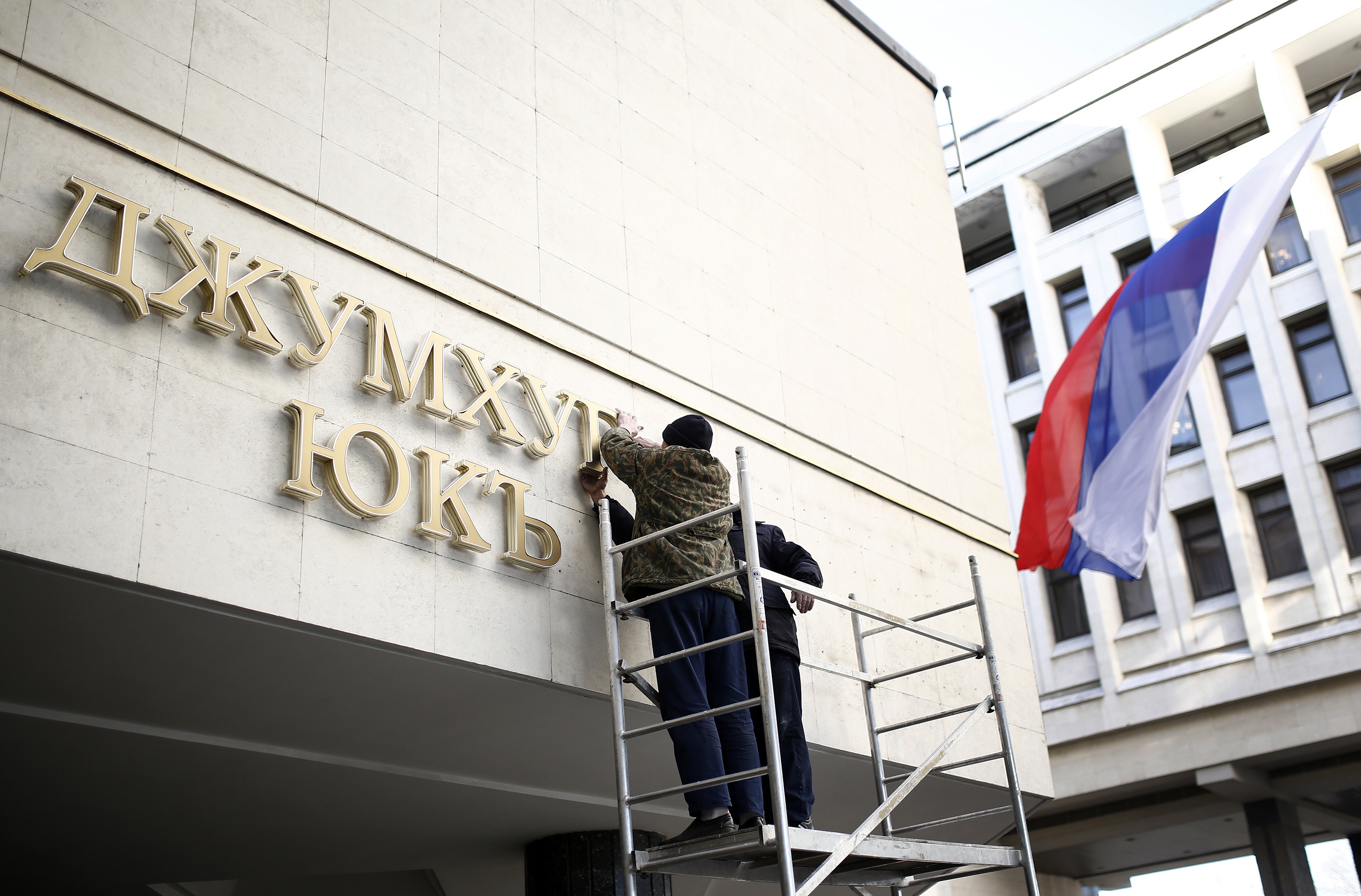
(Photo: Name plates on the walls of the Crimean parliament building are removed after the annexation of Crimea by Russia on March 18, 2014. By Bulent Doruk/Anadolu Agency/Getty Images)

America’s Foreign Policy Is Bankrupt

by Patrick Appel

Literally:

If America and Europe have failed to adequately defend Ukraine, it’s not for lack of guns. It’s for lack of money. Over the last year, the real contest between Russia and the West hasn’t been a military one (after all, even McCain knows that risking war over Ukraine is insane). It’s been economic. In part because of two wars that have drained America’s coffers, and in part because of a financial crisis that has weakened the West economically, the United States and Europe have been dramatically outbid. …

Whenever the United States debates using its money to buttress democracy and Western influence in a strategically important part of the world, commentators offer comparisons with the Marshall Plan that America offered Europe after World War II. But in today’s dollars, according to one estimate, the Marshall Plan would total roughly $740 billion. That kind of money would certainly enable far-reaching economic reforms in Ukraine, and likely anchor the country in the West for years to come. But, of course, the suggestion is absurd. Today’s Senate can barely pass an aid package 740 times as small.

Sanctions For Sanctions’ Sake, Ctd

by Jonah Shepp

Yesterday, the US slapped sanctions on seven Russian and four Ukrainian officials for their involvement in the Crimean secession, including ousted Ukrainian president Viktor Yanukovych, but not on Vladimir Putin himself. The EU also announced similar sanctions on targeted individuals. Adam Taylor takes a closer look at the names on our list:

These people may not be household names in the United States or Western Europe, but they hold real power in Russia, which may not be apparent from the one-line descriptions given by the White House.

For starters, there’s Vladislav Surkov, described as a presidential aide to Putin. Surkov is notorious in Russia-watching circles as the theater director who later became a PR man for Mikhail Khodorkovsky. He eventually came to the Kremlin and used his understanding of publicity and image to help sustain and strengthen Putin’s presidency, with some even suggesting that he was the real power behind the throne. He was called “Putin’s Rasputin” in the London Review of Books, and the “Gray Cardinal” by many others. While he apparently fell out of favor after anti-Putin protests in 2012, he was brought back last fall to help deal with Ukraine and other situations.

Bershidsky slams the list, which he says doesn’t include the real culprits:

If the U.S. authorities’ purpose was to punish people responsible for Putin’s Ukrainian escapade, they should have started with the Russian president himself: He alone decides what Russia will or will not do. They also could have gone to the trouble of finding out who commanded the unmarked Russian troops that spread across Crimea, and who sent goons to foment unrest in southeastern Ukraine. Punishing Putin, however, must have seemed like a scary idea, and identifying those who did his dirty work turned out to be too challenging.

The EU, in fact, did a better job on that front. On Monday, it revealed its own list of 21 people targeted for sanctions, and it includes the commanders of Russia’s Black Sea Fleet and southern and western military districts, as well as a longer list of pro-annexation legislators and separatist Crimean officials.

Russia plans to retaliate with sanctions of its own:

[W]hile the final list is still being crafted, it will include top Obama administration officials and high profile U.S. senators, in an effort to roughly mirror the U.S. sanctions against Russian officials and lawmakers, according to diplomatic sources. At the top of the list in Congress is Senate Majority Whip Dick Durbin, who recently co-authored a resolution criticizing Russia’s invasion of Crimea.

Durbin’s inclusion on Putin’s list would mirror Obama’s naming of Valentina Matvienko, the head of the upper chamber of the Russian Duma. Senate Majority Leader Harry Reid and Minority Leader Mitch McConnell are not expected to be on the Russian sanctions list.

Scott Clement notes that sanctions are the only response to Russia most Americans support:

Americans’ reluctance was laid bare in a CNN poll last week. Obama’s current policy is widely popular, with almost six in 10 supporting economic sanctions on Russia (it was 56 percent support  in a Post-ABC poll). But at least half of Americans opposed all five other potential actions asked in the survey: economic assistance to Ukraine’s government (52 percent opposed), canceling an international summit (58 percent), sending weapons to Ukraine’s government (76 percent), U.S. air strikes (82 percent) and ground troops (88 percent).

Larison reiterates the futility of sanctions:

When the U.S. passed the Magnitsky Act, did this cajole Russia into adopting reforms of its legal system or force it to commit fewer abuses? Obviously, it did nothing of the kind. All that it achieved was to irritate Moscow and convince them of American hostility, and it led to a series of Russian retaliatory measures that damaged relations with the U.S. and made the situation inside Russia significantly worse than it was before. Attempting to compel desired changes in Russian behavior contributed to a deterioration in the conditions that the attempt was supposed to ameliorate. These tactics almost never work, but Westerners keep trying them out of a misguided belief that anything that the other government dislikes must be the right and the smart thing to do. All sanctions are ultimately “unserious” in that they are reflexive responses to international events that often achieve nothing good. Sanctions frequently can’t deliver the results that their advocates claim that they can, but they can be dreadfully serious in their ability to wreck relations with other states and make bad situations worse.

Previous Dish on sanctions here.

Where Do RT Reporters Come From?

by Tracy R. Walsh

Often straight out of J-school:

RT America, by the accounts of the former and current employees with whom BuzzFeed spoke, has a strategy of hiring very young reporters who are eager to break out of small markets and want to cover international news. And the channel pays relatively well, more than most 22- or 23-year-olds expect to make in journalism. One former employee said a correspondent starting out could make as much as $50,000 or $60,000. “They’ll hire really young people and you almost feel like you’re working in a mini-CNN-type situation,” the former reporter said. “You’re not covering snowstorms or the puppy parade. You’re doing stories that are a lot bigger and meatier.”

And in Rosie Gray’s telling, it doesn’t take long for disillusionment to set in:

Soon after joining the network, the current and former employees said, they realized they were not covering news, but producing Russian propaganda. Some employees go in clear-eyed, looking for the experience above all else. Others don’t realize what RT really wants until they’re already there. Still others are chosen for already having displayed views amenable to the Kremlin. Anti-American language is injected into TV scripts by editors, and stories that don’t toe the editorial line regularly get killed.

Chait cringes:

A tragically large number of left-wing Westerners in the 20th century deluded themselves about the horrors of Soviet communism. As awful and unforgivable as it was, the process by which they made themselves into dupes was at least explicable:

They loved socialism, and one country in the world was implementing socialism, so they persuaded themselves, and for a while, it was working.

Today’s Russia dupes are a smaller, more pathetic lot. Above all they are just plain weirder, because they lack a clear ideological motive for their stoogery. Soviet Russia not only commanded a vast propaganda network, but embodied a doctrine with international appeal (and which had originated outside of Russia). Vladimir Putin’s Russia follows no model except Russian nationalism. To the extent it employs a non-nationalist philosophy, its main idea is that gays have weakened Europe. And yet the dupes still come.

Meanwhile, Weigel wonders how the network will find guests:

After [Alyona] Minkovski left the network, I saw fewer credible pundits make the walk to RT studios. I know of at least one magazine that warned its staffers not to go on anymore. Without sitting and auditing all of RT’s coverage, it seems like the network’s American opinion took more cues from the fringe.

This is where Abby Martin, a 9/11 truth activist and artist came in. In 2010 RT was getting exclusives with Rand Paul; in 2012 Martin was ambushing Paul to challenge his endorsement of Mitt Romney – a “Goldman Sachs, Bilderberg puppet.” It was Martin’s on-air denunciation of the Ukraine incursion [seen above] that woke up the media, again, to the strangeness of RT. It was anchor Liz Wahl’s on-air resignation and Martin’s quick back-peddling that deepened the strangeness, and brought new media attention, and will probably make it even harder for RT to book top guests. No secret here: D.C. (and New York) are in ready supply of pundits who want to go on TV shows and collect clips of themselves to show bookers for other TV shows. RT was a possible stop along the way, but some tanks in Crimea might have ended that.

Dish coverage of Wahl’s resignation here.

How Bad Might It Get In Ukraine?

by Jonah Shepp

Very bad, says Paul Hockenos, who compares the situation today to the former Yugoslavia in the 1990s:

[A]nyone who followed the unfolding of the wars in Croatia, Bosnia and Herzegovina, Macedonia, and Kosovo is surely horrified today by the dynamics between Russia’s Vladimir Putin, the Ukrainian leadership, the people of Crimea, and citizens in the rest of Ukraine. The similarities to the Balkans of the 1990s are, in many ways, striking: Just as Serbia and Croatia cynically exploited the presence of their compatriots outside the borders of their republics, so too is Putin manipulating the welfare of the Russophone Crimeans as justification for cross-border military operations, the seizure of territory, and a phoney referendum. As in the Balkans, the media has been turned into the mouthpiece of extreme nationalists. Once again, there’s inadequate security architecture to defuse tensions; and then there’s the radicalization of nationalism which, when fanned so fiercely, becomes a self-fulfilling prophecy and, in the Balkans, led to Europe’s worst bloodshed since World War II.

Alexander Motyl fears ethnic strife in Crimea:

Unsurprisingly, Ukrainians are terrified by Putin’s warmongering. A friend in Lviv, which is as far as one can be from Ukraine’s eastern border (or is it front?) with Russia, tells me that “people are petrified and believe war is inevitable.” So are Crimean Tatars, whose ancestral land has already been occupied by Putin’s troops and who remember Stalin’s genocidal policies in 1944, when the entire Tatar population was deported to Central Asia and half died.

What if Crimean Tatars, who have already begun forming self-defense units (and some of whom have begun talking of an anti-Russian jihad), take to the streets after Putin wrests Crimea from Ukraine? How will Putin respond? His warmongering statements suggest that mass internments of Crimean Tatars in concentration camps, ethnic cleansing, and even genocide are no longer inconceivable.

Oleg Shynkarenko expects a mass exodus from the region:

In the run-up to the vote, Russian media has been churning out non-stop propaganda about how thousands of Ukrainians are fleeing into Russia proper to escape neo-Nazis and fascists. But the reality is that many Crimeans are fleeing north to other regions of Ukraine, to escape the local militias manned by Russian separatists. This weekend, as reports surfaced of Russian armed forces landing in Kherson, the escape to safety seemed even more pressing for the region’s pro-Kiev activists and ethnic minority Tatars. …

Taras Beresovets is a political analyst of Crimea origin. He is sure that Ukraine is now witnessing the beginning of a long process of annexation and flight. He predicts that after the March 16 referendum, the suppression of dissidents and even ethnic cleansing could become more common. “At least 100,000 people will leave Crimea then”, Beresovets said.

Putin Is Just Getting Started

by Jonah Shepp

Looking north from Crimea, Jon Lee Anderson points out that the stage is already set for Russia to occupy the rest of eastern Ukraine:

Beyond Crimea, in the eastern Ukrainian cities of Donestk and Kharkiv, where there is also a large ethnic Russian population, public calls are being made for Crimea-style “referendums” to accede to Russia. Today, as if on cue, [Crimean prime minister Sergey] Aksionov’s deputy openly suggested that eastern Ukraine would follow Crimea’s example.

If snap referendums are called, will the Russian troops that are now massed on eastern Ukraine’s borders move into those areas in the name of protecting ethnic Russians from Kiev’s “provocateurs,” as in Crimea? Putin has reserved the right to intervene on their behalf. If Ukraine’s borders change yet again, what happens next?

Noting that there is no road linking Russia directly with the Crimean peninsula, Julia Ioffe thinks an invasion is geographically inevitable:

[W]hat happens if, as is quite likely, Kiev cuts newly-Russian Crimea off from gas, electricity, and water, which Crimea has none of on its own? How will Moscow, the new owner, supply its latest acquisition with the necessities? …

If you’re Russia, do you really want to ferry the necessities across the bay, or build an expensive bridge, or lay down expensive new pipelines? Wouldn’t you rather use pre-existing land routes (and pipelines)? Wouldn’t it just be easier to take the land just north and east of Perekop and the Swiss cheese area, now that you’ve already put in the effort to massively destabilize it? And while you’re there, wouldn’t you want to just take the entire Ukrainian east, the parts with the coal and the pipe-making plants and the industry? You know, since you already have permission?

Marc Champion considers how Europe would respond to further escalations:

Should Putin choose to escalate by moving troops into Ukraine beyond Crimea, even Germany has pledged to hit Russia with painful sanctions. This would damage the economy seriously: Former Russian Finance Minister Alexei Kudrin has forecast $50 billion in capital flight per quarter this year, “in a mild scenario.”

And yet, sanctions too can add to the logic of escalation. Serious economic sanctions would, as the most fervent Soviet die-hards and Russian nationalists have been hoping ever since the 1990s, create a full break with the West and return Russia’s economy to a less extreme version of its Soviet-era isolation — or, in their view, self-sufficiency. Sanctions would also force corrupt businessmen either to repatriate their ill-gotten gains or flee the country. The “liberals” who have, according to conservatives, held the country ransom for private gain since the collapse of the Soviet Union and prevented Russia’s return to greatness would be routed.

Andrew Bowen notes that, if Putin wants to risk an all-out invasion, he has the military power to do it:

Since few predicted the Russian occupation of Crimea, it would be premature to rule out the possibility of a full-scale invasion. While it would seem unlikely that Russian troops would march on Kiev, some sort of limited incursion into the Russian leaning east of the country is a very real possibility. The airborne forces and Spetsnaz units that would spearhead such an assault are available and close to the border. But those units would need to be backed up by larger regular Russian military formations after the initial incursion.

Whatever the future holds for the rest of Ukraine, it’s clear that Russia is staying put in Crimea.

Anna Nemtsova takes a closer look at what the Spetsnaz, Russia’s special forces, are already up to in Ukraine:

This week the Security Service of Ukraine (SBU) arrested a group of people led by a Ukrainian citizen who were said to be scoping out three of its most crucial military divisions in the southern Ukrainian city of Kherson.

In Donetsk in eastern Ukraine, press reports from the ground say that Russian provocateurs have attacked Ukrainians who organized anti-Russian street protests.

The forces behind these operations, according to U.S. officials briefed on the updates in Ukraine, are likely the Spetsnaz, the Russian military’s highly trained saboteurs, spies and special operations forces who may change the face—and the borders—of Ukraine without once showing the Russian flag on their uniforms. Or, for that matter, without wearing any particular uniforms at all.