About Last Night …

by Jonah Shepp

https://twitter.com/shaunwalker7/status/445308236867325953

Leonid Bershidsky summarizes how yesterday’s referendum in Crimea went down:

According to preliminary results, 96.6 percent of Crimea’s population voted in a hastily arranged referendum on Sunday for their territory’s secession from Ukraine and inclusion in Russia. The plebiscite was, predictably, a farce, with the votes counted behind closed doors in the absence of observers or the press, and with almost the entire indigenous population of Crimean tatars failing to turn out.

There were, however, fireworks on Sunday night, and locals celebrated in the streets. Most of them do want Crimea to be part of Russia, and it’s anybody’s guess why Russia and the pro-Russian authorities on the peninsula decided against arranging a real, honest, transparent vote. For some reason, Russia appears to be full of resolve to become an international pariah or expose the cynicism of Western politicians if they do not confer that status on Moscow. The Russian parliament is promising to act quickly to make Crimea part of Russia. The die is cast, and the Kremlin is now waiting to see what the costs will be, pretending as best it can that it does not care one way or another.

Oliver Bullough examines how this “unconstitutional sham” was orchestrated:

Some polling stations—such as the one in the village of Arpat—have helpfully laid out campaign literature. One leaflet had a BuzzFeed-style list of “10 reasons to be together with Russia.” These ranged from the spiritual (“In our many centuries of history, tens of thousands of sons of Russia have sacrificed their heads to give [Crimea] freedom”) to the practical (“Pensions in Russia are almost twice as high as in Ukraine”) to the rhetorical (“Today the people of Crimea have the chance to restore historical justice”).

There were no leaflets supportive of the constitution of 1992, incidentally.

The presence of international observers was also, of course, a joke:

[T]hey’re a very select group of about 30 international observers authorized by the Crimean government, who were paraded to the press at a news conference yesterday. “Speaking near-flawless Russian and repeating Russian talking points on the Ukrainian crisis word for word, a motley team of foreign election observers lined up to praise the referendum at a press conference Saturday evening,” Buzzfeed’s Max Seddon reported from the scene. The OSCE tried to get a team of 40 observers into Crimea, but warning shots were fired when the group tried to pass through a checkpoint last week. Crimea has since “invited” OSCE observers to attend the referendum.

Eric Posner passes along an e-mail from a Ukrainian reader highlighting even more brazen abuses:

If you follow the Russian and Ukrainian language press as well as Crimean groups on social-networking sites (such as SOS_Krym), you already realize that large scale attempts at voter fraud are under way. Several of my friends in Crimea (this has been verified by reports throughout the peninsula) have been visited by unidentified individuals who either make off with their passports or damage them. This just so happens to coincide with an announcement by Sevastopol city authorities that any form of photo ID will be accepted during the referendum, given what has been happening to passports. This is a clear invitation to “Russian tourists”, many of whom have already created problems in Donetsk and Kharkov.

Morrissey doubts any western countries will recognize the outcome:

The [Crimean] parliament has formally requested recognition for its new status at the UN and with Western nations, but they’re not going to get it — and that will extend the diplomatic issues with Russia. If Putin and Russia’s Duma annex Crimea, it will technically be a seizure rather than a legitimate annexation in the paradigm of self-determination. No Western nation is going to recognize the legitimacy of a plebescite held under occupation by foreign troops, no matter how many ethnic Russians live on the Crimean peninsula.

But Posner writes off the peninsula as lost:

It doesn’t matter that the referendum did not allow voters to express a preference for the status quo, that many of the 90+ percent who favor annexation by Russia (according to (possibly questionable) exit polls) may have been trucked in, that international election monitors were not used, that ballot boxes may have been stuffed, that Tatar groups refused to participate, that the public debate was drowned out by pro-Russian propaganda, and that Russian soldiers and/or pro-Russia militias roamed the streets. It is sufficient that there wasn’t violence, that western journalists were free to move about and interviewed plenty of ordinary people who strongly favored annexation, that there were enthusiastic public demonstrations in favor of annexation and celebrations after the result was announced, and that the outcome is consistent with demographic realities and what seems plausibly (to us ill-informed westerners) the preference of most Crimeans. Unless large groups of Tatars and ethnic Ukrainians take to the streets to protest the referendum and are clubbed by riot police, any western effort at this point to try to rescue Crimea from the invaders it embraces will be not only pointless but ludicrous.
Holy Crimea

Mara Kozelsky reminds us of Crimea’s significance in the history of the Russian Orthodox church:

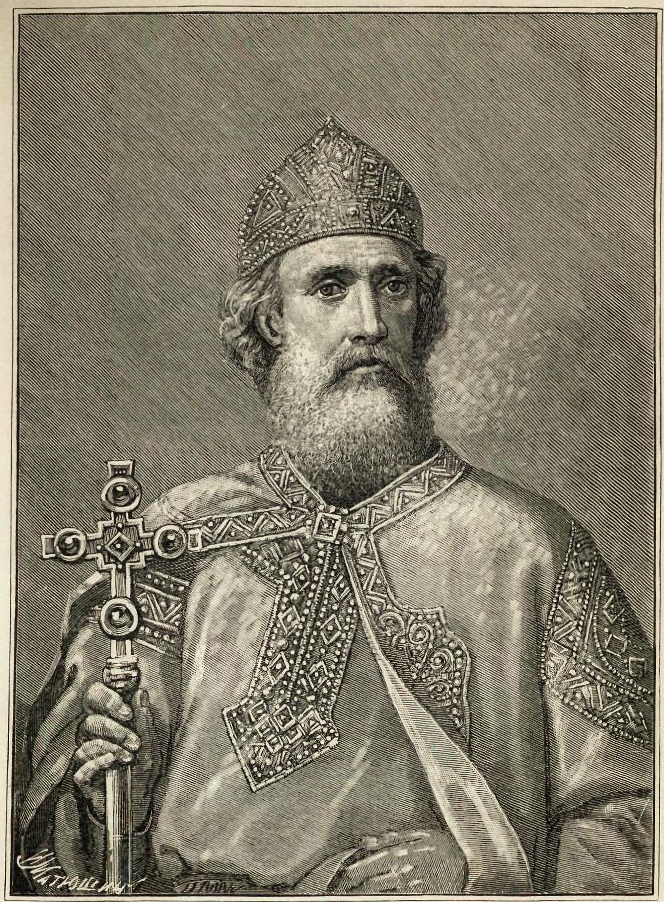
Crimea sits at the heart of both the Third Rome idea and Nicholas I’s nationality platform, because it was on the peninsula that Byzantium Vladimirpassed the mantle of Orthodoxy to Russia. In the ancient Greek colonial city of Chersonesos, the Byzantine emperor baptized the Kyivan Rus Prince Vladimir. Prince Vladimir’s conversion has been described by an early Russian nationalist as “the most important event in the history of all Russian lands,” because the conversion “began a new period of our existence in every respect: our enlightenment, customs, judiciary and building of our nation, our religious faith  and our morality.”

Beyond Prince Vladimir’s conversion, Crimea gave Russia a first century Christian pedigree.  Roman Emperor Trajan exiled the first century pope Clement to Crimea, where he founded an early Christian community that hid among neolithic caves. Some biblical scholars also believe St. Andrew the Apostle passed through Crimea en route to his mission field in Scythia.  Until the communists imposed an official policy of atheism, Russian archaeologists, historians and biblical scholars combed over the peninsula looking for the exact location of Prince Vladimir’s conversion and evidence supporting the first century legends. The Russian Orthodox Church, meanwhile, established a network of monasteries on the peninsula and promoted pilgrimages to “Russian or Crimean Athos.” Crimea became Russia’s very own holy place.

Boris Barkanov stresses the symbolic value of Ukraine writ large:

Ukraine (Kiev especially) is at the very heart of the origin myth of the Russian nation and civilization.  An analogous case is the significance of the Temple Mount and the Dome of the Rock (al-Aqsa Mosque) in Jerusalem to Jews and Muslims respectively.  This means that for Russian and Ukrainian nationalists, Ukraine is what UC Berkeley political scientist Ron Hassner has called a “sacred space.”  It appears indivisible, but has to be shared to avoid conflict and violence.  The same is true for Tatar, Ukrainian, and Russian nationalists regarding Crimea.  Defusing such conflicts requires thoughtful, innovative solutions that empower moderate, rather than radical, political forces on all sides.

Alexander Motyl, responding to an op-ed by Henry Kissinger from last week, pushes back on parts of this narrative:

Pace Kissinger, the Russian religion did not spread from “what was called Kievan-Rus.” What spread was Orthodox Christianity and it spread from Constantinople, thanks in no small measure due to the proselyting efforts of Ss. Cyril and Methodius, both Greeks. True, Ukraine “has been part of Russia for centuries,” but it’s been no less a part of the Mongol empire, the Grand Duchy of Lithuania, the Polish Commonwealth, the Habsburg Empire, and the Ottoman Empire.

(Illustration of Vladimir I of Kiev via Wikimedia Commons)

How We Feel About Ukraine, Ctd

ukraine5

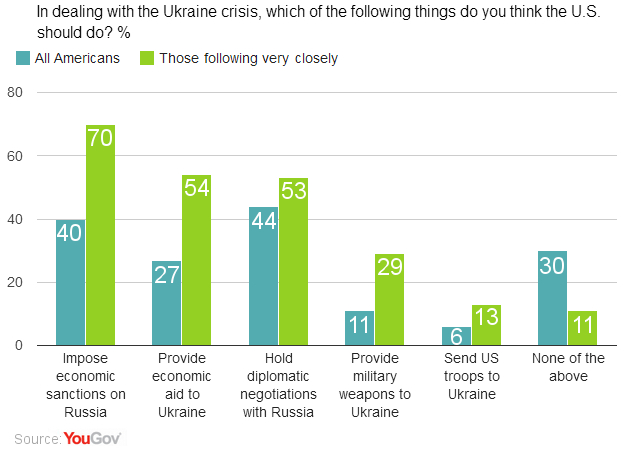
Kathy Frankovic summarizes the latest YouGov poll on how Americans think we should respond to the crisis:

Even those paying very close attention doubt that either a military or an economic response from the U.S., like sending troops to Ukraine, would result in Russian troop withdrawal.  Just one in four overall think military action by the United States would result in the Russians leaving the country.  One in four think economic sanctions on Russia would have that result. Still, most Americans would approve of some action by the United States, with the largest numbers supporting negotiations and economic sanctions against Russia.  A majority of those paying very close attention would also support economic aid.  There is far less support for military assistance and only 6% overall would favor sending U.S. troops to Ukraine.

Sheldon Richman proposes an option not asked about in the poll:

I’m talking about opening America’s borders—scrapping immigration controls.

Ukrainians who want to get out of their dicey neighborhood, whether permanently or temporarily, should be free to move to the United States. Look at it this way: How dare we Americans confine Ukrainians to a condition they might desperately wish to escape? How can we imagine ourselves to be a humane people while engaged in a policy with such odious consequences and implications for liberty?

Opening the borders, of course, is not offered here as a comprehensive answer to the conflict between Russia and the Ukrainians who want to be free of Russian influence, but it may be an answer for some Ukrainians. How many, no one can know. But it makes little difference. Let them in! There are about a million Ukrainians in the United States (2006 census figures), second only to Canada outside of Ukraine itself, with the largest centers in New York City, Philadelphia, Chicago, Los Angeles, Detroit, Cleveland, and Indianapolis. The newcomers need not be strangers in a strange land, though they should be welcome throughout the country.

More recent US polls on Ukraine here.

The Kremlin’s Narrative

Ian Bateson examines how through “speeches and state-controlled media Putin is able to create another world where the figures and places feel familiar, but the events and motivations are drastically different”:

When protestors on Kiev’s Maidan began organizing into so-called self-defense forces after attacks on demonstrators, Moscow was quick to call them Western-trained and funded militias. With the groups’ mismatched uniforms, bits of pipe, and occasional spaghetti strainer helmet Russia’s claims gained little currency abroad.

When men armed with automatic weapons wearing Russian military uniforms devoid of military insignia and accompanied by military vehicles bearing Russian license plates began appearing on Crimea’s streets, however, it was Russia’s turn. If Kiev could have self-defense forces than Crimea could too. And so Moscow declared them Crimean self-defense forces.

In this world Russia was not invading Ukraine, but reprising its role as the great vanquisher of Nazism, heroically halting the eastern advances of suitably amorphous Ukrainian fascism.

Oleg Kashin sees these distortions backfiring on Moscow:

Through its clumsiness, Russia has given the Ukrainians a winning image: that of a small defenseless country which has become the victim of aggression by a cruel, strong neighbor, as Lithuania, Latvia, and Estonia were in 1940. The Ukrainians, who have thus far been unable to boast of a rich national mythology, are writing their new heroic myth in real-time, about which films will be made and songs composed. This is often more important than any weapon.

Putin’s lie could be attributed to the particularities of international diplomacy, but in a situation where the entire world has already seen the Russian soldiers blockading Ukrainian bases on the Crimean peninsula, it’s hard to believe that the lie has any diplomatic subtext. Really, it’s just habit. A culture of propaganda has formed over the last fifteen years in Putin’s Russia, and even in the most critical moment, telling the citizens the truth would, for Putin, be a violation of some kind of personally sacred taboo.

David Remnick covers Putin’s press crackdown:

The latest step came on Wednesday, with the announcement that Galina Timchenko, the longtime and much admired editor of the news site Lenta.ru, has been fired and replaced by Alexei Goreslavsky, the former editor of Vzglyad.ru, a site that is far more sympathetic to the Kremlin.

The announcement came shortly after an agency called the Federal Mass Media Inspection Service (oh, Orwell!) warned that Lenta.ru was venturing into “extremism.” Lenta.ru had published an interview with Andriy Tarasenko, a leader of a far-right ultra-nationalist group, Right Sector. Part of the Kremlin’s pretext for the invasion of Ukraine has been to “protect” Russians from “fascists.” Tarasenko is an unlovely figure, but Lenta.ru was hardly endorsing him; the editors were guilty of nothing more than committing journalism. And now they are paying for it.

Richard Maass offers a poli-sci explanation for why Washington and Moscow have such radically divergent views of what is happening in Ukraine:

U.S. leaders have ‘renormalized’ their reference point after the Maidan revolution, accepting the West-leaning interim Ukrainian government as a legitimate foundation for any resolution to the crisis. In contrast, the reference point of Russian leaders continues to be the pre-Maidan status quo, as they seek to recover their lost influence in Ukraine or achieve compensating territorial gains. As a result, the United States is focusing on rolling back Russian “aggression” in Crimea, while Russian Foreign Minister Sergei Lavrov objects to U.S. proposals because they take “the situation created by the coup as a starting point.” If U.S. and Russian leaders are bringing contradictory perspectives to their attempts at negotiation, as prospect theory predicts, it is difficult to envision a diplomatic resolution to the crisis that will satisfy both sides.

Can The IMF Save Ukraine?

Daniel Runde urges Congress to approve IMF quota reform, which would open up more money to stabilize Ukraine:

The United States needs to lead the response to the Ukraine crisis because Europe is divided over Ukraine. For the United States to lead, we need IMF quota reform to have the credibility to ride herd on the IMF package. The quota reform will double the “quick money” that is available to Ukraine to $1 billion and double the IMF’s stockpile of money for crises to over $700 billion.

As of today, Ukraine has limited hard currency reserves, and they are shrinking. It has a banking crisis and has limited the amounts of money that depositors can withdraw. The country is on the brink of financial collapse and a financial collapse will open it up to further radicalization and instability — and a weaker Ukraine is an even easier victim for Russia.

Peter Boone and Simon Johnson throw cold water on the idea that financial aid can solve the country’s problems:

This fight over Ukraine between Russia and the West has been going on since the 1990s. Each time the Ukrainian government changes, one side rushes to the fore, offering funds and support. The great problem for Ukraine, and those civil society-oriented individuals that fought for the overthrow of Viktor Yanukovych, is that too much foreign support is forthcoming, making it too tempting for governments to switch allegiances, and extort funds from each side.

Any I.M.F. program will undoubtedly fail again unless this chronic struggle between Russia and the West over Ukraine is stopped. … The I.M.F.’s own analysis implies that large amounts of foreign funds, public or private, are not any kind of solution in this situation. But for political reasons the I.M.F. is likely to ignore the sensible conclusions drawn from its own experience.

Veronique de Rugy, no fan of the IMF to begin with, opposes quota reform:

[I]t would double the funds that the IMF is allowed to loan to any country it wishes, without much limit. For the United States, it means a 100 percent increase in its contribution to the IMF from its current level, $63 billion. According to the Congressional Research Service, “this would be the largest proportional quota increase in the history of the IMF.”

Russia And Ukraine, Marching As To War?

Maria Snegovaya believes Russia’s incursion into Crimea is the beginning of war:

Conflict escalation is likely to continue due to regime’s own logic and ideology, and the Kremlin’s latest actions also point in that direction. As southeastern Ukraine is destabilized by randomly emerging pro-Russia activists and mobs, the Kremlin continues concentrating large amounts of armored vehicles near Russian-Ukrainian borders, Russian authorities are preparing to seize the property of foreign citizens and institutions, and the country is threatening not to repay banking loans in economic sanctions are imposed.

Such escalation is unlikely to be peaceful. Putin lives in another world and fails to realize that Russia is far less welcome on the Ukrainian mainland than in Crimea. Southeastern Ukraine is split in between pro-Russia and pro-West Ukrainians, surveys show, and if Kremlin aggression continues into the mainland, the anti-Russian Ukrainians are likely to counteract. In other words: war.

Steven Pifer also doubts Crimea is the end of the story:

Some suggest the Ukrainian government should accept the loss of Crimea as a fact beyond its ability to reverse. It could then focus on the rest of the country, which poses plenty of political and economic challenges. Having taken Crimea, or at least pried it away from Ukraine, Russia perhaps would be content.

Moscow, however, likely will not be content as long as Ukraine desires to draw closer to the European Union—and Russia’s seizure of Crimea will only fan that desire. Kyiv will not accept the referendum or, should it come to that, Russia’s annexation of the peninsula. Doing so would not end the broader dispute with Moscow but would set a dangerous precedent that the Russians might be tempted to apply elsewhere, such as in eastern Ukraine, where ethnic Russians constitute a significant share of the population—though not a majority—and where there have been some pro-Russia demonstrations.

Andrew Kuchins calls this Putin’s “Brezhnev moment”:

No analogy is perfect, but my gut tells me that historians will regard Putin’s reckless decision to invade Crimea much like Brezhnev’s mistake in Afghanistan—as the beginning of the end. The Soviet system in 1979 had a much stronger foundation than Putin’s. The Communist Party was a very strong institution, and the leadership could trot out any number of achievements, from defeating Nazi Germany to achieving nuclear and military parity with the United States, to justify the system’s legitimacy. Most important, the communists’ tools of repression were far more powerful than those at Putin’s disposal today. Putin has failed to build any powerful institution in his 14 years in power. His principal claim to legitimacy and popular support has been the impressive economic growth Russia has enjoyed during his tenure.


How We Feel About Ukraine

Two new surveys are shedding some light on how Americans view the crisis in Ukraine. A WaPo-ABC poll finds the public divided on Obama’s handling of the situation but united in their support for sanctions on Russia:

But Obama, who ordered sanctions Thursday against individuals aiding the takeover, receives lukewarm 42 percent approval and 43 percent disapproval marks, with a substantial 15 percent holding no opinion.

Overall, Democrats and Republicans are in rare agreement in supporting sanctions, and familiar discord about Obama. Just over six in 10 of partisans in both camps support sanctioning Russia. And in an unheard of alignment of the far left and far right, 68 percent of liberal Democrats support sanctions, as do 69 percent of conservative Republicans.

Morrissey comments:

That’s really no big surprise. Now that we’re where we’re at, there aren’t too many options left on the table.

No one wants to go to war to keep Crimea Ukrainian, not even the Ukrainians. They’re more concerned about keeping Russia from annexing everything east of the Dnieper now, and trying mightily to prevent giving Vladimir Putin a pretext for doing so. Few want to just allow Putin free reign over the former Soviet republics with no consequences, either, so sanctions are about the only option we have. That’s not a partisan calculation, it’s reality.

The problem for Obama is how we ended up with so few options to stop Putin in the first place. That is why the approval rating for his handling of the situation is so low, compared to the support of the options Obama is now applying.

Another poll by Pew shows that Americans prefer to limit our involvement in Ukraine:

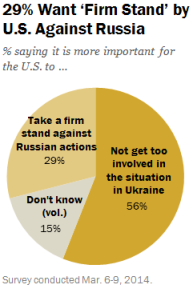
3-11-14-1By a roughly two-to-one margin (56% vs. 29%), the public says it is more important for the U.S. to not get involved in the situation with Russia and Ukraine than to take a firm stand against Russian actions.

The new national survey by the Pew Research Center, conducted March 6-9, 2014 among 1,003 adults, find more disapprove (44%) than approve (30%) of the way the Obama administration is handling the situation involving Russia and Ukraine, while roughly a quarter (26%) offer no opinion. … Those who are following the news very closely are more inclined than others to advocate for the U.S. to take a firm stand against Russia. Among those closely following the news, roughly as many say the U.S. should take a firm stand (47%) as prefer not getting too involved (43%).

Where Is Putin’s Next Target?

Ioffe explains why Putin’s aggressive concern for Russian minorities doesn’t extend to the Baltic countries, where they actually face serious discrimination:

[W]here is Putin when you need him? Where are the Russian soldiers in unmarked uniforms patrolling the streets of Tallinn, the referenda to join Russia, the town square electing marginal ethnic Russians to public office? And what, if you want to be cynical about it, of Estonia’s strategic importance? Think of Estonia’s prime access to the Baltic and Russia just happens to be building a northern gas pipeline to bypass Ukraine.

But Estonia, you see, is part of NATO. As is Latvia, as is Lithuania. And NATO has been stepping up air patrols in the region in the last week. So is it about protecting Russian speakers, or is about getting away with whatever you can get away with?

But Ed Morrissey points out that Moscow is planning to offer citizenship to Russo-Latvians:

This attempt to destabilize Latvia by making a quarter of its population Russian citizens gives away Putin’s game. It also serves as a direct affront to NATO and the West. Ukraine never did join NATO, but Latvia formally joined in 2004, as did its Baltic neighbors Lithuania and Estonia. Lithuania has a minimal ethnic-Russian population — less than 7% of its population — but Estonia’s population is 25% ethnic Russian. It’s no small wonder thatall three nations are now “jittery” over an “unpredictable” Russia[.]

Kazakhstan and Belarus, Adam Taylor reports, have reason to be nervous:

The Kremlin has justified the use of force in Crimea and Eastern Ukraine with a vow to protect ethnic Russians, an excuse that’s easily applied in other places. In Kazakhstan, there’s a significant minority of ethnic Russians in the north of the country, [director of the Center on the United States and Europe at the Brookings Institution Fiona] Hill points out – some 24 percent of the country is said to be ethnically Russian, and the language is widely spoken. While Belarus has fewer ethnic Russians (8.3 percent), it has largely become a Russophone state and there are a lot of murky questions about who might succeed Alexandr Lukashenko. Of course, Russia has agreed to respect the sovereignty of both countries, but they did that with Ukraine, too: The 1994 Budapest Memorandum, which Russia says they are ignoring due to the change in government in Ukraine. Neither Kazakhstan nor Belarus has recognized South Ossetia and Abkhazia, the states that broke away from Georgia, by the way.

Peter Eltsov and Klaus Larres believe Putin is foolish to assume that those who speak Russian identify as Russians:

Many Russian-speaking people living in Ukraine and in many other post-Soviet states no longer consider themselves Russian. This illustrates a truth regarding national identity: Things change fast. Punjabis from Lahore and Amritsar speak the same language but have distinctively different national identities: Indian and Pakistani. Bangladesh is even younger that Pakistan, yet it did not take long for its citizens to acquire a new identity. During the last four to five decades many, if not most, of the three-million-plus Turks living in Germany lost much of their Turkish identity. In particular, this applies to those under 30. They sway to and fro between two cultures, whether or not they have obtained German citizenship.

Vlad The Beloved

Putin’s actions in Ukraine are quite popular in Russia, as is the president himself:

Most Russians appear to support Putin’s moves: Polls by different organizations, from pro-Kremlin VTsIOM to the liberal-leaning Levada Center, suggest that the president’s popularity is at its highest since his re-election in 2012.

Joanna Szostek blames state TV:

The news on Channel 1, Rossiya 1 and Rossiya 24 is aimed, first and foremost, at viewers in Russia, where the power of these channels is indeed considerable. Television continues to be the primary news source for almost 90 per cent of the Russian population. Around 65% of Russians believe the main federal channels to be ‘completely’ or ‘for the most part’ objective. Their news programmes have enjoyed soaring viewing figures during the crisis in Ukraine – some 13 million Russian viewers tuned in for one ‘Vesti’ bulletin on 21 February. It is therefore unsurprising to see that Russian public opinion on the Ukrainian revolution is broadly in line with official rhetoric.

For David Harsanyi, Russia illustrates the point that democratic processes don’t guarantee liberal outcomes:

[T]he reversal of once promising liberal reforms in Russia is not the result of an undermining of democracy. It happened with the full consent of the electorate. In Russia’s first presidential election, in 2000, Vladimir Putin, who had previously been made prime minister, won 53 percent of the vote. In 2004, he won 71 percent of the vote. In 2008, his lackey Dmitry Medvedev also won in a landslide. In 2012, Putin returned to the presidency in a landslide election with a parliament dominated by members of his party, giving him virtually one party rule.

Sadder still, Putin may be a better choice. It’s not like there democrats with widespread support are waiting in the wings. Remember, it was the Communist Party leader, Gennady Zyuganov, who came in second place last election with 20 percent of the vote.  In a 2009 poll. nearly 60 percent of Russians said they ‘deeply regret’ the Soviet Union’s demise.

Masha Gessen examines how Putin has encouraged a “political culture … based on the assumption that the world is rotten to the core”:

This was first evident in the way Putin talked about corruption. In his official autobiography, published in 2000, Putin told a joke in which President Carter and Soviet leader Leonid Brezhnev compare notes: Both are embezzling, but Brezhnev embezzles twice as much, blatantly. This is the line Putin’s officials have taken in response to all accusations of graft over the last 14 years: Corruption is endemic to all governments; Russian corruption is just less hypocritical.

The same goes for Russia’s treatment of minorities and political protesters, as well as violations of international law: Putin and his officials are always quick to point out that Western countries are also imperfect on these issues. More than a rhetorical device, this is an expression of the Putin world view: He believes that all governments would like to jail their opponents and invade their neighbors, but most political leaders, most of the time, lack the courage to act on these desires.

“Yes” Or “Yes”

UKRAINE-RUSSIA-UNREST-POLITICS-CRIMEA

Katya Gorchinskaya points out that Crimea’s independence referendum doesn’t allow voters to choose the status quo:

The ballot asks two questions and leaves no option for a “no” vote. Voters are simply asked to check one of two boxes: Do you support joining Crimea with the Russian Federation as a subject of Russian Federation? And: Do you support restoration of 1992 Crimean Constitution and Crimea’s status as a part of Ukraine? That Constitution declares that Crimea is an independent state.

Steve Saideman calls this further evidence that the vote is a sham:

So, why bother with such a clearly illegitimate referendum? Authoritarian regimes have a long history of sham elections which provide some kind of domestic legitimacy to their rule.

To be fair, Russia’s elections have not been shams. Those for who governs in Russia, anyway. For those who govern in the frozen conflicts? Not so much. Still, those who disrespect democracy still feel compelled to use the guise of democracy to appear less authoritarian and more legitimate. It may not play well outside of Russia, but it might do ok within.

Indeed, some scholars have found that these kind of elections can be used to scare the opposition. That is, holding such an event puts opponents in difficult positions, as the fakeness may actually suggest that the government is strong, rather than weak.

Daniel Berman believes the outcome is predetermined:

The Crimean Parliament, in deciding to hold the referendum, a decision made with the help of Russian troops who removed the 36 traitors who had infiltrated the 100-man assembly, has by its own admission already decided upon accession to the Russian Federation. As the decision has already been made, the current election is a mobilization election – its objective is not to poll the population for its opinions, those are neither wanted nor desired, but rather to demonstrate to the wider world irreversibility of the decision on annexation, and the futility of efforts to reverse it. The campaign that is currently being run therefore aims to produce the highest possible turnout with the highest possible margin in support. The opinions of foreigners regarding its legitimacy are irrelevant – there will be no effort made to allow for a credible showing by the NO campaign. On the contrary, the No campaigners, by virtue of the their insistence on opposing the referendum, are demonstrating their desire to not be part of the new Crimea. It only makes sense then for the Russian forces to drive them out early.

Monitoring, Erik Voeten explains, won’t ensure the referendum is really free:

The problem is that there are many ways to manipulate an election. For example, Chris Blattman reports on a new paper, which shows that politicians simply relocate fraud from polling stations where monitors are present to places where they are not.

Even more troublesome, Alberto Simpser and Daniela Donnofind evidence that high-quality election monitoring induces governments to resort to tactics that may have long-term negative implications for democracy. Rather than simply stuff ballot boxes, which is easy to identify, governments rig courts and administrative oversight bodies or suppress the media. Indeed, Simpser and Donno find that high-quality election monitoring is correlated with subsequent declines in the rule of law, administrative performance and media freedom.

Posner advises letting Russia take the peninsula, from which it has little to gain:

In the end, Crimea—a poor, tiny region with a potentially unruly minority population of unhappy Tatars and resentful Ukrainians—is a booby prize in the contest over Ukraine. And in fact, Russia has lost that larger fight; Ukraine, more populous than Poland, is now permanently outside its orbit. Russia has no friends and only a handful of allies of convenience. Back in 2008, when Russia tried to persuade the world to recognize Abkhazia and South Ossetia as independent states, only Nicaragua, Venezuela, Nauru (population 9,000), Vanuatu (population 262,000), and Tuvalu (population 11,000) heeded the call (and Vanuatu later changed its mind). By contrast, the United States’ illegal military intervention in Serbia, a Russian client state, enabled Kosovo to break away and form a state with the support of the United States and more than 100 other countries. Today, Russia can call on Syria, Belarus, and Cuba for diplomatic support. It is a declining state that can do little more than bully a few impoverished and geopolitically insignificant neighbors. Let it.

Meanwhile, Keating situates Crimea within the long-running debate over self-determination vs. territorial integrity:

It’s true that Washington’s insistence that Ukraine’s territorial integrity be respected seems a bit incongruous with its support for the independence of, say, Kosovo or South Sudan. And Russia has certainly exploited the Kosovo precedent in its bids to gain international recognition for Georgia’s breakaway regions—Abkhazia and South Ossetia. On the other side, Russia has spent recent years talking itself blue at the U.N. Security Council about respecting territorial sovereignty in places like Libya and Syria but is willing to send its military into the territory of its neighbors on the pretext of protecting the rights of ethnic Russians—which is one possible reason why China’s been fairly tepid in its support for Russia’s actions.

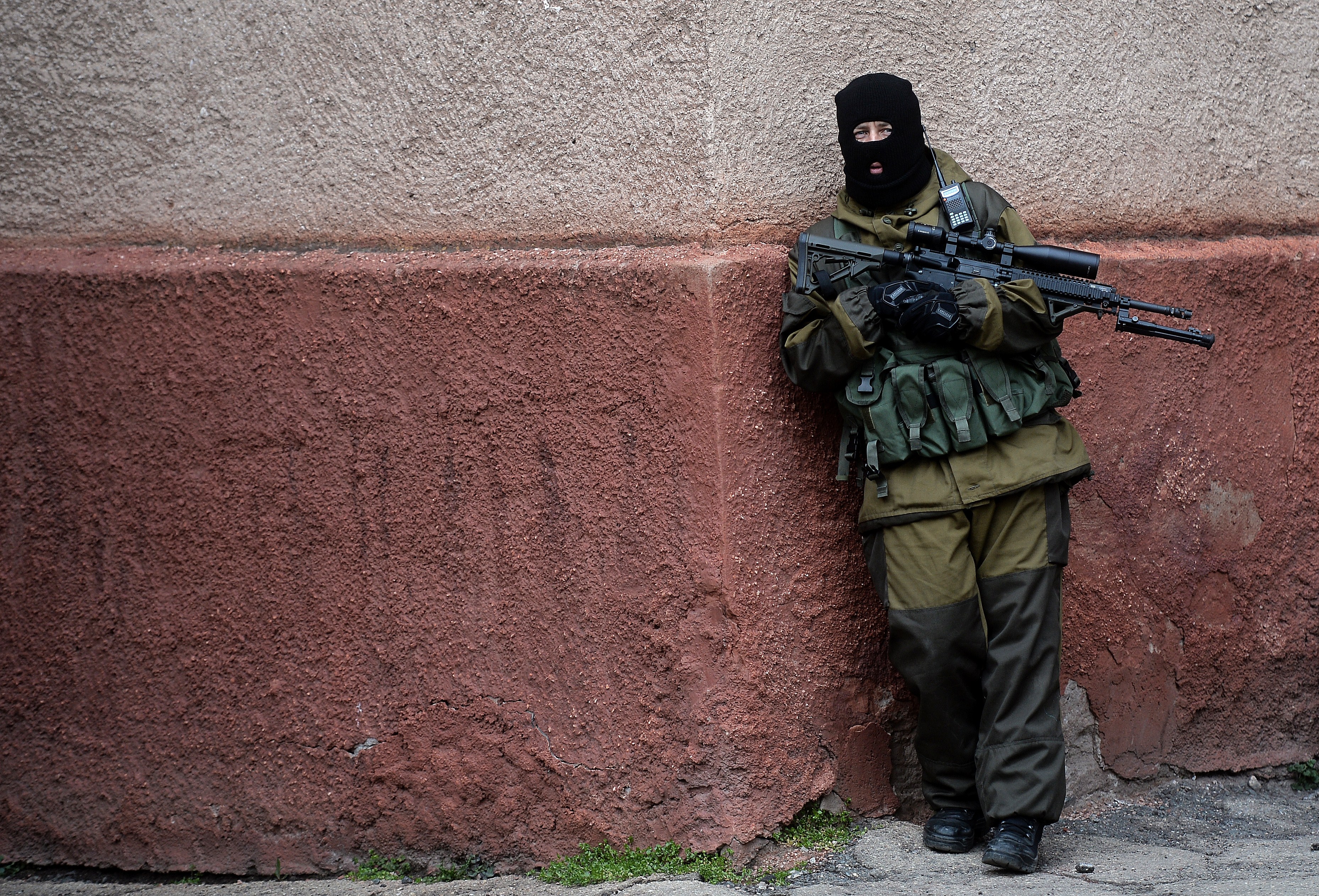
(Photo: A member of the new pro-Russian forces dubbed the ‘military forces of the autonomous republic of Crimea’ stands guard in the Republican military enlistment complex in Simferopol on March 10, 2014. Crimea’s pro-Russian authorities sought to boost their claim to break from Ukraine Monday as volunteer soldiers swore an oath of allegiance in front of prime minister Sergei Aksyonov. He told journalists 186 volunteers had so far joined the new Crimean ‘self-defence’ units after pro-Moscow forces took power in the region and announced their intention to join with Russia, with a referendum planned for Sunday. By Filippo Monteforte/AFP/Getty Images)