Looking East From Ukraine

The despots of Central Asia have two reasons to be nervous:

On the one hand, the success of the Euromaidan protests in driving Ukrainian leader Viktor Yanukovych from power obviously raises concerns amongst central Asia’s ruling elite regarding the sustainability of their hold on power.  When they first saw a popular protest movement lead to the removal of Eduard Shevardnadze in 2004’s Georgian Rose Revolution, popular protest movements quickly spread across Eurasia and fueled similar regime changes in Ukraine and Kyrgyzstan. Perhaps fearing a similar “viral” effect of Yanukovych’s ouster regionally, the regimes have sought to control information on the situation. …

On the other hand, central Asian leaders also must be watching recent events in Crimea with an eye toward the potential actions of Russia in its “near abroad.”

Although none of the central Asian states could be characterized as solidly anti-Russian, they all have reasons to exert their independence from Russia.  In this context, one must assume that recent events have transformed the “Ukrainian question” into the “Crimean question” for the central Asian leaders.

Meanwhile, Dan Twining considers the lessons for leaders in the Far East:

First, economic interdependence is no safeguard against military conflict. Europe is Russia’s largest trading partner and the primary market for Russia’s energy exports, which provide 50 percent of government revenue. Moscow craves a trade and investment agreement with the United States. These facts have not deterred Russia from invading Crimea — just as Japan-China interdependence has not moderated Chinese revisionism in the Senkaku Islands.

Second, autocracies overestimate their power and leverage, while democracies underestimate theirs. Russia is a declining power with horrific social indicators kept afloat by oil and gas revenue. Its “allies” — Belarus, Kazakhstan, and Armenia — do not form the coalition of the future. China has much more going for it. But the hype around its rise has inflated Beijing’s sense of itself, while diminishing Western and Japanese confidence. Yet the big democracies have far more internal political resilience than China’s regime, whose greatest fear is of its own people.

Hawking Points

Condoleezza Rice pushes for a tough response to Russia over Ukraine:

The immediate concern must be to show Russia that further moves will not be tolerated and that Ukraine’s territorial integrity is sacrosanct. Diplomatic isolation, asset freezes and travel bans against oligarchs are appropriate. The announcement of air defense exercises with the Baltic states and the movement of a U.S. destroyer to the Black Sea bolster our allies, as does economic help for Ukraine’s embattled leaders, who must put aside their internal divisions and govern their country. …

The events in Ukraine should be a wake-up call to those on both sides of the aisle who believe that the United States should eschew the responsibilities of leadership. If it is not heeded, dictators and extremists across the globe will be emboldened.

Responding to Rice, Larison tears up this notion that American inaction emboldens our rivals:

What Rice et al. perceive as “inaction” in Syria, Russia and Iran likely perceive as ongoing interference and hostility to their interests. The crisis in Ukraine also looks very different to Moscow than it does to the Westerners that have been agitating for an even larger and more active U.S. role.

Western hawks were frustrated by how slow their governments were to throw their full support behind the protesters, and as usual wanted the U.S. and EU to take a much more adversarial and combative approach with Russia because they see Western governments as being far more passive than they want. However, Moscow doesn’t perceive the U.S. role in Ukraine to be a limited or benign one, and the toppling of Yanukovych has been fitted into their view that the protests were a Western-backed plot from the beginning. The idea that Russia would have responded less aggressively to the change in government if the U.S. had been giving the opposition even more encouragement and support is dangerously delusional, but that is what one has to believe in order to argue that the U.S. “emboldened” Moscow in Ukraine.

Drum also doubts Putin was encouraged by American weakness:

Putin didn’t invade Crimea because the decadent West was aimlessly sunning itself on a warm beach somewhere. He invaded Crimea because America and the EU had been vigorously promoting their interests in a country with deep historical ties to Russia. He invaded because his hand-picked Ukrainian prime minister was losing, and the West was winning. He invaded because he felt that he had been outplayed by an aggressive geopolitical opponent and had run out of other options.

None of this justifies Putin’s actions. But to suggest that he was motivated by weakness in US foreign policy is flatly crazy.

Amid the saber-rattling, Adam Gopnik emphasizes the importance of preventing a war:

[W]e should be doing what sane states should always be doing: searching for the most plausible war-avoiding, nonviolent arrangement, even at the cost of looking wishy-washy. … The parallel with the failure of appeasement in the thirties is false, because that circumstance was so particular to its moment. The underlying truth then was that there was no point in appeasing Hitler because there was no possibility of appeasing him. The German Army was the most powerful force in Europe, indeed, in the world, and Hitler had long before decided on a general European war. He wanted one, and for him it was only a question, at best, of delaying it until his odds were marginally better. If Putin wants a general European war, we will know it when he invades a NATO nation. There is no shortage of real trip wires in the region, and no need to discover new ones.

Paul Miller pans the flawed approaches of both the liberal internationalists and the Cold Warriors, and suggests a third way:

The middle course would acknowledge that there are limits to what America can achieve: It cannot stop Russia from believing Crimea is vitally important to Russian security, and it cannot fight a cost-effective war with a nuclear power. The United States should realistically accept some form of Russian presence or influence in the peninsula and not turn this into a litmus test of American credibility.

At the same time, the United States should ask what is right for the Ukrainians, not just for Americans. It should not cynically abandon all Ukraine to Russia’s despotism. That may mean sustaining a large flow of aid to democratic dissidents in a Russian-dominated Ukraine, strengthening U.S. security assurances to the government if it manages to keep Russia at bay, or even bringing Ukraine fully into the orbit of Western institutions while letting Crimea secede or join the Russian Federation.

My take on the hawks’ position is here. Previous Dish on the US response to the Ukraine crisis herehere, and here.

How Much Should We Fear Fascists In Ukraine?

Moynihan rips into Putin’s defenders in the Western press:

Let’s acknowledge that ideologues rarely exist without a certain degree of hypocrisy. But when Viktor Yanukovych’s goon squads were unleashed on protesters in Kiev, wielding truncheons and firing bursts from Kalashnikovs, it was nevertheless disconcerting to see Ukrainian anti-government protesters–of varied political backgrounds and issuing varied demands–blithely dismissed by a significant number of Western journalists as fascists and neo-Nazis, if not stooges of the United States government. Indeed, it all sounded too much like the Soviet reaction to the 1956 Hungarian uprising, when Moscow claimed to have narrowly avoided “the threat of a fascist dictatorship” (which was, of course, precipitated by American interference) by the dispatch of a benevolent invading military force. And like 1956, one didn’t have to look to far to find–from both the fringe left and right, and many ironically self-identifying as anti-imperialist–those ready to “contextualize” the violence visited upon protesters and justifying the arrival of Russian troops on Ukrainian soil.

Remnick provides a reality check:

It is worth remembering that, in the back-and-forth of Ukrainian governments since 1991, both the pro-Russian leaders, like Viktor Yanukovych, and the pro-Europeans, like Yulia Tymoshenko, have been brazen thieves, enriching themselves at fantastical rates. Both sides have played one half of the country against the other. And the fact that the protests in Kiev were not, as Moscow claims, dominated by fascists and ultra-nationalists does not mean that such elements are absent from the scene.

Ukraine has yet to develop the politicians that its fragile condition and its dire economy demand. In December, when John McCain spoke to demonstrators in Kiev’s Independence Square, he stood side by side with Oleh Tyahnybok, who was once expelled from his parliamentary faction after demanding battle with “the Muscovite-Jewish mafia.” Perhaps this was bad advance work from team McCain—much like the advance work on the Sarah Palin nomination—but it did manage to fuel Moscow’s bonfire of suspicion.

Oleg Shynkarenko recently profiled Pravy Sektor (Right Sector), the far-right group – led by Dmitro Yarosh, seen in the above video – that allegedly threw the first molotovs at EuroMaidan:

The Right Sector trumpets the ideology of Ukrainian nationalism, which reaches its zenith in the Ukrainian Insurgent Army, which in its heyday was lead by [Stepan] Bandera. (He was assassinated by a KGB agent in Munich in 1959.) From 1942 to 1954, the group acted fought against the German and Soviet Armies. Now, its descendent organizations are dedicated to advancing the 20th-century throwback notion of the primacy of the nation-state. Their rhetoric may sound utopian (or dystopian), but it’s actually quite archaic. “If non-Ukrainians understand Ukrainians’ urge towards their nation, and are disposed to it and help in struggle, we are disposed to them too; if they are neutral and don’t prevent us in our struggle, we are neutral to them, too; if they object our right to be a nation-state and work against us, we are hostile to them,” Bandera once said.

But Jamie Dettmer isn’t too worried about the group:

The Kremlin has made much of the vanguard combatant role Right Sector and others of the far-right ilk played in the street battles that raged in Independence Square against Yanukovych’s feared berkut (riot police). And the Western media, when not covering the standoff in Crimea, has been drawn to the ideological menace of Ukraine’s far right and to the swaggering Right Sector fighters and their SS iconography in Kyiv’s Independence Square.

But opposition politician and rights campaigner Lesya Orobets says that while the Right Sector’s part in the ousting of Yanukovych shouldn’t be underestimated, its importance in the country’s future politics shouldn’t be overestimated. “They were a small element in the revolution, although significant, and they were brave enough to do what others wouldn’t,” she says. “But I don’t see much room for their radicalism now in democratic politics. Ukrainians are tolerant. Right Sector will have some small support if it develops as a political party, maybe five to seven percent of the vote. I don’t see a big political future for them.”

Whither Now, Crimea?

Jeremy Lott expects the peninsula’s referendum on annexation to Russia to pass:

You don’t have to buy Russian President Vladimir Putin’s public spin this was a far right coup to see why most residents of the Crimea might prefer the stability and familiar corruption of Russia to the protests and uncertainty of the Ukraine.

Russia was able to take the Crimea without firing a shot. The military has been able to hold it so far with only warning shots because Turchinov’s government is disorganized and torn. It is unwilling to risk a wider war over this pariah region, and this reluctance is only bolstering Russia’s claim.

It’s hard to gauge the sentiments of an occupied people, but many locals have spontaneously told reporters they are not unhappy with the outcome. “If the Russians weren’t here, the government of Ukraine would come and occupy us,” retired stage actor Vladimir Sukhenko told the AP. “They would make us speak Ukrainian.”

But Tomila Lankina believes the Crimeans might come to regret it:

The first point to note is that given Crimea’s strategic importance for Russia, the region is, and is very likely to remain, heavily militarized. Russian federal legislation has special provisions for governance of localities with substantial military, scientific, or strategic significance.

These entities are referred to as science cities, “Naukogrady,” closed territorial formations (Zakrytoe administratvno-territorial’noe obrazovanie), or closed military towns (Zakrytye voennye gorodki).  The Crimea and its municipalities with particular strategic significance are therefore likely to be subject to some form of direct administration or, at the very least, high levels of de facto central control over their politics and governance.

Ian Bremmer does some math and wonders whether the region is worth fighting for:

Between balancing Crimea’s budget and fulfilling its pension obligations, Ukraine shells out $1.1 billion a year to prop up its southern peninsula. And that’s not including the $3 billion investment Crimea needs to repair its crumbling infrastructure. This is all for a region with a gross product of around $4 billion—just 0.2 percent the size of Russia’s $2 trillion economy.

Posner argues that if Crimea secedes, it won’t violate international law:

Ukraine could certainly try to stop its territory from seceding–just as the United States fought to prevent the South from seceding–but if it fails, it can’t complain that the secession violates international law. Ukraine’s best argument is that the secession was driven by Russian meddling–Russia’s invasion of Crimea did violate international law, and the occupation violates Ukraine’s sovereignty. But if the referendum is free and fair, that argument will lose much of its force. Perhaps, Ukraine is owed some remedy by Russia (good luck), but that remedy could not be an injunction on Crimean secession, which would injure the Crimeans themselves.

Ilya Somin counters:

I am sympathetic to this view myself.

But even this relatively expansive vision of secession rights is not enough to justify what may soon happen in Crimea. The reason is that Crimean secession for the purpose of joining Russia is likely to result in human rights violations. It is safe to assume that Russian rule in Crimea will be at least as oppressive as it now is in Russia itself. And that rule has included numerous severe violations of human rights, including censorship of opposition speech, intimidation and imprisonment of dissidents, and persecution of gays and lesbians, among others. Vladimir Putin has ruled Russia exactly as one would expect from a former KGB officer. There is no reason to believe that he would rule Crimea any differently.

As for the rest of eastern Ukraine, Ralph S. Clem points out that it is unlikely to follow Crimea’s path:

Owing to a surge of ethnic Russian in-migration before and after World War II and population losses among Ukrainians and many of the ethnic minorities (in particular Jews and Crimean Tatars) in the interwar and World War II periods, the proportion of Russians in the oblasts of eastern Ukraine increased. Figures from the last Soviet census in 1989 reveal that the ethnic Russian component of eastern Ukraine’s population had increased to 36 percent; again, the lure was primarily jobs in the rapidly expanding coal and metallurgical complexes in the region. The ethnic Ukrainian share for eastern Ukraine dropped to 58 percent over this period. Importantly however, the first post-Soviet census count in Ukraine in 2001 showed a dramatic decrease in the number of ethnic Russians in eastern Ukraine — probably through a combination of low natural increase and changing self-identification from Russian to Ukrainian — and a growth in the numbers of Ukrainians, such that the Russian proportion of the region’s population dropped to just under 30 percent and the Ukrainian share grew to 66 percent. Thus, since independence, eastern Ukraine has become more Ukrainian.

Quote For The Day

RUSSIA-UKRAINE-POLITICS-UNREST

“All the important is yet to come. We do not expect a quick victory. Everything is to be paid for. Now we are witnesses of a birth of a new political reality, that is why everything acquires a special significance. This is not a technical enterprise, not a bargain. This is history itself. The struggle for Ukraine – is a struggle for reunification of Slavic peoples. Today it is clear that this reunion should be geographically different. Galicia and a number pro-western areas, and as well a large part of Kiev do not strive to Unity. We understand that. We won’t drag anyone by force. But we will not leave nor betray ours. However, for everything you have to fight and struggle to create a new political and historical reality …

If we win, we will begin the expansion of liberational (from Americans) ideology into Europe. It is the goal of full Eurasianism – Europe from Lisbon to Vladivostok. Great Eurasian Continental Empire. And we will build it. This means European Revolution will be Eurasian Revolution. This is our last horizon,” – Alexander Dugin, one of Vladimir Putin’s favorite polemicists. 

More on Dugin here.

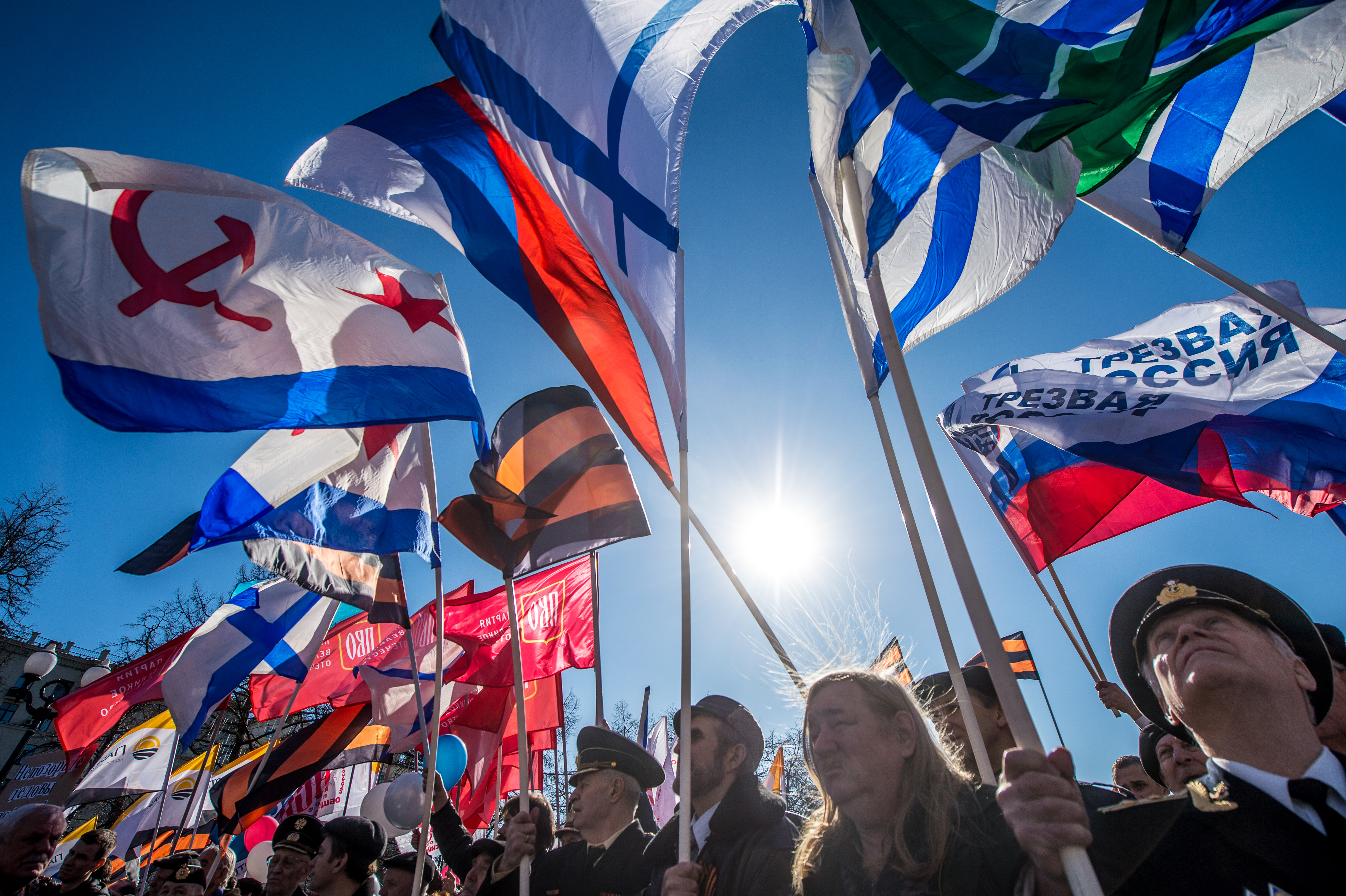
(Photo: Pro-Kremlin activists hold Russian national, Russian and Soviet naval flags and orange-black flags made of the St. George’s Ribbons, a well-known Russian symbol of military valor, during a rally in support of ethnic Russians in Ukraine in central Moscow, on March 10, 2014. By Dmitry Serebryakov/AFP/Getty Images.)

Sanctions For Sanctions’ Sake

Fred Kaplan thinks the sanctions the US imposed on Russia last week were a mistake:

[I]f Putin had been looking for some way out of this mess, he certainly wouldn’t be looking any longer, because de-escalating now would make it seem that he was backing down under Western pressure. Obama has had two long phone conversations with Putin in recent days, but as long as he insists on preconditions for renewed diplomacy (Putin must return his troops to their base, he must sit down with Ukrainian officials), Putin has no reason to comply. Russia has deeper interests in Ukraine than the West does—and more localized sources of pressure to make those interests felt.

That being the case, Putin can sit and wait. He has the upper hand in this game—and the more the West plays on his terms, the stronger his hand will seem. Sanctions won’t change his behavior, except to stiffen it—and once that becomes clear, Putin will seem stronger, the West will seem weaker, and a solution to the Ukraine crisis will recede in the distance.

Larison questions the utility of sanctions:

In general, trying to bludgeon another government into changing its behavior very rarely achieves anything positive, and the danger in trying this against a larger power is that it could then retaliate with punitive measures of its own. That would make the crisis harder to resolve and inflict damage on Western economies in the process, which would in turn spur demands for still harsher measures. Russia is already threatening to block inspections for the current arms reduction treaty, and it could choose to make things more difficult for the U.S. on other issues as well. Many Westerners seem very eager to demand economic punishment of Russia, but I suspect very few actually want to pay the price that could be associated with it.

Drezner approaches the issue from a different angle:

The first thing to understand about sanctioning Russia over its incursion into Crimea has nothing to do with the impact of the sanctions and everything to do with what is being demanded of Moscow. The United States wants Russia to withdraw military forces from a piece of territory they have long coveted. However much Russia has contravened international law over the past week, they’ve changed the facts on the ground. They control Crimea, and public opinion in that autonomous republic is pretty Russo-friendly. The current status quo for Russia is that they control that territory. In world politics, there is no greater demand to ask of a government than to make de facto or de jure territorial concessions. The domestic and international ramifications of such a concession are massive — especially after force was used to occupy the territory. So recognize that the demand being attached to the sanctions is so large that success is extremely unlikely.

Drum agrees:

For my money, the biggest price Putin is paying comes not from any possible sanctions, but from the very clear message he’s now sent to bordering countries who have long been suspicious of him anyway. Yes, Putin has shown that he’s not to be trifled with. At the same time, he’s also shown every one of his neighbors that he can’t be trusted. Two mini-invasions in less than a decade is plenty to ramp up their anti-Russian sentiment to a fever pitch.

Wise or not, sanctions are the most popular course of action, a new poll finds:

While almost 59 percent of Americans do support the U.S. and its allies imposing sanctions on Russia slightly over half oppose sending economic aid to Ukraine, and over 75 percent are against sending military supplies to Ukraine.

When it comes to possible military responses to the Ukraine crisis Americans are overwhelmingly opposed, with only 12 percent of respondents saying they would support having American troops on the ground in Ukraine and 17 percent saying they would support U.S. airstrikes on Russia forces in Ukraine.

Previous Dish on sanctions here, here, and here.

Is Obama Naive?

President Obama Meets With Israeli Prime Minister Netanyahu At The White House

Leon Wieseltier – surprise! – blames Obama’s rationality and his belief that others share it for blinding him to the ambitions of Putin’s Russia:

The lack of preparedness at the White House was not merely a weakness of policy but also a weakness of worldview. The president is too often caught off guard by enmity, and by the nastiness of things. There really is no excuse for being surprised by evil. There is also no excuse for projecting one’s good intentions, one’s commitment to reason, one’s optimism about history, upon other individuals and other societies and other countries: narcissism is the enemy of empiricism, and we must perceive differences and threats empirically, lucidly, not with disbelief but with resolve. “Our opinions do not coincide,” Putin said after meeting with Obama last year. The sentence reverberates. That lack of coincidence is now a fact of enormous geopolitical significance.

But opinions don’t coincide with almost all geo-political adversaries and even allies. That doesn’t mean that some common ground on the question of shared interests cannot also be reached, even as one retains no illusions about the underlying conflict. Rich Lowry shakes his head at the administration, which he says should have learned from the Bush era that Putin was not to be trusted:

Of all President George W. Bush’s failings, not giving the Russians a chance wasn’t one of them. He notoriously looked into the eyes of Russian resident Vladimir Putin at the beginning of his presidency and saw sweetness and light. His illusions were shattered by the end, with the Russian invasion of Georgia in 2008.

Larison counters Lowry’s whitewashing of Bush’s Russia policy:

It is not possible to understand Russian behavior over the last ten years without acknowledging the extent to which U.S.-Russian relations were wrecked by several Western policies, chief among them being Bush’s push for missile defense in eastern Europe and NATO expansion into the former USSR. If the Bush administration suffered from any illusions, it was that the U.S. could consistently goad and provoke Russia in its own region without consequences. By the end of Bush’s second term, that illusion was dispelled, and it was in order to repair the substantial damage that had been done in the previous five or six years that the U.S. successfully sought to find common interests with Russia.

Chait takes a broader look at Obama’s foreign policy. He argues, contra Fred Kaplan, that Obama isn’t a realist:

The Libya example alone cracks apart the case – no Realist would ever have committed American military power to save civilians in the service of a social revolution obviously unsettling to American interests.

The reason Obama has had liberal humanitarians like Power and Susan Rice on his foreign policy staff since his campaign, and throughout his presidency, is that he shares their ideological goals within the limits of what is practically attainable. Obviously, Obama is no George W. Bush. On the other hand, nobody else is George W. Bush, either. Most American presidents fall somewhere on the continuum between Bushian crusading moralism and Nixonian ruthlessness. Obama does, too.

Chait is right, it seems to me, on the broad level. And yet Libya remains more of an exception than a rule. And Obama seems to have learned from its unintended consequences just how dangerous liberal internationalist impulses can be.

(Photo: Israel Prime Minister Benjamin Netanyahu sits with U.S. President Barack Obama during a meeting in the Oval Office of the White House March 3, 2014 in Washington, D.C. Obama urged Netanyahu to ‘seize the moment’ to make peace, saying time is running out of time to negotiate an Israeli-Palestinian agreement. By Andrew Harrer-Pool/Getty Images.)

No, We Can’t Wreck Russia’s Economy, Ctd

Walter Russell Mead rejects the premise that the US or even the EU can pressure Putin economically:

Putin does not worry nearly as much about the Russian stock market as western leaders worry about financial markets in their own countries. Putin broke the oligarchs as a political force years ago; in Russia, corporations exist to serve the state and not the other way round. He is not worried that business leaders will lose confidence in him; in Putin’s Russia, it is business leaders who worry about losing the trust of the country’s political master.

As for banking crackdowns and visa limits, it will help Putin, not hurt him, if powerful Russians are unable to leave the country or move their money around in the West. One of his worries is that various oligarchs and power brokers can put enough money in the west to be able to get out from under his thumb. He would like all of his backers to be dependent on him for continued enjoyment of wealth and property. If the West wants to fence his backers in, so be it. (If the west goes after Putin’s own golden horde of ill-gotten simoleons, estimated by many to be north of $50 billion, the calculation might change.)

Daniel Berman notes that, for the governments of the UK and Germany, an economic war with Russia would be political suicide:

Both the UK Conservative Party of David Cameron and the German Christian Democrats under Angela Merkel have staked their political legitimacy on a particular vision of austerity and the belief that this austerity can bring economic growth, the former to Britain, the latter to the Eurozone as a whole. In particular Merkel has enforced her vision of belt-tightening not just on Germany, but on much of the EU including Greece and Italy. In return the results achieved by both governments have been mixed. The UK is growing again, but only at a rate of about 2.4%, with Germany a bit lower.

That number is critical. Sanctions would almost certainly hurt, likely to the tune of a. 8% haircut in GDP growth over the next year, especially without extensive stimulus spending. Critically however either option would destroy the legitimacy of the governments implementing them. A Keynesian approach would make a mockery of the policies followed hitherto and lead to resentment against Germany, while allowing that sort of haircut would eliminate the limited growth both economies have achieved. In the UK it would discredit Chancellor George Osborne, and almost certainly lead the Tories, already substantial underdogs for 2015, to their doom.

Jordan Weissmann investigates the idea of fighting Russia with natural gas exports:

“You hear these calls for us to ship gas to Europe,” [energy security expert Michael Levi] said. “We do not ship gas to anyone. Private companies ship gas. And Europe doesn’t buy gas. Private companies in Europe buy gas. The reality is that North American natural gas is not going to be attractively priced for most European companies. You can approve all the terminals you want. You still aren’t going to get any American companies to lose money pursuing geopolitical objectives.”

Danny Vinik calls out Republicans for blocking IMF reforms that would allow Ukraine to borrow the money it needs:

The reforms would allow Ukraine to borrow approximately 60 percent more (from $1 billion to $1.6 billion) from the IMF’s emergency fund. That’s money that Ukraine can use to pay off its debts and avoid a default. In certain scenarios, the IMF makes exceptions and allows countries to access additional funds, as it did with Greece and Ireland after the financial crisis. But there’s no guarantee it would do so with Ukraine. By blocking the passage of the IMF reforms, Republicans are actively making it harder for Ukraine to pay back its loans.

The U.S.’s refusal to pass the reforms—which 130 countries have already approved—only hurts our credibility. Given the broad constituency of nations that want to help Ukraine, this won’t stop the IMF from offering a loan. But it’s a bit rich for the U.S. to call for IMF help when it refuses to pass basic reforms that would have no material effect on the United States and that most of the world has already approved.

Previous Dish on sanctions here and here.

Has The World Never Changed?

I understand that’s a ridiculously broad question, but it arises from a ridiculously broad analysis:

Obama says Putin is on the wrong side of history and Secretary of State John Kerry says Putin’s is “really 19th-century behavior in the 21st century.” This must mean that seeking national power, territory, dominion — the driving impulse of nations since Thucydides — is obsolete. As if a calendar change caused a revolution in human nature that transformed the international arena from a Hobbesian struggle for power into a gentleman’s club where violations of territorial integrity just don’t happen.

Is it possible things are just a little bit more complicated than that? It could be that the impulse for national power, territory, dominion is now not obsolete, but simply much more attenuated now than it once was (and that argument is easily compatible with Kerry’s phrase). And the case for that is pretty strong. I mean: if nations have one driving impulse – “seeking national power, territory, dominion” – and if the record shows no change or evolution in this eternal truth, how do we explain huge tranches of recent history?
war2012Why on earth, for example, would European countries pool sovereignty in the EU? How could they be deluded into thinking that giving up “national power” could be a good thing? And why, for that matter, would this arrangement remain attractive to other countries as well, not least of which Ukraine? Why on earth did the US invade and conquer Iraq only to leave it a decade later? Why did we not seize the oil-fields with our military might to fuel our economy? What was Krauthammer’s hero, George W Bush, doing – singing hymns to human freedom rather than American hegemony?

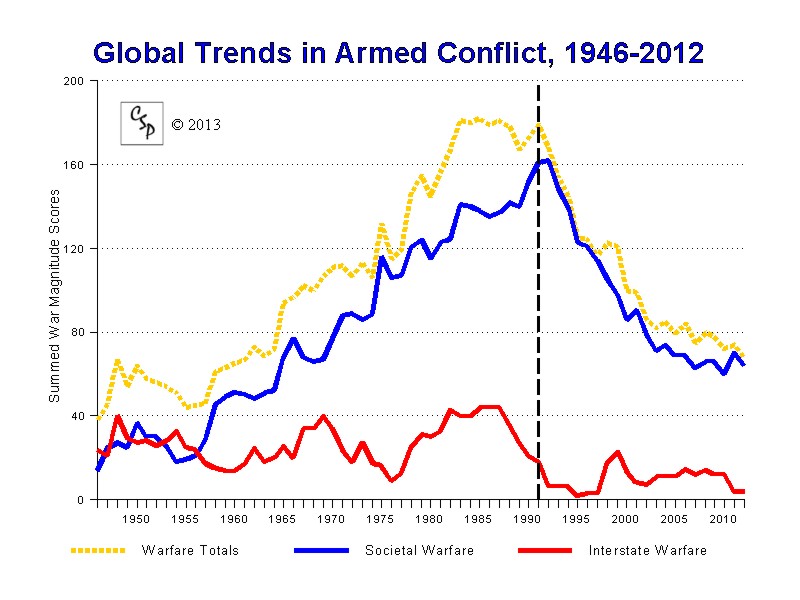
Why, for that matter, have military incursions into other countries become rarer over time? Why has the level of inter-state violence in human affairs declined to historically low levels?

The answers to that question are, of course, legion, and I’m not trying to settle the debate here. I’m just noting that if the classic aims of territory acquisition and dominion never change, Krauthammer has a lot of explaining to do.

Even with Putin, I think it’s worth noting that his current Tsarist mojo is not exactly triumphalist. Krauthammer concedes as much:

Crimea belonged to Moscow for 200 years. Russia conquered it 20 years before the U.S. acquired Louisiana. Lost it in the humiliation of the 1990s. Putin got it back in about three days without firing a shot.

So this is less like Hitlerian aggression and more like a sad attempt to re-seize one tiny portion that was part of Russia proper far longer than it was “lost”. More to the point, Putin “got it back” only in the wake of Ukraine deposing its democratically-elected, Russophile leader in a violent, popular putsch. Yes, if your contention is that the desire for territory/dominion/power is “obsolete,” you’re a fool. But if your contention is that this impulse plays a much less critical role in international affairs than in almost all previous periods in human history, you’d be merely making an empirical observation.

The truth is that global interdependence – the immensely complex and proliferating global economy that vastly expanded as communism collapsed under the weight of its own lies – clearly mitigates the classic impulse that Krauthammer approves of. It doesn’t abolish it – but it shapes it.

One reason we won’t see major armed conflict over Ukraine, for example, is because the Germans and Brits have too much to lose in terms of their economies – and Russia does too. In the end, economic power is the basis for military power. Economic power, in the global capitalist economy, is also related to soft power, to where human capital wants to go, and where money wants to flow. Becoming a global pariah is not GERMANY-CARNIVAL-ROSE-MONDAY-STREET-PARADEgood for that kind of thing – and it has a direct relationship to power as a whole. And one reason why Putin’s attempt to coerce Ukraine is not as win-win as Krauthammer suggests is that controlling and occupying countries by brute force is much more difficult than it used to be. The most advanced military machine in history occupied Iraq for a decade and lost. Ditto Afghanistan – for both the Soviets and the Americans. Ditto, for that matter, the Israelis on the West Bank. In each case, the occupying power’s cost-benefit analysis looks weaker than ever. And if Putin attempts to invade or annex Crimea, his headaches are sure to become even worse, as he manages Russia’s steep decline by beginning an armed conflict within what used to be the Soviet Union’s undisputed territory.

Then there is the simple matter of collective memory. For many Americans and for Krauthammer, the key referent is the Second World War which America won with almost none of the devastating trauma experienced by Germany, Britain or the Soviet Union. But in Germany and Britain right now, the collective memory is much more indelibly that of the Great War, where small matters of territory – like Crimea – metastasized through miscalculation into a generational catastrophe. Hence the resilience of the EU, even as it seems to cripple the economies of its weaker members through punishing austerity. Hence also, of course, the survival of the UN and the countless instruments of collective security we’ve built in its wake.
Concerns Grow In Ukraine Over Pro Russian Demonstrations In The Crimea RegionIn other words, power rests on money; and money rests on the global economy. Russia is able right now to get away with its somewhat lame attempt to annex Crimea because its core economy is so primitive and petro-based. But even then, its potential vulnerability to economic retaliation – through global trade and travel and finance – makes this a mug’s game at some point.

Putin, of course, may not see it this way. And understanding that is critical to dealing with him. But that means, in Merkel’s alleged phrase, that he is in “another world.” That may be disastrous, of course, when you’re running an autocracy with nukes. But in the real world, he is misreading his country’s and his own actual interests. In the real world, the invasion and occupation of Iraq was a huge defeat for the US. In the real world, permanently occupying the West Bank is national suicide. And in that sense, Putin is not a symbol of the world order reverting to its eternal nineteenth century dynamic. He is a symbol, in fact, of how that dynamic has ended, and how attempts to restart it are unlikely to result in the glorious military victories some still seem so eager to celebrate.

(Chart from systemicpeace.org. Photos from Getty)
Meanwhile, In Kiev …

John O’Sullivan is impressed at how the new Ukrainian government has pulled itself together amid Putin’s provocations:

[I]t has maintained a lively democratic unity; passed a series of reforms leading to a more liberal constitution, fresh elections and a new government; discussed these proposals with great transparency (its parliamentary proceedings are televised); won over the main oligarchs, who prefer even a Kiev regime hostile to corruption to a Putin-esque world in which the government is a rival oligarch; and responded firmly but not rashly to Russia’s invasion of Crimea and other provocations.

It has, accordingly, been accepted as legitimate throughout most of Ukraine even before the elections. Attacks on its supporters, attempts to seize official buildings, demonstrations by crowds calling for Russian intervention there have been seen in some eastern cities, but on a smaller scale than most experts predicted. Most Russophone Ukrainians seem to support Kiev — which suggests that a distinctly Ukrainian nationalism has spread eastwards in the past 20 years. And when they switched sides, the oligarchs ensured that much political and public opinion switched sides, too.

All of which means that there is simply not enough disorder and anarchy in Ukraine to provide [Putin] a pretext for any further incursion.

“Calm,” Massie adds, “even of a relative and tense kind, is Russia’s enemy”:

Perhaps Moscow will gain the Crimea but only, at least for now, at the expense of its own long-term ambitions in its near abroad. Indeed Moscow’s aggression may prove counter-productive, effectively ensuring Russia cannot achieve its own goals. Heckuva job, Vladimir.

If the east were to rise, best it rose quickly. But it has not risen and time is not on Russia’s side. Each day that passes without a fresh confrontation is time Moscow loses – time, too, that it can scarcely afford to lose. Time is Moscow’s enemy and Kiev’s friend. Even in the spring. If Russia was to bring Ukraine back into the fold it needed to do so quickly by winning a swift victory in decisive, indisputable, fashion.

Anna Nemtsova reports that the invasion is swelling the ranks of Ukraine’s nationalist militias:

[T]his week marked another transformation for the Maidan: Never before have they been as anti-Putin as they are now. From Monday night to Tuesday morning, after Russia’s threat, hundreds of volunteer recruits arrived on the Maidan and at other militia headquarters throughout Kiev, determined to join the impending fight against Russian forces. These well-organized and well-trained armies are independent from the new leadership. The nationalist armies, including Right Sector and White Hammer, are seen as the heroes of the Maidan — but they are critical of the new leadership. They told me they hate Yulia Tymoshenko and her allies who are now running the new government. But Putin’s threat of invasion brought these groups closer together again. On the Maidan, demonstrators chanted “Putin het! Putin het!” (or “Putin Out!” in Ukrainian) in the capital’s streets and squares. Signs reading “Putin, calm down!” and caricatures casting the Russian president as Adolf Hitler appeared all over the square: tacked onto piles of tires, on soot-covered barricades, on the nylon tents that have housed protesters for months.