Putin’s Annexation Of Crimea

UKRAINE RUSSIA-UNREST-POLITICS-CRIMEA

The worst outcome now seems likely:

MPs [in the Crimean parliament yesterday] voted by 78 votes to nil for the territory to leave Ukraine, further escalating what has become the most serious crisis in Russian relations with the west since the cold war.

At the same time, a referendum on more autonomy for the region due on 30 March was brought forward to 16 March, and the question was changed to give residents the option to unify the Black Sea peninsula with Russia. Crimea’s deputy prime minister, Rustam Temirgaliev, said the referendum was now only to “confirm” parliament’s decision, and he considered Crimea to be part of Russia already. He said that all Ukrainian troops on the territory should either leave or be treated as occupiers. Crimea is planning to introduce the rouble and readopt Russian state symbols.

Brian D. Taylor’s sees the referendum as a Kremlin provocation:

[The] fast-tracking of a Crimean referendum on unification with Russia, if Putin is behind it, suggests that he decided to speed right past the “off ramp” and head straight for formal annexation.

In that case, the prospects for positive-sum outcomes will have shrunk considerably. If Russia does formally annex Crimea, the United States and Europe should go ahead with sanctions, in order to hit Russian elites in their pocketbooks. In the medium term, the United States should help Central and Eastern European governments to diversify their energy supplies, away from their dependence on Russian gas.

The Bloomberg View editors take a similar stand:

Any plebiscite held within 10 days of its announcement is by definition a joke, yet the implications here are serious: No major country has annexed territory since World War II. Unless it can be prevented, the damage will extend to everyone concerned. The move would, first of all, destabilize a fragile Ukraine, not least by encouraging pro-Russians in other regions to follow Crimea’s example. Civil war would become difficult to avoid.

Helena Yakovlev-Golani and Nadiya Kravets believe the annexation “could be problematic for Russia in a number of important ways”:

First, annexing Crimea would be a costly enterprise. The peninsula is not self-sustainable and heavily depends on Kiev to balance its budget. Crimea has no fresh water supplies and it does not generate its own electricity; in fact, it receives 90 percent of water, 80 percent of electricity, 60 percent of other primary goods and 70 percent of its money from Kiev. Building or creating these capacities in Crimea will put a huge strain on the Russian budget, and given the ongoing slide of the Russian currency due to calamities in Ukraine, the decline is likely to continue together with the fall of foreign direct investment into Russia. Crimea with its 2 million person population would become an economic drain on Russia even more than the breakaway republics of Abkhazia and South Ossetia, whose populations totals some 250,000 and 45,000 respectively. In addition, economic problems would magnify due to reactions from Turkey and Europe.

But Bershidsky thinks annexation would be a win for Russia, despite the costs:

About 60 percent of Crimea’s natural gas comes from a Ukrainian company that extracts it in the Black Sea and the Sea of Azov. The peninsula gets 80 percent of its water and power from Ukrainian territory. These supplies will not be cut off, but Ukraine will probably want to charge more for them. Russia will either have to negotiate with an unfriendly government in Kiev or build parallel infrastructure, which will take years and billions of dollars.

All told, it looks like a good deal for Putin compared with the $50 billion price for the Winter Olympics that just ended in Sochi. At taxpayer expense, the Russian president is acquiring a priceless resource: an explosion in public support. According to the VTsIOM sociological service, Putin’s approval rating has reached new highs in the last two weeks, and is now at 68 percent. That’s worth more to the Russian leader in his 14th year in power than any accolades from the West could ever be.

Juan Cole questions the US’s credibility in opposing the secession:

It is not clear if Russia’s supporters in Crimea are serious about this accession to Russia or if they are just playing a bargaining chip intended to wring long term concessions from the interim Ukrainian government, such as a permanent lease of naval facilities in Crimea to the Russian navy. …

But those pundits (and President Obama himself) who are suggesting that a Crimean secession from Ukraine would be contrary to international law or unprecedented, or that the US would always oppose such a thing, haven’t been paying attention. The US position on secessions depends on whether Washington likes the country affected. And Washington itself toyed with partitioning Iraq while it was a colonial possession.

Posner assesses whether international law would prohibit it:

Crimea is currently occupied by Russian troops, and the question of secession was (as far as I know) put on the agenda only because of Russia’s illegal intervention. Unlike places like Quebec, the Basque Country, and Scotland, the question of secession is entirely new; there was never a live secession movement that sought reunification with Russia. Ukraine itself does not appear to favor secession of Crimea. The world ought to be skeptical about the Crimean Parliament’s intentions, but if a fair referendum is held, and there is overwhelming sentiment in favor of unification with Russia, then a major geopolitical victory will be within Russia’ grasp.

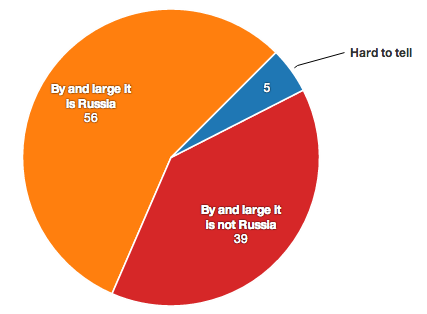
Adam Taylor looks at survey data that suggests Crimeans already largely identify with Russia:

This poll, conducted by a well-respected agency linked with the Russian state, found that a majority of Crimea Russiarespondents view Crimea as part of Russia. There are a few fascinating elements to this one. First, it was conducted in August, long before Ukraine’s situation blew up, so it appears to show some deep-rooted feelings about Crimea (which was, after all, part of Russia until 1954). It’s also worth noting that in this poll, more people thought Crimea was a part of Russia than Dagestan (41 percent) and Chechnya (39 percent) – both of which are republics in the Russian Federation.
Another survey complicates the identity issue further:

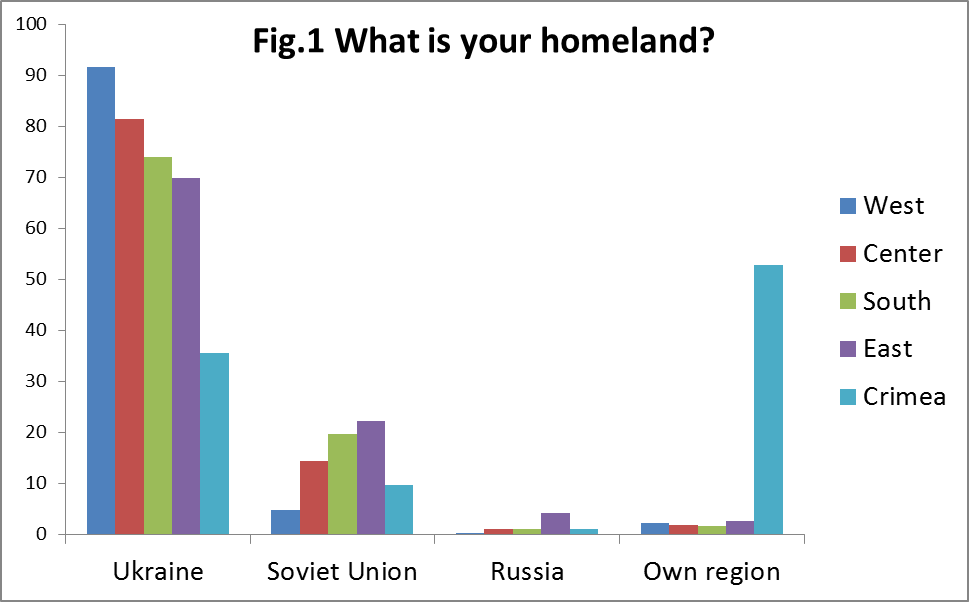
TMC-Figure-1Asked an open-ended question about where respondents considered their “homeland” to be, Crimeans, unlike easterners or other southerners, showed fairly little affiliation with the Ukrainian state. More than half of Crimean respondents replied by naming Crimea, while almost no one else mentioned their own region. Some 35 percent of Crimeans did volunteer Ukraine, and while allegiance to Ukraine was higher — around 50 percent — among ethnic Ukrainians and Tatars living in Crimea, these figures were considerably below the support in eastern Ukraine. In short, levels of attachment to Ukraine in Crimea are noticeably out of line with the rest of the country.
Natalia Antelava fears for the Crimean Tatars, who want the region to remain part of Ukraine:

Eskandar Baiibov, a deputy in the Crimean Tatar Mejlis, told me firmly that his community is unanimous in its backing for the government in Kiev, and that Crimean Tatars would boycott any referendum on joining Russia. But he is also terrified, he admitted, of the price that they might have to pay for refusing to give the Kremlin the support it wants.

“We are already seeing signs that they are trying to intimidate us, to split us, to stir trouble,” Baiibov said. “Ukrainians are also vulnerable, but at least they have Ukraine to go to. Where will we go? Crimea is our only home.” After the regional parliament voted to merge Crimea into Russia on Thursday, the chairman of the Mejlis, Refat Chubarov, released a statement to the press, calling for the United Nations to “immediately consider” sending a contingent of international peacekeepers into Crimea, “in order to deëscalate the military conflict … which can lead to mass casualties among the entire civilian population of the peninsula.

Previous Dish on the Tatars here.

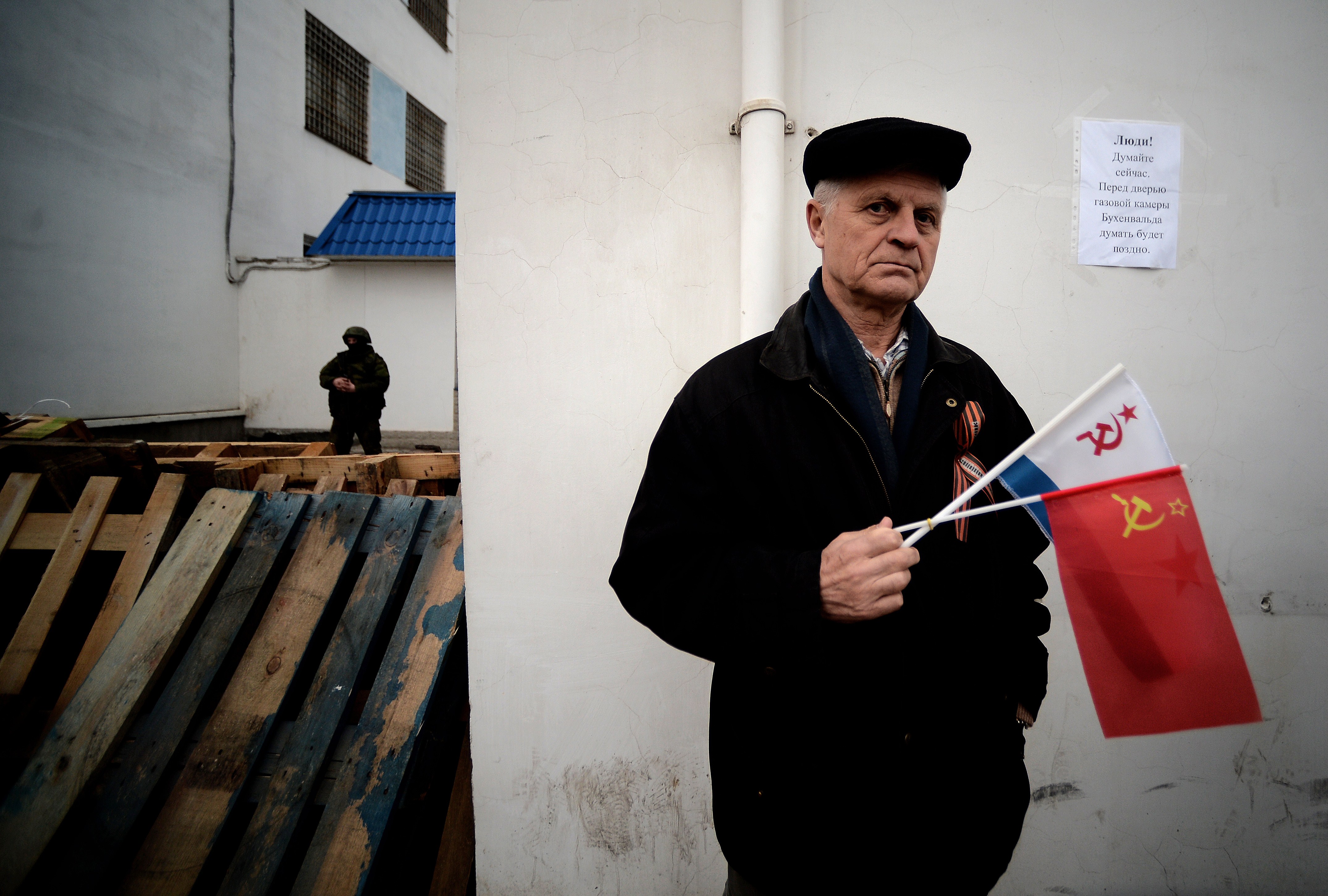
(Photo: One of several pro-Russian demonstrators blocking the entrance to the Ukranian Navy headquarters in Sevastopol holds Soviet flags, on March 7, 2014. By Filippo Monteforte/AFP/Getty Images)

Is Britain Russia’s Money-Launderer?

Here’s a screed (NYT) that puts some of the rhetoric around the Ukraine crisis in perspective. If the Europeans were truly concerned about Russia’s shenanigans, they have the leverage to impose huge damage. London alone could bring many Russian oligarchs to their knees – in ways the US cannot. But London isn’t. Just follow the money:

Russians … know that London is a center of Russian corruption, that their loot plunges into Britain’s empire of tax havens — from Gibraltar to Jersey, from the Cayman Islands to the British Virgin Islands — on which the sun never sets. British residency is up for sale. “Investor visas” can be purchased, starting at £1 million ($1.6 million). London lawyers in the Commercial Court now get 60 percent of their work from Russian and Eastern European clients. More than 50 Russia-based companies swell the trade at London’s Stock Exchange. The planning regulations have been scrapped, and along the Thames, up and up go spires of steel and glass for the hedge-funding class.

Britain’s bright young things now become consultants, art dealers, private bankers and hedge funders. Or, to put it another way, the oligarchs’ valets.

One suspects that Crimea is a small price to pay in return.

The Real Split In Ukraine

Tensions Grow In Crimea As Diplomatic Talks Continue

Generational, according to Ioffe:

The younger a citizen of Donetsk, the more likely she is to view herself as Ukrainian. The older she is, the more likely she is to identify as Russian. And this is the crux of it all: What we are seeing today is the reverberation of what happened more than 20 years ago. This is still the long post-Soviet transition. And this is what it’s like to wander in the desert, waiting for the old generation to die off.

(Photo: A child cries as a Russian Cossack places a traditional Cossack hat on her outside of the Simferopol parliament building in Simferopol, Ukraine on March 6, 2014. The Russian Cossacks surrounded the building in a show of support for Russia. By Spencer Platt/Getty Images)

What’s Wrong With Ukraine’s Economy?

ukraine economy

A lot:

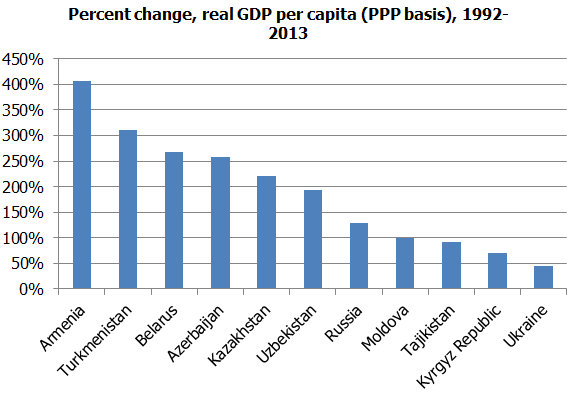
Ukraine was badly hit by the financial crisis and plummeting steel prices. GDP fell by 15% in 2009. That made it a prime candidate for economic streamlining. In 2010 the IMF agreed to loan Ukraine $15 billion—with conditions attached. A major target for reform were Ukraine’s cushy energy subsidies. The state gas company, Naftogaz, only charges consumers a quarter of the cost of importing the gas. Cheap gas discourages investment: Ukraine is one of the most energy-intensive economies in the world and domestic production has slumped by two-thirds since the 1970s. The IMF ended up freezing the deal in 2011 after Kiev failed to touch the costly subsidies.

Daniel Berman’s explains the EU’s new $15 billion aid offer:

This is not quite as generous as it seems – the aid is tied to the implementation of an IMF restructuring campaign that is sure to be almost as destabilizing in the short-run as the aid is intended to be stabilizing. If the goal was simply to strengthen the Ukrainian state in the near future, the aid should have been offered with fewer if any strings.

Nonetheless a major aid package is an excellent idea, and is precisely what should have been [done] 20 years ago. The 15 Billion Dollar package would have done infinitely more to strengthen Ukraine and to guarantee the nation’s territorial integrity than the near-worthless promises entailed within the Budapest Memorandum, or a decision to risk both American and Russian ostracism by retaining control of Nuclear weapons Kiev could not fire. Kiev’s greatest weakness through the last two decades and even today has been less its lack of military force, and more its lack of political unity. History teaches us that money does not solve those divisions on its own, but it sure damn helps. In times of crisis economic weakness is, as was demonstrated in 1930s France and Germany, a political, not an economic problem.

But he also wonders if it’s just a payoff:

The package can be just as easily seen as a bribe to console Ukraine for the loss of the Crimea as it can be as an effort to retake it. With Crimea seemingly preparing to increase the tension by petitioning to join Russia, that is suddenly a more important issue than anything else. Right now the package represents the overlap between the German and American positions because it can either console Ukraine for accepting Russia’s terms, or strengthen the Ukrainian state in its resistance, the respective goals of those two countries.

Paul Ryan Can See Russia From His Pet Political Issue

This is ridiculous:

[CNN host Kate] Bolduan pressed Ryan on what Congress could do in response to international crisis.

“Well, I think we should move forward on natural gas exports very quickly,” the former GOP vice presidential nominee insisted. “I think we should approve an LNG terminal in the east coast to go to Europe. I think we should approve the Keystone Pipeline. And I think we should show that the U.S. is going to be moving forward on becoming energy independent.”

“Moving forward with the Keystone pipeline!” Bolduan exclaimed. “That development would take years, though, to actually make that happen.”

Ryan argued that the controversial pipeline would be a “signal” to Russia.

Erik Loomis quips:

There’s no question that the one thing that will cower Putin is if Obama decides to pipe some Canadian fossil fuels through Nebraska to Gulf Coast posts.

Ben Adler explains why Keystone would have little effect on Russia:

After conflict between Russia and Ukraine led to supply disruptions in 2006 and 2009, Europe took measures to make itself less vulnerable. Meanwhile, as U.S. natural gas production has soared in recent years, U.S. demand for gas from the international market has shrunk, so even without exporting gas, we’ve been freeing up more of it for Europe. “The U.S. energy boom has already changed the balance of power in Europe away from Russia and to a more balanced posture, even without sending a single molecule of American natural gas over, because it has freed up supplies from places like Qatar and Norway to compete with Gazprom,” says Andrew Holland, senior fellow for energy and climate at the American Security Project, referring to Russia’s state-owned oil and gas company. …

All of this aside, there is still no evidence that Russia would be more respectful of Ukrainian sovereignty if it faced more competition for European gas markets. The main beneficiaries of allowing more exportation of fossil fuels would be the companies that produce those fossil fuels.

Russia’s Loss Isn’t Our Gain

Scott McConnell makes an important point:

The dream of chaos inside Russia still animates half the people inside the Beltway. Paula Dobriansky, a big deal ambassador during the Bush administration tells an audience that Putin’s real fear is that the Maidan revolutionary spirit will spread to Moscow. That is obviously what she wants—though why anyone would seek regime disintegration in a state that possesses hundreds of nuclear missiles in not obvious.

Adam Kirsch thinks seeing Russia through a Cold War lens is “making it hard for us to assess the real dimensions of the threat—to take Putin and what he represents entirely seriously”:

What we are seeing is a weird kind of negative feedback loop: The more dangerous Russia is, the more untimely it seems, so the less dangerous it appears. The problem is that, while Putin’s government and his ideology have little to do with the Soviet Union, the Soviet Union remains our reflexive frame of reference for anything having to do with Russian geopolitics; and the Soviet Union is no longer frightening to us. Partly this is a generational issue. No one under 30 today remembers the Cold War at all; no one under 60 played any major role in waging it. What remains is the defunct iconography of Cold War pop culture: Russian villains from the Bond movies to Rocky to Boris and Natasha, which could not seem less threatening today.


The Predicament Of Ukrainian Jews

Eli Lake addresses it:

Ukraine has never been a very good country for the Jews. The 19th and early 20th centuries were marred by pogroms against Jewish communities. Under Soviet occupation, many Jews that stayed in Ukraine faced the state sponsored anti-Semitism of the Communist system. More recently, a few neo-Nazi groups have openly participated in the popular uprising that ousted President Viktor Yanukovych baring at times swastikas.

Nonetheless, leaders of Ukraine’s small Jewish community (experts estimate there are between 80,000 and 350,000 Jews in Ukraine) say they are more worried about anti-Semitic attacks from Russian operatives and Yanukovych loyalists than the nationalists who gathered in Kiev and other cities to oust him.

Marc Tracy’s take:

Both sides are using Ukraine’s Jewish community as a symbolic pawn, in which the credibility of the other side can be diminished by accusations of anti-Semitism. And that is remarkable. In a sense, it’s even laudatory. Babi Yar—in which, outside Kiev, over just two days Nazi Einsatzgruppen shot more than 33,000 Jews—was barely 70 years ago. 900,000 Ukrainian Jews, more than half the country’s pre-war Jewish population, were murdered in the Holocaust. This was in no small part because occupying Germans were able to secure the cooperation of homegrown anti-Semites, who had been carrying out pogroms in parts of their country that at the time were a designated region for Jews to settle in for decades preceding World War Two.

He bets that “it would be better for Ukraine’s Jews for Ukraine to retain its sovereignty and territorial integrity”:

If Ukraine is divided along ethnic lines, then ethnic minorities—most of all the Muslim-majority Tatars but also, potentially, Jews—could find themselves the odd peoples out.

Meanwhile, Jeffrey Veidlinger points to the history showing that “before Crimea was an ethnic Russian stronghold, it was a potential Jewish homeland.”

The Focus Of Our Foreign Policy

Beinart expects America’s rivalry with Russia to replace the War on Terror:

When there’s serious tension between America and other major powers, that tension becomes the dominant reality in U.S. foreign policy. And it’s likely that tension will endure. Vladimir Putin has now twice invaded his neighbors in an effort to halt, if not reverse, the West’s encroachment into the former U.S.S.R. Yet the more bullying he becomes, the more desperately many in Ukraine, Georgia, Moldova, and perhaps other ex-Soviet republics will seek economic and military bonds with Europe and the U.S. Large chunks of the former Soviet Union now constitute a gray zone where competition between Russia and the West can breed diplomatic feuds, economic sanctions, and even proxy war.

Michael Brendan Dougherty has a very different view:

[T]he political class in America should remember that Moscow is mostly a symbolic foil in world affairs, not a great geostrategic foe.

America’s political class should stop ducking under its desks and wailing for some kind of symbolic action or rebuke to soothe the nerves. It’s unnecessary. The Kremlin used to compete with the free world for entire continents — now it is reduced to an embarrassing grab at Crimea. An aggressive U.S. response over a sliver of Ukraine would not be meeting Putin’s strength with our strength, but matching his desperate anxiety with our own.

Fred Kaplan suggests we are making too much of Putin:

Just as Putin is not as much in command as many Western hawks suppose, Russia is not as great a power as Putin himself likes to project. It’s at best a regional power, with no global reach. Even his incursion into Crimea is hardly an imperial gesture. Leonid Brezhnev sent five tank divisions into Czechoslovakia. (Now that was aggression!) U.S. military advisers estimate that the Russian army could invade eastern Ukraine if Putin so ordered, but they say it’s much less clear how long they could sustain an occupation, especially with even sporadic insurgent resistance.

Putin Is Losing?

That’s what Massie thinks:

Putin’s hopes for his Eurasian Economic Union are ruined now. He has Belarus and Kazakhstan in his pocket and little Armenia may have little choice but to join. But that’s it. Ukraine is the prize and the only one really worth having. Without Ukraine Putin’s pet project is, if not meaningless, severely devalued. The other former Soviet republics are like so many toes; Ukraine is an entire leg.

And Putin has lost that leg. Or at any rate, at least half of it. Moscow’s best hope scenario now is only half as promising as that posited just a year ago. It bears remembering that since Putin’s demands proved too much for Yanukovych they will be unacceptable to any other plausible government that may take power in Kiev. Putin’s hand is weaker than it seems.

Daniel Berman isn’t so sure. He imagines a scenario where Putin emerges “from this crisis having neutralized any prospect of Ukrainian NATO membership, secured Russia’s position in the Crimea, and strengthened Russian-German ties”:

Eastern Ukraine is of far greater use to Putin as a hostage for Kiev’s good behavior than as a Russian province.

The region is poor, with high unemployment, a devastated environment, and little prospect of improvement without extensive investment. Its seizure, would, as many have observed and Putin clearly comprehends, lead the rump of Ukraine into undying hostility and NATO membership, moving that alliance’s borders 400 kilometers to the East.

By contrast, leaving it in Kiev’s hands gives Putin the opportunity to pressure the Ukrainian government by threatening to engage in subversion and military action in the region, especially as its emotional and political value to both Ukraine and the West will increase the longer it remains under Kiev’s control. Putin can wield both economic pressure through Gazprom, and utilize political unrest in the East to destabilize the government in Kiev while offering the prospect of recognition if Ukraine’s leaders make their pilgrimage to Moscow to receive his forgiveness.