Millman doesn’t see how the country could have kept its nukes:
Was it even plausible that Ukraine could have held on to an independent nuclear deterrent after the collapse of the Soviet Union? The answer is almost certainly, “no.” Indeed, it’s hard to imagine any action that would more greatly have imperiled the stabilization of the post-Soviet order than such a determination on Ukraine’s part. Western and Russian interests were aligned in wanting to see Ukraine denuclearized; an independent nuclear Ukraine would have been treated as a dangerous rogue state. Russia’s ability to project power in the immediate aftermath of the collapse of the Soviet Union was extremely limited, but Ukraine’s ability to defend itself was even more ephemeral. The best evidence that Ukraine had no real choice but to denuclearize is precisely that Ukraine got almost nothing in exchange for agreeing to hand over its Soviet nuclear weapons.
Earlier Dish on Ukraine’s nuclear disarmament here.
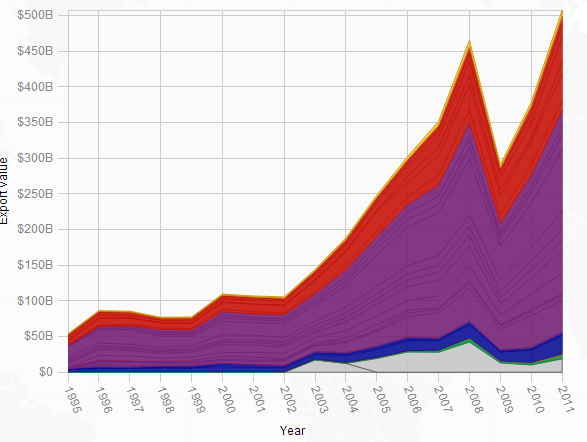
Danny Vinik uses charts on Russian exports and imports to explain why American sanctions against Russia pack little punch:
The little blue areas in each graph is the United States. The purple is Europe. Without the E.U.’s cooperation in implementing sanctions, American sanctions won’t hurt Russia very much. Of course, because the the E.U. economy is so interconnected with Russia’s, it means any economic sanctions will also hurt the E.U. That’s the reason that countries like Germany and the Nertherlands are withholding support for sanctions and instead pushing for a diplomatic solution. That may make sense for those countries, but it makes the U.S. threat of sanctions very weak.
Vinik also looks at what Russia sanctions would mean for US companies:
The U.S. Chamber of Commerce estimated that U.S. exports of goods and services to Russia in 2011 was more than $10 billion. That’s not much compared to the $2.1 trillion in total exports that American companies did that year. Nevertheless, Russia is an emerging market with growing incomes, and U.S. companies have been actively looking to increase their investment there in recent years. Companies like Pepsi, Coke, and Ford will be reluctant to support any economic sanctions that dig into their bottom line, especially if the European Union refuses to implement their own sanctions. Since the U.S. and Russia do very little business together (only $30 billion in 2013), any unilateral sanctions from the U.S. will only have a marginal economic effect, although they may offer symbolic value as well.
Peter Feaver wonders what Putin’s counter-counter-move will be:
The commentary has rightly focused on the immediate A-B-C moves: (a) what Russia has done in Crimea, (b) what the West should do in response to that, (c) what Russia would do in Crimea and Ukraine after the West has acted. Less attention has been paid to the things we will all be talking about once those preliminary moves have taken place: how Putin will seek to impose costs on the West for the sanctions and other diplomatic steps we take in move “b.” Germany appears to be quite concerned about this, though much of that concern may just be about lost business opportunities. Of greater importance will be the cost-imposing strategies available to Putin elsewhere on the geopolitical chess board, especially Syria, Iran, and perhaps even Afghanistan.
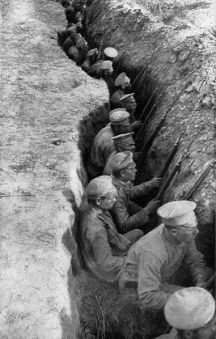
I am really struck this morning with the difference between US and German newspapers in their handling of the situation in Ukraine. The reporting of the facts is the same, essentially. But the editorial voice couldn’t be more distinct. Echoing through the German papers is an admonition, during the centennial of the beginning of the Great War, to be mindful of the conditions that led to its launch: hysteria, rabid nationalism, thoughts of the pride and glory of great nations, elements of personal vanity, militarism. These are forces that have historically led to great misery for humanity and that have clouded the history of Europe. They are all also things that can be found in some measure in the current controversy.
The Germans find much frightening in Putin, and in particular they see in his dealings unpleasant echoes of the predatory practices of the Hitler regime. But they are also sharply critical of the US, of the hyperventilation coming out of the Beltway, and even of Kerry’s desire to push promptly to isolate Russia, when they sense that post-Putin Russia is more likely to be a responsible part of Europe and relaunching a Cold War would only tend to strengthen the reactionary elements in Russian society.
They favor a response that is more incremental, cautious, measured, and one that avoids absolutely demonizing Russia. They prefer one that will bolster over time the more positive elements in Russian society. They are focused on extending a strong helping hand to Ukraine.
But beyond this, there is both a lack of a clear prescription of what to do next and a strong distrust of America. Obama is a big improvement over his predecessor, they reason, but he is still far too beholden to the toxic voices of neo-conservatism that sound so loudly within the Beltway.
It says a lot that Germans see this current moment as redolent of the folly of 1914, while Americans see it through the prism of the 1930s. The Germans, it seems to me, are more on point. Yes, there are some tactics that Putin is using with respect to diaspora Russians the way Hitler did with diaspora Germans, but the parallel, like all such Godwin-like parallels, can be dangerously misleading. Putin does not have a massive, modern industrial state behind him, and a unified mobilized citizenry; he has a faltering petro-oligarchy, atop a fragile Potemkin “democracy”; Putin claims no global ideology except the preservation of Russian power in its sphere of influence; Putin could only fight or occupy Ukraine at huge costs to his own power and the stability of his regime. When you consider all this, he is a problem to be contained or, so far as is possible, ignored.
What worries me about some of the signals coming from the White House is that they are repeating some of the errors of the past. They seem to have a solid grip on a realist and sober foreign policy, and then they have a spasm of relapse: intervening in Libya, declaring a “red line” in Syria. Putin needs to be contained and there need to be costs if he doesn’t retreat from Crimea. But grandiose threats and polarizing rhetoric can be deeply counter-productive. He’s made a huge blunder. The core task right now is to ensure we don’t make an even bigger one.
Today, I kept being gobsmacked – smack, smack, smack, smack, smacked in the gob. By which I mean Rumsfeld – yes Rumsfeld! – and Cheney and Butters – yes, Butters! – are actually out there in public condemning president Obama for “weakness”. In an inspired moment of total lunacy, Butters even blamed Putin’s Crimea bullying on Benghazi! I know we all have to pretend that they have every right to speak their minds (and, of course, they do) – but really. The men responsible for the collapse of America’s military deterrent by losing two strategically catastrophic wars of choice actually have the gall to get up there and accuse Obama of weakness! The men who let Osama bin Laden get away; the men whose Putinesque derangement led to the total disintegration of Iraq; the men who presided over Iran’s achievement of nuclear infrastructure; the men who made a laughing stock out of US intelligence; the men who lost Afghanistan; the men who bankrupted the country by war and spending … these men now claim strategic prescience, manly foresight and a record of a “strong” America? There are times when the gob smacks itself.
And look at their role model, the man they think has run circles around Obama, the man they think is playing brilliant chess to our lame checkers. Or better still listen to him. In Ioffe’s memorable piece today,
Putin squirmed and rambled [at his press conference]. And rambled and rambled. He was a rainbow of emotion: Serious! angry! bemused! flustered! confused! So confused. … Today’s Putin was nervous, angry, cornered, and paranoid, periodically illuminated by flashes of his own righteousness. Here was an authoritarian dancing uncomfortably in his new dictator shoes, squirming in his throne.
This is the Metternich of our time? This is the model for running foreign policy? It tells you so much about the neocons that they have descended into this pit of ugly incoherence. And as for the American people, sick of a weak president, and eager to flex American military muscle again … well, it turns out only 18 percent believe the US has any responsibility to protect Ukraine. But the neocons have long since stopped looking at public opinion. For them, it’s always 1978. But Obama is no Carter; and they have no Reagan – a president, of course, they also excoriated for “weakness” in his time.
Matthew Klein looks at Russia’s growing economic troubles:
Real gross domestic product growth has already slowed from 5.1 percent in 2011 to just over 1 percent in 2013. Car sales fell by 5.5 percent in 2013, despite the Russian government’s introduction of subsidized auto loans. If that weren’t bad enough, European demand for natural gas — about 30 percent of which comes from Russia — has been steadily falling since 2010. Additional supply could come on line in the coming years from the U.S. and Israel at the same time as Russia expands its own production capacity. The net effect could be a glut that would lower prices and further reduce Russia’s access to hard currency.
To put the Ukraine’s economy into some perspective, let’s go to the CIA World Factbook.
The annual gross domestic product of the country is $175.5 billion. That is about 4 days of GDP in America. Indeed, the entire stock-market capitalization of the Ukraine is about the size of Walt Disney Company. Ukraine’s per capita income is a touch higher than Egypt’s. In other words, it is not very economically significant.
Ukraine depends on Gazprom for the vast majority—70 percent in 2011—of the gas needed to heat homes and keep its industry functioning. This is a matter of no small import given its usually harsh winters. “Ukraine just hasn’t paid attention to the gas problem at all,” [Fiona] Hill [of Brookings] said. “It’s had too many people getting rich acting as middlemen for Russian gas.”
It might take Ukraine three to five years to bring its gas sector up to speed, she added. But Clifford Gaddy, a Brookings Institution economist who specializes in Russia, pointed out that “Ukraine . . . has not found alternatives to Russian gas, and it will not be able to. They are too expensive. Gas is and will always be a Russian lever.”
Update from a reader:
I think it was very useful to present some quantification of the differences in the economies and militaries of Russia and Ukraine, but those numbers are quite misleading as markers for how a shooting war between Russia and Ukraine might proceed.
First, while the Economy of Russia is vastly larger, the Russian economy is freakishly reliant on the Ukraine. The modern economy of Russia is built primarily on the export of natural gas (e.g., oil and gas exports provides 50% of all government revenue) and 2/3 of their exported gas transships the Ukraine. The Russian economy that would be fighting a shooting war with Ukraine would be much weaker than the one assessed in 2013 because those gas lines would certainly be shut down, possibly for a protracted period. A true war with Ukraine … even one with a relatively quick “victory” for Russia, will result in a severe economic contraction Russia if the Ukrainian nationalists destroy pipeline infrastructure. Put another way, the value to Russia of the gas that transships Ukraine is worth more money than the entire economy of the Ukraine.
Second, while all of Ukraine’s (limited) military resources would be devoted to defending its territory, Russia has simmering territorial or political conflicts with nearly all of its neighbors, as well as a perceived threat from the United States. Russia may have 40,000 armored fighting vehicles, but it cannot use them all in the Ukraine without wars opening up on other fronts. Similarly, a large part of Russian military spending is for weapons systems that are designed for conflict with the US and could not be used against Ukraine (e.g., nuclear subs, ICBMs).
If Ukrainians chose to fight an invading Russian Army, they could extract a stunningly high cost both militarily and economically from Russia. My view is that Putin’s movement of unmarked troops and agitators into Crimea/Ukraine makes tactical sense only as a test to determine if Ukrainians would actually chose to fight an invasion by Russia. Putin is putting a toe in the water to determine the temperature. If he can get Ukrainian military commanders in to surrender without firing a shot, then an invasion is likely. If not, he has still not risked that much.
James Mann tires of the administration’s rhetoric on Russia:
The administration loves to brand actions it doesn’t like as relics of the past. “It’s really nineteenth century behavior in the twenty-first century,” Kerry said of Putin’s Crimean gambit. A senior administration official who sounded like either National Security Advisor Susan Rice or Ben Rhodes told reporters on background, “What we see here are distinctly nineteenth- and twenty-first century decisions made by President Putin to address problems.”
Well, to start with, by definition Putin’s decisions are taking place in the twenty-first century. The administration here seems to be using the centuries like a teacher handing out a grade: twenty-first century is an A, twentieth century is a C, nineteenth century is an F. More importantly, talking this way raises an uncomfortable question: Does the reality of the twenty-first century conform to what Obama administration officials think it is?
We are speaking very loudly. We are carrying a small stick. We are not really disciplining the Russians. We are not clearly defining what is important to us. We are acting like King Lear. We are issuing pathetic declarations which nobody is taking seriously.
When I saw Secretary Kerry on television yesterday, I think it was a very sad performance. He was visibly angry. He was visibly defensive. He was accusing Russians using very harsh language of violations of international law. His description of the political process in Ukraine which led to this situation was incomplete and disingenuous at best. And then, after he said all of these things, he did not say, “Well, because of the Russians violating international law, threatening international security, that because of that the President of the United States is moving our naval assets in the Black Sea!” With the language he was using, that’s what you would expect him to do. But he was carrying a small stick.
Rhetoric is not policy and sounding tough doesn’t roll back Russia’s advances. The administration will have to do something that does not come naturally to it: think strategically. This means taking steps, preferably quietly, to demonstrate our commitment to the security of the Baltic States. It means considering strengthening the Ukrainian military if the conflict escalates. But it also means avoiding empty public threats, respecting Russia’s dignity and avoiding creating an impression that it’s our way or the highway.
No serious observer is now predicting a scenario where U.S. troops are on the ground in the Ukraine. That said, an array of military responses could be taken by the White House to increase pressure on Russia to withdraw. In 2008, when Russia invaded Georgia, President George W. Bush moved U.S. warships into the region and used them to supply humanitarian aid. Thus far the Pentagon has “put on hold all military-to-military engagements between the United States and Russia,” though it has yet to redeploy any U.S. military assets in response to Russia’s invasion of the Crimea. That might change if Russia moves beyond the Crimea into eastern Ukraine. “It’s one thing to hold your military base in the Crimea; it’s another thing to start moving into eastern Ukraine,” says Robert Kahn, a senior fellow at the Council on Foreign Relations. “The Ukrainians would almost certainly resist, and then you have the option of a civil war.”
So far, the Obama Administration has not drawn any clear red lines about the American response if Putin does move into eastern Ukraine.
Totten thinks it’s best to keep that red line blurry:
[T]he last thing the West should do is tell Putin where the red line is located exactly. Want to prevent an explosion in far-eastern Europe? Let him think he’s in danger of crossing it now. Otherwise he may sense a green light from the West to swallow whatever he wants on his side of the EU. Let him see a yellow light, at least, if a red light is asking for too much.
There are various ways to signal a yellow if not a red.
Retired Admiral James Stavridis shared a few ideas in Foreign Policy magazine. Michael Barone has more. Parking destroyers in the Black Sea off Yalta might be a good place to start. The US sent ships to that region when Russia invaded Georgia in 2008. The Russians didn’t withdraw from occupied Abkhazia or South Ossetia, but at least they stopped where they were, withdrew from Gori, and left the capital Tbilisi alone.
No matter how powerful the U.S. military may be, any promises the U.S. makes to the Ukrainian people as they face down some of the world’s worst neighbors are going to be hollow and false. American officials can’t—and shouldn’t—make promises that they’re in no position to keep. Hollow assurances may lead Ukrainians to assume that they’ll get backing that won’t materialize—just as many Hungarians felt betrayed after NATO (understandably) failed to intervene to support the 1956 uprising despite encouraging pro-freedom rebels through Radio Free Europe and other official media.
What Josh Rogin hears about the administration’s plans:
Behind the scenes, Obama administration officials are preparing a series of possible battle plans for a potential economic assault on Russia in response to its invasion of Ukraine, an administration source close to the issue told The Daily Beast. Among the possible targets for these financial attacks: everyone from high-ranking Russian military officials to government leaders to top businessmen to Russian-speaking separatists in Ukraine. It’s all part of the work to prepare an executive order now under consideration at the Obama administration’s highest levels. …
Administration sources cautioned that no decision has been made by President Obama regarding the path ahead for sanctions. But that the targets under consideration include not only the Russian government and military, but also organizations and individuals who can be shown to have helped or are helping foment unrest in Ukraine, both inside and outside Crimea.
Right now, the catcalls from the right are little more than transparent political opportunism. Obama’s “weakness” didn’t provoke Putin’s military incursion into Crimea. If anything, it was provoked by Putin’s feeling that the West was gaining influence in Ukraine and he was losing it. Nor is Obama refusing to respond decisively. He is refusing to give in to hysteria, but he plainly intends to make Putin pay a price for his adventurism. The fact that this can’t be done instantly is just a feature of the world, not a sign of fecklessness on Obama’s part. It’s time for everyone to stand down a bit and see how he plays his hand.
The GOP is criticizing Clinton’s outreach to Russia:
“Hillary’s Russia Reset: Nailed It,” proclaimed the website for America Rising, an opposition research firm and political action committee that has been taking aim at potential 2016 Democratic presidential candidates since soon after the 2012 contest. The tumblr post tweaking Clinton featured the then Secretary of State cackling as she held out her infamous “reset” button with the Russian foreign minister, a gesture that can come across as silly in light of recent events in Ukraine.
But that was just the opening salvo in what has been a steady stream of knocks on the presumed Democratic front-runner, with Arizona Senator John McCain telling The Daily Beast on Saturday that Clinton “got it all wrong.”
[T]here have been a number of lazy assertions that the so-called “reset” is somehow at fault in what has been happening.
When the “reset” was still going on, it had some modest but real successes, but once the original agenda was exhausted there was very little incentive or political will on either side to keep it going. Judged on its own terms as a means of repairing U.S.-Russian relations from its previous nadir in 2008, the “reset” did what it was supposed to do, but it could not magically change how Russia perceived its interests in the “near abroad” nor could it alter the way that the Kremlin behaved inside Russia. The Libyan war and the way it was conducted certainly soured Russia on further cooperation, especially because of how Russia was persuaded to permit U.N. authorization, and by 2012 the “reset” was essentially over. In its wake, U.S.-Russian relations resumed their dreary course as the U.S. was pursuing a number of goals in Syria and elsewhere that Russia flatly rejected.
(Photo: An assistant shows the block with a red button marked “reset” in English and “overload” in Russian that US Secretary of State Hillary Clinton handed to Russian Foreign Minister Sergei Lavrov during a meeting on March 6, 2009 in Geneva. By Fabrice Coffrini/AFP/Getty Images. Update from a reader: “‘Reset’ in Russian is ‘perezagruzka’.)
After watching the full presser, Ioffe decides that “Merkel was absolutely right: Putin has lost it”:
For the last few years, it has become something like conventional knowledge in Moscow journalistic circles that Putin was no longer getting good information, that he was surrounded by yes-men who created for him a parallel informational universe. “They’re beginning to believe their own propaganda,” Gleb Pavlovsky told me when I was in Moscow in December. Pavlovsky had been a close advisor to the early Putin, helping him win his first presidential election in 2000. (When, in 2011, Putin decided to return for a third term as president, Pavlovsky declared the old Putin dead.) And still, it wasn’t fully vetted information. We were like astronomers, studying refractions of light that reached us from great distances, and used them to draw our conclusions.
Today’s performance, though, put all that speculation to rest.
Asked whether the international community as a whole has a responsibility to get involved in resolving the situation in Ukraine, less than a third of Americans (30%) think that what is going on in Ukraine is the world’s business. 28% say that the world doesn’t have a responsibility to get involved, while 42% just aren’t sure.
Support for any US intervention to defend Ukraine against a Russian invasion is even lower. Only 18% say that the US has any responsibility to protect Ukraine, while 46% say that the US does not.
I’m guessing that a full occupation of Ukraine is much too large for the appetite of the Russian people to stomach. A stalemate, or a process, is much preferable to war, a war that would doubtless exacerbate whatever tensions already exist. In Ukraine, Russian belligerence will alienate the world community much more indelibly, and Russians know that. The Crimea is gettable. Ukraine is not, without significant costs that Russians — who are getting whiffs of what it’s like to exercise global political leadership again (think Iran and Syria) — probably won’t let their technocratic oligarchical political system bear.
 US and German newspapers in their handling of the situation in Ukraine. The reporting of the facts is the same, essentially. But the editorial voice couldn’t be more distinct. Echoing through the German papers is an admonition, during the centennial of the beginning of the Great War, to be mindful of the conditions that led to its launch: hysteria, rabid nationalism, thoughts of the pride and glory of great nations, elements of personal vanity, militarism. These are forces that have historically led to great misery for humanity and that have clouded the history of Europe. They are all also things that can be found in some measure in the current controversy.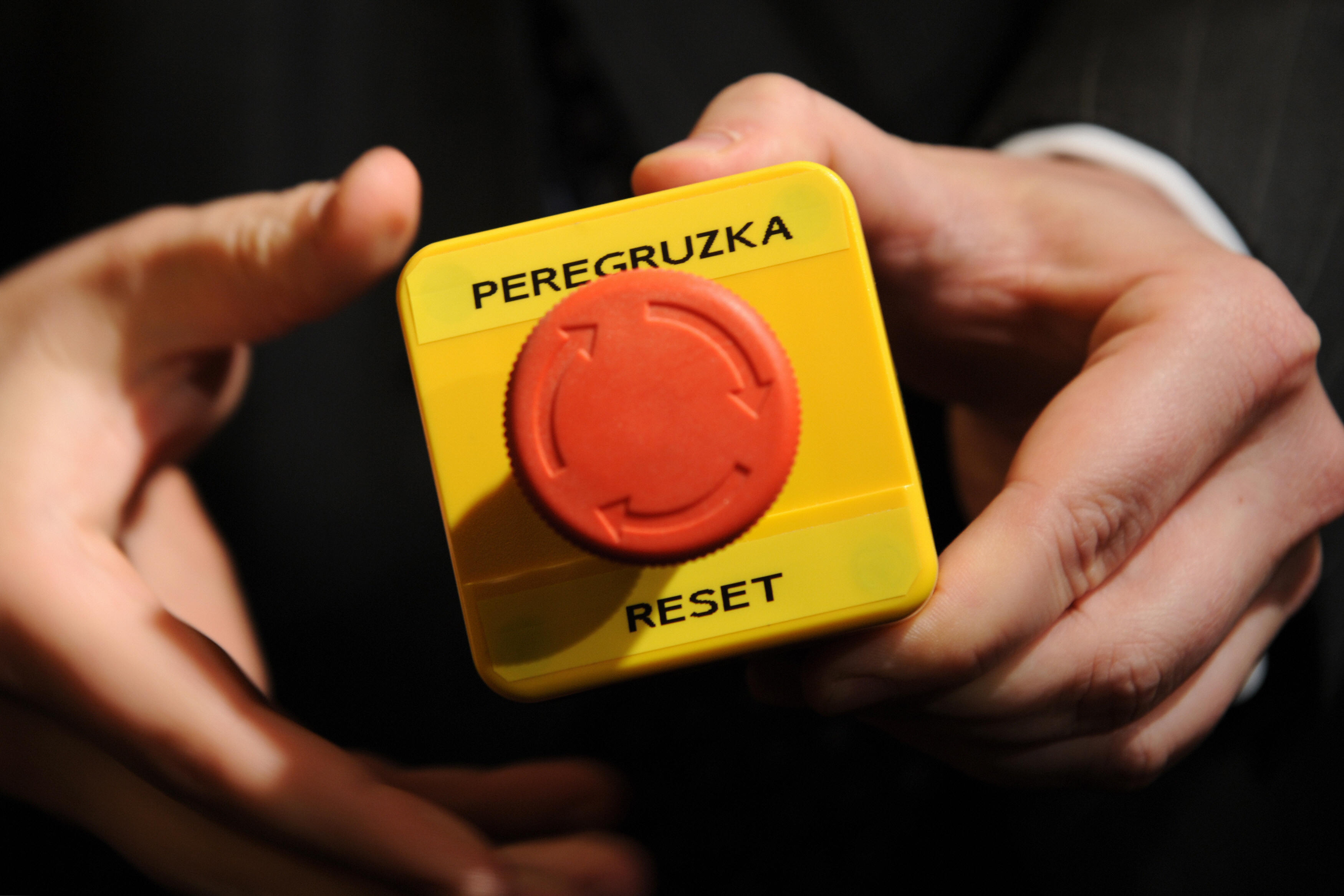
 The Dish