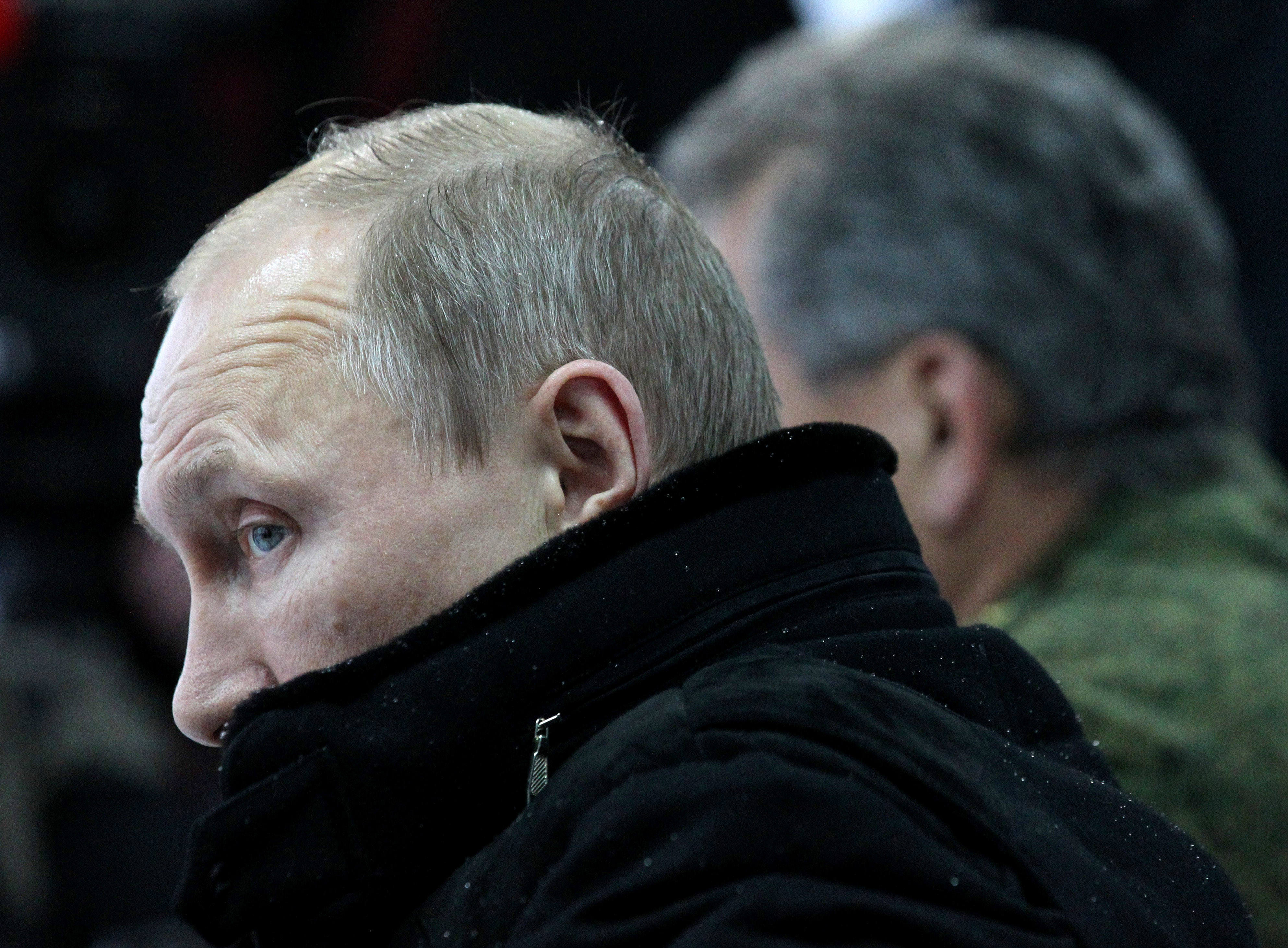
Ukraine’s Nuclear Mistake?

Stephen L. Carter flags a paper (pdf) by Robert Mathers “about the trade-offs involved in Ukraine’s 1994 decision to give up the weapons that had made it the third-largest nuclear power on earth”:

The West basically purchased the weapons, by investing in refitting Ukrainian industry. Some 1,900 warheads were transferred to Russia. Some 111 ICBMs and 46 heavy bombers were destroyed.

And, as Mathers points out, Ukraine also gave up the means to rebuild its arsenal: From the mid-1950s through 1991, a plant in Dnipropetrovsk “produced over eight types of intermediate-range and ICBMs, to include the 10-warhead behemoth SS-24.” In return for all of this, Ukraine received what Mathers presciently refers to as “perceived” promises that the U.S. would guarantee its safety against Russian attack.

Walter Russell Mead claims that Russia’s aggression toward Ukraine could mark “the end of a rational case for non-proliferation in many countries around the world”:

If Ukraine still had its nukes, it would probably still have Crimea. It gave up its nukes, got worthless paper guarantees, and also got an invasion from a more powerful and nuclear neighbor.

The choice here could not be more stark. Keep your nukes and keep your land. Give up your nukes and get raped. This will be the second time that Obama administration policy has taught the rest of the world that nuclear weapons are important things to have. The Great Loon of Libya gave up his nuclear program and the west, as other leaders see it, came in and wasted him.

It is almost unimaginable after these two powerful demonstrations of the importance of nuclear weapons that a country like Iran will give up its nuclear ambitions. Its heavily armed, Shiite-persecuting neighbor Pakistan has a hefty nuclear arsenal and Pakistan’s links with Iran’s nemesis and arch-rival Saudi Arabia grow closer with every passing day. What piece of paper could Obama possibly sign—especially given that his successor is almost certainly going to be more hawkish—that would replace the security that Iran can derive from nuclear weapons? North Korea would be foolish not to make the same calculation, and a number of other countries will study Ukraine’s fate and draw the obvious conclusions.


“This Is Putin’s Waterloo, Not Ours”

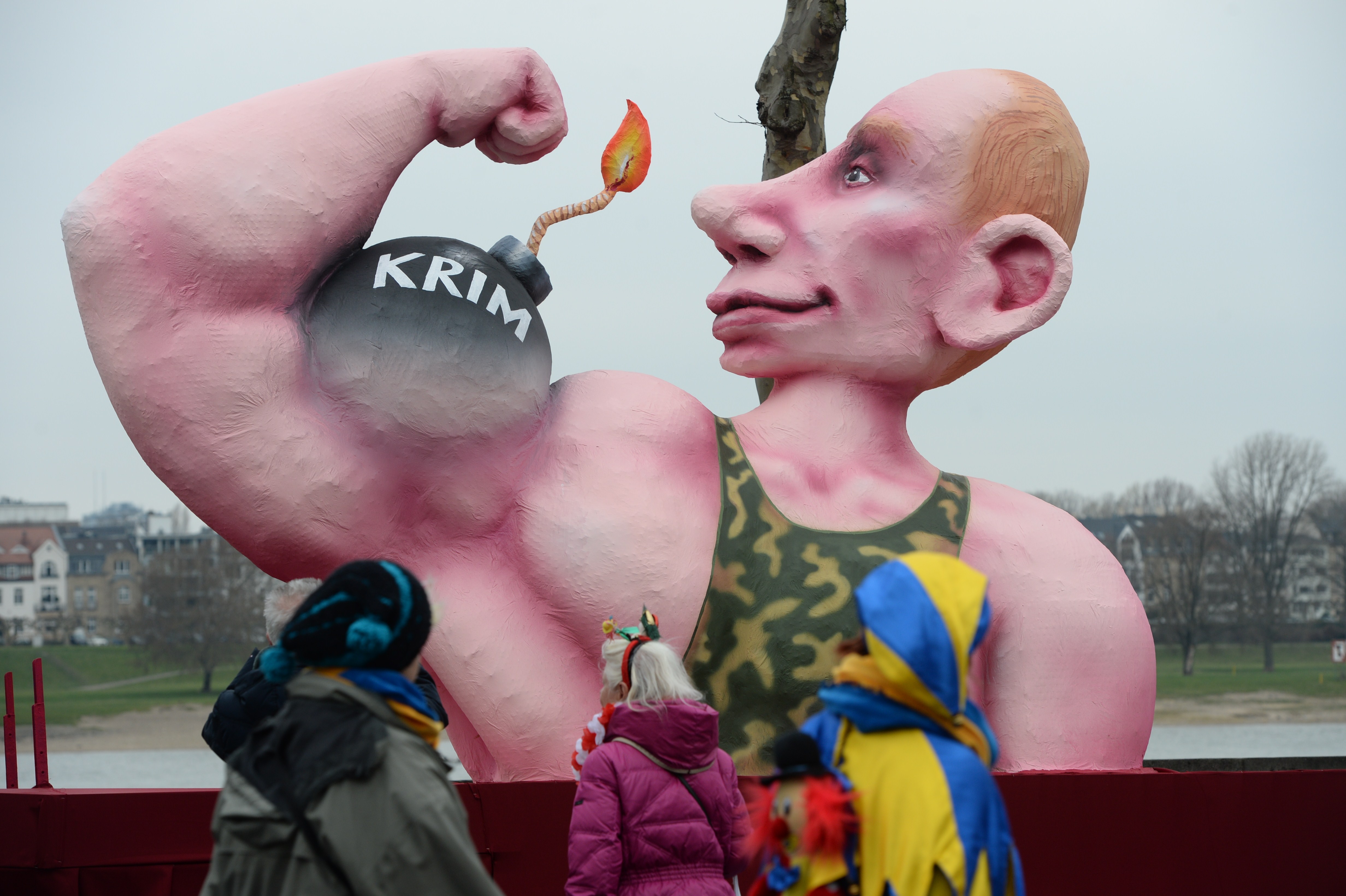
GERMANY-CARNIVAL-ROSE-MONDAY-STREET-PARADE

Michael Cohen has a splendid rebuttal to the all the hyper-ventilating from the liberal internationalists and unreconstructed neocons among the punditariat. Money quote:

You don’t have to listen to the “do something” crowd. These are the same people who brought you the wars in Iraq and Afghanistan, among other greatest hits. These are armchair “experts” convinced that every international problem is a vital interest of the US; that the maintenance of “credibility” and “strength” is essential, and that any demonstration of “weakness” is a slippery slope to global anarchy and American obsolescence; and that being wrong and/or needlessly alarmist never loses one a seat at the table.

The funny thing is, these are often the same people who bemoan the lack of public support for a more muscular American foreign policy. Gee, I wonder why.

(Photo: People look at a figure of Russian President Vladimir Putin showing a bomb reading “Crimea” on his arm during the traditional Rose Monday parade in Duesseldorf, Germany on March 3, 2014. By Patrick Stollarz/AFP/Getty.)

The Uni-Polar Moment Has Passed

Larison tackles Rubio:

Over the weekend, Rubio offered eight proposals for “punishing” Russia. Some are old stand-bys of symbolic retribution (e.g., condemnation at the U.N., boycotting the next G-8 summit, expelling Russia from the G-8) that are more or less easy enough to do and will have no effect, while others are much more reckless and foolish, such as pushing harder for Georgian membership in NATO, that will certainly make Russia more intransigent. Speeding up the process of bringing Georgia into NATO is just the sort of useless, ill-considered goading that will make it even more difficult to avoid further escalation in Ukraine. It is the sort of proposal one would make if one wanted U.S.-Russian relations and the situation in Ukraine to keep getting worse.

Daniel Berman sees Rubio’s op-ed as a symptom of America’s refusal to accept a multi-polar world:

The defenders of American preeminence while warning fearfully of the rise of China have in fact latched onto it as way of avoiding the more dreadful prospect of a multi-polar world and a return to great power politics. If China is a rising superpower seeking world domination, then the US can lead an alliance of the rest of the world, a force sure to trump whatever resources China can muster.

But China has been MIA in this crisis, revealing a dirty little secret. China has never been as interested in the reality of overseas empire in the same way the European powers have been, and its international efforts have mostly been used to block EU and American efforts to force their “norms” on the world, not to promote its own “Chinese Model” an invention of Thomas Friedman and the NYT editorial page.

The new world looks increasingly multipolar and based on state, not sub-state actors. China will throw its power into ensuring this takes place by blocking Western efforts to create a one-world order, but will at the same time refrain from giving the West its second choice, a two-world order. And that means that China is not going bail out Western geopolitical thinkers, they will have to do it on their own.

Hobbled By The Iraq Legacy

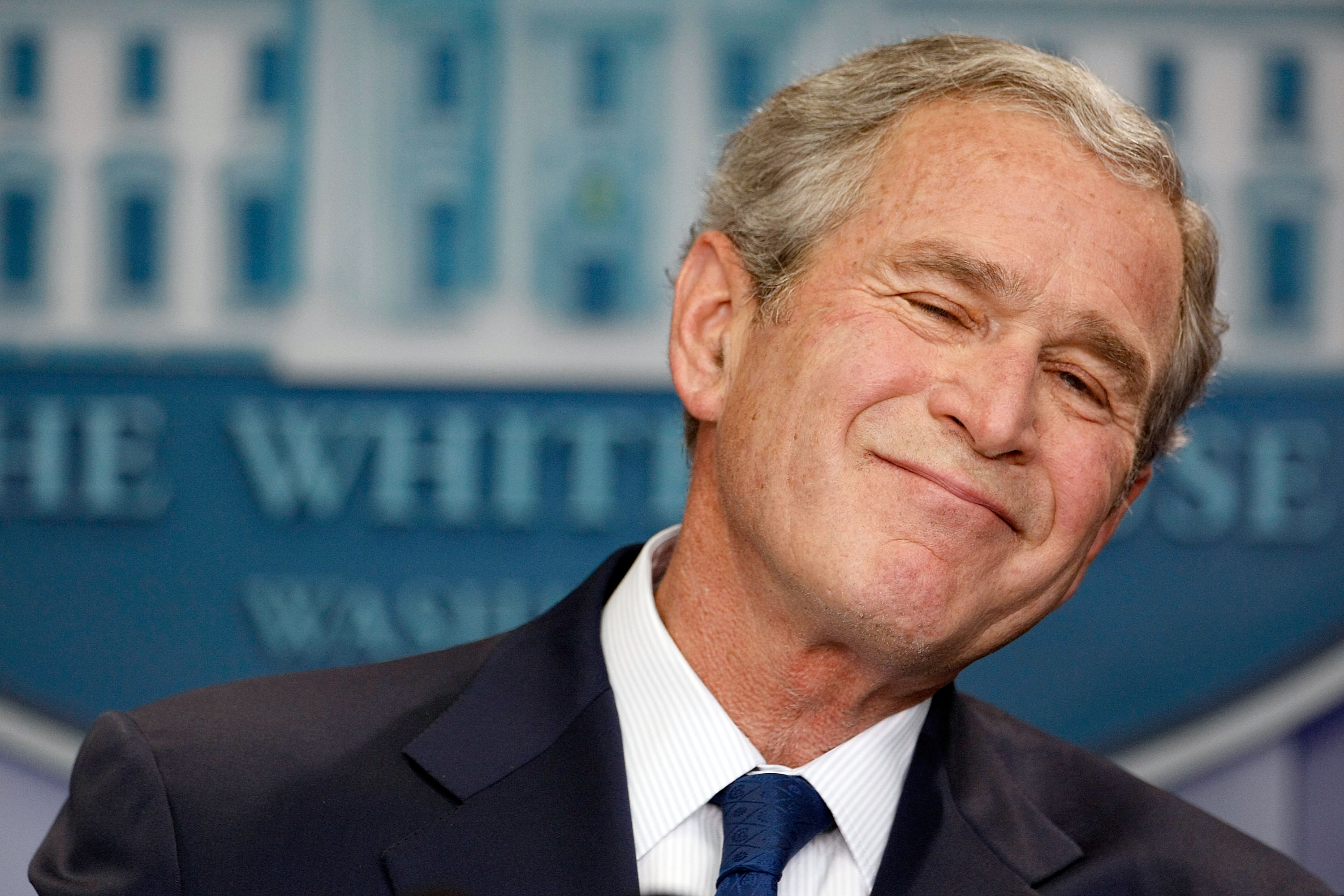
President Bush Holds News Conference

The Bush administration faced Putin’s Russia with the same mixture of sticks and carrots that the Obama administration has – although, quite clearly, Putin saw in Cheney a man with identical instincts and beliefs about the wielding of military power. But the invasion of Iraq makes the US’s current position in defense of Ukraine’s inviolable sovereignty fraught with historical parallels. Only Dick Cheney would fail to hear the irony in John Kerry’s words yesterday:

You just don’t invade another country on phony pretext in order to assert your interests.

Jack Matlock, in a shrewd analysis, notes further:

So far as violating sovereignty is concerned, Russia would point out that the U.S. invaded Panama to arrest Noriega, invaded Grenada to prevent American citizens from being taken hostage (even though they had not been taken hostage), invaded Iraq on spurious grounds that Saddam Hussein possessed weapons of mass destruction, targets people in other countries with drones, etc., etc. In other words, for the U.S. to preach about respect for sovereignty and preservation of territorial integrity to a Russian president can seem a claim to special rights not allowed others.

It gives me absolutely no pleasure to note this. But Iraq is a lot further away from the US than Ukraine is from Russia, and while WMDs did not exist in Iraq, pro-Russian populations sure do exist in Crimea and Eastern Ukraine.

What interests me most about this is whether China will be consistent, and isolate Russia still further.

(Photo from Getty)

Giving Putin An Off-Ramp?

It may make no tangible difference, but no responsible Western leader should seek now to escalate the crisis. Even in the Bush administration, the Cold War nostalgics lost the debate:

A faction around Vice President Cheney would embrace the view of Russia as an enemy and attempt to recruit ex-Soviet states such as Georgia and the Ukraine against them. Yet this faction would never dominate US policy. During the Georgian War of 2008 Rice remained committed to the partnership, blaming the Georgians for provoking the crisis and urging them to accept Russian terms for mediation, even going so far as to imply Cheney’s responsibility for the crisis.

Jacob Heilbrunn observes that Obama “has few tools at his disposal to compel a change in Russian behavior”:

[T]he main constraint on Putin’s freedom of movement in Ukraine will be that it’s dangerous for him to enmesh himself in a prolonged war in Ukraine. If he seeks to occupy the eastern Ukraine, all bets are off–Ukraine is not Georgia. It has 200,000 troops–ten times, Elke Windisch notes, as many as Tbilisi did. And it is calling up a million reservists. Still, Ukraine would be unlikely to be able to withstand a full-scale Russian invasion. Its tanks, for example, consist mostly of fifty-year-old Soviet era T-64s. The real trouble would come in occupying Ukraine. It would likely become not only a geopolitical but also a military nightmare for Putin, on the order of Iraq or Afghanistan.

Rather than threatening Putin, Obama should continue to seek to offer him an exit strategy–just as Putin offered him one out of Syria. By all accounts, this is what Obama is seeking to do. Such a course won’t satisfy the nostalgic cold warriors in Washington, but it would defuse a conflict that should not be allowed to jeopardize the West’s relations with Moscow.

Kaplan suggests a specific way forward:

Perhaps Obama could offer assurances that he won’t offer Ukraine membership in NATO (that’s not a live issue anyway), nor will he push to revive the plan for Ukraine to join the European Union. This latter pledge would be a big deal:

The protests were set off when Yanukovich cancelled plans for a formal association with the EU, after Putin lured him back into Moscow’s bed with a $15 billion aid program. In exchange for these assurances, Putin would call off his shock troops, recognize the Ukrainian parliament’s ouster of Yanukovich (whom Putin never liked anyway), and allow Ukrainian elections to go ahead this May, perhaps under international observation. Obama could present the deal as a victory for democracy (the Ukrainian people will decide!). Putin could swallow the deal, believing that a pro-Russia candidate might win (legitimately or otherwise). In any event, the Ukrainian politicians will have been shown what Putin could do if they get out in front of their skis again.

Well, here’s hoping. But that happy scenario does not seem consonant with the emotions roiling the Kremlin as we speak. Here’s the balancing act Beinart recommends:

The U.S. and its European allies should do everything possible to strengthen the government in Kiev politically, economically, and maybe even—clandestinely—militarily. And they should think creatively about what kinds of economic and diplomatic measures might hit the Russian elite where it hurts, with the hope of at least stopping a Russian conquest of all of eastern Ukraine. That such efforts may undermine Russian cooperation on other issues, like Iran and Syria, is a risk the West will have to take.

But the Obama administration will also have to tell Kiev’s revolutionaries that while it supports a unified, democratic Ukraine, it does not support an anti-Russian Ukraine. Russia will not permit it, and at the end of the day, the United States cannot protect Ukraine from Russia’s wrath. It’s a bit like Finland’s dilemma during the Cold War or Taiwan’s now. Even if Ukraine regains control over its domestic affairs, it will never enjoy complete control over its foreign policy. The U.S. has a moral obligation to support democracy and self-determination. But it also has a moral obligation not to make promises it can’t keep.

Which Side Would Make Ukraine Richer?

Europe:

Lost amid the upheaval in Kiev is the fundamental question: Would the country be better off if its economy became more integrated with the West, or if it remained in Russia’s orbit? Economic history suggests that the protestors, not Yanukovych, are right. Although global income convergence is at best a stuttering phenomenon, being a poor member of a rich region is a better course to wealth than midlevel status in a poor region. …

When it comes to convergence within economic communities, the evidence suggests that two lessons of real estate apply: First, you’d rather be the last house on the right side of the tracks than the first house on the other side. Second, if you want your investment to appreciate, it’s best to be the cheapest house in an expensive community than the luxury condo in a lousy neighborhood.

On Friday, Cassidy outlined the risks of helping Ukraine financially:

If nothing is done, Ukraine will default on its loans, and its currency will collapse: that much is pretty certain. But another bailout wouldn’t resolve all the country’s problems. In the short run, it may well intensify them. As the price of extending new loans, the I.M.F. and other lenders would surely insist that the Ukrainian government take some unpopular steps, such as phasing out costly energy subsidies and balancing its budget. Such austerity policies often makes things worse, at least for a while. Even in places where bailouts eventually work, such as Ireland, they involve a very painful transition.

Update from a Dutch reader:

That map you posted makes me very proud to be European. It feels counter intuitive that Europeans are pretty much refusing to take up arms right now. However, their strategy works. The map proves it. Sure, European peace gloves have always been backed by a nuclear American stick, but the gloves work. They move borders and bring peace. Estonians and Lats now pay with the same currency my parents do. There are no more borders between my parents’ home and the Baltic states. Kids who were born when I was in high school as citizens of the USSR – enemies of the West – are now EU citizens, paying with the euro and can travel as easily throughout the EU as Americans can in America. That’s not something people anyone would have predicted a mere 25 years ago.

Putin’s Posture, Ctd

How Dickey sees it:

In many ways the most dangerous aspect of the rationale Moscow has laid out for its intervention is what might be called “the Putin doctrine,” which is that it has the right to intervene to “protect” Russian populations wherever they may be. It used that rationale in its war against Georgia in 2008. And since there are large Russian populations in the Baltics, which are NATO members, that’s a red flag right there that has to be a red line.

Erik Voeten bets against Putin messing with NATO:

NATO is built around a promise that its member states defend each other from military threats. Ukraine is not a member but the Baltic states and Poland are. Given Russia’s extremely broad assertions that it has a right to defend Russian speakers (and the Baltic states have many that are not always treated so well) the current actions constitute a threat for these states. NATO has both military and institutional resources that can reinforce its commitment to defend the Baltic states and Poland. It is likely to use those. This is, of course, one way in which a smaller conflict could erupt into a bigger one. Yet, despite all the protestations that we wrongly see Putin through Western eyes, I remain confident that a military conflict with NATO is not something he wishes to risk.

Meanwhile, Masha Lipman compares contemporary US-Russia relationship to the US-USSR one:

One major difference between then and now is the absence of ideological antagonism: the postwar Soviet empire proclaimed the advantage of the socialist path over the capitalist one. Today, Russia’s opposition to the West has evolved as a purely nationalist project. Russia’s military response to the events in Ukraine is framed as a protection of “ours”—and “ours” are Russian, no matter where they live. The idea of Ukrainian sovereignty is totally disregarded.

This is Putin’s response to Ukraine’s attempt to build a new nationhood that combines a leaning toward the Western world with the nationalism of Ukraine’s own west; both “wests” are regarded by Putin as utterly hostile to Russian interests. In the words of Dmitry Trenin, an expert on Russian foreign policy, the fear in Moscow is that “the new official Ukrainian narrative would change from the post-Soviet ‘Ukraine is not Russia’ to something like ‘Ukraine in opposition to Russia.’ ”

Earlier Dish on Putin’s posture toward the world here.

“In Another World”?

Russian President Vladimir Putin Attends Military Exercise Near Saint Petersburg

Reading all the grim reports from Ukraine this morning, this quote really stood out. It’s a report of what Angela Merkel reportedly told Barack Obama in a phone-call last night, after speaking with Vladimir Putin:

She was not sure he was in touch with reality, people briefed on the call said. “In another world,” she said.

That is the truly worrying thing. But it is always worth trying to see things from the point of view of our foe, to see if his madness makes some kind of internal sense, and to see if we have any blind-spots that may hinder us from the smartest response. Greg Dejerejian notes:

One need not be a Putin apologist to recognize some salient facts: 1) the Maidan movement included ultra-nationalists and even neo-fascists, 2) the Yanukovych transition deal was crudely scuppered leaving the Russian side caught unawares and looking flat-footed (never appreciated by Vladimir Putin); and 3) this was followed by deeply provocative measures by the new Government in Kiev to move to extinguish Russian minority language rights. More assertiveness was surely on tap, as the mood was manifestly one of triumphalism.

I fell prey to this myself, buoyed by obvious and instinctive support for any country resisting the boot of the Kremlin, and too blithe about the consequences of a revolution that overthrew a democratically elected president. But as we now know only too well, Ukraine is deeply divided between its pro-Western West and its pro-Russian East; any attempt to resolve this underlying tension decisively was bound to risk real rifts within the country and tempt Russia to intervene. Anatol Lieven has a must-read:

President Viktor Yanukovych’s rejection of the EU offer led to an uprising in Kiev and the western and central parts of Ukraine, and to his own flight from Kiev, together with many of his supporters in the Ukrainian parliament. This marks a very serious geopolitical defeat for Russia. It is now obvious that Ukraine as a whole cannot be brought into the Eurasian Union, reducing that union to a shadow of what the Putin administration hoped. And though Russia continues officially to recognize him, President Yanukovych can only be restored to power in Kiev if Moscow is prepared to launch a full-scale invasion of Ukraine and seize its capital by force. The result would be horrendous bloodshed, a complete collapse of Russia’s relations with the West and of Western investment in Russia, a shattering economic crisis, and Russia’s inevitable economic and geopolitical dependency on China.

It seems vital to me that we see what Putin is doing from his point of view. What seems to us like an unprovoked, Sudetenland-style invasion is both mercifully less than that (so far) and also, critically, a function of Putin’s string of recent setbacks. He has already lost a huge amount. And he is now recklessly and thoughtlessly acting out as a result. Dmitri Trenin describes Moscow’s current worldview thus:

In Moscow, there is a growing fatigue with the west, with the EU and the United States. Their role in Ukraine is believed to be particularly obnoxious: imposing on Ukraine a choice between the EU and Russia that it could not afford; supporting the opposition against an elected government; turning a blind eye to right-wing radical descendants of wartime Nazi collaborators; siding with the opposition to pressure the government into submission; finally, condoning an unconstitutional regime change. The Kremlin is yet again convinced of the truth of the famous maxim of Alexander III, that Russia has only two friends in the world, its army and its navy. Both now defend its interests in Crimea.

How to deal with an authoritarian leader, increasingly paranoid about the West, his greater regional aspirations turned to dust, who is now wielding military power in a manner more reminiscent of the Cold War than of anything since? One obvious response is counter-provocation, of the kind that John McCain and the Washington Post editorial board would instinctively prefer. It seems to me that, given how Putin has reacted to Western pressure so far, this would merely invite more recklessness.

The saner approach is to try and mollify some of Russia’s legitimate concerns about Ukraine – the rights of the pro-Russian Ukrainians in the East, for example, some of which were suspended (and now restored) by the new Kiev government, while persuading him of unstated but profoundly adverse consequences if he ratchets up the use of force even further. David Ignatius – unlike the breathless neocons on the WaPo editorial page – makes the case very effectively this morning. What our goal must be now, above everything, is avoiding any pretext for a Russian invasion of Eastern Ukraine.

And the truth is: this is very much in Russia’s actual interests. Its stock market and currency are in free-fall this morning, but a full-scale invasion of Ukraine would mean a mutual bloodbath, effectively destroying Russia’s standing in the world, tearing up its relations with the major powers, including, possibly China, and rendering it a rogue, primitive, paranoid power, whose elites would be cut off from the global trade and financial markets they rely on. There must be some faction in the Kremlin able to see this, even if it only occupies a small part of Putin’s mind.

But it will not be enough. Ukraine has long occupied a powerful place in the Russian imagination. Pride and identity are at stake now, and they make a catastrophe much likelier. And so the West needs both to be firm about military intervention but also cognizant of Russia’s genuine fears and insecurity in the wake of recent events. Djerejian again:

Further aid to Ukraine should likely be made conditional on ensuring minority rights in Eastern and Southern Ukraine are better respected, and critically, that no preemptive military activity by Kiev in those areas take place … By moving to soften the tone and policy in Kiev, better respecting Russia’s historic interests (please let us retire talk of NATO Membership Action Plans and such), and offering honest broker type conflict resolution channels (not bidding up an East-West show-down in Pavlovian fashion as if inevitable) the following goals could possibly be accomplished in the short-term: 1) delaying or ideally preventing formal annexation of Crimea; 2) restraining Putin from invading Eastern Ukraine and 3) most important, helping defuse the specter of a horrible civil war in the heart of Europe’s eastern flank.

These options do not have the emotional satisfaction of McCain’s outrage and Cold War nostalgia. They will not satiate the neoconservative lust for conflict or for simple black-and-white moralism in foreign affairs. They may be politically difficult for the president to sustain. But they might actually be the only way to defuse some of the extremely dangerous dynamics now in play in Euro-Asia. This is all happening, one should recall, on the 100th anniversary of the outbreak of the Great War. I’ll leave the last word to Lieven:

A century ago, two groups of countries whose real common interests vastly outweighed their differences allowed themselves to be drawn into a European war in which more than 10 million of their people died and every country suffered irreparable losses. In the name of those dead, every sane and responsible citizen in the West, Russia, and Ukraine itself should now urge caution and restraint on the part of their respective leaders.

The alternative is unthinkable.

(Photo: Russian President Vladimir Putin watches a military exercises at Kamenka polygon on March 3, 2014 near Saint Petersburg, Russia. By Sasha Mordovets/Getty Images)
Putin’s Posture

Maria Snegovaya unpacks his view of foreign policy:

The recent literature on Putin is [correctly] drawing attention to his pro-Soviet imperialistic views: remember, to Putin the collapse of the USSR the biggest geopolitical catastrophe of 20th century. But what exactly this pro-Soviet worldview means is fairly poorly understood. To get a grasp on one needs to check what Putin’s preferred readings are. Putin’s favorites include a bunch of Russian nationalist philosophers of early 20th century – Berdyaev, Solovyev, Ilyin — whom he often quotes in his public speeches. Moreover, recently the Kremlin has specifically assigned Russia’s regional governors to read the works by these philosophers during 2014 winter holidays. The main message of these authors is Russia’s messianic role in world history, preservation and restoration of Russia’s historical borders and Orthodoxy.

She illustrates her point by quoting from a 1950 essay by Ilyin:

We know that Western nations don’t understand and don’t tolerate Russian identity… They are going to divide the united Russian ‘broom’ into twigs to break these twigs one by one and rekindle with them the fading light of their civilization. They need to partition Russia to equate it with the West, and thus destroy it: a plan of hatred and lust for power

KermlinRussia, the highly influential satirical duo, explains Putin’s calculus:

The West has already begun to threaten Russia with political and economic isolation, but this stems from a misunderstanding of the nature of Putin’s power.

For example, Western analysts say that “Russia will not invade Crimea because Russia’s economy is in bad shape and this would only weaken it further.” They are mistaken. Putin no longer needs economic growth. He has grasped the contradiction between economic growth and the consolidation of his own power, and he has made his choice. He understands very well that in 2011-2012 it was the most economically active and wealthy segments of the population that protested against him. He understands that millions of entrepreneurs and workers of the knowledge economy had already emigrated to the U.S. and European Union during his reign. And he understands that a solution which simultaneously halts economic growth and strengthens the patriotism of the poorest segments of the population is an opportunity to kill two birds with one stone.

On that note, Andrew Ryvkin looks at how the Crimea invasion is playing in Russia:

A growing number of right-leaning Russians, known for their resentment of Putin due to his lax stance on Central Asian immigrants and his support of the Muslim republics of Northern Caucasus, are praising the invasion. To many of them, this regime’s shortcomings can now be overlooked, overshadowed as they are by the image of a “Great Russia” finally reunited with its prodigal sibling, Ukraine. No one really cares what happens in Russia, as long as this country still has the balls to send a military force outside of its borders to protect ethnic Russians. The fact that Russia often can’t provide security for its citizens—mostly ethnic Russians—within its own borders, often losing in its never-ending war on homegrown terror, fades away at the prospect of a territorial gain and a victorious war.

With Ukraine, the Kremlin is creating its own axis of evil: America, the “fascists” who seized power in Kiev, and their liberal Russian supporters.

Motyl’s view:

If one considers Russia’s interests, none of this — the armed intervention in Crimea, the claimed right to intervene anywhere in Ukraine — makes sense. Putin’s arguments simply do not hold water. As objective observers will confirm, there is absolutely no threat to Russian citizens anywhere in Ukraine. There may have been a diminution of overall law and order following the collapse of Viktor Yanukovich’s regime, but that affects all Ukrainian residents equally. Nor is the Kremlin’s claim that putative “fascists” from Western Ukraine are about to descend on Crimea and the southeast even remotely true. By the same token, intervention, war, international isolation, and the like will not enhance Russians’ living standards or their sense of well-being. There may be a temporary spurt of excitement at seeing the Russian tricolor hoisted in Donetsk, but that enthusiasm will quickly fade when Russians realize that these regions will impose an enormous economic liability. And, finally, there is no way that a truncated Ukraine’s transformation into a hostile anti-Russian state and a permanent occupation by Russian troops of potentially rebellious provinces — after all, there are also large numbers of pro-Western Ukrainians in the southeast — could possibly serve Russia’s interests.

There is only one reason Putin has embarked on what Russian democratic opposition leader Boris Nemtsov calls “folly”: flexing his military muscle enhances Putin’s authority as a strongman who will reestablish Russia’s grandeur and brook no people-power in former Soviet states.

Ukraine On The Brink, Ctd

Go here to catch up on our coverage over the weekend. The latest tweets punctuating the crisis:

https://twitter.com/ilyamuz/status/440477813431607296

The Lede is live-blogging.