How Should The West Respond?

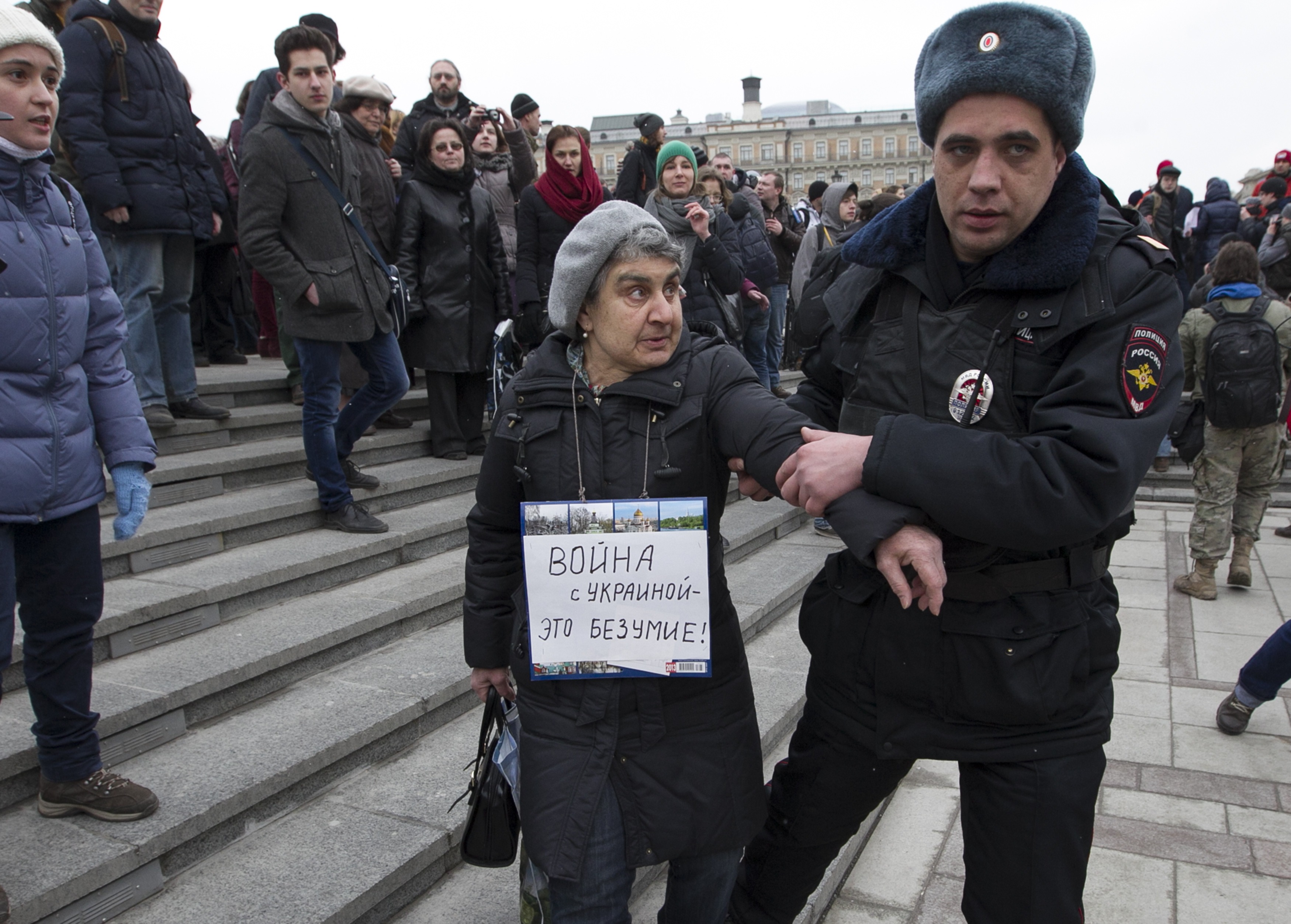
Russian Anti-War Protesters Detained In Moscow

I’m still absorbing all the information I can, and hope to post something at length tomorrow. But this much seems clear to me: Putin has panicked. To initiate a full-scale war with Ukraine, after effectively losing it because of the over-reach and corruption of Yanukovych, opens up scenario after scenario that  no prudent Russian statesman would want to even consider, let alone embrace. That doesn’t mean he won’t continue to over-reach or that we should be irresolute in confronting this aggression; just that we should be clear that the consequences of further escalation will be deeply damaging for his regime – and certainly far graver for him than for the West.

Obama and Putin spoke on the phone last night. Here’s what Leon Aron wishes Obama had said:

Ideally, the conversation would have been one in which the American president was speaking not only for the U.S., but also for NATO and the EU. The president is likely to have pointed out that the risks would involve Russia’s membership in the G-8, the safety of financial and other assets of the Russian elite which are located outside of Russia, as well as the ability of the members of this elite and their families to visit, live or study in the U.S. and the EU. In addition, Moscow’s behavior could trigger new export controls, which given its dependence on Western technology, particularly in the oil and gas sector as well as in the food industry, could have a very negative impact on the Russian economy.​

Alongside these measures, the U.S. and its allies might also provide – publicly and in private – a few face-saving devices for Russia, such as guarantees that the Russian-speaking Ukrainians will be free from harassment or discrimination of any kind; an introduction of U.N.  peacemaking forces in Crimea to protect the political rights of all Crimeans, and the reaffirmation of the pre-existing “special status” of Crimea within Ukraine, as well as the continuation of the pre-existing Russian sovereignty of the leased naval base in Sevastopol.

It seems to me that the Western-based financial assets of the Russian oligarchy should be the first targets for potential retaliation. Timothy Snyder explains why:

Russian propaganda about depraved Europe conceals an intimate relationship. Tourism in the European Union is a safety valve for a large Russian middle class that takes its cues in fashion and pretty much everything else from European culture. Much of the Russian elite has sent its children to private schools in the European Union or Switzerland. Beyond that, since no Russian of any serious means trusts the Russian financial system, wealthy Russians park their wealth in European banks. In other words, the Russian social order depends upon the Europe that Russian propaganda mocks. And beneath hypocrisy, as usual, lies vulnerability.

Soft power can hurt. General restrictions on tourist visas, a few thousand travel bans, and a few dozen frozen accounts might make a real difference. If millions of urban Russians understood that invading Ukraine meant no summer vacation, they might have second thoughts.

Ben Judah disagrees, noting that Europeans have become more and more dependent on Russia’s money:

Moscow is not nervous. Russia’s elites have exposed themselves in a gigantic manner – everything they hold dear is now locked up in European properties and bank accounts. Theoretically, this makes them vulnerable. … But, time and time again, [Russia’s elites] have watched European governments balk at passing anything remotely similar to the U.S. Magnitsky Act, which bars a handful of criminal-officials from entering the United States.

All this has made Putin [very] confident that European elites are more concerned about making money than standing up to him. The evidence is there. After Russia’s strike force reached the outskirts of Tbilisi, the Georgian capital, in 2008, there were statements and bluster, but not a squeak about Russia’s billions. After Russia’s opposition were thrown into show trials, there were concerned letters from the European Union, but again silence about Russia’s billions.

But messing with Ukraine is different. Europe will feel – does feel – far more threatened by an attack on Ukraine than on Georgia. And Putin has frittered away any benefit of the doubt he once might have had. We have many cards to play. Putin has one: military force. But if he uses it, he will be in a full-scale war within his own region of influence. Whatever else that is, it is not a demonstration of strength. It’s a sign of profound weakness.

(Photo: An elderly woman wearing a sign that reads “War against Ukraine is madness” is detained by riot police during an unsanctioned anti-war rally close to the Kremlin at Manezhnaya Square on March 2, 2014. Dozens of protesters were detained by police on Sunday during a rally against the military intervention in the Ukraine, after the parliament in Moscow gave President Vladimir Putin approval to use Russian military forces in Ukraine. By Sasha Mordovets/Getty Images.)

Ukraine On The Brink

https://twitter.com/shaunwalker7/statuses/440152242570924032

https://twitter.com/michaeldweiss/status/440200687784189952

https://twitter.com/PzFeed/statuses/440181042180534272

If Putin’s forces continue to occupy Crimea, Mary Mycio warns that the mini-state won’t be so easy for Russia to govern:

Most of the Crimea is basically a desert, with less annual rainfall than Los Angeles. It is impossible to sustain its 2 million people—including agriculture and the substantial tourist industry—without Ukrainian water. Current supplies aren’t even enough. In Sevastopol, home of the Black Sea Fleet, households get water only on certain days. In fact, on Feb. 19, when snipers were shooting protesters on the streets of Kiev, Sevastopol applied for $34 million in Western aid (note the irony) to improve its water and sewer systems.

The Crimea’s dependence on Ukraine for nearly all of it electricity makes it equally vulnerable to nonviolent retaliation. One suggestion making the rounds of the Ukrainian Internet is that the mainland, with warning, shut off the power for 15 minutes. It may not normalize the situation, but it could give Moscow pause. Of course, Russia could retaliate by cutting off Ukrainian gas supplies, but that would mean cutting off much of Europe as well. Besides, Ukrainians proved this winter that they aren’t afraid of the cold, and spring is coming.

And Russian occupiers would have to face down the dogged Tatars. Oleg Kashin describes how ordinary Russians view the Ukraine:

Russia and Ukraine split up 23 years ago. A whole generation has grown up in each country since then. … The Russian public views the Ukrainian state with a sense of irony and even contempt. This attitude is often unfair, but it [sees] Ukraine as a culturally heterogeneous patchwork. Travelling from a place like Lviv or Lutsk to a place like Kharkiv or Odessa, it is often hard to believe that these cities are part of the same country: Post-Soviet Ukraine is like Austria-Hungary—an empire made up of incongruous parts. In the mind of the Russian public, the justification for a possible Russian invasion of Ukraine settled into place many years ago: Russia has been unable to shake off the view that eastern Ukraine is Russian territory.

Matt Ford adds that other former Soviet states are now watching nervously:

Fifteen independent countries, including Russia, emerged from the Soviet Union’s disintegration. Six of them—Ukraine, Belarus, Moldova, and the three Baltic states of Estonia, Latvia, and Lithuania—are in Europe, and all of them have a complicated relationship with modern Russia. Seven other countries once belonged to the Warsaw Pact, the Soviet Union’s military alliance in Eastern Europe. With the Cold War’s end, none of them had faced the threat of military intervention by the communist superpower’s successor state—until now.

Eugene Rumer and Andrew S. Weiss outline the potential impact for neighboring countries:

Any invasion—which is what it would be—of a vast country of 46 million in the heart of Europe, sharing borders with NATO allies Poland, Hungary, Slovakia and Romania, would pose a major security challenge for the United States and other key European powers.

Even without further Russian action, allies such as the Baltic countries will be seeking U.S. reassurance. Lithuania has already asked for Article IV consultations under the NATO Treaty in response to a clear threat to its security. These countries likely will also ask for hard reassurances—such as deployments of U.S. and other allied troops and equipment on their territory—as Turkey did in 2012 when Syria shot down a Turkish jet. They will also need help to shore up their eastern borders and prepare for possible flows of refugees from Ukraine. The Baltic states will probably ask for similar reassurances.

But Zack Beauchamp isn’t worried about Cold War II:

Russia’s turn to blunt military force in Ukraine is emblematic of the basic flaws behind its push to regain its global and regional standing. The reality is that Russia is a middling power with nuclear weapons; it can frustrate America in Syria, but it can’t make progress towards bending the world to its will using the sort of strategies it has tried to date.

Military power alone can’t do the trick. In a world of free trade and highly globalized markets, territorial conquest simply isn’t a good way to make your country stronger. In fact, it’s harmful. “War has lost its evident appeal,” political scientist John Mueller correctly notes, “because substantial agreement has risen around the twin propositions that that prosperity and economic growth should be central national goals and that war is a particularly counterproductive device for achieving these goals.” War won’t bring Ukraine into Russia’s fold, let alone a broader swath of Eastern Europe and Central Asia.

Drum believes Putin is acting out of desperation:

The reason Putin has sent troops into Crimea is because everything he’s done over the past year has blown up in his face. This was a last-ditch effort to avoid a fool’s mate, not some deeply-calculated bit of geopolitical stategery.

Make no mistake. All the sanctions and NATO meetings and condemnations from foreign offices in the West won’t have much material effect on Putin’s immediate conduct. But that doesn’t mean he doesn’t care about this stuff: he does, and he’s been bullying and blustering for a long time in a frantic effort to avoid it. Now, however, having failed utterly thanks to ham-handed tactics on his part, he’s finally decided on one last desperation move. Not because the West is helpless to retaliate, but because he’s simply decided he’s willing to bear the cost. It’s a sign of weakness, not a show of strength.

Mark Adomanis predicts that the economic impact on Russia will be devastating:

The Moscow stock market is going to get absolutely clobbered when it opens tomorrow, and many foreign investors are going to bolt for the exits as quickly as they can. Depending on the severity of the situation in Ukraine, the Russian financial system could come screeching to a halt. It’s a given that many of these decisions impacting Russia’s economy will be made in haste and without a sober calculation of costs and befits, but that’s the way the world works: investors often overreact to political events and they will certainly overreact to a military invasion of a neighboring country.

David Satter claims that the invasion has more to do with Russia’s internal worries than external:

Russia and Ukraine under Yanukovych shared a single form of government – rule by a criminal oligarchy. This is why the anti-criminal revolution that overthrew Ukrainian president Viktor Yanukovych is a precedent that is perfectly applicable to Putin’s Russia. It is also the reason why, from the Russian regime’s point of view, the Ukrainian revolution must be stopped at all costs. …

In 2011 and 2012, Moscow witnessed the biggest protests since the fall of the Soviet Union over the falsification of elections and Putin’s decision to run for a third term as president. The protests eventually fizzled but, given the worsening economic situation, they could be reignited.

Remnick highlights the expanding crackdown within Russia:

At the same time that he is planning his vengeful military operation against the new Ukrainian leadership, he has been cracking down harder on his opponents in Moscow. Alexey Navalny, who is best known for his well-publicized investigations into state corruption and for his role in anti-Kremlin demonstrations two years ago, has now been placed under house arrest. Navalny, who won twenty-seven per cent of the vote in a recent Moscow mayoral ballot, is barred from using the Internet, his principal means of communication and dissidence. The period of Olympic mercy has come to an end.

He sees a grim future for Ukraine:

These next days and weeks in Ukraine are bound to be frightening, and worse. There is not only the threat of widening Russian military force. The new Ukrainian leadership is worse than weak. It is unstable. It faces the burden of legitimacy. Yanukovych was spectacularly corrupt, and he opened fire on his own people. He was also elected to his office and brought low by an uprising, not the ballot; he made that point on Friday, in a press conference in Rostov on Don, in Russia, saying that he had never really been deposed. Ukraine has already experienced revolutionary disappointment. The Orange Revolution, in 2004, failed to establish stable democratic institutions and economic justice. This is one reason that Yulia Tymoshenko, the former Prime Minister, newly released from prison, is not likely the future of Ukraine. How can Ukraine possibly move quickly to national elections, as it must to resolve the issue of legitimacy, while another country has troops on its territory?

Who Are The Tatars?

https://twitter.com/jetpack/status/439186681971740672

Oxana Shevel puts the pro-Ukrainian minority in context:

The new Ukrainian government leaders have called for calm, the far right Right Sector said it will not be sending its men to Crimea, and in a conciliatory gesture to Russian-speakers, acting president Turchynov today vetoed the law the Ukrainian parliament adopted several days earlier repealing the 2012 law elevating the status of the Russian language. With the Security Council in session to discuss events in Crimea and Western leaders urging restraint and warning Russia that violations of Ukrainian sovereignty and territorial integrity are unacceptable, there is hope that a diplomatic solution to the crisis could be found.

But even if diplomacy fails and the Russian military seizes Crimean territory with the intention of controlling it permanently, it will be much harder for Russia to establish control of Crimea than it was in South Ossetia, Abkhazia and Transnistria. The main reason for this is the Crimean Tatars.

The Tatars — a Muslim group that was deported en masse from Crimea by Stalin in 1944 and that for decades has waged a peaceful struggle for the right to return — have been coming back in droves since 1989. According to the latest Ukrainian census, from 2001, 243,433 Crimean Tatars account for 12.1 percent of the Crimean population of 2,033,700. They represent a highly mobilized and unified constituency that has consistently been pro-Ukrainian and opposed to pro-Russian separatism on the peninsula. Going back to the 1991 independence referendum, the narrow vote in favor of Ukrainian state independence in Crimea may have been thanks to the vote of the Crimean Tatars.  Since then, the Crimean Tatars and their representative organ, the Mejlis, have cooperated with the pro-Ukrainian political parties.  …

There has been no comparable local mobilized group opposed to Russian takeover in any other of the breakaway regions.

And they would likely fight to the finish:

Analyst Semivolos says the Crimean Tatars, as a nation, have a “post-genocidal mentality.” “Crimean Tatars in many ways are still living through the experience of genocide to the present day. For them, in many ways, it isn’t over, the process of returning, in many ways it is continuing,” he explains. “That is why there is this perception of threats, of existential threats, threats to their lives, their physical existence. And they view all sorts of actions, even ones that Russians themselves consider defensive, but for Crimean Tatars, they are attacks.”

Catch up on all of the Dish’s Ukraine coverage here.

Invasion Is Imminent, Ctd

Earlier tweet reax here. Max Seddon summarizes today’s developments:

Putin asked Russia’s upper house of parliament for permission “to use the Armed Forces of the Russian Federation on the territory of Ukraine until the normalization of the socio-political situation in that country,” the Kremlin said in a statement. The body is a rubberstamp institution that fulfills Putin’s every wish and voted unanimously to approve his request less than two hours later.

In an extraordinary session of the Federation Council reminiscent of a Soviet party congress, senators accused protesters in Kiev of having been trained in Lithuania and Poland to overthrow President Viktor Yanukovych and moved to ask Putin to recall Russia’s ambassador to the United States as a rebuke to U.S. President Barack Obama[.] … Ukraine has accused Russia of an “invasion” of Crimea, where Russia has a key naval base, but Putin’s request would give him the right to send troops anywhere in the country.

It’s not yet clear if or when a formal invasion might begin. But the US seems to have been caught flat-footed:

“Nobody thought Putin was going to invade last night,” one Senate aide who works closely on the Ukraine crisis. “He has the G8 summit in Sochi coming up, no one really saw this kind of thing coming.” This source also stressed that events are still moving quickly on the ground. “There is still a question about whether this is Russian troops coming across the border or Russian troops moving around the installations in Crimea.” …

Among the options being considered [by the Obama administration], according to U.S. officials, is boycotting the G8 Summit scheduled for Sochi in June and encouraging other countries to do the same. If Russian troops stay in Crimea, it could scare off trade and further investment in Russia and also further weaken the ruble. It’s debatable whether that would influence Russian thinking.

Michael Weiss is critical of the administration:

It’s obvious that Putin calculated correctly yet again. The United States was gulled into thinking that Russia would forbear this time because the siloviki gave assurances to a U.S. diplomatic corps eager to believe anything that it would do. Washington’s own intelligence community, fresh from proclaiming a year ago that Bashar al-Assad had “weeks left” in power, assessed yesterday that “we don’t have any reason to think” that the surprise drill of 150,000 soldiers announced overnight by Russian Defense Minister Sergei Shoigu would amount to “more than military exercises.” And given that the United States has yet to definitively label what transpired eight months ago in Egypt a “coup,” the Kremlin must have also reckoned that a rapid takeover of Crimea would be all over but for the shouting as Washington sputtered to define exactly what had just transpired, much less attempted a coherent response to yet another international crisis.

Ioffe sizes up the Russians:

We didn’t think Putin would do this. Why, exactly? This has often puzzled me about Western analysis of Russia. It is often predicated on wholly Western logic: surely, Russia won’t invade [Georgia, Ukraine, TK] because war is costly and the Russian economy isn’t doing well and surely doesn’t want another hit to an already weak ruble; because Russia doesn’t need to conquer Crimea if Crimea is going to secede on its own; Russia will not want to risk the geopolitical isolation, and “what’s really in it for Russia?“—stop. Russia, or, more accurately, Putin, sees the world according to his own logic, and the logic goes like this: it is better to be feared than loved, it is better to be overly strong than to risk appearing weak, and Russia was, is, and will be an empire with an eternal appetite for expansion. And it will gather whatever spurious reasons it needs to insulate itself territorially from what it still perceives to be a large and growing NATO threat. Trying to harness Russia with our own logic just makes us miss Putin’s next steps.

Larison’s take on the crisis:

Obama has threatened Russia that there would be unspecified “costs” for what it is doing, but whatever real costs Russia pays will not be imposed by Western governments or the U.N. Moscow is not only wrecking its reputation with most Ukrainians, but it is also potentially risking a ruinous war that could make it a pariah in much of the world for little real gain.

Western mediation is probably of little use here, but if there is a government that might be able to get through to Moscow at the moment it might be Germany. Because Germany has taken Russian interests into account more often in the past than other major Western governments, it might be able to defuse the situation before it results in violence and further escalation. It should go without saying that the U.S. and NATO shouldn’t make any threats to take their own military action or make promises to Ukraine that everyone already knows they aren’t going to keep. They would be foolish, they wouldn’t be meant or taken seriously, and they would only make the crisis harder to resolve. …

Annexing Crimea outright would be a clumsy and provocative action that would leave the new government in Kiev with almost no choice but to fight, so it seems more likely that there would be an attempt to use continued control over Crimea as leverage in future dealings with Kiev. Does Russia “want” Crimea? Maybe not officially as a part of Russia, but it does seem to want to be able to use control of it to its advantage. Whether this takes the form of phony independence or just autonomy remains to be seen.

Millman wonders if the Ukraine would be better off giving up Crimea:

I can make a reasonable case that Ukrainian nationalists should welcome Russian intervention in Crimea. The status-quo ante meant a large Russian bloc, and a large Russian naval base, within Ukraine. The former makes it harder for Ukrainian nationalists to dominate the country electorally; the latter makes it harder to maintain a policy of distancing from Russia. Lose Crimea, and both problems are solved.

Of course, nationalists can’t simply allow sovereign territory to be seized by enemy forces. But what if Crimea achieves de-facto independence, but is not annexed by Russia and independence is not recognized by any other country? Kiev could demand an end to the violation of its sovereignty. And Russia could refuse to accede to that demand. And this could become the new status quo. Wouldn’t that, in the short-term, anyway, be optimal from the perspective of a Ukrainian nationalist?

Josh Marshall wonders if control of Crimea is all the Russians are considering:

There is of course the possibility that Putin may have in mind the occupation of most or all of Ukraine. But this is difficult to envision. Not only would the international response be ferocious. More importantly, recent events have shown that sustaining and normalizing such an occupation in the vast portions of the country where ethnic Ukrainians predominate would be difficult and debilitating.

The real levers Obama or more specifically the US and Europe have are the ability to make the price of a Russian land grab some version of international pariah status, through a mix of economic and diplomatic exclusion. Europe’s dependence on Russian natural gas and oil significantly complicates that option. But the combined economic might of the US and the EU is vast in comparison to Russia’s.

Taking a step back, Masha feels that “the Crimean invasion is a landmark in Russian domestic politics”:

It signals a loss of innocence: no longer will Russians be able to think that Putin merely feels nostalgic for the USSR. It also signals ever greater polarisation of Russian society: in addition to all the other lines along which Russians are divided and across which civilised dialogue is impossible, there is now the chasm between supporters and opponents of the planned annexation. It also means the political crackdown in Russia will intensify further.

These clear and tragic consequences obscure the challenge the new Crimean war poses to Russia’s post-imperial consciousness. “I can be reasonable about everything, but I cannot give up the Crimea,” was a line from the late Galina Starovoitova, who as Boris Yeltsin’s adviser on nationalities policy, oversaw Russia’s first attempts at releasing its colonies. She meant that, like just about every Russian, she felt the Black Sea resort area was part of her birthright, whatever the maps may say.

Quote For The Day

“The jealous and intolerant eye of the Kremlin can distinguish, in the end, only vassals and enemies, and the neighbors of Russia, if they do not wish to be one, must reconcile themselves to being the other,” – George F. Kennan.

Ongoing coverage of the Ukraine crisis here and to come …

Invasion Is Imminent

https://twitter.com/ARothNYT/status/439783262987485184

https://twitter.com/shaunwalker7/status/439768671058419712

The Guardian is live-blogging. More Dish updates soon.

Face Of The Day

Concerns Grow In Ukraine Over Pro Russian Demonstrations In The Crimea Region

Pro-Russian Cossacks share a laugh next to a war monument at a gathering of pro-Russian supporters outside the Crimean parliament building in Simferopol, Ukraine on February 28, 2014. Crimea has a majority Russian population and armed, pro-Russian groups have occupied government buildings in Simferopol. According to media reports, Russian soldiers have occupied the airport at nearby Sevastapol while soldiers whose identity could not be initially confirmed have stationed themselves at Simferopol International Airport in moves that are raising tensions between Russia and the new Kiev government. By Sean Gallup/Getty Images.

Chaotic in Crimea, Ctd

https://twitter.com/KevinRothrock/statuses/439474997594451968

And attack helicopters:

The Interpreter continues to see Russia’s actions as a prelude to war:

For days we’ve been reporting rumors that the Russian government was expediting passports for ethnic Russians wishing to flee Crimea. There was a draft law debated to this effect in the Russian State Duma. Now, this announcement on the Russian Foreign Ministry’s Facebook page:

Consulate General of the Russian Federation in Simferopol urgently requested to take all necessary steps to start issuing Russian passports to members of the “Berkut” fighting force.

In other words, Russia is now urging the nationalization of Yanukovych’s riot police. Why is this important? Before Russia invaded Georgia in 2008 they issued passports to ethnic Russians.

Some background on that invasion:

[In 2008], Moscow was accused of stirring up tensions in the separatist regions of Abkhazia and South Ossetia and goading Mikheil Saakashvili, Georgia’s pro-western president, into ordering his armed forces to retake control of South Ossetia. Russia responded by sending in troops and warplanes and crushing the Georgian military in the five-day conflict.

But Jonathan Marcus doesn’t think comparisons to Georgia are appropriate:

Georgia was a small country that had deeply irritated Moscow and one that could do little to respond against Russia’s overwhelming military might. … Given the size of Ukraine and the divisions within its population, it would simply saddle Russia with involvement in what might rapidly become a bitter civil war. Russian pressure at the moment serves a different goal. Ukraine is heading towards bankruptcy. It needs outside funding. Moscow knows that Western financial institutions must play some kind of role. Its concern is to underline in as clear terms as possible that any future Ukrainian government should tilt as much towards Moscow as it does to the EU. Russia’s bottom line is that Kiev should resist any temptation to draw towards Nato.

Joshua Tucker sides with Marcus:

Ukraine is a much bigger country, with a much bigger population, and a much bigger military. Georgia has 37,000 active military personnel and 140,000 active reserve personnel.  Ukraine has 160,000 active, and 1,000,000 reserve.  A war with Ukraine would look very different from a war with Georgia. …

What’s really in it for Russia?

Say everything goes as best as it possibly could for Russia: Crimea secedes, Ukraine goes along with it without a fight, and Crimea eventually joins Russia.  Russia gets some nice new beaches, but do they really want a Ukraine as a neighbor which now (a) regards Russia as the biggest external threat it has, and (b) has just lost lots of Russian-speaking voters?  Wouldn’t that seem to guarantee a hostile Ukraine for years and years to come?  And would another region of Russia with a potentially restive ethnic minority, [the Turkey-backed Crimean Tatars,] be worth that price?

Leon Mangasarian adds that a full military conflict remains unlikely:

[Eastern European analyst Anna Maria] Dyner said economic concerns are an even bigger reason discouraging Russia from overt intervention in Ukraine. The Kremlin doesn’t have “a huge amount of money to spend on such a big operation,” she said. More fundamentally, she added, Russia’s slowing economy is a factor.

“Ukraine is an important gas transit country to Europe and a conflict would probably damage pipelines, further harming ties with the West,” Dyner said. “This would damage the Russian economy, which is the last thing Putin wants right now, just as they’re thinking about reforms amid weak growth.”

But Luke Harding believes that “Moscow’s military moves so far resemble a classically executed coup” in Crimea:

[S]eize control of strategic infrastructure, seal the borders between Crimea and the rest of Ukraine, invoke the need to protect the peninsula’s ethnic Russian majority. The Kremlin’s favourite news website, Lifenews.ru, was on hand to record the historic moment. Its journalists were allowed to video Russian forces patrolling ostentatiously outside Simferopol airport. …

From Putin’s perspective, a coup would be payback for what he regards as the western-backed takeover of Kiev by opposition forces – or fascists, as the Kremlin media calls them. The Kremlin argument runs something like this: if armed gangs can seize power in the Ukrainian capital, storming government buildings, why can’t pro-Russian forces do the same thing in Crimea?

Meanwhile, Josh Rogin reports that the troops in Crimea may not be official Russian forces, but rather soldiers working for the equivalent of Russia’s Blackwater, probably under the direction of Russia’s military:

[Analyst Dimitri] Simes cautioned that information about the fast moving events in Crimea is hard to verify, but the message coming out of Moscow is that these security contractors were deployed by the Russian military for two purposes; first of all they want to secure the airport to ensure that thousands of pro-western protesters don’t descend into Crimea to push back against the Crimean population’s effort to establish a new government and seek some autonomy from the new government in Kiev, which most Crimeans see as illegitimate.

Second, the forces could be paving the way for Yanukovich to travel to Crimea, where he will maintain that he is still the president of all Ukraine. In fact, Yanukovich was involved in the decision to deploy the security contractors to the airport, he said. …

[T]he private security forces provide a loophole for Vladimir Putin; he can claim there is no Russian “military” intervention while using Russian-controlled forces to exert influence inside Ukraine. The plan would be to give the new Crimean government a space to hold a referendum and then elections, thereby establishing a province with some autonomy from Kiev.

Keating doesn’t think anybody would be able to stop Russia from having its way with Crimea:

The fragile new Ukrainian government, which has other problems, not the least of which is keeping other parts of the country from splitting off, doesn’t really seem like it’s in a position to retake Crimea by force, risking a full armed intervention by the Black Sea Fleet. These moves likely violate the 1994 agreement between the U.S. and Russia under which Moscow agreed to respect Ukraine’s sovereignty within its current borders in return for Kiev giving up its Soviet-era nuclear weapons. Beyond verbal warnings, the United States certainly seems extremely unlikely to intervene.

He nonetheless warns against assuming this would a big win for Putin:

[G]aining de facto control over yet another dysfunctional pseudostate, essentially ensuring long-term tension with Kiev in the process, certainly doesn’t seem as good an outcome as what Russia thought it was getting a month ago: a government of the whole of Ukraine tied economically and politically to Russia rather than Europe. This isn’t really a great outcome for anyone.

Chaotic In Crimea, Ctd

More ominous developments after yesterday’s occupation of parliament by paramilitary forces:

Unidentified armed men have seized two airports in Crimea overnight, causing Ukraine’s new interior minister to talk of “a military invasion and occupation” by Russia. … They wore military fatigues with no insignia and refused to talk, though one told news agencies they were part of a self-defence unit who wanted to ensure that no “fascists” arrived in the region from Kiev.

At Sevastopol airport, a military airport that handles few commercial flights, a man who said he was a captain in the tactical aviation brigade but declined to give his name, told the Guardian there were about 300 people of unknown identity inside the airport. “We don’t consider it any invasion of our territory,” he said without elaborating. He said the men looked like military, were wearing two different types of uniform and were armed with sniper rifles and AK-47s. “We don’t know who they are, nor where they’ve come from.”

The interim Ukrainian president has dismissed the head of the armed forces, while Russia’s parliament “began considering a law that would allow Moscow to add new territories to Russia in a simplified manner”. There was also this incident at the Russian border:

At least 20 men wearing the uniform of Russia’s Black Sea fleet and carrying automatic rifles surrounded a Ukrainian border guard post on Friday, in a tense standoff near the port city of Sevastopol in Ukraine’s Crimea region. A Reuters reporter in the Balaklava district saw Ukrainian border police in helmets and riot gear shut inside the border post, with a metal gate pulled shut and metal riot shields placed behind the windows as protection. A servicemen who identified himself as an officer of the Black Sea Fleet told Reuters: “We are here … so as not to have a repeat of the Maidan.”

Paul Sonne reports that “Crimean special forces and local militiamen with Kalashnikovs and masks have hoisted Russian flags and set up checkpoints on the only two highways that connect the Black Sea peninsula to mainland Ukraine”:

In Chongar, the checkpoint on the highway that connects Crimea to Ukraine’s largely Russian-speaking east, Russian flags flapped in the wind Friday as about a dozen armed Crimea-based riot police, known as berkut, checked cars and trucks. An encampment of roughly 30 mostly Cossack volunteer militiamen set up tents beside the policemen to serve as backup in case pro-Ukrainian forces attempt to enter the territory.

In an overview of Crimean history, Adam Taylor warns against assuming the region’s Russian nationalists will be unified:

While the Russian nationalists in Crimea have been given a lot of attention in the past few days, some say they aren’t a coherent force. Ellie Knott, a doctoral candidate at London School of Economics who conducts research in Crimea, has argued convincingly that the Russian nationalist and Crimean separatists are in practice hindered by their own internal divisions, and that many ethnic Russians in Crimea have a more complicated sense of national identity than might first appear. And while Russia has shown itself willing to get involved in the affairs of post-Soviet states, most recently with Georgia over the breakaway state South Ossetia, few are predicting it will openly get involved in a dispute with Ukraine anytime soon.

Calming nerves, Eli Lake reports that so far the US intelligence community doesn’t think Putin will invade:

The assessment is based in part on the fact that not enough medical units have been ordered to accompany the Russian troops to the Ukrainian border to suggest preparation for war, according to one Congressional staffer who has seen intelligence on Russia. This source also said no signal intercepts have detected plans for an invasion. …

Fiona Hill, the director of the Center on the United States and Europe at the Brookings Institution, said she did not expect Russia to launch a land invasion into Ukraine. She did however say that the Russian Navy’s presence in the Black Sea port of Sevastopol in the Crimea would be a potential flash point. “There is one place where they could indeed do something militarily, Crimea,” Hill said. “If there was any kind of threat to the bases, they could mobilize their forces.”

The Guardian is live-blogging. Meanwhile, at a “surreal” press conference held in the Russian city of Rostov-on-Don, the deposed Ukrainian president spoke defiantly:

[Yanukovych] said Crimea should remain part of Ukraine, and called on Russia to act decisively against the new government in Kiev. “I think Russia should, and is obliged, to act, and knowing the character of Vladimir Vladimirovich Putin, I am surprised he is so restrained and keeping silent,” Yanukovych said. …

He said he believed there should be no military activity in Crimea, but insisted Russia should not “sit in the corner and not act”. Yanukovych, who had not been seen in public for a week since he fled Kiev, denied that he was on the run and that he had been overthrown, and claimed he had been “cynically tricked” by the international community, who had allowed “fascists” to take over. The ousted president said he would not take part in elections scheduled by Ukraine’s parliament because they were illegitimate and he is still the president.