Quote For The Day II

Supporters of Russia stage demonstrations in Crimea

“History is littered with wars which everyone knew would never happen,” – Enoch Powell.

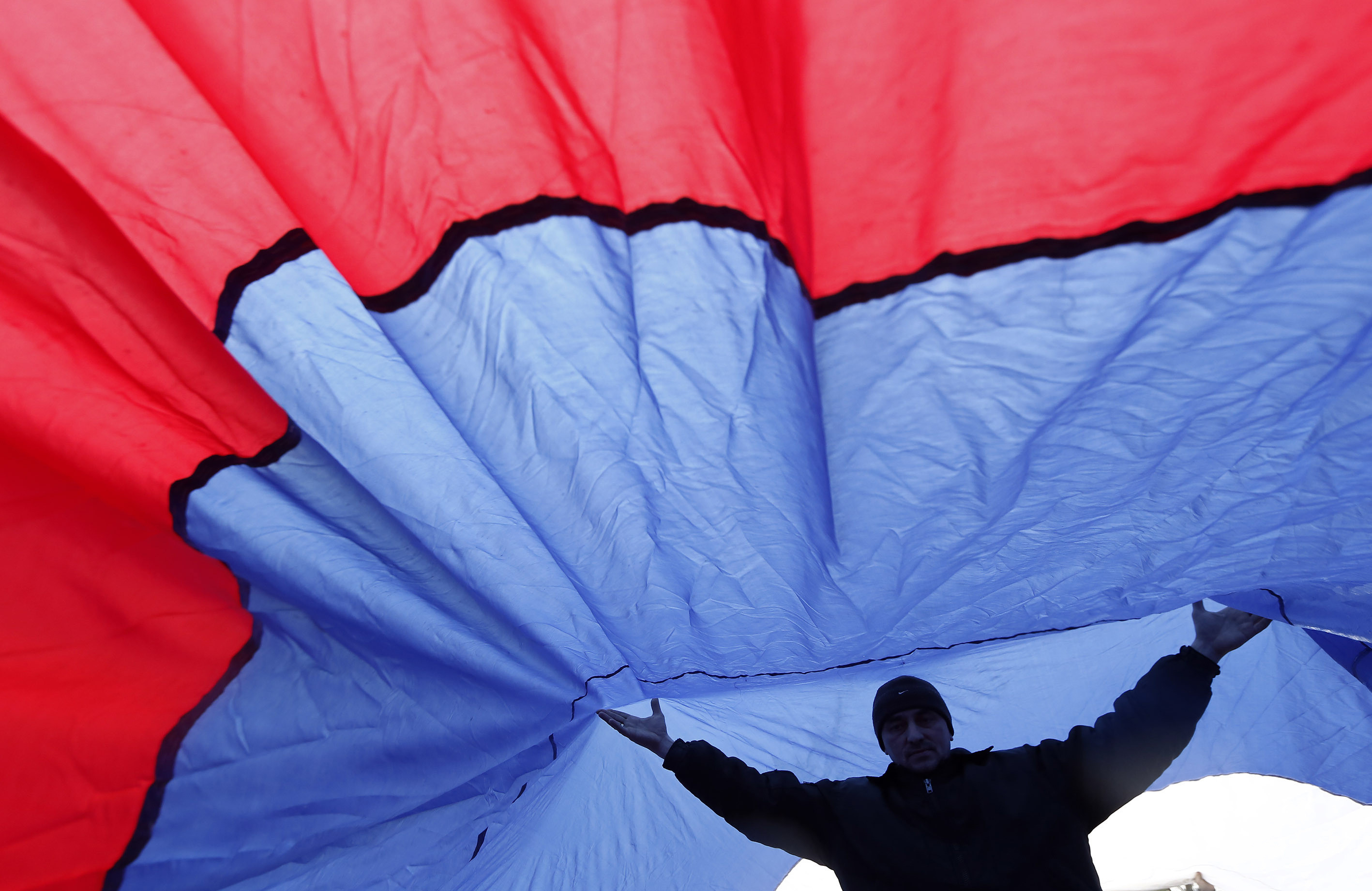
(Photo: More than a thousand people supporting Russia, stage a demonstration in front of the Parliament of Crimea on February 27, 2014 in Simferopol, Crimea. By Bulent Doruk/Anadolu Agency/Getty Images)

Chaotic In Crimea

Armed men just seized government buildings in Simferopol, the capital of Ukraine’s autonomous Crimea region, raising the Russian flag above the parliament building and refusing to allow workers in (NYT):

Police officers sealed off access to the buildings but said that they had no idea who was behind the assault, which sharply escalated tensions in a region that serves as home to Russia’s Black Sea Fleet and also to a number of radical pro-Russia groups that have appealed to Moscow to protect them from the new interim government in Kiev, the Ukrainian capital.

The Lede is live-blogging. Simon Shuster puts the event in context:

Since revolutionaries took over Ukraine’s capital a week ago, the ethnic Russian majority in the Crimea has largely refused to recognize the new government. In some Crimean cities, citizens have begun forming pro-Russian militias to resist the new authorities. “There’s not a chance in hell we’re going to accept the rule of that fascist scum,” Sergei Bochenko, the commander of a local militia group in the Crimea, told TIME last week in the city of Sevastopol. He said his battalion was armed with assault rifles and had begun training to “defend our land.”

Tatyana Malyarenko and Stefan Wolff take a wider look at Crimean separatism:

Separatist forces have a broad social base in Crimea. Available polling data since 2006 has consistently indicated that more than 50% of residents in the peninsula would support annexation to Russia. These figures suggest a strong pro-Russian sentiment among the region’s ethnic Russians and Russian-speaking Ukrainians, but not one that has so far automatically translated into an active pursuit of separatism.

At the same time, there are also strong anti-separatist forces in Crimea, notably the Crimean Tatars, who make up approximately 12% of the peninsula’s population. One of the Soviet Union’s nationalities that experienced deportation under Stalin, they have gradually returned to the Crimea since the break-up of the Soviet Union in 1991. While they have continued to experience ethnic prejudice and discrimination in Ukraine, they are, for obvious historical reasons, fundamentally opposed to Crimea “returning” to Russia.

Meanwhile, Yanukovych is seeking refuge in Moscow:

Russian newspaper RBK reported on Thursday that ousted Ukrainian President Viktor Yanukovych was spotted at a Moscow hotel and is currently staying at a state-run sanatorium nearby. Although, his presence in Russia is still unconfirmed, the paper carried Yanukovych’s plea for protection from the Kremlin. “I have to ask Russia to ensure my personal safety from extremists,” he wrote. Despite fleeing, he still insists that he is still the rightful leader of Ukraine.

And, as we noted yesterday, Russia is carrying out military exercises not far from Ukraine:

Okay, so according to Ria Novosti, more than 150,000 troops are due to take part in the drills, as well as 90 planes and more than 120 helicopters. While we don’t know precisely where the troops will be, Moscow has said the drills would happen in the Western and Central military districts. … [W]hile the Western district does border Ukraine, it also covers a huge amount of other land, too. It is possible that some of the troops in this district may be relatively close to Ukraine: According to the Wall Street Journal, the 20th Army, based about 200 miles from the border, is listed to be involved in ”operational and tactical exercises.” On the other hand, the military district in the South is the only one that borders Crimea, and Russia says it is not the part of the drill at all.

Ed Morrissey fears that Putin is laying the groundwork for intervention:

For the moment, he’s still playing his cards close to the vest; he’s agreed to sit down for IMF discussions on a Ukraine bailout to take the place of the one Putin suspended, for instance. Yanukovich is simply a clown show, though, as his credibility in Ukraine is shot, and Putin knows it. The Crimean peninsula will be the flashpoint for any action, and it’s not long odds on Ukraine losing it, either diplomatically or otherwise.

But Timothy Snyder warns that meddling in Crimea would be dangerous for Russia, setting a “rather troubling precedent” for similar meddling by China in the east.

Russia’s Response To Ukraine

Max Boot fears that it’s forthcoming:

With Ukrainians having overthrown Putin’s ally, Viktor Yanukovych, Putin has ordered a riposte: Russian army units in western Russia and air forces across the country have been scrambled for an unscheduled “exercise.” At the same time, the pro-Russian population of the Crimea, home to an important Russian naval base, has been talking about secession from the rest of Ukraine–no doubt with the Kremlin’s encouragement.

It is by no means inconceivable that the two events could be linked–that Putin could send his troops into part of eastern and southern Ukraine on the pretext of “protecting” the Russian minority, much as Hitler did with Czechoslovakia.

Ukraine expert Alexander Motyl doubts that Russia will be so reckless:

Will Russia lead a charge to reinstall the ancien régime or break off bits of Ukraine? The former scenario is almost impossible, as the regime has melted away and there is no one left to reinstall. The latter is theoretically possible—at least in the Crimea—although it would mean that President Putin has lost all his geopolitical marbles.

If Putin does throw all caution to the wind and acts only on irrational impulse, he will only consolidate democratic rule in Ukraine (nothing rallies people around the flag as much as foreign intervention: even Yanukovych’s financial backer, the multibillionaire Rinat Akhmetov, spoke out against partition on February 24th) and provoke Russian democrats and Crimean Tatars to take to the streets (or, possibly, to arms—in which case, you can kiss the peninsula’s vaunted beaches good-bye). Such action would also be warning Belarus and Kazakhstan that they might be next. When the dust settles, democratic Ukraine will still be standing, Putin’s Russia could be destabilized, and his Customs Union and Eurasian Union would essentially be kaput. An intervention or economic embargo would bring Putin’s Russia nothing at best and enormous risks at worst.

Who Controls Ukraine Now?

UKRAINE-UNREST-POLITICS

Masha Lipman warns that the new balance of power is unstable:

The authority of the decision-makers in the Ukrainian parliament is not entirely secure. At least some of their decisions may be questioned by regions in the east of the country that barely took part in the bloody struggle in Kiev. In the mostly pro-Russian Crimea, fifty thousand people showed up for a rally on Sunday where the governing force in Kiev was denounced as “Fascist riffraff.” They chanted, “Long live the great Russian city of Sevastopol!” Separatist sentiments are widespread in the Crimean peninsula; Sevastopol, its largest city, is the home of the Russian Black Sea fleet, which makes the Crimea even more of a problem for the new government in Kiev.

Alex Berezow argues that the opposition “must act quickly and carefully to fix Ukraine’s enormous problems, otherwise the country could split in two”:

The new government must reunify the country. Mr. Yanukovych’s supporters — including the Kremlin — feel as though his removal from power was unlawful. That is going to cause long-lasting ill feelings. The new government must make it clear that Mr. Yanukovych’s expulsion was due to corruption and corruption only. However, the parliament has already voted to drop Russian as one of the country’s official languages. This is a big mistake. It gives the impression that ethnic Ukrainians in the western part of the country despise the ethnic Russians in the eastern half. Does Ukraine really want to have an ethnic conflict added to the current political crisis?

Jamile Trindle and Keith Johnson wonder how Russia will respond:

The new leaders were part of the opposition that revolted against President Viktor Yanukovych’s decision to accept Russia’s cash and reject closer trade ties with Europe. Now, they are free to put the country back on a European trajectory, and reconsider signing the trade and political agreement that Yanukovych rejected, but they may face the same fallout from Russia that he did. Ukraine relies on Russia, not just for trade, but also for natural gas imports.

If Ukraine’s short-term financial lifeline comes with the signing of the association agreement with the European Union, which will allow for a free trade zone and lift visa restrictions, it will carry one big additional risk: the threat that an angry Russia could use its energy leverage to try to cow Kiev back into its orbit.

(Photo: An anti-government protestor waits in front of a parliamentary building in Kiev on February 25, 2014. Today Ukraine’s interim leader delayed the appointment of a new unity government until February 27 as the country tries to find a way out of its most serious crisis since independence. By Bulent Kilic/AFP/Getty Images)

What If Ukraine Splits? Ctd

Alexander Motyl calls the country’s east-west divide a false binary that doesn’t explain the conflict as neatly as some Western commentators would like:

The real divide in Ukraine is not between East and West, but between the democratic forces on the one hand and the Party of Regions on the other. The latter is strongest in the southeast, mostly because its cadres (who are mostly former communists) have controlled the region’s information networks and economic resources since Soviet times and continue to do so to this day. Their domination since Ukraine’s independence rests on their having constructed alliances with organized crime and the country’s oligarchs, in particular with Ukraine’s richest tycoon, Rinat Akhmetov. They have enormous financial resources at their disposal, control the local media, and quash — or have quashed — all challengers to their hegemony. Their rule has been compared, not inaccurately, to that of the mafia. Ukrainians in the southeast tend to vote for them, less because they’re enamored of Yanukovych (they are not), and more because they have no alternatives and, due to the Region Party’s control of the media, see no alternatives.

But Christian Caryl says neglecting the divide is “wishful thinking”:

To emphasize these complexities is not — as some would claim – to deny Ukraine’s viability as a state. Nor does it imply that Ukraine ought to be carved up into constituent units.

Ukraine is perfectly capable of continuing its existence as a state if it can find an institutional framework that will take its political diversity into account — instead of lurching from one crisis to the next as it has over the past 15 years.

Ukraine’s regional differences do, however, mean that we should take the possibility of civil conflict seriously. Reporters in Kiev have already described the rise of quasi-military “self-defense units” among the protesters. What has gone largely unremarked is the rise of similar paramilitary groups in the East. As this map by political observer Sergii Gorbachev shows, Yanukovych’s political machine has been busily standing up “militia units” throughout the East, sometimes with overt ties to local gangland structures. Here, for example, is a Russian-language interview with one ex-convict who’s setting up his own pro-Yanukovych militia in the Eastern city of Kharkov. He won’t say how many members the new group has, but he’s quite open about its aims: “I’m preparing my population and my people for war.”

Adam Taylor points to Crimea, where loyalties are distinctly Russian, as a potential breakaway region:

From the 18th century on, the region was part of Russia, but that changed in 1954, when the Supreme Soviet of the Soviet Union passed it from the Russian Soviet Federative Socialist Republic to the Ukrainian Soviet Socialist Republic, a decision that is still controversial in some circles. Today the peninsula might still be a part of Ukraine, but in many ways it is separate from the rest of the country: It has its own legislature and constitution, for example, and it’s still very Russian: Some  60 percent of the population is ethnically Russian, with the rest being Ukrainian or Crimean Tatars.

It appears that some members of this Russian community have regarded the events in Kiev with a mixture horror and opportunism: The chaos in Ukraine could finally be the region’s chance to turn back to Moscow.

Max Fisher, who has pushed a structural explanation of the conflict, argues that both competing narratives have some merit:

The structural storyline, of an identity crisis fueled by history and demographics, appeals for its neatness and its comprehensive breadth. But it tends to rankle people, and not without reason, who see it as explaining away the bravery and idealism of the protesters, or forgiving the very real abuses of Yanukovych.

The more human narrative, of regular Ukrainians pushed to the breaking point by an abusive government they can no longer tolerate, is much more emotionally satisfying. Anyone can relate to it. It appeals especially to Americans, who feel an immediate affection for any pro-democracy movement, particularly one that expresses a desire to reject Russia and embrace the West. Still, this story ignores the 30 percent of Ukrainians who wanted to reject the E.U. deal for a Russia-led trade union, and it ignores the pro-Russia attitudes in the eastern half of the country. It almost seems to tell pro-Russia Ukrainians that they don’t count, which can feel a bit Russophobic.

Putin Freaks Out

Arrest Warrant Issued For Former Ukrainian Leader As Square Becomes Shrine To Dead

There was something rather delightful in the way that Ukraine’s refusal to be forced into a Euro-Asian Community of Putin-favored despots ruined the new Tsar’s Olympics. The revolt of the Ukrainians – even some supporters of Yanukovych –  exposes the stark limits of Putin’s approach to politics: always zero-sum, contemptuous of the West, posturing across the globe, acting the way dumb tyrants always act. The Kremlin is now touting the Friday “truce” agreement that its representative refused to sign. And so it is unsurprising that the Kremlin has gone completely over-the-top in reacting to the weekend’s epic events:

“If you consider Kalashnikov-toting people in black masks who are roaming Kiev to be the government, then it will be hard for us to work with that government,” prime minister Medvedev said. “Some of our foreign, western partners think otherwise, considering them to be legitimate authorities. I do not know which constitution, which laws they were reading, but it seems to me it is an aberration … Something that is essentially the result of a mutiny is called legitimate.” …

The Russian foreign ministry statement pressed all the buttons that will have the west and Kiev alarmed about ethnic and religious strife fracturing the country in two. It complained that ethnic Russian rights were already being violated after the parliament rescinded the status of Russian as a second language. “Referring merely to revolutionary expediency, [the parliament] is imposing decisions and laws aimed at repressing the human rights of Russian and other national minorities. There are even calls for a complete ban of the Russian language,” it said.

Now we’ll see how mature the opposition is, and whether it can control its more radical elements, which would only goad Russia to more brinksmanship. Fisher says it’s a positive sign that the parliament took the lead in pushing out Yanukovych on Friday:

What makes this an even bigger deal is that, while foreign countries have played a role, it’s ultimately Ukrainians pushing through a resolution, and doing it democratically. Most of the time, these sorts of crises end when one side is simply defeated outright, or cuts a middle-of-the-night deal brokered by foreign powers. But what’s happening right now in Kiev is being driven by procedural, by-the-letter votes in the country’s own parliament. In many ways, it’s a victory not just for but by democracy and the rule of law.

And that’s maybe the most amazing thing about Parliament so aggressively undermining Yanukovych — that they’re doing it democratically, within the rule of law, following all the rules of procedure and form. That’s just extremely rare in “transitional” states in the long process of developing from an authoritarian to democratic system, particularly post-Soviet states.

It is. But now the president is being charged with mass murder:

The Kyiv Post reports that acting Interior Minister Arsen Avakov announced on his Facebook page this morning that Mr. Yanukovych and “other [former] government officials” are wanted for “mass killings of civilians.” Though the charges do not name the alleged victims, the Post writes that it is “presumed that the investigation centers on whether Yanukovych hired snipers or ordered riot police to shoot EuroMaidan [Independence Square] demonstrators in January and February.” At least 100 people have been killed in Ukraine‘s political turmoil, including at least 75 in the past week.

Ioffe worries that demobilizing the protesters’ armed contingent might be a challenge:

The so-called self-defense groups patrolling and ruling the Maidan these last few months are now highly organized groups of men who have tasted victory—and their own power. What do you do after you take up a baseball bat and topple a president? Go back to your day job? The new interim Interior Ministry head said he promised the groups posts inside the Ministry, but the devil will absolutely be in the details: there are a lot of these guys, and some of them really are extremists. Will there be room for all of them? If not, what will happen to the rest?

Uri Friedman says to watch the power struggle:

It’s also worth keeping an eye on what happens among Ukraine’s opposition leaders. The triumvirate —Oleh Tyahnybok of the Svoboda (Freedom) party, Vitali Klitschko’s of the Udar (Punch) party, and Arseniy Yatsenyuk of the Batkivshchina (Fatherland) party—may have united against Yanukovych, but their uneasy alliance is beset by power struggles and ideological divides, particularly between the mainstream opposition parties and the far-right Svoboda party (what U.S. Ambassador Geoffrey Pyatt, in his leaked “Fuck the EU” call with U.S. diplomat Victoria Nuland, referred to as “troubles in the marriage”). Now the powerful Tymoshenko, who some activists support and others view as part of the corrupt political elite, has entered the mix. And the extent to which these leaders can win over the diverse mix of protesters in the street remains an open question.

Max Boot predicts shenanigans from the Kremlin:

We can expect a riposte from Putin before long, and from his allies in Ukraine who are down but not defeated. How the revolution will unfold no one knows, but Ukraine has had plenty of experience of thwarted upheavals. This is, after all, the second popular uprising against Yanukovych, the first being the Orange Revolution of 2004-2005. Although thwarted in his attempt to steal that election, Yanukovych returned to power in 2010, managing to win a fair election after his political adversaries failed to show results while in office.

Bershidsky points out that revolution or no revolution, Ukraine is still broke:

Sweet as revenge may be, what Ukraine needs now isn’t a Yanukovych trial or tourist destinations such as Mezhihirya (pictures of gold-laden interiors of the former prosecutor general’s home are also popular on the social networks). Right now, the country needs $35 billion to avoid default, according to acting Finance Minister Yuri Kolobov, until recently a Yanukovych loyalist. If Ukraine is to get that money from the International Monetary Fund, the European Union the U.S. and, possibly, Russia, it needs to concentrate on finding ways to go forward, not look back at its ugly past. Otherwise, there will be plenty of politicians and bureaucrats hungry for a bite of the aid package, and their gnawing will go unheard in the revolutionary din.

And lastly, Brian Merchant implores us not to stop watching now that that the “excitement” appears to be over:

It’s certainly an overused technique, but framing stories as “apocalyptic” or “dystopian” gives audiences an easy window for empathy. We’re all afraid that our world will fall apart, after all, and seeing it happen anywhere gives us a paroxysm of worry, fear, and guilt. The bombs and clubs are coming down on our fellow humans, and we imagine their specter looming over us too—it’s healthy, I think, to stare, engrossed, with trepidation and sympathy.

But in order for the experience to amount to much more than looking at porn, we have to keep watching. The livestream is still rolling, you know. After the fire-licked glow and apocalyptic combat comes real, 3D-life: the scenes now filling the stream reveal the tumult of compromise, the measuring of loss, and a mass of people groping for the next step.

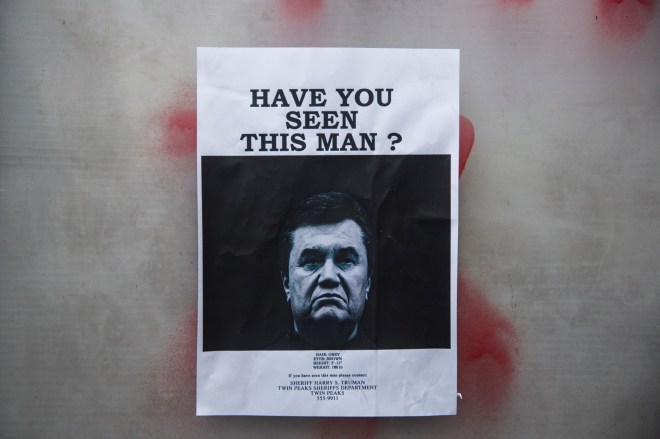
(Photo: A wanted poster showing a portrait of ousted Ukrainian president Victor Yanukovych on February 24, 2014 in Kiev, Ukraine. Ukrainian interim interior minister has today announced that an arrest warrant has been issued for the ousted president. By Rob Stothard/Getty Images.)
The Uprisings Around The Globe

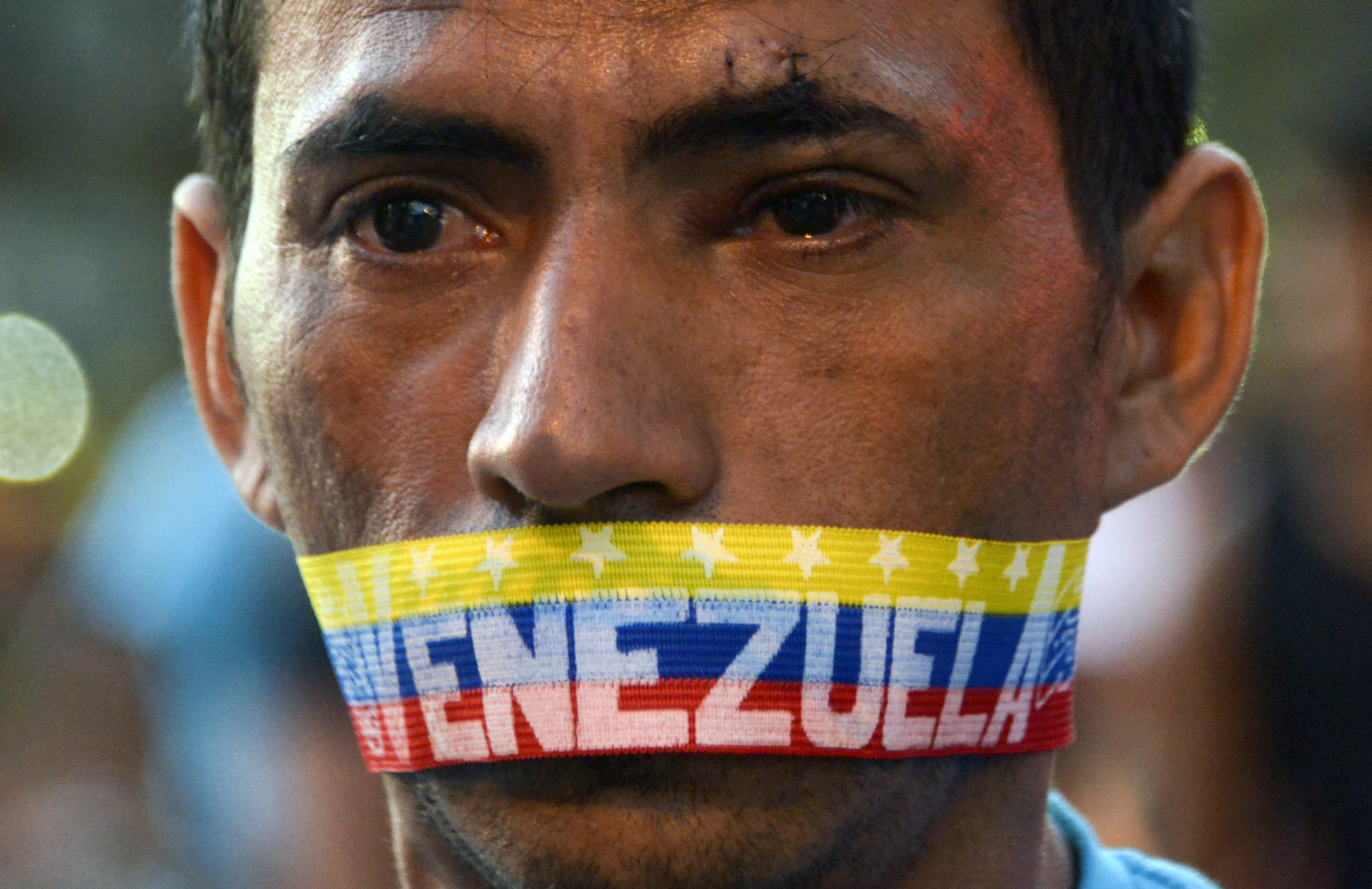
VENEZUELA-POLITICS-OPPOSITION-PROTEST

Ed Krayewski sees the protests in Ukraine, Venezuela, and Thailand as part of a global backlash against irresponsible “democratic” governments:

To varying extents, Ukraine, Venezuela, and Thailand have democratically-elected governments.  And in each case, those governments, rather than working to do their best to represent all people, have demonized and alienated the opposition, claiming their slim margins of victories as mandates to act in any way they please.

The root problem in each country is unaccountable government. That unaccountability, in each case, is an outgrowth of the attitude that a mere democratic majority (of the actually-voting voting population) suffices to permit the government to do anything it wants under the guise of having a popular mandate for it.

Dalibor Rohac and Juan Carlos Hidalgo note several “striking parallels” between Ukraine and Venezuela. On the two countries’ economies:

In 1990, Ukraine’s GDP per capita was $8,200, which was roughly identical to Poland’s.Today, Poland’s GDP is $18,300 and Ukraine’s has gone down to $6,400. Unlike its post-communist neighbors to the West, Ukraine did not pursue deep institutional reforms and its economy was seized by a narrow group of oligarchs, with close connections to political power and to the Kremlin. The son of the President Viktor Yanukovych, Oleksandr, has become one of the richest men in the country during his father’s time in the office, while incomes of most Ukrainians stagnated.

In Venezuela the economic situation has deteriorated sharply since the death of Hugo Chávez last year. The country has the highest inflation rate in the world (officially 56 percent in 2013, although according to Steve Hanke’s Trouble Currency Project, the implied annual inflation rate is actually 305 percent). After years of nationalizations, expropriations, and currency and price controls—all under the name of “21st Century Socialism”—the private sector has been decimated. Hour-long lines in supermarkets are a daily occurrence and shortages of basic food staples and medicines are widespread. And just like in Ukraine, corruption is rampant as the ruling elite rake in the profits from oil revenues. This has resulted in the rise of a new privileged class called the “Boligarchs.” so-named because they’ve prospered tremendously under the so-called Bolivarian revolution.

(Photo: A man attends a protest against the government of Venezuelan President Nicolas Maduro in Caracas on February 23, 2014. By Raul Arboleda/AFP/Getty Images)

The Other Sponsored Content …

Rosie Gray has a must-read on how the Ukraine government tried to get pro-Yanukovych op-eds into the US journalist mainstream. The usual suspects pop up. Money quote:

Huston didn’t directly deny being paid by Scoville. “I would not be open to say who pays me and who doesn’t,” he said.

Other writers who were producing incongruous pro-Party of Regions stories at the time include Ben Shapiro of Breitbart and Seton Motley, a conservative blogger. One of Shapiro’s Ukraine posts, “Hillary Sides With Anti-Semitic Ukrainian Opposition,” is nearly identical to a post that appeared four days later in a different publication under Huston’s byline: “Clinton Dept. of State Backing the Anti-Semitism Party in Ukraine?”

Shapiro said he hadn’t been paid by anyone other than his employers to do the posts.

The Modern Way To Kill Freedom

Steinglass wants us to “understand the nature of the threat to freedom we’re seeing these days, in Ukraine and around the world”:

Viktor Yanukovich is a democratically elected president who has used his powers to eliminate liberal-rights safeguards and jail political opponents on dubious charges. He has reinforced his political position by building cronyistic relationships with powerful business figures. In this system the state creates economic rents and awards them to favoured business interests, who in turn buttress the state’s political power, all while maintaining the trappings of democracy. In other words, Ukraine looks a lot like Russia or Egypt; more significantly, it looks like other states that are in the early stages of similar threats to liberal democracy, such as Turkey and Hungary. The enemy of liberal democracy today is more often kleptocracy, or “illiberal democracy” (as tiger-mom Amy Chua put it in her book “World on Fire“), than ideological totalitarianism. The threat is less obvious than in the days of single-party states and military dictators. But it ends up in the same place: economic stagnation, a corrupt elite of businessmen and politicians, censored media, and riot police shooting demonstrators.

A Deal To Stop The Bloodshed?

Violence Escalates As Kiev Protests Continue

Adam Martin summarizes that latest news from Ukraine:

Ukranian President Viktor Yanukovych signed a deal with protest leaders in Kiev on Friday, agreeing to early presidential elections, a coalition government, and a constitutional reduction of presidential powers. The deal, brokered by European Union and Russian mediators, restores the 2004 Ukranian constitution “with a rebalancing of powers towards a parliamentary republic,” Yanukovych said. The Ukranian parliament approved the reversion to the old constitution on Friday evening.

Radek Sikorski, Poland’s foreign minister, made the case for compromise to the opposition with characteristic bluntness:

Some good news for the former president, Yulia Tymoshenko:

Hayes Brown wonders if the protesters will abide by the agreement:

Despite the leadership’s willingness to sign onto the agreement, it is unclear whether the protesters in the Maidan will follow their lead and clear the square they have held for months on end.

According to the Kyiv Post, when opposition leader Oleh Tiahynbook addressed the crowd asking “Do we agree to this?”, referring to Yanukovych remaining in office, “the thousands of people assembled overwhelmingly shouted ‘no’ in response.” Kyiv Post’s CEO Jakub Parusinksi tweet out “If deal info true, #EU just exchanged minor diplomatic victory for the safety of #Ukrainian people.”

Demonstrators may continue to make demands, specifically Yanukovych’s immediate exit, feeling they come from a position of strength at the moment. On Friday a group of police officers from the city of Lviv, which has been a secondary hotbed of anti-Yanukovych sentiment, joined protesters in Kyiv, providing the opposition with a morale boost.

Max Boot chimes in:

It would be good if the accord sticks, in order to prevent further fighting, but at this point it is far from clear that it will do so. It was only on Wednesday, after all, that a previous truce had been announced, and then just as promptly broken. It is clear, however, that at least for now Yanukovych has temporarily disappointed his backers in the Kremlin by refusing to declare “emergency powers” and call in the army to clear out demonstrators from central Kiev after his police force failed to get the job done.

A small glimmer of hope.

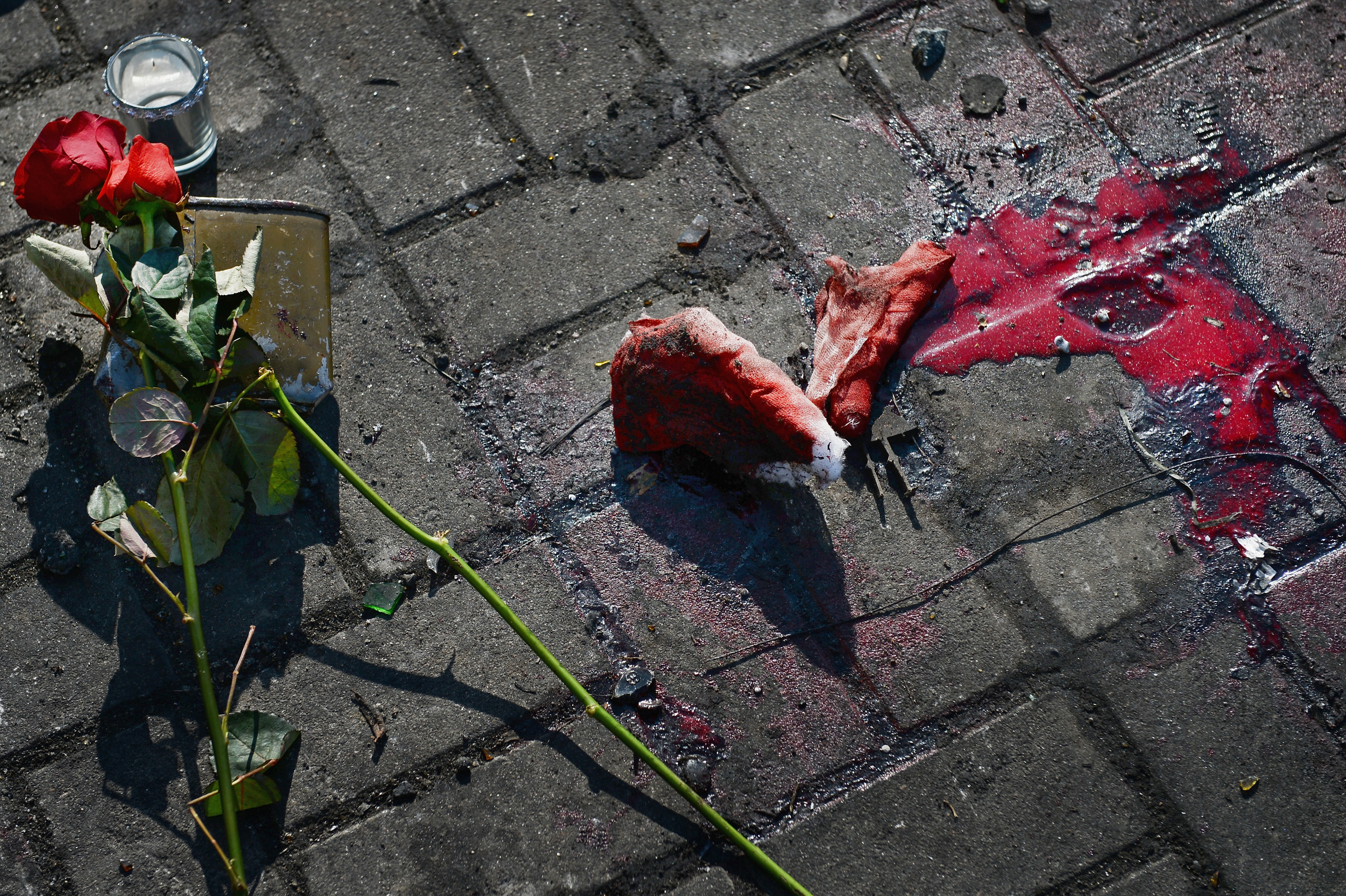
(Photo: Tributes are placed at the spot where an anti-Government protestor was shot by a sniper near to Independence square, on February 21, 2014 in Kiev, Ukraine. Ukraine’s president Viktor Yanukovych is thought to have reached a deal with the opposition to end the crisis, after all-night talks in Ukraine mediated by EU foreign ministers. By Jeff J Mitchell/Getty Images)