Alexander Motyl doubts the government will allow it to happen:
Personally, I have no doubt that Ukraine without its southeast would be much stronger, more stable, and more prosperous than Ukraine with its southeast. The southeast’s rust-belt economy needs either to be shut down entirely or to be refitted at the cost of trillions of dollars of non-existent investments. Moreover, the statistics plainly show that Kyiv subsidizes the Donbas, and not vice versa.
The southeast also has a low birth rate, a high death rate, low life expectancy, high energy consumption, and high AIDS and crime rates. Last but not least, the southeast is home to the ruling Party of Regions and the Communist Party. Remove the southeast and Ukraine’s treasury experiences an immediate boon; its demographics, energy consumption, and health improve; and its politics automatically become more democratic and less corrupt.
Although lopping off the Donbas would benefit the rest of Ukraine, Yanukovych’s mafia regime desperately needs Ukraine to be whole. If Luhansk and Donetsk were to split away, their rust-belt economy would collapse without Kyiv’s financial support and the Regionnaires, trapped in their polluted bailiwick, would have nothing to steal.
Brian Whitmore asks Motyl about the country breaking apart:
[Q] with the crisis escalating and becoming increasingly violent, do you think Ukraine is heading toward partition?
[A] No, not really. I think the country is headed toward [President Viktor] Yanukovych’s collapse though. I’m not sure if it’s a matter of days, weeks, or months. But in cracking down he’s essentially signed his own death warrant.
Future sanctions against Ukraine would almost certainly be far more limited than what has been in place against Iran, out of concern that the sanctions could hurt ordinary Ukrainians and push public opinion toward embracing an alliance with Russia. Sanctions would likely focus solely on Ukrainian officials and their supporters. They would also be less effective because Russia would likely not join in on measures targeting one of its closest allies. The current crisis began late last year when Ukrainians took to the streets after Yanukovych rejected an EU trade deal in favor of a bailout from Russia.
Sam Cutler, a policy advisor for sanctions law firm Ferrari & Associates, says sanctions alone are unlikely to force the government to ease its crackdown or negotiate with protesters. “It’s a way for politicians in the EU and the U.S. to say, ‘Look how much we’re doing,’ and to take a moral stand, but it has to be a complement to a broader policy,” Cutler said.
Hayes Brown looks at the actions that have been taken already:
The European Union on Thursday approved targeted sanctions on Ukrainian government officials, as well as an arms embargo on the country. The U.S. also announced on Wednesday evening that it was imposing a visa ban on 20 Ukrainian officials as part of their initial response to recent escalations. Experts, however, say that the announced embargos are unlikely to do much to change Yanukovych’s calculations. This is particularly true of the arms ban, since as Ukraine was a primary hub for manufacturing weapons during the Soviet Era they are awash in weapons.
I don’t see what constructive difference imposing targeted sanctions would have, but since imposing sanctions is almost always done just to express disapproval rather than achieve anything I suppose that is what the U.S. and EU will end up doing. All in all, there doesn’t seem to be very much that the U.S. can do that would be constructive, and it shouldn’t seek to have a larger role in trying to resolve the crisis.
As the sun rose, it became all too apparent that lethal weapons – not merely stun grenades, rocks and Molotov cocktails, but rifles and pistols – had entered the fray on both sides. The conflict appeared to be spiraling toward a civil war, as deadly clashes between armed protestors and police were also reported in at least three other cities. Both sides blamed each other for the escalation.
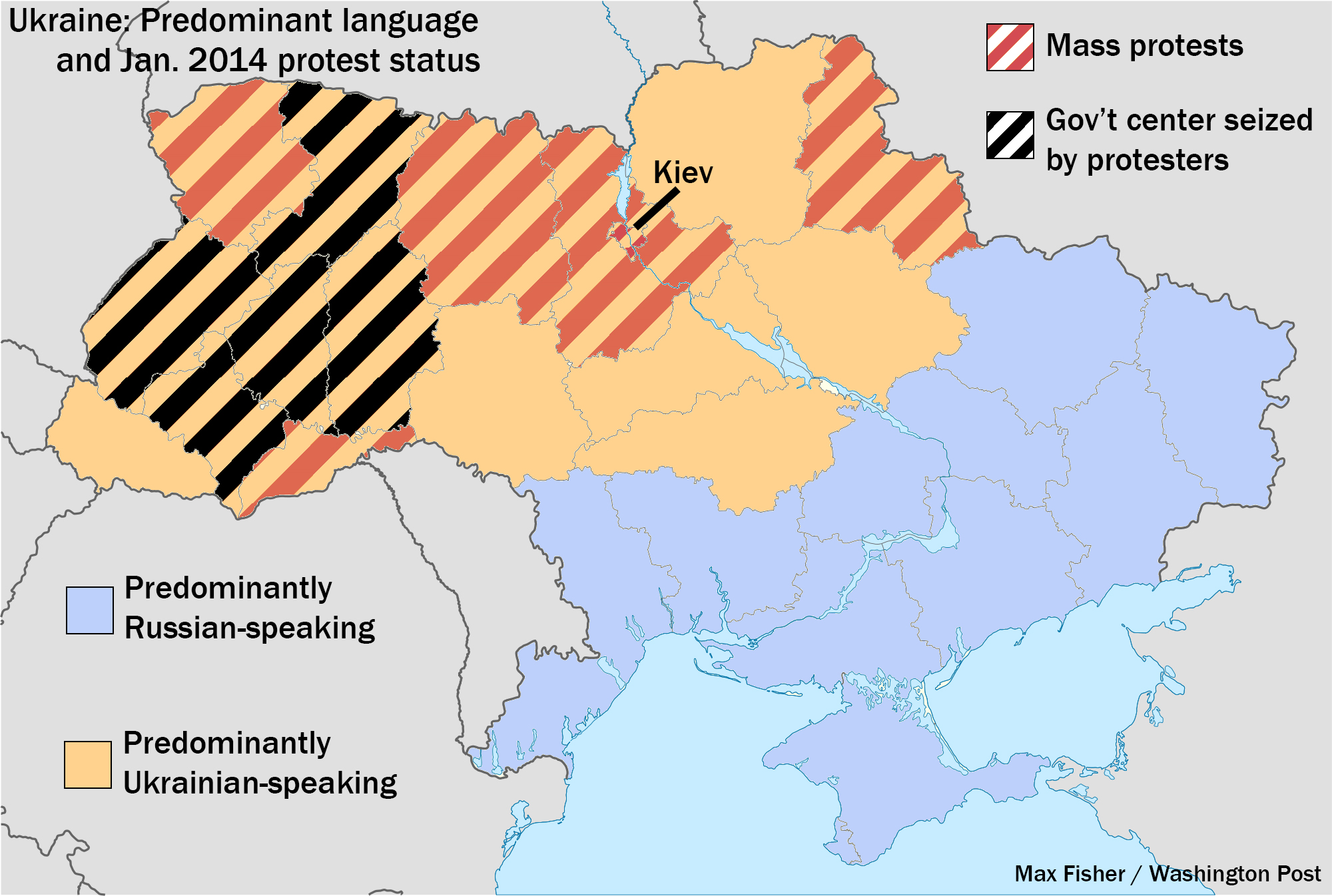
Ukrainians may be split almost down the middle on whether they support the protests, but few support the use of force against them. Also, despite the country’s clear split between the Catholic, Ukrainian-speaking west and Orthodox, Russian-speaking east, support for the country’s independence has actually increased over the years, even in the east. (Crimea, which is majority-ethnic-Russian, may be something of an outlier.) And while the general ideological sentiments of the two camps are clear, it also seems like actual enthusiasm for Yanukovych is fairly thin, even among government supporters, and the opposition’s leadership is divided between three men—Vitali Klitschko, Oleh Tyahnybok, and Arseniy Yatsenyuk—all of whom carry some fairly serious flaws as potential leaders of a long-term nationalist uprising.
The government’s talk about “anti-terrorist” operations doesn’t bode well. And Yanukovych fired his army chief on Wednesday – an extremely bad sign. We don’t know why he did it, but speculation has immediately turned to the possibility that the army chief had refused orders to bring the military out into Kiev’s streets. If that’s the case, then this is worrying both because it implies that Yanukovych may have been pushing for military involvement and because it hints at possible splits within the military leadership. All very bad signs.
Masha Lipman warns that “Ukraine is balancing on the brink of a large-scale armed conflict”:
Yanukovych, from his perspective, has to stay in power at any cost. He had his most serious political rival, Yulia Tymoshenko, jailed. If he loses power, he can expect that the same will happen to him, especially after he has brought his country to a bloody political crisis in which several dozen have already been killed and hundreds wounded. His circle of cronies, his son among them, many of whom have enriched themselves through corruption during his tenure, may face the same fate.
As I wrote in late January, the last time that protests reignited, Ukraine’s politics have long been divided into two major factions by the country’s demographics. What’s happening right now is in many ways a product of that division, which has never really been reconciled. Just about every Ukrainian government since independence has been seen as representing one “side” of this divide, with the other hating him or her as a perceived foreign pawn. That’s exacerbated by political corruption and by the fact that Ukraine’s troubled economy does indeed make it reliant on outside countries. Today, Ukraine is still demographically divided, its government is still troubled by corruption, and its economy is still in bad shape. As long as those things are all true, public unrest is likely to continue.
Policy makers should not rule out the possibility that the country could split, enter a period of prolonged violence, or even face something approaching a civil war. This does not mean that any of these outcomes are foreordained, but for anyone looking forward it is no longer unreasonable to speculate about the causes or the consequences of such outcomes.
This is a potentially revolutionary situation – we are watching violent street protests that could force out a government that was, whether we like it or not, reasonably democratically elected. It is also an emergency in which an ill-informed EU policy played a role. In demanding an all or nothing, now or never, decision from a Ukraine that needed emergency financing more than it needed European promises, it badly misplayed its hand.
Ioffe calls the protests “Putin’s worst nightmare”:
The last time that this many people came out to the Independence Square (the Maidan) in Kiev, nine years ago, protesters undid the election of Victor Yanukovich and brought to power a Western-friendly government. In the process, they scared the living daylights out of Putin. … Ukraine is Slavic. Ukraine speaks Russian, even though the Western part insists on having its own tongue. Kiev is the cradle of Russian civilization. Ukraine, in Putin’s mind, is almost just another province of Russia, one that, by some accident of history and politics, has a different government and a different name. He is said to have said as much to George W. Bush in 2008. “Don’t you see, George, that Ukraine is not even its own state?” he is reported to have smirked.
Update from a reader:
And what must really be causing Putin to tear his chest hair out is the fact that, so long as he is the very public face of the ongoing Winter Olympics in Sochi, he pretty much has to sit on his hands at precisely the time when his allies in the Ukraine most require his support. Hell, it’s entirely possible that before the Games end, things in will be too far gone in “just another province of Russia” for him to rescue the pro-Putin government. How schadenfreude-tastic would it be if, on account of an Olympics whose staging is designed to prop up his image at home and abroad, Putin gets a bloody nose and a black eye?
Meanwhile, Bob Dreyfuss thinks there is little the West can do about the violence in Kiev:
Likely, there will be American and European sanctions against Ukraine now, at least directed at some of its leaders, but sanctions will simply push the country’s leaders even farther from the West, and from any accord with the European Union. In the Cold War-like struggle between the United States and Russia over Ukraine, which many Russians (including Vladimir Putin, Russia’s autocratic, czar-like leader) see as part of Russia’s sphere of influence, Moscow—which urged the Ukrainian government to crack down on protesters—may have won a round. But a bloody, shaky peace, filled with simmering hatreds, is not likely to be the final result of the ongoing crackdown in Kiev.
Gideon Rachman also considers the role of the US and EU:
The West’s instinct in these situations is to call for fresh elections and that is certainly a demand that can be expected to be promoted now. In theory, this should lead to the establishment of a legitimate government, ending the need for violence. But what if elections in Ukraine actually confirm that this is a deeply-divided country with an increasingly incompatible west and east? That is certainly one possible outcome of a poll. At that point, a durable political solution might need something rather more drastic, and difficult, than holding fresh elections.
In Focus has photos from the protests. A startling contrast via Twitter:
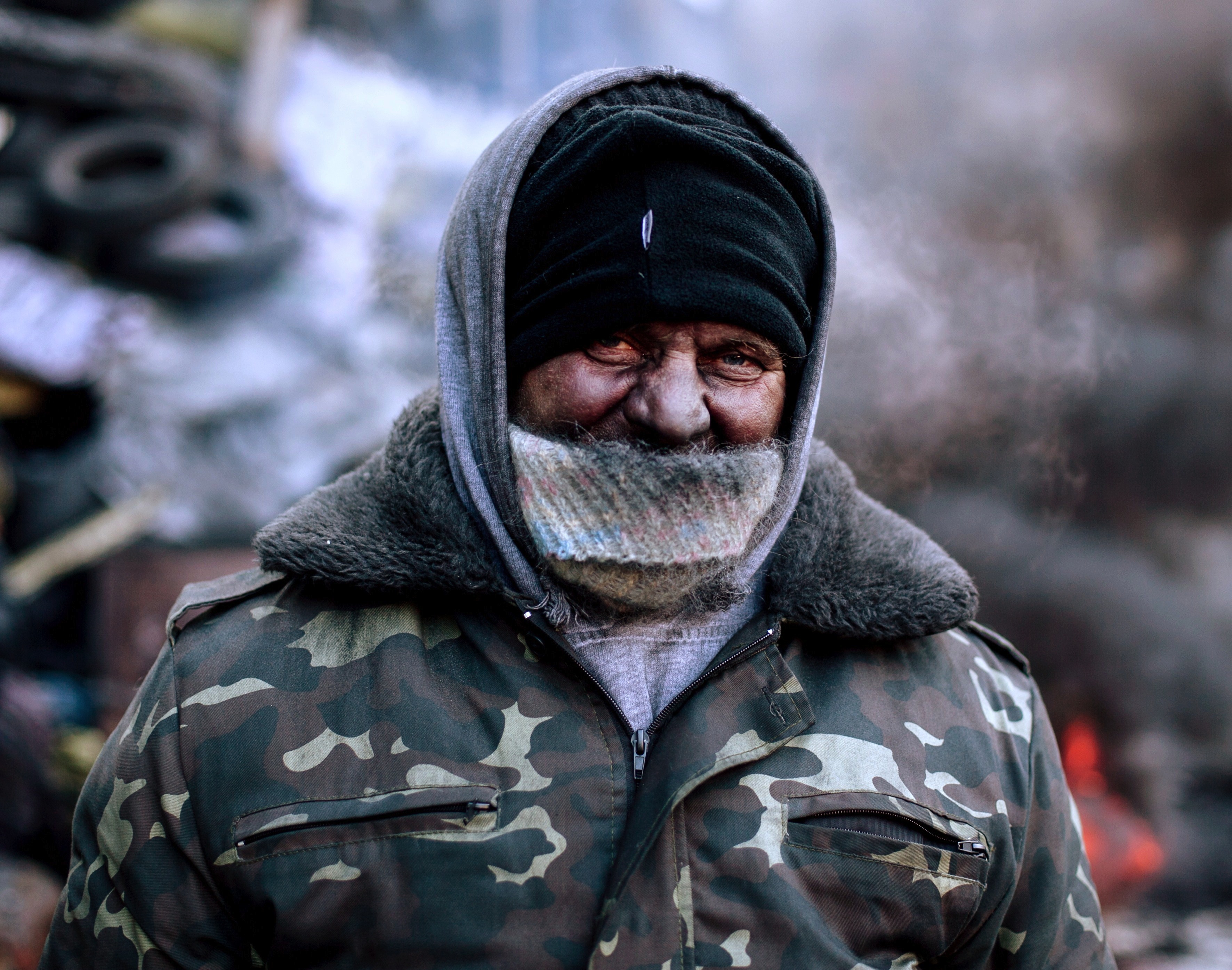
An anti-government protester stands at a demonstrators’ barricade in Kiev on January 31, 2014. A bill passed by Ukraine’s parliament to amnesty arrested activists gives protesters a 15-day deadline to leave occupied streets and administrative buildings otherwise it will not be implemented, according to the text published the day before. The Ukrainian army has previously said it would not interfere in the protests, which erupted in November after Yanukovych scrapped an integration deal with the European Union in favour of closer ties with Kiev’s historical master Moscow. By Angelos Tzortzinis/AFP/Getty Images.
In a desperate effort to appease opposition protesters, Ukraine’s Prime Minister Mykola Azarov and his government resigned today, while parliament repealed a draconian anti-demonstration law passed two weeks ago. But it may be too little, too late:
“It’s more like a smoke break,” said Sergei Kononenko, who was helping to man the makeshift barricades a short walk from the Presidential residence. “We’re not going anywhere.”
Neither, it seems, is President Viktor Yanukovych. In the past two weeks, as riot police have tried and failed repeatedly to clear the streets, he has shown that he will grant practically any of the protestors’ demands – except his own resignation. “That is non-negotiable,” says Nestor Shufrich, a senior lawmaker from the President’s political party. … As for the party’s options now, he would not say whether force was the only one. “That is up to the President,” he says. But if the protesters still refuse to leave the center of Kiev, and if the President still refuses to leave his post, the stalemate will continue until someone flinches. “That’s when things could get bloody,” says Kononenko, the protester.
[E]xperts warn that historically, once a government starts making concessions, it is more likely to inflame revolution than placate its opposition. “I do not see any signs that the situation can be improved or that compromise can be reached,” says Sergei Gaiday, a political scientist who runs the Kiev-based “social engineering” agency Gaiday.com. “What is happening in parliament no longer has any influence on what is going on out in the streets. The protesters have too many demands, and these are not being met.”
Writing before the latest news broke, Gavin Weise noted how the opposition’s goals had escalated since the protests first broke out in November:
Talk of lesser aims, such as an amnesty for prisoners or opposition representation in Yanukovych’s cabinet, sounds hollow and has probably come too late. After this week’s spreading violence and last week’s Russian-style legislation limiting freedom of assembly and speech, growing numbers of Ukrainians just want to see Yanukovych and his cronies punished and exiled from the political world.
A handful of passionate readers are pressing us to stay on top of things:
US press coverage is, on the whole, pathetic. Anne Applebaum’s recent piece is the most intelligent assessment I’ve read yet. BBC and The Guardian have some good articles. The German press is somewhat better; Der Zeit is doing a pretty good job, because they have contacts on the ground. But Twitter is the best place to work from. Start with #Euromaidan, and work from there.
Please, do more. What has happened since your last post is truly extraordinary.
Another reader who was in Ukraine recently recommends the Facebook page of Euromaiden, which is “translating into English the latest news being passed along the social networks and the Internet.” Another:
Ukrainska Pravda has a live feed that’s updating every day in English. Here’s a summary of what’s going on and an updated map of who is in control of what from yesterday. My friends who are there/have family there have been warning that the Internet in Ukraine and Kyiv might go down, so I’m not sure how accurate any updates can be or will be.
Another reader from a few days ago takes stock:
Sit with this news from Ukraine for a second. A country of 40 million people in the heart of Europe, divided between a pro-European, conservative-to-liberal, Christian (Catholic and Orthdox) west that is corrupt and a pro-Russian, illiberal east that lives by corruption too is descending into an extremely dangerous political crisis.
The president of the country, twice convicted of violent crimes in his youth, has grown obscenely wealthy at the expense of the people of his country, while mouthing platitudes about joining Europe. When he turns his back on Europe in November, protests turn up in Kyiv. That very night, student activists are beaten, some very seriously. Ukrainian society is outraged and the protests grow even more massive.
The protests last for weeks on end, and they attempt to disperse them violently December 11. The opposition negotiates with the government. Then things settle down. Then the government once again provokes the protesters by passing an insane law outlawing any protest activity whatsoever on January 17. Banned are: wearing helmets, wearing camouflage, driving in groups of more than 5 vehicles, criticizing the judiciary, and retroactively giving amnesty to members of the “Berkut” riot police for any beatings that they have delivered to protesters. It is at this point that the violence has truly escalated and protesters have began to arm themselves with clubs and helmets and actively fight with the police. I lived in Ukraine for 13 months in the last couple of years and can testify firsthand that the place is seething with political discontent with the Yanukovych regime. They will not be satisfied with anything short of a change in government; if Russia intervenes, the western half of Ukraine will fight to the death to defend its long-repressed statehood.
Given Ukraine’s regional divisions (which may be exaggerated, but which are nevertheless real), half the country completely rejects the legitimacy of the Yanukovych government. And they will be willing to fight the government, leading to a possible Syrian scenario in a state that borders on the European Union. When will Europeans wake up and see that this directly affects them? Ukraine is not some forgotten Siberia thousands of miles from Paris and Berlin (not to mention London). It is a border state with Poland, Slovakia, Romania, Hungary, Moldova, and Belarus! Not only that, but the fate of democracy and market reforms there are a hugely influential example to all of the post-Soviet states, from Belarus to Moldova to Kazakhstan and all the way to Moscow itself. If democracy in Ukraine succeeds, ordinary Russians will be forced to ask themselves, why not here?
And with all of this at stake, Obama remains absolutely silent. And you have remained largely silent yourself. Please! I urge you: take some time to reflect on this crisis and the stakes that it has for the U.S. and especially for Europe. I should mention that the U.S. and Russia are guarantors of the country’s borders and independence as a result of the country’s renunciation of its Soviet-era nuclear arsenal in 1994. This country cannot be ceded to the Russians to do whatever they want with simply because it borders on their country. The futures of millions of people and dozens of my personal friends and family are 0 in a Russian-dominated Ukraine.
I should know: I am the great-grandson of a Ukrainian Greek Catholic priest who spent 10 years in Siberia for continuing to practice his faith – performing baptisms, hearing confessions, and performing the liturgy -after his church was “outlawed” at a spurious synod in 1946. The Ukrainian Greek Catholic Church is by far the largest Eastern Rite Catholic Church, fully in communion with Rome, and for the 42 years during which it was outlawed by the Soviets, it was the largest “catacomb” church in the world.
Please educate yourself and speak out! This is an issue of fundamental importance to security on the European continent and a moral issue par excellence. I was inspired with your coverage of the Green Revolution and wonder why there has been so little about Ukraine! If you want to escape America’s foreign policy fixation on the Middle East, then take an interest in a major foreign policy issue outside of it!
In 2010, Ukrainian President Viktor Yanukovych won all of the country’s Russian-speaking provinces and lost all the others. The recent protests have intensified this split:
Ukraine’s ethno-lingistic political division is sort of like the United States’ “red America” and “blue America” divide, but in many ways much deeper — imagine if red and blue America literally spoke different languages. The current political conflict, which at its most basic level is over whether the country will lean toward Europe or toward Russia, is part of a long-running and unresolved national identity crisis. Yes, it’s also about Yanukovych’s failures to fix the economy and his draconian restrictions against basic freedoms. But there’s so much more to it than that, which helps make the crisis so intractable.
Protests have popped up again in Kiev after the Ukrainian parliament passed a new law that essentially bans demonstrations:
The relatively quiet spell was broken last Thursday, when the Ukrainian parliament passed a series of new laws that seriously limit the scope for protests. The laws were rushed through by President Yanukovych’s supporters, with a show of hands and no time for discussion. Not for the first time, a brawl broke out in parliament. But the voting procedure was clearly fine with Yanukovych, and the next day he signed the laws.
The laws, summarized in English on this infographic, clearly limit Ukrainians’ freedom of assembly. They introduce penalties for wearing helmets at demos, setting up tents and public stages and distributing “extremist” materials, among other activities. People driving cars in columns of more than five could have their licenses and vehicles confiscated (presumably a response to the increasingly popular “automaidan” initiatives). Foreign observers are particularly dismayed at the law—which could have been copy and pasted from Vladimir Putin’s Russia—that labels NGOs receiving money from abroad “foreign agents.”
Timothy Snyder declares that, “On paper, Ukraine is now a dictatorship”:
In practice, will Ukraine become a dictatorship? Ukrainians have powerful reasons to resist. These laws, now signed by the president, end the Ukrainian republic as they have known it. They also much reduce the possibility of future European integration, something which is yearned for throughout the country, and for that matter among elites and the political class. No one in Brussels or European capitals is going to lobby for a trade deal with a leadership that has explicitly chosen authoritarianism. If these laws are allowed to stand, the future of Ukraine will thus be with Belarus and Russia, for lack of another option. This makes no economic sense, since Europe’s market is bigger and more important. The only kind of sense it makes is political, for a president who knows he is too weak in his own society to win another democratic election.
Hannah Thoburn looks at the fractures within the country:
A large percentage of Ukrainians hold [Ukrainian president Viktor] Yanukovych personally responsible for solving the current political crisis,but his choosing one side over the other will polarize this already divided country more than it has been before. Yanukovych’s political base is in eastern Ukraine, where the majority speak Russian and identify strongly with Russia. Only 17 percent of eastern Ukrainians approve of the protest movement and would be only too happy to see their president quash it in whatever manner he deems necessary. Meanwhile, 80 percent of citizens in the western and more European-leaning part of the country approve of the protest movement and disapprove of the president’s recent decisions. They did not vote for him and will not support him.
While rounding-up videos of the protests, Fisher flags the clip above:
This is important: Most protesters are not violent, and what’s happening in Kiev is not, despite some government assertions to the contrary, a “mass riot.” Still, there’s been violence, with some protesters throwing flares at the vast rows of security forces. This video shows what it looks like from the police’s perspective …
 The Dish