Will Europe Pass Serious Sanctions? Ctd

The answer – finally –  appears to be yes:

Although the European Union agreed last week to consider sanctions against Russia’s energy, defense, and financial industries, it was unclear how far they would go. It’s still uncertain how broad the sanctions will be, but the call on Monday indicated a change of tone from last week, when EU politicians were trading barbs over whether Britain or France was more reliant on Moscow’s money.

The EU will likely restrict each industry slightly, rather than imposing a full ban — such as an arms embargo. That approach would help address the fundamental problem of different EU countries relying more on Russian business in different industries.

Yglesias is excited:

After a five-way conference call between the leaders of Germany, France, the United Kingdom, and Italy the European Union seems ready to outline tough new sanctions on Russia. Not just the shooting down of MH 17, but Russia’s total lack of remorse or post-shootdown restrain appears to have been a game-changer in terms of German politics and that’s been enough to swing the situation around. The sanctions package is looking very similar to ideas outlined last week in a memo obtained by the Financial Times. The new package belies the notion of a “weak” Europe that is refusing to counter Russian aggression.

But Cassidy doesn’t expect the sanctions to amount to much:

We already know that Russia’s energy sector—which supplies power to many European countries, not just Germany—is likely to escape most of the new restrictions. The exact terms of the arms embargo have yet to be decided, but it isn’t expected to have any effect on existing contracts, such as France’s delivery, later this year, of a Mistral warship. That leaves the new financial sanctions, and I’d be willing to wager that they won’t be as draconian as they might appear, either.

Last week, Anne Applebaum analyzed Putin’s grip on Europe:

Which is worse? France sending Russia a ship that could be used against NATO allies in the Baltic or the Black Sea? Or Britain’s insistence on its right to launder Russian money through London’s financial markets? It was an amusing spat, not least because it plays into the stereotypes: Britain versus France, crooked bankers versus cynical politicians. The dispute dominated headlines as Europeans debated the right response to Russian aggression in eastern Ukraine.

But in some sense, it also disguises the real nature of Russian influence in Europe. For Russia’s strongest political influence is not in relatively large countries such as Britain or France, where at least these things are openly discussed, but rather in weaker countries that barely have a foreign policy debate at all.

Yesterday, Ioffe took a closer look at the EU industries that would be impacted by Russian sanctions

For example, German car manufacturers. Russia is their second-biggest market. If sanctions get in the way of that, German autoworkers are out of some jobs. Or if E.U. sanctions affect defense contracts, French workers building Mistral warships (for which Russia has already paid $1.1 billion) will also find themselves out of a job, and possibly striking. If Russia cuts off titanium exportsit is the world’s largest producer and the best at machining the partsAirbus and Boeing have to stop building Dreamliners and double-deckers.

Countries like Bulgaria and Italy who are reluctant to hit Russia harder are involved in building the South Stream gas pipeline and also see a lot of revenues from Russian tourists. Bulgaria is especially vulnerable: 70 percent of its tourists are Russian. The U.K. financial industry launders a lot of Russian cash, so they are understandably reluctant to voluntarily plug up that flow. Cyprus is in a similar situation, both with Russian tourists and Russian offshores.

“A lot of jobs would be affected, but the macroeconomic effect is less than is often claimed,” says Cliff Kupchan, head of the Russia practice at the Eurasia Group.

Daniel Gross isn’t holding his breath for a bold EU response:

If the EU were suddenly to shut down all the gas pipelines and order Russian oil tankers to turn around, it would certainly inflict some short-term damage on Russia. But there are plenty of other customers out there for Russia’s oil, which is pretty fungible. As for natural gas, the huge new supply deal Putin inked with China means that a large customer will be emerging in Russia’s east. And while European countries could make a point of purchasing oil from non-Russian sources, they don’t have a ready replacement for Russia’s natural gas.

Taking serious steps to reduce purchases of Russian energy would require European leaders to show both moral courage and an overt willingness to inflict financial pain on large and well-connected companies. But both of these things are in short supply—just like natural gas and oil.

Earlier Dish on EU sanctions here.
The Next Phase Of The Ukrainian Conflict

Serhiy Kudelia expects that, if Ukrainian “insurgents are pushed out of big cities, the ongoing asymmetric warfare in Donbas that will be fought largely by conventional means is likely to take the form of an underground guerrilla movement”:

Similar to the PKK in Turkey, ETA in Spain or the IRA in the Northern Ireland, it will rely on sporadic attacks on government and military installations to exhaust the incumbent and damage its governing capacity rather than establish control over a territory. And like Hezbollah in Lebanon or FARC in Colombia, it will rely on outside powers for provision of arms, funds and training. In its new form, guerrilla attacks will likely spill over to other Ukrainian regions, particularly Western Ukraine. According to the latest poll, most Donbas residents (39%) blame radical nationalist organizations for the ongoing conflict, with Western intelligence services being close second (34%).

The path to solving the current conflict in Donbas goes not only through Brussels or Washington, but also through Moscow.

While Russia has become an active participant in the conflict, it is also the only actor with real leverage over the insurgents. By denying them sanctuaries on its territory and ending arms supplies, it will effectively cut their main lifeline. However, the Kremlin will not acquiesce to an outcome that ignores what it views as its legitimate interests in the region with a large ethnic Russian presence. While Russia’s immediate commitment to peace is doubtful, the prospect of a protracted conflict on its border, growing international isolation and risks of regional war is also hardly appealing for Putin. All the sides – Ukraine, Russia and the West – should in principle be interested in finding a sustainable resolution to the conflict. One thing that prevents them from negotiating in earnest now is the belief that their interests will be better served by continued fighting. However, as the recent study of war duration shows, irregular wars last much longer than conventional or symmetric non-conventional wars (113.32 months on average). So if guerrilla war begins there may not be an end to violence in sight.


How Ukrainian Rebels See The World

Noah Sneider provides a glimpse:

There was hope that the tragedy of MH17 would force Russia, Ukraine, and the rebels to wake up from their post-Soviet fever dream. But following the crash, the parallel realities that exist across eastern Ukraine only became sharper. Prospects for peace have all but disappeared. Among rebels, blaming the Ukrainian forces for downing MH17 is an article of faith. Most locals (fed by the Russian media) agree, seeing it as a plot concocted in Kiev to discredit the separatist movement. And the Ukrainian forces, meanwhile, have pressed their offensive further, both at Saur-Mogila and around the cities of Donetsk and Luhansk.

After the recent downing of two Ukrainian fighter jets, Max Fisher sees “no reason to believe that the rebels have become any more cautious or restrained about shooting down airplanes since the MH17 disaster”:

Crucially, the planes were flying at 17,000 feet, according to the Ukrainian government — meaning that shooting them down would, as with MH17, require a sophisticated and highly complicated surface-to-air missile system. That is just way too high to be shot down by amateur fighters wielding shoulder-fired missiles. Ukraine’s rebels have admitted to possessing such military hardware, the Buk (also known as SA-11) surface-to-air system.

The point is that these two most recent jets were shot down by people who had the professional military training necessary to operate complex, vehicle-based missile systems.

Meanwhile, Olga Kashin profiles separatist leader Igor Strelkov:

Through all the years of Putin’s rule, Russian politics had become a dull play, with fictitious political parties and a Parliament in Putin’s pocket. Political journalists were forced to write day after day about meaningless initiatives and empty statements. Everything changed when the Ukrainian crisis began: For the first time in many years, there was an epic drama involving imperial ambitions, business interests, history, geopolitics, and warfare. Reenactor Igor Strelkov became the main hero of this drama. He has, perhaps, more fans in Russia now than any politician of the older generation, of whom the Russian television viewer has long grown weary. The Russian journalist Andrei Arkhangelsky conducted a special study of Russian talk radio stations and has come to the conclusion that Strelkov’s name is mentioned even more frequently than Putin’s. Arkhangelsky even speaks of a “Strelkov generation” that has come to replace the “Putin generation”but this is an exaggeration. Putin needed Strelkov in order to rattle the new Ukrainian authorities. Thanks to him, part of the Ukrainian territory has remained volatile, and this has allowed Putin to claim that Kiev is not in control, that Ukraine’s revolution is a dead end.

But now that Strelkov is suspected of international terrorism, Putin will not need him much longer. Probably in the coming days, Vladimir Putin will do everything possible to get rid of an ally who has become a deadly danger, whose war games now force Putin to make midnight phone calls to Western leaders and to publically justify himself in a way unheard of in Putin’s Russia.

Anna Nemtsova also covers Strelkov:

An article published by Strelkov’s adviser, Igor Druzd, on Wednesday laid out the case that Putin, today, is facing the same choice that ousted Ukrainian President Victor Yanukovych faced a few months ago: either send in the army and win control over Novorossia territories in eastern Ukraine—or lose his presidency. “I hope that the Ukrainian tragedy will neither become the tragedy of Russia nor the personal tragedy of Putin,” wrote Strelkov’s adviser.

Ukrainian authorities insist that, in fact, Russian heavy weapons already are deployed and Russian personnel already are fighting in Donbass, as eastern Ukraine is known. The Ukrainian authorities say it was the Kremlin, specifically Russian Defense Minister Sergei Shoygu, which coordinated all Strelkov’s actions.

Putin Isn’t Backing Down

Janine Davidson is distressed:

[T]he lack of de-escalation and the media war being conducted by Putin are both alarming signals to the international community that this tragedy has not fractured the resolve of the pro-Russian separatists, nor those in the shadows supporting them.  Since the downing of MH-17, pro-Russian separatists have used surface-to-air missiles to bring down two more Ukrainian military jets; for now, there seems no interest in dialing down hostilities.

Eugene Rumer advocates talking to Putin:

It is impossible to rewind this tape, but even at this late point in the crisis there is no substitute for talks and compromise. A military solution is out of the question. Putin has made it clear that he does not want to send his army into Ukraine. He has also made it clear that he can and fully intends to keep Kyiv from winning the war in Eastern Ukraine by sending more fighters and more weapons there. At this point freezing the conflict in place and then looking for a way out of it appears as the only possible option. But that requires talking by all parties to all parties without preconditions. Piling on sanctions and arming Ukraine will only prolong this crisis.

Heidi Hardt downplays the value of direct negotiations between Russia and NATO:

The least costly but least effective route would be for NATO to reopen formal communications with Russia. As of May 1, NATO officially suspended all cooperation with Russia, including cooperation on terrorism, proliferation and other areas related to peace and security. As James Goldgeier writes, Russian President Vladimir Putin ultimately ‘wants instability, not stability, in Ukraine,’ suggesting that pressure for a negotiated solution may have some value. Putin, however, has shown resilience to both diplomacy and targeted sanctions in past crises, such as the 2008 Georgia conflict. This suggests that a return to dialogue or even offering Russia the benefit of reengaging in civilian cooperation would have limited value for convincing the government to stop arming and supporting the separatists.

Masha Gessen posits that Putin “has not lost his resolve to take eastern Ukraine, nor has it been affirmed—Ukraine has very little to do with this story at all”:

It’s not Ukraine that Putin has been waging war against: It’s the West. And if you analyze the Russian president’s statements and actions in the past week through the prism of Putin’s great anti-Western campaign, you will find very few contradictions in them—and even less reason to hope for peace.

Over the course of two and a half years, since starting his third term as Russian president against the backdrop of mass protests, Putin has come to both embody and rely on a new, aggressively anti-Western ideology. It began with simple queer-baiting of protesters, which included accusing them of being agents of the U.S. State Department, and quickly transformed into an all-encompassing view of Russia and the world that proved shockingly powerful in uniting and mobilizing Russia. The enemy against which the country has united is the West and its contemporary values, which are seen as threatening Russia and its traditional values. It is a war of civilizations, in which Ukraine simply happened to be the site of the first all-out battle. In this picture, Russia is fighting Western expansionism in Ukraine, protecting not just itself and local Russian speakers but the world from the spread of what they call “homosfascism,” by which they mean an insistence on the universality of human rights.

Will Europe Pass Serious Sanctions? Ctd

Russian Exports

The Bloomberg editors condemn European states for dithering over Russian sanctions:

It’s true that sanctions alone may not persuade Putin to end his support of separatists in Ukraine. But there’s a chance they might — and even if they don’t, they’re still worthwhile. One thing sanctions can do — and there is some evidence they are hurting Russia’s economy already — is deter future behavior. If Putin has unleashed a nationalist hunger to restore Russian dominance that he has lost either the will or the ability to control, all the more reason to cut off the arms and money that fuel further adventures, in Ukraine or elsewhere.

Steve LeVine suggests targeting Gazprom could be effective:

Some analysts think that Putin is awaiting a sign of greater Western toughness in reaction to the crash of Malaysia Airlines 17 before deciding what he does next in Ukraine. “If Europe is only going to wag its finger—if he can get away with this kind of crisis—he will be encouraged to destabilize Ukraine even more,” Itzhak Brudny, a professor at the Hebrew University of Jerusalem, told Quartz. Targeting Gazprom—or even hinting that such a move is on the table—could be the best way to display that toughness.

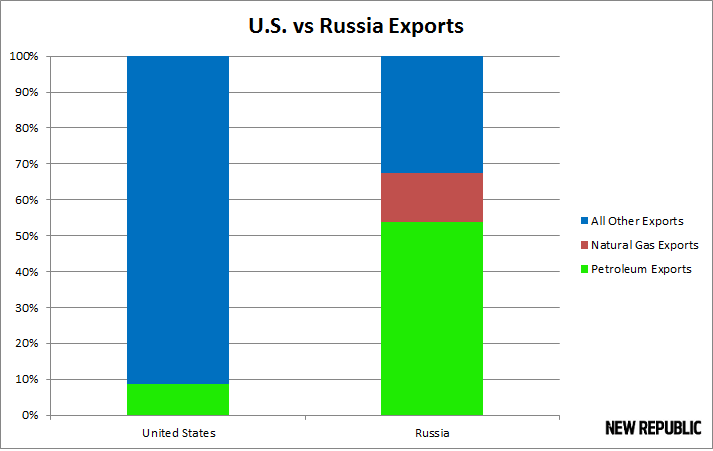
Danny Vinik demonstrates Russia’s reliance on energy exports with the above chart:

This is a double-edged sword: The dependence gives the world significant leverage to inflict economic damage on the Kremlin, but Europe’s reliance on Russian energy exports puts their economies at risk if they follow through on that threat.

Consider: In 2013, the United States exported more than $1.5 trillion of goods. Of those, just $137 billion were either crude oil or petroleum products. (Due to the Energy Department’s slow approval process, the U.S. has a de facto ban on natural gas exports.) In Russia, on the other hand, the export of crude oil, petroleum products, and natural gas made up more than two-thirds of their total exports … Oil and gas revenues make up more than 50 percent of the Russian government’s total revenue, most of it coming from Europe. If the Eurozone nations decided to reduce or end their purchases of Russian oil and natural gas, it would leave a massive hole in the nation’s budget.

Mark Whitehouse observes that “Europe’s economic ties to Russia are much stronger than they were when Putin came to power”:

Back in February 1999, soon after he took over from former President Boris Yeltsin, Russia’s share of German exports and imports was less than half what it is today. Apparently, building new pipelines to Europe has served Russia’s geopolitical interests well.

Jason Karaian finds that European public opinion is turning against Russia:

After the downing of a Malaysia Airlines plane in eastern Ukraine, more than half of Germans polled now support trade sanctions against Russia. This is a big jump from a similar survey in March, just after Russia’s annexation of Crimea … Support for sanctions rose even more in the UK over the same period, which will encourage prime minister David Cameron to keep up the tough talk against Russia, including picking fights with allies he deems less committed to the cause. But the British public is less keen on freezing financial assets than imposing trade embargoes, perhaps reflecting how much Russian cash currently flows through London’s financial center.

Earlier Dish on possible EU sanctions here.

How The Dutch Mourn

NETHERLANDS-UKRAINE-RUSSIA-MALAYSIA-CRISIS-VICTIMS

Russell Shorto admires it:

The Dutch are strikingly different from Americans in their gut reactions to things. When hit with a national shock, Americans will almost instinctively reach for ideology or ideals. People saw 9/11 as an assault on “freedom.” The Dutch have an innate distrust of ideology. You could relate that to World War II and their experience under Nazism, but it goes much farther back. It has something to do with being a small country surrounded by larger countries that have had long histories of asserting themselves.

It also stems from the fact that Dutch society grew not out of war against a human foe but out of the struggle against nature. Living in low lands on a vast river delta, the Dutch came together to battle water. Building dams and dikes and canals was more practical than ideological. For better or worse, the Dutch are more comfortable with meetings and remembrances than with calls to arms.

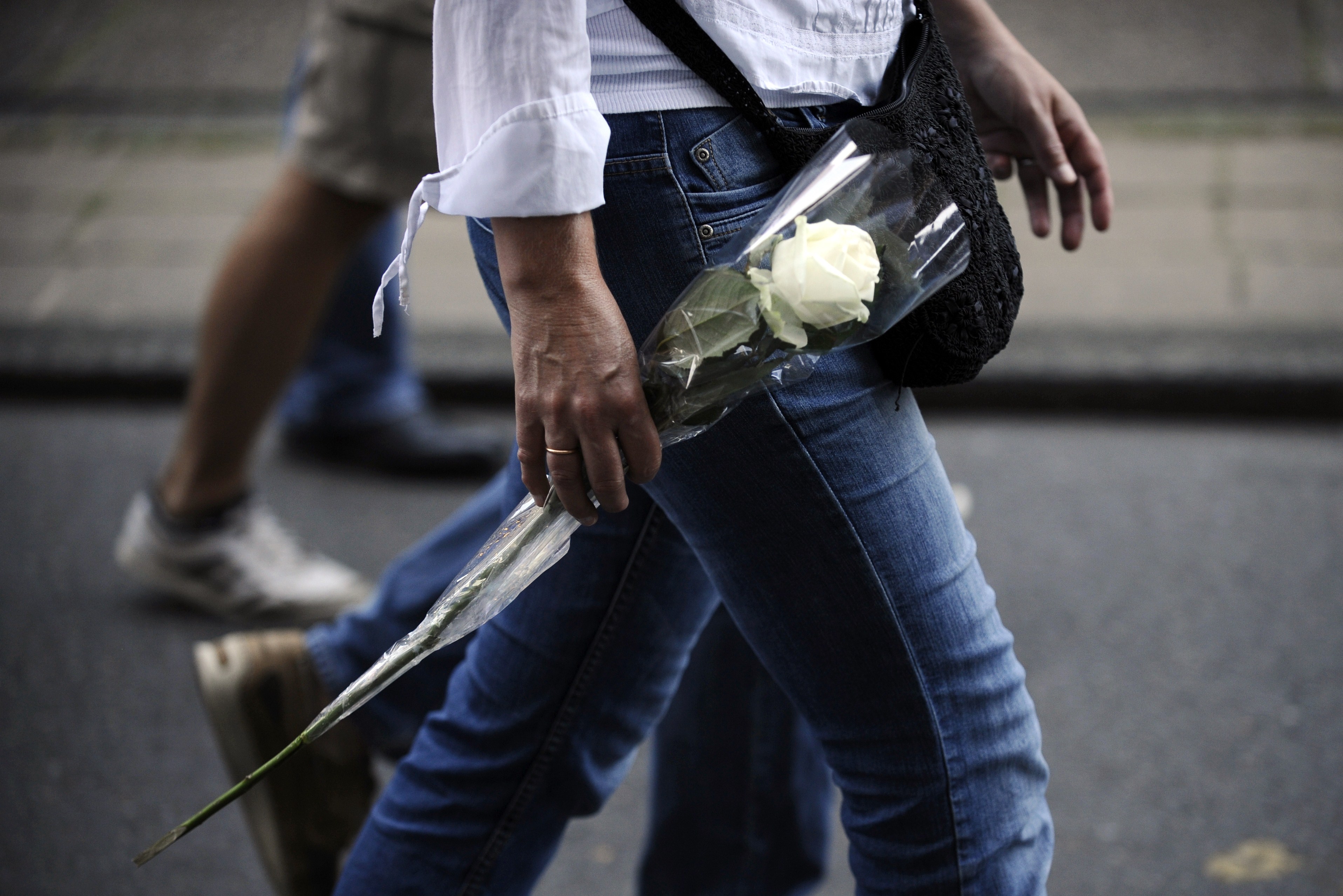
(Photo: A person holds a white rose during a silent march in memory of the victims of the downed Malaysia Airlines flight MH17, on July 23, 2014 in Amsterdam. By John Thys/AFP/Getty Images)

Our Sketchy Intel On Ukraine

UKRAINE-RUSSIA-CRISIS-MALAYSIA-ACCIDENT-CRASH

The government shared some of it yesterday. Shane Harris summarizes:

The officials offered little new information about the MH17 investigation, except to say that U.S. intelligence analysts are now persuaded that the jet was downed by accident, likely by forces who believed they were taking aim at a Ukrainian military aircraft. The officials circulated widely available information, including photographs of the suspected missile launcher posted to social media in recent days, and pointed to voice recordings posted to YouTube of separatists acknowledging that they shot down a jet, which they later discovered was a civilian plane. One official stressed that analysts weren’t relying solely on social media information, such as tweets and online videos. But nothing in the agencies’ classified files has brought them any closer to definitively blaming Russia.

Max Fisher’s two cents:

What’s perhaps more interesting is what the US intelligence officials would not say: that the attack was deliberate or that Russia pulled the trigger. The officials said they suspected the rebels fired on a commercial airliner mistakenly; this too had become conventional wisdom, as the rebels had only previously fired on Ukrainian military aircraft, but the hint of possible confirmation is something.

But the rebels compromised the wreckage, which makes our investigation much more difficult:

While Malaysia was finally able to recover the black boxes from the rebels at the crash site, investigators at the site have determined other evidence has been “significantly altered.” Michael Bociurkiw, a spokesperson for the Organization for Security and Cooperation in Europe, has said large pieces of the front of the plane have been cut away. Investigators have seen power tools on the site, used to cut into the fuselage. Rebels said their reasoning was to move the large plane pieces in order to retrieve bodies. However, OSCE said the cuts made were “very invasive.”

Clive Irving doesn’t think this obstacle is insurmountable:

There has been a lot of concern about contamination of the evidence at the site. In reality, it’s hard to deliberately mess up a debris field as large as this one. First of all, you would need to know which bits are likely to be the most damning, a knowledge unlikely to be present in this case. Secondly, large pieces of wreckage can’t be moved without someone seeing that happening. And, thirdly, even if you are moving pieces of wreckage, there are eyes in the sky watching it all from satellites.

Patrick Tucker explains what investigators will be looking for:

If the Obama administration is correct, what will the ground evidence show? The distribution of debris, once fully catalogued, would confirm a violent sudden explosion, as opposed to a long trail of parts indicating a slow breaking apart and would include missile shrapnel. It would also show that the radar-guided missile likely exploded within about 65 feet from the target. Infrared imaging might show explosive residue somewhat evenly distributed on the bottom of the plane.  Conversely, an excessive amount of explosive residue on the engines could indicate that the missile was heat seeking and not shot from an SA-11 and that the U.S. was wrong.

Mark Galeotti worries about Putin taking advantage of a lengthy investigation:

You don’t need to be a fan of the vintage British political sitcom Yes Minister to know that inquiries can as easily be used as tools of obfuscation and delay. As the suavely cynical Sir Humphrey Appleby puts it in one episode, “The job of a professionally conducted internal inquiry is to unearth a great mass of no evidence.”

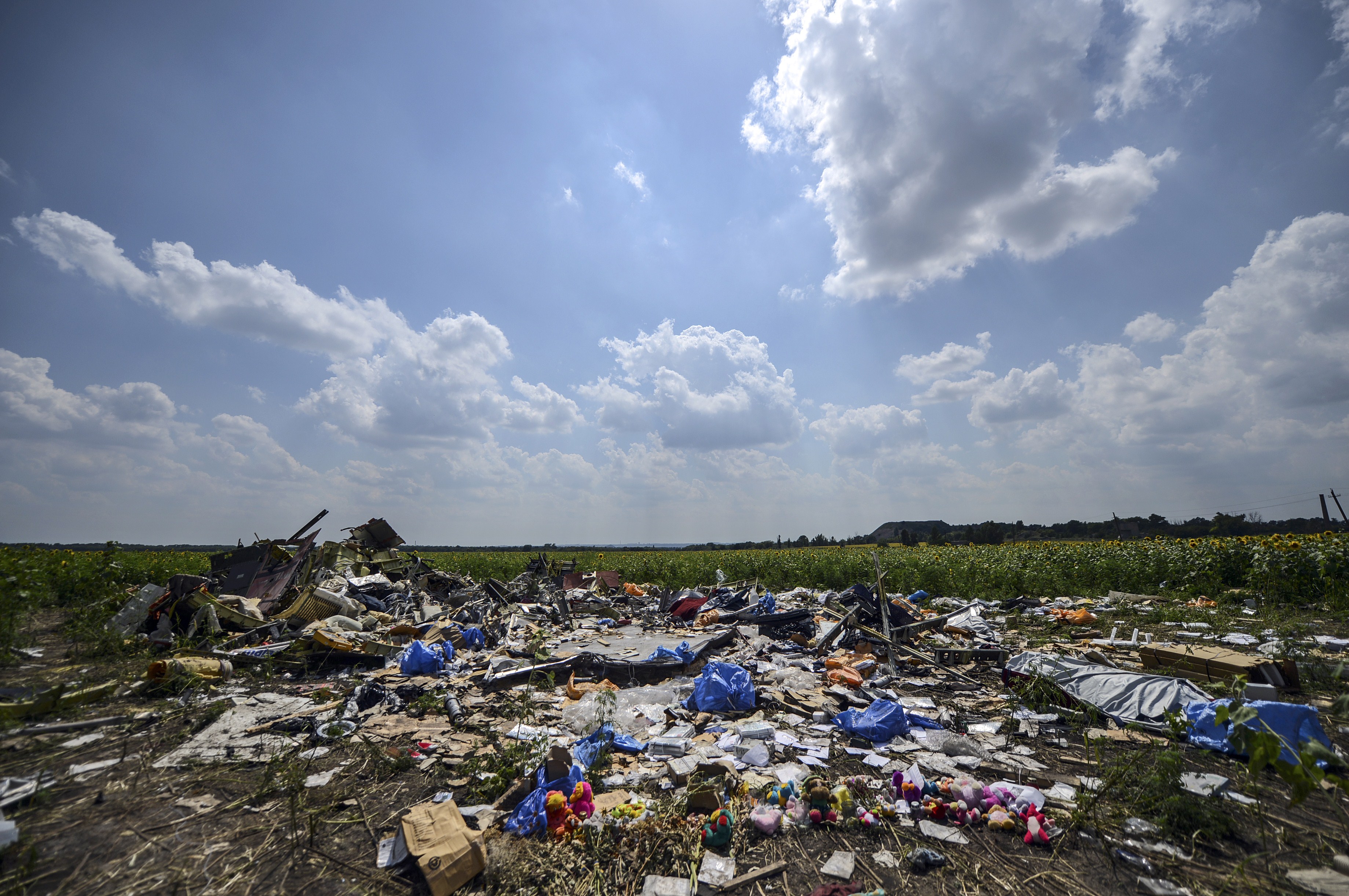
(Photo: A photo taken on July 23, 2014 shows the crash site of the downed Malaysia Airlines flight MH17, in a field near the village of Grabove, in the Donetsk region. The first bodies from flight MH17 arrived in the Netherlands on July 23 almost a week after it was shot down over Ukraine, with grieving relatives and the king and queen solemnly receiving the as yet unidentified victims. By Bulent Kilic/AFP/Getty Images)

Will Europe Pass Serious Sanctions? Ctd

foriegn markets

Yglesias argues that the EU is in the driver’s seat:

Here’s the one fact you need to know to understand where the real balance of power lies: Russia’s top trading partner is the European Union, but the EU’s top trading partner is the United States followed by China. In other words, the 306 billion euro trading relationship is a big deal either way you slice it, but it’s fundamentally a bigger deal for Russia than it is for Europe

And, as Tim Fernholz illustrates with the above chart, the Dutch have significant Russian capital under their control:

It’s no accident that Netherlands is one Russia’s largest offshore-financial centers—it has actively welcomed capital flows from multinational companies seeking to avoid taxes and scrutiny, and it just so happens many of those companies are Russian, often with ties to the Kremlin. That capital is useful for a small country like the Netherlands, but if investigators are able to prove allegations of Russian involvement in the air disaster, it will put the Netherlands’ financial sector in an uncomfortable bind: Can it be a banker to Russia’s biggest companies while Putin’s regime supports groups that murder Dutch citizens?

Yglesias, in another post, assumes that Europe will crack down on Russia eventually:

[N]o anti-Russian move comes without some costs. And those costs fall differently on different European countries. So everyone’s preference is for someone else to bear the cost. But that doesn’t mean nothing will be done. It merely means that some arrangement needs to be worked out to share the burden. That takes time. But pressure on Putin is steadily ratcheting up, and the Russian leader is fitfully trying to distance himself from his own overreach in Ukraine. Europe is slow, not weak.

Earlier Dish on possible EU sanctions here.

The Best Of The Dish Today

There’s always a moment – sooner or later – when a regime propped up by lies will have to account for an empirical reality that refutes it and threatens to bring the entire edifice down. That’s the potentially game-changing significance of MH17, it seems to me.

Here’s Putin’s strange 13 minute address to Russians today on foreign policy – after his deeply weird televised address at 2 am. He’s visibly panicking; and the faces of his colleagues are quite a study:

This embed is invalid

Notice the petulant raging at Ukraine and then the litany of paranoia and isolation: “we know what’s really going on.” No wonder the Russian population had to be talked down from widespread panic at the thought of an imminent invasion by the West! That’s how far Putin had ratcheted up the hysteria – a very dangerous place for a leader with nukes to be in. A reader who has been monitoring the Russian Internet writes:

As you can imagine, the last few days have been a rollercoaster ride on the runet. The first reaction to the downing of MH17 was panic. They were trying to shoot down Putin’s plane! Two doubles took off from Russian President Vladimir Putin Visits SamaraAmsterdam at the same time, one filled with corpses who all had new passports and totally new Facebook pages!

The second wave of the pro-Putinists was despair – “It is all over now! The only thing standing between us and slavery to Western interests is our beloved Vladimir Vladimirovich Putin!”

Now, already, it seems that they are quickly realizing that “everything has changed.” The anti-Putin journalists and posters are becoming much more courageous than they have been in recent months about opposing Putin directly. Here is a piece from Slon.ru, the Russian version of Salon:

The nighttime address to the nation was something unprecedented, and even more unprecedented was its content, in the sense that there was no content in this speech at all.  Why did Putin call up his press service, cameramen, make-up artists, and internet site workers and many others at 2 in the morning? Just to repeat once more that there would have been no tragedy if there hadn’t been any war in the Donbass, to call for peace negotiations and inviting ICAO aviation experts to the site of the crash? Couldn’t these two and a half points waited until the morning?

The pro-Putin people have seen their arguments fall to pieces against the reality of the situation. Putin is being portrayed as in a total panic. The anti-Putin forces are worried about what he might do in such a state, but he is no longer being seen as the magician in control.

All of which makes me appreciate the deliberativeness of Obama’s response, praised by my reader earlier today. Putin is blustering, lying, and using the crudest of means to impose his will on Ukraine. Obama is just slowly raising the costs – and those just got a lot more onerous for Russia. Today, the Europeans finally approved of a host of new sanctions, yet to be implemented. That may give Putin some room to climb down. But it won’t be easy. That’s the look on Putin’s face. It’s called rattled.

Today, because the news isn’t depressing enough, we checked in on Syria’s civil war. It makes Gaza look like a side-show: up to 700 people were killed last Thursday and Friday in clashes between ISIS and Assad. Next up: Libya teeters toward ever more chaos.

I sought relief in two stand-bys: Oakeshott, the last great English Romantic, and Montaigne – yes, we kicked off our third book club discussion today. You can buy How To Live here.

The most popular post of the day was For Israel, There Is No Such Thing As An innocent Gazan; followed by Putin Creates His Own Reality.

Many of today’s posts were updated with your emails – read them all here.  You can always leave your unfiltered comments at our Facebook page and @sullydish. 36 more readers became subscribers today. You can join them here – and get access to all the readons and Deep Dish – for a little as $1.99 month. Gift subscriptions are available here. A Founding Member writes:

I’ve been dragging my heels on renewing my subscription to The Dish. But the events of the last few weeks – clashes in Gaza, Central American children spilling into the U.S. border, the downing of a Malaysian Airliner in the skies over Ukraine, not to mention the bits and bobs of spirituality, pictures, gay sensibilities etc. etc. – demand the re-up.

I’ve got my NYT, my Gawker and yes, I hate to admit it, my Daily Mail, but I find the in-depth offerings on The Dish to be so much more nuanced, thoughtful and just off-kilter enough to make me want to read more, reflect, and oftentimes enlarge the scope of my viewpoint. Not sure what the future of media will be – digital, print, visual – but somehow, somewhere, I think you are going to be in the mix – annoying, exciting, comforting, challenging.

See you in the morning.

Some Clarity On Russia And Ukraine

Anne Applebaum has a really sober and accurate description of what has been going on:

This embed is invalid

A reader adds:

For too long, news reports have spoken of the “Ukrainian rebels” as if the warfare underway in the Donetsk to Luhansk corridor were some sort of bona fide local uprising. It is true that the populace in this zone have pro-Russian sympathies. But the suggestion that they rose up against Kiev is nonsense. Everyone who has looked closely at these operations–starting with a study of the personnel who sprouted up out of nowhere as local “mayors” or “leaders” has come to the same conclusion–this is a very sophisticated covert operation of Russian intelligence, using Russian personnel with clear links to the Russian intelligence services (but covert nevertheless) in all the starring roles, drawing on support from regular Russian military as well as the elite Spetsnaz units, with money, weapons, munitions and logistical support all supplied with a go-ahead from the Kremlin. In other words, Putin really is calling all the shots–including telling the “Ukrainian rebels” to make a show of being independent.

Now, that being established, let us not lose sight of the fact that the United States decided back in the Bush years to rely principally on covert operations for its counterterrorism operations, and Obama fully embraced this.

This is the reason for the full militarization of the CIA, its outfitting with its own air force, and the revving up of JSOC as the covert military unit of the Pentagon. The Kremlin has tracked all of this very carefully, and it’s firmly of the view that if the Americans can wage covert war around the globe using the CIA/JSOC, so can they, using their Spetsnaz and their covert military operations. This in no way excuses MH17, of course, but it provides some important context.

The U.S. decision to turn steadily in the direction of covert warfare has consequences, and we see some of them in the tools used by the Kremlin to fight in Ukraine. It’s a darker, nastier world, and Obama’s decisions have made a significant contribution to that.

Notwithstanding that observation, I’d say his handling of the MH17 incident, and the rest of the Russian adventure in Ukraine, has been pitch perfect. I can hardly imagine where we’d be with someone like John McCain or Butters at the helm. Probably inching our way towards global thermonuclear war… over whether Donetsk and Luhansk are part of Ukraine or part of Russia (talk about issues which matter not an iota in terms of U.S. national interest).