Flying Over A Conflict Zone

It’s more common than you’d think:

Since April, the Federal Aviation Administration had banned U.S. carriers from flying over Crimea and the Black Sea (due to potential miscommunication between Ukrainian and Russian air traffic officials and “related potential misidentification of civil aircraft”). But that no-fly zone did not include the mainland part of Ukraine where the Malaysian flight appeared to go down — and where the airline had flown regularly, once a day, in recent weeks.

The jet was on a major route:

Even more worrying is that the planned path that brought MH17 near the disputed region, known as airway L980, is one of the most popular and most congested air routes in the world. L980 is a key link between major international hubs in Europe, such as London Heathrow, Amsterdam Schiphol, and Frankfurt, and Asian megacities, like Singapore, Mumbai, and Hong Kong. The airspace over Ukraine is traveled by virtually every commercial flight from Western Europe to south Asia.

But they are avoiding that airspace now:

“A Game-Changer For Ukraine”

That’s Feaver’s read of the tragedy:

[I]f Ukraine is at fault, then Obama’s options of response are more limited: mainly reinvigorating efforts at negotiation. If Russia or pro-Russian forces are at fault, we will UKRAINE-AVIATION-ACCIDENT-RUSSIA-MALAYSIAlikely see much greater pressure to ratchet up sanctions even more significantly than has happened thus far, albeit in conjunction with reinvigorated efforts along the diplomatic track. Moreover, if Russia or pro-Russian forces are at fault, this puts Putin on the defensive to the point where a meaningful retreat is plausible — not a retreat from Crimea, which appears to be lost, but a retreat on Eastern Ukrainian pressure points — provided that Obama does in fact re-engage at a level commensurate with the stakes.

Ioffe agrees that this is major:

Make no mistake: this is a really, really, really big deal. This is the first downing of a civilian jetliner in this conflict and, if it was the rebels who brought it down, all kinds of ugly things follow. For one thing, what seemed to be gelling into a frozen local conflict has now broken into a new phase, one that directly threatens European security. The plane, let’s recall, was flying from Amsterdam.

For another, U.S. officials have long been saying that there’s only one place that rebels can get this kind of heavy, sophisticated weaponry: Russia. This is why a fresh round of sanctions was announced yesterday. Now, the U.S. and a long-reluctant Europe may be forced to do more and implement less surgical and more painful sanctions.

This also seems to prove that Russia has lost control of the rebels, who have been complaining for some time of being abandoned by President Vladimir Putin.

(Photo: A picture taken on July 17, 2014 shows bodies amongst the wreckages of the Malaysian airliner carrying 295 people from Amsterdam to Kuala Lumpur after it crashed, near the town of Shaktarsk, in rebel-held east Ukraine. By Dominique Faget/AFP/Getty Images)

Did The Rebels Do It?

Ukraine

Max Fisher examines a big piece of evidence:

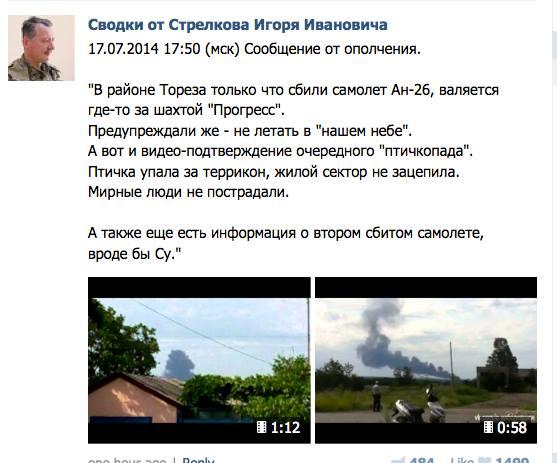
It looked like the smoking gun: exactly 35 minutes after Malaysia Airlines flight 17 went down over eastern Ukraine, a social media account belonging to the eastern Ukrainian rebel commander Igor Strelkov posted a message bragging of having “brought down” an aircraft.

But there this isn’t as clear-cut as it first seemed:

(1) Strelkov’s post, on the Russian social networking site VK, was quickly deleted. A later post appeared to blame Ukrainian government forces for shooting down the plane.

(2) The VK account may not actually be run by Strelkov at all. BuzzFeed’s Max Seddon spoke to eastern Ukrainian rebels who said the page “is a fake made by fans.” If that’s the case, it may be that Strelkov fanboys saw the plane go down, surmised (perhaps wrongly) that rebels had shot them down, and bragged about it on the VK page. It is also possible, to be fair, that the rebels were lying to Seddon about the VK page.

(3) Strelkov’s post appeared to claim credit for shooting down not a civilian airliner but an Antonov AN-26, a two-prop transport plane that is often used by militaries in eastern Europe. The AN-26 is 78 feet long; MH17 was a Boeing 777, which is 242 feet long. It’s possible that rebels mistook the large Boeing 777 for a much smaller AN-26, especially from thousands of feet away. But this casts a bit further doubt on the idea that people fired on the airplane and then posted on VK about it; if someone fired on the plane they likely would have noticed it was a large jet and not a small-ish prop plane.

Ukraine is blaming Russia:

How Hard Is Shooting Down A Jetliner?

Elena Holodny talked to sources on the ground that confirm seeing a Buk missile system near the site of the crash. Alexis Madrigal explains that “it may sound implausible that a group of rebel fighters could take out a 777, but, given the right anti-aircraft weaponry, it is not”:

The Buk system was developed by the old Soviet Union. Its missile batteries are portable. The missiles themselves are radar guided. If one is in the area, and there are people who can operate it, it has the technical capability to shoot missiles far beyond 33,000 feet.

A passenger jet, in particular, would make an easy target, relative to a fighter jet or a rocket. They are big and they move in very predictable straight lines across the sky. Passenger planes emit a transponder signal, too, which could be used for tracking.

Linda Kinstler suspects that whoever “shot down the Malaysia Airlines flight MH17 over Donetsk on Thursday, killing all 295 people aboard, probably didn’t know what they were shooting at”:

It appears that the plane was taken down by a Soviet-era Buk missile system, which separatists claimed to have gotten their hands on when they gained control of a Ukrainian air defense base on June 29. The Buk is a Soviet-era air defense system used by both Ukrainian and Russian defense forces.

“When you’re sitting behind a radar screen of one of these things, there’s no way to tell what it is. With the Buk, there’s no way to distinguish between friendly and foe. You’re just going to take a shot at it,” says Raymond Finch, a Eurasian military analyst at the Foreign Military Studies Office. “If [the separatists] had reports that the Ukrainians were flying over their airspace, they would shoot. It begs the question of who is sitting behind the trigger. Are they highly trained? My guess is no they are not.”

It’s highly possible that the civilian airliner was mistaken for a Ukrainian Il-76 military transport plane, the same model that separatists in Luhansk shot down on June 14, killing all 49 people on board, mostly Ukrainian servicemen.

What The Hell Just Happened Over The Skies Of Ukraine? Ctd

A reader adds:

Reading the coverage and the collection of tweets on your blog, I think it’s worth pointing out that whatever the rebels and anyone else might say, the rebels themselves were touting that they had the Buk system less than three weeks ago!

Another:

After reading this remarkable post on the Guardian site, I discovered a report from only hours ago on the ITAR-TASS site about a Ukrainian military craft being downed by rebels (an An-26 mentioned above). It’s too early to conclude anything, of course, but the evidence so far sure seems to point to a fuck up of horrible dimensions on the part of the rebels.

But another urges caution:

I got home from work early and am a bit of an airplane nut, so I turned on the TV to see if there was anything on about the Malaysian Airlines flight.  I’m flipping through channels and I see wall-to-wall coverage of this crash.  Why?  I’ve been watching an ABC News Special Report and you have Ray Kelly talking about terrorism, you have Richard Clarke talking about terrorism, you have (the normally more composed) Martha Raddtz talking about how this is the scariest time in the world that she can recall.

What the hell are these people talking about???

The only story here is that a passenger plan may have been shot down IN THE MIDDLE OF A MILITARY CONFLICT where there were warnings for commercial flights not to pass through the area.  There is NO suggestion of “terrorism.”  There is NO connection to anything occurring in Israel/Gaza, Syria, Yemen, or Iraq. There is NO connection to ISIS.  So why is the media treating these current events as if they are all connected and that the connection is that they all pose an immediate threat to the United States?

There is an interesting story here, particularly for ramifications for Russia’s relations with the EU and how the Ukraine situation is handled in the future.  But this is not going to cause the U.S. to become involved in World War III with the Russians.  Though it’s hard to think that the U.S. media doesn’t want that.

The hysteria is completely out of control and incredibly irresponsible.  I’m not sure there is anything that can be done about this, but covering these kind of events as if they were 9/11 all over again is going to cause the same post-9/11 mistakes and overreach to be made all over again.

We are tracking the coverage and will post credible updates as soon as we get them. Update from a reader, who responds to the most recent one above:

Terrorism doesn’t begin and end with 9-11 and the Middle East or threats to the United States. I guess I understand how many Americans don’t know about much of the past 50 years of activity of ETA, IRA, Red Army Faction/Baader-Meinhof Group terrorism throughout the world. Even that leaves out terrorism by states such as bombing of Venezuelan commercial airline flights by the CIA. Many people around the globe took to America’s post-9/11 propaganda technique of calling their military opponents “terrorists.” This isn’t anything new.

Another reason this is being called “terrorism” is because the Ukrainian government has called these Russian special forces troops masquerading as separatists “terrorists” from the beginning of the conflict. When Ukraine announced the downing this morning, they immediately called it an act of terror. The only difference between these Russian special forces troops and IS (ISIS) and Al-Qaeda besides affiliations is probably suicide missions. IS is no more deadly than when Russian forces were operating in Chechnya. As was previously reported, these same guys in Ukraine have been doing the same thing for years in Georgia and elsewhere. For a good idea on just what types of scheming Russia is doing to regain some territory lost after the fall of communism check out this Foreign Affairs article. Estonia dealt with the exact same pre-op setup with Russians claiming mistreatment of Russian Estonians and fake protest rallies. Most of the protesters in that situation were undercover Estonian security operatives. Estonia never allowed things to progress to a Crimea or Georgia level.

Another:

If this video posted by the Ukrainian security services isn’t a fake, it is a smoking gun:

It’s in Russian, but essentially you have rebel commanders bragging about shooting down a plane, happily acknowledging it is a civilian one, and subsequently discovering it is Malay.

What The Hell Just Happened Over The Skies Of Ukraine?

https://twitter.com/varlamov/status/489804742068277248

https://twitter.com/MaximEristavi/status/489798171649114112

From the prime minister of Malaysia:

https://twitter.com/jc_stubbs/status/489818073546108929

https://twitter.com/MaximEristavi/status/489806504045084672

https://twitter.com/mike_giglio/status/489798640735903744

https://twitter.com/MatevzNovak/status/489805405565243392

https://twitter.com/DavidKlion/status/489797501088964608

https://twitter.com/shaunwalker7/status/489809889901166592

An unconfirmed report:

https://twitter.com/strobetalbott/status/489809871475593216

The Guardian is live-blogging.

Putin’s Splendid Little War

The Ukrainian government drove pro-Russian separatists out of Slovyansk this weekend and is now vowing to retake the major industrial city of Donetsk. David Patrikarakos reports that the fighters of the “Donetsk People’s Republic” are getting ready to make their last stand:

On July 7, separatists started work protecting the city from attack. They blew up three bridges on key roads leading to Donetsk to slow the advances of the Ukrainian army. (This also damaged the railway lines.) Two other bridges on roads from Slovyansk to Donetsk were also destroyed. The rebels are insulating the city as they get ready to hunker down and prepare for an extended battle.

A siege or stalemate looks like the most likely option.

Poroshenko is determined to recover the east, but shelling Ukraine’s most important industrial city would be disastrous both for the economy and for any hope of reconciling in the future. Meanwhile, the separatists can defend their positions, but the chances of making gains are now unlikely in the extreme. The only real chance now for the rebels to fight back would be if their allies in Moscow accepted separatists’ demands for direct military assistance. But this is equally unlikely, and even the otherwise confident rebels know it.

In fact, Moscow appears to have abandoned the rebels entirely. Ioffe passes along reports that Russia has even closed its border to them:

Not only are they not letting men and materiel into Ukraine from Russia, but they’re also blocking men and materiel from flowing in the opposite direction. That is, the very men that Moscow has riled up to the extent that they have taken up arms and are ready to die in order to get the region out of Ukraine and into Russia are not welcome to seek refuge in Russia. (Not even, it seems, the ones originally from Russia.) A group of 300 fleeing rebels reportedly even came under fire by the Russians as they tried to escape into Russia.

The Russians haven’t confirmed or denied these Ukrainian reports, but it would not be out of step with Russian military history: The Red Army was notorious for its use of so-called barrier troops that were stationed behind active combat troops to prevent retreat. They became especially notorious in World War II when, drowning in the meatgrinder of the German advance, ill-equipped and poorly trained Soviet soldiers (many of them volunteers) were shot for retreating.

But Simon Shuster questions whether Putin can back off from Ukraine without paying a hefty political price:

The rebels were not the only ones to see this as a sign of duplicity. Russian nationalists have begun to turn on him as well, posting diatribes and even music videos that seek to goad Putin into war, juxtaposing his pledges to “defend the Russian world” with images of bombed-out villages and Russian corpses in Ukraine. “We gave them hope,” Alexander Dugin, one of the leading nationalist ideologues in Russia, said during a television appearance last week. “When we said we’re a united Russian civilization, this didn’t just come from a few patriotic forces. It came from the President!” And it will not be easy for Putin to back away from those promises. A nationwide poll taken at the end of June suggested that 40% of Russians supported military intervention in Ukraine, up from 31% only a month earlier.

Drum sees the Russian strongman cutting his losses:

That Putin. He’s quite the guy, isn’t he? It appears that he eventually figured out that Ukraine wasn’t going to fall neatly into his lap, and the cost of fomenting an all-out war there was simply too great. It turned out that Ukrainians themselves didn’t support secession; Western powers were clearly willing to ramp up sanctions if things got too nasty; and the payoff for victory was too small even if he had succeeded. So now he’s had to swallow a new, more pro-Western Ukraine—the very thing that started this whole affair—along with the prospect of renewed anti-Russian enmity from practically every country on his border. But he got Crimea out of the deal. Maybe that made it worth it.

Well, maybe it did. David Silbey still believes Moscow’s meddling in Ukraine was “a pretty deft piece of great power maneuvering”:

Russia has neatly acquired the Crimea, stirred up enough trouble in Ukraine that Western governments have largely stopped talking about that annexation, and all without committing any substantial forces or getting pulled into a Ukrainian civil war. Ukraine is more pro-west, now, sure, but it’s weakened by the loss of the Crimea and the political chaos. Russia’s other neighbors are suspicious of Putin, but, realistically, they’re also aware of their own vulnerability, and are likely to believe (as with the invasion of Georgia) that the west will reconcile with the Russians after a decent interval. What are the statute of limitations for territorial annexation?

The Strategic Dumbness Of Vladimir Putin

Although it was his for the taking a year ago, Alexander Motyl believes Vladimir Putin’s ham-fisted approach to Ukraine has cost him a satellite state. I’ve been wondering who would be the first to take a few steps back and look at the costs and benefits of Putin’s treating Ukraine with such contempt and crudeness. “If you treat a bona fide country with a bona fide people with a bona fide identity as your dirty backyard,” he writes, “don’t be surprised if you slip in the mud and fall on your face.” He makes a good case:

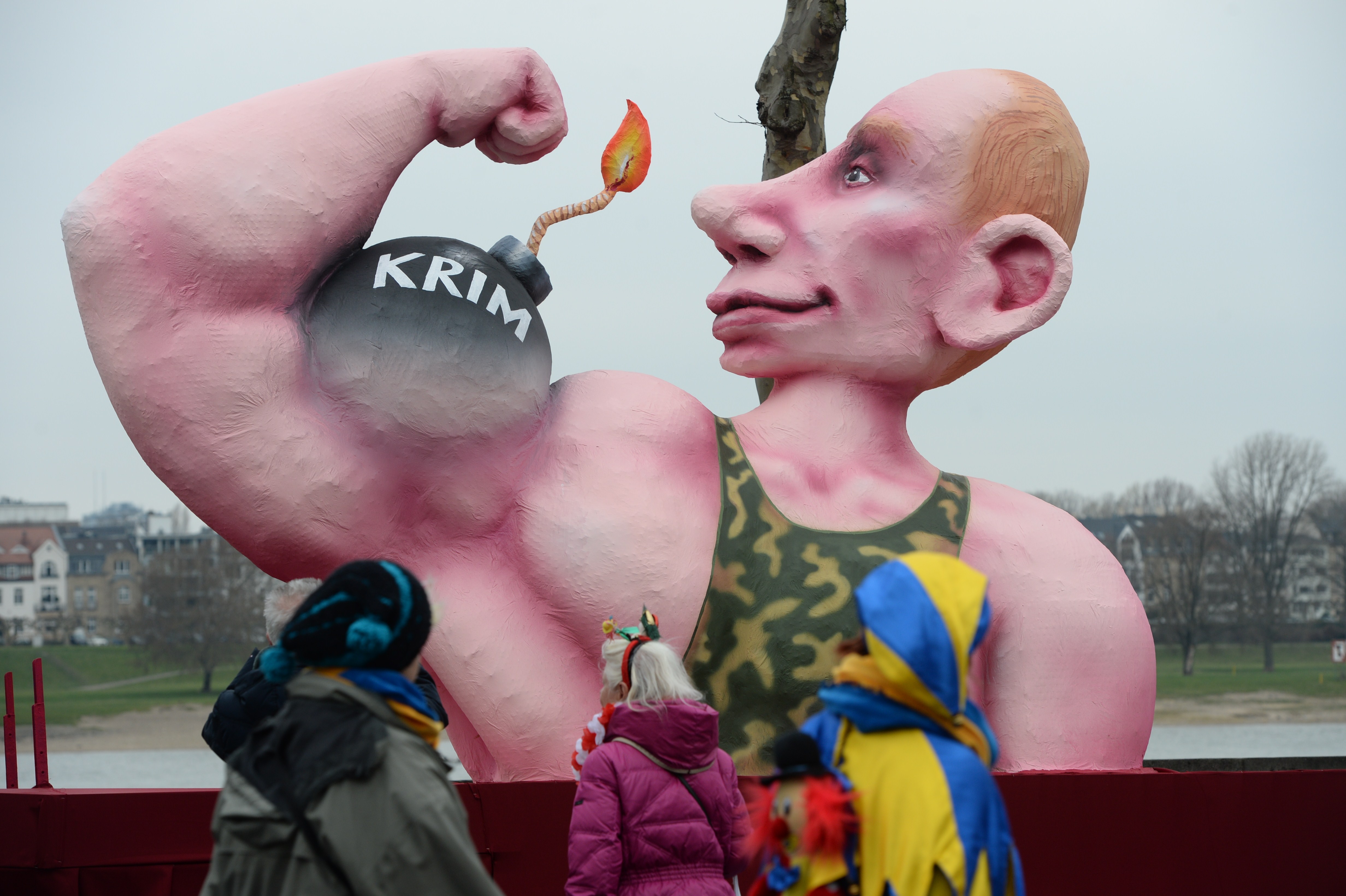
Putin’s first major slip was during the 2004 Orange Revolution, when, stupidly, he backed Viktor Yanukovych. That disaster taught Putin nothing, and, nine years later, he made the same mistake during the Euro Revolution. How could a supposedly smart leader GERMANY-CARNIVAL-ROSE-MONDAY-STREET-PARADEback the same loser—not once, but twice? How could that same supposedly smart leader still insist that the loser remains Ukraine’s legitimate president—even after a fair and free election gave a huge mandate to Petro Poroshenko? The sad thing is that, after 15 years in power, Putin still doesn’t “get” Ukraine.

Putin’s most egregious blunder was to coerce Yanukovych into rejecting the Association Agreement with the European Union last fall. That strategic error led to the demonstrations in Kyiv, Yanukovych’s downfall, the emergence of a pro-Western, democratic Ukraine, and Russia’s transformation into a rogue state and sponsor of terrorism. That’s bad enough. Worse, Putin’s move was premised on his belief that the agreement would remove Ukraine from Russia’s sphere of influence. Sure, it would have provided Ukraine with a foothold in Europe, and, yes, it would have diminished Ukraine’s international isolation in the long run, but a Yanukovych-misruled Ukraine would have remained firmly ensconced in Russia’s backyard for a long time to come.

(Photo: Patrik Stollarz/AFP/Getty Images)

No Gas For U!

As promised, Russia’s energy giant Gazprom cut off gas exports to Ukraine on Monday due to the country’s unpaid bills. But the company says gas will still flow to Western Europe through trans-Ukrainian pipelines. This is obviously not just about payments:

The previous disputes in 2006 and 2009 were largely about payments and price levels – and agreements were eventually reached in a more-or-less business-like fashion. The current situation, which has flared in the wake of Russia’s annexation of Crimea and the on-going conflict in Eastern Ukraine makes it clearer than ever the way in which the Kremlin uses energy exports as a geopolitical lever.

In this context, it is difficult to see how a lasting agreement on gas prices can be brokered without a wider agreement between Ukraine, the EU and Russia on Ukraine’s future and its territorial integrity. The gas dispute is a litmus test of the wider geopolitical crisis and, with no resolution in sight, it promises to be a worrying winter for gas consumers in Europe.

Walter Russell Mead sees the gas war as yet another clever coup for Putin:

All of this is being done with plausible deniability in mind. Moscow is carefully flying below the radar here, not escalating the provocations to the point of formal aggression, but nevertheless having the same effects on Ukrainian stability and viability. Putin is counting on the irresolution of a divided West: as long as the waters are muddy, it’s easier for European countries sitting on the fence to hesitate about taking tougher measures.

With natural gas prices rebounding from a steady decline this spring, Putin is getting more spending money just when he wants it. Put that together with instability in the Middle East—a reminder to Europe that it isn’t easy to free itself from dependence on Russian energy—and it seems that Putin is holding all the good cards these days.

But markets, somewhat surprisingly, aren’t freaking out. Jason Karaian offers several reasons why:

Despite the pipeline explosion, a parallel line was able to carry gas to Europe without too much disruption, Ukraine’s gas company said (link in Ukrainian). The current dispute is also taking place in the warmer months, whereas previous cutoffs came during the dead of winter. The 2011 opening of the Nord Stream pipeline, which pumps gas from Russia to Germany, has reduced the EU’s reliance on gas piped via Ukraine. And, across Europe, gas reserves are unusually high following recent mild weather, and unlike in 2006 and 2009, the pipelines that normally ship gas from Ukraine to the west are now able to reverse their flows, if need be. For these and other reasons, the markets see the dispute as more of a skirmish than a full-blown war.

The Dish previously touched on the natural gas dimension of the Ukraine crisis here.

Meanwhile, Back In Ukraine

The country’s recently elected president, Petro Poroshenko, is trying to cobble together a deal to end the conflict with separatist rebels in the restive east:

In a meeting with the Ukraine’s National Security and Defense Council on Monday, the newly elected president said that he will offer a ceasefire to separatists in the east “as early as this week,” but only on the condition that Ukrainian forces are first able to fully secure the Ukraine-Russia border. The thinking is that once the border is secured, separatists will be cut off from Russian resources and more likely to negotiate on the government’s terms. It will also afford Ukrainian troops some much-needed relief from the aggressive anti-terrorist operation, which killed 49 troops over the weekend when separatists shot down a Ukrainian plane near Luhansk.

Linda Kinstler goes on to give her assessment:

It’s not a bad plan, and it’s certainly a shrewd political move for Poroshenko, who is hoping that the peace plan’s emphasis on decentralization will drum up support for his government among eastern Ukrainians. But there are also a few serious problems that could compromise the entire effort, the first of which is that it is nearly impossible for Ukraine to secure the border at current capacity. …

Even if the border is adequately secured in the near future, it’s unlikely that the separatists will agree to a ceasefire. “That too is an aspirational goal, frankly, because there appear to be many factions, many actors who don’t seem to be reporting to one single controlling authority,” says [the Carnegie Endowment’s Eugene] Rumer. “A ceasefire accepted by one faction doesn’t mean that other factions will accept it.” The separatists already refused to cooperate with the creation of civilian corridors for the evacuation of civilians, despite the fact that both Russia and Ukraine endorsed the effort. There’s no reason to think they’ll agree this time aroundunless, as the Ukrainian government hopes, they are forced to.

Peace can’t come soon enough, as the rebels are getting more and more deeply entrenched. Alec Luhn profiles the “emerging warlords” of eastern Ukraine, whose ultimate loyalties remain unclear:

When pro-Russian protesters first occupied the Donetsk regional administration building in April, different rebel groups and units staked out each of the 11 floors. Since then, these motley bands have been eclipsed by three powerful, armed factions: the Russian Orthodox Army, the Vostok Battalion, and Oplot. Each is built around an influential commander who spends his time not only waging the ongoing guerrilla war against Kiev’s forces, but also dispensing harsh justice and detaining civilians, sometimes for prisoner exchanges. Each group has several hundred men, including Russian volunteers, and heavy armaments. (During a recent visit to Vostok’s base, I saw four fighting vehicles, two anti-aircraft guns, numerous rocket-propelled grenades, and surface-to-air missiles.)

Are these commanders the backbone of an emerging independent East Ukraine, or are they burgeoning warlords staking out their turf for whatever comes next?