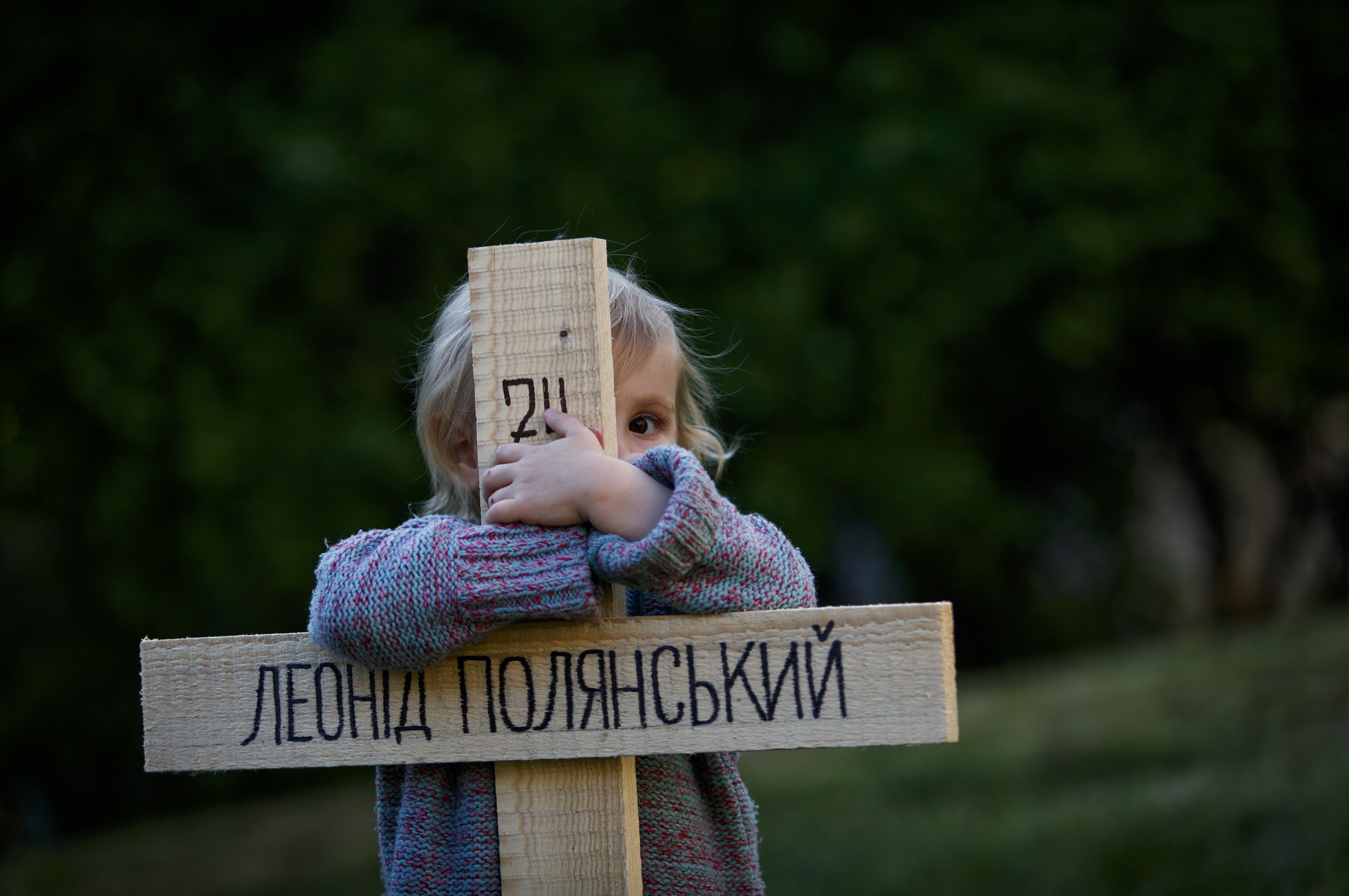
A girl embraces a cross at symbolical cemetery in Prague, Czech Republic on April 23, 2014. Activists placed 107 meter tall wooden crosses each carrying the name of a victim of Ukraine’s Maidan protests. By Matej Divizna/Getty Images.
A girl embraces a cross at symbolical cemetery in Prague, Czech Republic on April 23, 2014. Activists placed 107 meter tall wooden crosses each carrying the name of a victim of Ukraine’s Maidan protests. By Matej Divizna/Getty Images.
Pro-Russian forces in the eastern Ukrainian city have abducted American reporter Simon Ostrovsky (whose latest Vice dispatch from Slovyansk is above):
Ostrovsky, a veteran reporter for a number of outlets, had been filing regular video reports from the region for Vice, including the one above on Ukrainian forces’ botched attempts to retake Slovyansk, which was posted on Sunday. This just the latest is a series of attacks on the press by pro-Russian forces in the area, including the arrest of journalist and activist Irma Krat. [Ostrovsky’s cameraman Frederick] Paxton himself was beaten by a pro-Russian crowd last week. The Committee to Protect Journalists has documented multiple cases of journalists being “assaulted, detained, or obstructed from reporting” in Russian-controlled Crimea.
It seems the insurgents have no plans to release him anytime soon:
“He’s with us. He’s fine,” [the group’s spokeswoman] Stella Khorosheva told The Associated Press, adding, “(We) need to be careful because this is not the first time we’re dealing with spies.” Khorosheva also told The Daily Beast that Ostrovsky is being held according to the “laws of war” because “he was not reporting in a correct way.”
Perhaps more worrisome, the spokeswoman said that the militants had planned the journalist’s kidnapping. “We knew where he was going and the men manning the checkpoint were told to look out for him,” Khorosheva said of Ostrovsky. Sloviansk’s self-declared “mayor” told a journalist that he was holding the Vice News reporter “as is their right, will release him whenever he deems fit.” Speaking to the Russian outlet Gazeta.ru, Vyacheslav Ponomarev said, “We won’t release Ostrovsky any time soon. We need hostages — small change to trade with Kiev.”
Joe Coscarelli suspects the pro-Russians didn’t appreciate his brand of gonzo journalism:
He was … reporting in the Vice and Ostrovsky way, which one reporter described as “poking the bear with a video camera and seeing what reaction he gets.” A dual citizen of the U.S. and Israel, Ostrovsky has spent weeks in Ukraine aggressively covering the conflict by getting in the middle of it. In one clip, he approaches the Russian insurgents only to get roughed up. “Stand fucking still,” the soldier tells him as the camera gets jostled. “I said stand still. I’ll shoot to kill!” (The video has since been made private by the Vice News YouTube channel, but can be seen here.)
Robert Mackey puts the kidnapping in the context of the volatile situation in the city (NYT):
Tensions in Slovyansk spiked over the weekend, when a gun battle late Saturday left at least three men dead in murky circumstances. On Tuesday, Ukraine’s acting president, Oleksander Turchinov said in a statement that government forces would relaunch the operation to quell the separatist movement after it was revealed that one of the “brutally tortured” bodies discovered near Slovyansk was a government official from the president’s own political party.
Before his disappearance, Mr. Ostrovsky reported on Monday via Twitter that Vyachislav Ponomaryov, a pro-Russian activist and the town’s de facto mayor, had berated journalists for “provocative” questions about the town’s former mayor, and a woman pressed reporters to make donations toward the funeral expenses of the separatists killed in the shootout.
Anna Nemtsova discovers that the conflict has engendered a schism of sorts within the Orthodox church:
Throughout Ukraine, where 11,000 Orthodox churches serving over 10 million believers answer to the Moscow Patriarchate, priests prayed for peace without a “fascist” and “neo-Nazi” government, as they call the new authorities in Kiev, but also without war and victims. Yet the leaders of the church hierarchy are drawing their own battle lines in a country divided not only by language and ethnicity, but by the nationalist leanings of the religious patriarchs.
In Kiev, at the height of protests that brought down Yanukovych, Orthodox priests passed through the crowd blessing the demonstrators, and on Easter Sunday there, Patriarch Filaret made a blunt political speech. He described Russia as “evil” and prayed, “Lord, help us resurrect Ukraine.”
In Moscow, Patriarch Kirill addressed an audience that included Russian President Vladimir Putin. Kirill prayed “that peace be restored in the minds and hearts of our brothers and sisters in blood and faith and that the lost ties and cooperation which we all need so much also be restored”—which would sound benign if Putin’s political technicians were not working so hard to shatter peace in Ukraine so the Kremlin can restore “lost ties and cooperation” by invading and annexing the Russian-speaking parts of the country should Putin deem it necessary.
Russia's Lavrov: We view attacks by armed militants in southeastern Ukraine as attempts to provoke a civil war – @mfa_russia
— Maxim Eristavi (@MaximEristavi) April 21, 2014
#Ukraine update 1: Photographic evidence of Russian involvement in unrest in east Ukraine. http://t.co/mEH7Wbt6Mt pic.twitter.com/41SYYbYPXB
— Jim Roberts (@nycjim) April 21, 2014
The agreement signed last week to restore calm in eastern Ukraine quickly unraveled over the weekend, with clashes at a checkpoint in Slovyansk on Sunday that left three pro-Russian separatists dead:
The Russian Foreign Ministry quickly seized on the Easter Sunday clash as evidence that the new Ukrainian government could not keep order. The new mayor of Slovyansk, meanwhile, begged Russian President Vladimir Putin to send “peacekeepers” to protect the people. Ukraine’s leaders fear that Putin is looking for any excuse to take more direct action in the nation’s east, where many residents speak Russian and distrust the central authorities in Kiev. The Security Service of Ukraine called Sunday’s attack a “cynical provocation” staged by pro-Russia elements.
Daniel Berman thinks the Kremlin is looking to sink the agreement:
So why sign an agreement and then immediately torpedo it? Well, perhaps the Kremlin wants to “demonstrate” to the West that they do not control the separatists, and that the West will have to meet their minimum demands in order to gain a lasting cease-fire. Hitherto Kiev, Brussels, and Washington have tried to deal through Moscow on the assumption that Putin, because he had turned on the faucet of unrest could also turn it off.
By “disclaiming” responsibility for the unrest Putin puts Kerry and Ashton in the unfortunate position of having to talk with the separatist, which at a minimum involves recognizing them as legitimate actors who are genuine representatives of their communities. This wold be a devastating concession for Kiev even if the fragmented and chaotic nature of the separatist leadership and almost certain Kremlin sabotage would not render such negotiations futile.
There is a time aspect of this as well. Vice President Biden is arriving in the Ukraine today. Staging supposed Ukrainian “violations” of the cease-fire puts pressure on him in his meetings with Ukrainian leaders to keep the Ukrainian army out of the East, and makes proposals to supply weapons, ammunition and other military aid non-starters, as with a “truce” nominally in place, such efforts would be hostile acts.
On Friday, Michael Crowley saw this coming:
On the pro-Russian side, agitators occupying government buildings in Donestk and other eastern cities and towns seem uninterested in those words. “Lavrov did not sign anything for us,” Denis Pushilin, head of the self-declared Donetsk People’s Republic, told reporters. And why would he? Moscow has denied coordinating with the likes of Pushilin, even if almost no one believes it. The question is whether Pushilin and his ilk are truly independent—or just obeying Moscow’s orders to ignore the deal.
On the pro-European side, the demonstrators who have been encamped in central Kiev for months aren’t about to abandon the tent-city infrastructure where dozens of them died. It’s not clear whether Moscow ever considered that a realistic outcome of the Geneva deal or is simply drawing the equivalence to defend the antics of its supporters in the east. But almost nothing Moscow does can disband Kiev’s Maidan.
Ed Morrissey isn’t surprised:
It’s no accident that Russia accused Ukraine of being unable to keep order. That will be the context of their eventual intervention in that region — to protect the Russian-speaking populations in the Donetsk and other eastern regions, and potentially all the way across to the Transnistria region of Moldova. Just as in Crimea, they need the pretext to mature, while attempting to maintain deniability until it becomes more politically advantageous to take credit for it.
Max Fisher sums up Putin’s strategy in Ukraine:
The Russian playbook in eastern Ukraine appears to be this: instigate local separatist forces who will seize government areas and send in Russian commandoes, posing as local volunteers, to bolster them (this is what they did in Crimea). Simultaneously warn Ukraine not to use force against the separatists while putting Ukraine in a position where it has to use force against the separatists if it wants to keep control over its own territory. Mass Russian troops on the border and issue lots of subtle threats about how you might have to intervene if the violence you helped to instigate spirals out of control. …
If Russia does invade, its military is so much stronger than Ukraine’s that it seems likely that Ukrainian forces will simply pull back, as they did in Crimea. That would mean a Russian-occupied eastern Ukraine, which could well end with Russia annexing the territory through a Crimea-style rushed-through referendum. But it’s also possible that Ukrainian forces would stand and fight, or that the situation would slip out of control, and that could mean open war.
But Michael Totten explains why even a successful invasion could be a losing proposition for Putin:
He’d lose all his leverage over Kiev. Even an unspoken threat of invasion, occupation, and annexation is enough to make Ukraine act with tremendous caution toward Moscow, but if Putin pulls the trigger, Kiev would have nothing left to lose.
And the odds that Ukraine, shorn of nearly all its ethnic Russians, would ever again elect a president who’s soft on Moscow would be virtually nil. Ukraine would slip from Putin’s sphere of influence so utterly that the only way he’d be able to get it back into his orbit would be by invading and conquering the whole country.
Never mind the price he’d pay internationally for that kind of stunt; invading and occupying the largest country in Europe would require more than a half-million troops and God-only-knows how much money. And for what purpose? Ukraine poses no national security threat whatsoever to Russia.
Yesterday, a troubling report that Jews in Donetsk were being ordered to report to the local authorities and register their property made the rounds in the press and on the Internet. Ioffe explains that the story is overblown:
Today, the Western press caught up with the Ukrainian rumor mill: apparently, the People’s Republic of Donetsk had ordered all Jews over the age of 16 to pay a fee of $50 U.S. and register with the new “authorities,” or face loss of citizenship or expulsion. This was laid out in officious-looking fliers pasted on the local synagogue. One local snapped a photo of the fliers and sent it to a friend in Israel, who then took it to the Israeli press and, voila, an international scandal: American Twitter is abuzz with it, Drudge is hawking it, and, today in Geneva, U.S. Secretary of State John Kerry slammed the fliers as “grotesque.”
The Donetsk Jewish community dismissed this as “a provocation,” which it clearly is. “It’s an obvious provocation designed to get this exact response, going all the way up to Kerry,” says Fyodr Lukyanov, editor of Russia in Global Affairs. ”I have no doubt that there is a sizeable community of anti-Semites on both sides of the barricades, but for one of them to do something this stupid—this is done to compromise the pro-Russian groups in the east.”
But Anna Nemtsova talks to a local Jewish leader who points out that there are prominent anti-Semites within the pro-Russian camp and worries that nobody is looking out for his community:
According to Rabbi [Pinhas] Vyshedski, the press secretary of the self-proclaimed republic, Aleksander Kriakov, is “the most famous anti-Semite in the region.” Vyshedski wondered how separatists who are trying to position themselves as “anti-fascist” and claiming it’s Kiev that’s run by neo-Nazis could pick Kriakov as their spokesman. The sense of insecurity is heightened by the uncertainty and a feeling of abandonment. “I want to know why in two days of these threats, the Jewish community has not heard a single comment from either Donetsk—or from the Kiev authorities,” said the rabbi. … But the problem is, precisely, that there are no authorities who really control the situation in Donetsk Oblast just now.
Zack Beauchamp explains why this leaflet popped up:
Part of the reason this flier is such a big deal is that Russia and Ukraine are both using accusations of anti-Semitism as part of their attempt to portray the other side as in the wrong. The memory of World War Two, and of the devastation Nazi Germany caused their countries, is still fresh in both. Russia alleges that fascist supporters of the new Ukrainian government are threatening Jews, while the Ukrainians say the same about pro-Russian separatists.
So far, there’s very little evidence that the Ukrainian side is persecuting Jews. As Igor Volsky and Hayes Brown at ThinkProgress note, a recent UN report found could not find much evidence substantiating the Russian charges.
“Nobody is afraid of fascists,” east Ukrainian rabbi Shmuel Kaminezki told the New York Times. “But everyone is afraid of war with Russia.”
Freddie chides the US media for their credulity:
American media will believe literally anything you tell them about governments our own government doesn’t like, and the supposedly liberal, supposedly savvy, supposedly hip set are worse than anyone. Maybe every word of this story is true, and all the fevered panic about it is justified. But the broader point would remain the same: when it comes to “the bad guys,” American journalists will print anything, so long as it makes us look better and them worse.
American journos, pundits, writers, and internet obsessives: you are very, very bad at assessing evidence about regimes that your government does not like. You should not trust your own instincts when assessing the likelihood and legitimacy of stories about governments that are antagonistic to your own. Continuing to do the same thing over and over again, and then realizing the bad results after, is not an effective way to go about doing your job. Maybe try, you know, learning.
And Rosie Gray and Max Seddon frame the incident as a propaganda battle:
Ukraine’s Jewish community has become a flashpoint of the media war between Russia and Ukraine. Moscow and the Russian state-controlled media have revived old claims that Ukrainian nationalism is tantamount to Nazism and have amplified the voices of the existing Ukrainian far right, which is intensely anti-Russian. Russian President Vladimir Putin in March described the new Kiev government as “neo-Nazis, nationalists, and anti-Semites on the rampage.”
Pushilin, the pro-Russian local figure, has denied that his group put out the leaflets. And Kirill Rudenko, a spokesperson for the Donetsk Republic, also denied the group had anything to do with the flier. “This is a total lie. We haven’t handed out any fliers. Our only tasks are defending the occupier buildings and preparing for the referendum,” he told BuzzFeed. “This is an American Secret Services provocation to discredit us.”
But even as the source of the fliers remains unclear, the U.S. government Thursday mounted a coordinated campaign to tie the flier to the separatists.
Vice captures a Ukrainian police station being overrun:
Mark Thompson explores the Russian military tradition of maskirovka in more depth:
Maskirovka (which is rooted in the English word, mask) is designed to sow confusion and frustration among opponents by denying them basic information.
The anonymous troops in eastern Ukraine say only that they’re “Cossacks,” but Ukrainian and Western officials believe many of them are led by Russian special forces. Yet the murkiness of their origin and sponsors inflates their menace, and makes it more difficult to figure out how to deal with them. Snipping puppet strings between Ukraine and Moscow may be easier than controlling indigenous separatists operating independently. A combination of both complicates matters still further.
Patrick Tucker reports that Ukrainians are taking the matter of separating real protesters from Russian infiltrators into their own hands:
Anti-Russian grassroots organizations such as the website Ukraine Investigation have employed a crowd-sourcing technique similar to the Reddit thread “findbostonbombers” that sprouted up after the 2013 Boston Marathon bombings.
Ukraine Investigation founder Andriy Nurzhynskyy said that in many of the reports and user-uploaded photos that cross his desk, the “protesters” are armed with rifles like the Kalashnikov 103, a firearm that is unavailable in Ukraine. Conversely, authentic separatist protesters usually carry sticks. While Nurzhynskyy maintains that his site and others have been able to positively identify a small number of Russian military leaders in Ukraine, he said, “We understand that there are many unidentified persons and our work is not [finished].”
If the maskirovka tactics are meant to sow doubt about the identity of the “protesters,” they are not fooling Gen. Philip Breedlove, NATO’s Supreme Allied Commander in Europe:
- The pro-Russian “activists” in eastern Ukraine exhibit tell-tale military training and equipment and work together in a way that is consistent with troops who are part of a long-standing unit, not spontaneously stood up from a local militia.
- The weapon handling discipline and professional behavior of these forces is consistent with a trained military force. Rifle muzzles are pointed down, fingers not on triggers, but rather laid across trigger mechanisms.
- Coordinated use of tear gas and stun grenades against targeted buildings indicates a level of training that exceeds a recently formed militia.
- Video of these forces at checkpoints shows they are attentive, on their feet, focused on their security tasks, and under control of an apparent leader. This contrasts with typical militia or mob checkpoints, where it’s common to see people sitting, smoking, and so forth.
- The way these forces target government buildings, hit them in coordinated strikes and quickly secure the surrounding area with roadblocks and barricades is similar to what we’ve seen in Crimea. Again, indicative of a professional military force, acting under direction and leadership, not a spontaneous militia.
- Finally, the weapons and equipment they carry are primarily Russian army issue. This is not the kind of equipment that civilians would be likely to be able to get their hands on in large numbers.
Any one of the points above taken alone would not be enough to come to a conclusion on this issue, but taken in the aggregate, the story is clear.
Talks in Geneva between Ukraine, Russia, the US, and the EU produced an agreement last night:
U.S. Secretary of State John Kerry outlined the terms of the deal during a press conference in Geneva, Switzerland. All parties agreed that all sides refrain from violence. All illegal groups must be disarmed. All illegally seized buildings in eastern Ukraine must be returned to their legitimate owners. All illegally occupied streets and squares must be vacated.
The deal also calls for amnesty to all protesters who have left their public places and surrendered their weapons, providing they are not accused of crimes. “None of us leave here with a sense that the job is done because these words are on the paper,” Kerry said. “If we’re not able to see immediate progress, we’ll have no other choice than impose further costs on Russia.”
Brij Khindaria analyzes the deal:
Kerry obtained a Russian commitment to a quick de-escalation in coming days without quite knowing how to prevent new outbursts or to sustain the peace. Lavrov got a foot in the door of a constitutional revision that might turn Ukraine into a federation in which Kiev, the capital, does not have administrative control over the east and south. If things go Lavrov’s way, Putin will have got Crimea plus loyal autonomous Russian-speaking cohorts in Ukraine without having to occupy new territory.
President Barack Obama would be left with a fait accompli in Putin’s favor because the Kiev government is in no position to disarm or control the pro-Russian elements in the east and south. In any case, Putin will continue to help them covertly since he already has the Russian parliament’s support for such actions. Perhaps, today was a good day for Ukraine’s independence and domestic peace but much depends on whether the interim government in Kiev fully understands the power equation within the country and makes it compromises with Moscow.
Keating hopes this means the crisis is abating:
Hopefully the deal leads to the de-escalation of a situation that appeared to be on the verge of spiraling into mass violence, but there are a lot of unresolved questions, including how the regional governments of eastern Ukraine will interact with Kiev going forward, particularly on the issue of EU integration, which sparked this crisis in the first place. I’ll also be curious to see what a referendum on the future status of eastern Ukraine will actually look like.
The agreement also doesn’t address the 40,000 Russian troops massed on the Ukrainian border, meaning that Kiev could essentially be negotiating with a gun to its head in the weeks to come. The U.S. sanctions on Russian officials will presumably remain in place and could complicate other areas of cooperation for Washington and Moscow. Then, of course, there’s Crimea, which Ukraine is almost certainly not going to recognize as Russian territory and which Russia will almost certainly not give up.
Julia Ioffe points out that there’s no feasible mechanism for implementing the deal:
[W]ho’s going to enforce this disarmament? As we’ve seen in the last few days, the provisional Ukrainian government has been utterly unable to dislodge anybody from just about anywhere. Now they may have the added confidence of this agreement, but not much ability to follow through.
Moreover, points out, Masha Lipman, a political analyst and editor with the Moscow Carnegie Center, “who speaks on behalf of these men in the east? Who can tell them to disarm?” Same with the broad national discourse and inclusive constitutional reform: with whom would Kiev be speaking?
The Bloomberg editors also express pessimism:
There’s another problem, and no other way to put it: Putin lies. He lied about the role of Russian troops and infiltrators in Crimea (which he now acknowledges) and he’s lying about their role in eastern Ukraine. Putin’s shamelessness in this regard makes Ronald Reagan’s borrowed Russian injunction of “trust but verify” seem downright quaint.
Putin is likely to betray these latest commitments unless he’s convinced that doing so will have consequences. That’s why stiffer sanctions before today’s negotiations would have helped. Today’s agreement works the other way: by raising false hopes it will encourage Europeans opposed to new sanctions to resist all the harder. It’s exactly what Putin wanted.
Anne Applebaum outlines his innovative tactics, which she characterizes as “old-fashioned Sovietization plus slick modern media”:
Thirteen years ago, in the wake of 9/11, the United States suddenly had to readjust its thinking to asymmetric warfare, the kinds of battles that tiny groups of terrorists can fight against superior military powers. We relearned the tactics of counterinsurgency in Iraq.
But now Europe, the United States, and above all the Ukrainians need to learn to cope with masked warfare—the Russian term is maskirovka—which is designed to confuse not just opponents, but the opponents’ potential allies. As I’ve written, the West urgently needs to rethink its military, energy, and financial strategies toward Russia. But more specific new policies will also be needed to fight the masked invasions that may follow in Moldova or, in time, the Baltic states if this one succeeds.
Americans and Europeans should begin now to rethink the funding and the governance of our international broadcasters in order to counter the new war of words.
Kevin Rothrock points out how badly we are screwing up the information war:
The biggest fumble came this week, when the White House confirmed that CIA Director John Brennan traveled to Kiev last weekend. The Russian government and media have been loudly insisting that American spies orchestrated the overthrow of the Yanukovych government. And now it looked like Russian claims that the U.S. government was helping Kiev crack down on separatists in the Donbas region were true.
For its part, the State Department has been trying to reach out to Russian speakers on the Internet for years, but the crisis in Ukraine has highlighted just how clumsy those efforts are. Earlier this month, Russia’s Foreign Ministry went so far as to lampoon the U.S. embassy to Russia, which tweeted—to the amusement of many—a misspelled hashtag that was supposed to say “the isolation of Russia.” Russia’s diplomats warned the U.S. that it ought to learn how to spell a country’s name before spreading “spam” and offered their proofreading services to the State Department’s press office.
James Bruno compares the Russian and American approaches to diplomacy:
Russia has always taken diplomacy and its diplomats seriously. America, on the other hand, does not. Of this country’s 28 diplomatic missions in NATO capitals (of which 26 are either currently filled by an ambassador or have nominees waiting to be confirmed), 16 are, or will be, headed by political appointees; only one ambassador to a major NATO ally, Turkey, is a career diplomat. Fourteen ambassadors got their jobs in return for raising big money for President Obama’s election campaigns, or worked as his aides. A conservative estimate of personal and bundled donations by these fundraisers is $20 million (based on figures from the New York Times, Federal Election Commission and AllGov). The U.S. ambassador to Belgium, a former Microsoft executive, bundled more than $4.3 million.
By contrast, all but two of Moscow’s ambassadors to NATO capitals are career diplomats. And the two Russian equivalents of political appointees (in Latvia and Slovakia) have 6 and 17 years of diplomatic experience respectively. The total number of years of diplomatic experience of Russia’s 28 ambassadors to NATO nations is 960 years, averaging 34 years per incumbent.
Michael Brendan Dougherty notes the many differences between Israel’s and Russia’s predicaments and foreign policies, but he also sees a deep neocon dilemma:
For some neoconservatives, Benjamin Netanyahu is the totem of “moral clarity” on the international scene. And yet, these same writers will say that Obama is being played for a fool over Crimea. If Obama is a fool for not opposing Putin strongly enough, what does that make of Bibi’s moral clarity? Bill Kristol worries that Obama is placating Russia, and has said that Obama’s “weakness” has invited Russia’s aggression in the Ukraine. What has Israel’s silence done? When Kristol says that America should be making Putin’s friends pay a price, surely he doesn’t mean Israel.
Here’s a thought experiment. Imagine if France or Britain or Germany had abstained in the UN vote on the annexation of Crimea, and robbed the US of international support. Do you think Bill Kristol would not have mentioned it? Of course not. We’d be reading the umpteenth Weekly Standard piece on the feckless appeasers and ninnies of Old Europe. But when Israel does the same thing … crickets. Or even, in fact, lionization of Netanyahu as a strong figure on the world stage – compared, of course, with president Obama. After a while you notice something about this faction: when they are engaged on obvious inconsistency, Israel – not America – is almost always the reason why. And they will always, in that instance and that instance alone, blame America first.
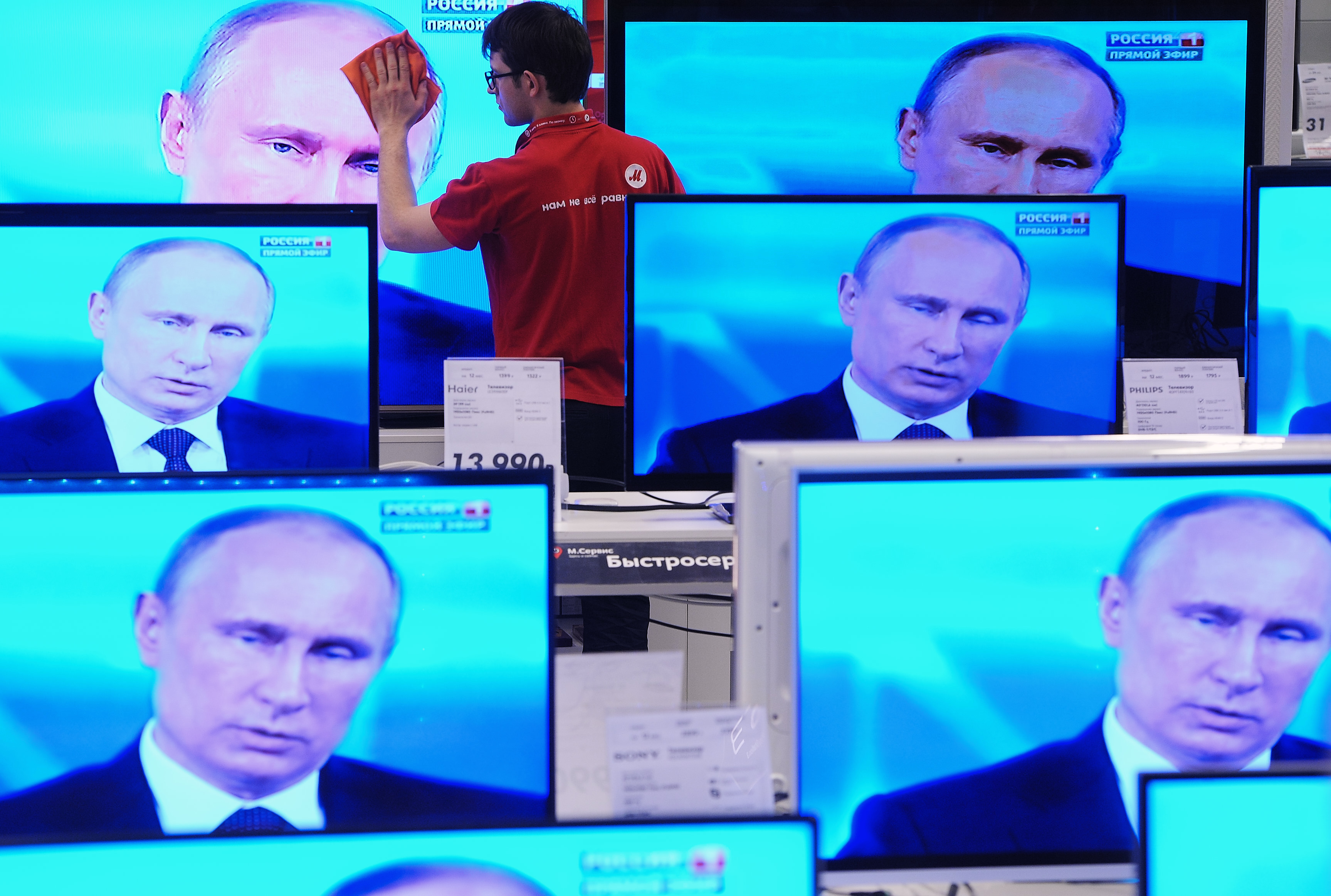
In case anyone doubted his intentions, here’s what Putin said on live TV today:
“The Federation Council granted the president the right to use military force in Ukraine,” he said, referring to the upper house of parliament. “I really hope that I do not have to exercise this right and that we are able to solve all today’s pressing issues via political and diplomatic means,” Putin said.
Putin referred to the region in question by its tsarist name “Novorossiya”, or “New Russia”, as it was referred to in the 19th century under tsarist rule, and suggested it was a historical mistake to hand it over to Ukraine.
He also admitted that Russian soldiers had been in Crimea prior to the referendum, though he still claims there are none in eastern Ukraine:
“Our servicemen stood behind the back of Crimea’s self-defence forces,” Putin said. “They acted politely, but resolutely and professionally. There was no other way to hold the referendum in an open, honest and honorable way and allow the people to express their opinion.”
But Julia Ioffe explains that the Russian invasion has already begun, and looks at some reasons why Ukraine isn’t really fighting back:
Who would do the shooting?
After the massacre on the Maidan in February, the new government in Kiev disbanded the Berkut, the Ukrainian special police who shot at protesters. Many were then publicly humiliated across Ukraine, having to apologize from city stages on their knees. This has created three problems. First, there are rumors that some of the former Berkut fighters, feeling betrayed and embittered—and unlikely to see this government as legitimate—fled to Russia, were outfitted by Moscow, and sent back to fight. Second, in disbanding Berkut, Kiev lost some of its best fighters, then ones that could potentially flush city buildings of special forces. Third, the move created uncertainty in the ranks of the rest of the Ukrainian police and armed forces: if they obey orders to fire now, will they be thrown under the bus later?
Jason Karaian highlights the dire financial situation of Ukraine’s military:
Today, the defense ministry trumpeted its 100-million-hryvnia ($8.9 million) fundraising drive, a big chunk of which came from mobile users donating 5 hryvnia at a time via a special text number. Meanwhile, the Finance Ministry also announced the issue of 1.1 billion hryvnia ($97 million) in war bonds to help finance the cash-strapped military. … On the ground, Ukraine’s military is badly outmatched by Russian forces. That was true even before Russia seized a number of ships in Crimea and, it was reported today, pro-Russian forces commandeered armored personnel carriers in eastern Ukraine. If the military escalation continues, it will take more than phone-in fundraisers and novelty bond issues for Ukraine to mount much of a defense.
Scarce resources are weakening the Ukrainian military in other ways, too. Reuters reported today on soldiers who claimed to have defected from Ukraine, citing a lack of resources and support from Kiev. “They haven’t fed us for three days on our base,” one said. “They’re feeding us here. Who do you think we are going to fight for?”
Anna Nemtsova has more on the defections:
[F]or now the Ukrainian military units ordered to put an end to the separatist movement in Donesk Oblast have refused to fight the protesters. Earlier on Wednesday outside Sloviansk, a crowd of pro-Russian demonstrators managed to convince a few dozen Ukrainian paratroopers from the same 25th Brigade to surrender. Ukrainian flags were taken off their four armored vehicles and locals presented with the flags of Russia and of the People’s Army of Donbas, the separatist militia. After switching sides, the soldiers drove to Lenin Square, where pro-Russian operatives have occupied the administration building since last week. Most of these militiamen claimed they were from Crimea; none of them spoke a word of Ukrainian. Still, they treated the surrendered Ukrainian paratroopers with courtesy and served them a nice meal inside the administration building.
The Ukrainian solders at Pchelkino Station were shocked when they heard that their colleagues had given up their weapons and their armored vehicles to pro-Russian protesters. But eventually they were convinced to do the same.
Eli Lake and Josh Rogin note the increasing possibility that Putin will make a move for Odessa:
Odessa is not only Ukraine’s most important remaining port for access to the Black Sea. It has also allegedly been a key avenue for Russian companies to export, sometimes with illicit or controversial purposes, goods overseas. Russian arms to the regime of Syrian President Bashar al Assad allegedly flowed through Odessa, for example. … The loss of Crimea and the Russian takeover of other waterways in Eastern Ukraine “puts even more pressure on Odessa as Ukraine’s last sea shipment lifeline, not just for the navy but for Ukrainian industry,” said Druckman. “There should be concern from the perspective of Ukraine losing access to the Black Sea.”
Gauging the exact level and nature of Russian interference inside Odessa is difficult. The Ukrainian domestic intelligence services claim to have arrested Russian intelligence officers there and pro-Russian militias in Odessa are organizing rallies daily.
(Photo: A shop assistant cleans a TV screen during Russian President Vladimir Putin’s nationally televised question-and-answer session in a shop in Moscow, Russia on April 17, 2014. By Dmitri Dukhanin/Kommersant via Getty Images)
 The Dish