Suzy Khimm summarizes Obama’s executive action on student debt:
Obama signed a memorandum on Monday that would allow more Americans to limit their student loan payments at 10 percent of their income. The action will expand on Obama’s “Pay as You Earn” program, which first launched in October 2011, making it available to those who took out student loans before October 2007. Those who opt into the program will have their student loan payments set according to a sliding scale based on income. The remaining balance is forgiven after 20 years; those working in public service have any remaining balance forgiven after 10 years.
The original “Pay as You Earn” program was only available to those who took out loans after October 2007 and continued to borrow after October 2011. The White House estimates that the program’s expansion will offer student debt relief to an estimated 5 million Americans.
But Derek Thompson believes the plan won’t fix the college-cost crisis:
The pay-as-you-earn plan is appropriate and targeted. It carries relatively few downsides, and it will help some students get on with their post-graduate lives. But we shouldn’t expect it to “fix” much now, because the existing program hasn’t “fixed” much already. Libby Nelson reports that just a tiny fraction of eligible borrowers are currently using Pay As You Earn. This is like giving somebody with a broken leg a half-off coupon for crutches – a perfectly decent ameliorative option that only works if the injured party chooses to use it.
Jana Kasperkevic concurs, arguing that “at the heart of the problem are the increasing tuition costs that often lead students to take on more and more debt”:
Consider this: as tuition at public four-year college increased by 250 percent, family incomes increased by just 16 percent. The increase in tuition last year amounted to a 2.9 percent increase for in-state students at four-year public college and a 3.8 percent increase for student at private colleges.
There are reasons for this increase, such as decreased funding from the government. According to CNN, US states have cut college funding by a total of $15.2 billion between 2007 and 2012. That’s a 17.4-percent drop in funding. During that time, the number of students increased by 12 percent. … Until US government tackles the issue of increasing cost of tuition and the fact that for majority of Americans going to college means taking on some kind of debt, the overall burden of student debt is only bound to increase
The editors at Bloomberg aren’t thrilled with the news either:
[T]he share of students who default, now at one in seven – its highest level in two decades. By that light, expanding access to income-based repayment is a good idea, as far as it goes. A more efficient idea, proposed by Republican Senator Marco Rubio of Florida earlier this year, would automatically enroll borrowers in those plans, rather than leaving students to wade through the details on their own. Otherwise, the students who most need those programs may not be the ones who know enough to sign up for them.
Another idea worth pursuing is effectively removing the possibility of default altogether, by having a borrower’s employer automatically deduct those income-based repayments from borrowers’ paychecks and send the money to the Internal Revenue Service. That’s what Republican Representative Tom Petri of Wisconsin has proposed, modeled on systems in the U.K. and elsewhere.
Libby Nelson notes that Congress “could take other steps to make it less likely that students need to take out loans in the first place” – but almost certainly won’t:
A decade ago, two House Republicans, including now-Speaker John Boehner, proposed cutting off financial aid at colleges that increase tuition too rapidly. Colleges strongly opposed the specter of federal price controls; Democrats refused to get on board; and the idea went nowhere. When President Obama proposed an updated version of the same idea, suggesting that Congress should some federal financial aid to reward colleges that offer good value and punish colleges that don’t, even Democrats left the idea out of their budget proposals.
That leaves student loans as the remaining tool in Congress’s college affordability toolbox. Unlike grants, they’re a moneymaker for the federal government under current accounting rules. And they’re less thorny politically because the vast majority of student loans already come from the Education Department. There aren’t other interests – like banks and colleges – to be taken into account when changing policy. Student loans aren’t the only lever Congress has over higher education policy. They’re just by far the easiest one to pull, and so lawmakers return to it again and again.
But Cardiff Garcia notes that a half-measure could be better than none:
[W]hat can be said with more confidence is that higher student loan debt has a deleterious effect on the lives of the people who have it. From [Wenli Li of the Philadelphia Federal Reserve’s] paper:
Researchers have found evidence that high debt burdens make students less likely to choose lower-paying careers such as teaching. Jesse Rothstein and Cecilia Rouse study a “natural experiment” generated by a change in financial aid policy by a highly selective university. The university introduced a “no loans” policy, in which it replaced the loan component of financial aid awards with grants. Interestingly, they find that debt causes graduates to choose jobs with substantially higher salaries, such as those in finance and consulting, and reduces the probability that students choose low-paid “public interest” jobs such as grade-school teacher or social worker. …
And from Brookings:
Dew (2008) finds a negative correlation between reduced marital satisfaction and student loan debt, positing that increased stress related to consumer debt—including student loans—could diminish marital satisfaction. About 14 percent of borrowers surveyed in 2002 reported delaying marriage due to student loan debt, up from 9 percent 15 years earlier. Over the same period, the share of borrowers who reported that they delayed having children due to student loans jumped from 12 percent to 21 percent (Baum and O’Malley 2003).
Meanwhile, Kelly Field observes that “the biggest beneficiaries of the change are likely to be graduate- and professional-school alumni with large debt balances and low-paying public-service careers”:
Consider, for example, a public defender who graduated from a private law school in 2012 with $125,000 in debt (the average that year) and has an adjusted gross income of $55,000. He could reduce his payment from $469 a month under income-based repayment to $312 under Pay as You Earn, according to the repayment estimator, and have more than $175,000 in debt forgiven, compared with less than $49,000 under income-based repayment. Ultimately, he would pay back more than $150,000 less than he would in an income-based plan.
Ctd …
McArdle argues against Obama’s proposed student-loan policy changes:
It’s not that the horror stories about people with low earnings and huge debts are imaginary – I have not only read those stories, but have also been one of them. However, that group is relatively small. And in order to give them an extra break on their payments, the president and Elizabeth Warren are proposing that we should also give a whole lot of money to folks who don’t really need it. That’s bad public policy; moreover, it’s not particularly progressive public policy.
That said, I do think we should do something to help people who are genuinely stuck with debt that they will never realistically be able to pay. We should end the exemption of student loans from bankruptcy so that anyone who is overwhelmed by debt can go to court and get a genuinely fresh start. The special treatment of student loans is an outrageous bit of self-dealing by the government, which appears to be fine with debt slavery as long as Uncle Sam gets to be the master. It should stop.
Drum counters:
[U]nlike McArdle, I’m persuaded by the aggregate numbers that we have a genuine problem here. We don’t have a problem with college grads buying ever more expensive cars, which is why no one wants to provide auto loan relief. We do have a problem with the cost of college skyrocketing.
The resultingly high aggregate student loan debt is having a noticeable adverse macroeconomic impact (family formation, buying a house, etc.) at a time when we can ill afford it, which makes the case for a temporary refinancing program fairly compelling. More generally, it’s also the case that no society is well served by making income a barrier to higher education. More and more, however, that’s what we’re doing.
Robby Soave’s view:
When federal lawmakers forgives debts – in part or in whole – they reward students who borrowed recklessly. They also incentivize universities to raise tuition prices. College administrators know that they can get away with demanding more money, because students will take out more loans, confident that the government will bail them out if they run into trouble – and the government will stick the taxpayers with the bill if the students aren’t able to pay.
Jordan Weissmann considers a Republican idea we noted yesterday:
Since 1983, Tom Petri, a low-key House GOP congressman from Wisconsin, has advocated an idea that education wonks sometimes call “universal income-based repayment.” It would completely scrap the convoluted system that former students currently rely on to repay their loans. Instead, college debt would work like just tax withholding. A borrower would simply pay a set percentage of her monthly earnings to the government, deducted straight from her paycheck.
Countries including Britain, Australia, and New Zealand already take a similar approach. And, as many educationexperts have agreed, bringing it stateside would likely cure some of the worst symptoms of America’s student loan binge. It would ensure that every single borrower’s payments stayed manageable and virtually eliminate the risk of delinquencies and defaults. Think of it as the financial equivalent of putting up gutter rails in a bowling alley – it’s a foolproof plan to stop borrowers from veering into trouble.
Meanwhile, Adam Ozimek argues that the real problem with higher ed is a lack of transparency about outcomes:
One potential concern is that transparency on outcomes might incentivize colleges to focus on selectivity to inflate their statistics. But even something as simple as reporting income divided by SAT score would incentivize schools to not just let the best students in. Or schools could use a value added type approach that incorporated more measures of demographics, socioeconomic status, and ability to estimate how much schools contribute to learning rather than simply selecting on ability. Overall, if you’re looking for a cause of our higher ed woes, then focus on informational problems, not debt. And if your looking for a policy, focus on transparency. That’s not to say there’s nothing that should be changed about student loans, but this is not the biggest issue here.
Reihan shifts the focus to the college experience itself:
Consider the findings of Paying for the Party, a masterful account of the many ways life at a large Midwestern flagship public university is rigged against students from working- and lower-middle-class backgrounds. Over the course of five years, the sociologists Elizabeth A. Armstrong and Laura T. Hamilton tracked a group of female students at “Midwest University,” a thinly disguised big public flagship school, starting in their freshman year. One of their most striking findings is that standard college advising consistently failed to meet the needs of students from modest backgrounds. Students from affluent backgrounds had extensive social networks at their disposal, which helped them turn degrees in “party majors” like sports communication and broadcasting or interior decorating into jobs in glamorous, or glamorous-sounding, fields. Students who didn’t have parents familiar with the ins and outs of higher education to help them navigate the system found themselves at the mercy of incompetent, indifferent, and overworked advisers who routinely led them astray.
Ctd …
A reader adds a personal touch to the blog debate:
What ever happened to working your way through school? I went to college form 1985 through 1994 to get my degree, going to school in the day time and working as a hospital orderly at first, then working for an engineering firm during the day and taking classes at night. I did my first year at a JuCo and the rest at a couple of state schools. Of course, I had to give up the fun campus lifestyle – no time for fraternities and parties (well, I found time for a few). But, when I graduated, I was student-debt free.
I realize that this is not the same as spending four years at at residential college or university, but that’s the breaks. Some people get to eat filet mignon and some of us have to eat hamburger. Bottom line is, maybe it took a bit more time and effort then some have to expend, my education has served me quite well in my career, and I never had the depression that must come from leaving school with the kind of debt that so many now incur.
I understand that tuition has increased, but dammit, everyone isn’t going to get to go to the Ivy League school that dream about. The state school in my town has a non-residential program that costs $8K/year, full time. Anyone should be able to deal with that.
Ctd …
A reader writes:
This writer’s complaint shows no connection to the contemporary job market or college reality. Anyone who writes about “Why don’t kids nowadays do what we did back in our day!” is probably full of shit. Not to put too fine a point on it.
I too worked my way through college: security guard, office clerk, janitor, movie theatre tickets/concessions, laborer on construction sites – then, once 21, waiter/bartender. I worked summers to save cash for the school year and during the school year as well. No frats, no
parties – just full-time work and classes (and years or semesters off when broke). I ended up with a PhD and in academe, where I now work advising and teaching and deal every day with the economic reality contemporary college students face.
So, kids nowadays, why don’t they just work instead of taking out student loans? The sort of jobs I got when I was their age are no longer available to your average college student in a four-year university. They have to spend their summers doing unpaid or lowly-paid or pay-tuition-to-get-course-credit-and-work-for-free internships to prep for their long-term career goals. What paying jobs are available for the kids who choose the JuCo/State School route are minimum-wage fast food/retail jobs that actually will not help you pay your tuition now, much less save money for tuition later.
“Summer jobs” don’t exist anymore. The average age of the minimum wage worker is now 35, not 18. This reality is just one more symptom of the end of the striving lower-middle class. Kids whose parents can pay the rent while their children work unpaid summer internship help their kids get – or stay-ahead. Kids who don’t have such resources are screwed, though some universities (including, thank God, the one I work at) do their best to help these kids with stipends or grants.
The good old days are done. Anyone who thinks otherwise isn’t paying attention.
Several more readers support that view with data:
In my work as a graduate teaching assistant and adjunct instructor over the past seven years, I can also attest to the fact that many undergraduate students are working while going to school – it just isn’t enough. The reader blithely concedes that “tuition has increased,” but that’s such an understatement. It’s a fitting coincidence that he said he started college in 1985 because this Labor Department study shows that college costs have not just “increased” but have skyrocketed over 500% since 1985. And this is while the cost of living has also increased but wages have stagnated.
Another adds, “Even the state institutions have more than doubled in cost since the ’80s.” Another continues along those lines:
Even state schools have gotten expensive. Emma Green at The Atlantic did a great piece back in April on Randal Olson’s graduate work at Missouri State University, where he determined that it now takes a little under 1000 hours of work at minimum wage just to cover the average cost of tuition only, and he was using in-state tuition data from state schools. With additional fees (including room and board and meal plans), the idea of working your way through college is just unrealistic now.
Another crunches some numbers:
$8000 a year for tuition, in the scenario your reader presented, means that working at just above minimum wage ($8), you’d have to work 1000 hours, or 20 hours/week to make that money. This is ignoring whatever deductions occur for federal/state/local income taxes and FICA taxes.
But wait! This is for a non-residential program, which means that you also have to cover housing and food. Let’s assume $300 a month in rent and $200 in food a month (~$2 a meal). That’s another $6000, or another 15 hours/week. And this doesn’t begin to include other costs such as transportation, books and supplies, clothing, etc.
So basically, even in the scenario your reader describes, you’re essentially working at least a full-time job on top of a full slate of classes and homework to make this work. Of course these costs are mitigated if you’re able to live at home, or your parents can help defray some costs, but students take out loans specifically because parents are not able/willing to defray these costs, and many students live in areas that aren’t close enough to any kind of college to commute.
Furthermore, this all supposes that these students are even able to get jobs. Given that the unemployment rate for 16-24 year olds is much higher than other age groups (13-15% vs. <7%), the unemployment rate for high school graduates is also way higher (7% vs. <5%), AND that these numbers are all down from their peaks in 2009-2010, I’m not certain how reasonable that is.
And even if they could make this situation work, it’s not apparent that it would be worth it. Employment rates for young college graduates aren’t very good, and if you drill down in the numbers deeper, those who come from less prestigious schools are more likely to be unemployed or underemployed. Should you scrimp and sacrifice to go to a local school, get a degree, and possibly be not much better off coming out of that, or should you take on debt to go to a better school without distractions? I’m not certain which of these is the better choice, but i don’t think it’s as clear cut as your reader does, especially when the benefits are four years off from when these students make their decision.
Finally, your reader was able to do what he did because a) he spread out his degree over 10 years, and b) his tuition costs were MUCH lower, even after you control for inflation. It’s a stark fact that tuition has outpaced both inflation and real wage growth over the last 30 years.
As a Millennial (and one of the lucky ones with no debt and a good job), it kills me when I hear people talking about how they managed to do this or that 20+ years ago. Things just aren’t that simple any more.
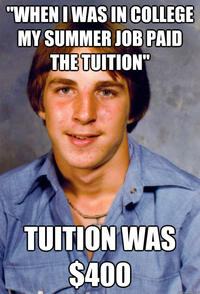
(Image of “Old Economy Steven” from Know Your Meme)
Ctd …
A reader writes:
I think that one aspect that is getting lost in all of this discussion of mounting student debt is that federal money is an enabler of growing college tuition. When the government gives students extra money to spend on college, they will tend to compete the price of tuition up. (Just how much the price increases depends on the relative elasticity of supply and demand.) If, instead, the government paid universities a certain amount per student admitted, the universities would tend to compete the price of tuition down.
It’s counterintuitive that subsidizing the customer doesn’t ultimately help the customer. But then a lot of economics is counterintuitive. Ironically, the best way the federal government could aid students would be to eliminate Pell Grants, tax write-offs and credits altogether and use that money to incentivize lower tuition rates on the supply side.
 The Dish