The Daily Wrap

Today on the Dish, we followed the Beck backlash; parsed polls for November; and reflected on the Big Question of the best way to engage people who disagree. Politicians weren't as important as parties; Christianity in America made a splash; and the Heritage Foundation's newest hire doesn't quite gel with its ideals.

We played with the Rubik's cube of Pakistani politics; and wondered sarcastically about what will happen to all the Mexican police officers fired for their ties to drug cartels. Ambinder previewed Obama's address tonight; we asked after Atlas; and according to Churchill, sometimes appeasement was necessary.

Preppies needed help to survive; the codex won one over the screen; and the official Oxford English Dictionary may be the internet's most recent casualty. Apatow and Serwer defended Apatow's mockery of American masculinity and we tackled domestic violence in pop culture. We mined maternity leave and the defense of diamonds; and McArdle seconded Bering on monogamy and jealousy while Dan Savage disagreed. FOTD here; cool ad watch here; Yglesias award nominee here; MHB here; VFYW here; VFYW contest #13 winner here; and your many suggestions for mapping future contests here. On the elite professions front, we touched on Scalia's choices and heard from dating coaches; civil servants in the shadows; attorneys; pastors and prostitutes.

–Z.P.
Sullivan Bait

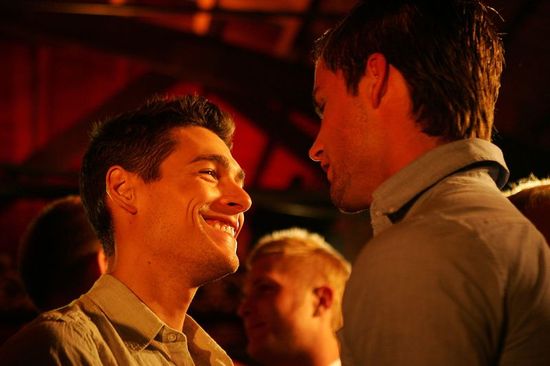
DavidMcNewGettyImages by Chris Bodenner A green shoot from the GOP on gay rights:

A major same-sex marriage fundraiser hosted by former RNC chairman Ken Mehlman and other Republicans provides one of the sharpest illustrations of how gay rights is becoming a cause among more elite, establishment members of the GOP. In addition to Mehlman, who recently announced that he was gay, the list of attendees includes several surprises, such as Ben Ginsburg, one of the Republican Party's top lawyers, and Henry Kravis and Paul Singer, two of the biggest donors to the GOP. According to one gay-rights activist involved in similar efforts, the fundraising pool goes even deeper. "There is a strong conservative case to be made in favor of gay marriage," former McCain campaign manager and fellow same-sex marriage fundraiser Steve Schmidt told the Huffington Post on Tuesday.

Money quote:

"I think there is a growing mass of people in Republican politics who are fundamentally sick and tired about being lectured to about morality and how to live your life by a bunch of people who have been married three or four times and are more likely to be seen outside a brothel on a Thursday night than being at home with their kids… There is a fundamental indecency to the vitriol and the hatred directed against decent people because of their sexuality.

Bold words – but the "prominent Republican" who said them didn't have the balls to print his or her name. So obviously there's still a long way to go. By the way, TNR recently released from its archives one of Andrew's conservative-based essays on gay marriage from 1996. The kicker:

The process of integration—like today's process of "coming out"—introduced the minority to the majority, and humanized them. Slowly, white people came to look at interracial couples and see love rather than sex, stability rather than breakdown. And black people came to see interracial couples not as a threat to their identity, but as a symbol of their humanity behind the falsifying carapace of race. It could happen again. But it is not inevitable; and it won't happen by itself. And, maybe sooner rather than later, the people who insist upon the centrality of gay marriage to every American's equality will come to seem less marginal, or troublemaking, or "cultural," or bent on ghettoizing themselves. They will seem merely like people who have been allowed to see the possibility of a larger human dignity and who cannot wait to achieve it.

An extended version of his argument here.

(Photo by David McNew/GettyImages)

About My Job: The Pastor

by Conor Friedersdorf

The reader writes:

My profession involves more listening than people imagine, and certainly more than people imagine from the "celebrity pastors" who get most of the media attention.  I am a pastor, serving a 100-member liberal Protestant congregation in a small city in northern California, outside the Bay Area.  Although I do prepare and deliver a sermon every week, much of my time is spent listening.

I listen to people and the story of their lives.  I am attentive to the trends in our community, such as our unemployment rate, affordable housing, and environmental concerns.  I listen to ancient voices preserved in sacred texts, not just my own Bible, but other texts, too, and contemporary voices in poetry, literature, drama.  I make it a point to listen to people whose views are different from mine, sometimes seeking them out.   Because I pray, and praying is for me more about listening than it is about talking, I listen for God in all these things.

Lately, what I've been hearing, is anxiety about the economy, anxiety that has not subsided in two years, and seems to be calcifying into a normal way of living for many people.

I want people to know that my master's degree includes significant work in counseling and spiritual care of people.  I want them to know that pastors like me, who are engaged with real people in real communities, are not trying to be famous, rich, or even influential in politics.  Pastors like me are trying to help people find meaning in life.  The "celebrity pastors" who grab the headlines are making my job more difficult every day.

The Prescient Pope, Ctd

by Zoe Pollock

A reader writes:

I think you misread Farrell's piece. While giving Pius some credit for dealing with the issue of evolution, Farrell's main point was the caveat you mention second: modern biology shows man descends (as do virtually all species) from a population, not a single individual (or couple), and this contradicts Pius's assertion that the doctrine of original sin requires "a sin actually committed by an individual Adam and which, through generation, is passed on to all and is in everyone as his own" (full text of Pius's Humani Generis here). Far from being prescient, Pius, as interpreted by Farrell, was thus wrong about what would be learned subsequently. Farrell is a bit off in not realizing that Pius was mostly concerned with addressing a 19th century idea (polygenism; not held by Darwin) that held that modern Homo sapiens has several independent origins (we didn't), and not with addressing modern evolutionary theory. I'm also not sure that Farrell's theologically correct: it's not self evident to me that common ancestry through populations violates the doctrine of original sin, although it might– I'll leave that for Catholic theologians to decide.

The late Stephen Jay Gould dealt with these exact issues in an essay he published in 1997. While Farrell notes briefly John Paull II's statement on evolution from 1996, "Truth Cannot Contradict Truth," Gould regards John Paul's statement as a significant revision to Pius's position. Gould's own summary of his essay:

Pius had grudgingly admitted evolution as a legitimate hypothesis that he regarded as only tentatively supported and potentially (as I suspect he hoped) untrue. John Paul, nearly fifty years later, reaffirms the legitimacy of evolution under the NOMA principle [=non-overlapping magisteria– Gould's term for how religion and science can coexist harmoniously, which he takes to be a quite Catholic point of view] —no news here—but then adds that additional data and theory have placed the factuality of evolution beyond reasonable doubt. Sincere Christians must now accept evolution not merely as a plausible possibility but also as an effectively proven fact. In other words, official Catholic opinion on evolution has moved from "say it ain't so, but we can deal with it if we have to" (Pius's grudging view of 1950) to John Paul's entirely welcoming "it has been proven true; we always celebrate nature's factuality, and we look forward to interesting discussions of theological implications."

Codex or Screen? Cont’d

by Conor Friedersdorf

Alan Jacobs is still reading Infinite Jest:

Wallace is a writer of riffs, and I have often been frustrated by my inability when using the Kindle to get a sense of just how long the riffs are. It helps to know whether this is going to be a relatively brief one or whether it will go on for pages: having that knowledge enables the reader to adjust the quality of his or her attention accordingly. Again and again while Kindling my way through IJ I have been forced into awareness of how much my reading practices rely on this spatial awareness: not just knowing how far I am into a book (since the Kindle always shows you where you are in percentage form), but knowing when the next chapter or section break is coming. It turns out that that kind of knowledge has always been very helpful to me, especially when I am reading a difficult or otherwise challenging book — but I never knew how helpful until now.

One aspect of the codex I like is the sense of progress I get comparing the thickness of what I've already read to what I've yet to read. The Web equivalent is that bar on the right margin, but especially when reading a lengthy article, it is often misleading about how much is left.

Face Of The Day

103737896

An Iraqi soldier mans his position at a checkpoint in central Baghdad on August 31, 2010, as US forces are set to declare an end to combat operations on August 31, leaving fewer than 50,000 soldiers in the country with the mission of training and advising local troops ahead of a complete withdrawal at the end of next year. By Ahmad Al-Rubaye/AFP/Getty Images.

For Stupid’s Sake, Ctd

by Patrick Appel

Apatow fires back at Christian Lorentzen. Money quote:

There certainly are a lot of dick jokes in Funny People but there is no way to portray comedians without having them tell a lot of those types of jokes. If I was a hundred percent accurate I would have doubled the dick joke count. The only thing more troubling than making jokes about the male penis would be to be serious and honor the male penis.

Churchill on Appeasement

by Conor Friedersdorf

Via Will at The League of Ordinary Gentlemen, a lesser known quote from Winston Churchill:

“The word ‘appeasement’ is not popular, but appeasement has its place in all policy,” he said in 1950. “Make sure you put it in the right place. Appease the weak, defy the strong.” He argued that “appeasement from strength is magnanimous and noble and might be the surest and perhaps the only path to world peace.” And he remarked on the painful irony: “When nations or individuals get strong they are often truculent and bullying, but when they are weak they become better-mannered. But this is the reverse of what is healthy and wise.”

Every time I hear that word, I think of this cable news exchange, one of my favorites in the history of broadcasting because it distills the intellectual dishonesty so prevalent in the medium. After watching it you'll always have a soft spot for Chris Matthews.

About My Job: The Shadow Civil Servant

by Conor Friedersdorf

A male reader writes:

I am not a government employee – I might as well be, but not for the reasons they think. I work in the federal division of one of the many IT companies in northern Virginia, and people assume that I lead a quiet life because we’re just like the government. This is sort of true: I don’t work mad hours like our teams on commercial contracts. However, we are the focal point of all of our customer’s frustrations of the structural impediments (and peer impediments) of their job, and nothing we do is ever good enough, even if we throw in the occasional bit of scope creep for goodwill purposes. We get a lot accomplished and at, if I may say so, a pretty reasonable price.

However, that’s the rub: reasonable is relative to other contractors, not in-house work. I am part of the hidden civil service, the legions of contractors who bulk out the federal government without showing up in civil service headcount and without – to be perfectly frank – delivering the same work for less than government staff. We might be faster, or more efficient (sometimes, anyway), but we’re not cheaper. Such are the exigencies of national politics though, that it’s easier to have a shadow civil service for 120 – 130% of the cost of the actual civil service, in order to say that the government hasn’t grown.