The Iranian Sexual Revolution

Afshin Shahi shines a light on how sex may be becoming “a form of passive resistance” in Iran:

Changing attitudes toward marriage and divorce have coincided with a dramatic shift in the way Iranians approach relationships and sex. According to one study cited by a high-ranking Ministry of Youth official in December 2008, a majority of male respondents admitted having had at least one relationship with someone of the opposite sex before marriage.

There are some clues as to what’s at play:

There are a number of potential explanations, including economic factors, urbanization, new communication tools, and the emergence of a highly educated female population — all of which are probably partly responsible for changing attitudes toward sex. At the same time, however, most of these factors are at play in other countries in the region that are not experiencing analogous transitions. (Indeed, a wave of social conservatism is sweeping much of the Middle East, while Iran moves in the opposite direction.) So what is different in Iran? Paradoxically, it is the puritanical state — rigid, out of touch, and dedicated to combating “vice” and promoting “virtue” — that seems to be powering Iran’s emergent liberal streak.

Drowning In Student Debt

A discussion of student loan debt from a couple weeks back:

This embed is invalid


Without action from Congress, interest rates on federal Stafford loans will double (from 3.4% to 6.8%) on July 1st. Ned Resnikoff reviews the political playing field:

If this all sounds vaguely familiar, it’s because Washington had a similar fight last year. That was when Congress first extended the law which keeps student loan rates fixed at 3.4%, after President Obama made an issue of it during the 2012 campaign. Though that law did lighten students’ debt burden a bit, it did little to slow the years-long explosion in student debt. This year, total student debt passed the $1 trillion milestone.

Nancy Folbre worries about the implications of the increase in student indebtedness:

As Robert Kuttner explains… bailouts and bankruptcy proceedings both provide a means for businesses to get out from under bad debt. The obligations of a college loan, by contrast, “follow a borrower to the grave.” The rolling thunder of accumulating student debt sounds a lot like the perfect storm of mortgage liabilities that threatened major financial institutions and precipitated the Great Recession in 2007.

… Whether or not you call it a bubble, evidence shows something is likely to pop. Both delinquency and default rates have increased substantially since 2005. According to the Institute for Higher Education Policy, only a little more than a third of 1.8 million borrowers who entered repayment in 2005 repaid their student loans successfully without delay or delinquency for the first five years.

Meanwhile, Mandi Woodruff talks to Nicole Jackson, a Florida lawyer who has lost hope of ever repaying the debt she accumulated during law school:

She graduated in 1994 with more than $100,000 of debt. Within three years, she had one daughter, a surprise set of twins, and was earning less than $50,000 per year. “It’s always been a struggle,” she said. “I worked for the state of Florida most of my [career] and the most I was making was $50,000/year. With three kids, it wasn’t enough money.” …

“[My debt] is not going anywhere because I do not make enough money, not because I have just ignored it,” she said. Her private loans took top priority. The payments were only $130/month, but since private lenders don’t offer the same deferment options as federal, it was either pay or roll out the welcome mat for debt collectors. Meanwhile, her federal loans ballooned. With an 8% interest rate, they appreciated even after she consolidated, growing from a principal balance of about $80,000 in 1994 to $186,000 today. Other than her home and a car payment, it’s the only debt she carries to this day.

Oh The Humanities!

David O’Hara and John Kaag lament the disciplines’ solitary, non-collaborative nature:

Academic life in the humanities still bears the form, if not the detail and substance, of the monastic life that shaped the modern university. Our offices and library cubicles are like cells, places to which we retreat so that we can “read, read, read, work, pray, and read again,” as the philosopher Charles Peirce put it back in 1877, quoting an old chemist’s maxim. Our graduate-school training habituates us in burying ourselves for long hours in solitary seeking, emerging only for the austere hours of communal liturgy, where most of us sit in silence while one chosen from among us stands and reads from the holy text. The main difference between us and the medieval monastics is that they, when they went into solitude, believed they were not alone. We moderns decidedly are.

They go on to argue that “[g]enuine communication, rather than personal notoriety or individual survival, should be the ultimate object of our work in the humanities”:

Cultivating a voice—one that is both sophisticated and understandable—takes an enormous amount of practice. And it requires more than a little humility (which both of us are still working on). We have to actually care when others don’t grasp our point. Miscommunication is not a function of others’ ineptitude, but a reflection of our own. That may not always be the case, but it is unequivocally possible. And we have the choice to consider this possibility seriously. Doing so might mean that we begin to collaborate and discover a voice that is worth being listened to. We cannot do this by ourselves. It is not good to be alone.

Face Of The Day

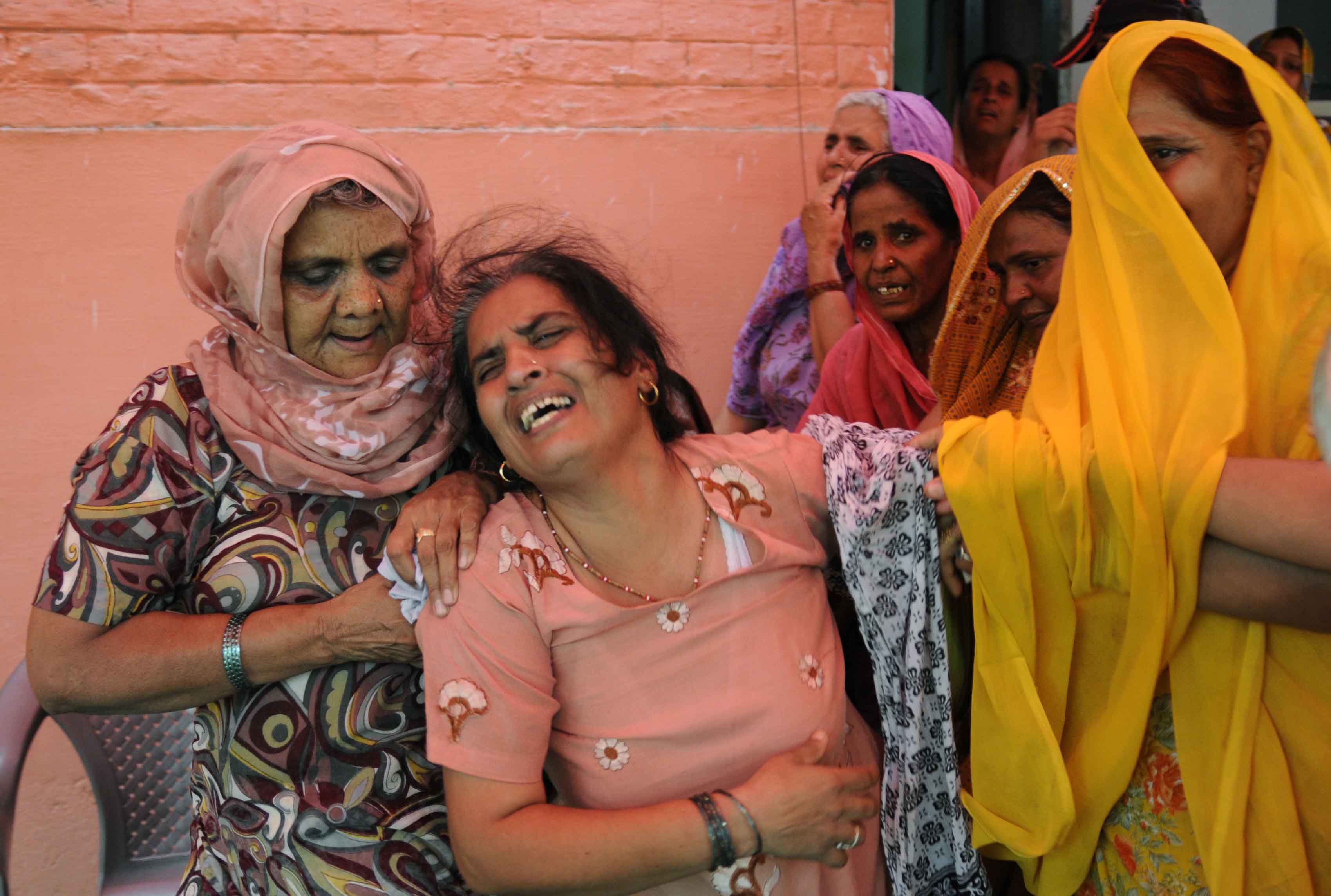
Mumbai Acid Attack Victim Cremated, Kin Seek CBI Probe

Bereaved family members of Preeti Rathi who died of injuries following an acid attack in Mumbai at her home in Narela village on June 3, 2013 in New Delhi, India. 23-year-old Preeti was cremated with state of honors here today. Some unidentified attackers threw acid on Preeti as she alighted from the New Delhi-Mumbai Garib Rath Express at Bandra station in Mumbai on May 2. Her family has demanded CBI probe into her murder. By Sunil Saxena/Hindustan Times via Getty Images.

Testing The “Tiger Mom” Theory

Researchers at the Chinese University of Hong Kong surveyed 71 Chinese mothers and 144 American mothers of European and African descent, as well as their 13-year-old children, to parse parenting styles:

The novel finding is that Chinese mothers more often than the Americans said their self-worth was tied to the success of their children, agreeing with statements like “When my daughter fails, I feel badly about myself”. Basing their self-worth on their children’s success accounted for 25 per cent of the between-country variance in mothers’ psychological control of their children. The researchers speculated other relevant factors could be: the Chinese notion of guan – according to which parents must dedicate themselves to their offspring, with their children’s success in the eyes of society taken as a sign of good parenting; and the Chinese focus on a “face” culture – the idea that one’s sense of worth is measured by the respect gained from others.

The limitations of the study:

The study doesn’t prove that basing their own self worth in their children’s success causes Chinese mothers to exert greater psychological control over their children. It’s possible the causal direction runs the other way, or both ways. The study is also limited in only focusing on psychological control while neglecting behavioural control.

A Poem For Monday

Frederick_Carl_Frieseke_-_Femme_dans_un_jardin

“Sonnet 64” by Edmund Spenser (1552-1599):

Coming to kisse her lyps, (such grace I found)
Me seemd I smelt a gardin of sweet flowres:
that dainty odours from them threw around
for damzels fit to decke their lovers bowres.
Her lips did smell lyke unto Gillyflowers,
her ruddy cheeks lyke unto Roses red:
her snowy browes lyke budded Bellamoures,
her lovely eyes lyke Pincks but newly spred,
Her goodly bosome lyke a Strawberry bed,
her neck lyke to a bounch of Cullambynes:
her brest lyke lillyes, ere theyr leaves be shed,
her nipples lyke young blossomd Jessemynes,
Such fragrant flowers doe give most odorous smell,
But her sweet odour did them all excel.

Spenser poems from over the weekend here and here.

(From Amoretti, published in London in 1595 by William Ponsonby. Lady in a Garden, circa 1912, by Frederick Carl Frieseke via Wikimedia Commons)

Shielding The Fourth Estate

Steve Coll argues that legislation that aims to protect journalists from “indiscriminate government subpoenas” is important, but only if done right:

[Current guidelines for federal prosecutors seeking evidence from journalists] are far from ideal—they have loopholes that give an Attorney General wide discretion. Yet they have often discouraged Justice from overreaching. The guidelines require that the Attorney General sign off on all media subpoenas, that any demands “be as narrowly drawn as possible,” and that, in all but the most exceptional cases, news organizations be notified of a subpoena, giving them time to appeal it in court. …

In the long run, to rebalance the national-security state and to otherwise revitalize American democracy, the United States requires a Supreme Court willing to deepen protections for investigative reporters, as the majority in Branzburg would not. In response to criticism about the A.P. case, Obama has reintroduced federal legislation that would clarify journalists’ rights. Such a federal “shield law” might be constructive, but new legislation with overly broad national-security exceptions would be even worse than the status quo.

Peter Sterne talks to the Society of Professional Journalists:

The proposed federal shield law before the Senate is even weaker than Colorado’s. It simply allows journalists to petition a judge, who weighs the story’s public interest value and decides whether the journalist should be forced to reveal his or her sources. The Society of Professional Journalists, which has been pushing for shield laws, said that something is better than nothing, but it nonetheless called for stronger protections.

Meanwhile, Dick Durbin equivocates on who should be protected by a federal shield law:

[H]ere is the bottom line – the media shield law, which I am prepared to support, and I know Sen. Graham supports, still leaves an unanswered question, which I have raised many times: What is a journalist today in 2013?

We know it’s someone that works for Fox or AP, but does it include a blogger? Does it include someone who is tweeting? Are these people journalists and entitled to constitutional protection. We need to ask 21st century questions about a provision that was written over 200 years ago.

Will Obamacare Unleash The Free Market?

Sarah Kliff talks to experts about the competitiveness between health insurers on Obamacare’s exchanges:

“I would characterize it as modest plan competition,” Caroline Pearson, vice president for health reform at Avalere Helath, said. “In most markets, there seems to be a bit more choice than what’s available in the market today. But we’re certainly not seeing a wild influx of plans into the market.”

Cohn claims that more insurers in isn’t neccesarily better:

[T]here’s such a thing as too much choice in health insurance. And it actually shouldn’t take more than a few plans to foster serious competition, particularly given all the other changes Obamacare is making. “It’s important not to lose sight of the obvious stuff,” says Larry Levitt, a senior vice president at the Kaiser Family Foundation. “This market will become much more competitive just because people will be able to compare prices (which they can’t now because of medical underwriting) and be guaranteed access.”

Yglesias explains why too much competitiveness in the exchanges could be bad:

With a lot of insurers in the field, what essentially happens is that market power shifts to the hospitals and other providers. Insurers need to “compete” to gain access to key providers, so providers can charge high prices that insurers then largely pass along to customers as high premiums. It seems to me that the optimal situation is to have a few insurers in the exchange so that competition plus Medical Loss Ratio regulations keep premiums reasonable, while ensuring that the insurers retain market power vis-à-vis providers and thus can act as bulk purchasing agents on behalf of patients. But how many is “a few”? Three? Four? I don’t know. But as states set exchanges up, this is something to think about.