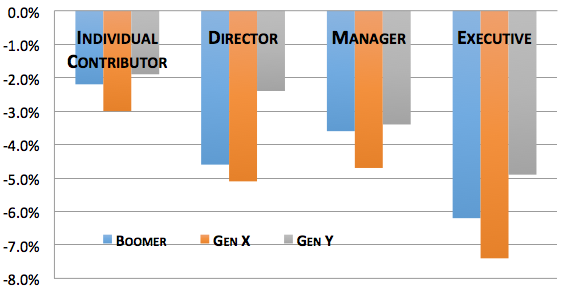
Derek Thompson shares the above chart on gender and generation in the workforce:
Intergenerational economic inequality is declining: The gap between male and female wages among Millennials is lower than it was among boomers or Gen-X. But the pernicious gender gap is reasserting itself as you look higher up in the corporate ladder. Income data shows that middle-aged women fall behind their male peers, particularly when they take time off to be moms. Men with families and children, on the other hand, earn more than their same-aged bachelor colleagues, according to Pew. So as Millennials grow up, today’s entry-level inequality could still yield to middle-age inequality.
If that paragraph doesn’t entirely make sense to you, [the above graph] should make things crystal clear.
It comes from data in a new PayScale and Millennial Branding study. You can see Millennials (in grey) have the smallest gender-wage gap at all levels, but the difference in pay deepens as you move up the corporate ladder.
This is what economists call the “sticky floor” theory of the gender wage gap. Women make very close to men coming out of college, but as men climb the corporate ladder, female salaries stick to the ground. Consider that women account for 49 percent of the bottom 99 percent of earners, but just 11 percent of the 1 percent, and just 9 percent of the top 0.1 percent of earners, according to one recent paper.
Jessica Grose comments on research suggesting that one specific factor may be in play:
A new study of Harvard Business School graduates from HBS’s Robin Ely and Colleen Ammerman and Hunter College sociologist Pamela Stone shows that high-achieving women are not meeting the career goals they set for themselves in their 20s. It’s not because they’re “opting out” of the workforce when they have kids, but because they’re allowing their partners’ careers to take precedence over their own. …
Of course, marital arrangements aren’t the only force holding women back. Part of the reason these women aren’t advancing at the same rate as their male counterparts is that after they have kids, they get “mommy-tracked.” In many ways, they’re not considered management candidates anymore. “They may have been stigmatized for taking advantage of flex options or reduced schedules, passed over for high-profile assignments, or removed from projects they once led,” the authors note. Other studies support these findings, as they have shown that there is a real, substantial motherhood penalty that involves lower pay and fewer promotions for women with kids, because employers assume they will be less dedicated to their jobs (as do, we now know, their husbands).
But the personal piece of the female achievement gap puzzle is important, and it’s something that’s very difficult to shift. The study’s authors note that while millennial HBS grads are a little more egalitarian than their older peers, half of the youngest men still assume that their careers will take precedence, and two-thirds of them assume their spouses will do the majority of child care.
 The Dish