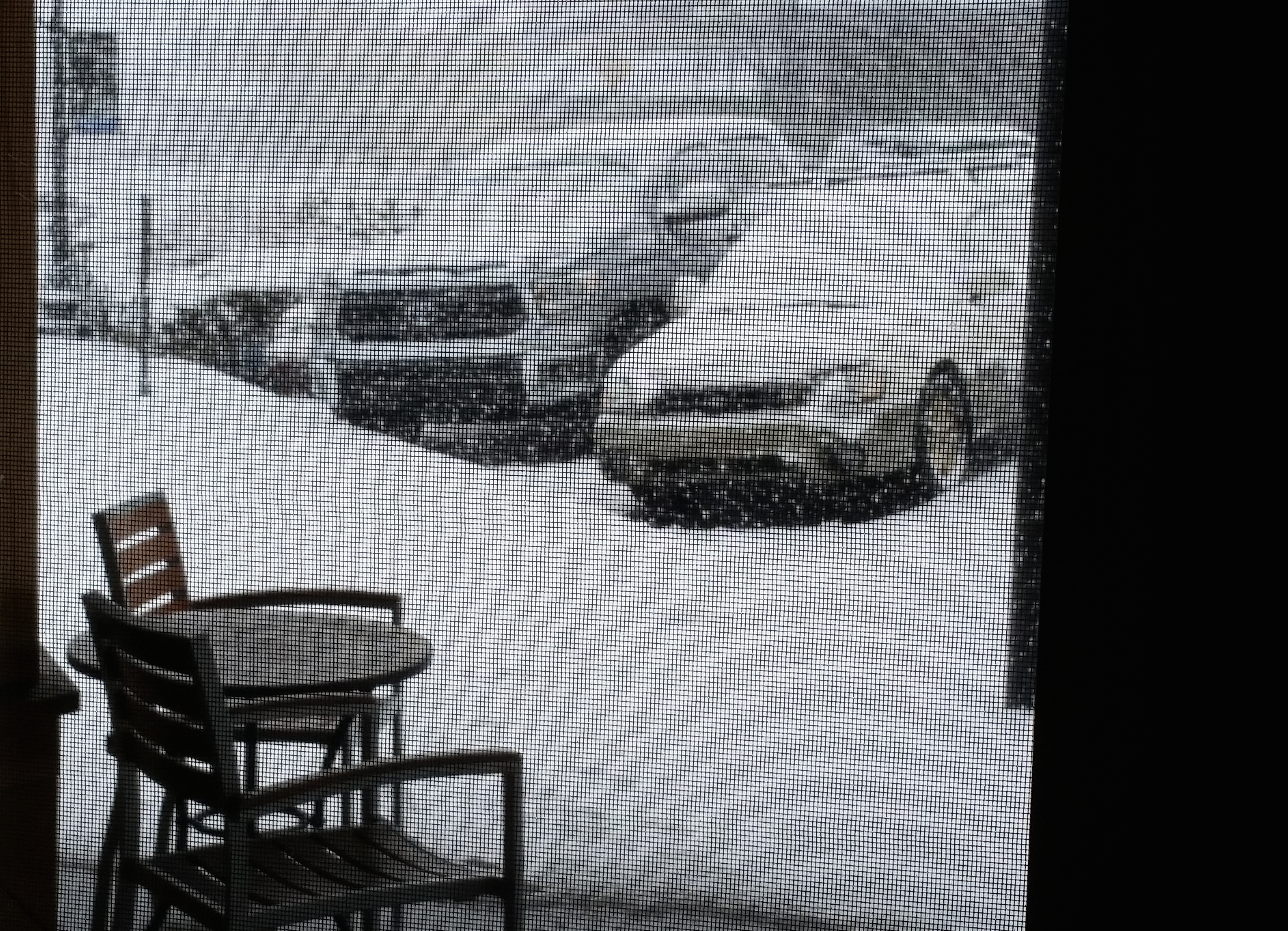
A Poem For New Year’s Eve

8431959849_d80d1b25f9_k

“Red Hook: December” by George Oppen (1908-1984):

We had not expected it, the whole street
Lit with the red blue, green
And yellow of the Christmas lights
In the windows shining and blinking
Into distance down the cross streets.
The children are almost awed in the street
Putting out the trash paper
In the winking light. A man works
Patiently in his overcoat
With the little bulbs
Because the window is open
In December. The bells ring,

Ring electronically the New Year
Among the roofs
And one can be at peace
In this city on a shore
For the moment now
With wealth, the shining wealth.

Please consider supporting the work of the Poetry Society of America here.

(From New Collected Poems © 1975 by George Oppen. Reprinted by permission of New Directions Publishing Corp. Also reprinted in Christmas Poems © 2008 New Directions Publishing Corp. Photo by Sam Howzit)

What Hitch Would Be Drinking Tonight

In a speech from 2009, he name-dropped his favorite drink in his inimitable way:

In an excerpt from his memoir, Hitch-22, he further elaborated on his drinking habits:

I work at home, where there is indeed a bar-room, and can suit myself. But I don’t. At about half past midday, a decent slug of Mr. Walker’s amber restorative, cut with Perrier water (an ideal delivery system) and no ice. At luncheon, perhaps half a bottle of red wine: not always more but never less. Then back to the desk, and ready to repeat the treatment at the evening meal. No “after dinner drinks”—​most especially nothing sweet and never, ever any brandy. “Nightcaps” depend on how well the day went, but always the mixture as before. No mixing: no messing around with a gin here and a vodka there.

Alcohol makes other people less tedious, and food less bland, and can help provide what the Greeks called entheos, or the slight buzz of inspiration when reading or writing. The only worthwhile miracle in the New Testament—​the transmutation of water into wine during the wedding at Cana—​is a tribute to the persistence of Hellenism in an otherwise austere Judaea. The same applies to the Seder at Passover, which is obviously modeled on the Platonic symposium: questions are asked (especially of the young) while wine is circulated. No better form of sodality has ever been devised: at Oxford one was positively expected to take wine during tutorials. The tongue must be untied.

(Hat tip: Ilia Blinderman)

The Best Threads Of 2014: “Why Aren’t Gay Men On The Pill?”

Dozens of readers this year added their very personal perspectives to the breakthrough drug Truvada and the baffling resistance to it by many gay activists. Read the whole discussion thread here. Below are a few previously unaired emails to add to the mix:

Most of the coverage of Truvada has been about the idea of “Truvada whores” who take the drug so that they can have indiscriminate sex with any number of people. I wanted to write truvadayou with a different perspective.  I am a HIV-negative guy in a relationship with an HIV guy. I’m 33 and he’s 30. Unfortunately he made some poor decisions in his very early 20s but he’s been very proactive since. He’s remained at an undetectable viral load for 7 years now and his more recent T-cell count was excellent, as it has been for a while. He was very straightforward with me when we started dating and that has helped a lot too.

Recently I began taking Truvada as an additional step to protect me. It’s very very inexpensive through my insurance and after a few months I’ve had no side effects. Not only does it provide physical aid but it also provides a great deal of emotional assistance. It puts me at better ease and it makes him feel better that there is basically zero chance that he could infect me. It also gives us a daily ritual in which we each take our daily medication, using each other to ensure that we are very strict on taking medication every day. Hopefully, as more news comes out, he’ll one day be free of his decade-old bad choices and we’ll live together totally and completely free.

But another reader cautions:

Your ongoing coverage of Truvada as pre-exposure HIV prophylaxis is fascinating and reaches a large number of gay men. This is why it’s important to correct a error that keeps occurring in Dish pieces on PrEP:

the notion that Truvada “reduces your risk of contracting HIV by 99 percent” (for example). PrEP does not reduce the risk by 99%; it reduces the risk by less than half.

As a young physician, I realize that the medical community does a crappy job of explaining statistics related to treatment. For your readers (a generally sophisticated bunch), here’s a breakdown of the numbers:

In the Truvada study in gay men (found here), 1248 men were given a placebo pill and 1251 men got Truvada. In the placebo group, 64 men subsequently got HIV (rate of infection: 64/1248 = 5.1%). In the Truvada group, 36 men subsequently got HIV (rate of infection: 36/1251 = 2.87%).

So what does Truvada do? With general sex practices, risk of HIV is low. Without Truvada, there’s a 95% chance you won’t be infected and a 5% chance you will be infected. With Truvada, there’s a 97% chance you won’t be infected and a 3% chance you will be infected.

Truvada does reduce HIV infection. And that change is about 2% in absolute terms (5% down to 2.87%) and about 44% in relative terms (5% reduced by 44% is 2.87%).

Saying Truvada “reduces your risk by 99%” mistakenly implies an enormous effect of the drug – one that was not shown by the trial.  Rather, it would be true to say that men taking Truvada had a 97% chance of remaining HIV-negative. But even without the drug, the chance of remaining HIV-negative was 95%. Truvada does make a difference, but it’s not a magic bullet.

Thanks for shining a light on this important issue.

Drinking Away Your Defenses

Just in time for New Year’s Eve, Max Ufberg reviews a study that links binge-drinking to a weakened immune system:

A new study in the journal Alcohol, led by Loyola University Chicago’s Dr. Majid Afshar, asked 15 testers—with a median age of 27—to drink, depending on their weight, between four to five vodka shots. (Consuming that much alcohol in such a short period of time certainly constitutes binge drinking.) Afshar and his researchers took blood samples 20 minutes after the subjects reached “peak intoxication,” and again two and five hours later. Afshar found that the subjects’ immune systems first revved up—working hard to fight off any sickness—after 20 minutes, but then slowed down significantly by the two- and five-hour measuring points.

To get more specific, Afshar saw higher levels of immune system essentials like proteins and white blood cells—specifically leukocytes, monocytes, and natural killer cells—after the 20-minute mark. But after two hours, and again at five hours, Afshar noted the opposite: Fewer monocytes and natural killer cells circulated around the immune system. This whole process is known as a biphasic immunologic response, but in practical terms, the immune system is significantly weaker a few hours after someone’s drunkenness has hit full force.

A Poem From The Year

15542276956_ff746840a6_k

“Tinsel” by Robin Robertson:

Tune to the frequency of the wood and you’ll hear
the deer, breathing; a muscle, tensing; the sigh
of a fieldmouse under an owl. Now

listen to yourself—that friction—the push-and-drag,
the double pulse, the drum. You can hear it, clearly.
You can hear the sound of your body, breaking down.

If you’re very quiet, you might pick up loss: or rather
the thin noise that losing makes—perdition.
If you’re absolutely silent

and still, you can hear nothing
but the sound of nothing: this voice
and its wasting, the soul’s tinsel. Listen . . . Listen . . .

Please consider supporting the work of The Poetry Society of America here.

(From Sailing the Forest: Selected Poems by Robin Robertson © 2014 Robin Robertson. Used by permission of Farrar, Straus and Giroux. Photo by Andrey Solovev)

“A Virtual Work Stoppage” Ctd

Matt Ford focuses on the “benefits of fewer NYPD arrests”:

Fewer arrests for minor crimes logically means fewer people behind bars for minor crimes. Poorer would-be defendants benefit the most; three-quarters of those sitting in New York jails are only there because they can’t afford bail. Fewer New Yorkers will also be sent to Rikers Island, where endemic brutality against inmates has led to resignations, arrests, and an imminent federal civil-rights intervention over the past six months. A brush with the American criminal-justice system can be toxic for someone’s socioeconomic and physical health.

And petty criminals are probably less likely to become career criminals if they can avoid the hardening experience of prison and the stigmas associated with it, especially when it comes to future employers. Allahpundit considers the political risks the NYPD is taking with its “virtual work stoppage“:

[M]aybe the slowdown in arrests is more of a protest, partly against de Blasio for being too sympathetic to “I can’t breathe” protesters and partly to give the public a taste of what life with a force that’s less aggressive in policing minor offenses would be like. That’s a tricky line PR-wise, though.

Now that voters know there’s an informal police boycott of punishing lesser offenses, how much will they blame de Blasio if the quality of life in NYC starts to decline and how much will they blame the force? Or does it matter? The political endgame for police here, I assume, is to have voters so disgusted with the state of the city under de Blasio that they’ll bounce him out of office in 2017 even if they blame the police for the uptick in crime. You can replace the mayor, after all, but you can’t replace the force.

A reader introduces another angle to the story:

I think that reporters covering the current unpleasantness ought to be focusing a bit more on the police contract negotiations. I think the police erroneously believe that throwing a permanent tantrum against the duly elected mayor of the city will somehow result in better negotiating leverage.

If I were the mayor, I would offer the police a contract with a cost of living increase and literally nothing else different than their current agreement. I get the tensions, I get the hurt feelings, but there is something unseemly about asking for a big fat raise after such rampant and unacceptable insubordination like we’ve seen lately. Since the union representatives have all but called for the mayor’s removal over this, why on earth should the mayor reward them for this? They serve the city and its citizens, not the other way around.

Friedersdorf remarks on that union-contract angle:

The right should greet [a planned police rally on January 13] with the skepticism they’d typically summon for a rally on behalf of government workers as they seek higher pay, new work rules, and more generous benefits. What’s unfolding in New York City is, at its core, a public-employee union using overheated rhetoric and emotional appeals to rile public employees into insubordination. The implied threat to the city’s elected leadership and electorate is clear: Cede leverage to the police in the course of negotiating labor agreements or risk an armed, organized army rebelling against civilian control. Such tactics would infuriate the right if deployed by any bureaucracy save law enforcement opposing a left-of-center mayor.

Rethinking Resolutions

Cass Sunstein investigates the “fresh start effect,” the tendency for people to “refocus their thinking and even reorient their conduct” at certain points in time, such as the beginning of a week, month, or year:

Why do temporal landmarks matter so much? First, they provide a clear opportunity to step back from daily life and reflect — to ponder whether your actions, and your life, mirror your highest goals for yourself. When you hit a birthday or a new year, you ask about the big picture.

But there is a second factor. [Researcher Hengchen] Dai and his coauthors contend that temporal landmarks open up new “mental accounts” that enable us to separate the past from the future. We make a sharp distinction between our past self (who ate too much and failed to exercise, or stuck with unrewarding work or a bad relationship) and our current self (who has turned over a new leaf). People’s behavior often stems from their sense of their own identity, and big changes happen more easily when they can convince themselves that their 2015 self is on a whole new path.

For Sofia Faqudi, what worked was convincing herself to make a single resolution for each month of 2014. She describes how setting smaller goals led her to success:

In November, my resolution was to skip coffee. It was similar to the February goal of no chocolate—but I no longer needed a referee or a financial penalty. After nine months of practice, I had developed the willpower to break an addiction. Yes, it was challenging to step off a red-eye flight and go straight to the office. But I did it. Resisting the temptation was easier after I hid the coffee in my apartment as well as the loyalty card to my favorite café. Walter Mischel, designer of the renowned Marshmallow Test, found that children who successfully refrained from eating the marshmallow did so by distracting themselves or covering their eyes. Those who kept looking at the marshmallow succumbed to the temptation. Removing coffee from my immediate vicinity paved the road to success.

Meanwhile, Ted Spiker shares his take on resolutions:

One of the best goals I heard in 2014 came from one of the spiritual leaders of the Sub-30 Club—a club I started a few years ago for people who wanted to run a sub-30-minute 5K, but includes many folks who were already speedier than that, like Laurie Canning. Laurie had said that her only running goal this year was to run with as many new people as she could, including those she had never met from our virtual group. Between training, new races, and meet-ups all over, she ended the year running with 25 new people. She says, “I have never enjoyed running as much as I have this year—ever.”

By the way, Laurie also completed the year doing 20,000 strict military pushups and crushed her previous best marathon time, running a 4:11. My takeaway: You can use a deeper goal to help achieve other ones.

Faces Of The Day

Scotland's First Same-Sex Marriage Ceremonies

Joe Schofield (R) and Malcolm Brown from Tullibody, Clackmannanshire are married in the Bootleg Room at The Corinthian in Glasgow, Scotland shortly after midnight in front of friends and family in one of the first same-sex weddings in Scotland on December 31, 2014. Same-sex couples have been able to enter into “civil partnerships” since 2005, but following a change in the law in March 2014, gay couples are now eligible to marry in Scotland. By Mark Runnacles/Getty Images.