
Abu Dhabi, United Arab Emirates, 10.25 am
Abu Dhabi, United Arab Emirates, 10.25 am
This reader thread, sparked by Danielle Campoamor’s story, is among the most powerful ones we’ve had this year. So far we’ve heard from a convict who was raped in prison, a white coed assaulted by a black basketball star, a young teenager sexually abused by his teacher, a followup from a woman who told us about her rape, and several others. Our next installment is from a gay reader – with an unexpected twist:
When I was 26, I was raped while traveling to London. I stayed several days longer than my straight friends and decided to go hit up the gay bars after they left. I met a guy from Germany, we danced and decided to go back to my hotel room. At some point he started to try to put it in. I told him that I wasn’t bottoming unless he wore a condom and that I didn’t have any. He held me down and went at it anyway. Which is the dictionary definition of rape, isn’t it?
I did not report the incident immediately and waited till I returned to the US several days later to seek treatment. I was honest with the doctor about what happened. She exerted extreme pressure on me to report the incident and get counseling. The process of trying to report such a crime is horrible. The police engaged in every behavior victim’s advocates dislike; victim blaming, disbelief, and homophobia were a constant.
The counseling service was likewise useless. I didn’t receive a return call about my situation for nearly two weeks. The woman who did call me back made it clear that she didn’t think my incident was worthy and then offered me a time-slot months in the future. I ended up just scheduling an appointment with my normal psychologist to discuss the incident.
I felt horrible and I wasn’t even traumatized by the rape itself. I couldn’t imagine what dealing with this bullshit and an actual traumatic experience would be like. I enjoyed that night with the German – a lot actually. He stayed the night, we hung out the next day and I stayed at his hotel that night. We had breakfast the next morning and said our goodbyes. I’m Facebook friends with him now. I expect to travel to Germany this summer to visit friends and we’re actively planning on meeting up for a day or two in Berlin.
Sex is a powerful experience. Like any powerful experience you can get hurt. I took a risk going out and picking up a random person to sleep with. I could have been very badly hurt but I wasnt. I did not contract any STDs or get physically hurt – both real possibilities. I learned to take some basic precautions and be prepared. I’ve started on PreP. I make sure to qualify hookups more than I used to.
I’ve also learned that I can’t be open about my experience because it doesn’t fit the narrative. I’ve literally had people blow up at me when I admitted that he’s apologized and I’ve forgiven him. I’ve learned never to suggest that other people might feel similarly; that makes me a rape-apologist. In the end, I’m not honest about my experience because too many people think they can cherry-pick ideas that validate their preferred narrative. But that’s the crux of the problem, isn’t it?
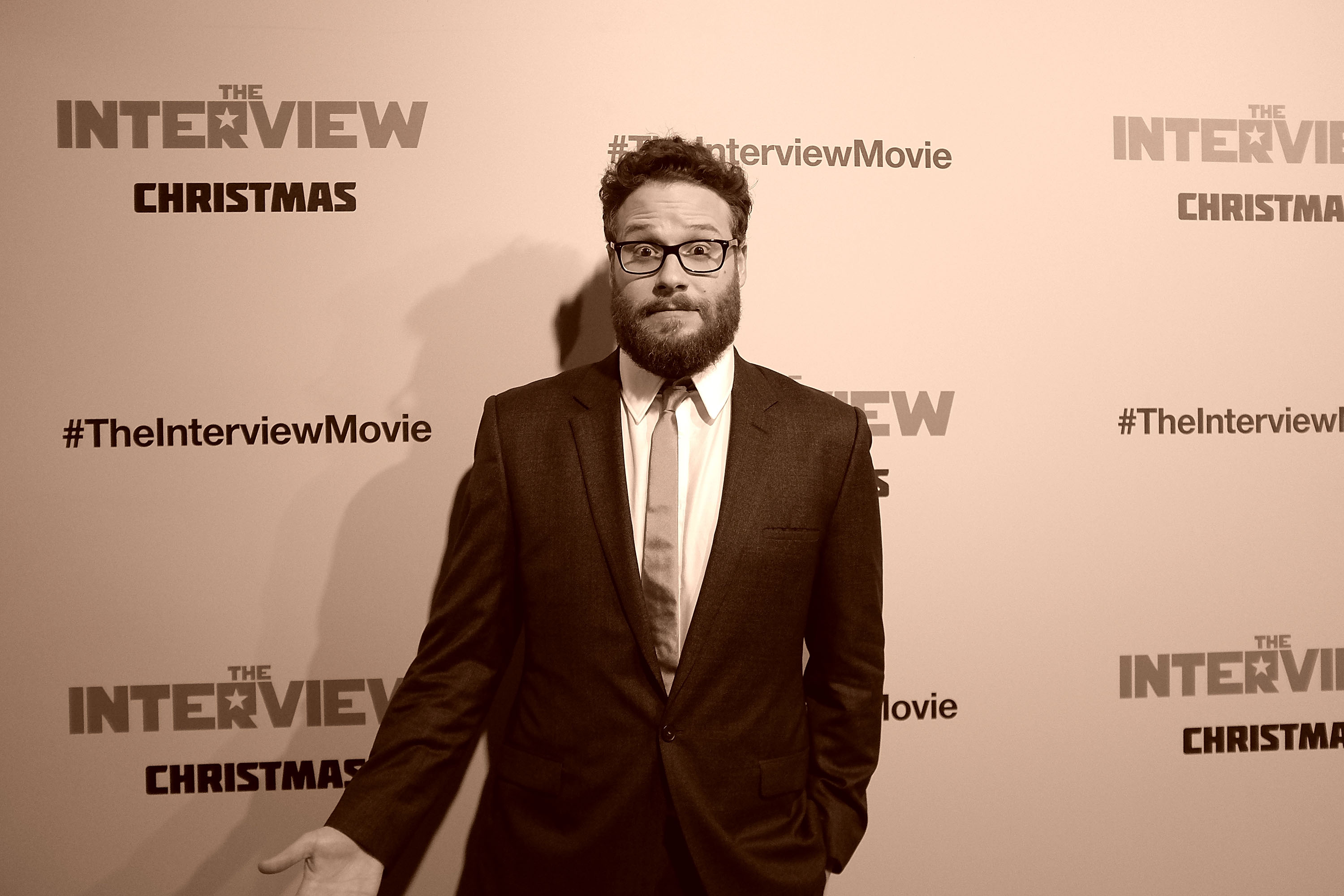
Cyber war expert Peter Singer calls Sony canceling the theatrical release of The Interview “a case study in how not to respond to terrorism threats”:
We have just communicated to any would-be attacker that we will do whatever they want.
It is mind-boggling to me, particularly when you compare it to real things that have actually happened. Someone killed 12 people and shot another 70 people at the opening night of Batman: The Dark Knight [Rises]. They kept that movie in the theaters. You issue an anonymous cyber threat that you do not have the capability to carry out? We pulled a movie from 18,000 theaters.
Eugene Volokh is also dismayed:
I sympathize with the theaters’ situation — they’re in the business of showing patrons a good time, and they’re rightly not interested in becoming free speech martyrs, even if there’s only a small chance that they’ll be attacked. Moreover, the very threats may well keep moviegoers away from theater complexes that are showing the movie, thus reducing revenue from all the screens at the complex.
But behavior that is rewarded is repeated.
Thugs who oppose movies that are hostile to North Korea, China, Russia, Iran, the Islamic State, extremist Islam generally or any other country or religion will learn the lesson. The same will go as to thugs who are willing to use threats of violence to squelch expression they oppose for reasons related to abortion, environmentalism, animal rights and so on.
Fred Kaplan wonders how far this will go:
Will hackers now threaten to raid and expose the computer files of other studios, publishers, art museums, and record companies if their executives don’t cancel some other movie, book, exhibition, or album?
Dreher notes that studios are already self-censoring:
[P]roduction on a new thriller starring Steve Carell and based in North Korea has now been cancelled. So film studios are afraid that what happened to Sony will happen to them. It is easy to imagine that studios and publishers will be intimidated into canceling or never taking on all kinds of projects on a wide variety of topics, simply out of legitimate fear of cybercrime or worse. Troubling.
Todd VanDerWerff expects Hollywood to become even more risk averse:
This decision was driven as much by placating theatre owners as much as anybody else, but it also has the effect of essentially writing off a whole area of the map.
What happens when someone wants to make a dumb action movie set in North Korea? Or a romantic comedy on both sides of the Korean border (as improbable as that would be)? Or a serious, weighty political drama about the struggles of the North Korean people, aimed at winning some Oscars? What do the bean-counters say then?
(Photo: Seth Rogen arrives at the Los Angeles premiere of ‘The Interview’ held in Downtown LA on December 11, 2014 in Los Angeles, California. By Araya Diaz/WireImage)
Tim Lee believes the crypto-currency can thrive as a global payment system, even if it fails as a currency. He compares it to another innovation that proved far more influential than anyone thought it would be:
History suggests that open platforms like Bitcoin often become fertile soil for innovation. Think about the internet. It didn’t seem like a very practical technology in the 1980s. But it was an open platform that anyone could build on, and in the long run it proved to be really useful. The internet succeeded because Silicon Valley have created applications that harness the internet’s power while shielding users from its complexity. You don’t have to be an expert on the internet’s TCP/IP protocols to check Facebook on your iPhone.
Bitcoin applications can work the same way. There are already some Bitcoin applications that allow customers to make transactions over the Bitcoin network without being exposed to fluctuations in the value of Bitcoin’s currency. That basic model should work for a wide variety of Bitcoin-based services, allowing the Bitcoin payment network to reach a mainstream audience.
Henry Farrell is skeptical, predicting that governments would act quickly to shut down such a system if it seemed to be taking off:
Because so many international transactions are (a) settled in dollars and (b) settled across payment systems run by banks and other financial intermediaries that are vulnerable to U.S. pressure, the U.S. can use these systems to exert political control. Now, imagine the likely response of the U.S. (and the E.U., and, for that matter, China) to a payment network which is designed from the ground up to be decentralized, so that it is impossible for any specific intermediaries to really control payment flows from one actor to another. Such a network would be impossible for states to control. The U.S. wouldn’t be able to use it, for example, to squeeze Iran out of the world financial system. If such a network ever showed signs of really becoming established (rather than being a relatively small-scale thought experiment, and money suck for libertarians with more ideology than good sense), the U.S. would ruthlessly act to isolate it from the international financial system.
And that is the story of Bitcoin.
In response, Lee contends that it might be too late for that:
Bitcoin already has more powerful allies than it did two years ago. In 2014 alone, dozens of Bitcoin startups have raised money. Their backers aren’t going to stand idly by while the government destroys their investments. … The Bitcoin network probably can’t be shut down; it can only be driven underground. Doing so won’t prevent serious criminals from using it, but it will make it harder for law enforcement to track down people using the network. And Bitcoin has good applications as well as bad ones. After going before Congress and endorsing these arguments last year, it would be awkward for regulators to do an about-face and declare war on the technology.
In short, if the regulators were going to try to shut down Bitcoin, they would have done it two years ago when it was still a fringe technology with no real support among elites. Now it’s too late.
In an update to his original post, Farrell answers that Lee “seems to me to underestimate the willingness of the US and other major states to pursue their strategic interests, even if it annoys business, and the vulnerability of any payments systems to regulatory action”. Drum agrees with Farrell, stressing that China, for example, won’t give two Bitcoins about making its backers angry:
The evolution of the internet itself provides conflicting guidance as an analogy. Generally speaking, national governments have had considerable difficulty regulating internet content. It’s just too distributed and fast moving. So perhaps digital payment networks similar to Bitcoin will eventually thrive because they pose similar problems to would-be regulators. Like kudzu, they’ll simply be impossible to contain.
On the other hand, countries like China have shown that internet content can be regulated. It merely requires sufficient motivation. And even less authoritarian governments have managed to throw a lot of sand in the gears when they rouse themselves to action. Given that regulating commerce and money is easier than regulating content, this bodes ill for the future of Bitcoin. There’s not much question that it can harried into uselessness if national governments decide to do it.
(Photo by Flickr user BTC Keychain)
Explore Castro’s rise and the deterioration of Cuba-US relations in the @nytimes archives: http://t.co/5tdfO2ITTq pic.twitter.com/neWc4N9INZ
— New York Times World (@nytimesworld) December 18, 2014
Readers react to the big news:
Normalization of relations is a great and long overdue policy. I have a question about it that I haven’t seen addressed: will it create an opportunity to close Guantanamo?
Another:
Hopefully everyone’s noticed that the Republicans opposed to normalizing relations with Cuba:
A) Have no problem with us having diplomatic relations with China, another Communist country with an even worse human rights record.
B) Are currently defending the US’ own recent human rights abuses, i.e. torture.
We all know the real reason: political posturing. Castro stripped Cuban aristocrats of their wealth. They fled to Florida and have been propping up anti-Castro policy ever since. There are no principles here.
Another asks:
Lost in all the coverage is the one issue I think is the most important – will this change the absurd “Wet-foot/Dry-foot policy?
After we normalize relations with Cuba, what happens to refugees who make it to U.S. shores? Or those who overstay their (presumably soon to be issued) visas? Will they be allowed to stay and fast-tracked to attaining resident status? Or will Cuban refugees be deported like Haitians, Mexicans and others who come here illegally? I’m not saying they should. But it’s wrong to treat economic refugees from Cuba who aren’t facing imprisonment as dissidents differently than those from other nations. Anyone have an answer to this?
Another outlines “the points to make”:
1) The 50-plus years of sanctions and embargoes were failing to drive the Castros and their ilk from power. Diplomacy such as this – with an effort to defuse tensions to where the authoritarian regime will end political harassment – is due its chance to work.
2) The outrage against a friendly posture towards Cuba by the far right, and by the anti-Castro hardliners, are going to fall on deaf ears. Polling has shown a sizable majority of Americans, sizable majority of CUBANS (especially younger generations distanced from the passions of the Cold War era) back an end to sanctions and normalizing relations.
3) Obama’s move is honestly a very small, very minor moment in our nation’s international efforts … except somehow this move is one of the cornerstones of Obama’s administration. Because it is one of the moves his office has done to improve our nation’s international reputation that has been damaged by the heavy-handed neocon exploitations of the Bush/Cheney years. This move is going to go over well with our Caribbean and Central/South American allies, for starters. And it’s been a move we SHOULD HAVE done since the fall of the Soviet Union …
While Obama’s and the nation’s reputation remains stained by the failures to bring Cheney and his ilk to trial for their torture regime, he’s at least made good faith efforts in other areas – isolating Putin over his assault on Ukraine, getting Syria to clean out MWDs, treating with Iran as part of efforts to block ISIL and the Taliban, etc. – to show the United States takes its role as a superpower serious. This move is part of that trend.
4) Obama shouldn’t have received that Nobel Peace Prize so early in his presidency; they should have waited until moves like this to demonstrate how he’s using diplomacy the best way possible: ending hostilities, improving relations with ally and foe alike, and
This isn’t over yet, obviously. A lot has to get resolved over the issues of reparations (property ownership seized from the 1960s for example) and human rights (end to political arrests, open local elections). But this is a huge step. It breaks the stalemate of embargoes that weren’t working, and it forces the political ideologues to face new realities.
Meep-meep.
Another addresses Will’s post:
I’m one of the Twitterers who posted a comment about getting to Cuba before Starbucks (in an @reply to a friend). But my comment was not intended the way you suggest, and the way that a dozen other think pieces are also suggesting. I had not forgotten that Cuba was unbelievably poor, and that their mid-century architectural/technological condition was actually the sad result of arrested economic development. I have no interest in poverty tourism.
What I meant – and what I think most people meant – was that we hoped Cuba could grow fully into a nation with their own culture, as free from American normalization as possible. It would be a shame if American developers stormed in and turned the country into just another Floridianesque suburb. That seems all too possible.
Of course, if that kind of American assistance is what’s best for Cuba, then that’s fine. I want what’s best for them. But how do you say all this in a tweet. Really.
The backlash on these comments is exactly that Illiberal Left position that you’ve been writing about on the Dish, hacking away at harmless comments for not being explicitly clear that such and such person is not being maligned. It’s pouncing on people for personal gain and satisfaction.
I’m excited and hopeful for Cuba.
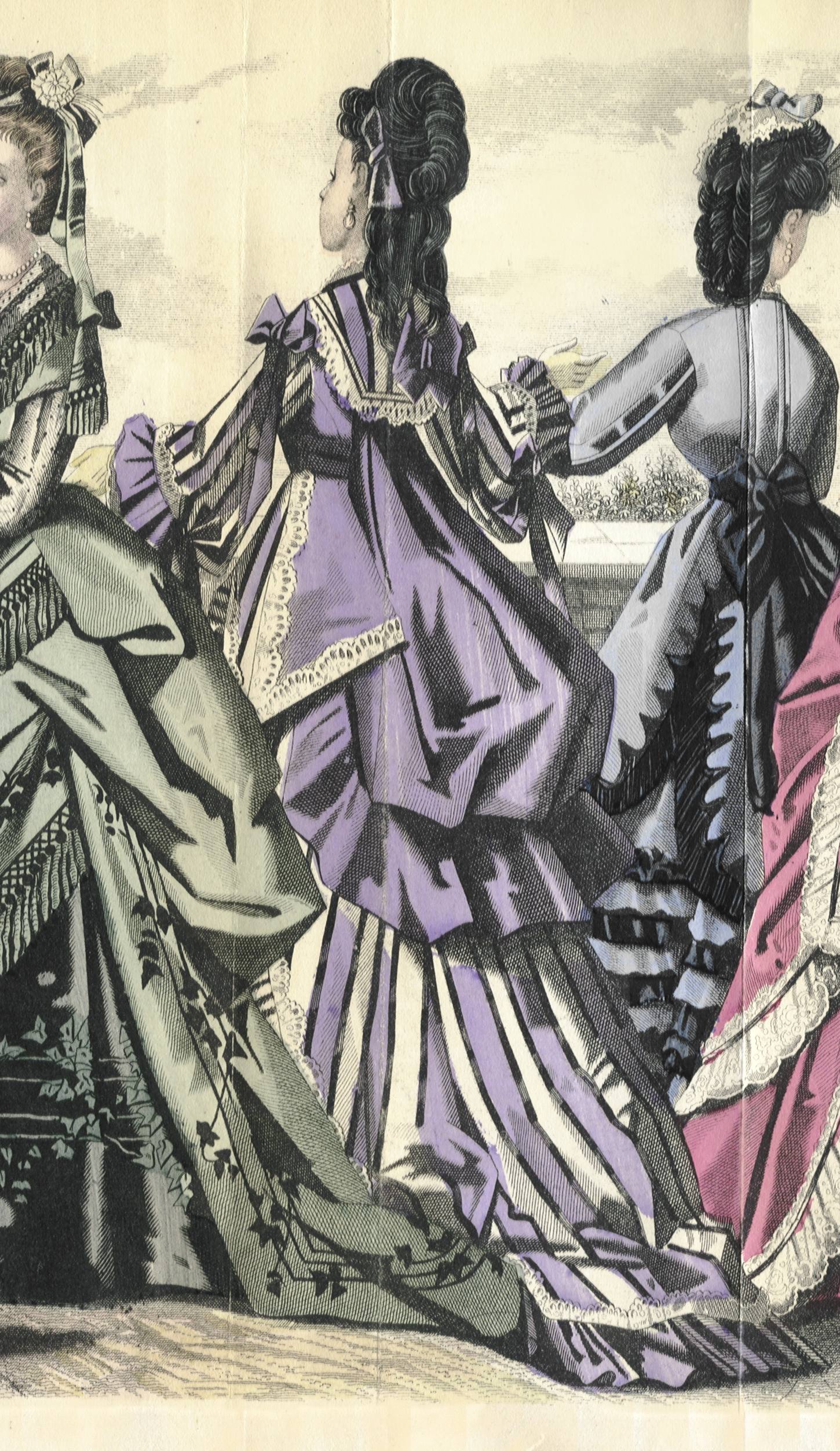
Leann Davis Alspaugh revisits the mauve craze that swept Europe in the mid-19th century:
In the 1850s, the color mauve was discovered by a young chemist who was trying to synthesize
artificial quinine. The residue from one his experiments became the world’s first aniline dye, guaranteed not to fade with time and washing. Queen Victoria wore a mauve gown to her daughter’s wedding, and Empress Eugénie of France cooed that the color matched her eyes—and an epidemic of “mauve measles” swept Europe. As cultural historian Simon Garfield noted in his 2001 book on the history of mauve, the color’s popularity led to burgeoning interest in the practical applications of chemistry and advances in the fields of medicine, weaponry, perfume, and photography. Mauve became indelibly associated with the elaborate, overstuffed décor of the Victorian period; when mauve returned in the 1980s, it was billed as “dusty rose,” a name much more congenial with that era’s other favorite color: hunter green.
(Image: Fig. 3 from a Godey’s Lady’s Book fashion plate, May 1872, via Flickr user clotho98)
Ambinder sees an opening:
Bush’s biggest opportunity corresponds to the biggest hole in the GOP platform: its radio silence on practical economic solutions for the middle class, which, it turns out, corresponds to the biggest bread-and-butter concern that Americans repeatedly chastise Washington for not addressing.
If he can move beyond supply-side economics and invent or adopt policies that directly benefit middle class voters who aren’t big savers, if he can speak to their concerns, if he can draw for us a picture for how a governing conservative president might function, then everything I’ve ever said about him — namely, that he’s a Bush and he can’t win the presidency, much less the nomination — goes out the window. If he can square THIS hexagon, and if he can get people to forget that he’s a Bush, he might be able to win both.
Republicans certainly don’t need a replay of Romney 2012, where the candidate focused too much on big macro issues like tax and entitlement reform — issues that failed to connect with voters struggling with everyday, middle-class problems. But that’s what a Bush candidacy could well look like. In an October fundraising letter for an education group he founded, Bush put forward a broad-strokes economic agenda that once again argued America needs to “radically simplify our tax and regulation structures to be fairer and more practical” and “reform our entitlement programs, which are now ballooning government beyond taxpayers’ means to pay for it.” That’s just GOP boilerplate that many voters will tune out.
But don’t fret quite yet, conservative reformers. There are still signs that Jebonomics has the potential to be smart and important. For instance, Bush also spent a lot of time in that letter discussing K-12 and higher education challenges and reform, both of which are crucial to improving middle-class fortunes. Anyone remember the Romney education plan, or him even talking much about student debt? The candidate actually had a plan, but it was a mystery to voters. Bush sounds like he could focus on these middle-class issues far more than Romney did.
Ambinder bets that “Cheney would still have us torturing innocents, even today”:
I can only think of Cheney now as the personification of the Cult of Terror, that September 11th, 2001 political construct that gave Americans license to act outside the stream of history instead of at its headwaters, and to suppress dissent in the name of state security. What makes this scarier, even, and why I feel justified in calling it a cult, is that it also suppresses, denigrates, and stigmatizes the moral and political foundations that it seeks to protect. It’s an American cult, because it plays to our own biases about what makes us special. It is not unique or exceptional.
Chait also examines the pro-torture mindset. He contends that “admiration for the methods used by totalitarian states is … embedded in the torture program created by the Bush administration”:
Three decades ago, right-wing French intellectual Jean-François Revel published a call to arms entitled How Democracies Perish, which quickly became a key text of the neoconservative movement and an ideological blueprint for the Reagan administration. Revel argued that the Soviet Union’s brutality and immunity from internal criticism gave it an inherent advantage over the democratic West — the United States and Europe were too liberal, too open, too humane, too soft to defeat the resolute men of the Iron Curtain.
“Unlike the Western leadership, which is tormented by remorse and a sense of guilt,” wrote Revel, “Soviet leaders’ consciences are perfectly clear, which allows them to use brute force with utter serenity both to preserve their power at home and to extend it abroad.” Even though Revel’s prediction that the Soviet Union would outlast the West was falsified within a few years, conservatives continue to tout its wisdom. And even as Revel’s name has faded further into the backdrop, recent events have revealed the continuing influence of his ideas.
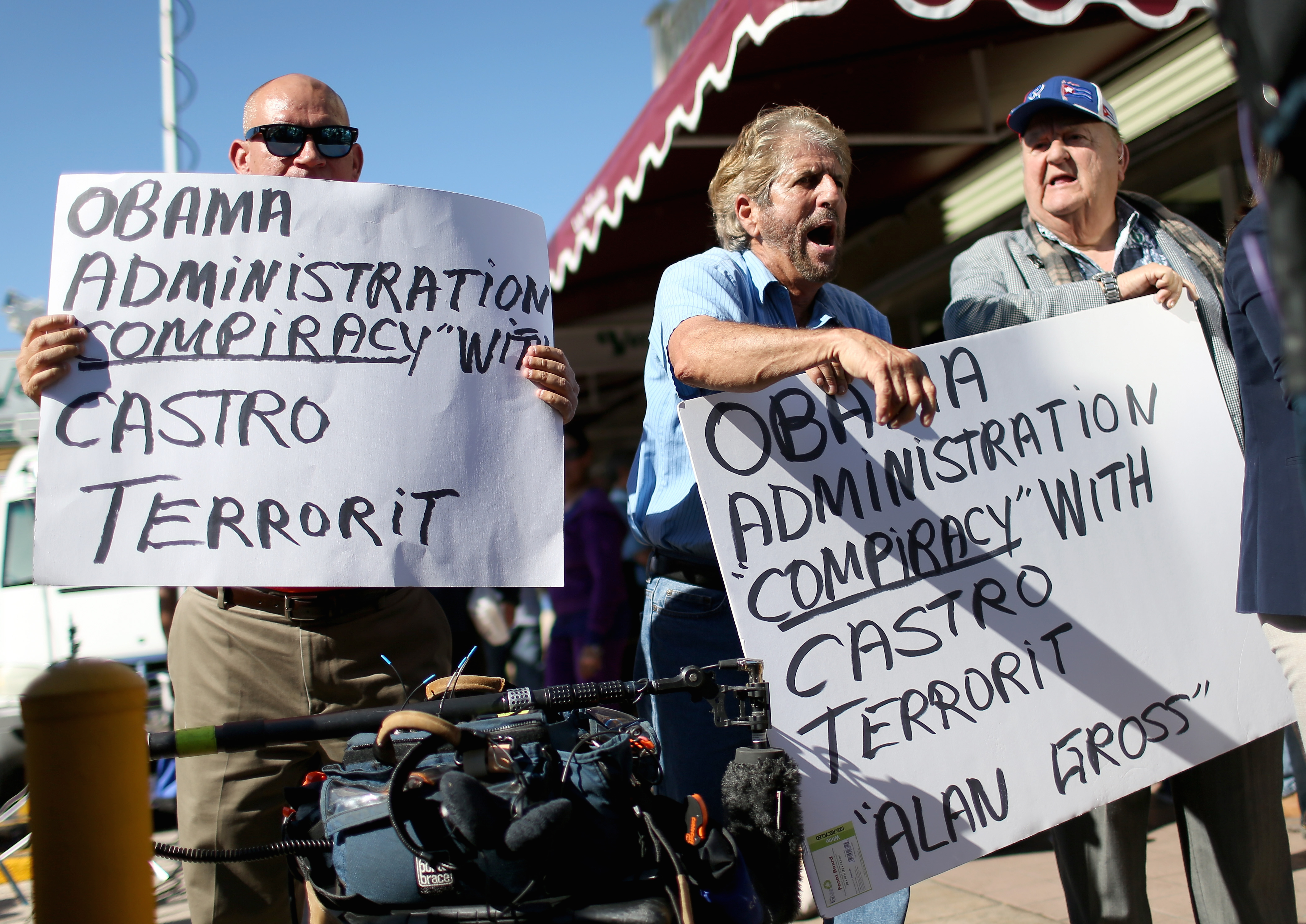
Osvaldo Hernadez, Miguel Saavedra and Carlos Munoz Fontanillehas (L-R) react to the news, outside the Little Havana restaurant Versailles in Miami, that Alan Gross was released from a Cuban prison on December 17, 2014. Gross, an American contractor, had spent five years in Cuban jail and reports indicate he is on his way back to the United States. By Joe Raedle/Getty Images.

Seth Stoughton wants police training to “emphasize de-escalation and flexible tactics in a way that minimizes the need to rely on force, particularly lethal force”:
Police agencies that have emphasized de-escalation over assertive policing, such as Richmond, California, have seen a substantial decrease in officer uses of force, including lethal force, without seeing an increase in officer fatalities (there is no data on assaults). It is no surprise that the federal Department of Justice reviews de-escalation training (or the lack thereof) when it investigates police agencies for civil rights violations. More comprehensive tactical training would also help prevent unnecessary uses of force. Instead of rushing in to confront someone, officers need to be taught that it is often preferable to take an oblique approach that protects them as they gather information or make contact from a safe distance. Relatedly, as I’ve written elsewhere, a temporary retreat—what officers call a “tactical withdrawal”—can, in the right circumstances, maintain safety while offering alternatives to deadly force.
Officers must also be trained to think beyond the gun-belt.
The pepper spray, baton, Taser, and gun that are so easily accessible to officers are meant to be tools of last resort, to be used when non-violent tactics fail or aren’t an option. By changing officer training, agencies could start to shift the culture of policing away from the “frontal assault” mindset and toward an approach that emphasizes preserving the lives that officers are charged with protecting. Earlier this year, officers took just that approach in Kalamazoo, Michigan, relying on tactics and communication rather than weaponry to deal with a belligerent man carrying a rifle. As a result, a 40-minute standoff ended with a handshake, not an ambulance. The Seattle Police Department offered an even more dramatic example in 1997, when they eventually ended an 11-hour standoff with a mentally ill man wielding a samurai sword by making creative use of a fire-hose and a ladder. The suspect was apprehended with only minor bruises, and no officers were injured.
Finally, police executives need to move beyond the reflexive refusal to engage in meaningful review of police uses of force. Police may act in the heat of the moment, although not nearly as often as is commonly believed, but that should not insulate their choices from review.
(Photo: A police officer watches over demonstrators in Ferguson, Missouri protesting the shooting death of teenager Michael Brown on August 13, 2014. By Scott Olson/Getty Images)

 The Dish